The store opens at nine and the line is already outside. Fourteen people work the floor today, and every one of them gets a thirty-minute break somewhere between eleven and three, one or two at a time, because the registers cannot go unstaffed. There is no conference room. The break room holds four chairs and a microwave. The caterer’s driver is circling the parking lot looking for a door that is not the front door. Retail catering runs on constraints an office never meets: staggered breaks instead of a lunch hour, a peak season that lands in December instead of pausing for it, overnight crews, mall delivery rules, and a district of stores that all need lunch on the same day at twenty different addresses. This guide covers the occasions retail teams cater for, how to feed a floor nobody can leave, what to order for the holiday run and for an inventory night, how multi-store ordering works, and what it costs per person.
In This Guide
- Why Retail Breaks the Office Catering Playbook
- The 7 Occasions Retail Teams Cater For
- Feeding a Floor That Eats in Shifts
- Quick Comparison Table
- The Peak Season Nobody Else Has
- Overnight Crews, Floor Sets, and Inventory Nights
- Ordering for Twenty Stores Instead of One Office
- Getting the Food Through the Door
- City Cost Guides
- How CaterAi Handles Retail Catering
- FAQ
Why Retail Breaks the Office Catering Playbook
Most catering advice assumes a building with a conference room, a loading dock, and someone at a front desk who can sign for lunch. Our guides for tech companies, law firms, financial services, and nonprofits all start from that building. Retail does not have one. Five things change as a result, and they compound.
- Nobody eats at the same time. The floor needs coverage from open to close, so your team rotates through breaks one or two at a time across a window that often runs four hours. A chafing-dish buffet set at noon is lukewarm by one and empty by two, which means the closing shift eats scraps of a meal you paid full price for.
- The calendar is inverted. Offices slow down in late November and December. Retail runs its hardest hours then, along with back-to-school and every holiday weekend in between. You need catering on the exact dates caterers have already sold out to corporate holiday parties.
- Overnight is a normal shift. Floor sets, resets, remodels, price changes, and physical inventory counts happen after the doors lock, because stock has to be frozen and the aisles have to be clear. A crew working ten at night to six in the morning needs a real meal in a window when almost nothing delivers.
- You know your headcount early. This one works in your favor. A growing list of cities and states now require retail schedules to be posted roughly two weeks in advance, with premium pay owed when managers change them late. Oregon runs the only statewide rule so far, and cities including New York, Chicago, Seattle, Philadelphia, Los Angeles, and San Francisco run their own. An office chasing RSVPs never has that certainty. You do, so use it when you book.
- The order is per store, not per company. A district manager feeding twenty locations is placing twenty deliveries to twenty addresses on twenty different loading arrangements, then handing finance one invoice. That shape has almost nothing in common with one drop at a headquarters.
Get those five right and retail catering becomes routine. Get them wrong and you have a driver stuck at a mall entrance, a night crew eating vending-machine dinner, and a closing shift that noticed the good food ran out before their break.
The 7 Occasions Retail Teams Cater For
1. Peak-Day Shift Meals
Black Friday, the Saturday before a holiday, a big promotional launch, a tax-free weekend. On these days your team cannot leave the store, so the food has to come to them and hold for hours. This is the single most common retail catering occasion and the one most worth getting right, because it lands on the days that make the quarter.
2. Overnight Floor Sets, Resets, and Inventory Nights
The occasion no office has. A crew works through the night resetting fixtures, executing a seasonal floor set, or counting every item in the building alongside a third-party count team. Hot, filling food delivered at the start of the shift keeps the pace up, and a stocked snack and coffee station carries the back half.
3. Grand Openings and Remodel Reveals
A new store or a finished remodel puts food in front of customers, local press, landlords, and corporate visitors on the same day. Passed bites, a party tray spread, or a light reception keeps the room moving without turning the sales floor into a dining room.
4. District and Regional Manager Meetings
Managers drive in from across a territory for a full-day session in a training center, a hotel meeting room, or a flagship back office. Boxed lunches keep the agenda on time, and a morning coffee and pastry setup matters more than usual for a room that started the drive at six. Our board meeting catering guide covers the same working-meal problem in a different room.
5. Seasonal Hire Onboarding and Training
Retailers bring on temporary staff in waves before the holiday run and train them in groups, often before or after store hours. A lunch and learn format works here, and feeding a room of brand-new hires on day one does real work on whether they come back for shift two.
6. Recognition, Milestones, and Holiday Parties
Sales-goal celebrations, store anniversaries, and the annual staff party. Retail holiday parties tend to land in January, after the season ends, which is a quieter and cheaper stretch for caterers. Our holiday party planning guide covers the format choices, and a company picnic suits the summer version.
7. The Standing Break-Room Program
Coffee, snacks, and breakfast on a recurring schedule rather than an event. For stores running long hours with thin margins on time, a stocked break room is the version of this that runs every week without anyone placing an order.
Feeding a Floor That Eats in Shifts
Start from the break schedule, not the menu. Write down when each associate goes on break and how long the window runs from the first break to the last. Four hours is common on a full-coverage day. Every ordering decision follows from that number.
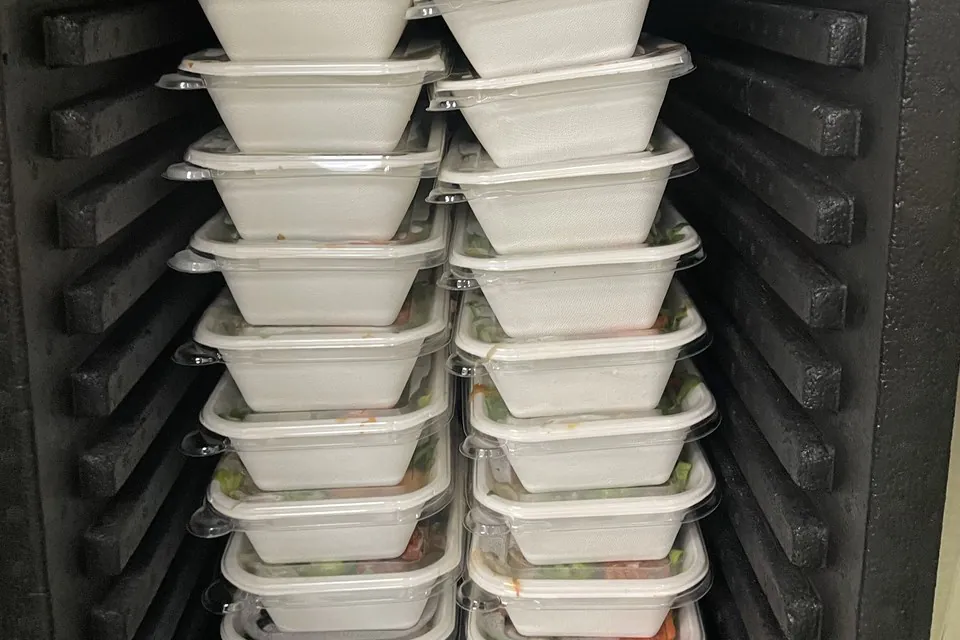
Portion individually. A sealed boxed meal, a wrapped sandwich, or an individual container waits for the person it belongs to. A shared tray does not. The last associate on break should open the same meal the first one did, and allergy-safe boxed lunches handle the restriction problem at the same time, since each box carries its own label instead of a shared serving spoon.
Pick food that survives holding. Braises, rice and grain bowls, pasta, barbecue, burritos, and hearty salads with the dressing on the side all hold. Fried food, delicate greens, and anything crisp does not. Our boxed lunch versus buffet comparison walks through which formats survive a long service window.
Split the drop when the window is long. Two deliveries three hours apart beats one delivery that has to last five, and it costs less than the food you throw away. On a peak day, a mid-morning breakfast drop and an early-afternoon lunch drop cover the whole roster while both are still fresh.
Put the food where your team already goes. A stockroom shelf, a folding table behind the register, or the corner of the break room, whichever your team already uses. Food set somewhere associates have to walk past customers to reach will sit untouched.
The question people forget to ask
Who is going to meet the driver? In an office there is a front desk. In a store there is a register nobody can leave and a back door nobody can hear. Name one person on shift, put their mobile number on the order, and tell the caterer where to pull in: the dock number, the service corridor door, the loading zone behind the strip center. The retail orders that fail rarely fail because of the food. They fail because a driver could not find a door.
Quick Comparison Table
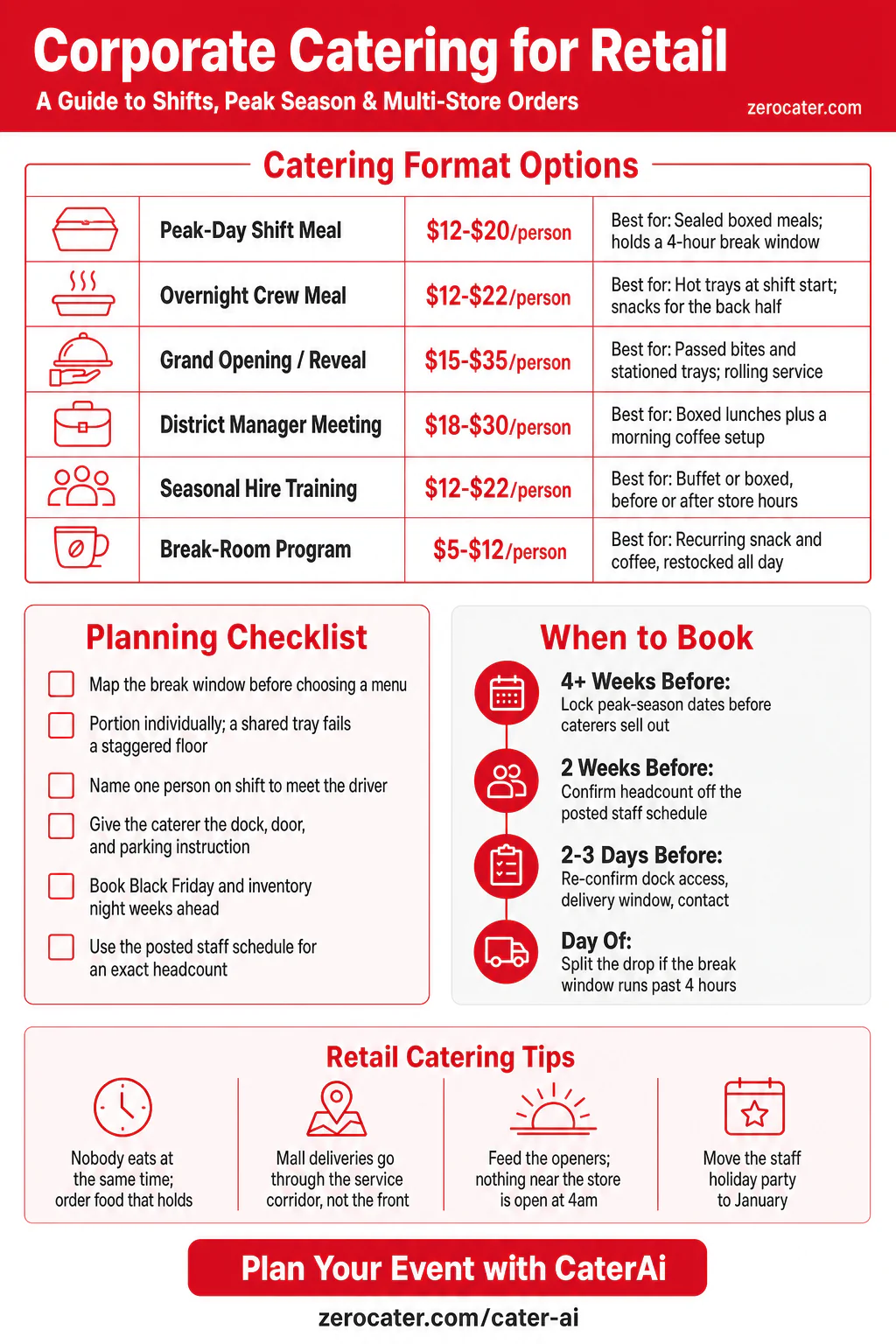
| Occasion | Best Format | Serving Window | Per Person |
|---|---|---|---|
| Peak-day shift meal | Sealed boxed meals, labeled | 4+ hours, staggered | $12 to $20 |
| Overnight crew meal | Hot trays or hot boxed meals | Start of shift, plus snacks | $12 to $22 |
| Grand opening or reveal | Passed bites, stationed trays | 2 to 3 hours, rolling | $15 to $35 |
| District manager meeting | Boxed lunches, coffee setup | Fixed agenda break | $18 to $30 |
| Seasonal hire training | Buffet or boxed, off-hours | Before or after store hours | $12 to $22 |
| Holiday or recognition party | Full buffet or stations | Off-site, after season | $25 to $50+ |
| Break-room program | Recurring snack and coffee | All day, restocked | $5 to $12 |
Ranges assume major-metro pricing before delivery, tax, and gratuity. Costs vary by city, so check the local numbers in our cost guides for New York, Chicago, and Los Angeles.
The Peak Season Nobody Else Has
Retail’s hardest stretch and the corporate catering industry’s busiest stretch are the same eight weeks. While every office in the metro books a holiday party, you need lunch delivered to a store on the Friday after Thanksgiving. Plan around that collision or lose to it.
Book the peak dates first, and book them early. Lock the Black Friday opening shift, the weekend before the holiday, and inventory night before you think about anything else. Caterers fill their December calendars months out, and the dates you need are the ones going fastest.
Use the schedule you already have. In cities with fair-workweek rules, the posted roster gives you an exact headcount two weeks out. Confirm your order against it rather than guessing high and eating the waste.
Ask about delivery windows before you commit. Peak-season delivery slots tighten, some caterers set blackout dates, and a promise of “sometime that morning” is not a plan for a store that opens at five.
Feed the openers. Doorbuster shifts start before dawn, before any coffee shop nearby is open. A boxed breakfast or a hot breakfast spread waiting when the team arrives at four in the morning is the highest-return catering order in retail.
Move the party to January. Retail staff parties held after the season are cheaper, easier to book, and better attended, because nobody is scheduled to work the floor that night.

Overnight Crews, Floor Sets, and Inventory Nights
Physical inventory counts run after the doors lock so stock stays frozen while a count team works the floor, the back room, and every display case. Floor sets, resets, remodels, and price changes run on the same overnight schedule for the same reason. Few industries ask a group of people to do heavy physical work between midnight and six in the morning, and feeding them takes a different plan.
Deliver at the start of the shift. Ten or eleven at night is a delivery window plenty of restaurants still cover. Two in the morning is not. Order the main meal for when the crew clocks in, and let it hold or reheat.
Go hot and hearty. A taco bar, a barbecue spread, a pasta tray, or hot individual meals all suit a crew that will be lifting fixtures for eight hours. Save the light options for the day shift.
Stock the back half. Coffee, cold drinks, fruit, and grab-and-go snacks matter more at four in the morning than the meal did at eleven. Our finger food guide has options that keep well on a table all night.
Include the count team. Third-party inventory crews are in your building all night too. Feeding them costs a few extra heads and buys goodwill on a night when accuracy matters to you more than it does to them.
Plan office lunch catering with CaterAi
Ordering for Twenty Stores Instead of One Office
A district manager placing lunch for the territory faces a problem no headquarters has: many small deliveries, many addresses, many headcounts, one budget, one invoice. Our manufacturing guide deals with multiple shifts at one site. Retail is the mirror image, one shift across many sites.
- Corporate sets the per-head budget, stores confirm the headcount. Corporate owns the number. The store manager owns the roster and the dietary list, because they are the only person who knows both.
- Keep the menu comparable across locations. A store that got sandwiches while the store across town got barbecue will hear about it. Comparable quality matters more than an identical menu, since local restaurants will differ by market.
- Route it through one account. One invoice, one spend report, one place to see what every store received. Chasing twenty receipts from twenty managers costs more in time than the food does.
- Write the delivery notes once, per store. Each location has its own dock, its own gate code, its own mall corridor, its own contact. Store those details once and every future order inherits them.
- Make it recurring where it repeats. Monthly district lunches, quarterly resets, and the peak-season calendar all repeat. A standing program beats a fresh round of phone calls each cycle. Our ordering guide covers the mechanics.
Getting the Food Through the Door
Store formats each break delivery in their own way, and the caterer will not know yours unless you tell them.
Enclosed malls. Property management keeps tenant deliveries off the concourse and out of the front doors. Drivers use a loading dock or a back service corridor, often inside a restricted window and sometimes after checking in with security. Many centers require vendors to have a certificate of insurance on file and want deliveries scheduled ahead. Get the dock location, the corridor door number, and the permitted hours from your mall office once, then hand them to every caterer after that.
Strip centers and standalone stores. Easier, though the back door stays locked and nobody hears knocking over the floor music. Give the driver a front-of-house instruction and a mobile number.
Downtown street-front stores. No parking, loading zones with time limits, and a driver who may need to double-park. Order early in the delivery window and keep the handoff fast.
Outlet centers and lifestyle centers. Long walks from any vehicle access point. Tell the caterer the walk exists so they pack for it and price for it.
Whatever the format, put the same four things on every order: where to park, which door, who to call, and what to do if that person is with a customer. Our event catering checklist covers the rest of the pre-delivery run-through.
Dietary Needs on a Rotating Roster
Retail rosters turn over faster than office ones, and seasonal hiring adds a wave of new people right when the catering volume peaks. Collect restrictions when someone is hired rather than the morning of an order, and store them somewhere the next manager can find them.
Cover the common ground with the menu itself. A vegetarian and a vegan option, a gluten-free option, and a halal or kosher choice where your team needs one will handle most of a floor. Individual labeled boxes solve the rest, since a labeled meal set aside for one person survives a staggered break window that a shared tray cannot. Our guide to mixed dietary needs goes deeper, and keto and healthy catering cover the requests that come up most on a long shift.
Cuisines and Formats That Suit a Store
The formats that work in retail share one trait: they hold, and they portion. Mexican travels and reheats better than almost anything, whether that is a taco spread from Tio Luis Tacos in Chicago, Bayshore Taqueria in San Francisco, El Xolo Tacos in Austin, or El Jefe’s Taqueria outside Boston.
Barbecue and Southern food hold heat for hours, which suits an overnight crew or a long peak day. Roaming Buffalo BBQ in Denver is the kind of vendor that scales to a full store roster. Pizza is the classic store-floor order because it survives a stockroom table and everyone knows what to do with it, and Joe’s Pizza in Manhattan or Mad Pizza in Seattle handle volume without a setup.
For anything that needs to sit wrapped and labeled for four hours, sandwiches from a shop like Togo’s in the Bay Area or New York Deli News in Denver are the safest format in retail. Mediterranean and Italian both work for a district meeting, and North American covers the crowd-pleasing end for a grand opening or a store celebration.
City Cost Guides
What a retail catering order costs depends on the market. Local pricing for all twelve metros we serve:
San Francisco, New York City, Chicago, Los Angeles, Boston, Seattle, Austin, Denver, Dallas, Atlanta, Washington DC, and Philadelphia.
For a grand opening or a district event, our roundups of the best corporate event caterers in New York, Chicago, Los Angeles, Dallas, and Atlanta are a faster starting point than a search.
How CaterAi Handles Retail Catering
Describe the store, get a menu that fits it. Give CaterAi the plain-language brief (“14 people, breaks staggered from 11 to 3, sealed individual boxes that hold, one vegetarian and one gluten-free, around $16 a head, delivered to the mall dock by 10:30”) and it builds options from over 1,000 restaurants that match the format, the timing, and the budget.
Delivery details that stick to the location. Store the dock, the corridor door, the contact, and the parking instruction once per store, and every future order for that address carries them. For a district running twenty locations, that is the difference between a routine order and twenty phone calls.
Dietary profiles that survive turnover. Save a store’s restrictions once and they hold as the roster changes, which matters when seasonal hiring lands in the same weeks as your heaviest catering volume.
One account across every location. For the standing break-room program and recurring shift meals, managed corporate catering runs the base load on a schedule. For grand openings, district meetings, and the holiday party, event catering covers the one-offs with setup and staffing. Both report into one spend view. See how it works.
Plan office lunch catering with CaterAi
Related reading: boxed lunch catering cost, boxed lunches for distributed teams, boxed lunch catering for training sessions, healthcare catering for another industry that never closes, offsite and retreat catering, build-your-own salad bars, and happy hour appetizers for a store celebration.
Frequently Asked Questions
How do you cater for a retail store when nobody takes a break at the same time?
Order food that holds and portion it individually so people can grab and go. Floor coverage means your team rotates through breaks of fifteen to thirty minutes across a window that can run four hours or longer, so a hot buffet is cold and picked over by the time the last associate gets back there. Sealed boxed meals, wrapped sandwiches, and individual containers all work because each one waits for the person it belongs to. Label them, note the dietary needs on the label, and give the closing shift the same quality of food the opening shift got.
How much does catering for a retail team cost per person?
It tracks the occasion. A break-room snack or coffee drop runs about $5 to $12 per person, a shift meal or peak-day lunch about $12 to $20, an overnight crew meal about $12 to $22 once you factor late delivery, a district or regional manager meeting about $18 to $30, a grand opening or customer-facing event about $15 to $35, and a holiday staff party about $25 to $50 and up. Ranges assume major-metro pricing before delivery, tax, and gratuity, and multi-store orders can lower the per-head cost when they route through one account.
How do you get a catering delivery into a mall store?
Route it through the mall’s service entrance and clear it with property management first. Most enclosed centers keep tenant deliveries out of the front doors and off the concourse, so the driver uses a loading dock or a back service corridor, often inside a restricted window, sometimes after checking in with security. Larger properties require a certificate of insurance on file for vendors and want deliveries scheduled in advance. Give your caterer the dock location, the corridor door, the allowed hours, and a phone number for someone who can meet the driver, because your associates cannot leave the register to go hunting for one.
What food works for an overnight floor set or inventory night?
Hearty, hot, individually portioned food delivered before the crew starts, plus something cold and caffeinated for the back half of the shift. Overnight teams do physical work through the hours when nothing is open, so a taco spread, a pasta tray, a barbecue drop, or hot boxed meals all land better than a light spread. Order it for the start of the shift or a few hours in rather than the middle of the night, since fewer restaurants deliver at 2am. Leave water, coffee, and grab-and-go snacks stocked for the rest of the night.
How do you order catering for multiple store locations at once?
Run it through one account that handles many small deliveries rather than treating each store as its own order. A district of twenty stores is twenty separate drops at twenty addresses, each with its own headcount, its own dietary mix, and its own delivery quirk, and corporate still wants one invoice and one spend report. Set the budget per head at the district level, let each store manager confirm headcount and any restrictions, and keep the menu consistent enough that nobody feels shortchanged. Recurring programs work better than a fresh round of calls each time.
When should you order catering for Black Friday and the holiday season?
Weeks ahead, and earlier than feels necessary. Retail peaks in the same weeks caterers are booked solid with corporate holiday parties, so the dates you need are the hardest dates to get. Lock the big ones first: the Black Friday opening shift, the weekend before the holiday, and inventory night. Predictive-scheduling rules in a growing list of cities and states require posted schedules roughly two weeks out, so you know your roster early enough to confirm headcount when you book. Ask about holiday delivery windows and blackout dates before you commit.
What should you serve at a district or regional retail meeting?
A working meal that fits a room of managers who drove in from several stores and will be in session all day. Boxed lunches keep a tight agenda moving and travel well when the meeting sits in a hotel meeting room, a training center, or a flagship back office. Add a morning coffee and pastry setup, since most people started early to get there. Cover the common dietary needs up front rather than collecting them in the room, and keep the afternoon light so nobody loses the last session to a heavy plate.
Do you have to feed retail employees on their meal break?
No law requires you to buy the food, but several states do require the break itself. A number of states set a minimum unpaid meal period once a shift passes five or six hours, and Maryland wrote a break rule specifically for retail employees. Catering does not change your obligation, though it changes what the break is worth: an associate with thirty minutes and no time to leave a mall spends most of it in a food court line. Feeding the floor on a peak day turns a break people waste into a break that works, which is why so many retailers cater the heaviest shifts.