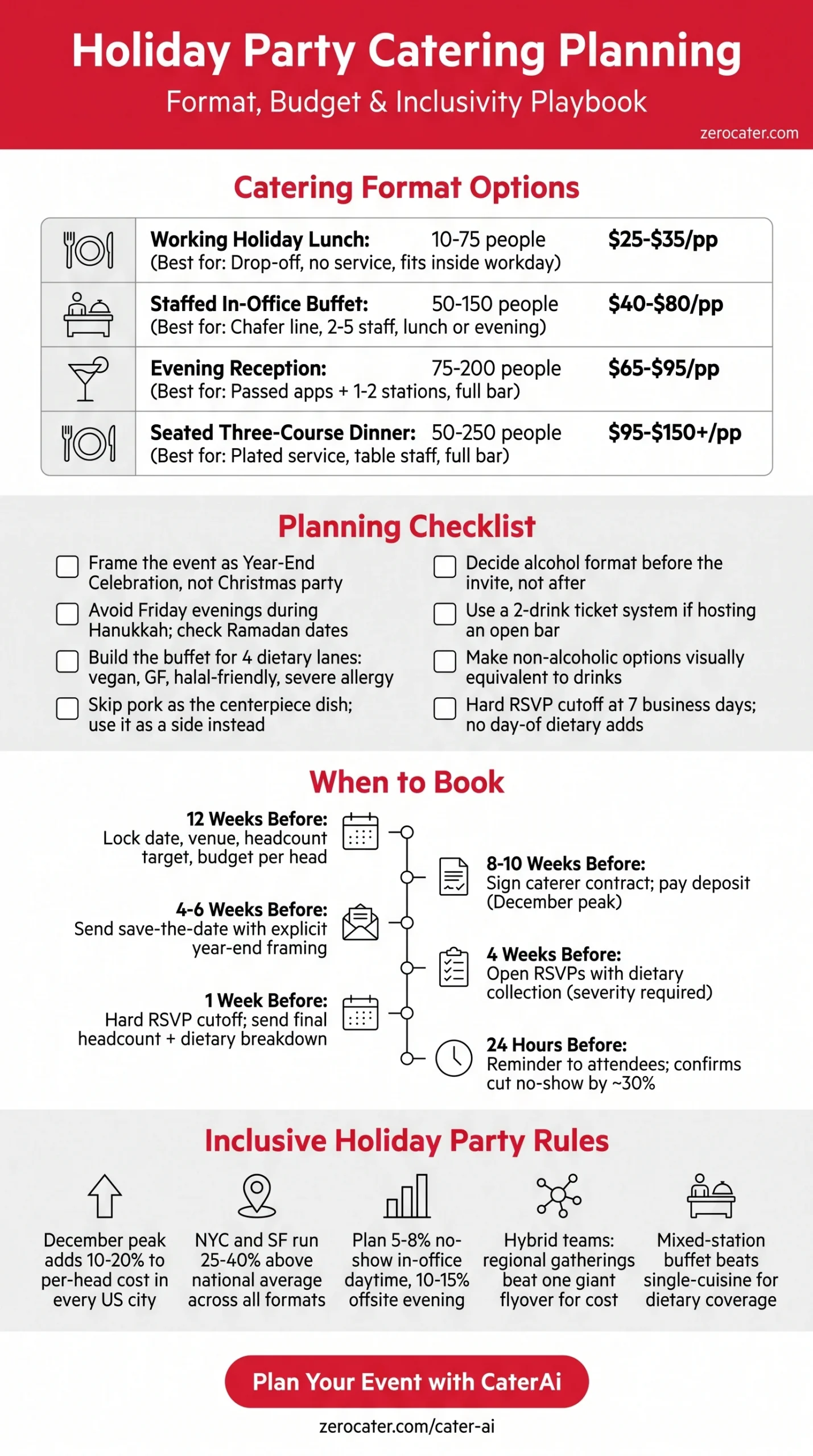
The office holiday party is the single highest-stakes catering event most companies run all year. Headcount is bigger than any standing meeting. Expectations are higher than any quarterly all-hands. Dietary needs span the full spectrum from severe allergy to halal to vegan to keto. Budgets run 5 to 10 times the per-person spend of a normal team lunch. And the planning window most office managers actually get is half what they need. Done right, the year-end party is the catering moment your team talks about for months. Done wrong, it is the most expensive way to disappoint everyone at once. This guide is the planning playbook: the booking timeline by event size, the four service formats that actually fit office events, budget tiers from $25 to $150 per person, the dietary and interfaith inclusivity rules, the alcohol decision framework, the hybrid-team coordination patterns that work, and the RSVP discipline that prevents last-minute headcount chaos.
In This Guide
- The Booking Timeline by Event Size
- Four Service Formats for Office Holiday Events
- In-Office vs. Offsite Venue
- Inclusive Holiday Planning
- The Alcohol Decision Framework
- Cuisines That Suit a Holiday Party Menu
- Hybrid and Distributed Team Coordination
- Budget Tiers from $25 to $150 Per Person
- Headcount and RSVP Discipline
- Frequently Asked Questions
The Booking Timeline by Event Size
Holiday catering follows a different timeline from any other corporate event because December demand stacks against fixed kitchen capacity. The result: the dates everyone wants (second and third weeks of December, Thursday and Friday lunch slots) book out 10 to 14 weeks ahead in every major US city. The lead time you actually need is a function of headcount and format:
| Event Type | Headcount | Recommended Lead Time | December Peak Lead Time |
|---|---|---|---|
| Drop-off lunch | 10 to 50 | 2 weeks | 4 to 5 weeks |
| Staffed in-office buffet | 50 to 150 | 4 to 6 weeks | 8 to 10 weeks |
| Evening reception (heavy apps) | 75 to 200 | 6 to 8 weeks | 10 to 14 weeks |
| Seated dinner with service | 50 to 250 | 8 to 10 weeks | 12 to 16 weeks |
| Offsite venue + catering | Any size | 8 to 12 weeks (venue first) | 14 to 20 weeks |
The non-December exception: if your party is Lunar New Year, Diwali, summer year-end celebration, or a January retro, the timeline drops by half. Caterer capacity is wide open in those windows; lead-time pressure is purely a December phenomenon.
The 12-week planning checklist
- Week 12: Lock the date, lock the venue (in-office vs. offsite), set the headcount target, set the budget per head.
- Week 10: Solicit menu proposals from 2 to 3 caterers. Compare on dietary coverage, format flexibility, and per-person cost (not just menu items).
- Week 8: Sign the catering contract. Pay the deposit. Lock equipment rentals if needed.
- Week 6: Send the save-the-date with venue, time, dress code, and the explicit “year-end celebration” framing.
- Week 4: Open formal RSVPs with dietary needs collection. Ask for severity level (preference vs. medical allergy).
- Week 2: Send RSVP reminder. Confirm equipment rentals and AV needs with venue.
- Week 1: Hard RSVP cutoff at 7 days. Send final headcount and dietary breakdown to caterer 5 to 7 days out.
- Day-of: Confirm caterer arrival time, setup logistics, and rain backup if outdoors.
Four Service Formats for Office Holiday Events
The format choice drives everything downstream: budget per head, lead time, staffing, and what you can reasonably ask the team to expect. The four formats that work for office holiday parties:
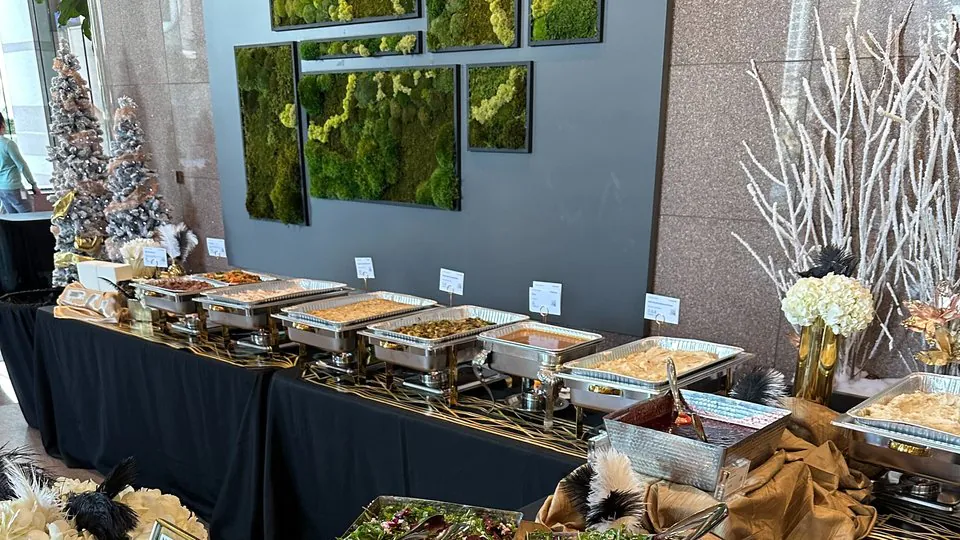
1. Working holiday lunch (drop-off or light staffed)
The most-ordered office holiday format. The caterer drops a buffet during the workday, the team takes a 60 to 90 minute break to eat, and people return to desks afterward. Pros: low cost, no after-hours childcare problem for parents, accessible to commuters and hybrid team members, finishes inside the workday. Cons: less ceremonial than an evening event, lower energy, easy for people to skip if a meeting runs over. Best for: companies under 75 people, teams where evening attendance is unreliable, second-tier holiday events you want to do well without overcommitting.
2. Staffed in-office buffet (lunch or evening)
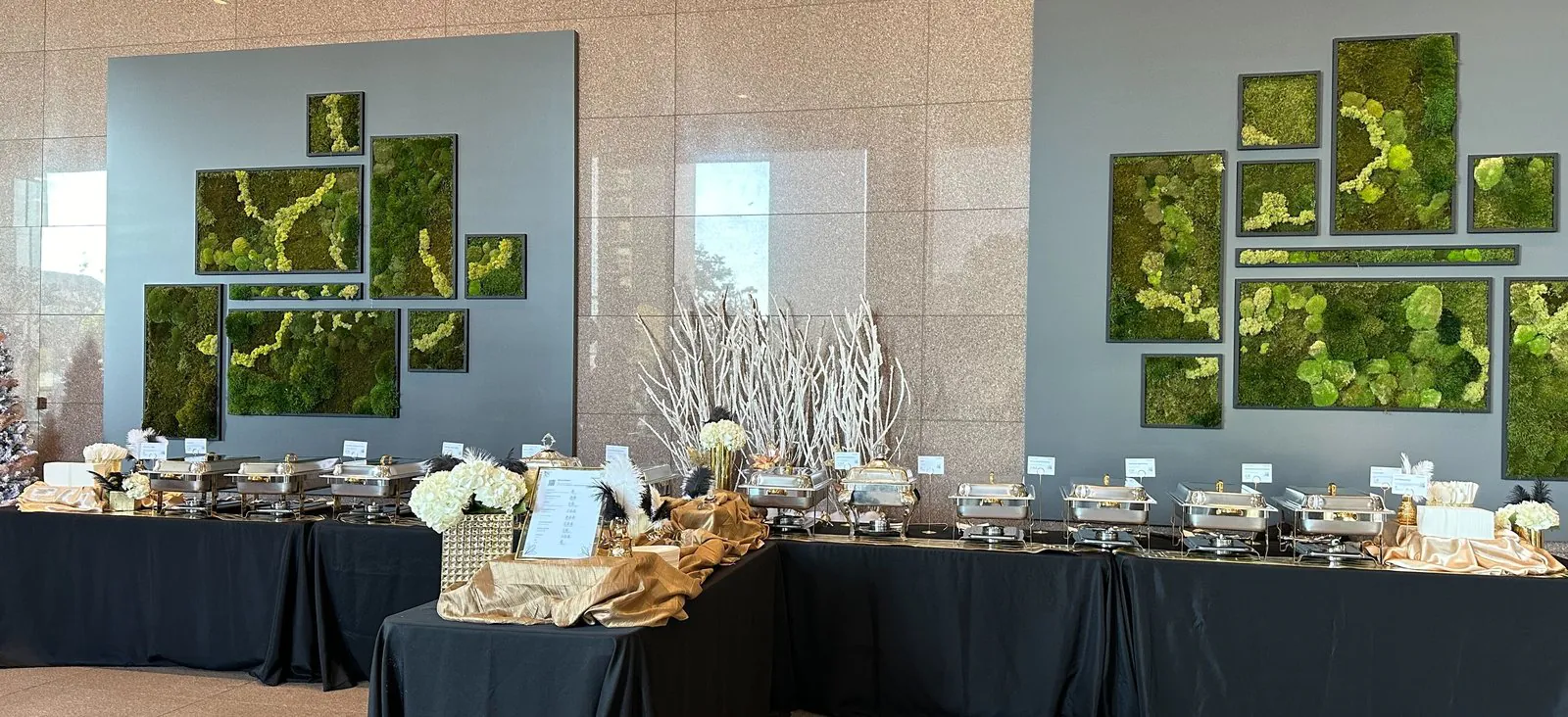
The format most office holiday parties default to: a tented or carved-out section of the office becomes the buffet, the caterer brings chafers and 2 to 4 service staff, the event runs 90 to 120 minutes with seated cocktail tables and a small program. Pros: flexible time slot (works as lunch or evening), scales from 50 to 200 people, the operations match what most office managers already know how to run. Cons: requires office space that can absorb a buffet line plus seating; the after-event cleanup is non-trivial. Best for: most mid-size companies, teams that want event energy without the cost of a venue rental.
3. Evening reception with heavy passed appetizers
The reception format trades the buffet line for tray-passed and station-based service: 4 to 6 passed app varieties continuously circulating, plus 1 to 2 stationary food stations (a carving station, a charcuterie display, a pasta station) where guests gather. Service staff is heavier (1 server per 20 to 25 guests for tray-passed). Pros: encourages mingling, higher event energy, looks more “produced” than a buffet, no line buildup. Cons: harder for guests with dietary restrictions to confidently eat (fewer labels, less control over ingredients), more expensive per head, requires a venue setup with mingling space. Best for: 100 plus person companies, milestone anniversary years, evening events where the social mixing is the point.
4. Seated three-course dinner
The most ceremonial holiday format and the most expensive. Plated service of three courses (starter, main, dessert), table service staff at 1 server per 12 guests, table assignments and a small program (toasts, awards, a CEO speech). Pros: high engagement, dietary needs handled cleanly through pre-orders, the format itself communicates “this matters.” Cons: rigid timing, requires a venue that can seat the full headcount, the most expensive format by 2x to 3x. Best for: 50 to 250 person companies celebrating an anniversary milestone, leadership-team dinners, IPO or funding-round celebrations.
In-Office vs. Offsite Venue
The venue decision sets the cost ceiling, the format options, and the accessibility profile of the event. The honest tradeoffs:
| Factor | In-Office | Offsite Venue |
|---|---|---|
| Cost | Catering only | Catering + venue rental ($2K to $15K) + service charges |
| Lead time | 2 to 8 weeks | 8 to 20 weeks (December peaks) |
| Accessibility | Maximum (everyone knows the route) | Mixed (commuters, parents face friction) |
| Capacity | Capped by office space | Up to thousands |
| Energy / novelty | Familiar; lower | Different setting; higher |
| Setup / breakdown | Your team owns it | Venue handles most |
| Audio / AV | Office equipment | Venue-provided, professional |
The in-office default for under 100 people: If your headcount is under 100 and the office can physically absorb a buffet plus seating, in-office wins on cost, accessibility, and operational simplicity. The catering budget is the entire budget; there is no venue line item. Your office is also where remote team members already know they can come.
The offsite case for 100 plus or milestone years: Above 100 attendees, most offices cannot absorb a true holiday party comfortably. An offsite venue (a hotel ballroom, restaurant private dining room, museum event space, rooftop bar) gives you capacity, ambiance, and dedicated operational support. For anniversary years (10th, 25th), the venue itself is part of the message.
Hybrid model: in-office cocktail hour or lunch (low-friction, accessible to everyone) plus an optional offsite evening event for the smaller subset who want a longer celebration. Splits the budget across two events, captures both audiences.
Inclusive Holiday Planning
The single biggest mistake office holiday planning makes is treating it as a Christmas event by default. Modern US workplaces have Jewish, Muslim, Hindu, Buddhist, atheist, and “no preference” team members who all signed up to work somewhere, not to attend a religious observance. The fix is straightforward and operational, not philosophical:
Frame the event as year-end, not Christmas
- Invite language: “Year-End Celebration,” “Annual Holiday Gathering,” “[Company] Winter Party.” Avoid “Christmas Party” as the title even if December dominated.
- Decor anchor: winter aesthetics (white florals, frosted branches, candles, evergreen, gold accents) work without invoking Christmas iconography. Skip Christmas trees, wreaths with red bows, and nativity-adjacent imagery as the visual centerpiece.
- Date selection: avoid Friday evening during Hanukkah for Jewish team members (the Sabbath observance creates a hard conflict), check Ramadan dates if your party falls in spring (Muslim colleagues fasting until sunset cannot reasonably attend a daytime food event), and avoid Diwali week if you have a sizable South Asian team unless your party is itself a Diwali celebration.
Dietary inclusivity is operational, not aspirational
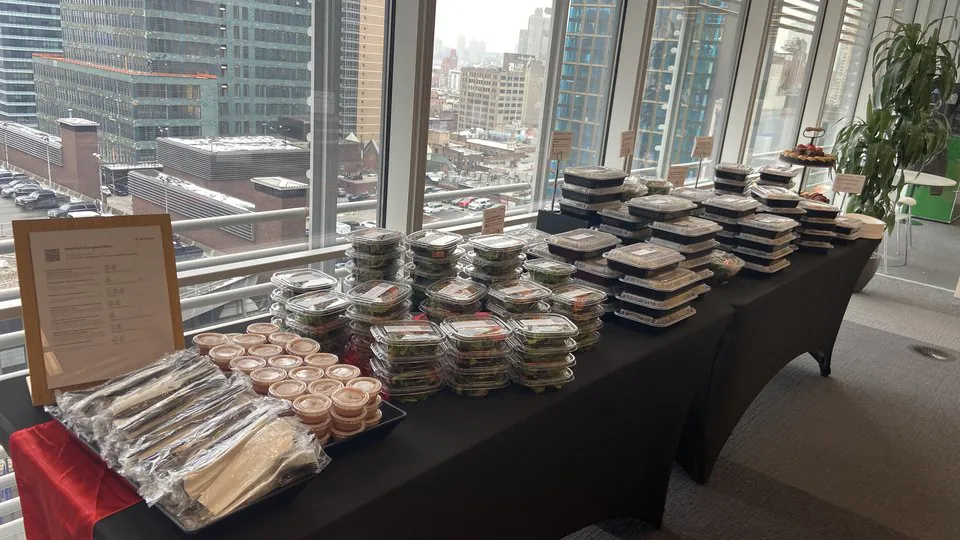
The party is no place to discover that 12 percent of your team is vegan and the menu has nothing for them. Plan for the full dietary spectrum from the start:
- Collect dietary needs at RSVP, with severity. Three categories: preference (vegetarian by choice), strong preference (vegan, kosher-style, halal-style), medical (severe allergy, celiac). The severity changes the operational response.
- Build the buffet for 4 dietary lanes, not just “vegan options.” Vegan, gluten-free, halal/kosher-style (no pork, no shellfish), and severe-allergy clearly labeled. See the complete guide to mixed dietary needs for the labeling system.
- For severe allergies (peanut, tree nut, shellfish), use individually packaged sealed meals. Buffet line cross-contact is real; the only safe answer for medical allergy is individual portions assembled separately. The allergy-safe boxed lunches guide covers the cross-contact protocol.
- Skip pork as the centerpiece. A pulled-pork BBQ or porchetta carving station as the visual main excludes Muslim, Jewish, and many Hindu team members from the headline dish. Pork sides are fine; pork as the headline is a self-inflicted exclusion.
For dietary deep-dives by category, see the vegan office catering guide and the gluten-free office catering guide.
The Alcohol Decision Framework
The alcohol question is the second-largest planning decision after venue, and the one most likely to be made implicitly instead of explicitly. Decide before the invite goes out, not after.
Three workable options
1. Full open bar (hosted). Beer, wine, 2 to 4 cocktails, full non-alcoholic menu. The traditional default. To reduce HR and over-service exposure, run a 2-drink ticket system: every guest gets two drink tickets at check-in, additional drinks are cash-bar. This is the format that signals “the company is treating you” without enabling the late-evening problems an unlimited open bar invites.
2. Beer and wine only with strong NA program. Removes the spirits-driven over-service risk while keeping the celebratory feel. Pair with a robust non-alcoholic menu: zero-proof beer (Athletic, Heineken 0.0), alcohol-free spirits in proper mixed drinks, an espresso bar, premium sparkling water on every table. The trend through 2025 and 2026 has been toward this format.
3. Fully dry with elevated mocktail program. Lower social cost for guests in recovery, pregnant team members, observant Muslims, or anyone choosing not to drink. Requires a creative mocktail menu (4 to 6 named drinks, not just “soda water with lime”) and visually equivalent presentation: same glassware, same garnish, same server attention as alcoholic drinks would get. Done well, dry parties get high satisfaction scores; done as an afterthought, they read as “the company cheaped out.”
The decision drivers
- Team age and culture: younger teams (median age under 30) drink more; older or family-heavy teams drink less. Engineering and tech teams have shifted markedly toward zero-proof preferences.
- HR risk tolerance: companies with prior HR incidents at events often default to dry or beer-and-wine-only as a policy decision.
- Daytime vs. evening: daytime events default toward dry or beer-and-wine; evening events default toward full bar with the 2-ticket guardrail.
- Religious composition: if a sizable share of the team observes Islam (no alcohol) or other dry traditions, full open bar marginalizes them. Beer-and-wine with strong NA, or fully dry, is the inclusive choice.
Whatever you choose, communicate it explicitly in the invite. “Open bar” or “beer, wine, and zero-proof options” or “dry event with mocktail bar” all set expectations correctly. Vague language (“drinks will be served”) creates assumptions that get violated.
Cuisines That Suit a Holiday Party Menu
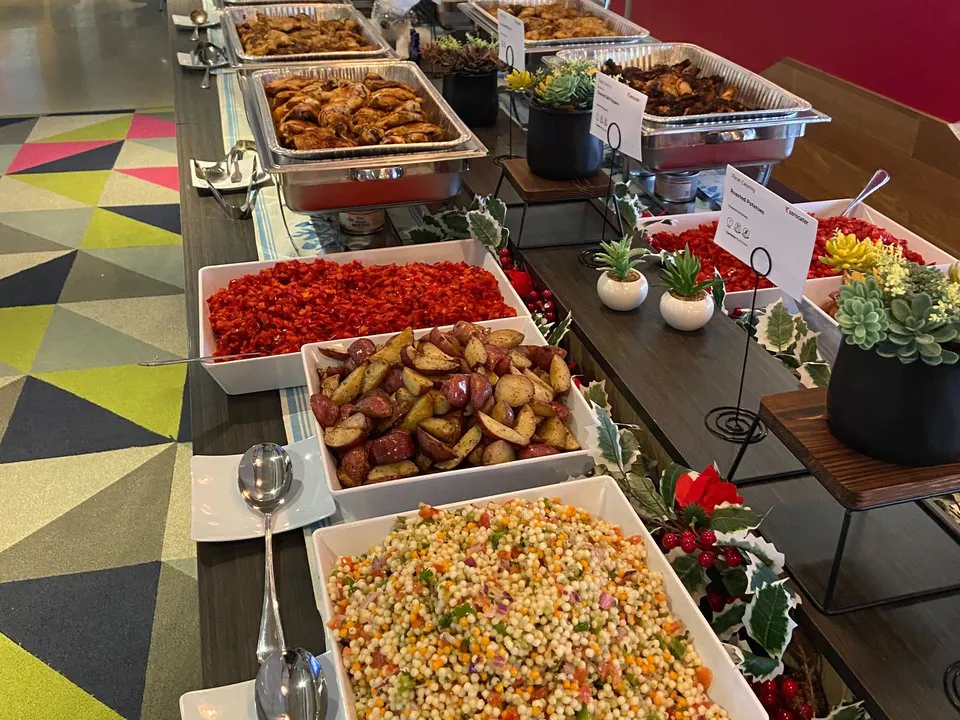
The cuisines that work best for office holiday parties share a common trait: they cover vegan, vegetarian, gluten-free, and halal needs without forcing separate menus or special-order workarounds.
Mediterranean and Middle Eastern
The single best-fitting cuisine for an inclusive office holiday party. Hummus, baba ganoush, tabbouleh, falafel, grilled chicken, lamb kofta, rice pilaf, fattoush salad. Vegan and gluten-free options are built into the cuisine, not bolted on. Naturally halal-friendly (no pork). Holds well at room temperature for a 90-minute reception window. Browse Mediterranean catering options; ZC partners include Zaatar Mediterranean in SF, A Saffron Thread in NYC, and Olive Mediterranean Grill in Chicago.
Italian family-style
Pasta stations, antipasto displays, salad bars, garlic bread, tiramisu. Easy to scale from 25 to 250 people, photogenic, and most guests have an opinion about which dish they want. Build the menu with at least one tomato-based pasta (vegan-adaptable), one cream-based (clearly labeled), one vegetable lasagna, and a separate gluten-free pasta tray. Browse Italian catering options.
Regional American comfort
Roast turkey or chicken, mashed potatoes, herb stuffing, glazed carrots, mac and cheese, Brussels sprouts. The format every American office team recognizes; works as the holiday-meal-but-secular default. Pair with one vegan main (a wild rice and roasted vegetable casserole, or a portobello roast) so plant-based guests are not stranded with sides.
BBQ (with caveats)
Smoked brisket, pulled chicken, smoked turkey, vinegar slaw, mac and cheese, baked beans. Energy is high, food is comforting, and most guests are happy. The caveats: BBQ is meat-forward by design (vegan options need to be planned in, not assumed) and pork-forward menus exclude observant Muslim and Jewish team members. For BBQ as the format itself, see our BBQ corporate catering guide; for holiday parties specifically, default to brisket and chicken with pork as a side rather than the headline. Browse BBQ catering vendors.
Mexican and Tex-Mex
Build-your-own taco bars, fajita stations, burrito bowls, Mexican wedding cookies for dessert. Naturally accommodates vegan, vegetarian, gluten-free, and halal needs through ingredient choice. Strong energy at the build-your-own station. Browse Mexican catering vendors; partners include Tio Luis Tacos in Chicago, Raging Burrito in Atlanta, and Folklore Artisanal Mexican Eatery in NYC.
Multi-station / mixed
For 100 plus person events, the highest-satisfaction format is a mixed-station build: one carving or hot main station, one Mediterranean or international station, one salad and grain station, one dessert station. Lets each guest assemble a meal that fits their preference and dietary need. The operational lift is only marginally higher than a single-cuisine buffet because the caterer is already setting up multiple stations.
Hybrid and Distributed Team Coordination
The hybrid-team holiday party is the planning challenge of the post-2020 workplace. The single in-office party that worked when everyone commuted to the same building no longer covers the team. Three patterns work:
Pattern 1: Regional in-person gatherings, same week
Each metro hub (NYC, SF, Chicago, Austin, etc.) hosts its own in-person party in the same week or month. Headcount per event is 5 to 30 people instead of 100, which actually unlocks higher-end formats per head: a private restaurant dinner for the SF team, a curated chef’s table for the NYC pod, a brewery buyout for the Austin contingent. The brand-level message (“we celebrated together”) is preserved through coordinated photos, swag, and toasts. This is the dominant pattern for fully distributed teams.
Pattern 2: Company-wide flyover
Remote team members travel to a central city for a 2-day in-person gathering: holiday party + an offsite-style program day. The cost is significant (flights, hotels, full per-person catering), but the engagement payoff is real for teams that rarely gather in person. Best for companies under 75 people and budget tiers above $300 per head fully loaded.
Pattern 3: Hybrid event with coordinated remote delivery
The in-office hub hosts a party; remote team members get a same-day catering delivery to their home address through a corporate catering service that ships nationally. A short virtual gathering (45 minutes, the toast moment, gift exchange, a CEO short address) ties the two formats together. The remote experience needs to feel like an equivalent celebration, not a consolation prize: a curated holiday meal box, real glassware, the same wine the office is drinking.
For the operational layer of running ongoing food programs across distributed teams, see our boxed lunches for hybrid and distributed teams guide.
Planning your office holiday party?
Plan holiday party catering with CaterAi
Tell CaterAi your headcount, format, and dietary breakdown. See holiday-ready menus from 1,000 plus vetted caterers in minutes.
Budget Tiers from $25 to $150 Per Person
Holiday catering pricing runs across a wider per-head range than any other office catering format because the formats span working lunch to seated dinner. December peak adds 10 to 20 percent on top of off-season rates in most major US cities. The honest tier breakdown:
| Tier | Per Person (Off-Peak) | Per Person (Dec Peak) | What You Get |
|---|---|---|---|
| Working holiday lunch (drop-off) | $22 to $30 | $25 to $35 | Buffet lunch, no service staff, 60 to 90 min event |
| Staffed in-office buffet (lunch) | $35 to $48 | $40 to $55 | 2 to 3 service staff, chafer setup, light decor |
| Staffed in-office buffet (evening) | $45 to $65 | $55 to $80 | 3 to 5 staff, full bar setup, premium menu |
| Evening reception (heavy apps + stations) | $55 to $80 | $65 to $95 | 5 to 8 passed apps, 1 to 2 hot stations, bar service |
| Seated three-course dinner | $80 to $130 | $95 to $150 plus | Plated service, table staff, full bar, dessert course |
What is in those numbers and what is not. The per-head cost above includes food, service staff for staffed formats, basic equipment (chafers, plates, utensils, linens). The numbers do not include venue rental for offsite events ($2,000 to $15,000 typical depending on city and venue), open bar alcohol if you want a separate liquor budget ($25 to $60 per person depending on format), service charges and gratuity (18 to 22 percent industry standard), or specialty rentals (lounge furniture, audio, lighting design).
City matters. Per-person ranges run roughly 25 to 40 percent higher in NYC and SF compared with the rest of the US. For city-specific cost benchmarks, see the NYC catering cost guide, the SF catering cost guide, and the Chicago catering cost guide. For boxed-format pricing across cities, see the boxed lunch catering cost guide.
Headcount and RSVP Discipline
Holiday parties have the highest-stakes headcount of any catering event because the per-head cost is high and the no-show rate is unpredictable. Missing your number by 20 percent in either direction is a four- or five-figure mistake at scale. The discipline:
Open RSVPs at 4 weeks out
Earlier than 4 weeks gets ignored; later than 4 weeks compresses your window for chasing late responses. Send the invite with a clear RSVP form (ideally a one-click email or a simple form, not a long survey) that captures: attending yes/no, dietary needs (with severity), plus-one if applicable, and one optional note for accessibility needs.
Hard cutoff at 7 business days before the event
Caterers need final headcount 5 to 7 days out to lock ingredient orders and staffing. The 7-day cutoff gives you a 2-day buffer to reconcile late RSVPs before sending final numbers. Communicate the cutoff explicitly in the invite (“RSVP by [date]; later additions cannot be accommodated”). For dietary needs especially, late-add requests after the caterer locks the menu are usually impossible to accommodate well.
Plan for a 5 to 15 percent no-show rate
- In-office events during the workday: 5 to 8 percent no-show rate.
- In-office evening events: 8 to 12 percent (people get tired, kids get sick, traffic happens).
- Offsite evening events: 10 to 15 percent (commute friction, weather, life).
Order to RSVP count, not RSVP plus a buffer. Leftovers from a 200-person catering order are operational waste, not a feature. If you systematically run short, raise the original RSVP number you set; do not pad the catering order.
Send a 24-hour reminder
The day-before reminder reduces no-show rate by roughly 30 percent in office settings. Include the time, location, dress code, and any operational details (where to park, where to enter, how to find the room).
Capture dietary needs at RSVP, not at the door
Day-of dietary requests cannot be honored well. Caterers cook for the headcount and dietary breakdown they were sent 5 to 7 days out. A vegan team member who shows up unannounced expecting a vegan plate is going to eat sides and feel forgotten. Make the dietary question impossible to skip in the RSVP form.
For the broader operational discipline of running office catering at scale, see our office manager’s guide to ordering catering. For the company-picnic format that uses many of these same patterns in an outdoor setting, see our company picnic catering guide. For board-meeting catering specifically (which uses different rules entirely), see the board meeting catering guide.
Where to go from here: for ongoing meal programs through 2026 (anchor day catering, weekly office lunches, hybrid-team coordination), Zerocater’s corporate catering programs handle the operational layer end to end. For one-off holiday parties and milestone events, Zerocater event catering handles staffing, rentals, and on-site coordination. To build a holiday menu in your city, CaterAi compares menus across 1,000 plus vetted caterers in real time. New to Zerocater? See how it works.
Where to find holiday catering in your city
- 15 Best Corporate Event Catering Companies in NYC
- 15 Best Corporate Event Catering Companies in SF
- 15 Best Corporate Event Catering Companies in Chicago
- 15 Best Corporate Event Catering Companies in LA
- 15 Best Corporate Event Catering Companies in Atlanta
- 15 Best Corporate Event Catering Companies in Dallas
- 15 Best Corporate Event Catering Companies in Denver
- 15 Best Corporate Event Catering Companies in Seattle
Frequently Asked Questions
How far in advance should I book holiday party catering?
For an in-office holiday lunch under 50 people, 3 to 4 weeks of lead time is enough. For 100 plus people with on-site service or a seated dinner, plan 8 to 12 weeks. December is peak holiday catering season in every US city, so the most-requested dates (the second and third weeks of December, especially Thursday and Friday lunch) sell out 10 to 14 weeks ahead. If your party is non-December (Lunar New Year, Diwali, summer holidays, year-end retros in January), 4 to 6 weeks is usually enough even for 100 plus people.
How much does holiday party catering cost per person?
Plan on $25 to $35 per person for a drop-off lunch buffet, $40 to $55 for an on-site staffed lunch buffet, $60 to $90 for an evening reception with heavy passed apps and one hot station, and $90 to $150 for a seated three-course dinner with service staff. December peak pricing runs 10 to 20 percent above off-season rates in most major US cities. NYC and SF run 25 to 40 percent higher than the national average across every format.
What is the best food for an office holiday party?
Mediterranean, Italian family-style, regional American comfort, BBQ, and Mexican all work well for office holiday parties because each format covers vegan, vegetarian, gluten-free, and halal needs without separate menus. Avoid heavy single-cuisine menus that exclude major dietary groups (a pure pork BBQ menu excludes halal and many Jewish team members; a cream-sauce Italian menu strands lactose-intolerant guests). The best-received office holiday menus are mixed-station builds: one carving or hot station, one vegetable-forward station, one dietary-inclusive station with clearly labeled vegan and gluten-free items.
Should the office holiday party serve alcohol?
Decide before you announce the event, not after. Three workable options: full open bar (hosted, 2-drink ticket limit reduces over-service risk and HR exposure), beer-and-wine only with a robust non-alcoholic menu (zero-proof beer, alcohol-free spirits in mixed drinks, espresso bar), or fully dry with an elevated mocktail program. Whatever you choose, brief the caterer to make non-alcoholic options visually equivalent: same glassware, same garnishes, same server attention. The trend through 2025 and 2026 has been toward dry or beer-and-wine-only formats with strong NA programs because it lowers the social cost for guests in recovery or who are pregnant, observant Muslim, or simply not drinking.
How do you make an office holiday party inclusive across faiths?
Frame the event as a year-end celebration, not a Christmas party. Use neutral language in the invite (“Year-End Celebration” or “Annual Holiday Gathering”), avoid Christmas-specific decor as the visual anchor (use winter or general festive aesthetics instead of trees and nativity), schedule the date away from observances that exclude attendance (avoid Friday evenings during Hanukkah for Jewish team members; check Ramadan dates for Muslim colleagues if your party falls in spring), and offer a robust non-alcoholic beverage menu. On food: pork-free or pork-side stations are a small operational lift that meaningfully widens who can eat at the buffet.
Should we host an in-office party or rent an offsite venue?
In-office wins on cost (no venue rental, no transportation), accessibility (everyone already knows how to get there, no travel for parents or commuters), and operational simplicity. Offsite wins on novelty (a different setting raises engagement), capacity (your office may not fit your full headcount), and the psychological reset (people behave differently outside the place they work). For headcounts under 100 with a flexible office space, in-office is usually the right call. For 100 plus people, hybrid teams that rarely gather in person, or anniversary milestones, an offsite venue is worth the budget premium.
How do you plan a holiday party for a hybrid or distributed team?
Hybrid teams need parallel planning, not just one party. Three workable patterns: regional in-person gatherings in each metro hub on the same week (5 to 30 people each, lower per-person cost than one large party), one company-wide flyover where remote team members travel to a central city (high engagement, high cost), or hybrid-format events where the in-person hub livestreams a moment to remote attendees who get a coordinated catering delivery the same day. Whatever the pattern, send remote team members an equivalent celebration: a curated holiday meal delivered to their home address through a corporate catering service, paired with a virtual gathering.
What is the right RSVP cutoff for holiday party catering?
Hard cutoff at 7 business days before the event, with a soft reminder at 14 days. Caterers need final headcount 5 to 7 days out to lock ingredient orders and staffing, so a 7-day cutoff gives you a 2-day buffer to reconcile late RSVPs. Communicate the cutoff explicitly in the invite (“RSVP by [date]; later additions cannot be accommodated”). Plan for a 5 to 10 percent no-show rate on day-of in office settings; offsite evening events run 10 to 15 percent. Order to RSVP count, not RSVP plus a buffer; leftovers from a 200-person party are operational waste, not a feature.
Plan holiday party catering with CaterAi