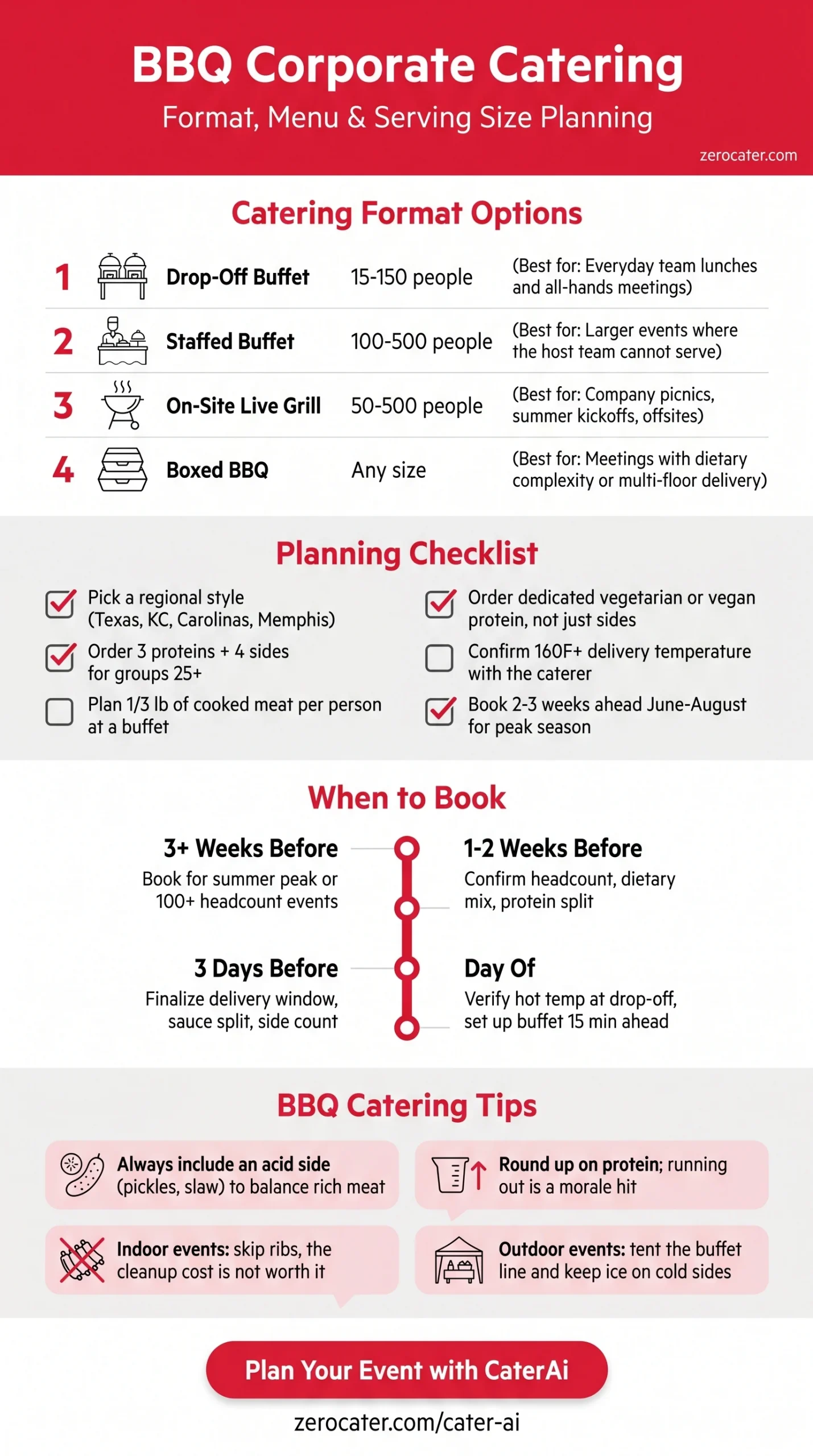
BBQ catering is having a moment with corporate planners, and for good reason. It scales cleanly from a 15-person team lunch to a 500-person company picnic, most people love it, and the format flexes across drop-off, buffet, and live-grill service styles. The cuisine is also one of the highest-performing in search: BBQ catering queries rank well but convert poorly because almost no one has written a serious office-focused BBQ catering guide. This is that guide. When BBQ catering actually fits an office, the four formats to pick from, serving sizes by headcount, dietary coverage, and the indoor-versus-outdoor logistics that trip up first-time planners.
In This Guide
- When BBQ Catering Fits Your Office
- The 4 Formats: Drop-Off, Buffet, On-Site Grill, Boxed
- The Core BBQ Menu Playbook
- Serving Sizes for 10, 25, 50, 100, 200+ People
- Dietary Coverage in BBQ Catering
- Indoor vs. Outdoor Logistics
- How to Order BBQ Catering Well
- Common Mistakes to Avoid
- How CaterAi Handles BBQ Orders
- FAQ
When BBQ Catering Fits Your Office
BBQ is not the default cuisine for a random Tuesday team lunch, and planners who treat it that way end up with sleepy afternoons and a meeting room that smells like a smoker for two days. Used well, BBQ catering is one of the best corporate formats out there. The trick is matching the cuisine to the moment.
BBQ catering works best for:
- Company picnics and outdoor events. The natural home for BBQ. Pair with outdoor office catering planning and an on-site grill if the venue allows it.
- Summer all-hands and kickoffs. Seasonal cue, celebratory feel, scales to hundreds.
- Team celebrations and quarterly milestones. Closing a big quarter, hitting a product launch, finishing a tough project. BBQ rewards a team in a way a sandwich platter never will.
- Sales kickoffs and offsites. Regional or national sales teams love BBQ for the shared-meal social component.
- Engineering team socials. Friday-afternoon, we-shipped-something catering that breaks the pattern of the usual cuisine rotation.
- Construction-site and field-office lunches. BBQ travels in sealed pans, handles outdoor venues, and feeds a crew that has been working physical jobs.
- Casual client meals. Prospects and partners who do not want a stuffy sit-down lunch.
BBQ catering is usually the wrong pick for:
- Tight-agenda board meetings. The cuisine is messy, the aromatics are strong, and sauced hands do not play nicely with printed decks. For board-level sessions, our board meeting catering guide covers the cleaner formats.
- Client-facing pitches or interview lunches. BBQ forces people to use their hands, which adds social friction. Boxed lunches are the better call here, covered in the boxed vs. buffet decision framework.
- Post-lunch meetings with heavy concentration demand. BBQ is calorie-dense. Afternoon productivity dips after a pulled-pork lunch are real and measurable. Save it for Friday.
- Small teams of under 10 people. BBQ economics work against small groups, and the leftover volume from a full buffet gets awkward fast.
The 4 Formats: Drop-Off, Buffet, On-Site Grill, Boxed
BBQ catering is not one format. Picking the right one is the single most important decision in the order, and each format has different cost, logistics, and experience implications.
1. Drop-Off BBQ Buffet (the office default)
The caterer smokes everything off-site, packs hot food into sealed aluminum pans and insulated carriers, delivers to your office at a preset time, and leaves. Your team sets up and serves from the pans. This is the format for everyday office BBQ lunches and the lowest-cost per-person option. Pair with disposable plates, utensils, and a serving tong per pan.
Best for: Team lunches, weekly catering rotations, mid-size all-hands (15 to 150 people), any indoor office BBQ. Delivery window: The caterer typically hits a 15-minute arrival window; food holds hot for 90 to 120 minutes in the pans.
2. Staffed BBQ Buffet
Drop-off service plus a team of one to three staff on-site for an hour or two. They handle setup, refresh pans, serve the protein lines, manage the sides, and clean up after. The added labor cost is usually 15 to 25 percent above drop-off but saves your team from playing caterer.
Best for: Larger all-hands (100+ people), events where the host team cannot double as servers, board retreats with an outdoor component, any gathering where a clean post-lunch handoff matters. What to specify: staffing duration (minimum 1 hour, typical 2 to 3), setup time window (usually 45 minutes before service), and cleanup expectations.
3. On-Site Live-Fire Grilling (the experience)
The caterer brings a mobile smoker or grill to your venue and cooks on-site. Smells of live smoke, showpiece meat on a cutting board, a pitmaster slicing brisket to order. This is the picnic-and-offsite format, not the office format. Venue permits, fire code, and outdoor access make it impractical in most corporate office buildings, but it is the right call for company picnics, offsite retreats, and celebratory events with a budget for the experience.
Best for: Company picnics, summer kickoffs, team offsites, client-appreciation events, 50-plus attendees. Practical constraints: outdoor venue with electrical access (or approved open-flame permit), at least 4 hours of setup lead time, and usually a minimum-order threshold from the caterer.
4. Boxed BBQ (the meeting-room option)
Individual BBQ meal boxes: a protein-and-sides combo per person, sealed and labeled. The newest format in the BBQ catering menu and the most office-friendly. Handles dietary restrictions cleanly, scales across multiple floors, travels to satellite offices, and preserves the meal for staggered meeting breaks without degradation. For the full case on boxed catering formats, see the boxed lunch catering vs. buffet decision framework.
Best for: Conference meetings with staggered breaks, multi-floor offices, hybrid teams with a remote-delivery component, client meetings where presentation matters, high-dietary-complexity groups. What to specify: individual labeling with recipient names for pre-ordered meals, dietary markers on every box, sauce packets on the side rather than pre-applied.
The Core BBQ Menu Playbook
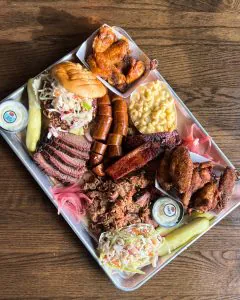
A strong office BBQ order covers three proteins, four sides, two sauces, and a bread. Any less and the spread feels thin; any more and waste climbs. Here is how to think about each category.
Proteins (pick 2 or 3)
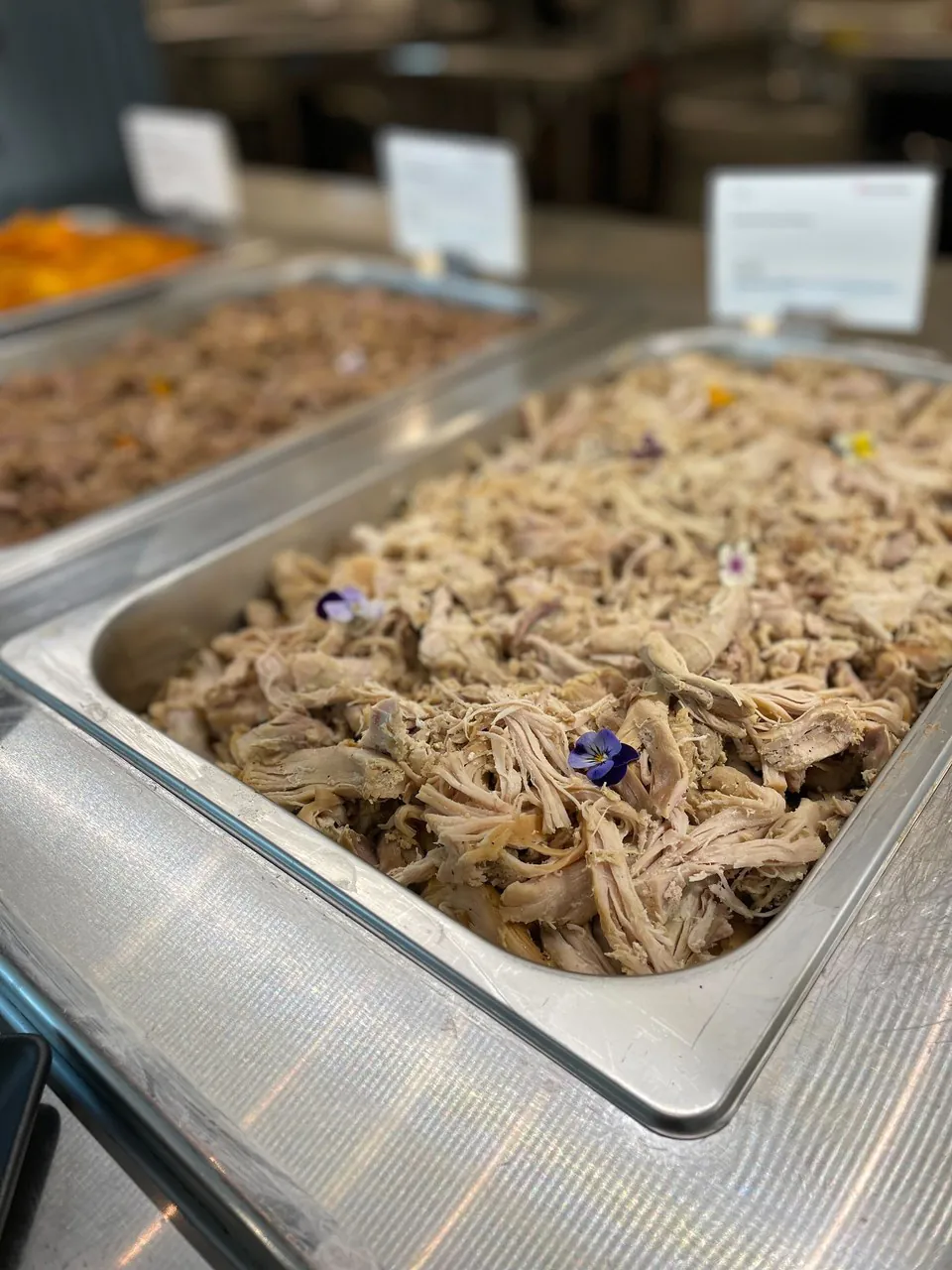
- Pulled pork: the reliable crowd-pleaser. Low cost per portion, holds temperature for hours, sandwich-friendly. The baseline protein for almost every office BBQ order.
- Brisket: the showpiece. Sliced or chopped, smoked 12 to 18 hours. Higher cost per portion, but the protein that earns a BBQ order its reputation. Worth budgeting for at celebration events.
- BBQ chicken: the diplomatic option. Covers guests who do not eat pork or beef, lighter in calories, familiar. Either whole-pieces (thighs, legs, bone-in breasts) or pulled chicken.
- Ribs: the indulgence. Pork spare ribs or baby backs. Higher cost per portion and messy, but a memorable addition for picnic-style events. Less office-friendly than other proteins.
- Hot sausage links (hot links, andouille): the flavor-forward option. Sliced for buffet, whole for sandwich format.
- Smoked turkey: the underrated one. Light, dietary-friendly, still smoky. Good for audiences with lighter appetites.
- Vegetarian or vegan BBQ protein: jackfruit pulled “pork,” smoked portobello caps, grilled vegetable skewers, or plant-based burnt ends. Ask the caterer for their specific offering.
Sides (pick 3 or 4)
- One starch-heavy side: mac and cheese, baked beans, potato salad, or cornbread stuffing.
- One crunchy acid side: coleslaw (vinegar-based or creamy), pickle plate, or cucumber salad. This one is non-negotiable. It balances the rich meat and resets the palate.
- One green side: mixed green salad, broccoli salad, or kale salad. For an office audience, this lifts the meal above sad-backyard-cookout territory.
- One regional accent side: collard greens, Brunswick stew, hush puppies, fried okra, mac salad, or cornbread. Signals the regional style of the BBQ (Texas, Carolinas, Memphis, Kansas City) and gives the meal a sense of place.
Sauces (pick 2)
- Sweet/Kansas City-style: tomato, molasses, brown sugar. The default. Kids love it, adults eat it, nobody complains.
- Vinegar/Carolina-style: tangy, thin, pepper-forward. Cuts the richness of pulled pork beautifully.
- Spicy/mustard or chipotle: a third option for the heat-seekers. Optional but appreciated.
Breads and finishing
- Dinner rolls or slider buns for pulled-meat sandwiches.
- Cornbread or jalapeno cornbread as a side.
- Pickles, white onions, and sliced jalapenos in small bowls along the buffet line.
Dessert (optional but recommended)
- Banana pudding, peach cobbler, pecan pie squares, or brownies. BBQ desserts trend Southern and homey. Single-serve portions work better than a communal pan.
Serving Sizes for 10, 25, 50, 100, 200+ People
The most common BBQ catering mistake is under-ordering protein for a hungry audience. These are battle-tested planning numbers for a mixed-appetite corporate crowd where BBQ is the full meal.
| Headcount | Total Protein | Protein Options | Sides | Recommended Format |
|---|---|---|---|---|
| 10 people | 3–4 lbs cooked | 2 | 3 | Drop-off or boxed |
| 25 people | 8–10 lbs cooked | 2–3 | 4 | Drop-off buffet |
| 50 people | 16–20 lbs cooked | 3 | 4 | Drop-off or staffed buffet |
| 100 people | 32–40 lbs cooked | 3 | 4–5 | Staffed buffet |
| 200+ people | 70–100 lbs cooked | 3–4 | 5–6 | Staffed buffet or on-site grill |
Planning notes: these numbers assume BBQ is the whole meal. If you are adding substantial appetizers, a salad course, or a separate vegetarian station, drop the protein volume by 15 to 20 percent. For crowds heavy on heartier appetites (construction crews, sales kickoffs, offsite sales teams), scale up by 15 percent. For lighter-lunch crowds (tech offices, afternoon meetings), a third of a pound per person usually covers it.
Dietary Coverage in BBQ Catering
BBQ catering has a reputation for being the cuisine that ignores dietary needs. That reputation is 15 years out of date. A serious BBQ caterer now handles the full range of office dietary profiles, though you have to specify what you need.
Vegetarian and vegan options at a BBQ caterer:
- BBQ jackfruit as a pulled-“pork” substitute in sandwiches or on the protein line. Texturally excellent when done well.
- Smoked portobello mushroom caps as a steak-style protein, often marinated and smoked alongside the meat.
- Grilled vegetable skewers with peppers, zucchini, onion, and cherry tomatoes.
- Plant-based burnt ends made from tofu, tempeh, or commercial plant-protein products. More common at modern BBQ caterers.
- BBQ cauliflower or cauliflower “wings” for appetizer-style settings.
- Vegan mac and cheese, vegan coleslaw, vegan baked beans (made without pork fat or lard) are available at most full-service BBQ caterers.
Gluten-free: almost all BBQ proteins are naturally gluten-free, as are most sides (slaw, potato salad, collard greens, baked beans, roasted vegetables). Cornbread and dinner rolls are the gluten-containing items, so gluten-free eaters either skip bread or the caterer provides GF rolls as a substitute. Watch for wheat-based flour in sauce thickeners and in some smoked sausage casings, and ask for GF confirmation on sauces.
Halal: some BBQ caterers offer halal-certified beef and chicken, and most will accommodate pork-free menus by default (substituting beef brisket and chicken for pulled pork and sausage). Specify “no pork, halal proteins” and ask for certification documentation if the audience requires it.
Kosher: kosher BBQ is its own sub-category with dedicated caterers. A non-kosher BBQ caterer cannot retrofit kosher certification mid-order. If kosher is on your requirement list, find a certified kosher caterer from the outset.
Common allergies: BBQ sauces frequently contain soy and Worcestershire (which contains anchovies and soy). Nut-free is rarely an issue for the proteins, but can show up in pecan-based desserts or certain slaw recipes. Always ask for the full allergen breakdown and request dedicated allergen-safe portions for identified guests. The full ordering process for mixed-dietary groups is covered in our mixed dietary needs guide.
Indoor vs. Outdoor Logistics
The single biggest logistics decision in BBQ catering is whether the event is indoor or outdoor. The cuisine is famously outdoor-friendly, but most office BBQ catering happens indoors and the logistics are very different.
Indoor BBQ Catering (the office case)
- Food cooked off-site, delivered hot in sealed pans. Standard drop-off or staffed format.
- Smoke odor management: BBQ aromatics are strong. Open a window or turn on HVAC exhaust in the serving area. The smell is celebrated on day one and unwelcome by day three.
- Table surface protection: BBQ sauce stains. Cover serving tables with disposable linens or paper runners.
- Clean-up materials: more wet-wipe napkins than usual, and a dedicated trash can next to the food line for bones and disposables.
- No live flame: commercial office buildings almost universally prohibit indoor open flames, so scratch on-site grilling from the indoor playbook.
Outdoor BBQ Catering (picnics, offsites, events)
- Venue selection: grass, gravel, or pavement. Avoid wooded areas for smoker placement (sparks), and check local fire code and permit requirements for open-flame events.
- Weather contingency: BBQ buffet lines under direct sun get hot fast. Tent the serving area. Have a rain plan if the forecast is uncertain.
- Power: staffed BBQ events typically need electrical access for warming equipment, serving lights after dusk, and speaker systems. If the venue does not provide it, rent a generator.
- Seating: BBQ is communal. Family-style picnic tables work better than individual chairs.
- Shade: for a 50+ person outdoor BBQ in summer, shade is non-negotiable. Rent pop-up tents or use natural tree cover.
- Waste management: outdoor events accumulate trash fast. Bring extra bags and coordinate cleanup with the venue or caterer.
- Food safety: USDA guidelines say hot foods should stay above 140 degrees Fahrenheit and cold foods below 40 degrees Fahrenheit. In 85-degree outdoor heat, both windows shrink. Keep BBQ on warming trays with Sterno or in insulated carriers, and plan to serve within 2 hours of setup.
How to Order BBQ Catering Well
The failure mode of BBQ catering is that it can read as a generic meat-and-sides dump. The fix is in the ordering, not the budget.
What to Specify With the Caterer
- Regional style: Texas (beef-forward, dry rubs, minimal sauce), Kansas City (sweet sauce, mixed meats, burnt ends), Carolinas (vinegar or mustard sauce, pulled pork focus), Memphis (dry-rub ribs, sweet-and-tangy sauce). Pick one and commit.
- Protein mix by dietary profile: “35 lbs mixed proteins for 100 people, roughly 40% pulled pork, 40% brisket, 20% chicken, plus 8 portions of smoked portobello for vegetarians.”
- Sauce delivery: sauces on the side in bottles or small bowls, never pre-applied. People have strong opinions about sauce-to-meat ratios.
- Temperature target: hot food delivered at 160 degrees Fahrenheit or above, not “warm.” If the caterer cannot commit to temperature, they cannot commit to food safety.
- Labeling: dietary markers on every buffet pan (V for vegan, VG for vegetarian, GF for gluten-free, DF for dairy-free, contains-pork flag).
- Utensils and serving tongs: one dedicated tong per pan to prevent cross-contact. Compostable or reusable preferred.
- Plate material: sturdy. BBQ plates with thin paper disintegrate under sauce. Specify heavy-duty disposables or real plates.
- Lighting on long buffet lines: for 100+ people, a well-lit buffet runs through the line 30 percent faster than a dim one.
Picking a BBQ caterer for corporate orders. Every major metro has outstanding BBQ caterers that handle office orders well. A few to browse on Zerocater:
BBQ Caterers on Zerocater
- San Francisco Bay Area: City Smoke House (SF), Hazy BBQ (Danville).
- Los Angeles: Angie’s Brisket House.
- Chicago: Bell Heirs BBQ.
- Seattle: Jones Barbeque.
- New York metro: Mighty Quinn’s (Union, NJ).
- Denver: Jamaican Jerk & BBQ.
Browse all BBQ catering on Zerocater or see our city-specific lists like Atlanta and Dallas, both strong BBQ markets.
Common BBQ Catering Mistakes
- Under-ordering protein. BBQ is the cuisine where “we have plenty” becomes “we ran out at minute 20” the fastest. Always round up on the protein volume, not down. Leftovers pack for the office fridge. Running out is a morale hit.
- Pre-saucing the meat. Sauce preferences vary. Pre-applied sauce eliminates choice and turns pulled pork into a single note. Sauces on the side, always.
- Forgetting the acid side. Slaw, pickles, or vinegar-based cucumber salad. Without acid, the meal is heavy and one-dimensional. The cheapest single upgrade in BBQ catering is ordering enough pickles.
- Ordering ribs for an office buffet. Ribs are messy, require both hands, and generate significantly more plate real estate than pulled meat. Save them for picnic-style events with seating.
- No vegetarian protein. “There’s coleslaw” is not a meal. If you have vegetarians in your audience, order a dedicated vegetarian protein option, not just sides.
- Skipping rolls or bread. Pulled pork without a bun is a half-meal. Order enough rolls for headcount plus 15 percent.
- Underestimating trash generation. BBQ generates more waste per plate than most cuisines. Rinse bins, extra liners, and a dedicated bone bucket are worth the prep.
- Holding hot food too long. BBQ pans drop below food-safe temperature after 2 hours on a drop-off buffet. For longer serve windows, go staffed with refresh pans.
- Booking late in summer. Peak-season BBQ caterers book out 2 to 3 weeks ahead in June through August. Last-minute summer BBQ orders often come back with a “no availability” response.
How CaterAi Handles BBQ Catering Orders
CaterAi is Zerocater’s planning tool, and it’s useful for BBQ catering in a few specific ways that reduce the manual work on your plate.
Caterer matching by service format. BBQ caterers vary widely in what they offer (drop-off only, staffed, on-site grilling, boxed). CaterAi filters by your service format need so you do not have to chase down each caterer’s availability individually.
Headcount to protein math. Every BBQ caterer has their own way of quoting per-head portions. CaterAi translates your headcount into consistent portion planning so the protein math does not shift by vendor.
Dietary layer. CaterAi stores team dietary profiles and automatically flags whether the caterer you are considering can cover your vegetarian, gluten-free, or halal requirements before you place the order, rather than discovering gaps at delivery.
Cuisine rotation. For office programs, BBQ gets monotonous at more than once a month. CaterAi tracks your order history and surfaces cuisine variety recommendations so the rotation stays interesting without manual tracking.
For ongoing programs, Zerocater’s managed catering covers daily and weekly office BBQ as part of a broader cuisine rotation. For one-off events, corporate event catering handles company picnics, summer kickoffs, and celebration events at scale. See how the platform works.
Plan Your Office BBQ Order with CaterAi
Frequently Asked Questions
Does BBQ catering work for office events?
Yes, BBQ catering works well for office events when the format matches the setting. Drop-off BBQ buffets handle everyday team lunches and all-hands meetings. Boxed BBQ is the right call for multi-floor offices, hybrid teams, or tight time budgets. Live on-site grilling fits company picnics, offsite retreats, and summer all-hands. The cuisine is popular across dietary profiles, scales cleanly from 10 people to hundreds, and works indoors or out with the right logistics.
How much BBQ meat should I order per person for a company event?
Plan for roughly a third of a pound of cooked meat per person at a buffet with two or more protein choices, or closer to a half pound per person if BBQ is the entire meal with only one protein. For mixed crowds with multiple sides and a dessert, a third of a pound per person typically covers appetites with minimal leftovers. Caterers portion this for you when you give them the headcount, so the easier move is to tell them the number of attendees and let them calculate.
What sides should come with office BBQ catering?
A balanced office BBQ buffet includes a starch side (mac and cheese, baked beans, or potato salad), a crunchy vegetable side (coleslaw or cucumber salad), and a green side (mixed green salad or broccoli salad). Add cornbread or dinner rolls and a pickle plate. Four sides plus bread is the sweet spot for groups of 25 or more. For smaller teams, three sides is enough. Do not skip the pickles and onions, the acid balances the rich meat.
Is BBQ catering good for vegetarians and vegans?
A dedicated BBQ caterer covers vegetarians and vegans better than most people expect. BBQ jackfruit sandwiches, smoked portobello mushroom caps, grilled vegetable skewers, plant-based burnt ends (from tofu or tempeh), and smoked mac and cheese are standard offerings at most serious BBQ caterers. Classic BBQ sides (coleslaw, baked beans made without pork, cornbread, potato salad) are naturally vegetarian. Ask the caterer for their vegetarian and vegan protein options when you order, and specify how many of each you need.
Can I do BBQ catering indoors?
Yes. Indoor BBQ catering is almost always served as a drop-off buffet or a staffed buffet with the food cooked off-site and transported hot in sealed containers. Live grilling indoors is typically off-limits due to fire code and ventilation requirements, but the off-site smoker plus indoor buffet setup preserves the BBQ flavor and experience without the logistics of outdoor grilling. Most corporate BBQ catering in offices is indoor drop-off.
How far in advance should I book BBQ catering?
Book BBQ catering at least five to seven business days ahead for drop-off orders and two to three weeks ahead for events with live on-site grilling, large headcounts over 100 people, or summer-season outdoor bookings. Popular BBQ caterers book out fast in June through August. For recurring office BBQ lunches, lock in the rotation at least 30 days ahead to hold your preferred delivery slot.
What makes a BBQ caterer good for offices specifically?
A BBQ caterer good for offices delivers hot food on time in sealed, food-safe containers, handles drop-off setup without requiring a staffed team on-site, provides clear dietary labeling, and offers both protein variety and vegetarian or vegan options. The best corporate BBQ caterers also understand office logistics (loading docks, floor delivery, setup windows around meeting schedules), accept recurring orders for ongoing catering programs, and have experience scaling a single menu across headcounts from 15 to 500.