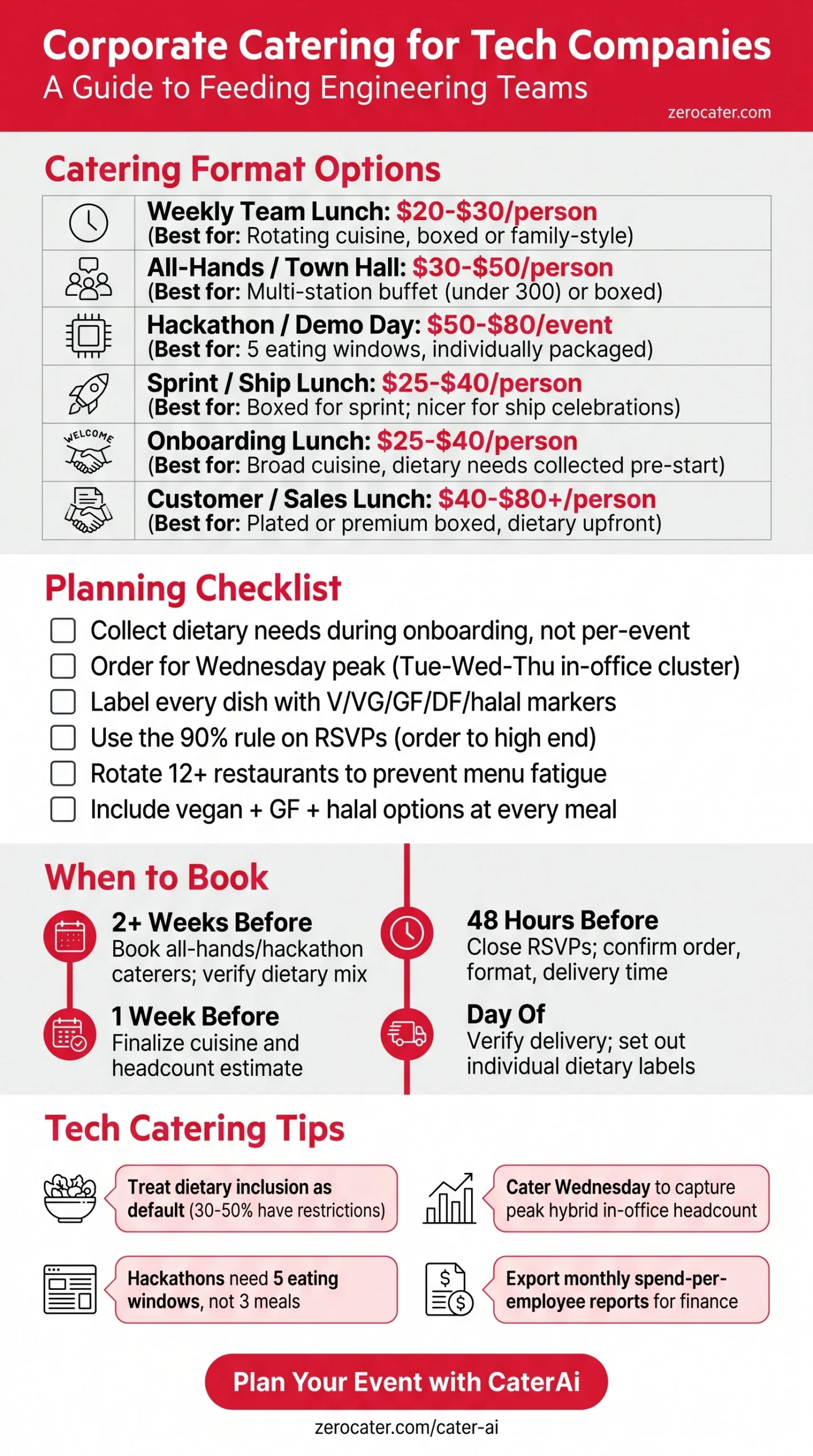
Tech companies cater more meals per employee per year than any other corporate sector, and they cater meals that are uniquely complicated. A typical 200-person engineering org has roughly 40 to 80 people on a vegetarian or vegan diet, 10 to 30 observing halal, kosher, or Hindu-vegetarian restrictions, 6 to 16 managing gluten-related medical needs, and 4 to 10 with multiple severe food allergies. No other industry stacks dietary restrictions this densely. Add in hybrid scheduling that makes Wednesday headcount triple Friday, hackathons that need food at 2am, and recruiting expectations set by FAANG perks, and the catering brief is unrecognizable from what a law firm or finance team orders. This guide covers what to feed engineering teams, how to budget by occasion, and the logistics that distinguish a working tech catering program from one that costs a fortune and still has people Slacking the office manager about the soup.
In This Guide
- Why Tech Companies Cater Differently Than Any Other Industry
- The 6 Occasions Tech Companies Cater For
- Quick Comparison Table
- What to Order: Menu Ideas by Occasion
- The Dietary Stack: Why Tech Has the Highest Restriction Density
- Recurring Programs vs. On-Demand Orders
- The Logistics Tech Companies Get Wrong
- Hybrid Headcount: The RSVP Problem
- Tech-Hub City Guides
- How CaterAi Handles Tech Company Catering
- FAQ
Why Tech Companies Cater Differently Than Any Other Industry
Tech catering looks superficially similar to any other corporate program (lunches, all-hands, events), but five structural differences make the underlying logistics distinct.
1. The dietary stack is denser. Engineering teams are heavily international, heavily health-conscious, and heavily ethics-driven on food choices. The result is dietary overlap unlike any other workspace. A 200-person engineering org will routinely include 40 to 80 vegetarians or vegans, 10 to 30 people observing halal or kosher or Hindu-vegetarian restrictions, 6 to 16 with medical gluten needs, and 4 to 10 with severe allergies. Many people belong to two or three categories at once. Compare this to a typical law firm where vegetarian rates run 8 to 15 percent and dietary restrictions stay below 20 percent overall. Tech catering has to treat dietary inclusion as the default, not the exception. Our guide to ordering for mixed dietary needs is the operational counterpart to this section.
2. Hybrid scheduling creates variable headcount. Most tech companies operate on a Tuesday-Wednesday-Thursday in-office pattern after the 2023 to 2025 return-to-office shift. Wednesday in-office attendance commonly runs 30 to 70 percent higher than Friday. Catering planning that assumes flat headcount loses money on Mondays and runs out of food on Wednesdays. Programs need to flex with the pattern, and our boxed lunch guide for hybrid and distributed teams covers the format adjustments in detail.
3. Recruiting and retention put food in the comp package. Engineering talent compares offers explicitly: equity, base, benefits, and perks. Food consistently ranks in the top three workplace amenities when candidates compare companies. FAANG companies set the bar with daily free meals, and smaller tech companies cannot match that budget, but a well-run Friday lunch program (at roughly $1,500 per employee per year at $30 times 50 Fridays) gives the same recruiting signal at a fraction of the cost. The catering line in the budget is a retention line.
4. Engineering culture treats food as recaptured focus. Pulling a developer off deep work to leave the building for lunch is more expensive than the lunch itself. A senior engineer earning $250,000 fully loaded costs the company about $1.20 per minute of working time. A 45-minute lunch outing costs $54 in pure time. Catering that lets the team eat in 20 minutes and stay in the flow state pays for itself the same day.
5. Sprints, releases, and on-call create predictable spikes. Two-week sprint cadences mean ship lunches every other week. Quarterly release rhythms mean a celebration meal on roughly the same Thursday each quarter. Hackathons happen on predictable schedules. On-call rotations need predictable snack stocking. Unlike industries that cater for random events, tech demand is forecastable, and a good program treats it as a recurring calendar problem, not a series of one-offs.
The 6 Occasions Tech Companies Cater For
1. Weekly Team Lunches and Friday Programs
The default tech catering occasion: a recurring weekly lunch, almost always on Wednesday (peak in-office day) or Friday (cultural anchor). The team eats together, headcount is roughly the same week-to-week, and the program is permanent. This is where the dietary stack matters most, because the same restrictions show up every week and any gap gets noticed fast.
Format: Rotating cuisine weekly. A 12- to 16-restaurant roster keeps repeat frequency low. Mix global cuisines aggressively, with at least one vegan and one gluten-free option clearly labeled at every meal. Either family-style platters or individually portioned (boxed or bowl) formats work, with individual portions edging ahead post-2020 for hygiene preference and waste reduction.
Budget: $20 to $30 per person. This is the highest-frequency line in the budget, so unit cost discipline matters. Over 50 weeks at 100 people, even a $5 per-person reduction saves $25,000 per year.
2. All-Hands Meetings and Town Halls
Monthly or quarterly all-hands gatherings where the whole company assembles for company updates. The meal is part of the social experience: it brings people together before or after the formal presentation. Headcount is large (50 to 500+), service has to be fast, and dietary coverage has to be complete because the whole company is in the room.
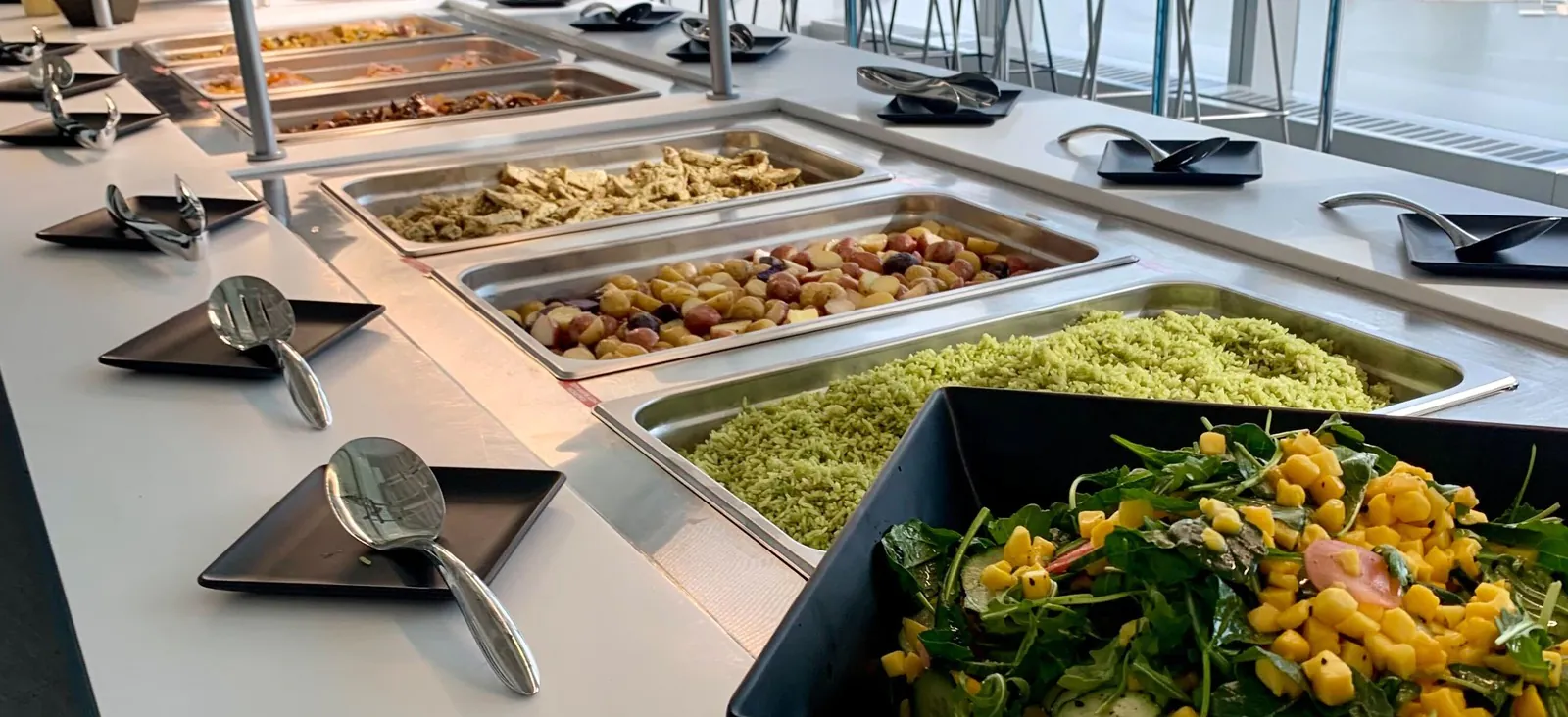
Format: Multi-station buffets for groups of 50 to 300 with two or three parallel cuisines so the line moves. For 300+, switch to individually boxed meals delivered by group to keep the food service from eating the meeting. Always label dishes with dietary markers (V, VG, GF, DF, halal, kosher) at the point of service.
Budget: $30 to $50 per person. The variety required for full-company dietary coverage drives the cost above weekly-lunch level, and the cadence (monthly or quarterly) is low enough that the per-event spend is manageable.
3. Hackathons and Demo Days
The most logistically distinct catering occasion in tech: 24- to 48-hour events where the team is building continuously and needs food at unconventional hours. Hackathons typically run kickoff dinner, late-night snacks, breakfast, lunch, and closing demo dinner across the event window. The eating happens at workstations, not at a sit-down service, so individual packaging is mandatory.
Format: Five eating windows across the event. Kickoff dinner: substantial entrees in a buffet or boxed format. Late-night (10pm to midnight): pizza or sandwiches plus caffeine. Breakfast: breakfast burritos, bagels, or breakfast boxes. Lunch: individually packaged sandwiches or grain bowls. Demo dinner: nicer than the kickoff, often a celebration meal. Stock the room with snacks (granola bars, fruit, chips, candy) continuously across the event.
Budget: $50 to $80 per person across the entire event. Per-meal cost stays around $15 to $20 because casual formats predominate, but the cumulative count adds up.
4. Sprint Kickoffs and Release Parties
The bi-weekly sprint rhythm and quarterly release schedule create natural catering moments. Sprint kickoffs (every two weeks) are working meals where the team aligns on the next iteration. Release parties or ship lunches mark a successful deploy and are part of the engineering culture. Both are smaller (10 to 40 people), team-scoped rather than company-wide.
Format: Sprint kickoffs lean toward working-lunch formats (boxed or sandwich platters) since the team is in planning mode. Ship lunches lean toward celebration formats: a slightly nicer cuisine, real plates if possible, longer time block. Some teams do BBQ ship lunches as a deliberate ritual.
Budget: $25 to $40 per person. Higher than weekly because of the celebratory element, lower than all-hands because the team is smaller.
5. Onboarding and New-Hire Welcome
The first-week meal is a small signal that carries weight. New engineers are forming first impressions, and a thoughtful welcome lunch (especially one that accommodates their dietary needs without their having to ask) lands well. Many tech companies make this a recurring Tuesday or Thursday lunch where the cohort of new hires meets the broader team.
Format: Smaller group (5 to 20 people, depending on hiring volume), often combined with cross-team intro meetings. Boxed meals with broad cuisine variety work well, since the new hires have not declared preferences yet. Survey dietary needs as part of pre-start onboarding so day-one catering is correct without having to ask.
Budget: $25 to $40 per person. The spend is small in absolute terms but the perception value is high.
6. Customer Visits, Partner Demos, and Sales Lunches
When a customer comes on-site for a roadmap review, a partner team visits for a technical integration, or sales hosts an executive lunch, the catering is part of the impression. This is the closest tech analog to the law-firm-client-meeting use case: a higher-touch, presentation-quality meal where dietary preferences should be collected in advance from the visiting group.
Format: Plated or premium boxed lunches with upscale cuisine. Mediterranean, Japanese sushi assortments, Indian thalis, or chef-composed grain bowls work well. Real plates or high-quality disposables, branded napkins if available, sparkling water on the table.
Budget: $40 to $80+ per person. The ROI on a customer renewal or a partner integration is straightforward, and the catering is a small fraction of the meeting’s value.
Quick Comparison Table
| Occasion | Format | Budget/Person | Cadence | Dietary Complexity |
|---|---|---|---|---|
| Weekly team lunch | Rotating cuisine, boxed or family-style | $20 – $30 | Weekly | High (recurring audience) |
| All-hands / town hall | Multi-station buffet (under 300) or boxed (300+) | $30 – $50 | Monthly / quarterly | Very high (full company) |
| Hackathon / demo day | 5 eating windows, individually packaged | $50 – $80 (all in) | Quarterly / ad hoc | High |
| Sprint kickoff / ship lunch | Boxed or sandwich platters; nicer for ship | $25 – $40 | Bi-weekly / quarterly | Medium (team scoped) |
| Onboarding lunch | Boxed, broad cuisine variety | $25 – $40 | Per hiring cohort | Medium |
| Customer / sales lunch | Plated or premium boxed | $40 – $80+ | Ad hoc | High (collect in advance) |
What to Order: Menu Ideas by Occasion
Weekly Team Lunches: 12-Week Cuisine Rotation
A representative rotation that hits the major cuisines without repeating. Adjust for your roster.
- Week 1: Mediterranean bowls (chicken or falafel, hummus, tabbouleh)
- Week 2: Mexican burrito or taco bar with vegan and gluten-free proteins
- Week 3: Japanese sushi and poke assortment
- Week 4: Indian thali (vegetarian-default; the dietary stack favors this)
- Week 5: Italian pasta bar with gluten-free option
- Week 6: Korean bibimbap or Korean BBQ build-your-own
- Week 7: Vietnamese banh mi or pho station
- Week 8: Thai curry bowls and pad thai
- Week 9: Chinese family-style with multiple proteins
- Week 10: BBQ with vegetarian sides
- Week 11: Build-your-own salad and grain bowl bar
- Week 12: Breakfast-for-lunch or a local favorite to close the rotation
All-Hands and Town Halls
- Three-station buffet: Mediterranean station, Asian station, sandwich/wrap station, each with vegan and GF entrees
- Build-your-own bowl bar: grains, proteins (including tofu and beans), vegetables, sauces, garnishes
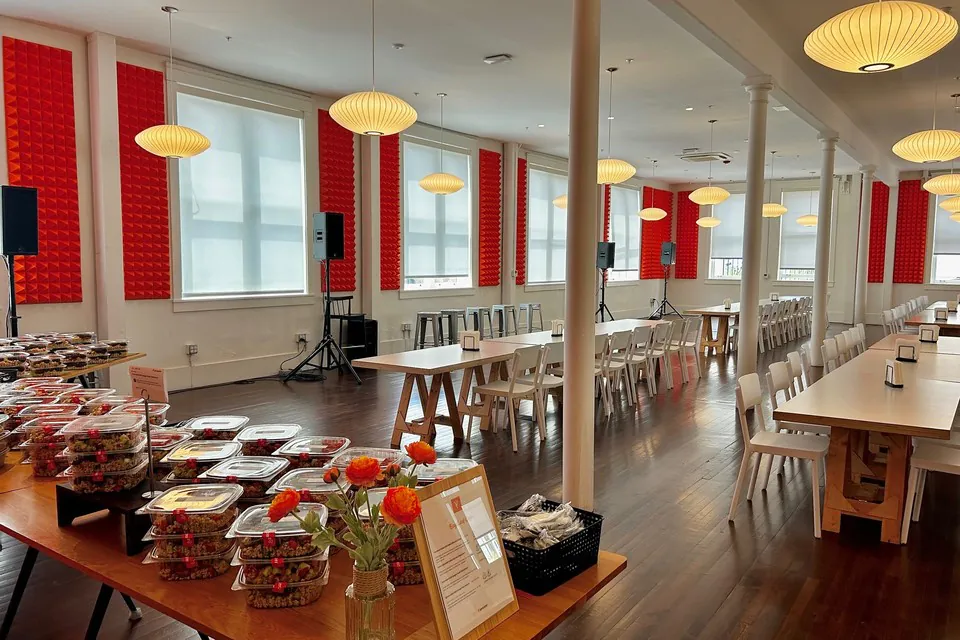
- Boxed-meal-by-diet (for 300+): pre-sorted boxes labeled regular, vegan, gluten-free, halal, kosher
- Reception-style mezze and grazing tables for after-hours all-hands or company celebrations
For dietary-segmented boxed meals at scale, see our guide to allergy-safe boxed lunches.
Hackathon Eating Windows
- Kickoff dinner (6pm): hot buffet, pasta or curry bar, salads, soft drinks
- Late-night (10pm to midnight): pizza variety pack, cookies, energy drinks, fresh fruit
- Breakfast (7-8am): breakfast burritos, bagel and shmear, parfait cups, coffee
- Lunch (12pm): boxed sandwiches or grain bowls, chips, dessert, sparkling water
- Demo dinner (closing): upgraded cuisine (BBQ, Mediterranean grill, or sushi), the celebration meal
- Ambient snacks: granola bars, trail mix, fresh fruit, chips, candy refilled twice per day
Customer and Sales Lunches
- Plated Mediterranean: grilled protein, hummus, tabbouleh, warm pita, dessert plate
- Sushi chef’s selection: premium rolls, nigiri, edamame, miso soup, mochi
- Composed grain bowls: individually plated, restaurant-quality, with a vegan and a fish option
- Upscale boxed lunches: grilled salmon or steak, seasonal vegetables, artisan bread, real flatware
Browse Japanese, Mediterranean, and Italian catering on Zerocater.
The Dietary Stack: Why Tech Has the Highest Restriction Density
The single most consequential thing to understand about tech catering is that dietary inclusion has to be designed in, not added on. Three structural reasons:
International hiring. The H-1B, OPT, and remote-global hiring patterns common in engineering recruiting bring in workers from India (Hindu vegetarian, Jain, halal observers), the Middle East and North Africa (halal), Israel (kosher), East and Southeast Asia (varied), and elsewhere. A team that pulled half its hires from any of these populations will have a meaningfully different dietary mix than a U.S.-domestic average.
Ethics-driven plant-based adoption. Vegetarianism and veganism are more common among college-educated adults under 40 in tech metros than in the U.S. broadly. Surveys consistently put tech-worker vegetarianism at 20 to 35 percent and veganism at 5 to 12 percent, versus 5 to 8 percent and 1 to 3 percent nationally.
Allergy awareness and disclosure. Younger workers are more likely to disclose food allergies and intolerances than older generations. This means tech rosters get the truer underlying rate rather than the older “I’ll just eat around it” pattern. Gluten, dairy, tree nuts, peanuts, and shellfish are the most common.
The dietary inclusion floor for tech catering
At every meal, regardless of size, include at minimum: one vegan entree, one gluten-free entree, one nut-free entree, and clear labeling for any dish containing dairy, eggs, soy, or wheat. For all-hands and customer-facing events, add explicit halal and kosher options. Print dietary markers on individual labels, not just on a separate sign at the buffet.
Build a company-wide dietary profile. Collect dietary needs once during onboarding, store them in your HR system or catering platform, and reference the data for every order. Asking per-event is unsustainable at tech-scale. Our vegan office catering guide and gluten-free office catering guide cover the format specifics for the two most common restrictions.
Halal and kosher coverage. Halal is the more commonly observed of the two in tech workforces (driven by Muslim engineering hires from India, MENA, and Southeast Asia). Halal certification for catering is widely available in major metros and adds modest cost. Kosher catering is rarer but matters in NYC, Boston, and parts of the Bay Area; kosher-certified vendors typically need 5 to 7 days of lead time and a meaningful price premium. Plan ahead.
Recurring Programs vs. On-Demand Orders
The right operating model depends on cadence.
Managed recurring programs are the standard for tech companies that cater weekly or more often. A platform like Zerocater’s managed catering program handles vendor roster management, dietary tracking, cuisine rotation, headcount adjustment, and scheduling. The office manager (or People Ops lead) does not have to rebuild the process from scratch every week, and the program scales as headcount grows.
On-demand ordering covers the ad-hoc events: hackathons, customer visits, ship lunches, all-hands. CaterAi lets you describe what you need (“75 people, vegan and GF coverage, lunch by noon Thursday, $30 budget”) and builds a custom menu from over 1,000 restaurants. Useful for the long tail of one-off occasions.
The hybrid approach is most common. Mid-stage tech companies (50 to 500 people) typically run both: a managed weekly program for the Wednesday or Friday recurring lunch, with on-demand ordering for everything else. The platform consolidates billing and reporting so the People Ops team has one dashboard. See how the platform works.
Plan office lunch catering with CaterAi
The Logistics Tech Companies Get Wrong
The #1 mistake: treating dietary inclusion as an afterthought
The most common failure is ordering a “normal” menu and adding one vegan tray as a courtesy. With dietary restrictions running 30 to 50 percent at typical tech companies, this leaves the most-restricted half of the team with one option while everyone else has six. The fix is to design every meal around the dietary stack from the start, treating restrictions as the default rather than the exception.
- Over-ordering on light days, under-ordering on heavy days. Hybrid scheduling means Wednesday in-office can be 70 percent higher than Monday. Catering programs that assume flat headcount waste food half the week and run short on the other half. Build the rotation around the actual headcount curve.
- Ignoring the 90-percent rule on RSVPs. Tech employees RSVP late and incompletely. Treat the RSVP count as a floor, not a ceiling: order for 105 to 110 percent of the count, except when individual boxed formats force exact counts. Accept the 5 to 10 percent leftover cost as the price of not running out.
- Not labeling dishes individually. A single sign at the buffet does not work when 30 percent of the team has dietary needs. Tent cards or printed labels on each dish (V, VG, GF, DF, contains nuts) eliminate the constant Slack pings to the office manager.
- Same-restaurant fatigue. Weekly programs that repeat restaurants within four weeks lose perceived quality fast. The complaint that “the food got bad” almost always means “the variety got bad.” Hold to a 12+ restaurant rotation.
- Treating hackathon catering like normal catering. Hackathons need food at hours when most caterers do not deliver, and the format has to support eating at a workstation. Lock in a hackathon-specific vendor list separately, not the same roster used for weekly lunches.
- No spend visibility for finance. Tech CFOs scrutinize perks line items after 2023. A program that cannot produce a clean monthly report on spend, headcount served, and cost per employee gets cut. Choose a platform that exports the data finance needs.
Hybrid Headcount: The RSVP Problem
The single hardest operational problem in tech catering after 2023 is RSVP accuracy in a hybrid environment.
The pattern. Most tech companies cluster in-office days on Tuesday, Wednesday, and Thursday. Wednesday is the peak day at most companies, with 30 to 70 percent more people in the office than Monday or Friday. The variance is not just week-to-week; it is event-to-event. A team offsite, a holiday, a deadline push, or a weather day can move actual attendance by 20 percent from the RSVP count.
What works. Three operational rules cover most cases.
- Cater on Wednesday by default. If a company catering program runs only once per week, Wednesday captures the peak headcount and gets the highest perceived value. Friday is the cultural anchor at many companies but in-office attendance has declined; Wednesday is the operational anchor.
- Use the 90-percent rule on RSVPs. Order for 90 to 100 percent of the RSVP count for boxed individual formats (where exact count is unavoidable) and 105 to 115 percent for buffet formats (where slack is cheap). The remaining waste is the cost of not running out, which is worse for morale.
- Close the RSVP window 48 hours out. Late additions cause more problems than they solve. A hard cutoff lets the caterer prep accurately and gives the office manager planning certainty. The exception is on-call rotations and customer visits where late additions are unavoidable; build a small buffer for those.
Distributed and fully-remote teams. When the team is not co-located, the catering pivot is to meal stipends or boxed delivery to home addresses for synchronous events. Our boxed lunches for hybrid and distributed teams guide covers the operational pattern for this in detail. For the format comparison between boxed and buffet, see boxed lunch vs. buffet.
Tech-Hub City Guides
The major tech metros have different catering landscapes. Cost, cuisine breadth, and vendor density vary. Below are city-specific catering guides and starter vendor lists for the metros with the highest tech employer concentration:
By City
- San Francisco / Bay Area: La Mediterranee, Kawashima’s Kitchen, Kitava (allergy-friendly) | SF catering guide | SF cost guide
- New York City: A Saffron Thread (Indian), 251 Ginza Sushi (premium sushi), Souvlaki GR (Greek/Mediterranean) | NYC catering guide | NYC cost guide
- Seattle: tech hub for Amazon, Microsoft, and a deep cloud-services bench | Seattle catering guide
- Austin: strong cluster of mid-stage SaaS and infrastructure companies, BBQ and Tex-Mex catering cultures | Austin catering guide
- Boston / Cambridge: heavy in biotech-and-engineering hybrid teams, Kendall Square cluster | Boston catering guide
- Chicago: trading-tech, healthtech, and Loop-area enterprise software | Chicago catering guide | Chicago cost guide
- Denver / Boulder: growing remote-and-hybrid hub, lighter density but real demand | Denver catering guide
- Los Angeles: Snap, SpaceX, and a fast-growing creator-tech cluster | LA cost guide
- Washington D.C.: govtech, defense-tech, and the AWS GovCloud anchor | D.C. catering guide
Browse Japanese, Indian, Mediterranean, Korean, and Vietnamese catering directories to find the right vendors for your office.
How CaterAi Handles Tech Company Catering
CaterAi is Zerocater’s AI-powered planning tool, and it solves the specific catering problems tech companies hit at scale.
Dietary profiles at the team level. Add each engineer’s dietary needs once during onboarding (or import from your HR system). Every subsequent order automatically respects the stack: no one has to re-declare, no one ends up with a single sad vegan tray, and the office manager does not have to maintain a spreadsheet.
Variety enforcement. CaterAi tracks what your team has eaten over the past four to twelve weeks and surfaces options the team has not seen recently. The chronic problem of “we keep getting the same restaurant” disappears.
Headcount and RSVP handling. Integrations with calendar tools and Slack let CaterAi flex orders against actual attendance. For all-hands and recurring lunches, the headcount can adjust automatically up to a defined cutoff.
One platform for every occasion. Whether it is a $25-per-person Wednesday lunch or an $80-per-person customer demo dinner, recurring programs and event catering run through the same system. People Ops has one dashboard, Finance has one report, and the office manager has one place to track everything.
Spend reporting for finance. Monthly exports break down spend by event type, headcount, dietary mix, and cost per employee. The CFO conversation gets simpler.
Plan office lunch catering with CaterAi
Frequently Asked Questions
How much does tech-company catering cost per person?
Tech catering ranges from $18 to $80 or more per person depending on the occasion. Weekly team lunches and Friday programs run $20 to $30, hackathon meals run $18 to $25 across the day, sprint kickoffs and ship lunches run $25 to $40, all-hands and town halls run $30 to $50, and customer-facing demos or executive meetings start at $40 and reach $80 or more. Add 20 to 25 percent for delivery, tax, and gratuity.
What dietary restrictions are most common at tech companies?
Engineering teams typically run 25 to 40 percent vegetarian or vegan, 5 to 15 percent halal or kosher or Hindu vegetarian, 3 to 8 percent gluten-free for medical reasons, and 2 to 5 percent with multiple food allergies. The overlap is the highest of any white-collar industry. See our mixed dietary needs guide for the full operational playbook.
How do you feed a hackathon?
Plan five eating windows across a 24- or 36-hour event: kickoff dinner, late-night snacks around 11pm, breakfast, lunch, and a closing demo dinner. Use different formats for each window so the team does not feel like they are eating the same thing repeatedly. Lean on individually packaged foods so people can eat at their workstation. Budget $50 to $80 per person across the entire event.
Should a tech company offer a Friday lunch program?
Friday lunch programs are a high-leverage perk because the cost per employee per year is low (about $1,500 at $30 per person times 50 Fridays) compared to recruiting and retention costs. The key is variety: rotate cuisines weekly and never repeat the same restaurant within four weeks. Many companies have shifted the recurring lunch to Wednesday post-2023 to align with peak in-office days; see the hybrid headcount section above.
How do you handle variable headcount with hybrid teams?
Order to the maximum reasonable headcount on heavy in-office days (typically Tuesday, Wednesday, Thursday) and use a 90-percent rule on RSVPs: if 50 people RSVP, order for 45 to 50 and accept a 10-percent leftover cost as the price of not running out. Use individually packaged formats so leftovers can be claimed the next day. Our boxed lunches for hybrid teams guide covers the format adjustments.
What is the best catering format for an all-hands meeting?
For all-hands of 50 to 300 people, multi-station buffets with two or three cuisines work best. Set up three parallel stations to keep the line moving, label every dish with dietary markers, and include at least one vegan and one gluten-free entree per station. For all-hands of 300 or more, switch to individually boxed meals delivered by group so the food service does not eat half the meeting. See our format comparison for the trade-offs.
How should tech companies handle catering for hybrid in-office days?
Most tech companies cluster in-office days on Tuesday, Wednesday, and Thursday, with attendance 30 to 70 percent higher than Monday or Friday. Build the catering rhythm around this: a weekly recurring lunch on Wednesday captures peak attendance, and the second day (Tuesday or Thursday) can be a lighter snack or coffee program. Avoid catering on Mondays and Fridays unless a specific event requires it.
Is corporate catering tax-deductible for tech companies?
In the United States, business meals provided to employees are generally 50 percent deductible. Office snacks and meals provided for the employer’s convenience (working through lunch, all-hands, on-site events) qualify under IRS Section 274. Confirm with a tax advisor for specifics.