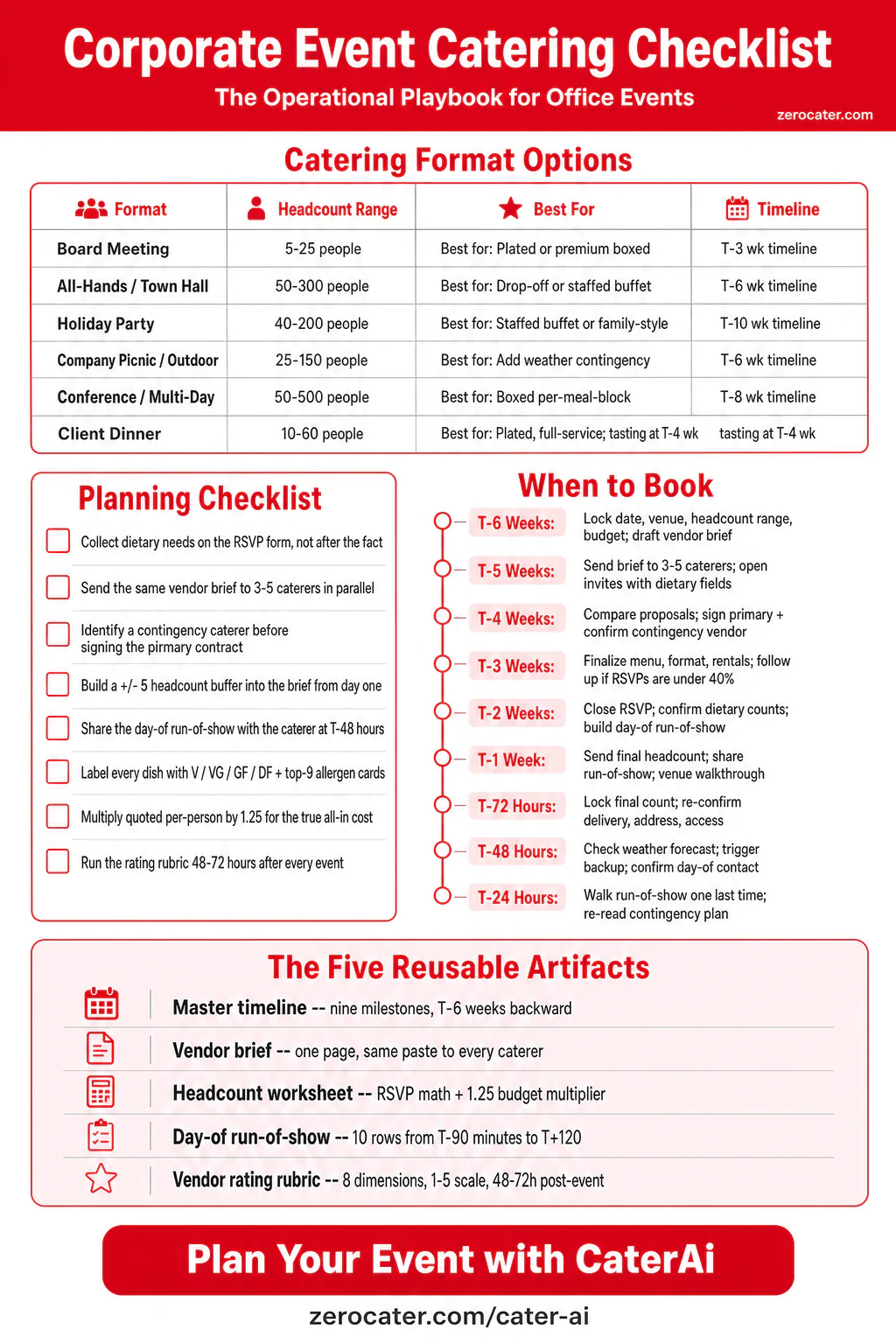
Corporate event catering is the operational layer that turns a date on a calendar into a meal on a table. When it works, no one notices. When it fails, you spend the next two weeks rebuilding trust with the team that didn’t get fed and the executive whose client dinner went cold. The difference between the two outcomes is almost always a checklist. Not vibes, not vendor loyalty, not “we always use that caterer.” A checklist.
This guide hands you that checklist as five reusable artifacts: a master pre-event timeline that starts six weeks out and ends the morning of service; a one-page vendor brief you paste into every RFP; a day-of run-of-show that maps 90 minutes pre-service through cleanup; a contingency rubric for the four failure modes that actually happen (weather, no-shows, late vendor, dietary surprises); and a post-event rating rubric that decides which caterers stay in rotation. The system works for board meetings, holiday parties, picnics, all-hands, conferences, and client dinners. Adapt the layers, keep the structure.
In This Guide
- When You Need This Checklist (And When You Don’t)
- The Master Timeline: T-6 Weeks to T-1 Day
- The Vendor Brief Template
- Headcount & Dietary Math
- The Day-of Run-of-Show
- Contingency Plans for the Four Failure Modes
- The Post-Event Vendor Rating Rubric
- Adapting the Checklist by Event Type
- Common Mistakes the Checklist Catches
- Tools & Templates
- FAQ
When You Need This Checklist (And When You Don’t)
The checklist exists for events where a failure has consequences. The threshold is roughly: more than 25 people, more than $1,000 in spend, or a senior stakeholder in the room. Below that line, the team-lunch reflex (text the usual vendor, confirm the address, expect a delivery) is fine. Above it, the gap between “it’ll be great” and “the chafers ran out at 12:20 and 40 people went hungry” is filled by process, not luck.
Use the checklist for:
- All-hands and town halls with 50+ attendees
- Board meetings, executive offsites, and partner-facing events
- Holiday parties, anniversaries, and milestone celebrations
- Company picnics, summer offsites, and outdoor activations
- Client dinners and customer-facing receptions
- Multi-day conferences and training programs
- Any event where you are working with a caterer for the first time
Skip the checklist for:
- Recurring weekly team lunches where the caterer is on autopilot
- One-off small-team meetings under 15 people
- Pickup orders where you control delivery and setup yourself
Most office managers and event planners run 4-12 checklist-grade events a year. The checklist pays for itself the first time it prevents a single failure.
The Master Timeline: T-6 Weeks to T-1 Day
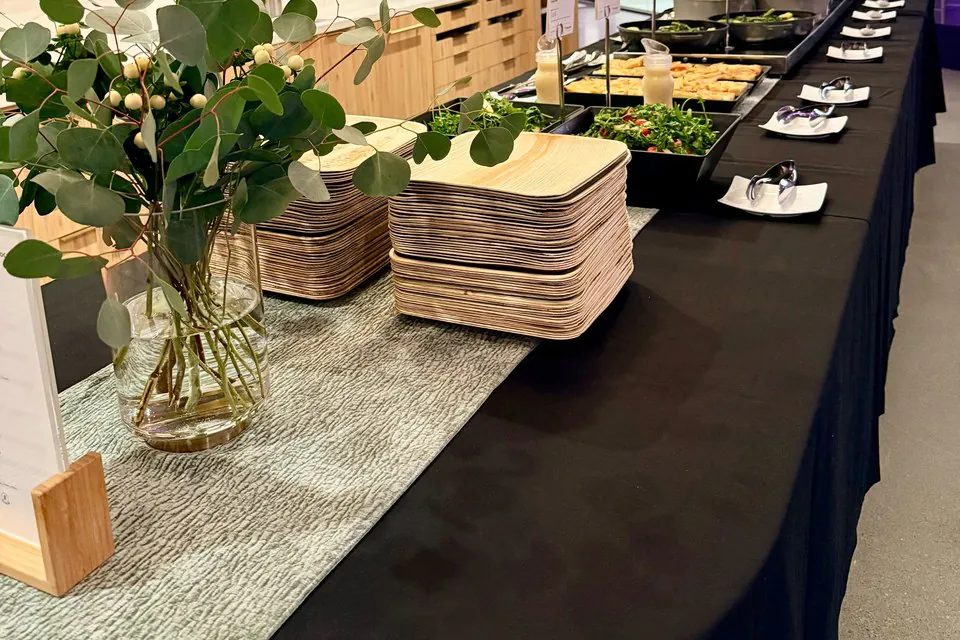
Every successful corporate event runs against a timeline that starts six weeks out. The exact lead times shift with event size, but the sequence is consistent. Anchor your planning to this table and adjust the dates rather than the sequence.
| When | What | Who Owns It |
|---|---|---|
| T-6 Weeks | Lock the date, venue, expected headcount range, and budget envelope. Build the invite list. Draft the vendor brief. | Event owner |
| T-5 Weeks | Send the vendor brief to 3-5 caterers. Schedule 30-minute calls or tastings. Send invites with RSVP and dietary fields. Confirm venue access (loading dock, freight elevator, parking). | Event owner |
| T-4 Weeks | Compare proposals on a single line-item spreadsheet. Pick primary caterer. Identify and confirm contingency caterer. Sign contracts and pay deposits. | Event owner + finance |
| T-3 Weeks | Finalize menu, service format, and equipment list. Confirm rentals (linen, chafers, glassware, tents for outdoor) with rental vendor. Send save-the-date follow-up if RSVP rate is under 40%. | Event owner |
| T-2 Weeks | Close primary RSVP window. Tally dietary needs and confirm with caterer. Confirm staffing levels (servers, bartenders, chef attendants). Build the day-of run-of-show. Confirm weather backup plan for outdoor events. | Event owner |
| T-1 Week | Send final headcount (+/- 5 buffer locked). Share the run-of-show with caterer. Confirm day-of point-of-contact on both sides. Run a final walkthrough at the venue. Print signage, name cards, and dietary labels. | Event owner + caterer |
| T-72 Hours | Final headcount lock. Re-confirm delivery window, address, and access. Confirm contingency vendor is on standby. Charge the deposit balance per contract. | Event owner |
| T-48 Hours | Confirm weather forecast for outdoor or hybrid events. Trigger backup plan if forecast shows rain, wind over 20 mph, or temps outside 50-90 deg F. Send a one-line confirmation text to the caterer day-of contact. | Event owner |
| T-24 Hours | Verify chargers, AV, and any non-catering rentals are confirmed. Walk the run-of-show one last time. Re-read the contingency plan. Set the meeting / pre-event checklist on your calendar for T-2 hours next morning. | Event owner |
For events under 50 people, you can compress this timeline to T-3 weeks. For events over 200 people, expand it to T-10 weeks. The sequence stays the same; only the date column changes.
If you are running this kind of timeline for the first time, also read the foundational Office Manager’s Guide to Ordering Catering: it covers the upstream inputs (budget, vendor selection, recurring vs one-off) that feed this checklist.
The Vendor Brief Template
The biggest single time-saver in event catering is sending the same brief to every caterer in the same format. It eliminates four days of back-and-forth on the front end, makes proposal comparison a 15-minute spreadsheet exercise, and protects against the “well, you didn’t mention” disputes that surface at T-24.
Paste this directly into your first email to any new caterer:
1. Event basics
• Event name and type: [e.g. Q4 All-Hands Lunch]
• Date: [YYYY-MM-DD]
• Service window: [12:00 doors open, 13:30 service ends]
• Delivery window: [10:30-11:00 arrival, 14:00 fully out]
• Address: [Street, floor, suite]
• Loading access: [loading dock + freight elevator | street + walk-up | other]
• Parking: [validated garage | metered street | no on-site]
2. Headcount
• Confirmed range: [85-95 attendees]
• Lock date for final count: [T-72 hours]
• Tolerance for adjustment: [+/- 10 up to 48 hours out]
3. Service format
• Preferred: [boxed | drop-off buffet | staffed buffet | family-style | plated]
• Staffing needs: [0 staff | 1 attendant | 2 servers + 1 chef | full team]
• Equipment we supply: [tables, ice, beverages, serviceware]
• Equipment we need from you: [chafers, linen, serving utensils, plates, cups]
4. Menu
• Cuisine preference: [open | American | Mediterranean | Italian | etc.]
• Must-include dishes: [if any]
• Must-exclude: [pork, shellfish, anything with peanuts]
• Dietary breakdown by headcount: [70 standard | 8 vegetarian | 5 vegan | 4 gluten-free | 3 dairy-free]
• Major-allergen flagging required: [yes]
5. Budget
• Target per-person, all-in: [$X]
• Total budget ceiling: [$X,XXX]
• What is included in “all-in”: [food, service charge, delivery, tax, rentals, gratuity]
6. Day-of contact
• Our point-of-contact: [Name, mobile, email]
• Your day-of contact required: [Name, mobile required, on-site arrival contact]
7. Three must-haves
• [Individual dietary labels on every dish]
• [Hot food held above 140 deg F through 13:30]
• [Cleanup complete and out by 14:00]
8. Proposal due
• [T-4 Weeks date]
• Format requested: line-item per-person cost, service charge, delivery, tax, total
• Reply with: confirmed availability, sample menus at the budget level, two references for similar-size events
Send this to 3-5 caterers in parallel, not in sequence. The fastest responders are usually the best-organized operations.
Headcount & Dietary Math
Headcount math is where over-ordering and under-ordering both originate. Buffets without good math waste 15-20% of food cost. Boxed lunches without good math leave 5-10 people without a meal. The formula handles both.
The Three RSVP Rules
- The 90% rule. For mandatory events with confirmed RSVPs, order for 90% of “yes” responses plus 10% for walk-ins. Net: roughly 100% of confirmed yeses. For optional events, drop to 70-80% of yeses.
- The +/- 5 buffer. Build a tolerance of +/- 5 attendees into the vendor brief from day one. This lets you adjust at T-48 without renegotiating the contract.
- The over-order pivot. Order to the high end for boxed (exact-portion formats) and to the middle for buffets (which have 10-15% portion overage built in).
The Dietary Headcount Worksheet
Run this every event:
| Category | Typical Office % | Tech / Coastal Skew | Notes |
|---|---|---|---|
| Vegetarian | 8-12% | 15-22% | Always offer at least 2 vegetarian mains |
| Vegan | 3-5% | 6-10% | One dedicated vegan main and two sides |
| Gluten-free | 5-8% | 8-12% | Separate utensils to avoid cross-contamination |
| Dairy-free | 5-8% | 8-15% | Watch hidden butter, cream, parmesan in sauces |
| Halal | 3-6% | 8-15% | Higher in tech, finance, and large coastal metros |
| Kosher | 1-3% | 3-8% (NYC, LA, Chicago) | Sealed, individually packaged kosher boxes |
| Major-allergen-free | 2-4% | 3-6% | Peanuts, tree nuts, shellfish: dedicated boxes |
For deeper coverage on the dietary side, see How to Order Catering for Mixed Dietary Needs, Vegan Office Catering, Gluten-Free Office Catering, and Allergy-Safe Boxed Lunches. Each goes deep on the dietary mechanics this guide can only summarize.
The Quick-Budget Formula
For total event spend, use:
Total = (Headcount × Per-Person Quoted Price) × 1.25
The 1.25 multiplier covers service charge, delivery, tax, and tip on top of food. For premium plated events with 22%+ service charges, use 1.30-1.35.
Example: 80-person staffed buffet at $48/person quoted = 80 × $48 × 1.25 = $4,800 all-in. Plug this number into your budget envelope before signing the contract.
Plan corporate event catering with CaterAi
The Day-of Run-of-Show
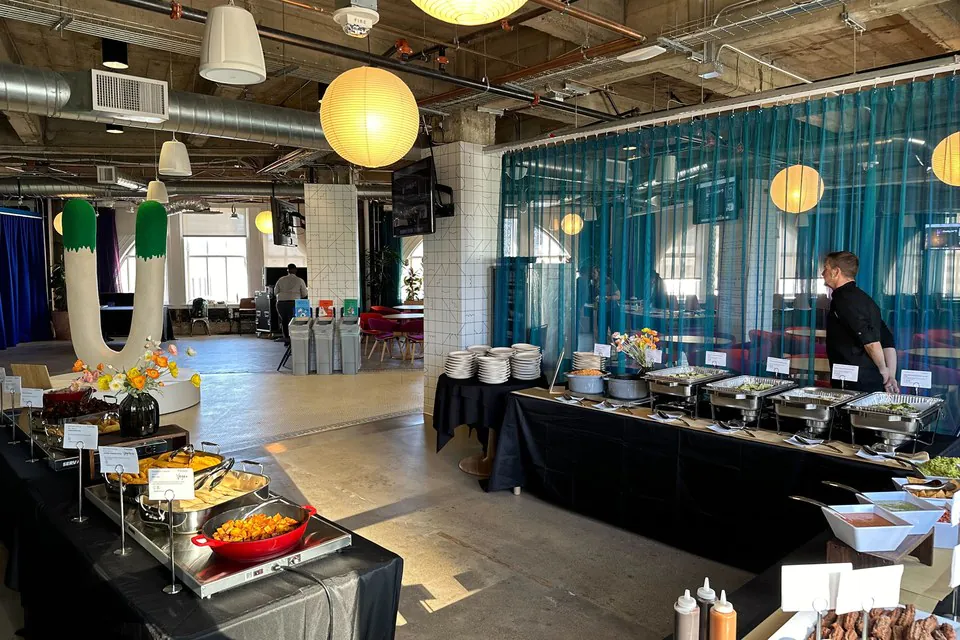
The run-of-show is the minute-by-minute schedule for the day-of. Share it with the caterer 48 hours ahead. Anything off-schedule by more than 15 minutes is the trigger to call the day-of point-of-contact.
Standard Lunch Run-of-Show (Doors at 12:00)
| Time | What Happens | Trigger if Late |
|---|---|---|
| T-90 (10:30) | Caterer arrives and stages in loading area | 11:00 = call day-of contact |
| T-60 (11:00) | Hot food on the line, chafers fired, sterno tested | 11:20 = escalate to caterer manager |
| T-45 (11:15) | Dietary labels placed, serviceware staged, beverage station up | 11:35 = activate contingency if no progress |
| T-30 (11:30) | Final walkthrough with caterer lead. Confirm all labels, hot temps, dietary stations | 11:45 = call manager, prepare announcement |
| T-15 (11:45) | Point-of-contact at door / lobby. Final email blast to attendees | 11:55 = decide on delay announcement |
| T-0 (12:00) | Doors open. Service begins. Chef attendant in place | N/A |
| T+30 (12:30) | First chafer level check. Replenish hot proteins | N/A |
| T+45 (12:45) | Second chafer check. Bring out dessert station | N/A |
| T+90 (13:30) | Service window ends. Caterer begins cleanup | N/A |
| T+120 (14:00) | Caterer fully out. Quick venue walkthrough. Sign delivery slip | 14:30 = contract-overage trigger |
Adapt the times for evening events, breakfast meetings, and conference all-day formats by shifting the T-0 anchor; the relative spacing stays the same. For breakfast service at 8:00 AM, set T-90 at 6:30 AM. For an evening reception at 5:30 PM, set T-90 at 4:00 PM. The +30 and +45 chafer checks always happen, regardless of the meal.
Contingency Plans for the Four Failure Modes
In a decade of corporate catering, the same four things go wrong: the weather changes, attendees no-show, the vendor is late or cancels, and a surprise dietary need shows up at the door. Plan for each before the day-of.
Failure Mode 1: Weather
Applies to outdoor events, hybrid indoor-outdoor, and venues with rooftop or terrace components. Trigger forecast at T-72.
- Rain probability over 40%: activate tent rental. Most rental vendors need 48 hours notice.
- Wind over 20 mph: swap open chafing dishes for covered, cancel cocktail-style standing receptions, and prepare to relocate to an indoor backup.
- Temperatures outside 50-90 deg F: outdoor service shifts to indoor or a covered space. Hot food held longer than 30 minutes in temps over 90 deg F is a food-safety risk.
- Severe weather (snow, ice, advisories): postpone or relocate. Plan the call by T-48 at the latest.
For outdoor events specifically, the Company Picnic & Outdoor Office Catering guide covers the rentals, equipment, and packaging mechanics in depth. Use this checklist for the operational layer; use that guide for the outdoor-specific food choices.
Failure Mode 2: No-Shows and Variance
Confirmed RSVPs do not equal day-of attendance. Standard variance is +/- 8-12% on the no-show side. Build the buffer in from the brief; never order to exact RSVP count for any event larger than 30 people.
- Mandatory events: 90-95% of confirmed yes count will show up
- Optional events: 70-85% of confirmed yes count will show up
- Walk-ins: 2-8% additional, especially on free-food events with public RSVP
If you over-order: arrange a donation route in advance (employee fridge, a local food bank with pre-arranged drop-off, the building’s overnight cleaning crew). If you under-order: have a 30-minute pickup option mapped (boxed lunches from a nearby vendor with reliable lead time).
Failure Mode 3: Vendor Late or No-Show
The single highest-stakes failure. Build a contingency vendor into your initial selection process. The contingency vendor needs three properties:
- Can stage 50-75 boxed lunches or a drop-off buffet within 90 minutes
- Has been used by your team or someone in your network in the last 12 months
- Is on a delivery platform that accepts mobile payment
Trigger the contingency the moment the primary vendor misses the T-60 (hot food on line) mark with no clear path to recovery. Do not wait until T-15; the contingency needs the same 60-90 minutes to arrive.
If the primary vendor cancels at T-24 or earlier, you have time to repurpose the contingency as the new primary. Renegotiate, recover, and rate the original down in your post-event rubric.
Failure Mode 4: Dietary Surprise at the Door
Someone shows up with a dietary need that was not collected on the RSVP. Most common: a vegetarian who skipped the form, a gluten-free attendee who joined the team last week, a guest brought by an executive that nobody knew about.
- Build a 5% buffer of dietary-flexible options at every event (vegan + GF + dairy-free crossover dishes)
- Have one labeled “universal” option: a hummus + crudite + grain salad that works for vegan, GF, DF, and most halal preferences
- Keep a pickup-ready fallback list: 2-3 nearby vendors that can deliver an individual meal in under 45 minutes
For events where dietary mix is the central planning challenge (multi-team events, customer-facing functions, off-sites with guests), the Allergy-Safe Boxed Lunches playbook on individual packaging is the cleanest format. It eliminates buffet cross-contamination and lets you label every box.
The Post-Event Vendor Rating Rubric
The rubric runs 48-72 hours after the event. Score on a 1-5 scale across eight dimensions. Add a one-line note for each. Keep the scoresheet in a shared doc; over a year you build a vendor leaderboard that’s worth more than any third-party review.
| Dimension | What 5/5 Looks Like | What 1/5 Looks Like |
|---|---|---|
| Communication | Replies under 4 business hours; sends T-48 confirmation unprompted | Missing replies; T-24 changes; no day-of contact provided |
| On-time arrival | Arrives at T-90; staged and ready by T-60 | Arrives within 15 min of T-0; chafers not lit at service start |
| Food quality | Hot food hot, cold food cold, presentation matches proposal | Temp issues, dishes missing from menu, presentation off |
| Dietary accuracy | Every dish labeled with V/VG/GF/DF; ingredient cards present | Labels missing or wrong; cross-contamination risk |
| Staff professionalism | Uniform, friendly, proactive replenishment, clean | Disengaged, slow, sloppy, leaves stations unattended |
| Quantity / waste | 10-15% surplus, no runouts | Runouts before T+30, or 40%+ surplus |
| Cleanup | Out by contracted exit time; venue spotless | Late departure; trash or stains left behind |
| Billing | Final invoice matches contract; no surprise line items | Unexpected charges; missing line items; weeks-late invoicing |
Total score 32-40: keep in rotation as a preferred vendor. 24-31: re-use with explicit feedback on the gap. 16-23: use only as a backup. Under 16: remove from the roster.
Adapting the Checklist by Event Type

The five artifacts (timeline, vendor brief, headcount math, run-of-show, rating rubric) work across event types. The adaptations are about which layer to emphasize:
Board Meetings (5-25 People)
Compress the timeline to T-3 weeks. Emphasize the vendor brief’s three must-haves: presentation, on-time delivery, and one extra dietary option beyond confirmed RSVP. Use a plated, family-style, or premium boxed format; never buffet for a board meeting under 25 people. Read the bucket-specific guide: Board Meeting Catering.
All-Hands and Town Halls (50-300 People)
Full T-6-week timeline. Emphasize the run-of-show; with 100+ people, every minute of chafer-replenish slippage means a runout at one end of the line. Choose drop-off or staffed buffet at 100+, multi-station buffet at 300+. For tech-heavy or distributed teams, see Corporate Catering for Tech Companies for the in-office cluster patterns that determine when to schedule.
Holiday Parties (40-200 People)
Full T-6-week timeline, often pushed to T-10 weeks because December calendars saturate fast. Emphasize the vendor brief’s dietary breakdown and the run-of-show’s alcohol service window. Staffed buffet or family-style is the standard format; reception-style with passed appetizers for cocktail formats. The Holiday Party Catering Planning guide breaks down the booking timeline, alcohol decision framework, and budget tiers from $25 to $150 per person.
Company Picnics and Outdoor Events (25-150 People)
Add the weather-contingency layer to the master timeline. Emphasize equipment and rentals (tents, generators, refrigerated trailers). Cuisine choices matter more than indoor; food that holds well at room temperature outdoors (BBQ, mezze, sandwiches) beats anything sauce-heavy. The Company Picnic & Outdoor Office Catering guide covers the outdoor-specific layer.
Conferences and Multi-Day Programs (50-500 People)
Run a separate checklist per meal block (breakfast, mid-morning break, lunch, afternoon break, dinner reception). Emphasize individually packaged formats for sessions where attendees eat at staggered times. For multi-day rotations and session-break logistics, see Boxed Lunch Catering for Conferences & All-Day Training.
Client Dinners and Customer Events (10-60 People)
Run the full timeline at compressed scale. Emphasize the vendor brief’s “three must-haves” line: presentation, dedicated staff, and one bespoke menu element. These events get the highest per-person spend ($100-$225+) and the smallest tolerance for error. Always do a tasting at T-4 weeks.
Recurring Weekly Lunch Program
The checklist does not apply to recurring weekly programs. For ongoing meal programs, the corporate catering program setup runs once and then operates on auto. Use the rating rubric quarterly to keep vendors honest.
Common Mistakes the Checklist Catches
The top ten failure patterns in corporate event catering, mapped to the checklist layer that prevents them:
- “We always use that caterer.” Vendor brief forces a fresh comparison. Loyalty is fine; testing it against three competing proposals every 12-18 months is professional discipline.
- Confirming the date before the venue confirms catering access. Pre-T-6 mistake. Always verify loading dock, freight elevator, and parking before locking the date.
- Skipping the day-of contact requirement. The vendor brief mandates a named day-of contact with a mobile number on both sides. If a vendor refuses to commit one, drop them.
- Ordering to confirmed RSVP count for a buffet. Buffets need 10-15% surplus baked in; ordering to exact RSVP guarantees a 12:30 runout.
- Not collecting dietary needs on the RSVP form. Asking after the fact gets you 40% response rate at best. The form question is mandatory.
- One label per dish instead of allergen cards. V/VG/GF labels are not enough; major-allergen cards (top 9) are required for any event with 50+ attendees.
- Putting all eggs in one vendor. The contingency vendor is identified before the contract is signed, not after the primary vendor cancels.
- Treating the run-of-show as optional. Caterers who push back on a written run-of-show are usually the ones who arrive late.
- Skipping the post-event rating. Without the rubric, vendor selection drifts back to “we always use that caterer.”
- Confusing service charge with gratuity. 18-22% service charge on a contract is usually a fee, not a tip. Always read the line items and add direct gratuity for staffed events.
Tools & Templates
The five-artifact system runs on whatever you already use: shared docs, spreadsheets, a project tracker. The structure is what matters, not the tool.
- Master timeline: a calendar with the nine milestones plotted backward from your event date
- Vendor brief: a one-page doc, pasted into the first email of every RFP
- Headcount worksheet: a spreadsheet with RSVP counts, dietary counts, and the 1.25 budget multiplier
- Run-of-show: a 10-row table shared with the caterer at T-48
- Rating rubric: a tracked sheet of vendor scores updated 48-72 hours after every event
For ongoing event programs, a managed corporate catering platform handles the vendor brief, headcount, and dietary mechanics for you. CaterAi is the conversational planner for one-off events: share the brief in a chat, get menu recommendations from 1,000+ partner restaurants, and order in minutes. For event-specific needs, see Zerocater event catering. For recurring meal programs, corporate catering programs. To understand how it all fits together, see How Zerocater works.
For cost planning, the metro cost guides break down per-person all-in pricing in detail: NYC, San Francisco, Chicago, LA, Boston, Atlanta, and Austin.
For format-by-format planning, see Boxed Lunch Catering vs. Buffet: When to Order Which, Boxed Lunch vs. Buffet vs. Family-Style, and The Best Boxed Lunch Catering Companies. For breakfast-anchored events, see Boxed Breakfast Catering for Morning Meetings. For hybrid teams: Boxed Lunches for Hybrid & Distributed Teams.
Plan corporate event catering with CaterAi
Frequently Asked Questions
How far in advance should I book catering for a corporate event?
It depends on event size and format. Small team lunches (under 25 people, drop-off or boxed): 2-3 business days. Mid-size events (25-75 people, drop-off buffet or staffed): 2-3 weeks. Large events (75-200 people, staffed buffet or family-style): 4-6 weeks. Premium plated events, holiday parties, or anything overlapping a major-event window: 6-8 weeks minimum. Block the caterer the moment headcount is locked.
What should be in a catering vendor brief or RFP?
Send every vendor the same one-pager covering: event name and type, date and time window, address with loading-dock notes, expected headcount with a buffer, service format, dietary breakdown with counts, cuisine preference, budget per person all-in, three must-haves, and the day-of point-of-contact. The template earlier in this guide is the version we recommend. Paste it directly into the first email.
How do I estimate headcount accurately for catering?
Use the 90% rule for confirmed RSVPs and add 5-10% for walk-ins. For mandatory all-hands or board meetings, order for 95-100% of invited headcount. For optional events, order for 70-80% of yeses. Build a +/- 5-person buffer into your vendor brief from day one so the caterer can scale 48 hours out without renegotiating.
What dietary categories should every corporate event cover?
At minimum: vegetarian, vegan, gluten-free, and a major-allergen-free option. For tech-heavy offices and any event with 40+ attendees, also include halal and dairy-free options. Collect dietary data on the RSVP form, not by survey after the fact. Label every dish at the event with V, VG, GF, DF, and ingredient cards listing the top 9 allergens.
What is a day-of run-of-show for catering?
A minute-by-minute schedule from caterer arrival through cleanup. The standard 12:00 lunch run-of-show: caterer arrives T-90 (10:30), hot food on line T-60 (11:00), labels and serviceware out T-45 (11:15), final walkthrough T-30 (11:30), point-of-contact at door T-15 (11:45), service begins T-0 (12:00), chafer checks at T+30 and T+45, cleanup starts T+90 (13:30), caterer fully out T+120 (14:00). Share with the caterer 48 hours ahead.
What happens if the caterer is late or cancels?
Always have a contingency caterer identified during initial vendor selection. If the primary is more than 30 minutes late with no communication, call the day-of contact. If they cannot confirm a 60-minute arrival, activate the contingency: a nearby drop-off vendor or delivery-platform fallback that can stage 50-75 boxed lunches in under 90 minutes. Document the failure in the rating rubric and either renegotiate or remove the vendor.
What does it cost to cater a corporate event?
Per-person, all-in: Boxed lunches $16-$35, drop-off buffets $22-$50, staffed buffets $38-$85, family-style $32-$75, plated full-service $72-$225+, breakfast $11-$28. Ranges vary by metro. Always add 25-30% to the quoted per-person price for the true all-in cost: service charge 18-22%, delivery $15-$60, local sales tax, plus gratuity for staffed service. See the metro cost guides for region-specific pricing.
Do I need to tip the caterer?
For drop-off and pickup, 10% of the food cost is standard; 15-18% for delivery teams who set up. For staffed service, an 18-22% service charge is usually built in; check whether it covers staff gratuity. If it does not, add 15-20% gratuity directly to the staff. Always confirm in writing whether the service charge is gratuity, an administrative fee, or split.