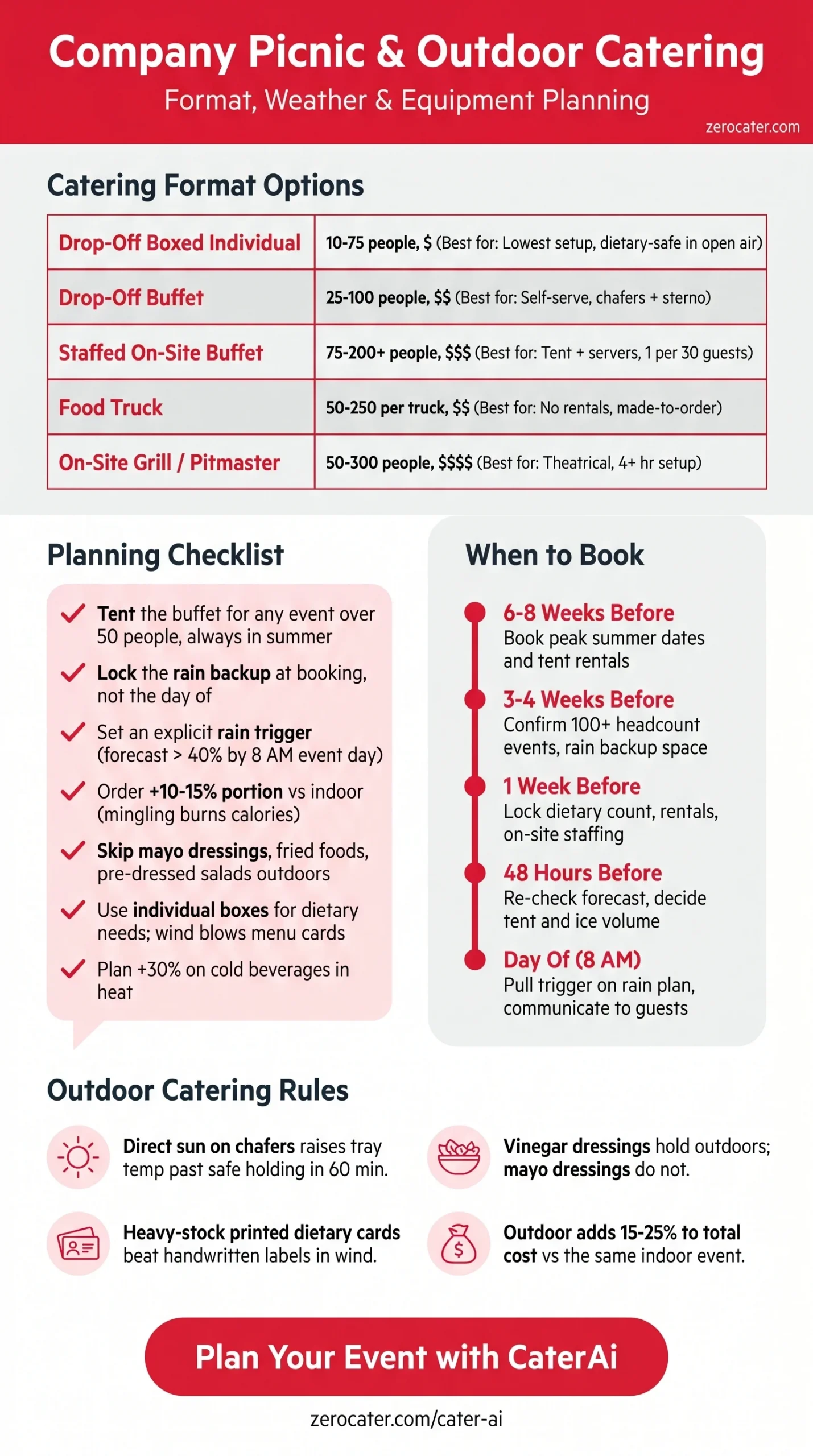
Outdoor catering is not just indoor catering with a different floor. The food has to survive a 90-minute gap between kitchen and plate. The buffet has to work in wind, sun, and the occasional bee. Dietary labels need to stay readable when the breeze picks up. Cold things need to stay cold and hot things need to stay hot in conditions you do not control. Done right, an outdoor company picnic is the highest-engagement catering format you can run for the cost: people remember it for months. Done wrong, you spend the same money to watch potato salad spoil and coworkers eat lunch standing in the sun. This guide covers the five service formats that actually work outdoors, the cuisines that hold up between truck and table, the weather contingency planning most office managers learn the hard way, the rentals and equipment list you cannot improvise on the day, allergen-safe packaging in open air, and what outdoor service actually costs versus the indoor equivalent.
In This Guide
- When Outdoor Catering Actually Works
- Five Service Formats for Outdoor Catering
- Cuisines That Travel Well to Outdoor Settings
- Weather Contingency Planning
- The Rentals and Equipment Checklist
- Allergen-Aware Packaging in Open Air
- Serving Sizes for 25, 50, 100, and 200 Plus People
- What Outdoor Catering Actually Costs
- Frequently Asked Questions
When Outdoor Catering Actually Works
Not every company event belongs outside. Outdoor service trades on novelty (people are happier eating in fresh air) at the cost of variability (you cannot control the weather, the temperature of the food at minute 60, or the bug population at minute 75). Here is the honest fit list:
Outdoor catering is the right call when
- The event is celebratory, not transactional. Anniversaries, milestone launches, end-of-quarter wins, summer all-hands, return-from-offsite. People remember the picnic; they tolerate the sandwich-at-desk lunch.
- You have a venue with shade or tent capacity. A grass courtyard with mature trees, a rooftop with retractable shade, a park pavilion. Direct unshaded sun for 90 minutes is uncomfortable for guests and unsafe for food.
- The headcount is between 25 and 200. Under 25, the rentals are not worth it. Over 200, you are running a catered event, not a picnic, and the planning shifts toward full-service corporate event catering.
- Forecast is favorable. Look 7 days out at booking, again 48 hours out, and again at 8 AM event-day. A 20 percent chance of rain at noon is a green light. A 60 percent chance is a backup-plan trigger.
- You can offer guests a shaded seat or a stand-and-mingle reception with high-tops. No outdoor event should require guests to sit on grass for 90 minutes unless that is explicitly the vibe.
Outdoor catering is the wrong call when
- The agenda includes formal presentations, screen-based content, or live demos. Outdoor wind, glare, and ambient noise wreck audio and AV.
- You are catering a board meeting, client lunch, or hiring event. See our board meeting catering guide for those formats; precision and quiet matter more than novelty.
- Your headcount fluctuates day-of by 30 percent or more. Outdoor rentals and staffing are sized at booking; flex headcount makes the per-person cost double.
- Forecast highs are above 95 degrees or lows below 55 degrees at event start. Both push food safety and guest comfort past the point where the novelty pays off.
Five Service Formats for Outdoor Catering
Outdoor catering uses the same building blocks as indoor service plus food trucks and grills. The right format depends on headcount, venue, and how much hands-on staffing you want to coordinate:
| Format | Best Headcount | Setup Required | Per-Person Cost Tier |
|---|---|---|---|
| Drop-off boxed individual | 10 to 75 people | None (caterer drops, you stack) | $ (lowest) |
| Drop-off buffet (chafers + serving utensils) | 25 to 100 people | Self-serve, you manage flow | $$ |
| On-site staffed buffet (tent, chafers, servers) | 75 to 200 plus people | Caterer handles, 1 server per 30 guests | $$$ |
| Food truck | 50 to 250 people per truck | Truck arrives self-contained | $$ |
| On-site grill (BBQ pitmaster) | 50 to 300 people | Pitmaster + crew, 4 plus hours on site | $$$$ |
1. Drop-off boxed individual
The lowest-friction outdoor format and the format dietary safety likes best. The caterer delivers individually packaged meals, your team stacks them on a table, guests grab what they need. No chafers, no warming gear, no servers, no equipment to return. Boxed lunches survive 60 to 90 minutes at room temperature with no quality loss, which covers most outdoor lunch windows. For everything boxed-format-specific, see our complete boxed lunch catering guide for meetings and the boxed lunch vs. buffet comparison. For an outdoor picnic specifically, boxed individual is the format hybrid teams default to because attendance fluctuates, the meals are individually labeled for dietary needs, and there is nothing to clean up.
2. Drop-off buffet
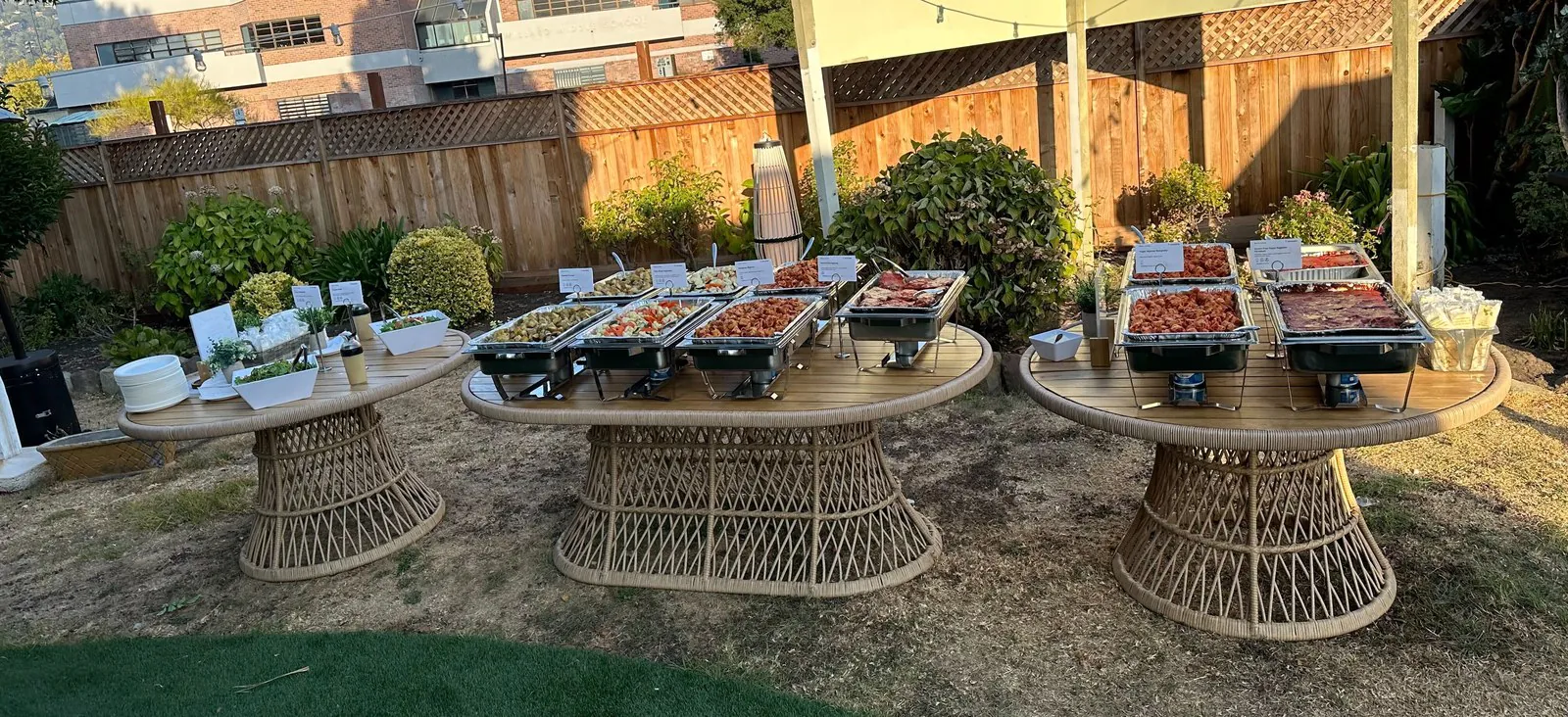
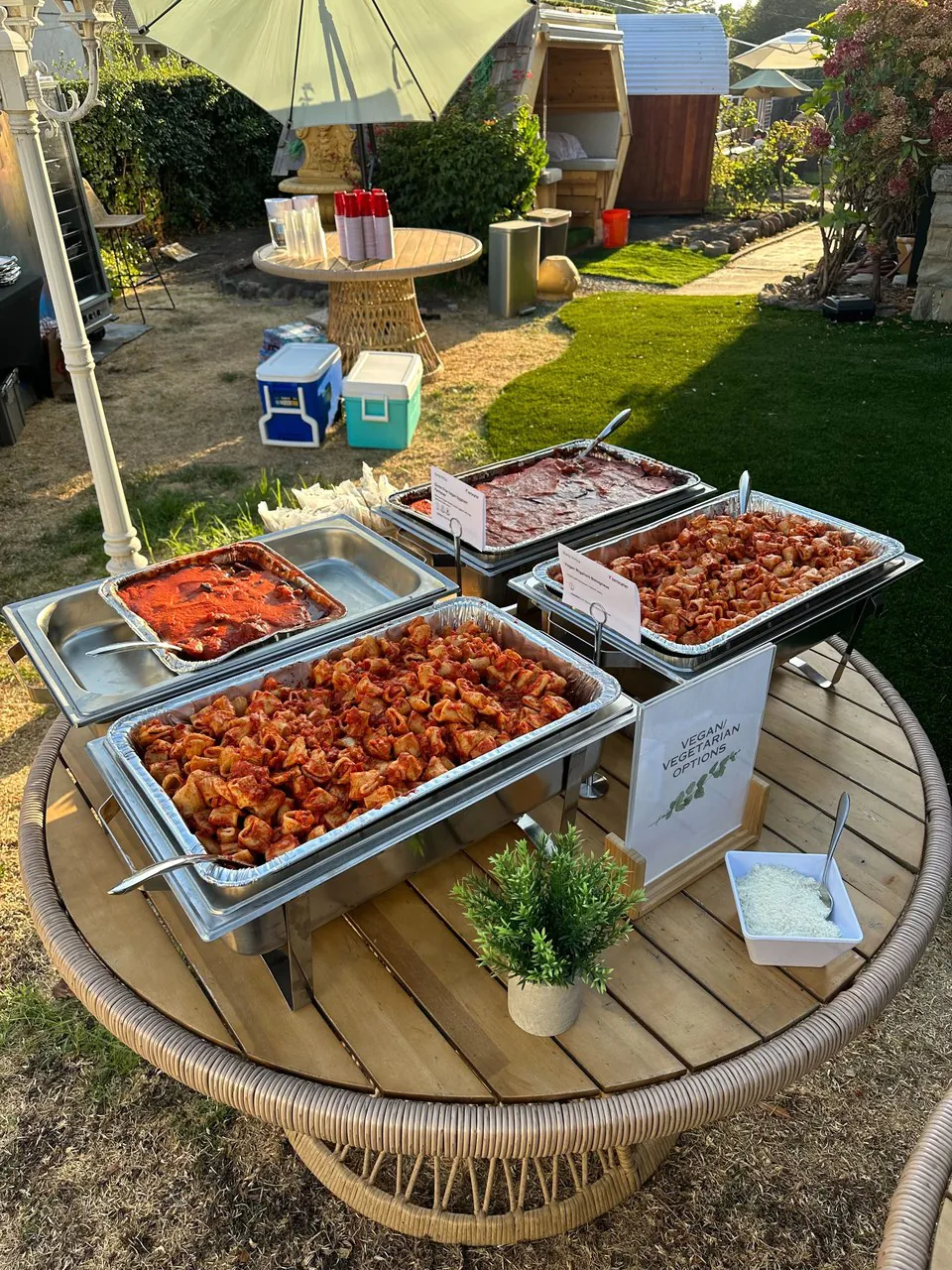
The caterer drops chafers, serving utensils, sterno fuel, and platters; your team places them on tables you provide and serves the line yourselves. This format works for 25 to 100 people who are happy with self-serve, and it is the most cost-efficient way to feed an outdoor crowd warm food with menu variety. The catch: your team is now operating the buffet (refilling, watching levels, managing the line). Plan for one volunteer per 40 guests staffing the food table.
3. On-site staffed buffet
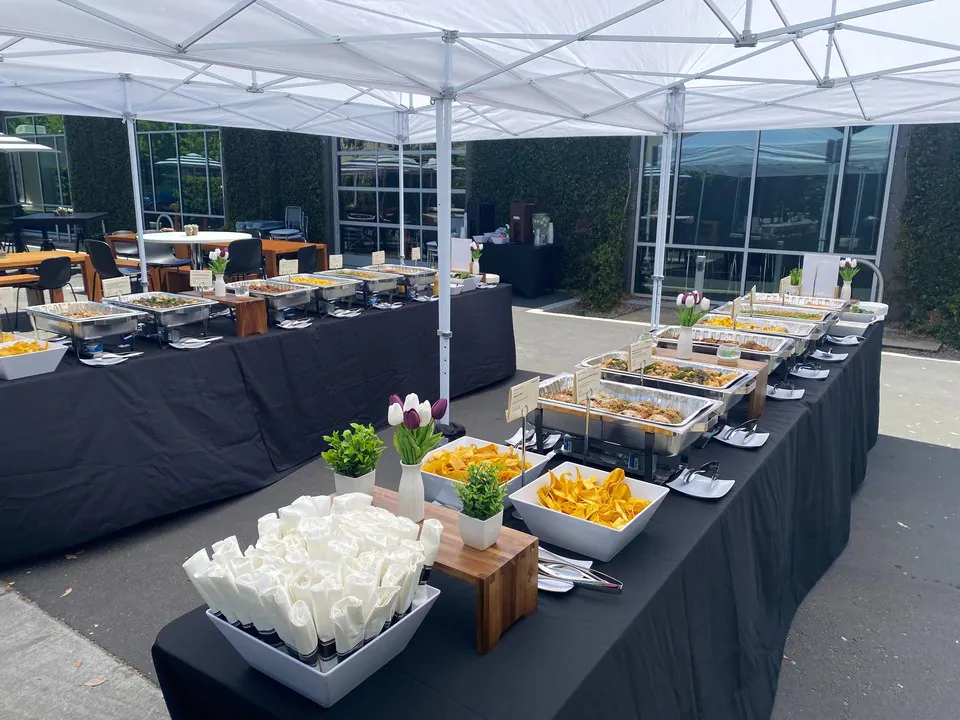
Full-service: the caterer brings tent, tables, linens, chafers, servers, and breaks down everything at the end. Industry standard is one server per 30 guests for buffet service. This is the format for company picnics over 75 people where you want guests focused on the event, not the food line.
4. Food truck
One truck handles 50 to 250 people depending on cuisine and venue access. Tacos, BBQ, pizza, gourmet sandwiches, and Korean BBQ all run well from trucks. Pros: zero rental overhead, the truck is the kitchen and the buffet, made-to-order food, novelty value. Cons: line speed (most trucks serve 60 to 90 plates per hour, so a 200-person event needs two trucks or a long lunch window), venue access (the truck has to physically reach the event location), and minimums (most trucks have a 1.5 to 3 hour minimum and a $1,500 to $3,000 floor). For a 100-person company picnic, a food truck often costs the same as a drop-off buffet without the equipment hassle.
5. On-site grill or BBQ pitmaster
The most theatrical outdoor format and the most expensive: a pitmaster and crew arrive 4 plus hours before service, smoke or grill on site, and serve from a setup that smells the building from a block away. Best for company milestones, summer kickoffs, anniversary celebrations where the cooking is part of the event. Our BBQ corporate catering guide covers this format end to end (the four BBQ-specific service formats, regional menu playbook, and serving sizes from 10 to 200 plus people on the cuisine itself).
Cuisines That Travel Well to Outdoor Settings
Outdoor catering exposes the gap between food that looks good in a kitchen and food that holds up between delivery and the moment a guest puts it on a plate. Some cuisines are built for it; some fall apart in 20 minutes. Here is what works:
BBQ and American comfort
BBQ is the prototype outdoor cuisine because everything in the format is designed for chafer holding: brisket, pulled pork, smoked chicken, mac and cheese, baked beans, cornbread. None of it suffers from sitting at 165 degrees for an hour. Add coleslaw without mayonnaise (vinegar-based dressings only outdoors), a green salad dressed table-side, and pickles. Browse American catering options and BBQ catering options; ZC vendor pages worth a look include Renegade Burrito in Denver and Carlitos Barbecue Taqueria in NJ/NY.
Mexican and Tex-Mex
Tacos, burrito bowls, fajita bars, and quesadillas all hold well in chafers and pack cleanly in individual boxes. The format is naturally allergen-flexible (rice and bean bowls cover vegan and gluten-free without substitution) and crowd-friendly (build-your-own bars give guests agency and reduce the “what is in this?” anxiety). Browse Mexican catering vendors; ZC partners include Tio Luis Tacos in Chicago, Raging Burrito in Atlanta, and Folklore Artisanal Mexican Eatery in NYC.
Mediterranean and Middle Eastern
Grilled chicken, lamb shawarma, hummus, baba ganoush, tabbouleh (with the mint and parsley fresh), pita, falafel. Mediterranean food is born for room-temperature service: most of it tastes equally good warm or cool, dressings are oil-and-acid based instead of dairy, and the format pairs naturally with vegan and gluten-free needs (rice bowls, falafel without pita). Browse Mediterranean catering options; partners include Zaatar Mediterranean in SF, A Saffron Thread in NYC, and Olive Mediterranean Grill in Chicago.
Deli and sandwich platters
Wraps, hoagies, gourmet sandwiches, sliders. The packed-and-sliced format requires zero warming equipment and survives indefinite outdoor time as long as it is not in direct sun. The trade-off: less event energy than a hot buffet, less photogenic, less “we did something nice.” Best for working lunches outdoors (offsite afternoons, working picnics) rather than celebration events. Browse sandwich catering options.
Grain bowls and salad-forward
Build-your-own grain bowl bars (rice, quinoa, farro plus protein plus veg plus sauces) handle outdoor service well in chafers and chilled stations. The advantage: extremely accommodating for dietary needs because guests assemble their own bowl. The disadvantage: requires more buffet stations than a standard hot-food line, which adds rental cost.
Cuisines that struggle outdoors
Avoid these for outdoor service unless you have a specific work-around:
- Anything with mayonnaise dressing in the sun: potato salad, classic coleslaw, pasta salad with mayo, deviled eggs. The food safety risk is real (USDA guidance: discard after 1 hour above 90 degrees, 2 hours otherwise). Use vinegar dressings instead.
- Fried foods: fried chicken, fries, calamari, tempura. They lose crispness within 20 minutes of leaving the fryer. If you must, request that they arrive in the last 15 minutes of setup and serve immediately.
- Pre-dressed leafy salads: arugula and spring mix wilt in 30 minutes when dressed. Serve dressing on the side and let guests dress their own plate.
- Sushi or raw fish: outdoor temperature variability puts this in the food safety risk zone almost immediately. Either skip or request a refrigerated display.
- Cheese-heavy pizzas in transit over 30 minutes: the cheese congeals. Either order a food truck pizza arrangement that bakes on site or skip pizza altogether for outdoor.
Weather Contingency Planning
The single biggest difference between an indoor catering order and an outdoor one is that you cannot control the weather. The single biggest mistake outdoor planners make is treating that variable as something to hope away. Treat it as a planning input instead.
The rain plan
Lock the rain backup at the same time you book the primary venue. Three options work depending on your office setup:
- Same date, indoor backup space: Book the office cafeteria, conference center, or covered patio for the same time slot. Same caterer, same menu, different location. Easiest to communicate.
- Same date, format switch to fully boxed: If your indoor backup cannot accommodate a buffet setup, switch to individually boxed meals delivered to the indoor space. The caterer keeps the order; you skip the buffet equipment.
- Date shift by one day: For events booked further out, build in a “rain date” 24 to 48 hours later. Communicate clearly that the date may shift; require RSVPs for both possibilities.
Set an explicit rain trigger. “Greater than 40 percent forecast rain at event start time, decided by 8 AM event day, communicated by Slack and email to all attendees by 8:30.” A specific trigger turns weather decisions into operations. A vague rain plan turns into a panicked group thread at 11:30 AM.
The heat plan
Forecast highs above 90 degrees turn outdoor catering into a food safety challenge. Plan for:
- Move the event earlier: Lunch at 11:30 instead of 12:30, breakfast at 8:30 instead of 10. The first hour of a hot day is dramatically more comfortable than the third.
- Tent the buffet always. Direct sun on chafer trays raises surface temperature past safe holding within 60 minutes.
- Add a hydration station. Pitchers of ice water plus lemon and cucumber, or a separate beverage tent with cold drinks, is standard for outdoor events over 80 degrees.
- Skip cream and dairy desserts: Ice cream, custards, and tiramisu collapse fast in heat. Stick with cookies, brownies, fruit, and shelf-stable bars.
- Brief the caterer to use ice baths under chafers, not sterno warming, for items like fruit, charcuterie, and pre-cut salads. Cold-holding is harder outdoors than hot-holding.
The wind plan
Wind is the underrated outdoor variable. It blows over menu cards, flips chafer lids, scatters paper napkins, and sends light tablecloths airborne. Plan for:
- Tablecloth weights or clamp-on edges. Standard at any outdoor event; ask the caterer to bring them.
- Heavy-stock dietary labels printed in advance, not handwritten cards on table tents. Wind blows tent cards over within minutes.
- Beverage cans, not pitchers, for outdoor events with sustained breeze. Pitchers spill; cans do not.
- Avoid lit sterno open flame in winds over 15 mph. Switch to electric chafers if your venue has power, or shorten the holding window.
The Rentals and Equipment Checklist
Indoor catering uses your office furniture and your kitchen. Outdoor catering does not have either, so the equipment becomes its own line item. Here is the complete checklist for outdoor service:
| Item | When You Need It | Source |
|---|---|---|
| Tent (10×10 minimum, 20×20 standard) | Any event over 50 people; always over the buffet | Caterer or rental company |
| Buffet tables (6-foot rectangular) | Drop-off buffet or staffed buffet | Caterer or rental |
| Linens (black or white) | Drop-off buffet and up | Caterer (most include) |
| Chafers, sterno, serving utensils | Drop-off buffet and up | Caterer (always include) |
| Coolers and ice for cold items | Any outdoor event with cold sides or beverages | Caterer or office supply |
| Beverage station (drink dispensers, cups, ice) | Any outdoor event in summer | Caterer or office |
| Plates, napkins, utensils (compostable preferred) | Buffet formats; boxed comes self-contained | Caterer (always include) |
| Trash and recycling bins (extra bags) | Always | Office or rental |
| Hand-washing or sanitizer station | Any outdoor event without immediate restroom access | Office |
| Dietary signage (printed, weight-resistant) | Always; brief caterer 5 days before | Caterer |
| Seating (chairs, picnic tables, or high-tops) | Any seated event over 25 people | Venue or rental |
| Power source (generator if no outlets) | Electric chafers, beverage chillers, sound | Rental company |
| Restroom access (porta-potties for parks) | Park venues over 50 people, 3 plus hour events | Rental company |
Three rental rules to know before you call vendors:
1. Tent rental runs $200 to $500 per 10×10 in most US cities, $500 to $1,200 for a 20×20. Permits may be required for larger tents in city parks; ask the rental company who handles the permit.
2. Bundle rentals through the caterer when possible. Most full-service catering companies have rental partners and can roll equipment into a single line item, which saves the coordination overhead of running two vendors. The premium is usually 10 to 15 percent over going direct, often worth it.
3. Confirm power needs 5 plus days before the event. If you need electric chafers, beverage chillers, or sound, the venue or rental company needs lead time to position a generator. Last-minute generator rental in summer can be impossible to source.
Allergen-Aware Packaging in Open Air
Outdoor service makes the case for individual boxed meals stronger than indoor service does. Three reasons:
Wind blows menu cards. Indoor dietary labels stay where you put them. Outdoor labels need heavy stock, weights, or pre-printed wind-resistant signage. The friction of communicating “this dish contains tree nuts” rises sharply in any breeze.
Shared serving utensils get cross-contaminated faster. Indoor buffets cycle utensils through dishwashing in real time when needed. Outdoor service does not. A vegan guest using the same spoon someone just dipped into the cheese sauce is a real problem at minute 60.
Inspecting a dish in the sun is harder. A guest with celiac disease cannot easily verify a buffet item is gluten-free when the label is squinting-bright and the steam table is hot to lean over.
The mixed format that works
Use a hybrid approach: most of the picnic is buffet (variety, festivity, lower per-person cost), plus a separate dietary station with clearly-labeled individual boxes for vegan, gluten-free, halal, and severe allergy needs. The dietary station should be:
- Set up before the buffet opens, so guests with dietary needs are not standing in the main line.
- Labeled in advance with printed cards, not handwritten labels that smudge or blow away.
- Stocked at 1.2x your dietary headcount, because guests without restrictions sometimes pick up a dietary box if it looks good.
- Located near a shaded area, so guests who need to inspect ingredients can do so out of direct sun.
For the full dietary playbook, see our guide to ordering catering for mixed dietary needs, the vegan office catering guide, and the gluten-free office catering guide.
Planning an outdoor company picnic?
Plan company picnic catering with CaterAi
Tell CaterAi your headcount, venue, and weather window. See outdoor-ready menus from 1,000 plus vetted caterers in minutes.
Serving Sizes for 25, 50, 100, and 200 Plus People
Outdoor portion sizing differs from indoor in two ways: people eat slightly more outside (the calorie-burn-while-mingling factor adds roughly 10 to 15 percent), and the second-pass habit is stronger at picnics than at office lunches. Plan headcount accordingly:
| Headcount | Recommended Format | Tent / Equipment | Staff |
|---|---|---|---|
| 25 guests | Drop-off boxed individual or drop-off buffet | 10×10 tent optional, recommended in heat | None |
| 50 guests | Drop-off buffet or food truck | 10×10 tent over buffet (mandatory in summer) | None or 1 caterer attendant |
| 100 guests | Staffed buffet or food truck | 20×20 tent over buffet, separate seating tent | 2 to 3 servers |
| 200 guests | Staffed buffet (multi-station) or 2 food trucks | Two 20×20 tents minimum, plus seating | 5 to 7 servers + 1 manager |
| 300 plus guests | On-site grill or multi-station buffet | Custom site plan; 4 plus tents typical | 8 plus crew, dedicated event lead |
Two outdoor-specific portion adjustments versus indoor:
- Add 10 to 15 percent to standard portions. Outdoor mingling burns calories; people eat more.
- Plan for a 30 percent overage on cold beverages. Hot weather plus standing equals significantly higher hydration than indoor lunch service. Order more than your gut says.
What Outdoor Catering Actually Costs
Outdoor adds roughly 15 to 25 percent over the equivalent indoor catering total once rentals, on-site staff, and weather contingency are factored in. The drivers:
- Equipment rentals (tents, chairs, beverage stations): $500 to $3,000 depending on event size.
- On-site staff (servers, attendants): $35 to $50 per server per hour, with 4-hour minimums standard.
- Weather contingency: If you booked an indoor backup, that is a deposit you may not recover. If you booked a rain date, you doubled some logistics.
- Permits (city park venues): $50 to $500 depending on city and headcount.
- Travel time and setup: Outdoor venues are usually farther from the caterer’s kitchen than your office, which adds delivery time billed at hourly rates.
Per-person cost ranges by format (outdoor versions):
| Format | Indoor Cost / Person | Outdoor Cost / Person |
|---|---|---|
| Drop-off boxed individual | $18 to $28 | $22 to $32 |
| Drop-off buffet | $22 to $35 | $28 to $45 |
| On-site staffed buffet | $40 to $65 | $50 to $85 |
| Food truck | N/A | $18 to $32 (incl. minimums) |
| On-site grill / pitmaster | $50 to $75 | $65 to $110 |
City matters. Per-person ranges run roughly 25 to 40 percent higher in NYC and SF compared with the rest of the US. For city-specific cost benchmarks, see the NYC catering cost guide, the SF catering cost guide, and the Chicago catering cost guide. For boxed-format-specific pricing across cities, see the boxed lunch catering cost guide.
Where to find outdoor caterers in your city
Most major US cities have caterers who specialize in outdoor service: BBQ pitmasters, food trucks, full-service event catering. The city-specific lists:
- 15 Best Corporate Event Catering Companies in NYC
- 15 Best Corporate Event Catering Companies in SF
- 15 Best Corporate Event Catering Companies in Chicago
- 15 Best Corporate Event Catering Companies in LA
- 15 Best Corporate Event Catering Companies in Atlanta
- 15 Best Corporate Event Catering Companies in Dallas
- 15 Best Corporate Event Catering Companies in Denver
For ongoing meal programs (anchor day catering for hybrid teams, weekly outdoor lunches in summer), Zerocater’s corporate catering programs handle the operational layer end to end. For one-off picnics and event-specific outdoor service, Zerocater event catering handles staffing, rentals, and on-site coordination. To see what is available in your city, CaterAi compares menus across 1,000 plus vetted caterers in real time. New to Zerocater? See how it works.
For the broader format and audience playbook, see our boxed lunches for hybrid teams guide and the office manager’s guide to ordering catering.
Frequently Asked Questions
How far in advance should I book a company picnic caterer?
For a standard outdoor lunch under 50 people, 7 to 10 business days is enough. For 100 plus people with on-site service, plan 3 to 4 weeks of lead time so the caterer can confirm staffing, equipment rentals, and a permit for the venue if one is required. May through September is peak outdoor catering season, so popular date weekends fill up 6 to 8 weeks ahead in most major US cities. Always book the rain backup at the same time you book the primary date.
What is the best food for an outdoor company picnic?
BBQ, Mexican, Mediterranean, deli sandwich platters, and grain bowl formats all hold up well outdoors. Avoid anything with mayonnaise or dairy that has to sit on a buffet line in direct sun (potato salad, coleslaw with cream dressing, cold seafood), anything fried (loses crispness within 20 minutes), and tossed salads dressed in advance. The rule: pick foods that taste good at room temperature and tolerate 30 to 45 minutes between delivery and service.
How much does outdoor company picnic catering cost?
Plan on a 15 to 25 percent premium over equivalent indoor catering once rentals, on-site staff, and weather contingency are included. A drop-off boxed lunch at $22 per person indoors becomes roughly $26 to $28 per person delivered to a park venue. A staffed on-site buffet at $40 per person indoors lands closer to $50 to $55 outdoors with tent rental, tables, chafer fuel, and one server per 30 guests. Food trucks bypass most rental costs and run $18 to $30 per person depending on cuisine and minimums.
Do I need a tent for an outdoor company picnic?
For any outdoor event over 50 people, yes, even on a clear-forecast day. A 20 by 20 foot pop-up tent over the buffet line keeps food temperature stable and gives guests a shaded gathering point. For 100 plus people, plan two tents: one over the food, one over a seating area. The food tent is non-negotiable in summer heat because direct sun raises chafer-tray surface temperature past safe holding within an hour. Most caterers either include tent setup in on-site service packages or coordinate with a rental company for an extra $200 to $500 per tent depending on size and city.
How do you handle dietary restrictions at an outdoor company picnic?
Outdoor service makes individual boxed meals the safer default for dietary needs. A buffet line outdoors is harder to label clearly (wind blows menu cards), shared serving utensils get cross-contaminated faster, and a celiac team member cannot easily inspect a tray sitting in the sun. The cleanest setup: order the bulk of the picnic as buffet for variety, plus a stack of clearly-labeled individual boxes for vegan, gluten-free, halal, and severe allergy needs at a separate dietary station. Brief the caterer on the labeling system 5 days before the event so labels arrive printed, not handwritten.
What is the best service format for an outdoor company picnic?
It depends on headcount and venue. Under 25 people in a courtyard or small park, drop-off boxed lunches require zero setup and zero cleanup. 25 to 75 people: drop-off buffet with chafers, the company sets out and serves. 75 to 200 people: on-site staffed buffet under a tent with one server per 30 guests. 50 plus people on a budget: a single food truck handles the whole event for roughly the cost of a drop-off buffet, with no rental overhead. Over 200 people: multi-station service or two food trucks parallel.
What is the rain backup plan for a company picnic?
Lock the rain backup at booking, not the day of. Three options work: book the indoor space (office cafeteria, conference room, or a covered patio) on the same date with the same caterer; switch to a fully boxed format that travels back inside without setup; or move the date by one day. Communicate the rain trigger publicly (forecast greater than 40 percent rain at the event start time, decided by 8 AM event-day) so the team knows which format to expect by mid-morning. A vague rain plan turns into a chaotic last-minute scramble; an explicit one is just an alternate venue with the same food.
Plan company picnic catering with CaterAi