Morning meetings have a catering problem that lunch meetings do not. Most caterers’ kitchens open at 7 AM and most office loading docks open at the same time, which collapses the window between caterer load-out and meeting start. Hot buffets need 30 to 45 minutes of on-site setup before service. Hot proteins lose quality after 30 minutes in chafing dishes. Attendees arrive in waves, not all at once. Boxed breakfast catering is the format built for that window. Each meal is sealed at the caterer’s kitchen, delivery is a drop-off (no on-site staff, no warming gear), distribution takes five minutes for 50 people, and the format works whether attendees arrive together for an 8 AM all-hands or trickle in over the first half hour of an early board meeting. This guide covers when to use boxed breakfast, what goes in the box, how many to order, what it costs, and how to handle dietary needs at scale.
In This Guide
- Why Boxed Breakfast Wins for Morning Meetings
- When to Use Boxed Breakfast (and When to Skip It)
- Boxed Breakfast Menu Options
- Headcount Math for Morning Meetings
- Hot vs. Cold: What Travels Best for Early Delivery
- Dietary Inclusion at Breakfast
- Timing and Delivery Logistics
- Cost: What Boxed Breakfast Actually Runs
- Frequently Asked Questions
Why Boxed Breakfast Wins for Morning Meetings
Lunch catering is forgiving. The caterer’s kitchen has been running since 9 AM, the team is fully on-site, attendees gather in one room at noon, and a buffet has 90 minutes to deliver food at temperature. Morning meetings break almost every one of those assumptions.
The morning delivery window is tight
Most caterer kitchens open between 6:30 and 7:00 AM. Most office buildings open loading docks at 7:00 AM. Most early meetings start between 8:00 and 9:00 AM. That leaves a one-hour to two-hour window for the caterer to finish prep, load the truck, drive across the city, navigate elevator and security, and deliver food to your floor. Buffet setups eat 30 to 45 minutes of that window for chafing, sterno, equipment placement, and plating. Boxed breakfasts cut setup to zero: the boxes are sealed at the kitchen, dropped at the door, and the office manager stacks them on a counter.
Attendees arrive in waves
Morning meeting attendance is rarely synchronous. Some people arrive 15 minutes early to grab coffee and settle. Some arrive precisely at start time. Some join the meeting late after a delayed train. A buffet that is hot at 7:45 AM is room temperature by 8:30. Boxed breakfasts hold their quality from delivery through the last arrival because each box is sealed; pastries do not stale, fruit does not warm, yogurt parfaits do not separate.
Hot buffets need staff at 7 AM
Staffed hot breakfast buffets require a serving team on-site to manage chafers, refresh hot proteins, and clean up. Most catering staff schedules start at 8 or 9 AM; getting a service crew on-site at 7 AM costs a premium and reduces the pool of available caterers. Boxed breakfasts are drop-off only: one delivery driver, no on-site staff, the office manager handles distribution.
Distribution scales linearly
200 boxed breakfasts distribute in five minutes if they are pre-stacked on a counter labeled by dietary preference. The same volume through a buffet line takes 25 to 40 minutes. For morning meetings with a 30 to 45 minute lunch-equivalent window before the next session begins, a slow distribution cuts directly into agenda time.
Dietary needs are tracked at the individual level
Buffet breakfast forces every attendee to inspect every dish in real time. With breakfast specifically, that inspection is harder than at lunch because cross-contact concerns (gluten in pancakes, dairy in scrambled eggs from a chafer, nuts in granola) are more common in the morning lineup. Boxed breakfasts label every meal with what is inside, so a teammate with celiac picks up the GF-labeled box and skips the inspection entirely. Our guide to ordering catering for mixed dietary needs walks through the labeling system; our gluten-free catering guide covers the cross-contact specifics.
When to Use Boxed Breakfast (and When to Skip It)
Boxed breakfast is not the right answer for every morning event. The format wins decisively for short meetings with staggered arrivals, recurring early sessions, and large-headcount kickoffs. It loses to a hot buffet for long-format gatherings where the food experience is part of the agenda. The decision matrix:
| Meeting Type | Best Format | Why |
|---|---|---|
| Early team kickoff (8 AM, 30-60 min) | Boxed | Tight delivery window, staggered arrivals, short eating time |
| Board meeting breakfast (executive session) | Boxed (premium) | Polished individual presentation, no setup distraction at the table |
| Quarterly all-hands breakfast (100+ attendees) | Boxed | Distribution speed at scale, dietary labeling, no buffet line |
| New hire onboarding breakfast | Boxed | Predictable headcount, individual seating, low-effort host |
| Hybrid anchor day breakfast (recurring) | Boxed | Variable attendance, individual portions handle headcount swings |
| Off-site retreat breakfast (extended) | Hot buffet | Long format, one-room gathering, food is part of the experience |
| Continuous-flow client breakfast | Continental spread | Drop-in arrivals over a 2-hour window, self-serve pastries hold |
| Board retreat with kitchen access | Hot buffet | Setup time available, warming station extends hot window |
The break-even is roughly 30 minutes from delivery to the last person eating. Under that, boxed breakfast wins on logistics. Over that, hot food benefits from buffet service or warming equipment. For the broader format question across all breakfast catering scenarios, see our complete office breakfast catering guide.
Boxed Breakfast Menu Options
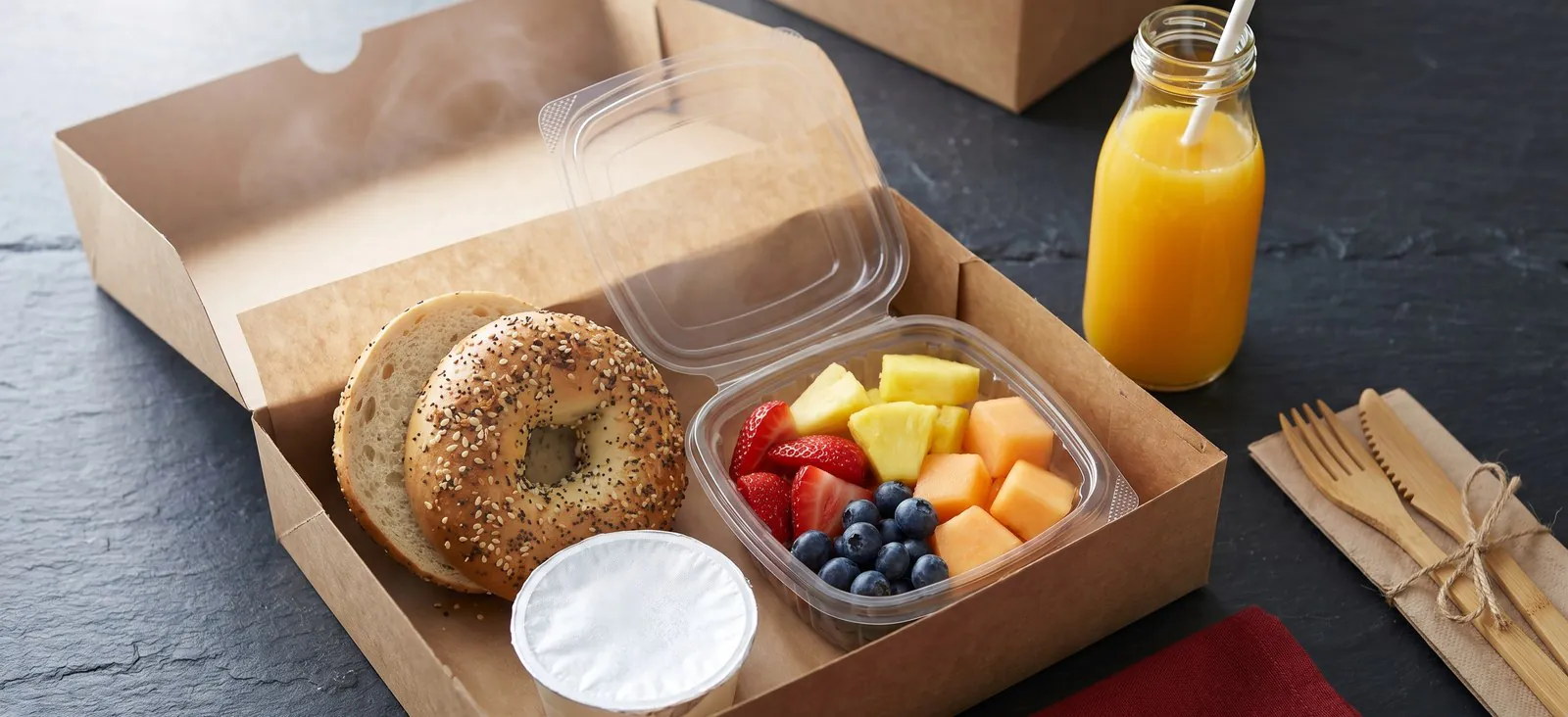
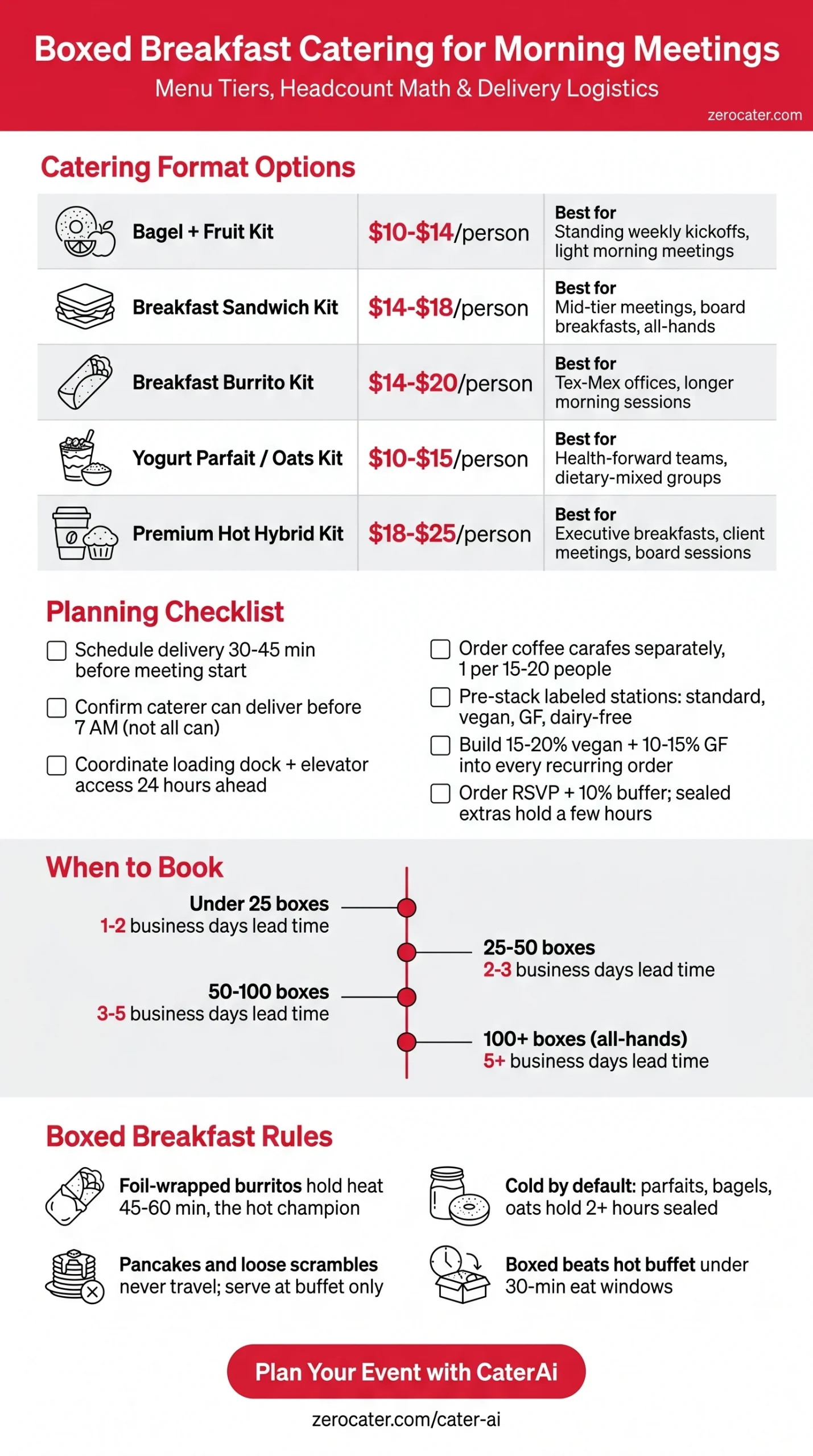
A boxed breakfast kit has three components: a main item, a fresh side, and a beverage. Most caterers offer three or four menu tiers, and a recurring program rotates through them across the week to avoid menu fatigue.
Tier 1: Bagel and Fruit Kit ($10-14 per person)
- Main: Single fresh bagel (everything, plain, sesame, or rotation). Sliced clean.
- Spread: Foil-topped cup of plain or scallion cream cheese. Some kits add butter or jam packets.
- Side: Small clamshell of seasonal mixed fruit (strawberries, pineapple, blueberries, melon).
- Beverage: Bottled orange juice or bottled water. Coffee carafes ordered separately.
- Best for: Standing weekly team kickoffs, light morning meetings.
Tier 2: Breakfast Sandwich Kit ($14-18 per person)
- Main: Breakfast sandwich on a croissant, biscuit, or English muffin. Egg and cheese (vegetarian-friendly) or egg and bacon/sausage.
- Side: Fruit cup or small breakfast potato side.
- Beverage: Bottled juice, cold brew, or hot coffee from the catering carafe.
- Best for: Mid-tier morning meetings, board breakfasts, all-hands events where you want a real meal but not a full hot buffet.
Tier 3: Breakfast Burrito Kit ($14-20 per person)
- Main: Breakfast burrito with scrambled egg, cheese, potato, and a protein (sausage, bacon, or chorizo). Vegetarian and vegan versions widely available.
- Side: Salsa or hot sauce packets, fruit cup.
- Beverage: Bottled juice or coffee.
- Best for: Tex-Mex-friendly offices, longer morning sessions where attendees want something filling.
Tier 4: Yogurt Parfait or Overnight Oats Kit ($10-15 per person)
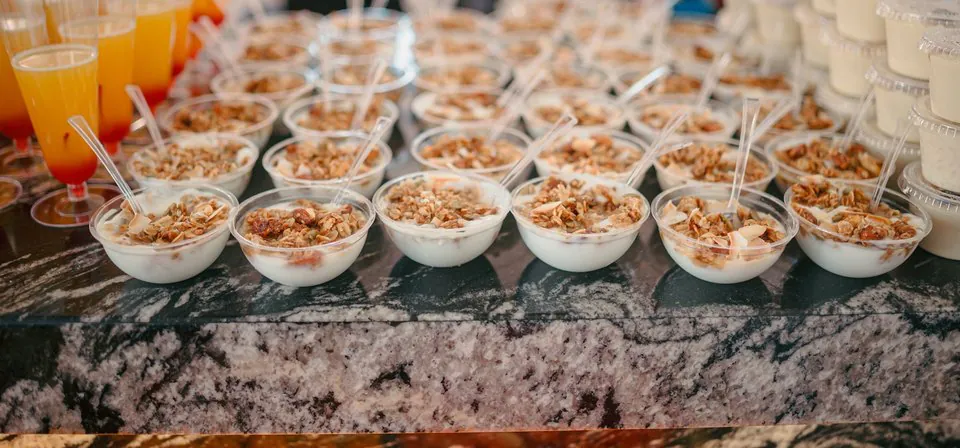
- Main: Layered yogurt with house-made granola and fresh fruit, OR overnight oats with chia seeds, almond milk, and seasonal toppings.
- Side: Mini muffin, banana, or trail mix packet.
- Beverage: Bottled juice, plant milk, or coffee.
- Best for: Health-forward offices, dietary-mixed teams (parfaits naturally GF, overnight oats easily vegan).
Tier 5: Premium / Hot Hybrid Kit ($18-25 per person)
- Main: Hot breakfast sandwich or burrito kept warm in insulated packaging plus a separate cold component (yogurt, parfait, or fruit).
- Side: Two sides: hot potato hash plus fruit, or hot side plus pastry.
- Beverage: Bottled premium juice, cold brew, or specialty coffee.
- Best for: Executive breakfasts, client meetings, board sessions where presentation matters.
For a recurring weekly program, rotate three of these tiers across the month so the same team does not get the same kit every Tuesday. The most common rotation pattern is bagel kit, breakfast sandwich, parfait, repeat. For hybrid teams, see our boxed lunches for hybrid and distributed teams guide; the same anchor-day logic applies to breakfast.
Headcount Math for Morning Meetings
Breakfast headcount is more predictable than lunch in some ways and less predictable in others. RSVPs are usually accurate because the meeting is calendared. But early-morning attendance can shift on weather, train delays, and “I’ll just grab coffee on the way” decisions that no one tells the office manager.
For one-off morning meetings
Order at confirmed RSVP plus 10 percent. Internal meetings tend to draw 5 to 12 percent drop-ins beyond the RSVP list, and morning drop-ins are especially common because the meeting is the first thing on the calendar.
Allocate dietary boxes proactively. For a 50-person breakfast, plan 8 vegan or vegetarian boxes, 5 gluten-free, and label everything clearly. For a 100-person breakfast, plan 15 vegan, 10 gluten-free.
Confirm caterer minimums. Many breakfast caterers have a 10 to 15 person minimum. For smaller meetings (5 to 8 people), expect a per-person premium or order from a caterer that lists no minimum.
For recurring morning programs
Track for 3 weeks. Order at the planning headcount you would use for buffet (typical 75 to 80 percent of the team) and count actual attendance.
Calculate the rolling average. Drop the highest and lowest weeks, take the mean. That is your standing order baseline.
Adjust quarterly. Recurring breakfast attendance drifts (new hires, RTO mandates, seasonal patterns). Recalculate every 13 weeks.
Add a 10 percent buffer. Sealed boxed breakfasts hold safely for several hours in the office fridge. A small over-order means the office has cold-brew bottles and bagels for tomorrow’s coffee chats. Under-ordering at breakfast is harder to recover from than at lunch because most caterers are already on their next delivery by 8 AM.
For boxed lunch headcount math (which translates almost directly), our complete boxed lunch catering guide for meetings walks through the rolling-average system in more detail. Our office manager’s guide to ordering catering covers the operational layer.
Hot vs. Cold: What Travels Best for Early Delivery
Boxed breakfast leans cold by default, but most caterers offer hot options if your office is within a tight delivery radius. The question is what actually travels well in a sealed kraft box from a kitchen 20 minutes away.
| Item | Travels Well? | Notes |
|---|---|---|
| Bagel + cream cheese | Excellent | Cold component, no quality drop over 60 minutes |
| Breakfast sandwich (egg + cheese on croissant) | Good if delivered within 30 min | Sandwich softens after 30 min in sealed packaging; some caterers wrap in foil + insulation |
| Breakfast burrito (foil-wrapped) | Very good | Foil holds heat for 45-60 min; the format that travels best of any hot breakfast |
| Yogurt parfait | Excellent | Cold component, layered to keep granola crunchy until eaten |
| Overnight oats | Excellent | Cold component, designed to be made ahead and held |
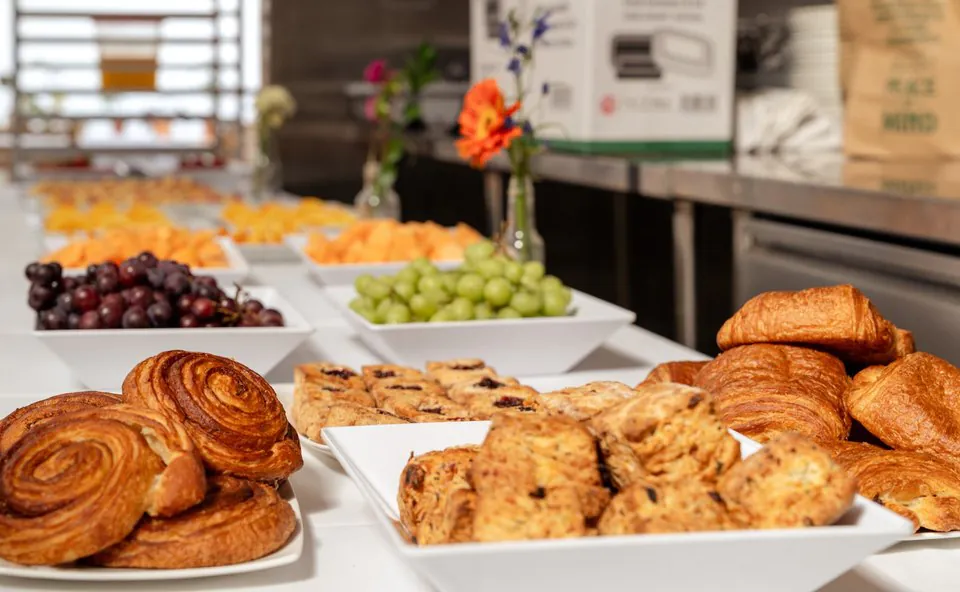
| Pastries (croissant, danish, muffin) | Excellent | Hold for several hours at room temperature |
| Hot potato hash side | Mediocre | Loses crispness within 20 min; better as a buffet item than a boxed component |
| Scrambled eggs (loose) | Poor | Texture suffers in sealed packaging; better as a buffet item |
| Pancakes / French toast | Poor | Steam softens texture in a sealed box; serve at a buffet only |
| Bottled juice or cold brew | Excellent | No quality issue; sealed at the kitchen |
| Coffee (in the box) | Don’t | Order coffee carafes separately; per-person bottled coffee in a box adds spill risk and packaging cost |
The pattern: cold-by-design items hold beautifully (bagels, parfaits, fruit, overnight oats), foil-wrapped hot items hold for ~45 minutes (burritos), and dishes that depend on texture contrast (pancakes, hash) lose to a buffet. For boxed-vs-buffet decision-making across both lunch and breakfast, our boxed lunch vs. buffet guide walks through the format trade-offs.
Planning breakfast for an early meeting?
Plan boxed breakfast catering with CaterAi
Tell CaterAi your headcount, dietary mix, and delivery time. See custom boxed breakfast options across 1,000 plus vetted caterers.
Dietary Inclusion at Breakfast
Breakfast has a higher hidden-allergen rate than lunch. Pancakes contain wheat. Granola often contains nuts. Yogurt contains dairy. Scrambled eggs from a chafer often have butter or cream added. Most attendees do not pause to read every label at 8 AM, which means a single buffet line can silently exclude two or three people every meeting.
Boxed breakfast solves this at the individual level. The default planning template:
| Dietary Need | % of Order | Best Boxed Option |
|---|---|---|
| Vegan | 15-20% | Overnight oats with plant milk, fruit cup, vegan muffin |
| Vegetarian (non-vegan) | 15-25% | Bagel + cream cheese kit, egg-and-cheese sandwich, yogurt parfait |
| Gluten-free | 10-15% | Yogurt parfait (verify GF granola), egg cup, breakfast bowl with no toast |
| Dairy-free | 10% | Plain bagel with vegan butter, fruit + nut box, breakfast burrito (no cheese) |
| Nut-free | All boxes labeled if contain nuts | Most boxed breakfasts default nut-free; granola is the main risk and should be marked clearly |
For dietary-rich teams, our mixed dietary needs guide covers the labeling system; our gluten-free office catering guide covers cross-contact for celiac team members; our vegan office catering guide covers vegan menu construction.
Timing and Delivery Logistics
Morning catering logistics are tighter than lunch. The basics:
Schedule delivery 30-45 minutes before the meeting
For an 8 AM meeting, request a 7:15 to 7:30 AM delivery. That gives a buffer for traffic and elevator delays, lets the office manager set up boxes before attendees arrive, and gives early arrivals time to grab and settle. Confirm the caterer’s earliest delivery window when you place the order; not every caterer can deliver before 7 AM, and that constraint can shape who you book.
Verify loading dock and elevator access
Many office buildings open loading docks at 7 AM and require advance notice for early deliveries. Coordinate with building management 24 hours ahead so the caterer’s driver does not arrive at a locked dock at 6:45 AM.
Set up labeled stations
For 50+ person breakfasts, pre-stack boxes at three or four labeled stations: standard, vegan, gluten-free, dairy-free. Pre-sorted distribution turns chaos into a 5-minute grab.
Plan coffee separately
Coffee almost never travels well per-person in a box. Order full carafes (one carafe per 15-20 people) plus cups, lids, milks, and sugar. Most breakfast caterers offer carafes as a separate add-on; some offices have a self-serve coffee setup that handles this layer in-house.
Order 5 business days ahead for events over 50 people
Recurring weekly programs can be scheduled standing. One-off events of 50+ benefit from 5 days of lead time so the caterer can scale up the kitchen team and confirm dietary boxes.
For board meeting catering specifically (where breakfast is most often part of the agenda), our board meeting catering guide covers the executive presentation layer; for event-specific morning catering, Zerocater event catering handles the all-hands-scale logistics.
Cost: What Boxed Breakfast Actually Runs
Boxed breakfast is the most cost-efficient catered breakfast format. Here is what each tier actually costs in major US metros:
| Tier | Per-Person (Menu) | Per-Person (All-In) | vs. Hot Buffet |
|---|---|---|---|
| Bagel + fruit kit | $10-14 | $13-17 | ~50% less |
| Breakfast sandwich kit | $14-18 | $18-22 | ~40% less |
| Breakfast burrito kit | $14-20 | $18-25 | ~40% less |
| Yogurt parfait / overnight oats kit | $10-15 | $13-19 | ~50% less |
| Premium hot hybrid kit | $18-25 | $23-31 | ~25% less |
The 25 percent uplift on menu price covers delivery fee, service charge, and tip in most metros. For a city-by-city look at catering costs, see our NYC catering cost guide, SF catering cost guide, and Chicago catering cost guide; for the same math on lunch boxes, our boxed lunch catering cost guide walks through the per-person math in detail.
Why boxed beats hot buffet on cost
The cost difference is mostly labor. A hot breakfast buffet for 50 people requires 1-2 servers on-site for 60-90 minutes plus chafing equipment rental. Boxed breakfast for the same headcount is a single delivery driver and zero on-site labor. For a 50-person breakfast, that gap compounds to roughly $300-500 in service-team costs that boxed avoids entirely.
Caterers and ZC partner pages by city
Most of Zerocater’s 1,000 plus partner network offers some form of boxed breakfast catering. A few category leaders worth bookmarking:
- Bagels and morning pastries: Murray’s Bagels (NYC), West Town Bakery (Chicago)
- Pastry and donut programs: Duck Donuts (Queens), Paris Baguette (NYC)
- Hot breakfast / breakfast burritos: Search local Tex-Mex caterers in your city, most offer breakfast tacos or burritos as part of their catering menu.
- Cinnamon rolls and morning pastries: Cinnaholic (Seattle)
For a full city-by-city catering provider list, see our 15 best corporate event catering companies in NYC, SF best corporate caterers, Chicago best corporate caterers, LA best corporate caterers, and Atlanta best corporate caterers.
Frequently Asked Questions
Why is boxed breakfast better than a hot buffet for morning meetings?
Hot buffets need 30 to 45 minutes of staff setup before service, plus chafing equipment that has to land at the office before the meeting starts. Most caterer kitchens and office loading docks open at 7 AM, which leaves a thin window before an 8 or 9 AM meeting. Boxed breakfasts are sealed at the kitchen, dropped at the door, and ready to grab in five minutes, and individual packaging means staggered arrivals do not break the spread. Our boxed vs. buffet comparison walks through the format trade-offs in more detail.
How many boxed breakfasts should I order for a morning meeting?
Order for confirmed RSVPs plus 10 percent. For recurring early meetings, track actual attendance for two to three weeks, then set a standing order at the rolling average plus a small buffer. Sealed boxed breakfasts hold safely for a few hours in the office fridge, so a small over-order is forgiving. Under-ordering at breakfast is harder to recover from than at lunch because most caterers are already on their next delivery.
What goes in a typical boxed breakfast?
The standard kit is a main item, a fruit cup, a cream cheese or condiment, and a beverage. Common mains include a bagel with cream cheese, a breakfast sandwich (egg and cheese on a croissant or biscuit), a breakfast burrito, or a yogurt parfait with granola. Most kits add a small clamshell of mixed fresh fruit and a bottled juice or coffee. Premium kits add a hot side like potato hash or a second pastry. Wrapped utensils and napkins are included.
How much does boxed breakfast catering cost per person?
Boxed breakfast typically runs $10 to $22 per person delivered. A simple bagel-and-fruit kit lands at the bottom of that range; a premium hot breakfast sandwich or burrito kit with a hot side and a bottled coffee lands at the top. Plan a 20 to 25 percent uplift on the menu price for delivery, service fee, and tip in major metros. Boxed breakfast is roughly half the all-in cost of a staffed hot buffet, which is why it is the dominant format for recurring morning meetings.
When does hot breakfast win over boxed?
Hot breakfast wins when (a) the meeting is long enough that warm food is part of the experience, like an off-site or board retreat, (b) the office has a kitchen or warming station to extend the hot window, or (c) the team is gathering at the same time and eating together for 30 to 60 minutes. For short morning kickoffs, all-hands meetings with staggered arrivals, or recurring weekly meetings, boxed breakfast wins on logistics and consistency.
How do I handle dietary needs at a morning meeting?
Plan every boxed breakfast order to include at least one vegan option (overnight oats, a fruit-and-nut box, or a vegan breakfast wrap), at least one gluten-free option (yogurt parfait, egg cup, or breakfast bowl without the bread), and label every box clearly with what is inside. Default to nut-free unless the team has confirmed there are no allergies. Boxed breakfasts make labeling easy at the individual level; that is the single biggest dietary advantage over a buffet.
How early should I schedule the breakfast delivery?
Schedule delivery 30 to 45 minutes before the meeting starts. That gives a buffer for traffic and elevator delays, lets the office manager set up the boxes before attendees arrive, and gives early-arriving employees time to grab and settle. For 8 AM meetings, request a 7:15 to 7:30 AM delivery. Confirm the caterer’s earliest delivery window when you place the order; not every caterer can deliver before 7 AM, and that constraint can shape who you book. Learn more about how Zerocater works for recurring breakfast programs.