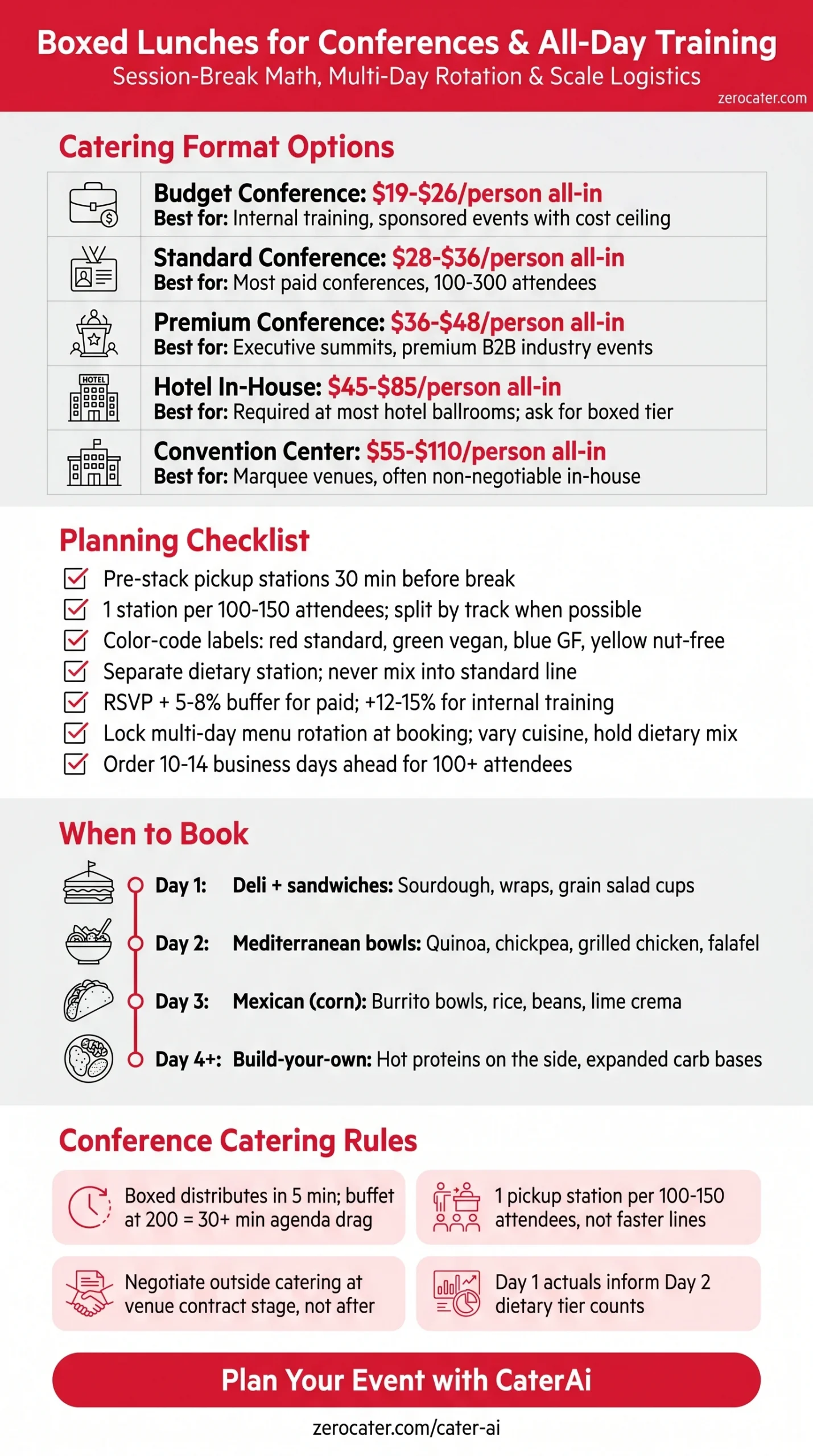
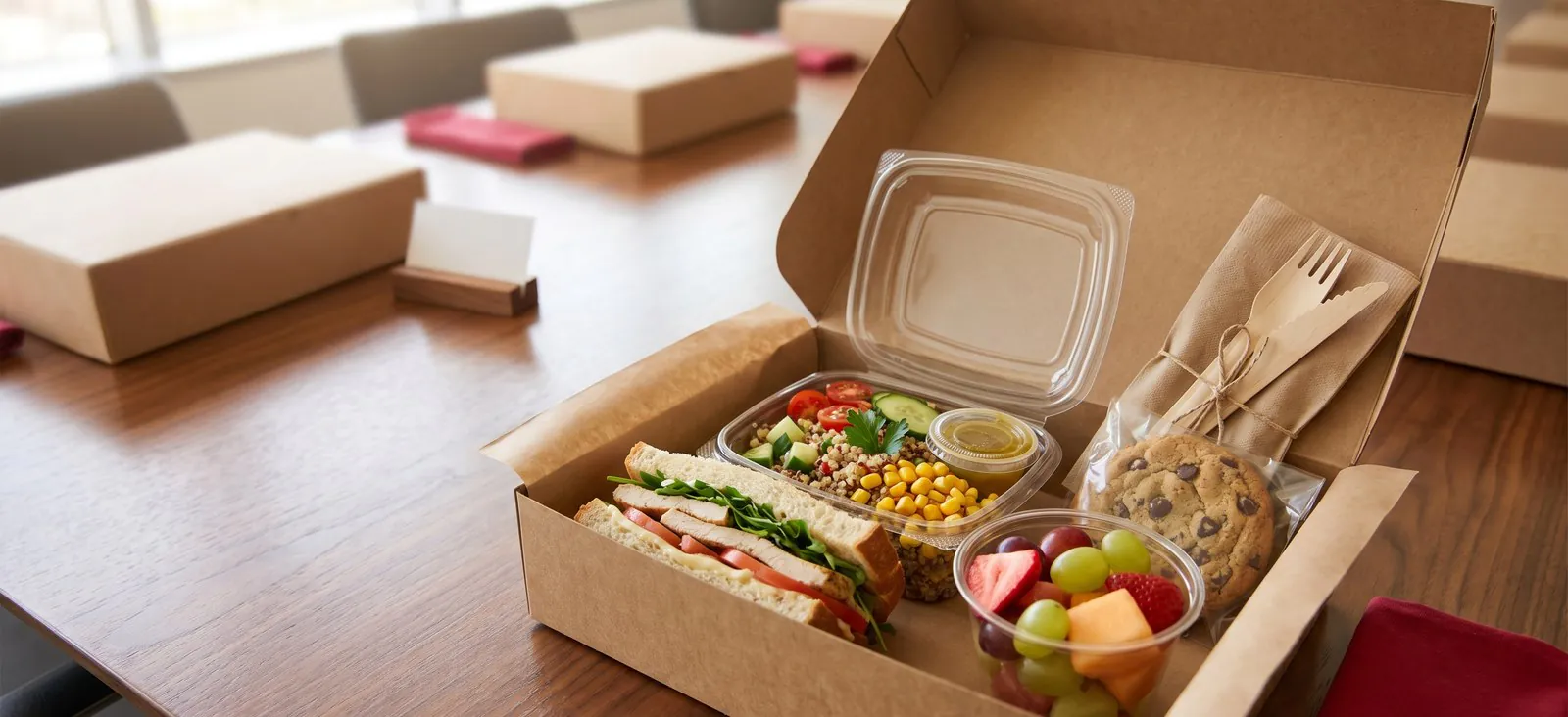
Conferences and all-day training events have a catering problem that lunch meetings do not. The break between sessions is 15 to 30 minutes, the headcount is 100 to 500, and the agenda has zero slack. A buffet line at conference scale takes 25 to 40 minutes just to clear (best case), plus 10 minutes of staff setup, plus the time to break down before the next session loads in. Boxed lunches solve the entire problem: pre-stacked at a pickup table, distributed in five minutes, eaten in fifteen, no on-site staff service, no agenda slip, no buffet bottleneck. This guide is the playbook for using boxed lunch catering at conferences and all-day training: the session-break math, the multi-day menu rotation, the track-coded distribution system, the headcount buffer rules, lead times, what it costs, and how to handle venue catering policies that try to push you back to a buffet.
In This Guide
- Why Boxed Beats Buffet at Conference Scale
- The 30-Minute Session Break Math
- Multi-Day Menu Rotation: Avoiding Day 3 Fatigue
- Headcount Math, Buffer Rules, and Day-Over-Day Adjustment
- Dietary Tracks and Color-Coded Distribution
- Scale Logistics: Pickup Stations, Staff, and Flow
- Timing: AM Coffee, Lunch, PM Snack Service
- Venue Catering Policies and How to Negotiate
- Lead Time and Booking Discipline
- What Conference Boxed Lunches Actually Cost
- Where to Order at Conference Scale
- FAQ
Why Boxed Beats Buffet at Conference Scale
For an internal team meeting of 25 people, buffet versus boxed is a preference call. For a conference of 200, it is a logistics decision with cascading agenda implications. Five reasons boxed wins at conference scale:
Buffets do not scale linearly
A buffet for 25 people takes about 12 minutes from “go” to last person seated. A buffet for 200 people, with the same dishes, takes 35 to 45 minutes from “go” to last person seated. The throughput of a single serving line is roughly six to eight attendees per minute, regardless of conference scale. A boxed pickup station processes 30 to 40 per minute. At 200 attendees, that is the difference between a 5-minute distribution and a 30-minute one.
Conference break windows are fixed
Most conference agendas allocate 30 to 45 minutes for lunch, with 15 to 20 of those minutes consumed by walking, networking, restroom, and re-seating. The actual eating window is 15 to 25 minutes. A 30-minute buffet bottleneck on a 30-minute break leaves the last attendees in line as the next session starts. Boxed lunches preserve the entire eating window for everyone.
Buffets need staffing that conferences usually do not budget
A 200-person buffet needs four to six service staff plus a captain plus a setup-and-breakdown crew. The staffing line item alone often runs $800 to $1,500 per service. Boxed lunches need one to two attendants per pickup station for box hand-off and dietary verification, total staffing cost typically $200 to $400. For a multi-day event, the staffing cost differential compounds.
Boxed lunches let attendees keep moving
Most conference attendees use the lunch break for networking, breakout sessions, exhibit hall walk-throughs, or quick calls. A buffet ties them to a single line, then a single seated meal. A boxed lunch lets them grab a meal and walk it to a networking corner, an exhibit hall, or back to their seat. For event hosts who want their attendees to move around the venue, boxed is the format that supports the program.
Boxed lunches are easier to track and cost-control
At a buffet, attendance is approximate; food cost is a function of how many people walked through, not how many ate. At a boxed lunch pickup station, every box is a discrete unit. Day 1 actuals inform Day 2 ordering. For a five-day conference, the headcount confidence improves day over day; for a buffet, the head count guesswork persists.
For the broader boxed-vs-buffet decision in non-conference contexts (smaller meetings, hybrid teams, board lunches), our boxed lunch vs. buffet guide walks through the format trade-offs in detail.
The 30-Minute Session Break Math
The single most useful planning move at a conference is to solve the catering problem against the actual break clock, not the abstract idea of “a lunch break.” The 30-minute break breaks down predictably:
| Phase | Time | What’s Happening |
|---|---|---|
| Session end + walk to foyer | 3-5 min | Attendees pack laptops, walk through aisles, exit ballroom |
| Restroom + buffer | 3-5 min | Restroom lines at conference scale add unavoidable time |
| Box pickup (boxed lunch) | 2-5 min | Walk to pickup station, grab labeled box, walk to seat |
| Eating + networking | 12-18 min | The actual meal window; networking happens parallel to eating |
| Walk back + re-seat | 3-5 min | Return to ballroom, find seat, settle for next session |
| Boxed total | ~28 min | Fits cleanly inside a 30-min break |
| Same break, buffet | ~50 min | Buffet pickup alone consumes 25-35 min for 200 people |
The buffet line steals 22 minutes from the agenda. Across a three-day conference with daily lunch and morning and afternoon snack breaks, the cumulative buffet drag is 60 to 90 minutes per day or three to five hours total. For a paid conference where session content is the product, that is a meaningful agenda compression.
Multi-Day Menu Rotation: Avoiding Day 3 Fatigue
The single complaint at multi-day conferences with boxed lunches is menu fatigue: same sandwich Day 1, same wrap Day 2, same bowl Day 3. The fix is rotation across cuisines, proteins, and starches so each day feels like a different meal even at the same per-person price point. The standard rotations:
Three-day conference rotation
| Day | Cuisine | Standard Box | Vegan / GF Variant |
|---|---|---|---|
| Day 1 | Deli / sandwiches | Sourdough turkey + provolone, grain salad cup, fruit, cookie | Hummus + roasted veg wrap (vegan); GF roll with same fillings |
| Day 2 | Mediterranean grain bowls | Grilled chicken with quinoa, chickpea, cucumber, lemon vinaigrette | Falafel bowl (vegan); same bowl, no pita (GF) |
| Day 3 | Mexican (corn-based) | Carnitas burrito bowl with rice, black beans, salsa, lime crema | Veggie/bean bowl (vegan); same bowl, GF (corn tortillas only) |
Five-day training rotation
For five-day all-day trainings, add two more cuisines to break up the week. The expanded rotation: Day 1 deli, Day 2 Mediterranean, Day 3 Mexican, Day 4 build-your-own grain bowl with hot proteins on the side, Day 5 Asian-fusion (rice bowls with grilled protein, sesame-aware labeling). The principle is the same: vary the protein, the carb base, and the cuisine.
Why dietary tiers should stay constant
Vary the standard menu day over day. Keep the dietary tier mix (vegan ratio, gluten-free ratio, nut-free protocol) constant. Attendees with confirmed dietary needs build muscle memory around what to look for on Day 1; changing the dietary system mid-event is the most common cause of dietary box mix-ups. Color-coding the labels and using the same color logic every day reinforces the muscle memory. Our allergy-safe boxed lunches guide covers the labeling protocol in detail.
Pricing the rotation
Most caterers charge a single per-person rate across the rotation as long as the cuisines are within the same tier (a Mediterranean grain bowl and a deli sandwich are roughly equivalent food cost; a sushi bento and a hot sandwich are not). For multi-day events, lock the per-person rate at booking and let the caterer handle the cuisine variation; do not negotiate per day.
Planning a multi-day conference catering rotation?
Plan boxed lunch catering with CaterAi
Tell CaterAi the conference dates, headcount, and dietary mix. CaterAi pulls vetted caterers that handle 100-plus boxed orders, multi-day rotation, and color-coded dietary labeling.
Headcount Math, Buffer Rules, and Day-Over-Day Adjustment
Conference attendance is more predictable than internal-team attendance because attendees registered and paid (or at minimum committed publicly), but it still has surprise variance from no-shows, walk-ups, and Day 1 walk-outs.
Initial buffer rules
| Event Type | Buffer Above Confirmed | Why |
|---|---|---|
| Paid conference, registered attendees | +5 to 8% | RSVPs are firm; small buffer for late additions |
| Free or sponsored conference | +8 to 12% | Higher walk-up rate, lower commitment |
| All-day training, internal company | +12 to 15% | Manager additions and floaters are common |
| All-day training, external attendees | +8 to 10% | External RSVPs land between the two extremes |
| VIP / executive sessions | +15 to 20% | Last-minute exec walk-ups carry meaningful brand cost |
Dietary tier ratios
Conferences trend higher on dietary diversity than internal team meetings. Plan a recurring boxed conference order with these tier ratios:
- Standard: 60-65 percent of total. Default Big 9 labeled, nut-free.
- Vegetarian (non-vegan): 12-18 percent. Cheese-OK; flag dairy contains.
- Vegan: 10-15 percent. Naturally covers dairy-free and most egg-free.
- Gluten-free: 8-12 percent. Verify GF status; “gluten-friendly” is not safe for celiac.
- Other allergen-aware (nut-free certified, sesame-free, halal, kosher): intake-driven, typically 2-5 percent.
Run a dietary intake question at registration (“Do you have any dietary needs we should plan around?”) to refine the ratios from generic to actual. For a 300-attendee event, a 5 percent shift on a single tier is 15 boxes; that is the difference between leftover and shortage.
Day-over-day adjustment
Track three numbers at the end of Day 1: standard boxes claimed, dietary tier boxes claimed, and total no-shows. On Day 2, drop each tier by the actual under-consumption observed. Real-world example: Day 1 ordered 300 standard, 30 vegan, 20 GF. Day 1 actuals were 280 standard, 22 vegan, 16 GF. Day 2 order: 290 standard (modest revert), 25 vegan, 18 GF. By Day 3, the order is calibrated within 2 percent of actuals.
For mid-week events that follow a familiar template, a single rolling-average adjustment after Day 1 saves food cost without the risk of Day 3 shortage. Our boxed lunches for hybrid and distributed teams guide walks through the rolling-average approach for ongoing programs.
Dietary Tracks and Color-Coded Distribution
At conference scale, the labeling system has to do work that no attendant can do in real time. The protocol that consistently lands a clean dietary distribution at 200-plus attendees:
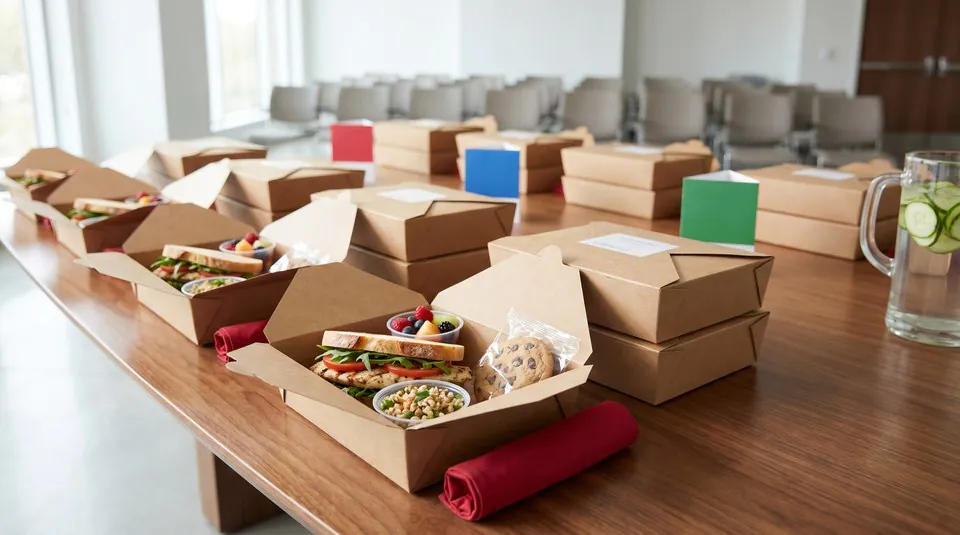
Color-code the labels by dietary tier
Use one color per tier across the entire event:
- Red label: standard, no dietary restriction.
- Green label: vegetarian and vegan (or split: solid green for vegetarian, green outline for vegan).
- Blue label: gluten-free.
- Yellow label: nut-free certified or other intake-flagged allergen.
- Purple label: halal or kosher when those are part of the intake.
The colors should match across all event communications: registration confirmation email, welcome packet, on-site signage. Attendees with dietary needs build muscle memory in the first hour; that is the goal.
Pre-stack dietary stations separately
Mixing dietary boxes into the standard stack is the most common cause of accidental box swap. The fix: a dedicated dietary station at one end of the foyer, with color-coded placards for each tier and an attendant who can verify the right box for the right attendee. For confirmed individual allergies, write the attendee’s first name on the box label and place those boxes at the dietary station for direct hand-off.
Communicate the labeling system in the welcome packet
Include a one-page “Lunch Logistics” section in the conference welcome packet (digital and printed) that explains the color-code, the pickup stations, the timing, and where to go for any dietary concerns. The packet eliminates 80 percent of the day-of “where do I get my dietary box” questions and frees the on-site staff to handle the genuinely complex cases.
Dietary verification at the station
For events of 100-plus, train one attendant to ask a simple confirmation question at the dietary station: “Are you the gluten-free meal?” If yes, hand off the labeled box. If the attendee is unsure or asks for a different tier, redirect to the standard line. This 10-second check prevents the most common error pattern (an attendee picks up a vegan box because it looked smaller, then a vegan attendee runs short).
For the broader Big 9 protocol that should sit underneath every event-scale dietary system, our allergy-safe boxed lunches guide covers the cross-contact, labeling, and intake layers in depth. For executive events with more rigorous dietary expectations, our board meeting catering guide walks through the C-suite presentation layer.
Scale Logistics: Pickup Stations, Staff, and Flow
Distribution at conference scale is a flow problem. The right answer is more pickup stations, not faster lines.
One station per 100-150 attendees
| Headcount | Pickup Stations | Staff per Station | Distribution Time |
|---|---|---|---|
| 25-50 | 1 | 1 | 3-4 min |
| 50-100 | 1-2 (standard + dietary) | 1-2 | 4-5 min |
| 100-200 | 2 (standard) + 1 (dietary) | 1-2 each | 5-6 min |
| 200-400 | 4 (split by track) + 1 (dietary) | 2 each | 6-8 min |
| 400+ | 6+ (split by track + foyer location) | 2 each | 8-10 min |
Split stations by attendee track or alphabet, not by random
For events with multiple session tracks (Track A, Track B, Track C, sponsor track), put one pickup station per track at or near the track’s exit door. Attendees walk toward the nearest station rather than queuing at one bottleneck. For events without a track structure, split alphabetically by last name (A-L at one station, M-Z at another) and post the split clearly on the welcome packet.
Where to put the stations
The right physical location is the foyer or hallway adjacent to the main session ballroom, never inside the ballroom and never in the exhibit hall (exhibitors will object if a 200-person line forms in front of their booths). For multi-floor venues, put a pickup station on every floor where sessions run, even if some floors only have 30 attendees; the cost of a small extra station is far below the cost of an elevator backup.
Staff: caterer-provided vs event-provided
Most caterers will include one to two delivery staff in the per-person price for orders of 100-plus. For events of 200-plus, ask the caterer to confirm dedicated on-site distribution staff for the first 30 minutes of the lunch break; this is usually included but not always. For events of 400-plus, expect to add one to two event-provided volunteers per pickup station for traffic management.
Trash and recycling
Plan two waste-collection points per pickup station: one for the boxed lunch (compostable kraft cardboard) and one for the plastic clamshells (recycling). Conference venues with sustainability commitments will require this; standard hotel ballrooms often only have a single trash stream and need a special request. Confirm at the venue walkthrough.
Timing: AM Coffee, Lunch, PM Snack Service
A full conference day usually has three catering services: morning coffee and continental breakfast, lunch, and an afternoon snack break. Boxed lunches are the lunch format; the AM and PM services are usually buffet-style because the format constraint is different.
Morning coffee and continental breakfast (7:30-8:30 AM)
Drop coffee carafes (one per 15 attendees), tea carafes, and a continental tray with bagels, pastries, fruit cups, and yogurt cups at the foyer pickup tables 30 minutes before sessions start. Attendees graze in waves as they arrive; no boxed format needed because attendance is staggered and people are coming in solo. For board-room style breakfast service that works at scale, our boxed breakfast catering for morning meetings guide covers the format options when boxed makes sense.
Lunch (typically 12:00-12:45 PM)
Boxed lunches drop at the venue 30 minutes before the lunch break starts. Stations pre-stacked, color-coded placards in place, attendants briefed on dietary tiers. Drop time is non-negotiable; ask the caterer to confirm the drop window at booking and include in the contract.
PM snack break (3:00-3:30 PM)
An afternoon snack table refreshes the room and gives attendees a non-meal energy lift. Standard package: granola bars, whole fruit (apples, bananas, oranges), trail mix in unbranded individual cups, fresh-baked cookies, fresh coffee refresh. $5 to $10 per attendee. For multi-day events, vary the PM snack day-over-day (cookies Day 1, charcuterie cups Day 2, fruit-and-cheese Day 3) to avoid the same fatigue problem as lunch.
Late-day reception (optional, 5:00-6:30 PM)
For first-day or last-day conference receptions, pivot away from boxed and into shared platters and stations: a charcuterie spread, hors d’oeuvres, hot pass-arounds. Boxed is the wrong format for an active networking reception because the form factor blocks one of the hands.
Venue Catering Policies and How to Negotiate
The single biggest cost lever at a conference is whether the venue allows outside catering. The variance is dramatic.
Hotels and traditional convention centers
In-house catering required, no outside food allowed. Per-person pricing typically runs $35 to $65 per box at a hotel ballroom, $40 to $80 at a marquee convention center, before service charge and tax. The hotel will default to upsell-priced buffet packages and need to be specifically asked for the boxed lunch tier. The boxed tier exists at almost every hotel; it is just not the front-of-menu option.
Co-working venues and conference centers
Outside catering usually allowed; per-person boxed lunch pricing drops to the $18 to $32 standard catering range. The cost difference at 200 attendees over three days is roughly $9,000 to $20,000.
University event spaces, corporate campuses, civic venues
Outside catering usually allowed; per-person pricing matches the standard catering range. Some university spaces have an in-house option that is competitive with outside; check both.
The negotiation timing
Negotiate outside catering at the venue contract stage, not after. Once the venue agreement is signed with an in-house catering clause, the leverage is gone. The right negotiating posture: “We want to bring in our catering partner. What is the venue’s policy on outside catering, and what would the per-person spread be between in-house and outside?” The venue may accept outside catering with a fee (5-15 percent of the catering bill paid to the venue) which is usually still a net win at conference scale.
If the venue is locked to in-house
Three angles still work:
- Ask for the boxed tier explicitly. “We want individually packaged boxed lunches, not the buffet package. What is your boxed catering option?”
- Bundle the menu rotation. Most hotels prefer to repeat one menu across the conference; ask for a three-day rotation to keep attendees fresh.
- Negotiate dietary tier inclusion. Hotels often charge an upcharge for vegan or GF; ask for them included at the same rate.
Lead Time and Booking Discipline
Conference catering is one of the few catering scenarios where 10 to 14 business days of lead time is the right answer, not the cautious one.
Why the long lead time matters
For orders of 100-plus boxes, most catering kitchens cannot drop a fresh order on three days notice without renegotiating their existing schedule. The 10 to 14 day runway covers four operational steps:
- Kitchen capacity planning. The caterer reserves prep capacity, sources volume ingredients, and may need to bring in extra prep staff for the conference week.
- Multi-day menu coordination. The full rotation gets locked at the booking stage; same-day swaps after Day 1 are operationally hard once Day 1 is prepped.
- Dietary intake processing. Registration intake, dietary tier ratios, allergen-specific labels, and any individual confirmed allergies all need 5 to 7 business days in advance.
- Venue logistics walkthrough. Drop windows, pickup station setup, trash routes, and any in-house-catering coordination if the venue has restrictions all need to be signed off 3 to 5 business days before Day 1.
Internal training events with shorter timelines
For internal all-day training of 50 to 100 attendees, 5 to 7 business days is usually enough. The kitchen capacity bar is lower, the dietary intake is faster (employees are easier to survey than external attendees), and the venue is usually a corporate office that does not have catering restrictions. For internal training of 100-plus or external attendees, default back to the 10-14 day window.
The booking checklist
At booking, lock the following in writing with the caterer:
- Day-by-day menu rotation with dietary tier variants per day.
- Dietary tier ratios per day with attendee-name flags for confirmed allergies.
- Drop window per day (specific time, not “morning”).
- On-site distribution staff count, station setup expectations.
- Day-over-day adjustment policy (how late can you change Day 2 counts?).
- Per-day per-person price, total cost, payment terms.
- Backup-caterer escalation path if a kitchen issue derails Day 1.
For high-stakes conferences with executive presentations or external press, the booking discipline doubles as risk management. A clean handoff document at booking eliminates 80 percent of the on-site fire drills. For internal training programs that recur monthly or quarterly, our office manager’s guide to ordering catering covers the recurring-program operational layer.
What Conference Boxed Lunches Actually Cost
Conference per-person catering pricing runs slightly above standard office catering because of presentation, menu rotation, dietary depth, and on-site distribution staffing.
| Tier | Menu Price | All-In w/ Service | Where It Fits |
|---|---|---|---|
| Budget conference | $15-$20 | $19-$26 | Internal trainings, sponsored conferences with cost ceilings |
| Standard conference | $22-$28 | $28-$36 | Most paid conferences, professional events 100-300 attendees |
| Premium conference | $28-$38 | $36-$48 | Executive conferences, industry summits, premium B2B events |
| Hotel in-house | $35-$65 | $45-$85 | Required at most hotel ballrooms; ask for boxed tier specifically |
| Convention center in-house | $40-$80 | $55-$110 | Marquee convention centers, often non-negotiable |
What the all-in number includes
The all-in number assumes the menu price plus delivery (8-12 percent), service or admin fee (10-15 percent), tip (15-20 percent on staffing), and tax (varies by city, typically 4-10 percent on prepared food). For conference-scale orders, ask for the all-in line-item quote at booking; “menu price” alone can hide a 30-40 percent uplift.
Volume pricing
For multi-day conferences with 100-plus attendees per day, ask for volume pricing of 5 to 10 percent off the menu rate. Most caterers will offer 5 percent at 100 boxes per day across three days, 8-10 percent at 200-plus per day. The leverage is real because the caterer is reserving kitchen capacity for multiple days.
Where boxed loses to buffet on cost
For very small in-room training (under 25) where buffet setup is fast and labor is light, buffet can be 10-15 percent cheaper per person. This is the only scale where the cost calculus runs the other way. Above 50 attendees, boxed wins on per-person cost when staffing is properly priced. For city-by-city pricing context, see our cost guides for NYC, SF, and Chicago.
Where to Order at Conference Scale
Most of Zerocater’s 1,000-plus partner network handles conference-scale boxed orders, but the kitchens that consistently deliver at 100-plus per day with multi-day rotation are a smaller subset. Categories worth bookmarking:
- Sub and deli chains (Day 1 sandwich rotation): Jersey Mike’s (Chicago), Capriotti’s (Denver), Joe’s Pizza (NYC) for Italian sub variants.
- Mediterranean and grain bowls (Day 2 rotation): Hummus Mediterranean Kitchen (Bay Area), Zo’s Salads & Bowls (Bay Area).
- Mexican and corn-based (Day 3 rotation): Renegade Burrito (Denver), Tio Luis Tacos (Chicago), Curry Up Now (San Francisco) for Indian-inspired wraps and bowls as a fourth-day variant.
- American and bagel-forward (AM continental): Murray’s Bagels (NYC), The Picnic Basket (NYC) for premium continental.
For city-by-city catering provider lists, see our 15 Best Corporate Event Catering guides: NYC, SF, Chicago, LA, Seattle, Denver, D.C., Boston, Atlanta, and Dallas. For brand-driven choices when the conference brief is national consistency across multiple cities, see our brand guides for Jersey Mike’s, Panera, Sweetgreen, and QDOBA.
Frequently Asked Questions
Why are boxed lunches better than a buffet for conferences and all-day training?
Conference break windows are 15 to 30 minutes between sessions. A buffet line for 100 people takes 25 to 35 minutes just to clear, plus another 10 minutes of staff setup. Boxed lunches distribute in five minutes from a pickup table because there is no service step. Each attendee grabs a labeled box, walks back to their seat or a hallway, and is eating within two minutes. For multi-day events that run on tight session schedules, boxed lunches preserve the agenda; buffets shorten it by 30 to 60 minutes per day. Our boxed vs. buffet guide covers the format trade-offs in detail.
How long does it take to distribute boxed lunches at a conference?
For 100 to 200 attendees, plan four to six minutes from break-bell to last-box-claimed when you set up multiple pickup stations. The math: one pickup station processes about 30 to 40 attendees per minute when boxes are pre-stacked and labeled. For 200 attendees, set up two stations of 100 boxes each at opposite ends of the foyer; for 400, use four stations split by track or attendee group. Add one staff member per station for box hand-off, dietary verification, and headcount tracking.
How do you menu-rotate boxed lunches across a multi-day conference?
Plan a different cuisine each day for events of two or more days so attendees do not get menu fatigue. The standard three-day rotation is Day 1 sandwiches and wraps, Day 2 grain bowls or Mediterranean, Day 3 Mexican or Asian-fusion. For five-day events, add a salad-forward day and a build-your-own day. Vary the protein, the bread or grain base, and the side cup; keep the dietary tier mix (vegan, GF, nut-free) consistent across days so attendees with confirmed dietary needs see the same labeling pattern every day.
How many boxed lunches should I order for a conference?
Order to confirmed registration plus 5 to 8 percent buffer for conferences (RSVPs are firmer than for internal meetings) and plus 12 to 15 percent for first-day all-day trainings (walk-ins are common). For multi-day events, drop the buffer by half on Days 2 and 3 because actual attendance is more predictable after Day 1. Track day-over-day count by dietary tier; if 18 vegan boxes were ordered and 12 were claimed on Day 1, drop the Day 2 vegan order to 14.
How do you handle dietary tracks at a conference with boxed lunches?
Color-code the labels by dietary tier (red for standard, green for vegetarian or vegan, blue for gluten-free, yellow for nut-free or other allergen-aware) so attendees can identify their box at a distance from the pickup line. Pre-stack the dietary boxes at a separate dietary station instead of mixing them into the standard line; this prevents accidental box swap and lets the dietary-needs attendees collect their meals without searching through the standard stack. Communicate the labeling system in the conference welcome packet so attendees know what to look for on Day 1. Our allergy-safe boxed lunches guide covers the Big 9 layer underneath.
How much does conference boxed lunch catering cost per person?
Conference boxed lunches typically run $18 to $32 per person delivered, slightly above standard office boxed lunch pricing because of premium presentation, more elaborate menu mix, and the multi-day rotation. Expect a 25 to 35 percent uplift on the menu price for delivery, service, and tip in major metro venues. Multi-day conferences with 100-plus attendees often qualify for volume pricing of 5 to 10 percent. Budget separately for AM and PM coffee or snack breaks, which add $4 to $10 per person per service.
What is the lead time for ordering conference boxed lunches?
Order 10 to 14 business days ahead for conferences of 100-plus attendees. The extra runway covers caterer kitchen capacity planning (most kitchens cannot drop a 300-box order on three days notice), multi-day menu coordination, dietary intake processing, color-coded label printing, and venue logistics walkthrough. For multi-day events, finalize the full menu rotation at the booking stage; same-day swaps are operationally hard once the kitchen has prepped Day 1.
Do conference venues let you bring in outside boxed lunch caterers?
It depends on the venue. Hotel ballrooms and traditional convention centers usually require their in-house catering and charge the highest per-person rates. Co-working venues, conference centers, university spaces, and corporate campuses often allow outside caterers and can cut the per-person cost by 30 to 50 percent. Confirm the catering policy at the venue contract stage; the right time to negotiate outside catering is before signing, not after. If the venue requires in-house, ask for the boxed lunch tier specifically (most hotels default to upsell-priced buffets and need to be asked for the boxed option).
Plan boxed lunch catering with CaterAi