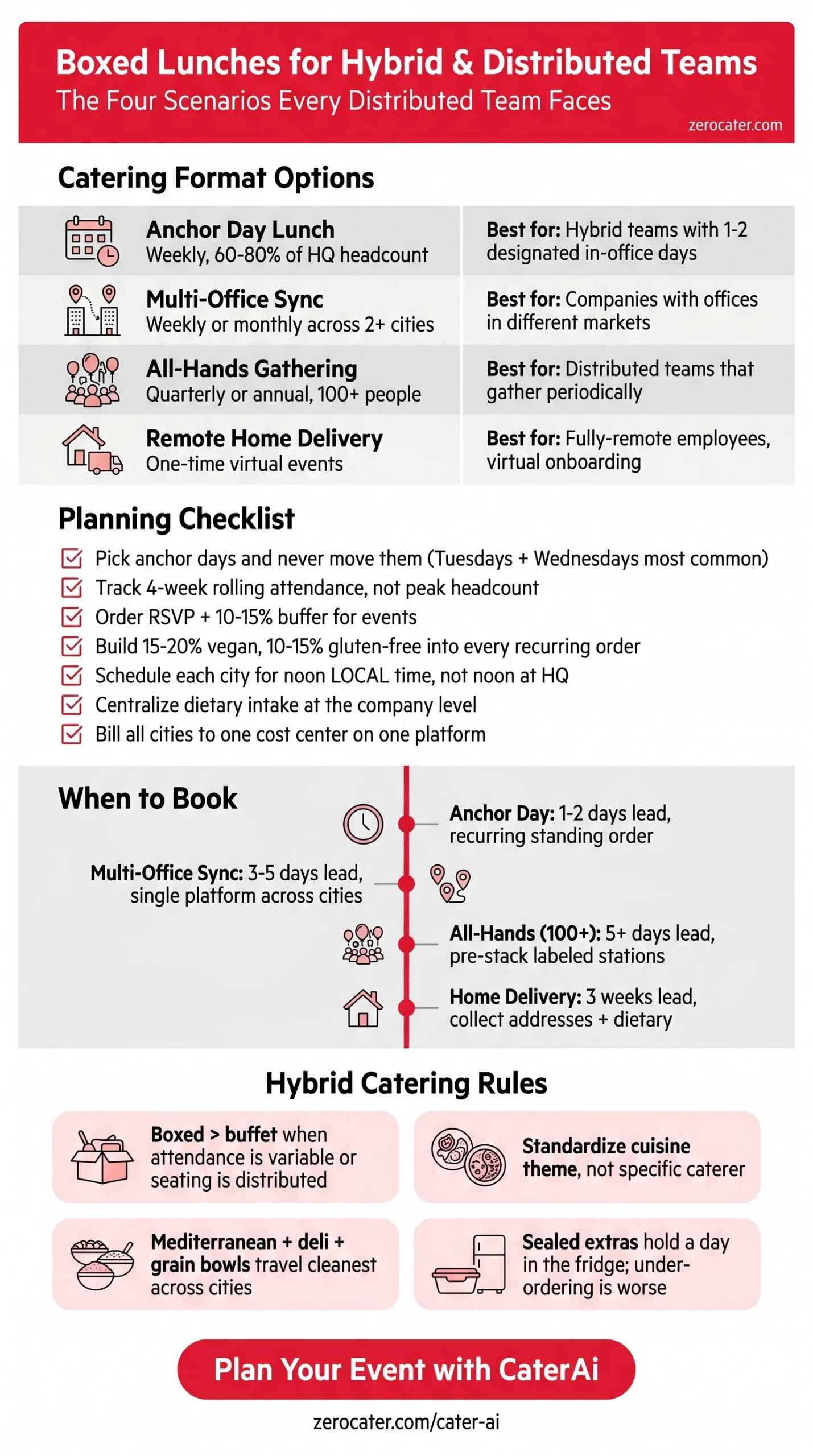
Hybrid and distributed teams have one catering problem in common: the headcount is never the same twice and the people are not always in the same place. Boxed lunch catering is the format built for that. Each person gets their own sealed, individually labeled meal, so a 60% attendance day works the same as a 95% attendance day. For multi-office companies, the same menu lands in every city at noon local time. For all-hands gatherings, 200 boxed lunches distribute in five minutes versus 30 plus for a buffet line. This guide is the playbook for using boxed lunch catering across the four scenarios distributed teams actually face: anchor days, multi-office sync, all-hands gatherings, and home delivery for fully-remote employees.
In This Guide
- Why Boxed Lunches Win for Hybrid and Distributed Teams
- The Four Hybrid Catering Scenarios
- 1. Anchor Day Catering
- 2. Multi-Office Synchronized Catering
- 3. All-Hands and Quarterly Gathering Lunches
- 4. Home Delivery for Fully-Remote Employees
- Headcount Math for Hybrid Teams
- Dietary Inclusion at Distributed Scale
- The Multi-Office Ordering Playbook
- Frequently Asked Questions
Why Boxed Lunches Win for Hybrid and Distributed Teams
Buffet catering was built for an office where every Monday-through-Friday looked the same: 95% attendance, lunch eaten in the same room, headcount predictable to the seat. Hybrid offices break every one of those assumptions. Here is what changes when you switch to boxed lunches:
Headcount can fluctuate without breaking the order
If 12 people RSVP and 18 show up, the buffet runs out by the time the second wave hits the line. If 20 RSVP and 12 show up, you watch trays of food go to waste. With boxed lunches, you order for confirmed attendance plus a small buffer, sealed extras hold for the next day, and a low-attendance week is simply a smaller order. There is no tray-shaped hole in the budget.
Distributed seating works fine
Hybrid days rarely cluster everyone in one conference room. Some people are at their desks, some in calls with remote colleagues, some grabbing 15 minutes between meetings. Boxed lunches can travel anywhere in the building and survive an hour at room temperature. Buffets do not. If your office has more than one floor or more than one wing, boxed lunches are usually the only format that actually feeds everyone.
Dietary needs are tracked at the individual level
A buffet line forces everyone to inspect every dish in real time. A boxed lunch program asks for dietary preferences once at signup and labels every meal accordingly. For a 50-person hybrid team where 15 people have some kind of dietary need, that single difference saves an hour of awkward inspection at the buffet line. Our guide to ordering catering for mixed dietary needs walks through the labeling and headcount math.
Multi-office becomes operationally possible
Trying to run a buffet in seven cities simultaneously is a logistical nightmare: equipment, staff, and timing have to land in seven places at once. Boxed lunches scale across cities trivially because the order is just headcount plus address. Most major catering platforms can deliver to NYC, SF, Chicago, LA, Boston, DC, Seattle, Atlanta, Dallas, Austin, and Denver on the same day with the same menu theme.
Remote employees can be included
For all-hands moments where the company wants to feed every employee, including remote workers at home, individual packaged meals are the only catering format that ships. A buffet does not box up and ship to someone’s apartment. A boxed lunch effectively does, just routed through a local restaurant in the employee’s city.
The Four Hybrid Catering Scenarios
Every distributed team’s catering needs collapse into four distinct scenarios. Each one has a different optimal approach, but boxed lunches are the through-line:
| Scenario | Frequency | Format | Best For |
|---|---|---|---|
| Anchor Day Lunch | Weekly recurring | Boxed, drop-off | Hybrid teams with 1-2 designated in-office days |
| Multi-Office Sync | Weekly or monthly | Boxed, drop-off, multi-city | Companies with 2+ offices in different cities |
| All-Hands Gathering | Quarterly or annual | Boxed at scale (100+) | Distributed teams that gather periodically |
| Remote Home Delivery | One-time events | Individual meals to home addresses | Virtual all-hands, onboarding, team milestones |
The rest of this guide walks through each one.
1. Anchor Day Catering
Anchor days are the in-office days a hybrid company designates, most commonly Tuesdays and Wednesdays. Roughly 70% of hybrid policies cluster around a 2-3 day in-office week, and Tuesday-Wednesday is the most common pairing because it captures mid-week productivity without forcing Monday or Friday compliance.
Anchor day catering is the recurring lunch program built around those days. The pattern looks like this:
- Cadence: One or two boxed lunch orders per week, on the same days, every week.
- Headcount: Variable. A 100-person hybrid team might see 60-80 in-office on a typical anchor day.
- Menu: Rotating cuisine so the same people do not get the same meal every Tuesday.
- Format: Boxed lunches, drop-off only. No staffing, no buffet equipment.
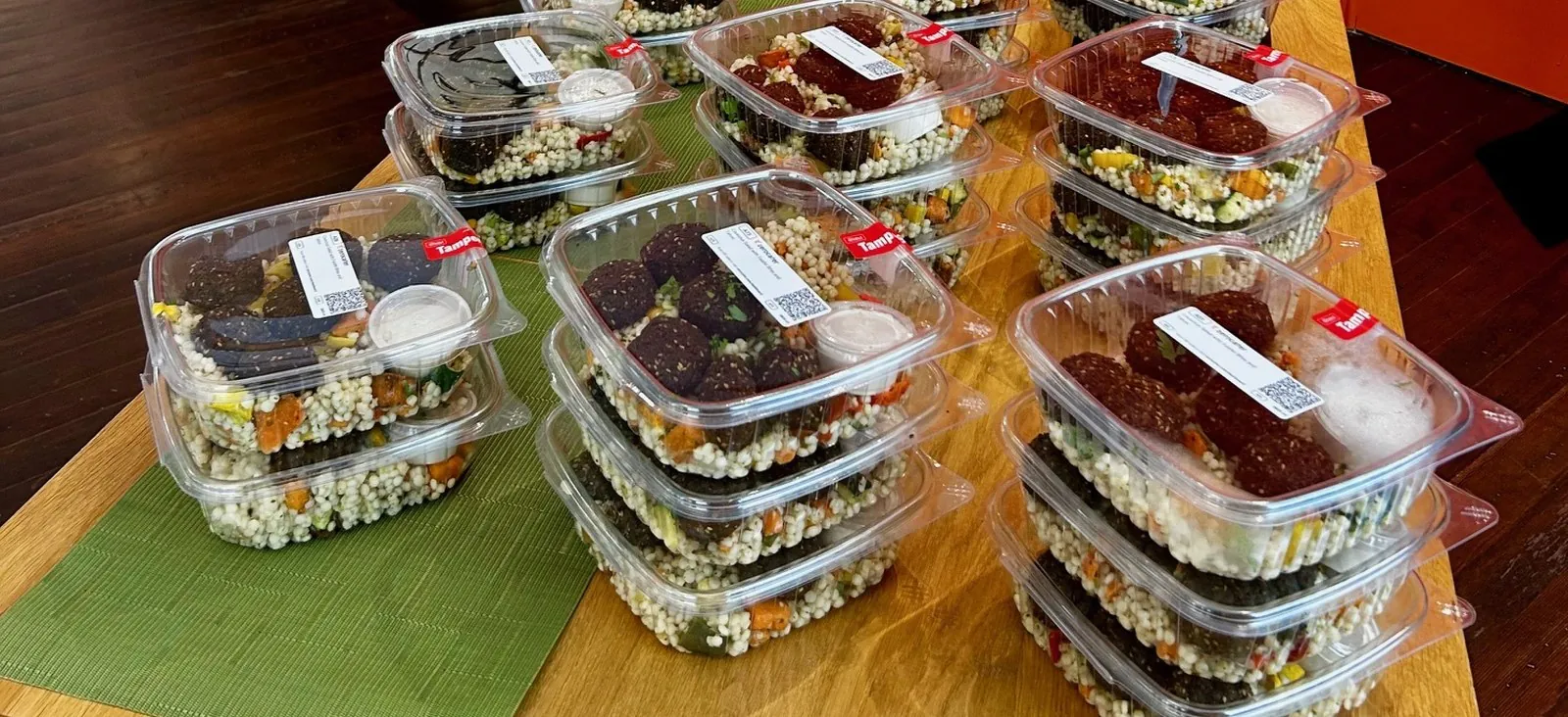
- Distribution: Stack in the kitchen or at a designated grab-and-go counter. Self-serve.
Why boxed beats buffet for anchor days: attendance is volatile (an offsite, a holiday week, a snowstorm can swing in-office headcount by 30%), employees are spread across desks and meetings, and the program is recurring so dietary preferences can be collected once and used every week. Buffet catering only makes sense for anchor days when the entire team eats together in one room, which is rare.
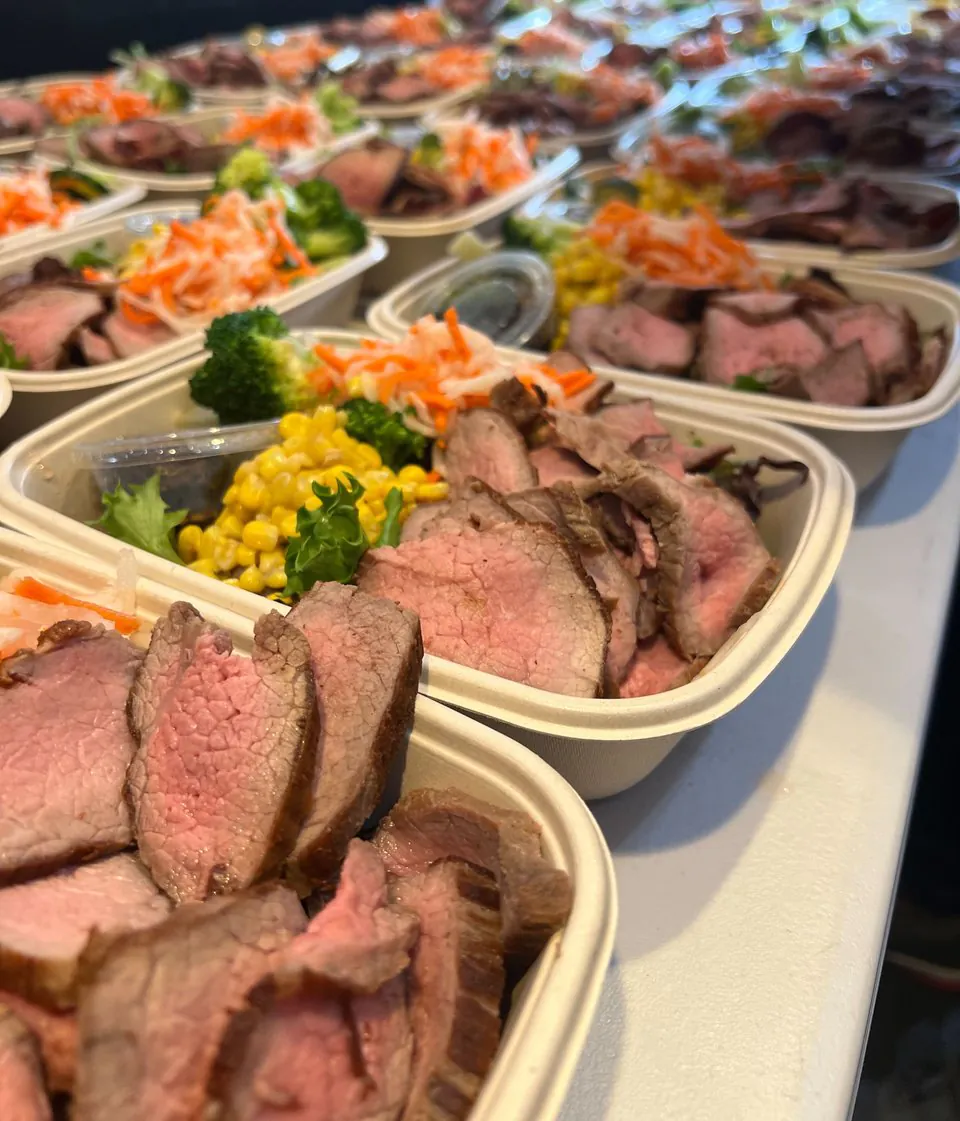
Setting up an anchor day program
Three steps:
1. Lock the cadence. Pick one or two specific days each week and commit. Inconsistent days train employees to ignore the program. The point of anchor day catering is that in-office days come with food, every time.
2. Build a four-week menu rotation. Mediterranean Tuesday, Mexican Wednesday, deli Tuesday, Asian Wednesday, repeating. A four-week rotation is long enough that nothing repeats too often, short enough to manage. See our complete boxed lunch catering guide for meetings for menu structure.
3. Set headcount on a four-week rolling average. Track actual attendance for the first month, then set a standing order at the average plus 10%. Adjust quarterly. This avoids both running out and over-ordering.
For setup, a recurring corporate catering program handles the operational layer (account management, dietary tracking, billing). For one-off anchor days you want to test before committing, CaterAi compares menus across 1,000 plus vetted caterers in real time so you can see what is available in your city.
2. Multi-Office Synchronized Catering
Companies with offices in multiple cities face a different version of the hybrid problem. Even if each individual office is fully on-site, the team is geographically distributed across markets, and synchronized lunches are how you keep team identity intact when everyone is not in the same building.
The classic use cases:
- Quarterly themed lunches: Same theme delivered in NYC, SF, and Chicago on the same day. “International Cuisine Week” lands as Mediterranean in NYC, Korean BBQ in SF, and Indian in Chicago, all delivered at noon local time.
- Monthly engagement events: A standing “First Friday Lunch” program where every office gets the same meal theme, varied by local cuisine availability.
- Customer success milestones: A celebration lunch for the whole company when a major contract closes, delivered everywhere simultaneously.
- Remote office equity: Closing the perception gap where HQ employees get more perks than satellite offices. Synchronized catering visibly says every office matters.
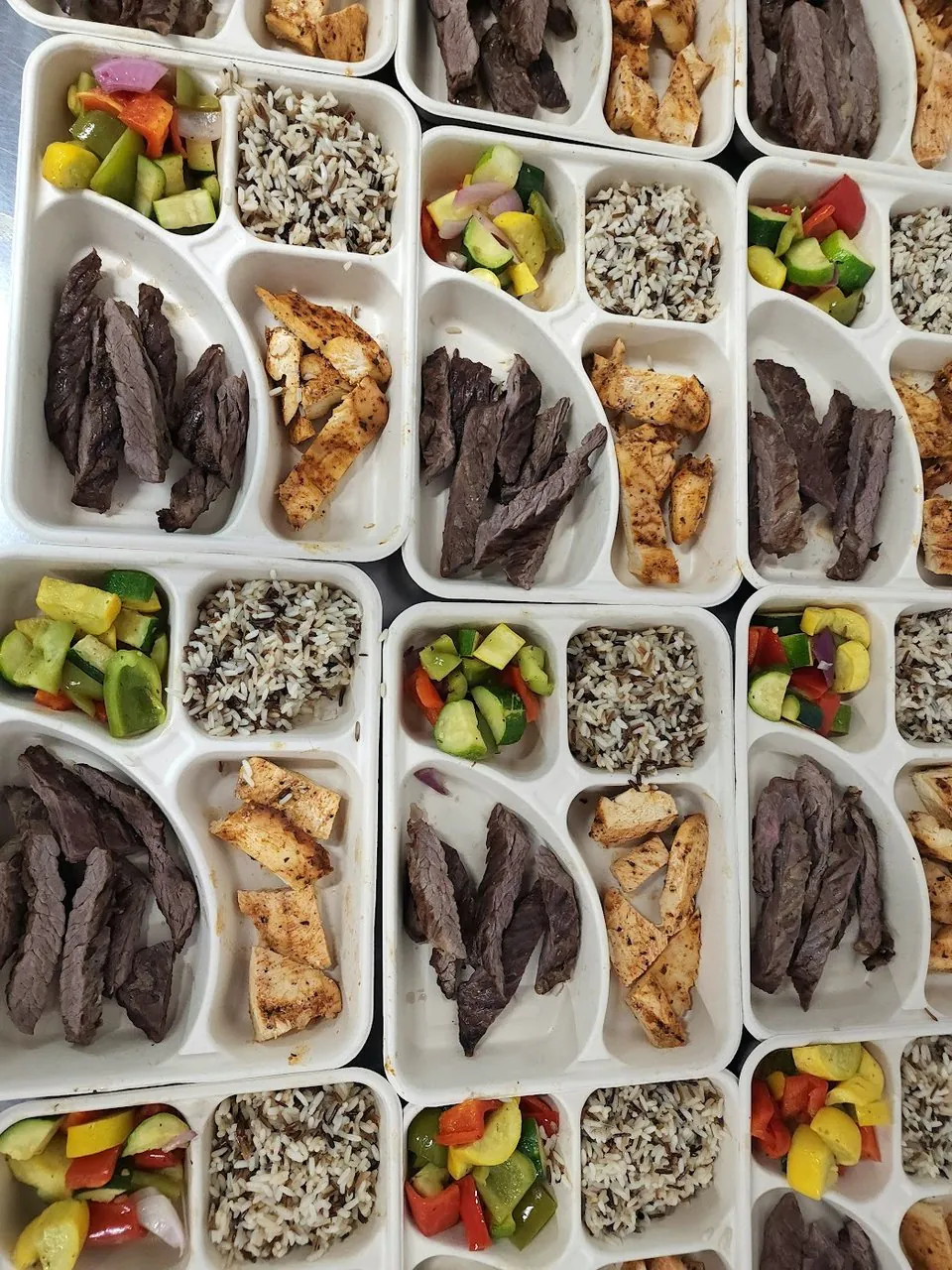
Cities where synchronized catering works at scale
Major catering platforms operate in most US metros. Zerocater serves the following with full boxed lunch coverage:
| City | Boxed Lunch Caterers | Local Cost Reference |
|---|---|---|
| New York City | 200 plus partners across all 5 boroughs | NYC cost guide |
| San Francisco | 150 plus partners (SF, Oakland, peninsula) | SF cost guide |
| Chicago | 120 plus partners (Loop, suburbs) | Chicago cost guide |
| Los Angeles | 100 plus partners across LA County | LA caterer list |
| Boston | 80 plus partners (Cambridge, Seaport, downtown) | Standard tier |
| Washington D.C. | 70 plus partners (DC, NoVa, MoCo) | D.C. caterer list |
| Seattle | 60 plus partners (Seattle, Bellevue, Redmond) | Seattle caterer list |
| Atlanta | 50 plus partners (Midtown, Buckhead, perimeter) | Atlanta caterer list |
| Dallas | 50 plus partners (downtown, Plano, Frisco) | Dallas caterer list |
| Austin | 40 plus partners (downtown, north Austin) | Close to national |
| Denver | 40 plus partners (LoDo, Boulder, suburbs) | Denver caterer list |
For multi-office programs to feel coordinated, the menu should land within the same cuisine family even if the specific caterers differ. Mediterranean is one of the easiest themes to standardize because it travels well across all major US markets and packs cleanly into individual boxes. Browse Mediterranean catering options nationally, including Zaatar Mediterranean in SF and A Saffron Thread in NYC.
3. All-Hands and Quarterly Gathering Lunches
The all-hands gathering is the inverse problem of an anchor day: instead of feeding a fluctuating subset, you are feeding the entire distributed team in one room, often once or twice a year, often with one shot to get it right.
The numbers are different at this scale:
- Headcount: 100 to 500 plus, depending on company size.
- Distribution time pressure: Most all-hands meetings have a 30-45 minute lunch window before the next session. Buffet lines for 200 people can take 25-40 minutes; everyone is still standing in line when the next session starts.
- Dietary complexity: Higher than anchor days because employees from multiple offices arrive with preferences set in their home cuisine markets.
- One-shot logistics: If something goes wrong (delayed delivery, missing dietary boxes, wrong headcount), there is no rerun next week.
Boxed lunches are the format that actually scales here. Two hundred boxed lunches distribute in under five minutes if they are pre-stacked on tables labeled by dietary preference. The same volume through a buffet line takes six to eight times longer.
The all-hands boxed lunch playbook
Order 5 days ahead. All-hands volume requires coordination from the caterer. Lead time matters more than at any other format.
Set up labeled stations. One table for vegan boxes, one for gluten-free, one for standard. Pre-sorted distribution turns chaos into a 5-minute grab.
Use rectangular tables, not round. Long rectangular tables let people line up on both sides simultaneously. Round tables force a single line.
Build in a 10% buffer. All-hands attendance can spike past RSVPs because internal events draw last-minute drop-ins.
Pre-place water at every chair. Box drinks add to distribution complexity; pre-set water means the box only needs to contain food.
For event-specific catering, Zerocater event catering handles the all-hands scale end to end (headcount management, dietary breakdown, multi-station setup, on-site coordination). For event types beyond all-hands, see our board meeting catering guide.
4. Home Delivery for Fully-Remote Employees
The hardest scenario: feeding employees who do not come into any office because they are fully remote, working from home cities scattered across the country.
For ongoing meals, recurring home delivery is rarely cost-effective compared to a stipend or restaurant credit program. The math: a $25 boxed lunch delivered to a single home address often costs the platform $40 plus all-in (food plus delivery to a residence plus packaging plus tip), versus $25 going directly to the employee through a meal stipend.
For one-time virtual events though, individual meal delivery is exactly the right format. The use cases:
- Virtual all-hands lunch: The CEO addresses the team for an hour, everyone eats lunch together on Zoom, lunches arrive at every employee’s home in time.
- Virtual onboarding: A new hire’s first day includes a welcome lunch shipped to their home, paired with a virtual lunch with their team.
- Team milestones: Project launches, work anniversaries, end-of-quarter celebrations where the company wants to feed everyone simultaneously.
- Hybrid kickoffs: An offsite where the in-person attendees eat boxed lunches in the office and remote attendees eat the same theme delivered to their door.
How home delivery actually works
For remote home delivery, most catering platforms partner with restaurant networks in each employee’s city. Practically speaking, the delivery is closer to a curated restaurant gift card than traditional catering: each employee picks from a handful of pre-vetted restaurants in their city, the meal is delivered at the scheduled time, and the company gets a single invoice. This is the only catering format where the per-meal cost is consistent across every employee regardless of where they live (because the platform absorbs market price differences into the program rate).
For event-specific home delivery, plan for:
- 3 weeks lead time to collect home addresses and dietary preferences.
- One-hour delivery windows rather than precise times (delivery infrastructure outside major metros is less precise than office catering).
- An RSVP cutoff at least 5 business days before the event so the platform can set up restaurant partners.
Planning catering for a hybrid or distributed team?
Plan boxed lunch catering with CaterAi
Tell CaterAi your headcount, cities, and dietary needs. See custom menu options across 1,000 plus vetted caterers in minutes.
Headcount Math for Hybrid Teams
Hybrid attendance is the variable that breaks most catering programs. The fix is not to guess; it is to track and average. Here is the headcount math that actually works for hybrid teams:
For ongoing programs (anchor days)
Weeks 1-3: Track actual attendance. Order at the planning headcount you would have used for buffet (typical 70-75% of total team), label it a learning period, count what actually shows up.
Week 4: Calculate a 4-week rolling average. Drop the highest and lowest weeks, take the mean of the middle two. That is your standing order baseline.
Adjust quarterly. Hybrid attendance drifts (new hires, RTO mandates, seasonal patterns). Recalculate the rolling average every 13 weeks and adjust.
Add a 10% buffer. Sealed boxed lunches survive a day in the kitchen fridge, so a small over-order is forgiving. Under-ordering is much worse than over-ordering by 10%.
For events (all-hands, offsites)
Require RSVPs. Set an RSVP cutoff 5 business days before the event.
Order at RSVP plus 10%. Internal events tend to draw 5-12% drop-ins beyond the RSVP list.
Pre-allocate dietary boxes. For a 100-person all-hands, plan 15-20 vegan boxes, 10-15 gluten-free, and 10 nut-free as a default. Adjust based on RSVP data if available.
For more on coordinating headcount, dietary, and timing for a meeting, see our office manager’s guide to ordering catering.
Dietary Inclusion at Distributed Scale
A hybrid catering program cannot afford to handle dietary needs case by case. Build inclusion into the standing menu instead. The rule of thumb:
| Dietary Category | Default % of Order | Notes |
|---|---|---|
| Vegan | 15-20% | Should be a strong meal, not “veggie sandwich without protein” |
| Vegetarian (non-vegan) | 10-15% | Can overlap with vegan options |
| Gluten-free | 10-15% | Grain bowls and salad-based boxes work well |
| Nut-free | All boxes labeled if contain nuts | Many caterers default to nut-free; verify per order |
| Halal | Plan based on team composition | Mediterranean and Middle Eastern caterers default to halal |
| Kosher | By request only | Requires certified caterer; adds significant per-meal cost |
The cost premium for dietary inclusion is small (vegan and gluten-free typically add $0-3 per box compared to the standard version) and it solves a problem that compounds at scale. A 50-person team where 15 people have unmet dietary needs every week is a 30% engagement leak. For the full dietary playbook, see our guide to ordering catering for mixed dietary needs and our vegan office catering guide.
Cuisines that handle dietary inclusion well by default include Mediterranean (lots of vegan and gluten-free options without substitutions), Mexican (rice and bean bowls work for vegan, corn tortillas for gluten-free), and grain bowl formats. Browse vendor pages including Curry Up Now, A Saffron Thread, and Saigon Sisters for menu reference.
The Multi-Office Ordering Playbook
The single biggest operational gap distributed teams hit: every city office manager has their own preferred caterers, billing flow, and dietary tracking, and synchronized programs become impossible to maintain. The fix is centralization.
Five rules for multi-office boxed lunch programs
1. One platform, one account. Run all city orders through a single catering platform with multi-city coverage. Per-city caterer relationships work for one-off events but break down for recurring programs.
2. Standardize the menu theme, not the caterer. Pick a cuisine theme each week (Mediterranean, deli, Mexican, Asian) and let local caterers in each city execute the theme. Standardizing on one specific caterer almost never works because no caterer operates in all your markets.
3. Schedule at noon local, not noon at HQ. Cross-time-zone catering needs to deliver at noon in each city, not at one absolute time.
4. Centralize dietary intake. Collect dietary preferences once at the company level, not per-city. Use a single source-of-truth list that the catering platform pulls from.
5. Bill to one cost center. Per-city accounts payable wreck the unit economics of the program. One invoice per month from one platform is the operational baseline.
For companies running this at scale, Zerocater’s corporate catering programs handle the multi-office layer end to end. For event-specific multi-city orders, CaterAi handles the menu comparison and ordering. Either way, the goal is to put one platform between your finance team and the per-city operational complexity.
For the broader cost reference across formats and cities, see our boxed lunch catering cost guide and the format-decision boxed lunch vs. buffet comparison.
Frequently Asked Questions
Why are boxed lunches better than buffet for hybrid teams?
Hybrid attendance is unpredictable. With buffet catering, you order for the worst case and either run out (under-order day) or pay for waste (over-order day). Boxed lunches solve this because each person gets their own sealed meal, so leftovers stay sealed and unwrapped boxes can be stored or sent home. Boxed lunches also work in distributed seating, which matters when not everyone clusters in the same conference room on a hybrid day. See our full boxed vs. buffet comparison for the scenarios where each format wins.
How do you coordinate boxed lunch catering across multiple offices?
Use a single catering platform that operates in all your cities (Zerocater serves NYC, SF, LA, Chicago, Boston, DC, Seattle, Atlanta, Dallas, Austin, Denver, and more). Place all orders under one account so dietary preferences, billing, and delivery instructions stay consistent. Schedule each city for noon local time, not noon at HQ. Build the menu around dishes that travel and box well across cuisines (sandwich/wrap boxes, grain bowls, Mediterranean) so every office gets a comparable meal even when caterers differ.
What is anchor day catering?
Anchor days are the specific in-office days a hybrid company designates (commonly Tuesdays and Wednesdays). Anchor day catering is the ongoing lunch program built around those days: a recurring boxed lunch order on the same one or two days each week so employees know in-office days come with food. Boxed lunches are the dominant format for anchor days because attendance varies week to week, dietary needs are easier to track at the individual level, and the meal works whether someone is at their desk, in a meeting, or eating in the kitchen.
How many boxed lunches should I order for a hybrid in-office day?
Order for confirmed RSVPs plus 10 to 15 percent buffer. Hybrid attendance fluctuates more than fully in-office, so use a four-week rolling average of actual attendance rather than peak headcount. For a recurring program, track for two to three weeks, then set a standing order at the average. For one-off events (offsites, all-hands), require RSVPs and order to that number plus 10 percent. Boxed lunches are forgiving of small over-orders because sealed extras can go to the office fridge for the next day.
Can you ship boxed lunches to fully-remote employees at home?
For one-time virtual events (all-hands lunches, virtual onboarding, team celebrations), yes: most catering platforms offer individual meal delivery to home addresses through partner restaurants in each employee’s city. Logistically, this is closer to gift-card-with-curated-restaurants than traditional catering. For ongoing remote employee lunches, restaurant credit programs or stipends are usually more cost-effective than recurring single-meal home delivery. Use individual delivery for synchronous events, stipends for everyday meals.
What dietary options should a hybrid catering program include?
Plan every recurring boxed lunch order to include at least one vegan, one gluten-free, and one nut-free option, and make 20 to 25 percent of the total order non-meat. Hybrid teams cannot easily survey the room before ordering, so build inclusion into the standing menu rather than handling it case by case. Use clear dietary labels (V, VG, GF, DF, N) on every box so employees at any office or workstation can pick the right meal without asking.
How do you keep multi-office catering consistent across cities?
Three rules: pick cuisines that travel well (Mediterranean, deli, Mexican, grain bowls), specify portion size and packaging tier in the order so every city gets the same caliber of meal, and rotate menus on a shared calendar so all offices eat the same theme on the same day. A single platform that manages all your city orders under one account is the simplest way to keep menus, billing, and quality standards aligned without each city office manager negotiating their own caterers. Learn more about how Zerocater works.
Plan boxed lunch catering with CaterAi