If you’re planning office catering in Denver, the short answer is: expect $22-$40 per person for most everyday orders, and $72-$155+ per person for premium events. That puts the Mile-High City about 15-25% above the national average, above Sunbelt metros like Dallas and Atlanta but comfortably below the coastal markets. Two things drive a Denver quote more than anything else. The first is labor: Denver is one of the few US cities that sets its own minimum wage, $19.29 per hour in 2026, among the highest in the country, stacked on top of Colorado’s $15.16 state floor, and both rates climb every January. That makes staffed service genuinely expensive here, so the gap between a self-serve drop-off buffet and a staffed one is one of the widest in this cost-guide series, the mirror image of low-labor Dallas. The second is the calendar: with around 300 days of sun and dry, mild summers, Denver’s peak outdoor-catering season runs May through September, the opposite of the Sunbelt cities where summer heat softens demand. Summer rooftops, mountain-view all-hands, and company picnics are the busy, pricey window here, not the slow one. Layer on a moderate 8.00% catering sales tax and a deep, affordable Mexican and global supply on the everyday tiers, and Denver becomes a market where the labor decision and the season matter more than almost anything else on the invoice. This guide breaks down exactly what Denver catering costs so you can budget with confidence.
In This Guide
- Cost by Catering Format
- What Each Format Looks Like
- Cost by Occasion
- Cost by Denver Metro Zone
- The Denver Labor Math
- Sample Menus by Budget
- What’s Included (and What Costs Extra)
- Why Denver Catering Costs What It Does
- Denver’s Surge Windows (Summer Comes First)
- How to Budget: A Quick Formula
- How to Save on Office Catering in Denver
- FAQ
Cost by Catering Format
The single biggest factor in your catering cost is the service format. Here’s what each option runs in the Denver metro:
| Format | Per-Person Range | Best For | Typical Headcount |
|---|---|---|---|
| Boxed Lunches | $16 – $28 | Team meetings, hybrid days, working lunches | 10 – 100 |
| Drop-Off Buffet | $22 – $40 | Weekly team lunches, all-team gatherings | 20 – 75 |
| Staffed Buffet | $40 – $70 | All-hands, client and stakeholder events | 50 – 200 |
| Family Style | $32 – $56 | Team dinners, department celebrations | 15 – 50 |
| Plated / Full-Service | $72 – $155+ | Executive dinners, board meetings, galas | 20 – 150 |
| Breakfast / Brunch | $12 – $24 | Morning standups, kickoffs, breakfast meetings | 15 – 100 |
| Snacks & Beverages | $8 – $16 | Afternoon breaks, workshop fuel | Any |
One important nuance: in Denver the gap between drop-off and staffed buffet service is one of the widest of any metro in this series, often $18-$34 per person for the same menu, because Denver’s city minimum wage is among the highest in the country. That’s the flip side of Dallas, where cheap Texas labor makes the same gap almost negligible. If your budget is tight, the most effective move is to skip on-site staff entirely: boxed lunches and drop-off buffets give you the most control, and Denver’s deep Mexican, BBQ, and Mediterranean supply keeps those tiers competitive.
What Each Format Looks Like
Numbers only tell half the story. Here’s what you’re actually getting at each price tier:
Boxed Lunches ($16 – $28/person)
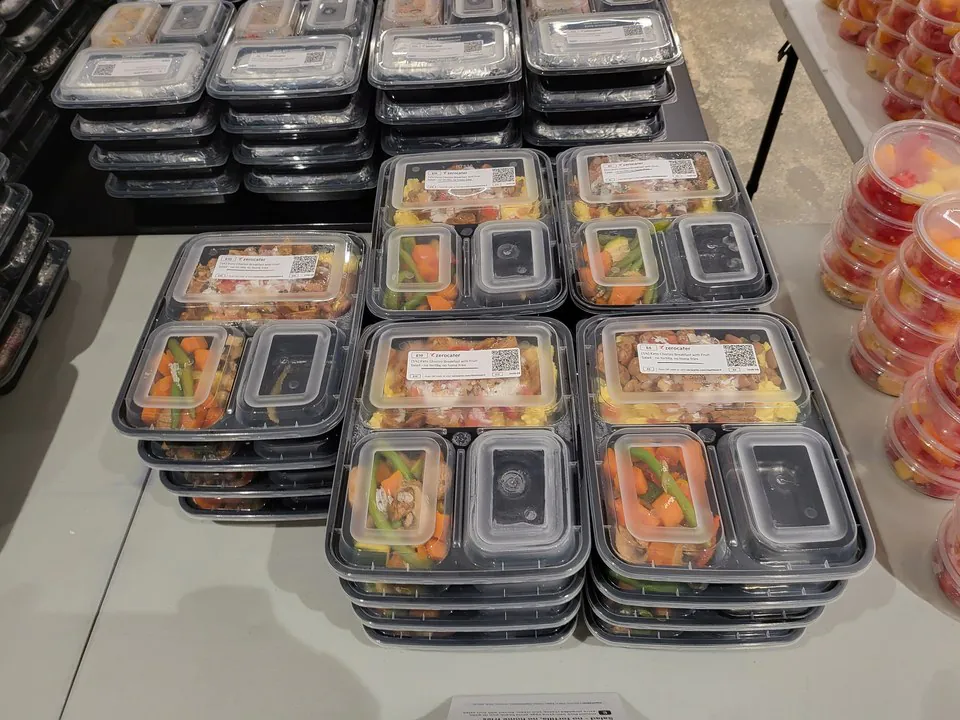
Each person gets their own container with an entree, side, and sometimes a drink or dessert. The big advantage is zero waste from over-ordering, and every box can be labeled with the recipient’s dietary needs. Cleanup is minimal, and because no on-site staff is required, boxed lunches are the most predictable per-head number you can get. In a high-labor market like Denver, that no-staff math matters more than it does almost anywhere else: a boxed order sidesteps the city’s steep server rates entirely. They are the default format for hybrid teams, working lunches, and any meeting where you want a clean cost with no surprises. A burrito or taco box, a grain bowl, or a deli box all land at the low end of the scale.
Buffet Service ($22 – $70/person)
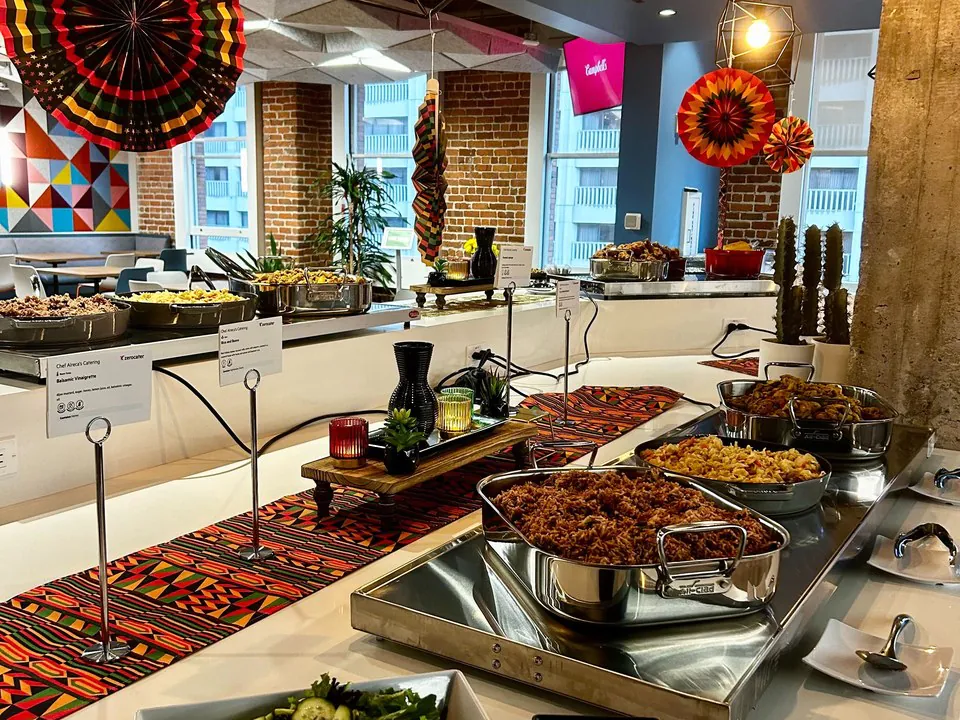
Buffets range from simple drop-off (caterer delivers and sets up, your team self-serves) to fully staffed with servers behind the line. The food is often identical between the two; the price difference is the labor, and in Denver that difference is steep. Drop-off buffets land in the $22-$40 range, while staffed service runs $40-$70. That $18-$34 spread is one of the widest in the country, the direct result of Denver’s high city minimum wage, so the drop-off-versus-staffed decision is a real budget lever here, not an afterthought. Mexican and Tex-Mex taco and fajita bars, BBQ spreads, and globally diverse trays out of Aurora and the south suburbs all shine as drop-off, which is part of why Denver’s everyday buffet floor stays reasonable even though staffed service runs high.
Full-Service Events ($72 – $155+/person)
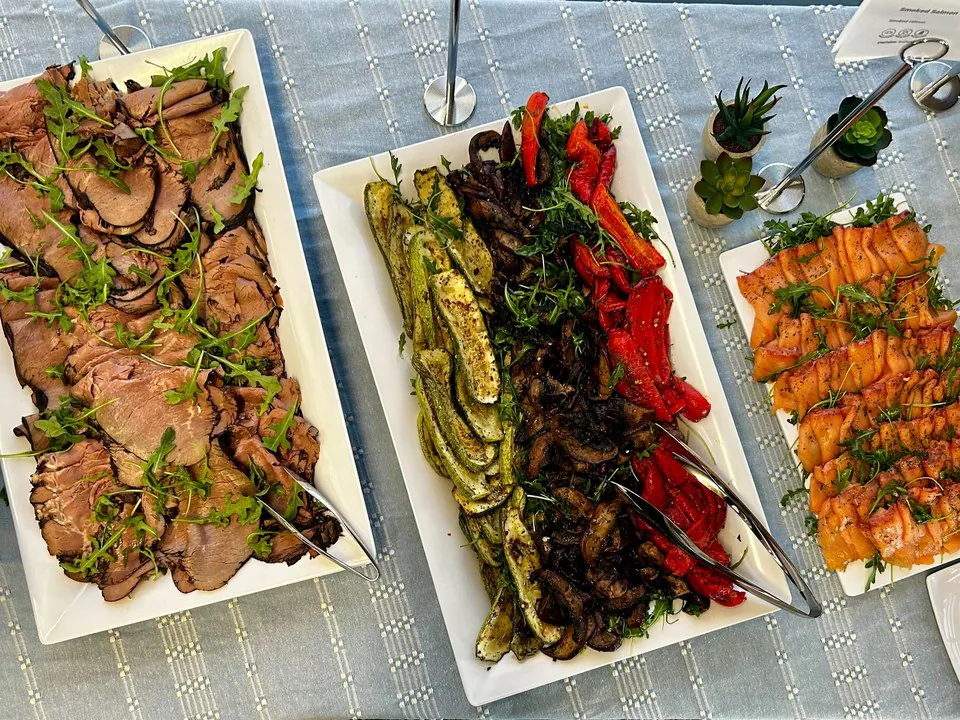
This is plated multi-course service or staffed stations with dedicated waitstaff, linen, proper serviceware, and often a bar component. You’re paying for the experience as much as the food, and in Denver you’re paying premium server wages on top, which is why this tier sits higher here than in the Sunbelt. Reserve it for board meetings, client dinners, fundraisers, and milestone celebrations where presentation matters as much as the menu. Denver’s signature move is the warm-weather outdoor event: a rooftop reception or a mountain-view patio dinner built on Colorado-raised beef, lamb, or Rocky Mountain trout. Just remember that these land in the city’s peak summer surge, so the same plated menu costs more in July than in February.
Cost by Occasion
Different events call for different levels of service. Here’s what to expect based on common office catering scenarios in Denver:
Daily or Weekly Lunch Program ($18 – $34/person)
Recurring meal programs get the best per-person rates because caterers plan around predictable volume. Most programs use boxed meals or drop-off buffets, rotating through cuisines, which is a strength in Denver where Mexican, BBQ, Mediterranean, Indian, Thai, and Italian are all well represented. You can rotate through Aloy Modern Thai, Pokeworks, and Everbowl for bowls, or Fishtail Cuisine of India and Nepal, The Monks Indian Cuisine, and Garnish Indian Fusion for Indian. If you’re feeding your team regularly, a corporate catering program can lock in volume pricing and simplify ordering across the week. In a high-labor market, keeping a recurring program self-serve is also the surest way to keep the per-head number low.
One-Off Team Meeting ($22 – $40/person)
The classic lunch-and-learn or project kickoff. Drop-off buffets work well here since they feel more communal than boxed lunches without adding a server line, which in Denver is exactly where you want to economize. Budget toward the higher end if you need dietary variety (vegan, gluten-free, halal options alongside the main spread). A taco bar or a build-your-own burrito spread is a Denver crowd-pleaser that scales easily and rarely needs staffing.
Client-Facing or Stakeholder Event ($50 – $95/person)
When clients or stakeholders are in the room, presentation matters. Staffed buffets or family-style service strike the right balance between polish and approachability. Add $32-$48/hour per server for staffing, with a 4-hour minimum on most accounts, which is among the higher server-rate bands of any city in this cost-guide series thanks to Denver’s minimum-wage rules. For recommendations on caterers who specialize in this, see our guide to the 15 best corporate event catering companies in Denver.
Large Company Event, Gala, or Holiday Party ($72 – $155+/person)
Full-service plated dinners, cocktail receptions, and multi-course meals fall in this range. The wide spread reflects the difference between a staffed buffet holiday party (around $72/person) and a seated, multi-course gala (around $130-$155+/person). Book these 3-4 weeks ahead in the regular calendar, and 4-5 weeks ahead for anything during the summer outdoor season or the Q4 holiday crunch. Explore Zerocater’s event catering solutions to streamline planning for large events.
Breakfast or Morning Standup ($12 – $24/person)
Continental spreads (pastries, fruit, coffee) run $12-$16 per person. Hot breakfast buffets with eggs, bacon, and potatoes run $16-$24, and a breakfast-burrito spread, a Denver staple, runs $13-$20 and feeds a room fast. Morning meetings are one of the most cost-effective catering occasions since the per-person cost is roughly half a lunch service, and they almost never require staffing. Renegade Breakfast in Arvada is one of many local options for a morning spread.
Cost by Denver Metro Zone
The Denver metro doesn’t have a single price level, and it stretches along the Front Range from Boulder in the northwest down through the Tech Center in the south. Where your office sits, and which side of the metro your caterer works from, changes both the per-person price and the delivery math. Here’s the rough lay of the land:
| Zone | Relative Pricing | Notes |
|---|---|---|
| Downtown / LoDo / Union Station | +6-14% vs. metro average | Corporate HQs (energy, finance, telecom); high-rise loading-dock scheduling and $15-$30 parking surcharges common, but the deepest caterer supply is close by |
| RiNo / Five Points | +5-12% vs. metro average | Creative, tech, and brewery district in converted warehouses; trendy menus and rooftops nudge pricing up, but loading is easier than downtown towers |
| Cherry Creek | +6-12% vs. metro average | Upscale retail and office district; premium pricing and valet or paid parking, polished presentation expected |
| Denver Tech Center / Greenwood Village | Metro average to +6% | The southern corporate-campus cluster; deep caterer supply and easy suburban loading keep costs in check, good value for large recurring orders |
| Boulder | +10-20% vs. metro average | A separate, premium market ~30 miles northwest (CU Boulder, tech, natural-foods cluster); high wages and thinner supply; use Boulder-area caterers, not central-Denver ones, to avoid stacking distance fees |
| Broomfield / Interlocken | Metro average to +6% | The tech corridor between Denver and Boulder; central enough to draw caterers from both directions, generally good value |
| Aurora | Metro average to -8% | The large, diverse east-side market; deep and inexpensive global cuisine and easy loading make it one of the best per-person values in the region |
| Centennial / Lone Tree / South Suburbs | Metro average | Suburban office parks with free, easy loading; well served from the Tech Center and southern caterers |
| Golden / West Foothills | Metro average to -5% | Easy loading and lower base pricing, but fewer local caterers, so a distance fee from the core can offset the savings |
The Front Range rule. Boulder, Broomfield, and the foothills are far enough from central Denver that ordering across the metro stacks a distance fee on top of the base price. Match the caterer’s side of the Front Range to your office whenever you can, especially for Boulder, where you are already paying the region’s highest base rate. Get the geography right and the rest of a Denver budget falls into place around the two things that really move it: staffing and season.
The Denver Labor Math
This is the part of Denver catering that trips up every budget built on a Sunbelt city’s assumptions. Denver is one of a small handful of US cities that sets its own minimum wage, and that wage is high and rising. As of 2026 the Denver city minimum is $19.29 per hour (with a $16.27 tipped rate for food and beverage workers), well above Colorado’s $15.16 state floor, and both are indexed to inflation and adjust every January. Because labor is the single biggest input to staffed service, that one fact shapes the whole Denver market.
| Factor | Denver Reality | What It Means for Your Order |
|---|---|---|
| Minimum Wage (2026) | $19.29/hour city ($15.16 state) | Among the highest catering-labor costs of any major metro, so staffed and plated service runs well above the Sunbelt. |
| Drop-Off vs. Staffed Gap | $18-$34/person, among the widest in the cluster | Skipping on-site staff is the single biggest budget lever in Denver. The labor decision is high-stakes here, the opposite of Dallas. |
| Annual Wage Escalator | Both city and state indexed to CPI, every January | Catering labor climbs predictably each year. Re-quote staffed events; last year’s number understates this year’s price. |
| Sales Tax on Catering | 8.00% combined (special 4.00% food rate) | Moderate, and a hair below Denver’s ~9.15% general retail rate. Build the full 8.00% into every budget. |
The practical takeaway: on a Denver order, the staffing decision is worth more than almost anything else. Upgrading from a drop-off to a staffed buffet can add more per head here than in any other metro we track, so reserve servers for the events that genuinely need them (client dinners, galas, large all-hands) and keep everyday team lunches self-serve. Get the staffing call right first, mind the season second, and a Denver budget becomes predictable.
Sample Menus by Budget
Price ranges are useful, but what does each budget actually get you? Here are real examples of what Denver-area caterers typically offer at each tier:
Budget Tier: $16 – $24/person (Boxed Lunch)
- Burrito or taco box, a torta, or a Mexican plate with rice and beans
- Deli or sub box with a side, or a grain bowl with protein
- Chips and salsa, a small side salad, or slaw
- Cookie or a piece of fruit, plus a bottled drink
Feeds one person. Includes packaging and utensils. No on-site staff, which keeps this the cheapest tier in a high-labor city. Order through Zerocater from Tia’s Taqueria, Denver Tortas, or Taco Sabe for Mexican, Urban Sombrero in Centennial, or New York Deli News for deli boxes in this range.
Mid-Range: $26 – $40/person (Drop-Off Buffet)
- BBQ spread: smoked brisket, pulled pork, sausage, and chicken
- Sides: mac and cheese, baked beans, slaw, potato salad, cornbread
- Or a Mexican bar: fajitas, build-your-own tacos, rice, beans, and all the toppings
- Or a Mediterranean spread: shawarma, falafel, rice, hummus, and pita
- Dessert and iced tea or canned beverages
Serves 20-50 people. Includes serving trays, utensils, and napkins. Drop-off setup by caterer (no server labor), which is the smart way to economize in Denver. Order from Roaming Buffalo BBQ or Jamaican Jerk BBQ for BBQ, Moose Hill Cantina in Lakewood for a taco bar, or Pita Central and Shawarma Shack for a Mediterranean spread.
Premium: $85 – $140/person (Plated)
- Passed appetizers: beef sliders, lamb skewers, trout crostini, seasonal canapes
- Choice of entree: grilled Colorado beef tenderloin, roasted lamb, or pan-seared Rocky Mountain trout
- House salad with a seasonal vinaigrette
- Sides: roasted vegetables, whipped potatoes, or a grain pilaf, plus warm bread service
- Dessert: seasonal tart, chocolate torte, or local fruit cobbler
- Coffee and tea service
Plated and served by waitstaff. Includes linen, serviceware, and full setup/breakdown. Beverages and bar service priced separately. Denver’s premium tier reflects high server wages, so it sits above the Sunbelt. For full-service event ordering, work with a caterer like Metropolitan Catering or 30Forth Kitchen, or browse the vetted network on CaterAi.
Not sure which format fits your budget?
Plan office lunch catering with CaterAi
Get custom menu options from 1,000+ vetted Denver-area caterers in minutes.
What’s Included (and What Costs Extra)
The per-person prices above cover food and basic packaging or plates. Here’s what typically sits outside that number:
| Item | Typical Cost | Notes |
|---|---|---|
| Service Charge | 18 – 22% of food subtotal | Covers coordination, logistics, and platform fees |
| On-Site Staff | $32 – $48/hour per server | The big Denver variable: 4-hour minimum typical, 1 server per 20-25 guests; among the highest server bands of any city in this series |
| Delivery Fee | $15 – $50 | Higher for long Front Range runs (central Denver to Boulder, or out to the foothills) |
| Parking / Building Access | $0 – $30 | Mostly downtown, LoDo, and Cherry Creek towers; suburban office parks have free, easy loading |
| Sales Tax | 8.00% on catering in Denver | Special 4.00% city food-and-drink rate plus state and district taxes; a hair below the ~9.15% general retail rate |
| Equipment Rentals | $4 – $12/person | Chafing dishes, linen, serviceware |
| Bartender | $40 – $60/hour | Separate from beverage costs; Colorado liquor rules apply |
| Seasonal Surge | +12-25% on staffed and outdoor events | Applies in the summer outdoor season and the Q4 holiday window |
The “30% Rule”: A good rule of thumb is to add 28-32% on top of the per-person food price to account for service charges, delivery, tax, and incidentals. A $34/person buffet really costs closer to $44 per person all-in. In Denver, the 8.00% sales tax is moderate, so the main thing that pushes you toward the higher end of that range is on-site staffing, not tax or distance. Drop-off orders sit near the bottom of the range; staffed events near the top.
Why Denver Catering Costs What It Does
Denver catering runs about 15-25% above the national average, which places it in the middle of this series: above Dallas (5-15%) and Atlanta (10-20%), roughly even with Austin (12-22%) and Chicago (15-25%), and below D.C. (17-28%), Boston (18-30%), Seattle (18-30%), Los Angeles (20-35%), San Francisco (20-35%), and New York City (25-40%). Here’s what sets the Denver number:
A high, self-set labor floor anchors everything. Denver is one of only a few US cities with its own minimum wage, $19.29 per hour in 2026, far above the federal $7.25 that governs the Sunbelt and well above Colorado’s own $15.16 state rate. That makes staffed and plated service expensive here, and it is why the gap between drop-off and staffed buffets is one of the widest in this series.
Labor costs climb every single year. Both the Denver city wage and the Colorado state wage are indexed to inflation and adjust each January. Unlike a flat federal-minimum market, Denver’s catering labor rises predictably year over year, so a staffed-event budget you built last year is already out of date. This is the one cost factor Denver shares with Seattle, and it rewards re-quoting over reusing old numbers.
The Mile-High calendar is inverted. With around 300 days of sun and dry, comfortable summers, Denver’s peak event season is the warm months, not the cool ones. May through September brings a wave of rooftop receptions, mountain-view all-hands, and company picnics that tightens staffed and outdoor availability and pushes pricing up, the opposite of Sunbelt metros where summer heat empties the outdoor calendar.
Fast growth keeps demand firm. Denver has been one of the fastest-growing major metros in the country, drawing tech, aerospace, energy, and finance employers along the Front Range. That steady in-migration keeps catering demand and wages firm, especially in the downtown core, RiNo, and the Tech Center.
Deep, affordable supply on the everyday tiers. The flip side is that Denver has an enormous base of Mexican, BBQ, and globally diverse caterers, concentrated in Aurora and the southern suburbs, competing for corporate business. That competition keeps the boxed and drop-off floor reasonable even as staffed service runs high.
Smaller orders cost more per head. Fixed costs like delivery, setup, and minimum staffing get spread across fewer people. Orders for 10-15 people typically run 15-25% higher per person than orders for 50 or more, and in a high-labor market a small staffed order is especially inefficient.
For pricing comparisons, see our guides to office catering costs in Dallas, office catering costs in Austin, office catering costs in Atlanta, office catering costs in Chicago, office catering costs in D.C., office catering costs in Boston, office catering costs in Seattle, office catering costs in Los Angeles, office catering costs in NYC, and office catering costs in San Francisco.
Denver’s Surge Windows (Summer Comes First)
Denver has a distinctive event calendar shaped by its sunshine and its corporate rhythms, and it runs opposite to the Sunbelt. If your office event lands in one of these windows, your catering math changes. Here’s the calendar to plan around:
| Window | Timing | Catering Premium | What Gets Hit |
|---|---|---|---|
| Summer Outdoor Season | May through September | +12-20% on staffed and outdoor events | Denver’s biggest crunch: rooftop happy hours, mountain-view all-hands, and company picnics cluster in the sunny, dry summer. Book 4-5 weeks ahead |
| Q4 Holiday Season | Mid-Nov through mid-Dec | +15-25% on staffed and plated | Holiday-party density across the metro tightens server crews and premium caterers. Book 4-5 weeks ahead |
| Fall Shoulder | September through October | +8-12% on staffed events | Pleasant weather plus the back-to-office cadence keeps demand firm before the holiday rush |
| Winter Shoulder | January through March | Flat to softer | Outdoor demand disappears and server crews open up; the cheapest weeks for staffed and plated catering |
Three rules for surge windows:
1. Treat summer like the holidays. In Denver, May through September is a genuine crunch, not a slow season. Book staffed and outdoor events 4-5 weeks ahead in the warm months, just as you would in December. This is the single most counterintuitive thing about budgeting catering in the Mile-High City.
2. Push premium events into the winter shoulder if you can. January through March is when outdoor demand vanishes and server crews free up, so it is the cheapest stretch for staffed buffets and plated dinners. An indoor January all-hands can cost meaningfully less than the same event in July.
3. Lean on boxed lunches and drop-off buffets to sidestep surges entirely. The everyday tiers have the deepest supply and need no servers, so they rarely move on price. For a summer-week internal team lunch, a Mexican or BBQ drop-off is often the same price as any other week.
How to Budget: A Quick Formula
Use this formula to get a realistic total that includes all the extras:
Realistic Budget = (Headcount × Per-Person Cost) × 1.30
The 1.30 multiplier covers service charges, delivery, Denver’s 8.00% sales tax, and a small buffer for last-minute additions. For a drop-off or boxed order with no staffing, you can use 1.28. For a staffed or plated event, use 1.32 to absorb Denver’s high server rates, and add another 5% if the event falls in the summer outdoor season or the Q4 holiday window. Here’s how that plays out across common scenarios:
| Scenario | Format | Per Person | 25 People | 50 People | 100 People |
|---|---|---|---|---|---|
| Team Lunch | Boxed Lunch | $22 | $715 | $1,430 | $2,860 |
| All-Hands | Drop-Off Buffet | $32 | $1,040 | $2,080 | $4,160 |
| Stakeholder Event | Staffed Buffet | $58 | $1,914 | $3,828 | $7,656 |
| Gala / Executive Dinner | Full-Service Plated | $120 | $3,960 | $7,920 | $15,840 |
| Morning Standup | Continental Breakfast | $15 | $488 | $975 | $1,950 |
For example, a drop-off buffet for 50 people at $32/person: 50 × $32 = $1,600, then $1,600 × 1.30 = $2,080 total budget. That gives you enough headroom for the service charge, delivery, and the 8.00% sales tax. The staffed-buffet and gala rows use the 1.32 multiplier; if either falls in the summer or holiday surge, add roughly 5% more.
How to Save on Office Catering in Denver
Denver runs above the Sunbelt on price, but you can keep the budget in check with a few city-specific moves. Here are the most effective ways to control costs without cutting quality:
Skip on-site staff whenever you can. This is the single most Denver-specific way to save. Because the city’s minimum wage is among the highest in the country, server labor is the line item that swings a quote the most. A drop-off buffet or boxed order avoids it entirely, and for everyday team lunches the food is identical to a staffed setup. Reserve servers for the events that truly need them.
Match the caterer to your side of the Front Range. Ordering from central Denver out to Boulder, Broomfield, or the foothills stacks a distance fee on top of the base price. For a Boulder office, use Mediterranean, Thai, or other Boulder-area caterers; for the south, lean on the deep Tech Center supply; and for the east side, tap Aurora’s affordable global cuisine.
Set up a recurring program. Caterers offer better per-person rates for predictable, repeating orders. A weekly lunch program can save 10-20% compared to one-off ordering. Zerocater’s corporate catering programs are designed around this, with dedicated account management and volume pricing built in.
Lean on Denver’s strongest cuisines for the budget tier. Mexican, BBQ, Mediterranean, Indian, and Thai all have deep Denver-area supply at competitive prices. You can order from The Halal Guys in Aurora, Chilgogi Korean BBQ in Greenwood Village, or Capriotti’s in Parker for affordable, crowd-pleasing spreads through Zerocater.
Schedule premium events for the winter shoulder. Counterintuitively for a ski state, January through March is the cheapest stretch for staffed and plated catering, because the summer outdoor rush and the holiday crunch are both over. If your gala or all-hands isn’t tied to a season, late winter saves 12-20% versus a summer date.
Order for the right headcount. Over-ordering is the single biggest source of waste. Buffets in particular lead to 10-15% more consumption per person than boxed meals. If you’re consistently throwing away food, switch to individual portions or trim your headcount estimate by 10%.
Plan dietary needs upfront. Last-minute dietary accommodations cost more because caterers need to source and prepare separate items on short notice. Collect dietary requirements when you send the meeting invite, not the day before. Our guide on ordering catering for mixed dietary needs covers this in detail, and our vegan, gluten-free, and allergy-safe boxed lunch guides cover specific cases.
Re-quote staffed events every year. Because Denver’s city and state minimum wages rise every January, last year’s staffed-event quote understates this year’s cost. Always get a fresh number rather than reusing an old one, and budget for a small annual labor bump on recurring staffed programs.
Use a platform to compare options. Instead of calling three caterers for quotes, use a platform like CaterAi to compare menus from over 1,000 vetted caterers, filter by dietary needs and budget, and check out in minutes. The built-in portioning tools help you avoid over-ordering, and you can adjust menus in real time through the chat interface.
For Denver tech and corporate offices specifically, our corporate catering for tech companies guide covers recurring-program patterns that work well in RiNo and the Tech Center. For event planning across the Front Range, see holiday party catering planning, board meeting catering, BBQ corporate catering, company picnic and outdoor catering, healthy office catering, finger food catering ideas, and the office manager’s guide to ordering catering.
Frequently Asked Questions
How much does office catering cost per person in Denver?
In Denver, expect to pay $16-$28 per person for boxed lunches, $22-$40 for drop-off buffets, $40-$70 for staffed buffets, and $72-$155+ for full-service plated events. Denver prices typically run about 15-25% above the national average, which places it above Sunbelt metros like Dallas and Atlanta but below the coastal markets. The main reason is labor: Denver sets its own city minimum wage at $19.29 per hour in 2026, among the highest in the country, stacked above Colorado’s $15.16 state floor, so staffed service costs more here than in most of the country.
Why is office catering more expensive in Denver than in Texas or the Southeast?
Labor is the biggest reason. Denver is one of the few US cities that sets its own local minimum wage, $19.29 per hour in 2026, well above Colorado’s $15.16 state rate and roughly two and a half times the $7.25 federal floor that governs Texas. Both the Denver and Colorado wages are indexed to inflation and rise every January, so catering labor here is not only high, it climbs predictably each year. On top of that, the metro’s fast in-migration and tight labor market keep wages firm and demand strong. The result is a market where staffed and plated service costs noticeably more per head than in Dallas, Atlanta, or most of the Sunbelt.
What is the cheapest way to cater a meeting in Denver?
Boxed lunches are the most budget-friendly option at $16-$28 per person, with built-in portion control, minimal cleanup, and easy dietary labeling. Because Denver labor is expensive, the gap between drop-off and staffed buffets is one of the widest in our cost-guide series, so the single biggest lever for a tight budget is to skip on-site staff: a boxed order or a self-serve drop-off buffet avoids the city’s high server rates entirely. Denver’s deep, affordable Mexican, BBQ, and global supply, especially out of Aurora and the south suburbs, keeps the boxed and drop-off floor competitive. A breakfast or burrito spread runs $12-$24 per person for morning meetings.
How much should I budget for catering for 50 people in Denver?
For 50 people in Denver, budget $1,040-$1,820 for boxed lunches, $1,430-$2,600 for a drop-off buffet, or $2,600-$4,550 for a staffed buffet. These estimates include a roughly 30% buffer for service charges, delivery fees, and the 8.00% combined sales tax that applies to catering in Denver. Use the formula: (headcount × per-person cost) × 1.30 for a realistic Denver total. Because Denver server rates are high, the staffed-buffet line is where the budget moves most, so if cost is the priority, keep the order self-serve.
Is catering taxed in Denver?
Yes. Denver applies a special 4.00% city tax to prepared food and drink, which combines with Colorado’s 2.90% state rate and the regional transit and cultural-district taxes for a total of about 8.00% on catering as of 2026. There is no exemption for prepared food, so build the full 8.00% into every Denver catering budget. One small bright spot: that 8.00% catering rate is actually a hair below Denver’s roughly 9.15% general retail sales-tax rate, because the city’s prepared-food rate is set lower than its standard rate. Tax is uniform within the city, though suburban addresses across the metro can vary slightly by local district.
When is the busiest and most expensive season for catering in Denver?
Summer, which is the opposite of most Sunbelt cities. Denver gets around 300 days of sun a year with dry, mild summers, so May through September is the peak outdoor-event season: rooftop happy hours, mountain-view all-hands, and company picnics all cluster in the warm months, pushing staffed and outdoor pricing up 12-20%. The Q4 holiday window (mid-November through mid-December) is the second crunch, with staffed and plated premiums of 15-25%. The cheapest weeks for premium-tier catering are the winter shoulder season, roughly January through March, when outdoor demand disappears and server crews open up. Book summer and holiday events 4-5 weeks ahead.
Is Boulder more expensive than Denver for office catering?
Generally yes. Boulder runs about 10-20% above the metro average, the priciest pocket in the region. It is a separate market roughly 30 miles northwest of Denver, anchored by the University of Colorado and a dense tech and natural-foods cluster, with high wages, premium real estate, and a thinner catering supply than the Denver core. The practical advice is the same as it is across the Front Range: use Boulder-based or Broomfield-area caterers for Boulder and Interlocken offices rather than ordering up from central Denver, so you avoid stacking a distance fee on top of an already-premium market.
How far in advance should I order catering in Denver?
For standard office lunches, 2-3 business days is usually sufficient. For events over 50 people, book 1-2 weeks ahead. Full-service plated events should be booked 3-4 weeks in advance, and anything during Denver’s two crunch windows, the summer outdoor season (May through September) and the Q4 holiday stretch (mid-November through mid-December), should be booked 4-5 weeks out, when staffed and premium availability tightens fast. One planning note specific to Denver: because the city and state minimum wages rise every January, a staffed-event quote from last year will understate this year’s price, so re-quote rather than reuse old numbers. Using a platform like Zerocater can speed up the process since you can browse menus and order from multiple caterers in one place.