For most office catering orders, the dietary tier is a checkbox: tag the order with vegan and gluten-free counts, label a few items, move on. That changes the moment your team includes a confirmed allergy. A peanut, tree nut, dairy, sesame, or shellfish allergy is not a preference; it is a medical condition where one shared serving spoon at a buffet line can land an employee in the ER. Boxed lunches solve this by collapsing the problem to its simplest form: each meal is prepared, sealed, and labeled at the caterer’s kitchen, one ingredient list per attendee, no shared surface area, no airborne flour, no cross-utensil contact. This guide covers the FDA Big 9, why individually packaged is the operational default for allergy-aware teams, the cross-contact landmines that buffets cannot solve, the labeling protocol every box should follow, headcount math for mixed teams, the cuisines that are easiest to make allergen-safe, and what to ask before you book.
In This Guide
- Quick Answer: Why Boxed Lunches Win on Allergen Safety
- The Big 9 Allergens You Need to Plan For
- Why Individually Packaged Beats Buffet for Allergens
- Cross-Contact Landmines That Boxes Eliminate
- The Labeling Protocol: What Every Box Should Show
- Ordering Protocol: Intake Survey, Ratios, Lead Time
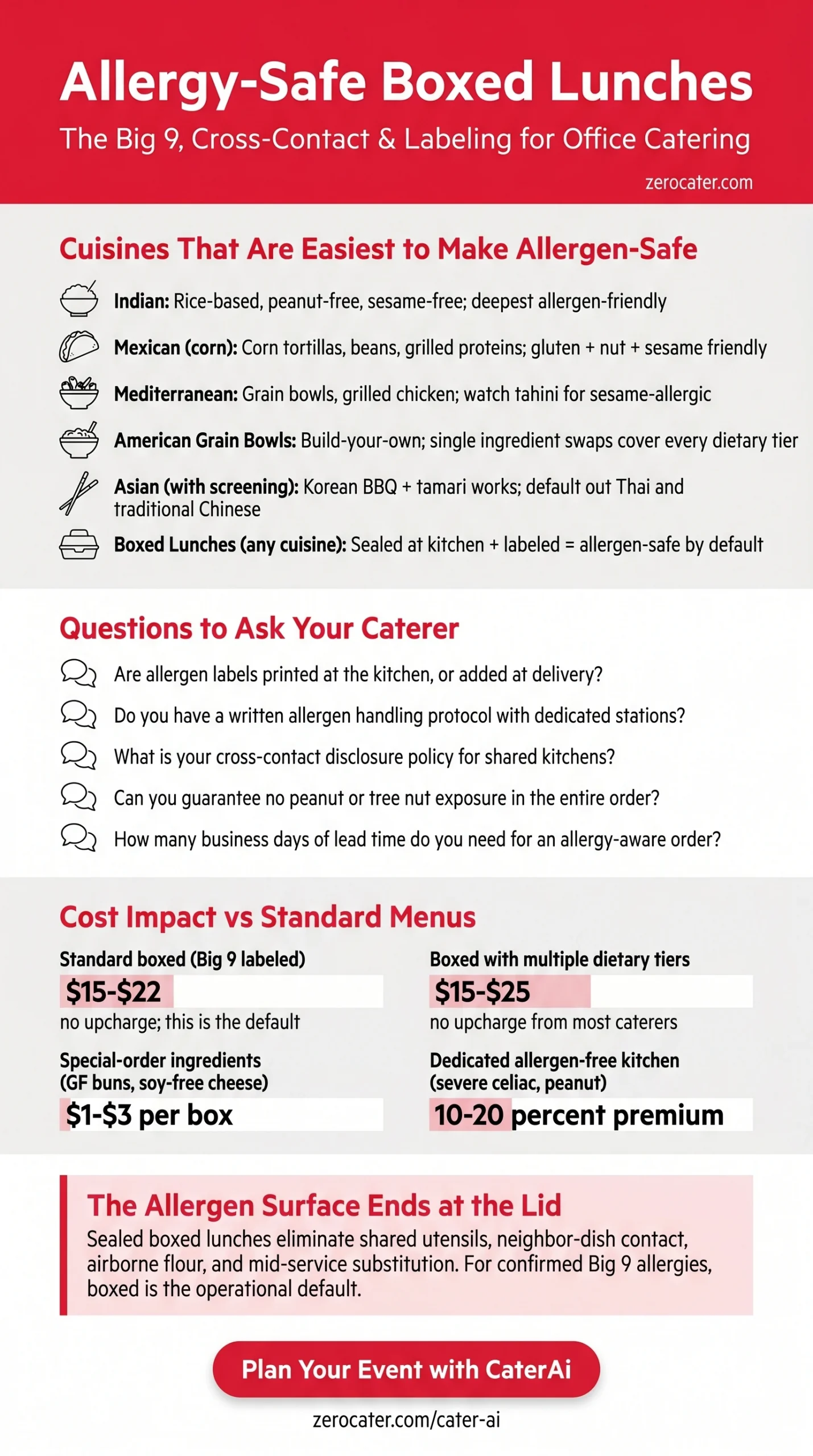
- Cuisines That Are Easiest to Make Allergen-Safe
- Questions to Ask Your Caterer Before Booking
- Cost: Does Allergen-Safe Catering Cost More?
- Where to Order Allergy-Safe Boxed Lunches
- FAQ
Quick Answer: Why Boxed Lunches Win on Allergen Safety
For an office team with at least one confirmed Big 9 allergy (peanut, tree nut, dairy, egg, gluten, soy, fish, shellfish, sesame), individually packaged boxed lunches are the operational default. The format collapses the safety problem to a single ingredient list per attendee, eliminates the shared serving utensils that make buffets risky, and moves the labeling responsibility to the caterer’s kitchen where it belongs.
The simple decision rule:
- Confirmed Big 9 allergy on the team: boxed lunches, individually labeled, sealed at the kitchen.
- Mixed dietary preferences (vegan, vegetarian, dairy-free) without medical allergies: boxed or buffet both work; our mixed dietary needs guide covers the labeling system either way.
- No specific dietary needs surveyed: default to a small dietary subset (15-20 percent vegan or vegetarian, 10-15 percent gluten-free) in any boxed order so the team is covered.
For the broader boxed-vs-buffet decision across all use cases, see our boxed lunch vs. buffet guide; for what boxed lunches actually cost, our boxed lunch cost guide walks through the per-person math.
The Big 9 Allergens You Need to Plan For
The FDA Big 9 was finalized when sesame was added to the federal allergen list under the FASTER Act in 2021. These nine ingredients account for roughly 90 percent of severe food allergic reactions in the United States. Every office catering order should plan around all nine, even if no one has self-disclosed.
| Allergen | Common Catering Sources | Hidden Sources to Flag |
|---|---|---|
| Milk / dairy | Cheese, butter, cream sauces, ranch dressing, mac and cheese | Caesar dressing (anchovy + parmesan), creamy soups, mashed potatoes (often buttered), some bread loaves |
| Eggs | Frittatas, egg salad, breakfast sandwiches, mayonnaise | Aioli (egg-based), some pasta (egg in fresh dough), brioche, glazed pastries |
| Fish | Salmon, tuna, fish tacos | Caesar dressing (anchovy), Worcestershire sauce, some Asian sauces |
| Shellfish | Shrimp, crab, lobster rolls | Imitation crab in California rolls (also wheat), some XO sauces, fish stocks |
| Tree nuts | Almonds, walnuts, pecans, pistachios in salads or pesto | Pesto (pine nuts), granola toppings, chocolate desserts (almond paste), Thai dishes (cashew) |
| Peanuts | Pad Thai, peanut sauce, satay, peanut butter cookies | Chinese kung pao dishes, some chili recipes, some baked goods (peanut flour) |
| Wheat / gluten | Bread, pasta, pizza, croutons, sandwiches, wraps | Soy sauce (wheat-based), couscous, tabbouleh (bulgur), beer, oat cross-contact |
| Soy | Tofu, edamame, soy sauce, teriyaki, miso | Most Asian sauces, some breads (soybean oil), vegan cheeses, processed meats |
| Sesame | Hummus (tahini), sesame seed buns, sesame oil dressings | Burger buns (often topped), Mediterranean dips, Asian noodle sauces, granola bars |
The hidden sources column is where boxed lunches earn their keep. A buffet line with hummus, a mixed grain salad with tahini dressing, and a sesame-topped roll has three sesame exposure points; a boxed lunch labeled “Contains: sesame” gives the affected employee one decision instead of three. Our gluten-free office catering guide goes deep on the wheat-and-cross-contact layer specifically; this guide covers the broader allergen surface area.
Why Individually Packaged Beats Buffet for Allergens
Buffet catering is a shared-resource model: shared dishes, shared serving utensils, shared steam and airflow over a hot line, shared crumbs that fall as people serve themselves. For preferences (vegan, vegetarian) the model is fine, because a teammate avoiding cheese can simply skip the cheese tray. For confirmed medical allergies, the same model breaks down at every shared touchpoint.
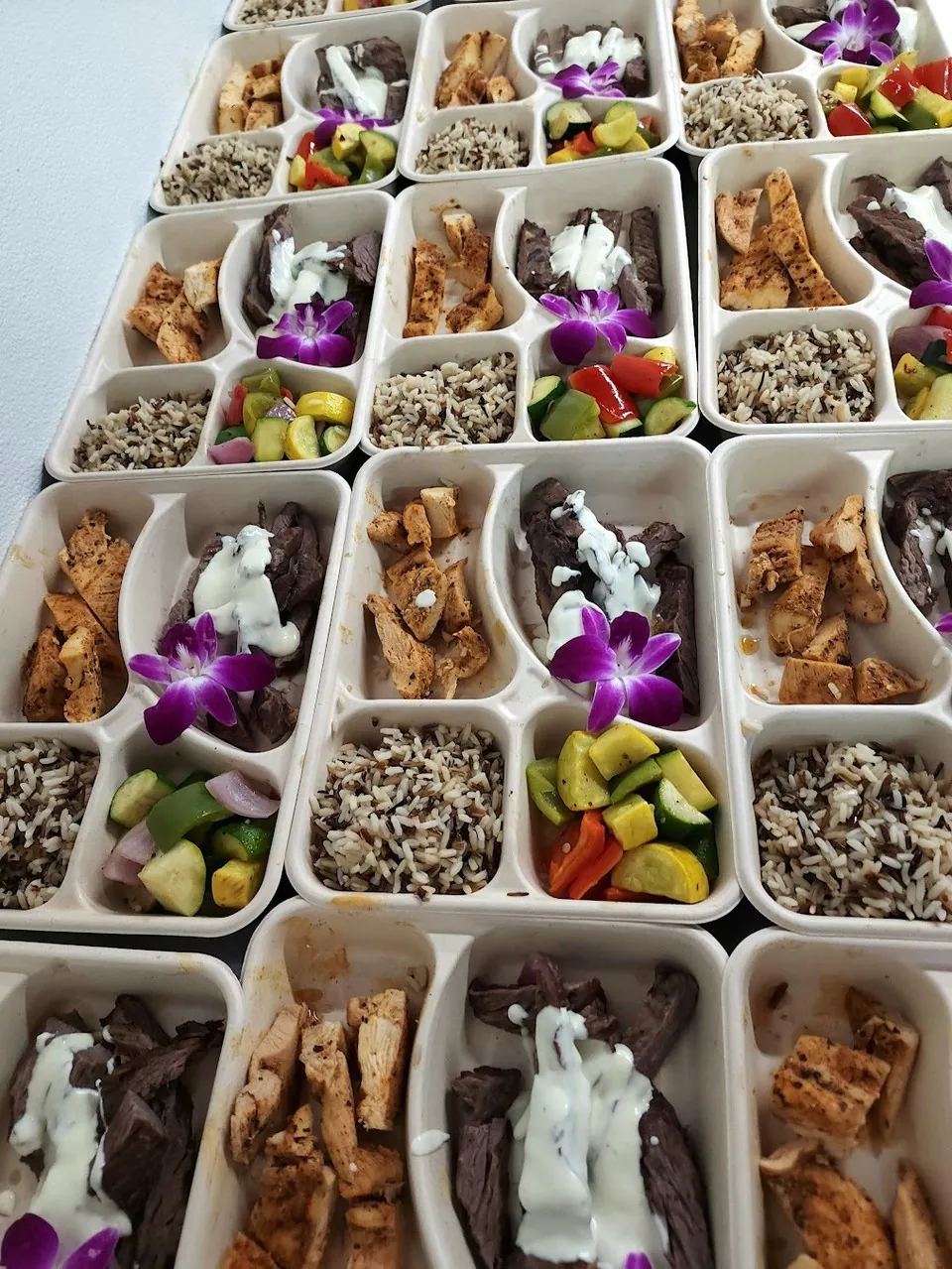
Boxed lunches eliminate shared utensils
The single most common buffet cross-contact event is shared serving utensils. The spoon used in the chicken with peanut sauce gets dropped back near the chickpea curry. The spatula from the buttered mashed potato touches the vegan stir-fry. Boxed lunches have no shared utensils. Each meal includes its own wrapped fork and napkin in the box.
Boxed lunches eliminate neighbor-dish contamination
On a buffet, every dish has neighbors. Crumbs from a sesame-topped bun fall into the green salad below. A serving of Caesar (egg + dairy + fish) splatters onto the next pan over. Sealed boxes have no neighbors at the food level. Boxes can be stacked side by side without any food-to-food contact.
Boxed lunches eliminate self-service inspection burden
At a buffet, every employee with an allergy has to read every label, ask the catering attendant about cross-contact for every dish, and trust that the answer is current. At an individually packaged boxed lunch table, the affected employee picks up the box specifically labeled for their need and skips the inspection entirely. The cognitive and social burden of self-service inspection is part of why allergy-aware employees often skip catered meals at work.
Boxed lunches lock the ingredient list at the kitchen
The most subtle buffet failure mode is mid-service substitution. The caterer runs out of the labeled gluten-free pasta and substitutes a similar dish without re-labeling, or the kitchen swaps the dairy-free ranch for the standard one because the dairy-free ran short. Boxed lunches are sealed at the kitchen with the original ingredient list locked in. There is no mid-service substitution because there is no service.
Boxed lunches scale linearly
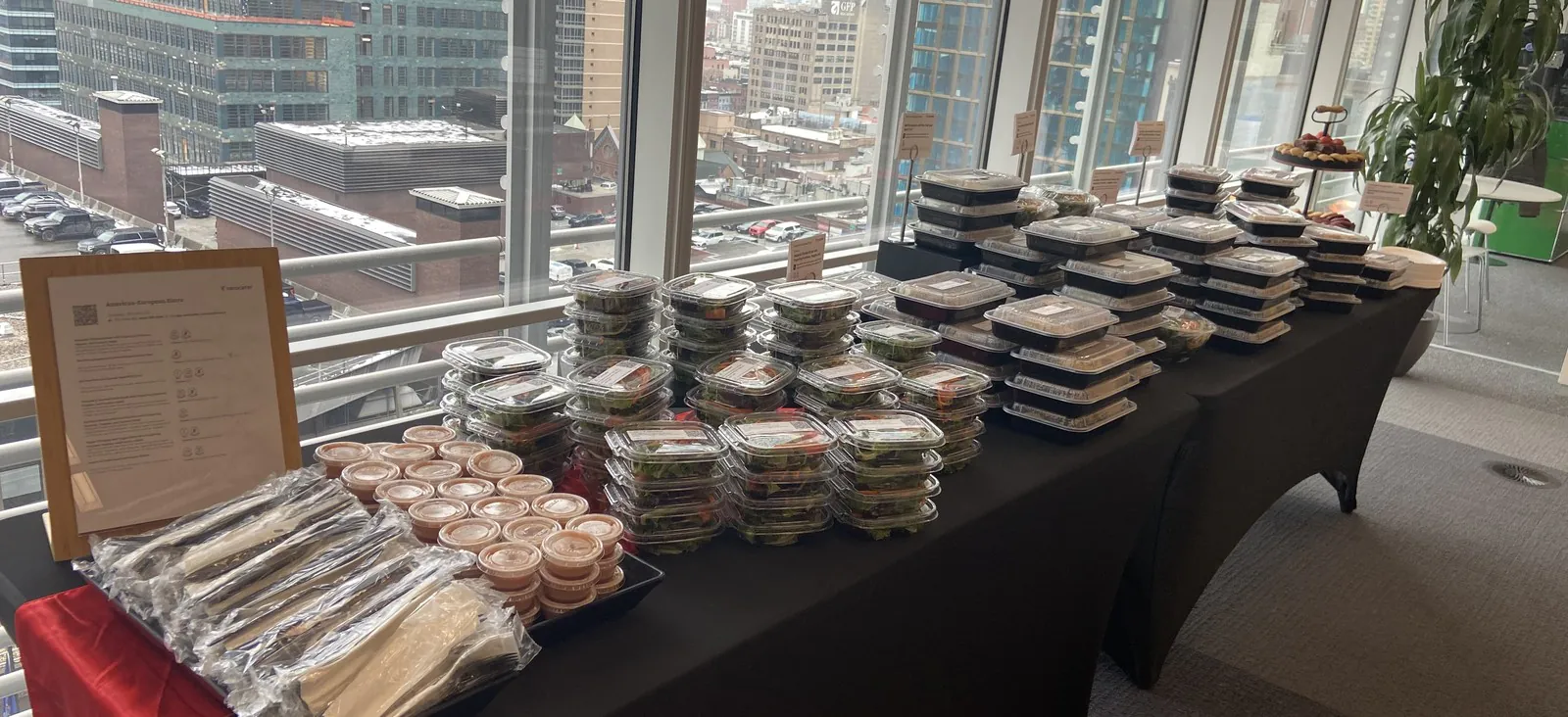
For 200 people across multiple floors of a building, a buffet-with-allergens setup needs serving staff at every station, dietary placards, and ongoing oversight. 200 boxed lunches with sticker labels distribute in five minutes from a counter, with the safety guarantees baked in at the kitchen. For hybrid offices and distributed teams, the format scales even further; our boxed lunches for hybrid and distributed teams guide covers the multi-location layer.
Cross-Contact Landmines That Boxes Eliminate
Cross-contact (often called cross-contamination, though “contact” is the more accurate FDA term) is the transfer of allergen residue from one food to another at a level small enough to be invisible but large enough to trigger a reaction. For severely allergic employees, the threshold is microscopic: a few peanut protein molecules, a quarter teaspoon of flour, a smear of dairy on a shared spatula. The most common cross-contact landmines in office catering:
| Landmine | Why It Happens at a Buffet | How Boxed Solves It |
|---|---|---|
| Shared serving spoons across dishes | Attendees swap spoons or kitchens use one tasting spoon | Box contains its own wrapped utensil; no shared service |
| Crumbs from bread or sesame buns | Bread tray sits above or next to dressed salads | Bread is in the same sealed box as one meal only |
| Airborne flour in a hot kitchen | Wheat is being prepped on the line near GF dishes | Sealed packaging eliminates airborne settling between kitchen and table |
| Soy sauce splatter into adjacent dishes | Stir-fry pan splashes onto a “GF” rice bowl on the buffet | Sauce is in a sealed cup or sauce-applied at the kitchen, not in transit |
| Cheese drag from grill to plant-based dishes | Same grill or board handles both before clean-down | Allergen-free dish is prepped, sealed, and never re-opened |
| Mid-service ingredient substitution | Caterer swaps dairy-free for standard ranch when stock runs short | Sealed box locks the ingredient list; no swaps after sealing |
| Tahini in “Mediterranean” dishes | Hummus tray sits next to vegetables; spoons mix | Hummus is in its own labeled cup or excluded from the sesame-allergic box |
| Imitation crab (wheat + shellfish) in salads | Salad bar combines proteins; crab not always labeled | Box ingredient list flags both allergens at the kitchen |
| Peanut sauce contact through ladles | Asian buffet shares ladles between curries | Each protein and sauce paired at the kitchen, sealed separately |
The pattern: every landmine is a function of shared service surface area. Boxes have zero shared service surface area. The allergen surface ends at the lid.
Ordering for an allergy-aware team?
Plan mixed-diet catering with CaterAi
Tell CaterAi your team’s allergen profile and CaterAi pulls vetted caterers that handle individual labeling, sealed packaging, and dietary intake at scale.
The Labeling Protocol: What Every Box Should Show
A boxed lunch with no label is just a sandwich in a box; the safety advantage only materializes when the labeling is right. The default protocol every label should follow:
| Label Field | What Goes Here | Why |
|---|---|---|
| Dish name | “Grilled Chicken with Wild Rice and Greens” | Lets attendees identify the meal at a glance |
| Protein and base | “Chicken / rice” | Quick scan for vegetarian, vegan, halal, kosher |
| Contains (Big 9) | “Contains: milk, soy” | Required for any confirmed allergy on the team |
| Free of (claimed) | “Gluten-free, peanut-free, tree-nut-free” | Lets affected employees identify their box without inspection |
| Cross-contact disclosure | “Made in a kitchen that handles peanuts, tree nuts” | Honest hedge for shared kitchens; protects both the employee and the caterer |
| Recipient name (optional) | “Sarah G.” | For confirmed allergies, name-on-box prevents accidental swap by colleagues |
Where the label should live
Labels go on the top of the box, not on the side or wrapped underneath. The reader should be able to identify the meal without picking it up, especially when boxes are stacked. For confirmed individual allergies, place the labeled box at the end of the line in a clearly marked station so colleagues do not accidentally take the wrong meal.
Who applies the label
Labels should be printed and applied at the caterer’s kitchen during packing, not handwritten by the office manager or attendant at delivery. Handwritten labels miss allergens, get smudged, or stick incompletely. Printed kitchen labels carry the caterer’s accountability; if the label is wrong, that is a kitchen QA failure, not a delivery error. Confirm this with the caterer at the booking stage.
Color-coding by dietary tier
For orders over 25 boxes, color-code the labels by dietary tier (red for vegan, blue for gluten-free, yellow for nut-free, green for standard) so attendees can identify their box at a distance. This is especially helpful when distribution happens at multiple stations on different floors.
Our mixed dietary needs guide walks through the labeling system in more detail; our office manager’s guide to ordering catering covers the operational layer at the office side, including how to communicate the labels to attendees ahead of the meal.
Ordering Protocol: Intake Survey, Ratios, Lead Time
The labeling layer only works if you know what to label for. The intake survey is the foundation of every allergy-aware order.
Run an intake survey 5 to 7 business days ahead
For one-off events, send a brief Google Form or Slack poll to the attendee list with three questions:
- Do you have any food allergies that require strict avoidance? (Yes / No / Prefer to say privately)
- If yes, which? Check all that apply: peanut, tree nut, dairy, egg, gluten, soy, fish, shellfish, sesame, other.
- Do you have any dietary preferences? Check all that apply: vegan, vegetarian, dairy-free, gluten-free, halal, kosher, no preferences.
The “prefer to say privately” option matters; some employees prefer to disclose to a single coordinator rather than via a public form. For confirmed disclosures, follow up by direct message and order one specifically labeled box per affected employee plus one safety backup.
Default ratios for unknown teams
If you cannot run an intake (small caterer with same-day delivery, last-minute event), default to these ratios for any boxed order over 20 people:
| Dietary Tier | Default % of Order | Notes |
|---|---|---|
| Vegan | 15-20% | Naturally covers dairy-free and most egg-free needs |
| Vegetarian (non-vegan) | 15-25% | Cheese is fine for non-vegan vegetarians but flag dairy contains |
| Gluten-free | 10-15% | Verify GF status with caterer; “gluten-friendly” is not safe for celiac |
| Nut-free (default) | 100% by default | Default the entire order nut-free unless team has explicitly cleared it |
| Sesame-free | Flag at intake | Hummus, sesame buns, tahini dressings are common; intake catches it |
| Standard | Remainder | Should still be Big 9 labeled even if no specific need |
Lead time for allergy-aware orders
Standard catering takes 1 to 3 business days of lead time for boxes under 50. Allergy-aware orders take 5 to 7 business days. The extra runway covers ingredient sourcing (gluten-free buns, nut-free pesto, soy-free sauces are not always in standard kitchen inventory), prep station setup (a dedicated cutting board and clean surfaces for allergen-free dishes), label printing with the right cross-contact disclosures, and a confirmation step with the kitchen lead 24 hours before delivery to walk through the dietary list.
Recurring programs simplify everything
For recurring weekly orders, lock the dietary mix once and the caterer prepares the same boxes every week without re-asking. The intake survey runs once; the labels print once; the kitchen prep runs once. After the first 2 weeks, you can adjust based on actual consumption (extra vegan boxes left over? drop the count by one) and treat the order as a standing template. For headcount math on recurring boxed programs, our boxed lunch catering for meetings guide walks through the rolling-average system.
Cuisines That Are Easiest to Make Allergen-Safe
Some cuisines are structurally allergen-friendly and require almost no special accommodation. Others contain hidden cross-allergens that even careful caterers can miss. The fastest way to land a clean allergy-aware order is to lean into cuisines that are naturally Big 9 light.
Indian: deepest naturally allergen-friendly cuisine
Most Indian dishes contain no peanuts, no sesame, no wheat (rice-based), and dairy substitutions are easy. Lentil dals, chickpea curries, vegetable korma made with coconut cream instead of dairy cream, basmati rice, tandoori chicken, and naan-replaceable sides all work. Watch out for: ghee in some curries (dairy), peanut and tree-nut garnishes on biryani, and cashew cream in shahi paneer. Most Indian caterers handle the swaps without an upcharge. Browse Zerocater’s Indian catering vendors or look at vendor pages like Curry Up Now (San Francisco) and Curry Up Now (Bay Area).
Mexican (corn-based): excellent for gluten + nut + dairy avoidance
Stay with corn tortillas, rice, beans, grilled proteins (chicken, steak, carnitas), pico de gallo, salsa verde, and roasted vegetables. Avoid flour tortillas (wheat), queso (dairy), sour cream, and chimichurri (sometimes contains nuts). Mexican is naturally peanut-free, sesame-free, and shellfish-free. Browse Zerocater’s Mexican catering vendors; vendor pages like Tio Luis Tacos (Chicago) and Renegade Burrito (Denver) handle dietary boxes well.
Mediterranean (rice-based): great for gluten + dairy avoidance, watch sesame
Grilled chicken, grain bowls, hummus (sesame), falafel, tzatziki (dairy), tabbouleh (wheat in bulgur), olives, roasted vegetables, and brown rice make this cuisine flexible. The sesame layer (tahini in hummus) is the watch-out for sesame allergies. Browse Mediterranean catering vendors.
American grain bowls: most flexible builder format
A build-your-own grain bowl model with rice, quinoa, chickpeas, roasted vegetables, grilled chicken, and a side of dressing on the side hits almost every dietary need with single ingredient swaps. Skip the croutons (wheat), avoid creamy ranch (dairy), and any pesto with pine nuts (tree nut). Dressings on the side mean each box can be assembled to spec.
Asian (with extra screening): possible but watch every sauce
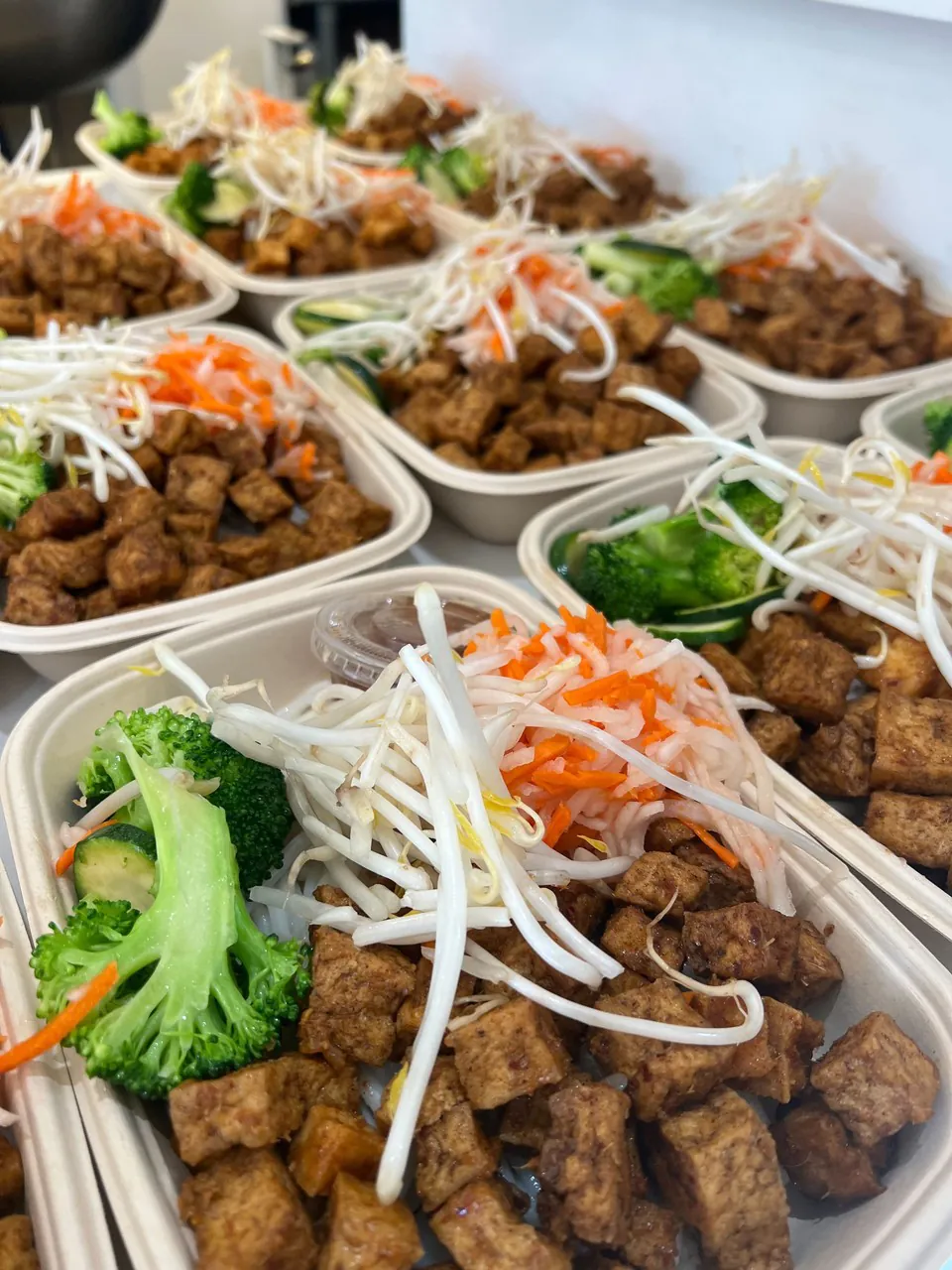
Asian cuisines need the most screening because soy, sesame, peanuts, and tree nuts appear in most sauces and dressings. Korean BBQ with rice and vegetables works if you swap soy sauce for tamari (usually gluten-free, but check the label; tamari is still brewed from soybeans, so it does not work for a soy allergy). Vermicelli rice noodles work for gluten-free. Pad Thai and kung pao should be defaulted out of allergy-aware orders unless the caterer can confirm peanut-free preparation in a dedicated station.
Cuisines to default out for severe allergens
Thai food (peanuts widely used), traditional Chinese stir-fry (peanut, soy, sesame across most dishes), and traditional Japanese ramen (wheat noodles, soy broth, sometimes fish stock) all require so much customization that they are usually not the right call for a confirmed-allergy team. Default to Indian, Mexican, or Mediterranean instead.
Questions to Ask Your Caterer Before Booking
Most caterers can handle dietary boxes, but the depth of their allergen protocol varies. Eight questions to ask at the booking stage:
- “Do you have a written allergen handling protocol?” A serious answer mentions dedicated cutting boards, color-coded utensils, separate prep stations, and a documented kitchen procedure. A vague answer is a yellow flag.
- “Are allergen labels printed and applied at the kitchen, or added at delivery?” Kitchen-applied is the right answer for confirmed allergies.
- “What is your cross-contact disclosure policy?” The right answer includes a “Made in a kitchen that handles X” disclosure on every box, even when the dish itself is allergen-free.
- “Do you have a dedicated allergen-free prep station for severe allergies?” Important for confirmed celiac or peanut allergies; less critical for preferences.
- “Can you guarantee no peanut or tree nut exposure in the entire order?” For nut allergies, yes/no should be a clean answer. If the answer is “we minimize,” that means there is risk.
- “What ingredients in this menu contain sesame, soy, or shellfish?” Tests the caterer’s ingredient transparency. A good caterer can answer instantly; a less prepared one will need to check.
- “How many business days of lead time do you need for an allergy-aware order?” 5 to 7 business days is the standard; less than 3 means the caterer is squeezing the prep window and label time.
- “Will the same chef and prep team handle our recurring orders?” Consistency reduces the risk of new staff missing the dietary memo on a recurring program.
For high-stakes events with executive dietary needs (board meetings, client lunches), our board meeting catering guide covers the executive presentation layer; for legal/compliance environments where dietary documentation matters, our corporate catering for law firms guide walks through the documentation discipline.
Cost: Does Allergen-Safe Catering Cost More?
Mostly no. Boxed lunches from a kitchen that already handles allergen-conscious orders cost the same as standard boxed lunches: $15 to $25 per person delivered, with the same 25 percent uplift for delivery, service, and tip. The cost premium kicks in at two specific points:
| Allergen Safety Tier | Per-Person (Menu) | Premium vs Standard |
|---|---|---|
| Standard boxed (Big 9 labeled) | $15-$22 | No upcharge; this should be the default |
| Boxed with dietary tiers (vegan + GF + nut-free in same order) | $15-$25 | No upcharge from most caterers |
| Special-order ingredients (GF buns, soy-free vegan cheese, tree-nut-free pesto) | $16-$28 | $1-$3 per box for ingredient sourcing |
| Dedicated allergen-free kitchen (severe celiac or peanut) | $20-$30 | 10-20% premium; rarely needed |
| Premium executive boxed (board lunch, plated equivalent) | $28-$40 | Premium for presentation, not allergen-safety; allergen tier is independent |
The takeaway: most teams do not need to spend more on allergen-safe catering. The labeling, sealed packaging, and intake protocol are the safety system; ingredient cost is a secondary lever. For city-by-city catering pricing context, see our NYC catering cost guide, SF catering cost guide, and Chicago catering cost guide.
Where to Order Allergy-Safe Boxed Lunches
Most of Zerocater’s 1,000-plus partner network handles individually packaged boxed lunches with allergen labeling. A few category leaders worth bookmarking, organized by cuisine where the allergen profile naturally fits:
- Indian (deepest allergen-friendly): Curry Up Now (San Francisco), Curry Up Now (Bay Area), Baal Cafe & Falafel (Bay Area)
- Mexican (gluten + dairy + nut friendly): Renegade Burrito (Denver), Tio Luis Tacos (Chicago), Folklore Artisanal Mexican Eatery (NYC)
- Mediterranean (gluten + dairy flexible, sesame watch): Hummus Mediterranean Kitchen (Bay Area)
- American grain bowls (most flexible builder): Zo’s Salads & Bowls (Bay Area), Saucy Greens (San Francisco)
- Sub shops (clear allergen labels by default): Jersey Mike’s (Chicago), Capriotti’s (Denver area)
For a full city-by-city catering provider list, see our 15 best corporate event catering companies in NYC, SF best corporate caterers, Chicago best corporate caterers, LA best corporate caterers, Seattle best corporate caterers, Denver best corporate caterers, D.C. best corporate caterers, Boston best corporate caterers, and Atlanta best corporate caterers.
Frequently Asked Questions
Are boxed lunches safer than buffets for employees with food allergies?
Yes. Individually packaged boxed lunches are the safest catering format for teams with confirmed food allergies because each meal is prepared, sealed, and labeled separately at the caterer’s kitchen. Buffets put every dish on a shared serving line where one shared spoon, a neighbor’s crumbs, or airborne flour can cross-contaminate a technically allergen-free dish. For confirmed peanut, tree nut, dairy, gluten, or sesame allergies, boxed is the operational default. Our boxed lunch vs. buffet guide covers the format trade-offs in more detail.
What are the Big 9 allergens I need to plan around for office catering?
The FDA Big 9 allergens are milk, eggs, fish, crustacean shellfish, tree nuts, peanuts, wheat, soy, and sesame. Sesame was added to the federal allergen list under the FASTER Act in 2021. These nine ingredients account for roughly 90 percent of severe food allergic reactions. Any office catering order should plan around all nine; sesame and tree nuts are the two most commonly missed in standard office menus.
How should boxed lunches be labeled for an allergy-aware team?
Every box should show four things: the dish name, the protein and base, all Big 9 allergens contained (“Contains: milk, wheat, soy”), and any cross-contact disclosures (“Made in a kitchen that handles peanuts and tree nuts”). For confirmed allergies, the safest label is a printed sticker applied at the caterer’s kitchen, not a handwritten note added at delivery. Labels should be on the top of the box where attendees can read them without picking up the meal.
How many allergy-safe boxes should I order for a mixed team?
For a 50-person order, plan 8 to 12 dietary-specific boxes (vegan, gluten-free, dairy-free as needed) and 38 to 42 standard. For confirmed individual allergies on the team, order one specifically labeled box per affected employee plus one safety backup. Always run an intake survey 5 to 7 business days ahead so you know the actual allergen profile, not the generic ratios.
Does allergy-safe catering cost more than standard catering?
For most allergens (dairy-free, gluten-free, nut-free), boxed lunches from a kitchen that already handles allergen-conscious orders cost the same as standard boxed lunches: $15 to $25 per person delivered. The premium kicks in at two specific points: a fully dedicated allergen-free kitchen (10 to 20 percent uplift, only relevant for severe celiac or peanut allergies) and special-order ingredients (gluten-free buns, soy-free vegan cheese) which add $1 to $3 per box. Most offices do not need either.
What cuisines are easiest to make allergen-safe for an office order?
Indian cuisine is the deepest naturally allergen-friendly option: most dishes contain no peanuts, no sesame, no wheat (rice-based), and dairy is easy to substitute. Mexican is excellent if you stay with corn tortillas, rice, beans, and grilled proteins (skip flour tortillas and queso for cross-allergen safety). Mediterranean grain bowls work well for everything except sesame (tahini is the watch-out). Asian cuisines need extra screening because soy, sesame, peanuts, and tree nuts appear in most sauces and dressings.
How far in advance should I order allergy-safe boxed lunches?
Order 5 to 7 business days ahead for orders with confirmed allergies, longer than the 1 to 3 business days that work for standard catering. The extra lead time lets the caterer source allergen-free ingredients, set up dedicated prep stations, print allergen-specific labels, and confirm the order with the kitchen lead. For recurring allergy-aware programs, set a standing order with the dietary mix locked in so the caterer prepares the same boxes every week without re-asking. Learn more about how Zerocater works for recurring programs.
Plan mixed-diet catering with CaterAi