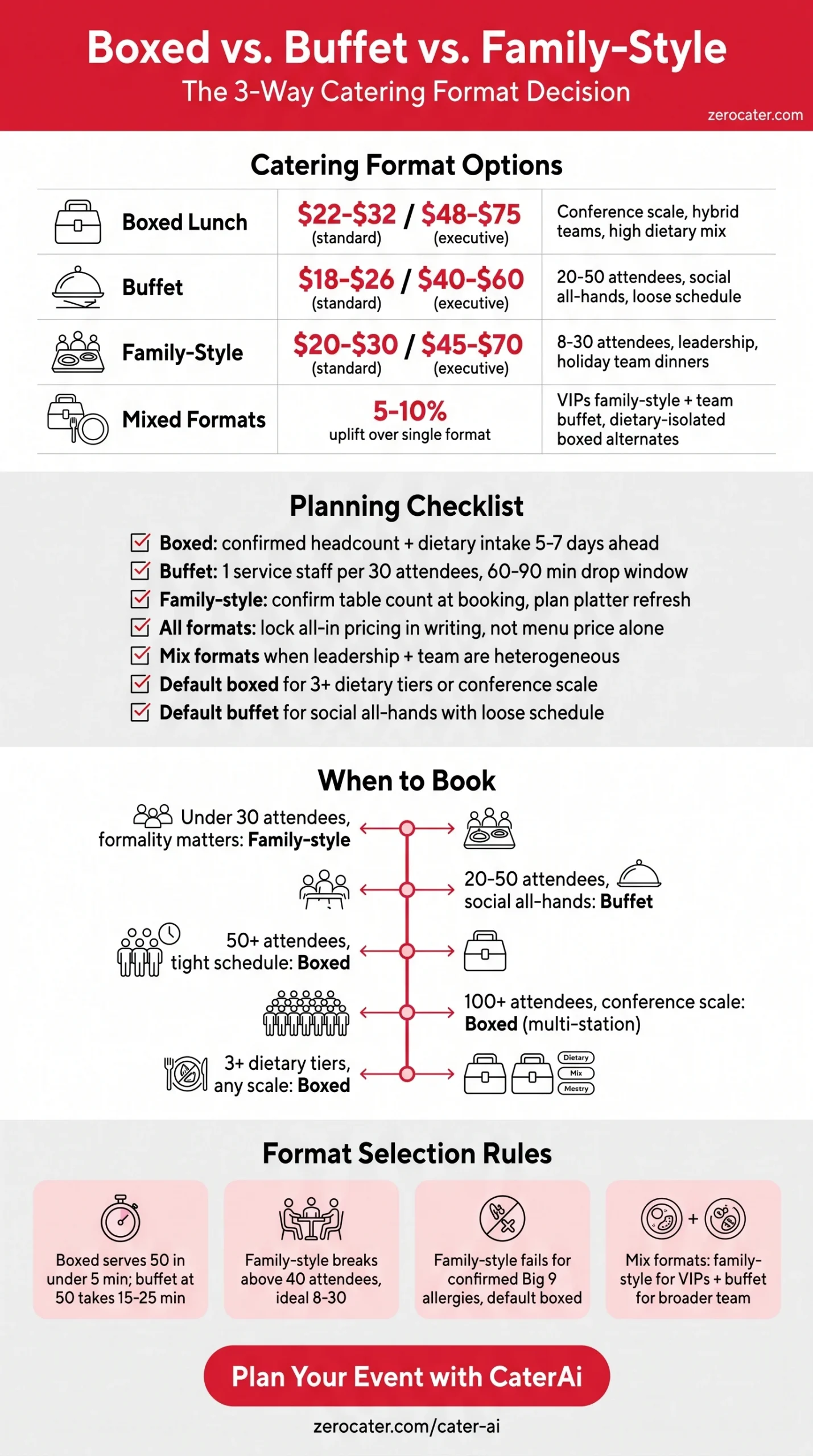
For most of the 2010s, office catering format was a binary choice: buffet for social meals where people would mingle, boxed for meetings where they would not. The binary still works for a chunk of office catering decisions, but it has been quietly replaced by a three-way choice. Family-style has risen from “the format you get at Carmine’s” to a credible third option, driven by shared-platter caterers expanding into office accounts, the post-2020 appetite for meals that feel like real events instead of refuels, and the rise of Italian, Mediterranean, Mexican, and Indian cuisines whose food was designed to be passed. This guide is the 3-way decision: when each format wins, when to mix them at the same event, what each one costs, and the operational mechanics for boxed, buffet, and family-style office catering.

In This Guide
- What Each Format Actually Is
- Why Family-Style Stopped Being a Footnote
- The 3-Way Decision Matrix
- When Boxed Wins
- When Buffet Wins
- When Family-Style Wins
- Format Mixing: Combining Two or Three at One Event
- Cost: What Each Format Actually Runs Per Person
- Time: Service Speed Across the Three Formats
- Dietary Handling: Which Format for Which Dietary Profile
- Cuisine Fit: Which Foods Belong in Which Format
- Operational Checklist Per Format
- Pitfalls to Avoid
- Where to Order Each Format
- FAQ
What Each Format Actually Is
The three terms get used loosely. The operational differences are sharp once you pin them down.
Boxed lunch catering
One pre-packaged meal per person, sealed at the kitchen, distributed from a pickup table or delivered to each desk. Every box contains a main, a side or two, a dessert, and cutlery, all in a single grab-and-go unit. The format was built around dietary isolation, multi-location distribution, and tight time budgets. Modern boxed lunch catering uses kraft cardboard or clamshell packaging with clear dietary labeling on the lid. See our full boxed lunch catering vs. buffet guide for the deep binary decision against buffet.
Buffet catering
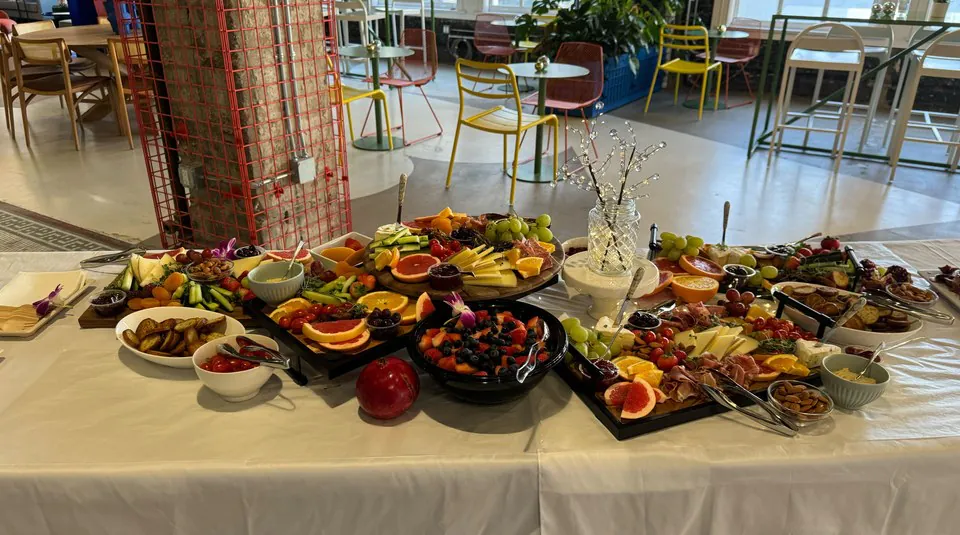
Bulk food in chafing trays, set up on a long table with a serving line. Each chafer holds 25 to 40 portions of one item: rice, protein, vegetables, salad, bread. Attendees walk the line, plate themselves, and either stand or sit. The format was built for scale and social mingling; it remains the default for most office catering above 25 attendees outside of conference scenarios.
Family-style catering
Large shared platters and bowls placed directly on each table, designed to be passed from one diner to the next. Each table seats six to ten and gets its own set of platters: a large pasta bowl, a salad bowl, a bread basket, a protein platter. Diners scoop onto their plates and pass the platter to the next person. The format originated in Italian, Mediterranean, Mexican, and South Asian restaurant traditions and has moved into office catering through caterers who already operated table-service business at restaurants.
Why people confuse these
Some caterers call a “buffet” what is really a stationed buffet (multiple food stations rather than one line), and some call “family-style” what is really a hosted buffet where staff plate from shared platters. The line between formats blurs at the high end of catering. For ordering and planning purposes, the operational distinction is what matters: boxed = sealed individual unit, buffet = self-serve from chafers, family-style = passed shared platters at each table.
Why Family-Style Stopped Being a Footnote
Five years ago, a typical office catering binary was: boxed for the meeting, buffet for the team lunch. Family-style was the format you ordered for a holiday dinner if the team was small. Three shifts moved family-style from edge case to first-class option:
The post-pandemic appetite for real meals
Hybrid and remote work made every in-office gathering a higher-stakes social event. Teams that come in twice a month want the meal to feel like something, not a refueling stop. Buffets feel routine; boxed feels transactional; family-style feels like a meal. Office managers report measurably higher attendance at in-office events when the catering format communicates effort, and family-style is the format that telegraphs effort without the cost or staffing of a full plated dinner. Our holiday party catering planning guide covers the formality scale in depth.
The rise of shareable cuisines in office catering
Italian, Mediterranean, Mexican, Indian, and BBQ all have national restaurant infrastructure built around shared platters. Carmine’s, Maggiano’s, Buca di Beppo, and dozens of independent regional Italian caterers all run family-style as their default service. Mediterranean meze, Mexican taqueria-style spreads, Indian thali, and BBQ tray service all naturally serve family-style. As Zerocater’s partner network expanded into these cuisines, family-style moved from “the thing Carmine’s does” to “a format option for any office team.”
Caterer-side economics
Family-style is operationally easier for caterers than buffet because there is no chafer setup, no service line, no staffing minimum. A family-style order drops at the office, the caterer arranges platters on the conference table or breakroom, and leaves. Some caterers offer family-style at a small discount to buffet for this reason; others price it identically; almost none price it higher than buffet for the same cuisine. The caterer-side cost-to-serve advantage made family-style economically competitive for the first time.
The size-of-team shift
Hybrid offices run smaller in-office events more frequently: a 12-person team in twice a month instead of a 50-person team in every week. The 12-person team is in family-style sweet-spot territory; the 50-person team is not. As office composition shifted, the population of meals that fit family-style grew.
The 3-Way Decision Matrix
The right format is a function of five variables: attendee count, occasion formality, dietary complexity, time budget, and office layout. The matrix:
| Variable | Boxed | Buffet | Family-Style |
|---|---|---|---|
| Attendee count | 5 to 500+ (no ceiling) | 20 to 200 sweet spot | 8 to 30 sweet spot |
| Occasion formality | Low to mid (working meals) | Mid (team lunches, all-hands) | Mid to high (leadership, holiday) |
| Dietary complexity | Excellent, isolated per box | Moderate, tray labels | Weak, shared platters |
| Time budget | Tight (under 30 min break) | Loose (45+ min) | Loose (45-75 min) |
| Setup required | None; drop and go | Tables, chafers, sterno, utensils | Platters on tables, serving spoons |
| Office layout | Any (multi-floor friendly) | Single space with long table | Conference table or grouped tables |
| Social experience | Low; eat at desk or seat | High; people mingle in line | Highest; seated, table-bound |
| Per-person cost | Baseline +10 to 25% | Baseline | Baseline +5 to 10% |
| Food waste | Low (headcount-tied) | High (15-20% over-order) | Moderate |
| Packaging waste | High (per-meal) | Low (bulk trays) | Low (bulk platters) |
| Lead time | 3-7 days (10-14 at 100+) | 3-7 days | 3-5 days (smaller orders) |
Quick rules of thumb
- Over 50 attendees on a tight schedule: boxed.
- 20-50 attendees, social all-hands, loose schedule: buffet.
- 8-30 attendees, formality matters, seated: family-style.
- High dietary complexity at any scale: boxed.
- Multi-floor or multi-location delivery: boxed.
- Leadership offsite, client lunch, holiday team dinner: family-style.
- Conference scale (100+): boxed (see conference boxed lunches guide).
Not sure which format fits your event?
Plan boxed lunch catering with CaterAi
Tell CaterAi the headcount, occasion, and dietary mix. CaterAi recommends the right format and pulls vetted caterers that handle boxed, buffet, and family-style.
When Boxed Wins
Five scenarios where boxed beats the other two formats, by a wide margin:
Conference scale and tight session breaks
At 100-plus attendees with 15 to 30 minute breaks, neither buffet nor family-style scale. A buffet for 200 people consumes 35 to 45 minutes just on the serving line. Family-style at 200 is not a format that exists; the table count alone breaks it. Boxed distributes in 5 to 6 minutes from multiple pickup stations. The full conference-scale playbook lives in our boxed lunch catering for conferences and all-day training guide.
Hybrid teams with split-delivery
When the team is in two offices, two floors, or part remote with a meal stipend, boxed is the only format that ships cleanly across locations. Buffet does not split. Family-style does not split. Boxed is purpose-built for distributed delivery. The mechanics are covered in our boxed lunches for hybrid and distributed teams guide.
High dietary complexity
When the team has multiple confirmed allergies, vegan attendees, gluten-free attendees, halal or kosher attendees, or any combination, boxed is the only format that isolates each meal cleanly. Buffet labels help but cannot prevent cross-contact at the serving utensil; family-style has no defense against cross-contact at all. For Big 9 allergen handling, see our allergy-safe boxed lunches guide; for mixed dietary planning, see our mixed dietary needs guide.
Confidential meetings and depositions
For depositions, board meetings with NDAs, partnership negotiations, or any meeting where the team needs to keep talking without a service interruption, boxed is the only format that does not require staff in and out of the room. Buffet and family-style both have setup, refresh, and clear visits that pause sensitive conversations. Boxed drops at the door and the meal happens at the table.
Outdoor or non-traditional venues
For company picnics with no shade, parking-lot food truck events, off-site campsites, hospital break rooms, or laboratory environments where open chafers are not allowed, boxed is the format that travels. Buffet and family-style both assume an indoor space with seating and tables that the venue does not always provide. Our company picnic and outdoor office catering guide covers the outdoor case in depth.
When Buffet Wins
Four scenarios where buffet is the right call:
20 to 50 attendees, social team lunch, loose schedule
This is the default office catering scenario. Team is in for a monthly all-hands, lunch is the social anchor, the schedule has 60 minutes for the meal, and the team wants to mingle. Buffet line is the format that supports the social design: people see each other in line, ad-hoc conversations form, the meal feels like a meal rather than a desk lunch. Boxed would feel transactional; family-style would be hard at this scale (5-7 tables of 7-8 each).
Budget-sensitive recurring programs
For ongoing meal programs (weekly team lunch, daily lunch program, recurring all-hands), buffet is the cheapest format. The 5 to 25 percent cost gap between buffet and boxed adds up: a $4 per-person difference times 50 people times 50 weekly meals per year is $10,000. For recurring programs, default buffet and use boxed for specific events that demand it. The recurring-program operational layer is covered in our office manager’s guide to ordering catering.
Breakfast and continental service
Morning service is almost always buffet because attendance is staggered (people arrive over 30 to 60 minutes), people graze rather than eat one full meal, and the AM coffee carafe model is a natural buffet form factor. Boxed breakfast works in specific scenarios but is the exception; see our boxed breakfast catering for morning meetings guide for when boxed breakfast wins.
Mixed-attendance events with unpredictable headcount
When the headcount is loose (“anywhere from 30 to 60 might show up”), buffet is the format that absorbs the variance because the per-person portion is not a fixed unit. Caterers will pad a buffet order by 15 to 20 percent and serve through the range. Boxed assumes a confirmed headcount; family-style assumes a confirmed table layout. Buffet is the format built for “we’ll see who shows up.”
When Family-Style Wins
Five scenarios where family-style beats both alternatives. This is the section that did not exist in the binary boxed-vs-buffet playbook.
Leadership offsites and executive lunches
For a 10 to 20 person leadership offsite, family-style is the format that telegraphs “this is a real meal” without the staffing or cost of plated service. Italian or Mediterranean family-style on the conference table reads as more thoughtful than a buffet line; passing platters builds the rhythm of a real meal with conversational beats; the team stays at one table the whole time. For executive lunches, see our board meeting catering guide for the formality layer underneath.
Holiday team dinners and end-of-quarter celebrations
For 12 to 25 person team holiday dinners, end-of-quarter dinners, milestone celebrations, family-style is the format that delivers occasion energy without the cost of a restaurant reservation or plated catering. The dishes look celebratory on the table; people pass the platter and toast each other; the meal feels designed rather than dispatched. Our holiday party catering planning guide covers the year-end occasion specifically.
Client meetings, partnership lunches, and prospect dinners
When you are hosting external attendees and the meal is half of the message, family-style telegraphs hospitality in a way that a buffet line cannot. The client is your guest; you are pouring the wine and passing the bread; the operating mode is “we made this for you.” Boxed reads as transactional, buffet as casual, family-style as the right register for relationship-building meals.
Tight-knit team events under 30
For teams of 12 to 25 doing a monthly team lunch, a birthday meal, or a project-kickoff dinner, family-style reinforces the team feel. Everyone shares the same dishes; nobody is in a buffet line while others sit; the meal is a single shared event rather than parallel individual events. The format reinforces the team identity in a way that boxed and buffet do not.
Italian, Mediterranean, Indian, Mexican, and BBQ cuisines
For these five cuisines specifically, family-style is the format the food was designed for. Italian pasta in a single large bowl with shaved parm and a salad to share, Mediterranean meze with hummus, baba ghanoush, falafel, and warm pita, Indian thali with curries and rice in shared bowls, Mexican taqueria spread with carnitas, salsa, tortillas, and rice, BBQ tray with brisket and sides, all of these read better as family-style than as buffet. See our BBQ corporate catering guide for the BBQ case specifically.
Format Mixing: Combining Two or Three at One Event
The under-discussed move: combine formats at the same event when the team is heterogeneous. Three pairings that consistently work:
Family-style for VIPs + buffet for the broader team
For a large all-hands or sales kickoff where leadership and an executive guest are in one breakout and the broader team is in the main room, run family-style on the breakout table and buffet for the main room. The leadership table gets the formality; the broader team gets the throughput. Caterers can split a single menu across both formats with a 5 to 10 percent uplift over a pure buffet order.
Buffet entrees + boxed dietary alternates
For team lunches with one or two confirmed allergies, run the main meal as buffet for the bulk of the team and add boxed alternates (vegan, GF, nut-free) sized for the dietary attendees. The dietary attendees walk past the buffet line to a small side table where their labeled box waits. This solves the cross-contact problem without splitting the whole order into boxed.
Family-style entrees + buffet sides
For 25 to 40 attendees where pure family-style is too many platter rounds but the team wants the family-style feel, run platters of the main protein and pasta on each table (family-style) plus a side station with salad, bread, and dessert (buffet). The format hybrid scales family-style up by another 10 to 15 attendees without breaking it.
Why caterers can do this
Most catering kitchens prep food in bulk regardless of the final format. The difference is in plating, packaging, and on-site setup. Splitting a single bulk prep across two service formats is a 10 to 15 percent staffing uplift; most caterers will accommodate it if asked at booking. The key word is “at booking”; same-day swaps are not feasible.
Cost: What Each Format Actually Runs Per Person
National-average pricing for office catering in major metros, before service charges, delivery, and tax:
| Tier | Boxed | Buffet | Family-Style |
|---|---|---|---|
| Budget | $15-$22 | $12-$18 | $14-$20 |
| Standard | $22-$32 | $18-$26 | $20-$30 |
| Premium | $32-$48 | $26-$40 | $30-$45 |
| Executive / event | $48-$75 | $40-$60 | $45-$70 |
The full-cost lens
Menu price is not the same as the all-in cost. The three formats land in different places once you add staffing, food waste, and packaging:
- Boxed all-in delta: Menu price plus 25 to 35 percent for delivery, service, and tip. No on-site staff for most orders under 100. Low food waste, high packaging cost.
- Buffet all-in delta: Menu price plus 25 to 40 percent for service, staffing, and tip. Staffing is the biggest variable: a 50-person buffet needs 1 to 2 service staff for $200-$400, a 200-person buffet needs 4 to 6 for $800-$1,500. Caterer pads the food order by 15 to 20 percent.
- Family-style all-in delta: Menu price plus 20 to 30 percent for delivery, service, and tip. No on-site staff in most cases. Low food waste, low packaging. The all-in cost is often closer to buffet than the menu price suggests.
For city-by-city pricing depth, see our cost guides for NYC, SF, Chicago, and LA. For boxed-specific cost analysis, see how much do boxed lunches cost for office catering.
Time: Service Speed Across the Three Formats
Service speed is the single most underweighted variable when teams pick formats. The math at three common scales:
| Headcount | Boxed | Buffet | Family-Style |
|---|---|---|---|
| 15 people | Under 3 min | 8-12 min | 5-8 min |
| 50 people | Under 5 min | 15-25 min | 10-15 min |
| 100 people | 5-7 min (2 stations) | 25-35 min | Not recommended (15+ tables) |
| 200 people | 5-6 min (4 stations) | 35-45 min | Format breaks down |
The time math is why boxed is the only viable format at conference scale, why buffet is fine for a 60-minute team lunch but is the wrong call for a 30-minute meeting, and why family-style works at 15 to 30 attendees but collapses above 40.
Dietary Handling: Which Format for Which Dietary Profile
Dietary handling is the variable where the three formats differ most sharply.
Standard meal, no dietary restrictions
Any format works. Pick on cost, scale, and occasion. This covers the bulk of office catering orders.
One or two vegan or vegetarian attendees
Any format works with a dedicated vegan or vegetarian dish. Buffet labels the vegan tray clearly; family-style adds a vegan platter to each table or to a leadership table specifically; boxed sends labeled vegan boxes. The Mediterranean meze and Italian family-style formats are particularly forgiving here because so many dishes are naturally vegan.
One or two gluten-free attendees
Boxed is the safest format because the GF meal is sealed and isolated. Buffet works with a labeled GF tray but cross-contact at the serving utensil is a real risk. Family-style fails for celiac because the bread basket and serving spoons cross between dishes. For non-celiac gluten-sensitive, family-style with clearly-labeled GF dishes is usually fine. See our gluten-free office catering guide for the protocol.
Confirmed nut allergies, sesame allergies, or Big 9 allergens
Boxed is the only safe format. Nut allergies and the broader Big 9 allergen set require kitchen-level isolation that buffet and family-style cannot guarantee at the serving step. For confirmed-allergy attendees at a buffet or family-style event, layer in a boxed alternate just for them; do not put them through the buffet line.
Halal, kosher, or religious-observance dietary needs
Boxed is the cleanest format because the religious-observance meal can be sourced from a certified kitchen separately and labeled clearly. Buffet works if the entire buffet is halal or kosher; mixed buffets create observance ambiguity at the serving spoon. Family-style at a mixed-observance team is hard because the shared platter cannot be guaranteed certified.
Mixed dietary complexity
When the team has three or more confirmed dietary needs (vegan + GF + nut-free + halal, for example), default to boxed for the entire team rather than running a dietary-tier layer on top of buffet or family-style. The complexity overhead of running parallel dietary lanes through buffet or family-style is usually higher than the cost uplift of going fully boxed. Our mixed dietary needs guide covers the threshold for when to flip to fully boxed.
Cuisine Fit: Which Foods Belong in Which Format
Cuisine and format are not orthogonal. Some foods were designed for one format and work poorly in another.
Best in boxed format
- Sandwich and deli: Subs, wraps, sandwiches all box cleanly. Jersey Mike’s, Panera, Subway, Honey Baked Ham, Firehouse Subs, McAlister’s Deli, and Jason’s Deli all run boxed-friendly catering programs.
- Grain bowls and salads: Mediterranean bowls, build-your-own salads, grain bowls all hold in a clamshell. Sweetgreen and CAVA-style bowls travel well boxed.
- Boxed sushi: Bento and chirashi formats are purpose-built for boxed.
- Breakfast pastry boxes: Continental boxes with pastry, fruit, and yogurt all box cleanly. See boxed breakfast catering.
Best in buffet format
- Tex-Mex and Mexican bar service: Build-your-own taco bars and burrito bars need a buffet line for assembly. Chipotle, QDOBA, and Moe’s Southwest Grill all default buffet-style.
- Asian noodle and rice bars: Pho stations, build-your-own ramen, rice-bowl stations.
- Breakfast continental: Bagel spreads, pastry trays, fruit platters, coffee carafes.
- Hot-and-cold sandwich spreads: Where the team picks half a sandwich plus a side.
Best in family-style format
- Italian pasta and entree dinners: Pappardelle bolognese, lasagna, chicken parmesan with sides. Olive Garden family-style is the chain example; independent Italian caterers do this better.
- Mediterranean meze: Hummus, baba ghanoush, falafel, fattoush, warm pita, grilled meats on shared platters.
- BBQ tray service: Brisket, ribs, pulled pork on a wood board with sides in bowls. See BBQ corporate catering for the format.
- Indian thali and curry spreads: Multiple curries, basmati, naan, raita, samosas on each table.
- Mexican taqueria spreads: Carne asada, carnitas, salsas, tortillas, rice, beans on shared platters.
Goes against the grain
A few cuisines run fine across all three formats: Mediterranean bowls work boxed, buffet, or family-style; BBQ runs in all three with format-appropriate sides; pizza works as boxed individual pies, buffet sliced, or family-style whole pies on each table.
Operational Checklist Per Format
Boxed lunch operational checklist
- Lock confirmed headcount with a 5 to 15 percent buffer depending on event type.
- Send dietary intake survey 5 to 7 business days before delivery.
- Confirm pickup station location and label color-code with caterer.
- Schedule drop 30 minutes before service window.
- One pickup station per 100 to 150 attendees.
- Separate dietary station for labeled dietary boxes.
- Pre-stack boxes; do not let attendees self-sort.
- Plan trash and recycling with two streams per station.
Buffet operational checklist
- Confirm buffet table dimensions: 8-foot table per 50 people, two for 100+.
- Confirm chafer count, sterno count, and serving utensil count with caterer.
- Plan service staff: 1 per 30 for self-serve, 2 per 30 for hosted plating.
- Schedule drop 60 to 90 minutes before service to allow chafer heat-up.
- Plate stack at the start of the line, napkin stack and cutlery roll-up at the end so guests keep a hand free while they serve.
- Label trays with dish name, allergens, and dietary tier.
- Plan trash and bus tubs for plates and cutlery.
- Confirm break-down timing with caterer; 30 to 45 minutes after service end.
Family-style operational checklist
- Confirm table count and seating layout with the office or venue.
- Plan one set of shared platters per table (6 to 10 seats).
- Caterer needs to know table count at booking; affects platter prep.
- Schedule drop 30 minutes before service for platter staging.
- Pre-stack plates, napkins, water carafes at each table.
- Serving utensils per platter; clarify caterer-supplied vs office-supplied.
- Plan refresh platters for tables that run out of one dish (Italian pasta is the typical short-runner).
- Bread basket and salad bowl refresh ladder, often the under-budgeted step.
Pitfalls to Avoid
Defaulting to buffet because “that’s what we always do”
Buffet was the right default in a 50-person-in-office-every-day world. For a 12-person hybrid team that comes in twice a month, family-style is almost always the better call. The team feels the difference, and the cost differential is small.
Family-style at conference scale
15 tables of 8 with shared platters is operationally impossible to execute in a 30-minute lunch window. Family-style scales to about 40 attendees in one room; above that, switch to buffet or boxed.
Boxed for a celebratory event
An end-of-year team dinner, a milestone celebration, a leadership offsite, all get diminished by a boxed format. The team reads the format choice as effort; boxed reads as transactional even when the food inside is excellent. Spend the cost differential on family-style or buffet for these events.
Mixing dietary tiers into a single buffet line
Running gluten-free, vegan, and standard through the same buffet line with the same serving utensils is the single most common dietary mishap in office catering. Either run a separate dietary station or flip to boxed for the dietary tier.
Under-staffing the family-style refresh ladder
Family-style needs platter refresh during service, especially for pasta-and-bread-heavy menus where the bread basket empties twice. If the caterer is not staying through the service, plan refresh from a side-stage backup; do not assume the original platters will hold.
Not asking about all-in pricing
Menu price is not the same as all-in cost. The 25 to 40 percent uplift on service, staffing, delivery, and tip lives in the fine print. Ask for the all-in line-item quote at booking; do not compare menu prices in isolation across the three formats.
Where to Order Each Format
Zerocater’s 1,000-plus partner network spans all three formats. By category:
Boxed lunch leaders
- National sandwich and deli chains: Jersey Mike’s, Panera, Subway, Jason’s Deli, Firehouse Subs, McAlister’s Deli, Honey Baked Ham.
- Bowl and salad: Sweetgreen.
- Local partners by city: The Picnic Basket (NYC), Curry Up Now (SF), Capriotti’s (Denver).
Buffet leaders
- Tex-Mex and Mexican bar service: Chipotle, QDOBA, Moe’s Southwest Grill.
- Italian buffet: Olive Garden.
- Chicken-forward: Chick-fil-A.
Family-style leaders
- Italian: Olive Garden family-style, plus independent regional Italian caterers. In NYC, look at Joe’s Pizza and Nom Wah (dim sum family-style).
- Mexican taqueria: Tio Luis Tacos (Chicago), Renegade Burrito (Denver), Raging Burrito (Atlanta).
- BBQ tray service: see the BBQ corporate catering guide.
For city-by-city catering provider lists, see our 15 Best Corporate Event Catering guides: NYC, SF, Chicago, LA, Seattle, Denver, D.C., Boston, Atlanta, and Dallas.
Frequently Asked Questions
What’s the difference between boxed, buffet, and family-style catering?
Boxed catering is one packaged meal per person, distributed grab-and-go from a pickup station. Buffet is bulk food on chafing trays that attendees serve themselves from a line. Family-style is shared platters placed on each table for guests to pass and serve onto their own plates, the format restaurants like Carmine’s and Maggiano’s built their reputations on. The three formats differ in setup, social dynamics, dietary handling, food waste profile, and per-person cost, and each fits a different kind of office meal.
When should I choose family-style over buffet for office catering?
Choose family-style for groups of 8 to 30 where people are already seated together (board lunches, leadership offsites, holiday team dinners, client meetings) and you want the meal to feel like an event rather than a refuel. Family-style works best with cuisines that pass well on shared platters: Italian, Mediterranean mezze, Mexican taqueria, Indian thali-style, BBQ tray service. It fails for groups over 40 (too many platter rounds), for grab-and-go meetings, and for events with significant dietary complexity since shared platters muddy allergen isolation.
Which catering format is cheapest per person?
Buffet is the cheapest per person at any scale where the bulk-food math works, typically 5 to 25 percent below boxed for the same cuisine. Family-style sits roughly 5 to 10 percent above buffet because of shared serving ware, table-by-table platter staging, and somewhat higher food cost per head (people tend to take a bit more from a shared platter than they would from a single box). Boxed is the most expensive per person because individual packaging, individual labeling, and grab-and-go logistics all add to the headline price. The cost gap is not the whole story, though: staffing, food waste, and venue requirements often shift the all-in math.
Which catering format handles dietary restrictions best?
Boxed catering is the strongest format for dietary handling because each meal is individually sealed, labeled, and isolated from cross-contact. A nut-free, gluten-free, or vegan box can ship with full confidence that it has not touched a standard meal. Buffet is moderate: tray-level labeling helps, but shared serving utensils and the speed of a buffet line create real cross-contact risk. Family-style is the weakest format for dietary handling because shared platters cannot be guaranteed allergen-isolated; the bread basket has touched everyone’s hands, the salad tongs go between bowls, and a single mistake compromises the table. For high-dietary-complexity events, default boxed. See our allergy-safe boxed lunches guide for the protocol.
Can you mix boxed, buffet, and family-style at one event?
Yes, and at scale it is often the right answer. Common pairings: family-style for an executive or VIP table in an adjacent room plus buffet for the broader team in the main space, buffet for the main meal plus a boxed take-home dessert for attendees who skipped the buffet, family-style entrees on each table plus a centrally-located buffet of dietary-isolated alternates for guests with allergens. The mixing is logistically harder than a single format and requires the caterer to plan it that way at booking, but it solves the dietary-complexity problem and the formality-tier problem in one move.
What size group is each format best for?
Family-style is the format with the tightest size ceiling: it shines from 8 to 30 attendees per room and starts to feel awkward above 40 (too many platter refresh rounds). Buffet works from 20 attendees up; below that the chafer setup is overkill. Boxed scales the highest with no upper ceiling, frequently used at 100 to 500 attendee conferences where every other format breaks down on throughput. For 5 to 15 person team meetings, all three formats work; pick on occasion, formality, and dietary mix rather than size.
How much faster is boxed than buffet for serving 50 people?
Boxed distributes in under 5 minutes for 50 people from a single pickup station; buffet takes 15 to 25 minutes from go to last-served. Family-style sits between at 10 to 15 minutes from platters arriving to everyone seated with food. The ratio gets more dramatic at scale: at 200 people, boxed is still 5 to 6 minutes with multiple pickup stations, buffet stretches to 35 to 45 minutes, and family-style is rarely run at that scale at all.
Which catering format produces the least food waste?
Boxed produces the least food waste because every order is a discrete unit tied to a confirmed headcount; no caterer pads the order by 15 to 20 percent the way they do for buffet. Family-style is moderate; platters can be sized to the table and unfinished platters do not count as waste in the same way. Buffet produces the most food waste in absolute terms because caterers consistently over-order by 15 to 20 percent to avoid empty trays mid-service, and most of the over-order ends up in the trash. The trade is packaging waste: boxed produces the most single-use packaging, buffet the least, family-style in between.
Plan boxed lunch catering with CaterAi