
Kosher is the most detailed dietary standard your office is likely to meet, and the rule that trips up the most planners has nothing to do with pork. It is the separation of meat and dairy. A kosher meal never combines the two, so a cheeseburger is out, cream sauce on the brisket is out, and butter on the roll at a meat lunch quietly disqualifies the whole spread. Skip that rule and a table that looks kosher is not. The reassuring part: the same system hands you a shortcut. A whole category of food, called pareve, is neutral, and ordering around it lets you feed observant colleagues well without running a supervised kitchen. This guide walks through what kosher requires, how certification works, the pareve strategy that keeps ordering simple, how to serve certified meals with no kosher kitchen, what it costs, and the Jewish-calendar timing that turns a compliant order into a thoughtful one.
In This Guide
- What Kosher Actually Means: Meat, Dairy, and Pareve
- Certification: Hechsher Symbols, Glatt, and the “Kosher-Style” Trap
- The Pareve Strategy: The Office Shortcut
- How to Serve Certified Kosher Without a Kosher Kitchen
- Kosher Menu Ideas by Format
- What Kosher Office Catering Costs Per Person
- The Jewish Calendar: Passover, Shabbat, and Holidays
- Covering Kosher and Everything Else in One Order
- Mistakes to Avoid
- How CaterAi Handles Kosher Catering
- FAQ
What Kosher Actually Means: Meat, Dairy, and Pareve
Kosher, or kashrut, is the body of Jewish dietary law that defines which foods are permitted and how they must be prepared. Most people know the headline prohibitions, pork and shellfish, and stop there. Those matter, but they are the easy part. Three ideas do the real work, and the third is the one standard caterers almost never account for.
Permitted and forbidden foods. Pork is out, and so is all shellfish. Fish qualifies only if it has both fins and scales, which rules out shrimp, crab, lobster, and catfish while keeping salmon, tuna, and whitefish. Land animals must both chew their cud and have split hooves, so beef and lamb are fine and pig is not.
How the meat is handled. Permitted animals have to be slaughtered the prescribed way, a process called shechita, carried out by a trained shochet, with the blood drained afterward. A kosher-eligible animal processed the conventional way is not kosher. This is the reason certified kosher meat costs more and why it is the hardest component to source.
The separation of meat and dairy. This is the rule that reshapes an entire order. Meat and dairy are never cooked or served together, so every kosher meal is either a meat meal or a dairy meal. No cheese on the pastrami, no cream sauce with chicken, no dairy dessert after a meat main. In a strictly kosher kitchen the separation goes all the way down to two sets of dishes, utensils, cookware, and prep areas. For an office, the practical takeaway is that you pick a lane per meal and stay in it.
Read those three together and the conclusion writes itself: you cannot reliably make a standard menu kosher by pulling two dishes. Kosher is decided by sourcing and handling you cannot see on the plate, which is why certification exists.
Certification: Hechsher Symbols, Glatt, and the “Kosher-Style” Trap
Because kashrut turns on things you cannot verify by looking, an entire certification system does the verifying for you. Learning to read it is most of what an office planner needs.
The hechsher. A hechsher is the kosher-certification symbol printed on a packaged product. The ones you will see most in the United States are the OU (Orthodox Union, a U inside a circle), OK, Star-K, and Kof-K. A letter D next to the symbol means the item is dairy, an M means meat, and Pareve (or no letter) means neutral. When you build a spread from packaged goods, those little marks are how you confirm each item.
The mashgiach. Packaged food carries its certification on the label. Prepared, cooked, catered food needs a live one. A mashgiach is a trained kosher supervisor who oversees a kitchen or event and acts as the on-site representative of the certifying agency, checking sourcing, inspecting produce, and enforcing the meat and dairy separation. Serious kosher catering comes with a mashgiach; ask who supervises the food.
Glatt kosher. Glatt refers to a higher, stricter standard, most often applied to meat. If a colleague or agency specifies glatt, treat it as the stricter tier and confirm the caterer can meet it.
The trap: “kosher-style” is not kosher
A deli advertising “kosher-style” is describing a menu, pastrami, matzo ball soup, bagels and lox, not a certification. The food may be made with non-kosher ingredients in an unsupervised kitchen. For a colleague who keeps kosher religiously, kosher-style does not qualify. It is a great fit when the goal is a Jewish-deli theme and no one at the table observes strictly, and the wrong call when someone does.
Five questions to ask a caterer
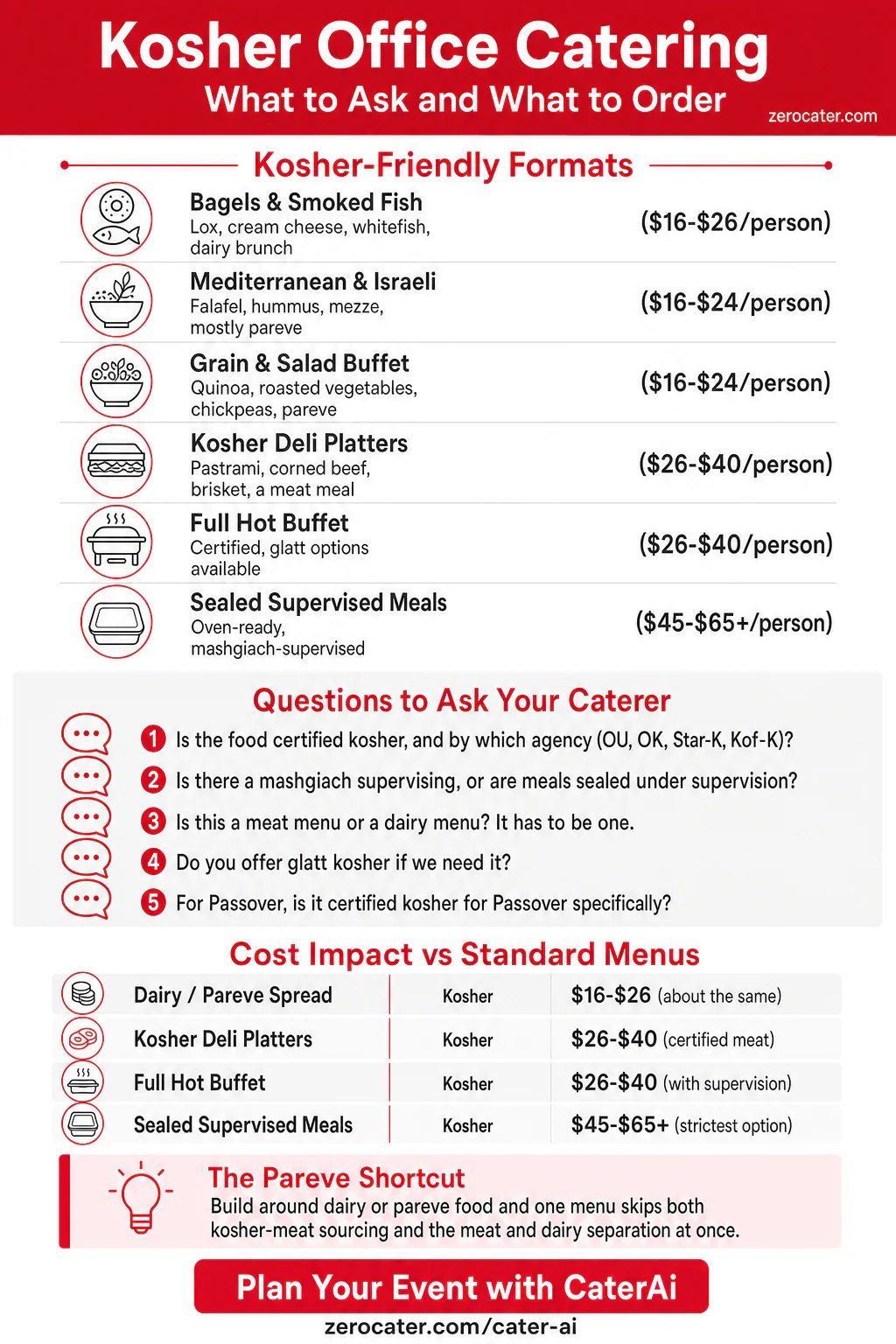
- Is the food certified kosher, and by which agency (OU, OK, Star-K, Kof-K)?
- Is there a mashgiach supervising, or are meals sealed under supervision?
- Is this a meat menu or a dairy menu? (It has to be one.)
- Do you offer glatt kosher if we need it?
- For Passover, is the food certified kosher for Passover specifically?
The Pareve Strategy: The Office Shortcut
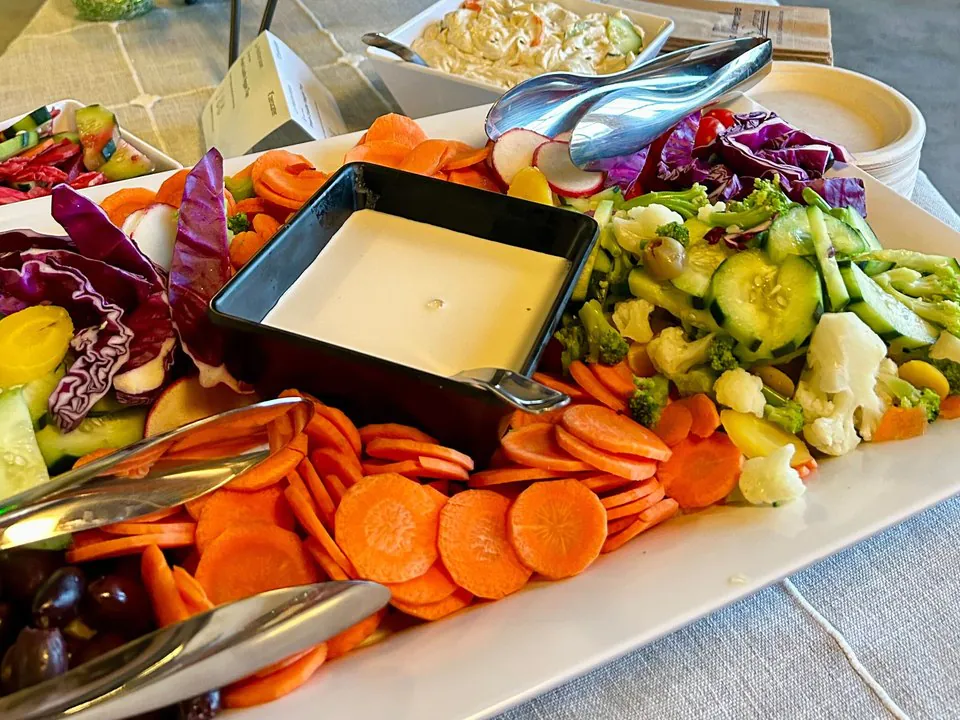
Here is where kosher stops feeling daunting. Pareve means neutral, food that is neither meat nor dairy: fish, eggs, fruit, vegetables, grains, legumes, nuts, and a long list of packaged snacks. Because pareve items may be eaten with a meat meal or a dairy meal, they dodge the two hardest parts of kosher catering in one move. There is no kosher-slaughter question, because there is no meat, and there is no separation problem, because pareve mixes with anything.
For an office, that turns into a simple play: build around a dairy or pareve menu and you avoid the most expensive, most supervision-heavy corner of kashrut entirely. Some of the most beloved Jewish catering spreads are already dairy or pareve by nature.
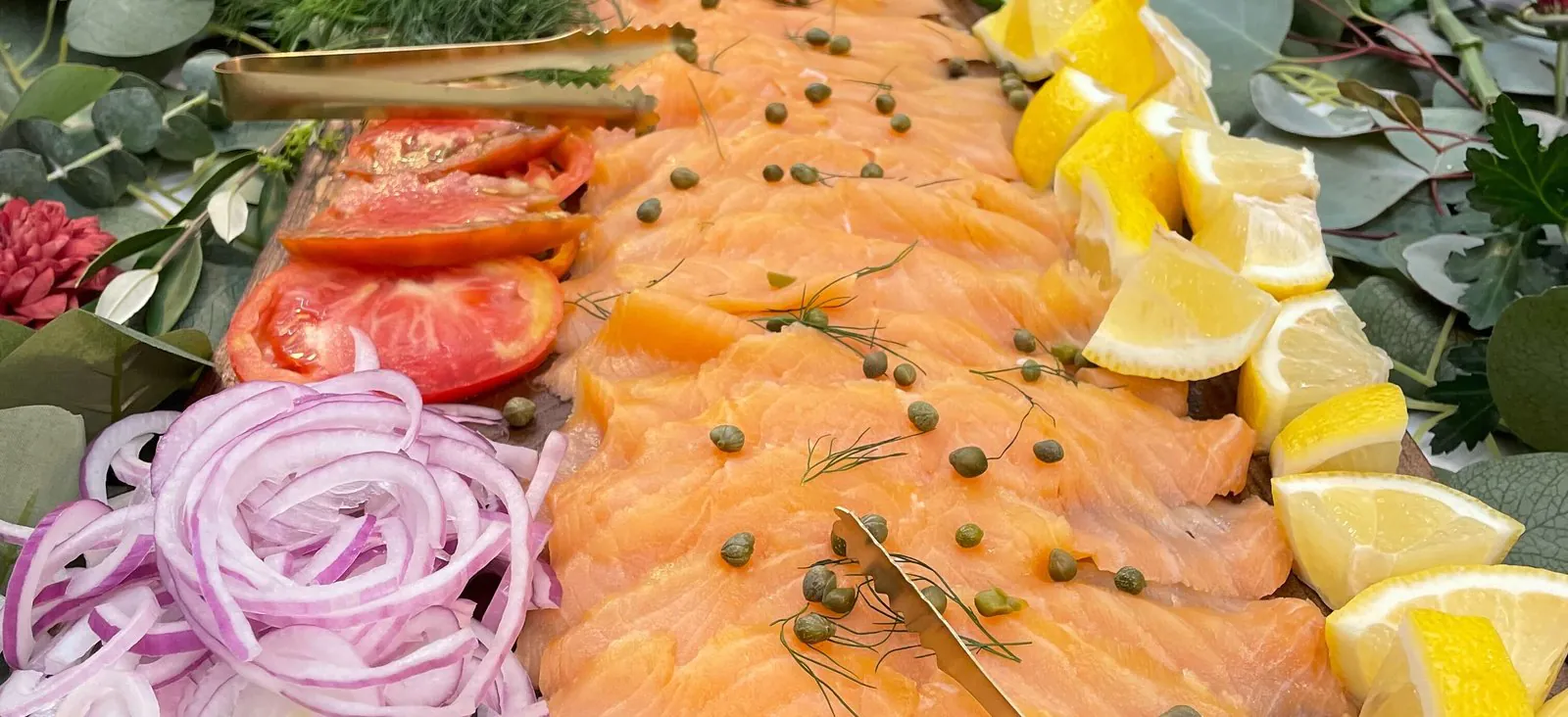
- Bagels and smoked fish (a dairy brunch): bagels, cream cheese, lox, whitefish salad, sliced tomato, cucumber, and red onion. Fish is pareve, the dairy is clearly dairy, and there is no meat to source.
- Mezze and grazing spreads (pareve): hummus, baba ganoush, falafel, tabbouleh, olives, and pita, mostly pareve and vegetable-forward.
- Grain and salad buffets (pareve): quinoa, roasted vegetables, chickpea salads, and grain bowls that anchor a light, easy-to-keep-kosher lunch.
Even here, the components still need to be certified to be truly kosher, so confirm the hechsher on packaged items and use a certified caterer for prepared ones. What the pareve route removes is the meat sourcing and the separation logistics, which is most of the difficulty.
How to Serve Certified Kosher Without a Kosher Kitchen
When a colleague keeps kosher strictly and you want to serve them a real hot meal, not just a salad, you do not need to build a kosher kitchen. The catering world solved this with the sealed, double-wrapped meal.
These meals are cooked in a certified kosher kitchen under a mashgiach, then sealed and double-wrapped before they leave. Because each one stays sealed until the person opens it, you can heat it in any office oven, kosher or not, without affecting its status. The seal is the point: it certifies that nothing touched the food between the supervised kitchen and the table. Your observant colleague gets a genuinely kosher hot meal in the same room, at the same meeting, as everyone else, and your office kitchen never has to change.
This is the standard answer for a mixed team with one or two strictly kosher members, and for client meetings or board lunches where you want everyone plated and no one singled out with a sad substitute. Order the sealed kosher meals for those who need them and a regular spread for the rest.
Kosher Menu Ideas by Format
Once you have sorted sourcing, the format question is the same as any office order. The strong options for a kosher or kosher-friendly spread:
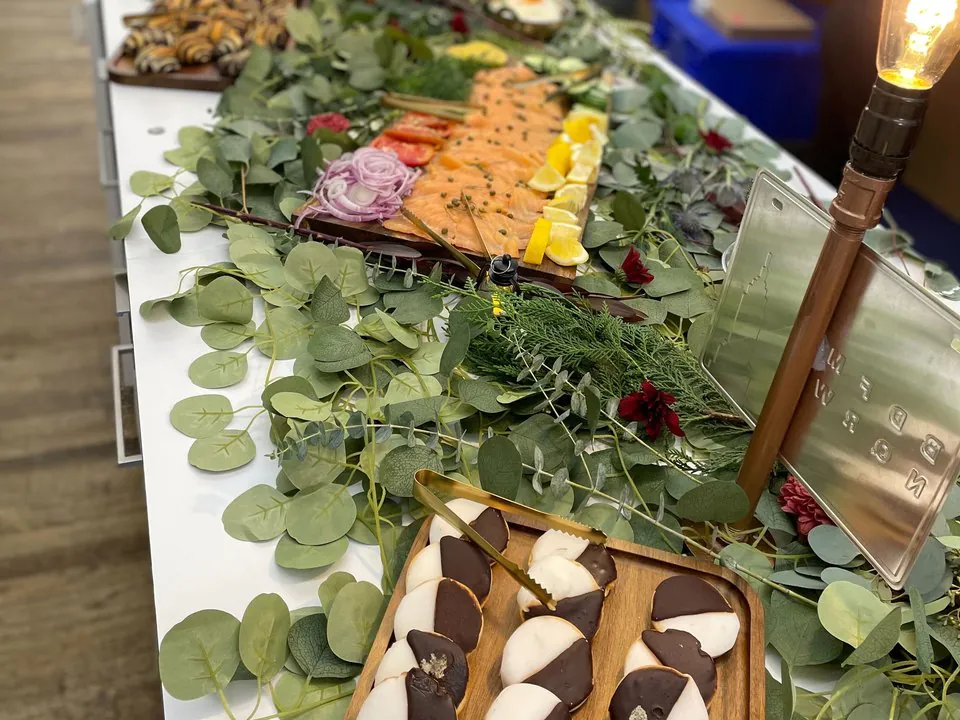
Bagels and Smoked Fish Brunch
The classic dairy spread and one of the easiest to keep kosher: bagels, an array of cream cheeses, lox and whitefish salad, and the standard garnishes. It travels well, holds at room temperature, and reads as a treat. Delis known for this format include Zucker’s Bagels & Smoked Fish and Murray’s Bagels in New York, and Rosen’s Bagels in Austin. Confirm certification if anyone at the table keeps strictly kosher, since a beloved local bagel shop may be kosher-style rather than certified.
Deli Sandwich Platters
Pastrami, corned beef, brisket, and turkey on rye with the full deli lineup of sides make a hearty meat lunch. This is where the certification question matters most, because deli meat is exactly the sourcing kosher governs. A certified kosher deli is the safe choice: New York Deli News in Denver is the deli format done for an office. Keep it a meat meal, which means no cheese and no dairy dessert.
Israeli and Mediterranean Mezze
Much of Mediterranean and Israeli cooking is pareve and vegetable-forward, which makes it a natural fit and a crowd-pleaser for a mixed room. Falafel, hummus, baba ganoush, salads, rice, and warm pita cover meat eaters and plant-based eaters in one order. Browse Mediterranean catering and Greek catering, and consider vendors like Zaatar Mediterranean and Hummus Mediterranean Kitchen in the Bay Area, Olive Mediterranean Grill in Chicago, Taboon Mediterranean Grill in Dallas, Zazu Mediterranean in New York, and SAJJ Mediterranean in Belmont.
Individually Sealed Hot Meals
For a strictly observant colleague, or an event where you want everyone plated, sealed mashgiach-supervised meals are the move. A protein over rice or roasted vegetables, sealed and oven-ready, each labeled kosher. See our best boxed lunch catering companies roundup and the boxed lunch vs. buffet breakdown for how individual formats compare.
What Kosher Office Catering Costs Per Person
Kosher pricing spreads wider than most dietary needs, and format is the reason. A dairy or pareve spread costs about what any office order does. Certified kosher meat and sealed supervised meals cost more because of sourcing and the supervision built into them.
| Tier | Per Person | What You Get | Best For |
|---|---|---|---|
| Dairy / Pareve | $16 – $26 | Bagels and smoked fish, mezze spreads, grain and salad buffets | Everyday team lunches and brunches |
| Certified Meat | $26 – $40 | Kosher deli platters, hot buffets, glatt options | Team events and celebrations |
| Sealed Supervised Meals | $45 – $65+ | Individually sealed, mashgiach-supervised, oven-ready meals | Strictly observant guests, plated board or client meals |
Add roughly 20 to 25 percent on top for delivery, tax, and gratuity. For how office catering is priced in general, see our boxed lunch catering cost guide.
Plan kosher catering with CaterAi
The Jewish Calendar: Passover, Shabbat, and Holidays
Serving kosher food is the baseline. Knowing the calendar around it is what tells Jewish colleagues you actually thought about them.
Passover. For about eight days in spring, Passover layers a second rule on top of kosher: no chametz, meaning no leavened grains. Bread, pasta, most baked goods, beer, and a long list of packaged foods are out, and matzo takes the place of bread. A normally kosher item is not automatically fine for Passover, so order food marked kosher for Passover specifically. Naturally compliant dishes like grilled proteins, roasted vegetables, salads, and fruit make the week easier. During Passover, skip the sandwich-and-pasta lunches and ask observant colleagues what they need.
Shabbat. The Jewish Sabbath runs from Friday sunset to Saturday sunset. Observant colleagues and many kosher caterers do not work, order, or take deliveries during that window, so plan Friday-afternoon and Saturday events accordingly and place kosher orders earlier in the week.
The High Holidays and more. Rosh Hashanah, the Jewish New Year, is a natural moment to cater something generous, with apples and honey for a sweet year. Yom Kippur is a fast day, so do not schedule a lunch, and a thoughtful move is a break-fast spread after sundown. Hanukkah brings fried foods like latkes and sufganiyot (jelly doughnuts). Marking these with the right food lands the same way a well-run holiday party does.
Covering Kosher and Everything Else in One Order
The pareve route pays off again when you are feeding a whole mixed room. A Mediterranean or Israeli spread is kosher-friendly and, at the same time, a strong vegetarian, vegan, and often gluten-free order, because its anchor dishes (hummus, falafel, salads, rice, grilled vegetables) satisfy several diets at once.
To build one menu that works for everyone:
- Anchor on a dairy or pareve spread so the kosher-meat question never comes up.
- Add individually sealed kosher meals for anyone who observes strictly.
- Keep at least one vegan and one gluten-free option in the mix, and label every dish.
- Ask, do not assume. A quick dietary question with the invite beats guessing.
For overlapping diets, our vegan, vegetarian, gluten-free, and allergy-safe boxed lunch guides go deeper, the mixed dietary needs guide covers juggling several at once, and the halal office catering guide is the companion for another religious-dietary need.
Mistakes to Avoid
The #1 mistake: treating kosher as “just no pork and shellfish”
It ignores kosher-meat sourcing and the meat and dairy separation, the two things that actually decide whether a spread is kosher. Start from certified food or sealed supervised meals instead of subtracting from a standard menu.
- Putting cheese on the meat. A cheese board beside the pastrami, or a dairy dessert after a meat main, breaks the meal. Pick meat or dairy per meal and stay there.
- Trusting “kosher-style.” It names a menu, not a certification. If someone keeps kosher religiously, confirm the food is certified.
- Assuming kosher covers Passover. During Passover you need food marked kosher for Passover, not just kosher.
- Leaving food unlabeled. If a colleague cannot tell which items are certified or which meal is meat versus dairy, it might as well not be there. Label everything.
- Scheduling around Shabbat or a fast day. Avoid Friday-evening and Saturday kosher orders, and never put a lunch on Yom Kippur.
How CaterAi Handles Kosher Catering
CaterAi is Zerocater’s catering planning tool, and it makes ordering kosher for a mixed team straightforward.
Describe the need, get a kosher-friendly menu. Give CaterAi the plain-language brief (“30 people, a dairy bagel-and-lox brunch, plus two sealed kosher meals for colleagues who keep strictly kosher, delivered by 9, around $22 a head”) and it builds a menu from over 1,000 restaurants, including certified kosher and naturally pareve options, that fits the requirement and the budget.
Dietary profiles that stick. Store the team’s needs once, including who keeps kosher and how strictly, and every future order respects them, so no one is repeatedly handed a substitute.
Variety across a recurring program. CaterAi tracks what the group has had recently and rotates among deli, Mediterranean, Israeli, and more, so a standing kosher-inclusive program never gets repetitive. For an ongoing meal program, Zerocater’s managed corporate catering handles the standing order, and event catering covers holiday celebrations and larger gatherings. See how it works.
Plan kosher catering with CaterAi
For related playbooks, see our guides to board meeting catering, healthy office catering, Indian corporate catering, the corporate event catering checklist, the office manager’s guide to ordering catering, and industry-specific catering for tech companies, law firms, and healthcare.
Frequently Asked Questions
What does kosher mean for catering?
Kosher describes food that meets Jewish dietary law. For catering it means three things at once: only permitted foods (no pork, no shellfish, and fish only if it has fins and scales), meat from permitted animals slaughtered the prescribed way (shechita) with the blood drained, and a strict separation of meat and dairy that runs through cooking, serving, and even the dishes. The simplest way to order kosher for an office is to choose a certified caterer or sealed, supervised meals rather than asking a standard kitchen to adapt a few dishes.
Can you serve meat and dairy together at a kosher event?
No. Keeping meat and dairy apart is one of the central rules of kashrut, and it is the one offices miss most. A kosher meal is either a meat meal or a dairy meal, never both. That rules out a cheeseburger, cream sauce on brisket, butter on a roll at a meat lunch, or a cheese board next to the deli platter. Separation also extends to equipment, so a strictly kosher kitchen keeps separate dishes and utensils. Neutral foods, called pareve, are the exception and can go with either.
What is the difference between kosher and kosher-style?
Kosher-style is a marketing phrase, not a certification. It usually means a menu of traditional Jewish deli food, like pastrami, matzo ball soup, and bagels with lox, that may be made with non-kosher ingredients in an unsupervised kitchen. Certified kosher means a certifying agency and its on-site supervisor, a mashgiach, have verified the sourcing, preparation, and meat and dairy separation. If a colleague keeps kosher for religious reasons, kosher-style will not satisfy the requirement. Ask directly whether the food is certified, and by which agency.
Do you need a kosher kitchen to serve kosher food at the office?
No. The common solution for a non-kosher office is sealed, double-wrapped meals prepared in a certified kosher kitchen under a mashgiach and delivered oven-ready. Because each meal stays sealed until the person opens it, you can heat it in any office oven without compromising it. This lets you serve a strictly observant colleague a genuinely kosher meal in the same room as everyone else. For a lighter touch, a dairy or pareve spread built from certified packaged items needs no kosher kitchen at all.
What is pareve, and why does it make kosher catering easier?
Pareve means neutral: food that is neither meat nor dairy, including fish, eggs, fruit, vegetables, grains, legumes, and many packaged snacks. Because pareve food can be eaten alongside either a meat or a dairy meal, building an office order around it sidesteps the two hardest parts of kosher catering at once, the kosher-meat sourcing and the meat and dairy separation. A bagel and lox brunch, a mezze spread, or a grain-and-vegetable buffet is naturally simple to keep kosher when the components are certified.
How much does kosher office catering cost per person?
It depends heavily on format. A dairy or pareve spread, like bagels and smoked fish or a Mediterranean mezze buffet, often runs about $16 to $26 per person, close to any other office order. Certified kosher meat and full hot buffets cost more because of sourcing and supervision, landing around $26 to $40 per person. Individually sealed, mashgiach-supervised meals, the strictest option, typically run $45 to $65 or more per person. Add roughly 20 to 25 percent on top for delivery, tax, and gratuity.
What does glatt kosher mean?
Glatt originally referred to the lungs of a slaughtered animal being smooth, with no adhesions that could raise a question about its status. In practice the word is now used more broadly to signal a higher, stricter standard of kosher supervision, especially for meat. If a colleague or a certifying agency specifies glatt, treat it as a request for the stricter tier and confirm the caterer can meet it rather than assuming standard kosher will do.
How do you cater the office during Passover?
Passover adds a rule on top of kosher for about eight days: no chametz, meaning no leavened grains, so bread, pasta, most baked goods, and many packaged foods are out, and matzo replaces bread. Order food marked kosher for Passover specifically, because a normally kosher item is not automatically Passover-friendly. Naturally compliant options like grilled proteins, roasted vegetables, salads, and fruit make it easier. If your team includes observant colleagues, avoid a bread-and-pasta menu that month and ask what they need.