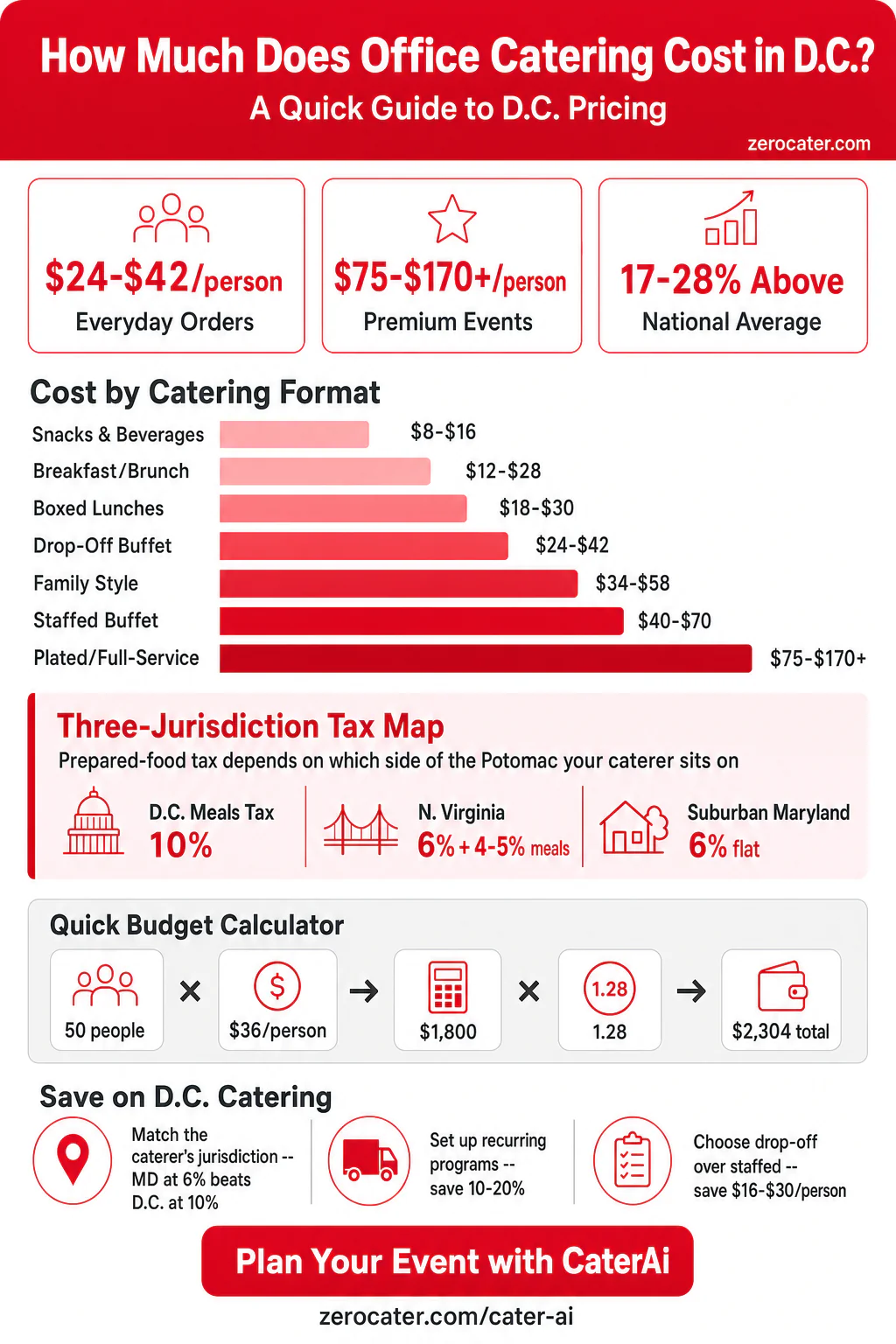
If you’re planning office catering in Washington, D.C., the short answer is: expect $24-$42 per person for most everyday orders, and $75-$170+ per person for premium events. But the real number depends on your format, headcount, occasion, and one thing no other major metro carries the same way: which of three tax jurisdictions your caterer sits in. Order inside the District and prepared food carries a 10% meals tax. Cross the Potomac into Arlington, Alexandria, Tysons, or Reston and it’s Virginia’s 6% sales tax plus a local meals tax. Cross into Bethesda, Rockville, or Silver Spring and it’s Maryland’s flat 6% with no add-on. Layer on a federal-government, K Street law-and-lobbying, and trade-association base that anchors one of the densest recurring catering markets in the country, and D.C. becomes a market where where you order from matters as much as what you order. This guide breaks down exactly what D.C. catering costs so you can budget with confidence.
In This Guide
- Cost by Catering Format
- What Each Format Looks Like
- Cost by Occasion
- Cost by D.C. Neighborhood
- The Three-Jurisdiction Tax Map
- Sample Menus by Budget
- What’s Included (and What Costs Extra)
- Why D.C. Catering Costs What It Does
- Spring, Fall, and Inauguration: D.C.’s Surge Windows
- How to Budget: A Quick Formula
- How to Save on Office Catering in D.C.
- FAQ
Cost by Catering Format
The single biggest factor in your catering cost is the service format. Here’s what each option runs in the D.C. metro:
| Format | Per-Person Range | Best For | Typical Headcount |
|---|---|---|---|
| Boxed Lunches | $18 – $30 | Team meetings, per-diem lunches, hybrid days | 10 – 100 |
| Drop-Off Buffet | $24 – $42 | Weekly team lunches, association meetings | 20 – 75 |
| Staffed Buffet | $40 – $70 | All-hands, client and stakeholder events | 50 – 200 |
| Family Style | $34 – $58 | Team dinners, department celebrations | 15 – 50 |
| Plated / Full-Service | $75 – $170+ | Executive dinners, board meetings, galas | 20 – 150 |
| Breakfast / Brunch | $12 – $28 | Morning briefings, kickoffs, breakfast meetings | 15 – 100 |
| Snacks & Beverages | $8 – $16 | Afternoon breaks, workshop fuel | Any |
One important nuance: buffet-style service runs 10-15% more than boxed meals for the same menu. People serve themselves larger portions, especially with proteins. If your budget is tight, or if your event is governed by federal per-diem rules, boxed lunches give you the most cost control and let you lean on D.C.’s deep Mediterranean, Peruvian, Central American, and Indian supply, all of which sit at the lower end of the per-person scale.
What Each Format Looks Like
Numbers only tell half the story. Here’s what you’re actually getting at each price tier:
Boxed Lunches ($18 – $30/person)
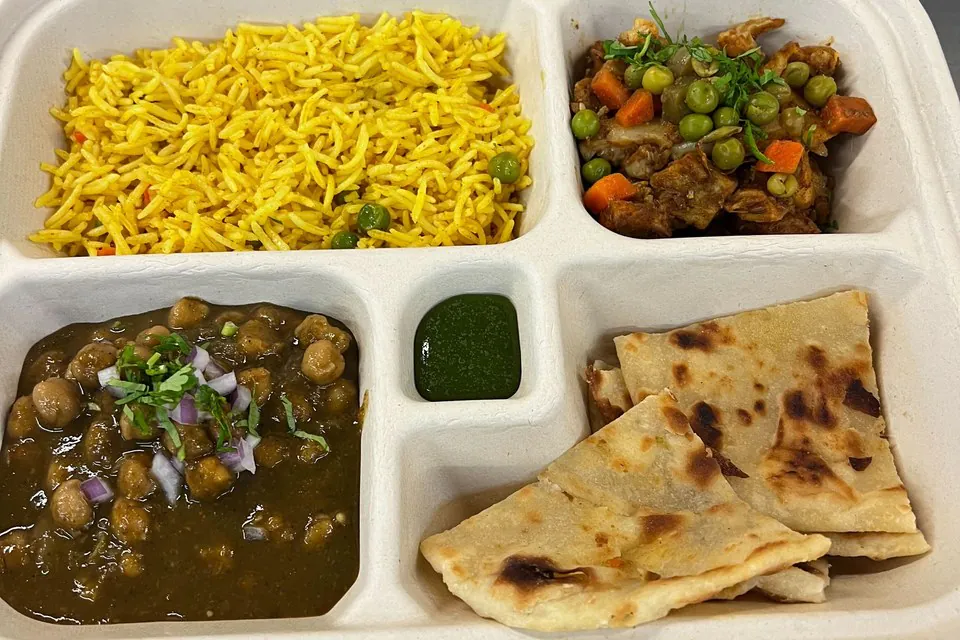
Each person gets their own container with an entree, side, and sometimes a drink or dessert. The big advantage is zero waste from over-ordering, and every box can be labeled with the recipient’s dietary needs. Cleanup is minimal. Boxed lunches are the default format for hybrid teams, Capitol Hill staff lunches, and any meeting that has to stay under a federal or association per-diem cap, since boxes hold well at room temperature for a 60 to 90-minute eating window.
Buffet Service ($24 – $70/person)
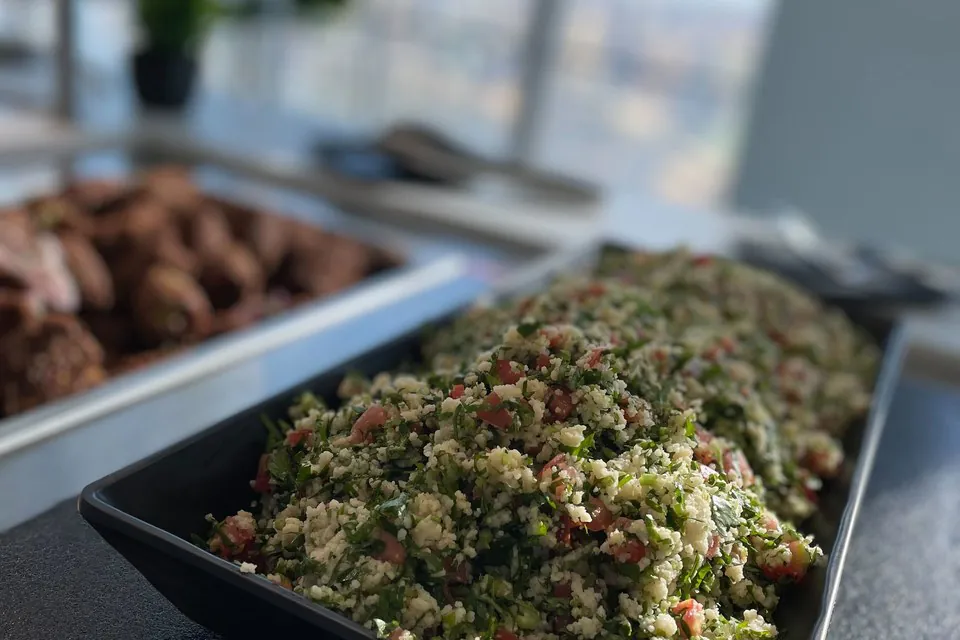
Buffets range from simple drop-off (caterer delivers and sets up, your team self-serves) to fully staffed with servers behind the line. The food is often identical between the two; the price difference is the labor. Drop-off buffets land in the $24-$42 range, while staffed service pushes $40-$70. In D.C., the gap is wider than in lower-cost metros because the District’s minimum wage and catering-labor rates sit near the top of the national pack, just behind Boston and the California markets.
Full-Service Events ($75 – $170+/person)
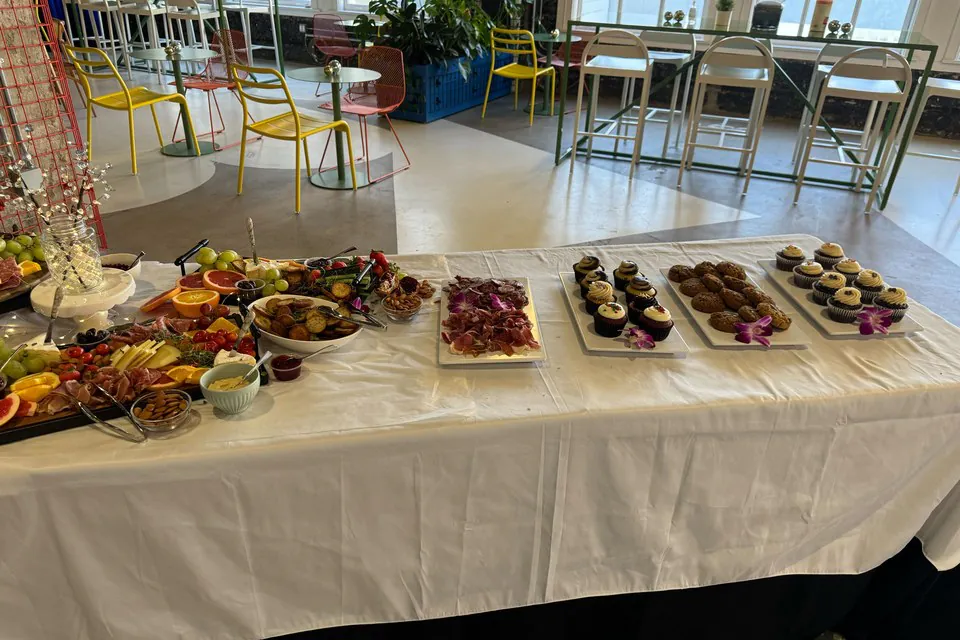
This is plated multi-course service or staffed stations with dedicated waitstaff, linen, proper serviceware, and often a bar component. You’re paying for the experience as much as the food. Reserve this for board meetings, client dinners, association galas, fundraisers, and milestone celebrations where presentation matters as much as the menu. The D.C. ceiling pushes toward $170+ per person during gala season and inauguration-week events, when the same caterer pool is bidding against fundraisers and hospitality programs at higher rates.
Cost by Occasion
Different events call for different levels of service. Here’s what to expect based on common office catering scenarios in D.C.:
Daily or Weekly Lunch Program ($20 – $34/person)
Recurring meal programs get the best per-person rates because caterers plan around predictable volume. Most programs use boxed meals or drop-off buffets, rotating through cuisines, which is a strength in D.C. where Mediterranean, Peruvian, Central American, Indian, Vietnamese, Korean, Thai, and Southern are all priced competitively. If you’re feeding your team regularly, a corporate catering program can lock in volume pricing and simplify ordering across the week.
One-Off Team Meeting ($24 – $42/person)
The classic lunch-and-learn or project kickoff. Drop-off buffets work well here since they feel more communal than boxed lunches. Budget toward the higher end if you need dietary variety (vegan, gluten-free, halal options alongside the main spread). D.C. offices tend to skew higher on dietary variety than the national average, especially the international-organization, nonprofit, and association crowd downtown and around Dupont Circle and Foggy Bottom.
Client-Facing or Stakeholder Event ($52 – $105/person)
When clients, members, or stakeholders are in the room, presentation matters. Staffed buffets or family-style service strike the right balance between polish and approachability. Add $35-$55/hour per server for staffing, with a 4-hour minimum on most accounts. For recommendations on caterers who specialize in this, see our guide to the 15 best corporate event catering companies in Washington, D.C.
Large Company Event, Gala, or Holiday Party ($75 – $170+/person)
Full-service plated dinners, cocktail receptions, and multi-course meals fall in this range. The wide spread reflects the difference between a staffed buffet holiday party (around $75/person) and a seated, multi-course gala (around $140-$170+/person). Book these 3-4 weeks ahead in the regular calendar, and 4-6 weeks ahead for anything in spring conference season or fall gala season. Explore Zerocater’s event catering solutions to streamline planning for large events.
Breakfast or Morning Briefing ($12 – $24/person)
Continental spreads (pastries, fruit, coffee) run $12-$16 per person. Hot breakfast buffets with eggs, bacon, and potatoes run $16-$24, and a bagel-and-shmear spread from a local bakery runs $13-$20. Morning briefings are one of the most cost-effective catering occasions since the per-person cost is roughly half a lunch service, and continental breakfast usually fits cleanly inside the GSA “light refreshment” budget that governs a lot of federal and association meetings.
Cost by D.C. Neighborhood
The D.C. metro doesn’t have a single price level. Where your office sits, and which side of the Potomac, changes both the per-person price and the tax and delivery math. Here’s the rough lay of the land:
| Zone | Relative Pricing | Notes |
|---|---|---|
| Downtown / K Street / CBD | +10-18% vs. metro average | Law firms, lobbying shops, and associations anchor recurring weekly accounts; 10% D.C. meals tax, high-rise loading-dock scheduling, and $15-$30 parking surcharges common |
| Capitol Hill / NoMa | +8-15% vs. metro average | Congressional offices, federal agencies, and trade associations; security and badging at federal buildings extends delivery windows |
| Golden Triangle / Dupont / Foggy Bottom | +8-15% vs. metro average | Nonprofits, international organizations, GWU; high dietary variety, 10% D.C. meals tax |
| Navy Yard / Capitol Riverfront / SW Waterfront | +5-12% vs. metro average | Newer corporate and federal offices, easier loading than the CBD, 10% D.C. meals tax |
| Georgetown | +8-15% vs. metro average | Narrow streets and limited loading add parking and access fees; 10% D.C. meals tax |
| Rosslyn-Ballston / Crystal City (Arlington, VA) | +5-12% vs. metro average | Amazon HQ2, consulting, and defense; Virginia 6% sales tax plus Arlington 4% meals tax |
| Tysons / Reston / Herndon (Fairfax, VA) | Metro average to +8% | Corporate HQs, tech, and government contractors; Virginia 6% sales tax plus Fairfax County 4% meals tax; easier parking |
| Bethesda / Rockville / Silver Spring (Montgomery, MD) | -3% to +8% vs. metro average | Biotech (NIH corridor), Marriott HQ, professional services; Maryland flat 6% sales tax, no local meals add-on, the lowest all-in jurisdiction |
| Alexandria / Old Town (VA) | +3-10% vs. metro average | Associations and consulting; Virginia 6% sales tax plus Alexandria 5% meals tax, the highest combined Virginia rate in the metro |
| Outer MD / VA suburbs | -5-12% vs. metro average | Best per-person value; match the caterer’s county to your office to avoid cross-jurisdiction delivery fees |
The cross-river trap. Ordering from a Virginia caterer for a downtown D.C. office, or a D.C. caterer for a Bethesda office, means paying distance fees plus bridge-and-Beltway traffic time, and it can change which tax rate lands on your invoice. Match the caterer’s jurisdiction to your office when you can. It’s the single most D.C.-specific way to control both the delivery line and the tax line.
The Three-Jurisdiction Tax Map
This is the part of D.C. catering that trips up every budget built on a single tax assumption. Unlike any other major metro, the D.C. area spans three separate tax jurisdictions, and prepared food is taxed differently in each one. The rate that lands on your invoice is set by where the order is delivered and where the caterer is registered, not by where your company’s headquarters is.
| Jurisdiction | Prepared-Food Tax | What It Means for Your Order |
|---|---|---|
| Washington, D.C. | 10% | The District taxes restaurant and catered prepared food at 10%, higher than its 6% general sales tax. This is the highest prepared-food rate in the metro and applies to every downtown, Capitol Hill, and Georgetown order. |
| Northern Virginia (Arlington, Alexandria, Fairfax, Tysons, Reston) | 6% + 4-5% local meals tax | Virginia’s 6% sales tax applies, plus a local meals tax: 4% in Arlington and Fairfax County, 5% in Alexandria. Effective combined rates land near 10-11%, similar to D.C. |
| Suburban Maryland (Montgomery & Prince George’s) | 6% | Maryland charges a flat 6% state sales tax on prepared food and does not allow county meals taxes, so Bethesda, Rockville, and Silver Spring are the lowest all-in tax combination in the metro. |
The practical takeaway: on a $2,000 food subtotal, the tax line alone swings about $80 between a Maryland caterer (6%, $120) and a D.C. caterer (10%, $200). For a recurring weekly program, that difference compounds into real money across a year. If your office is in suburban Maryland, ordering from a Maryland-registered caterer is the cleanest way to keep the all-in number down. If you’re downtown, the 10% rate is unavoidable, so build it into every budget from the start.
Sample Menus by Budget
Price ranges are useful, but what does each budget actually get you? Here are real examples of what D.C.-area caterers typically offer at each tier:
Budget Tier: $18 – $24/person (Boxed Lunch)
- Mediterranean chicken or falafel bowl, or a Peruvian roast-chicken plate with rice
- Side of tabbouleh, lentil salad, or a fresh green salad
- Pita, plantains, or a dinner roll
- Cookie or fresh fruit, plus a bottled drink
Feeds one person. Includes compostable packaging and utensils. D.C.’s deep Mediterranean, Peruvian, and Central American supply keeps the boxed floor competitive. Order through Zerocater from Fresh Bites Kitchen or Springbone Kitchen in the District, Poyoteca in Rockville, or Delia’s Mediterranean Grill in Alexandria for boxed catering in this range.
Mid-Range: $28 – $42/person (Buffet)
- Mediterranean buffet with chicken and beef shawarma, falafel, and grilled vegetables
- Rice pilaf, hummus, baba ganoush, tabbouleh, and warm pita
- Greek salad and a lentil or chickpea salad
- Baklava or seasonal fruit
- Iced tea or canned beverages
Serves 20-50 people. Includes serving trays, utensils, and napkins. Drop-off setup by caterer. D.C.’s Mediterranean and Indian catering supply is one of the deepest on the East Coast. Order from Medi Mediterranean Grill or Mediterranean Figs in Alexandria, Rice Around the Mediterranean World in Rockville, or pivot to Indian via Rasa in the District for similar pricing.
Premium: $80 – $135/person (Plated)
- Passed appetizers: crab cakes, seasonal crostini, and tenderloin bites
- Choice of entree: pan-seared rockfish, herb-roasted chicken, or grilled beef tenderloin
- Mid-Atlantic greens salad with a seasonal vinaigrette
- Artisan bread service
- Dessert: seasonal tart, chocolate torte, or a fruit galette
- Coffee and tea service
Plated and served by waitstaff. Includes linen, serviceware, and full setup/breakdown. Beverages and bar service priced separately. D.C.’s premium tier leans on Chesapeake seafood (rockfish, crab) and Mid-Atlantic produce, which doubles as a cost driver and a regional differentiator. For premium-tier and full-service event ordering through Zerocater, browse the vetted caterer network on CaterAi.
Not sure which format fits your budget?
Plan office lunch catering with CaterAi
Get custom menu options from 1,000+ vetted D.C.-area caterers in minutes.
What’s Included (and What Costs Extra)
The per-person prices above cover food and basic packaging or plates. Here’s what typically sits outside that number:
| Item | Typical Cost | Notes |
|---|---|---|
| Service Charge | 18 – 22% of food subtotal | Covers coordination, logistics, and platform fees |
| Delivery Fee | $18 – $55 | Often waived for larger orders; cross-river runs (VA-to-D.C. or D.C.-to-MD) add distance and bridge-traffic fees |
| Parking / Building Access | $15 – $30 | Common downtown, on K Street, Capitol Hill, and in Georgetown; federal and high-rise buildings may require ID, badging, and a pre-cleared loading window |
| Prepared-Food Tax | 6 – 10% | 10% in D.C., ~10-11% effective in Northern Virginia (6% + local meals tax), 6% in suburban Maryland |
| On-Site Staff | $35 – $55/hour per server | 4-hour minimum typical; 1 server per 20-25 guests (buffet) |
| Equipment Rentals | $5 – $15/person | Chafing dishes, linen, serviceware |
| Bartender | $40 – $65/hour | Separate from beverage costs; ABC rules apply across D.C., VA, and MD |
| Gala / Inauguration Surge | +15-30% on staffed and plated tiers | Applies during spring conference season, fall gala season, and inauguration weekends |
The “25% Rule”: A good rule of thumb is to add 25-30% on top of the per-person food price to account for service charges, delivery, tax, and incidentals. A $36/person buffet really costs closer to $45-$47 per person all-in. In the District, the 10% meals tax and downtown parking surcharges push that toward 30%, while a suburban Maryland order at 6% tax sits closer to 25%.
Why D.C. Catering Costs What It Does
D.C. catering runs 17-28% above the national average. That’s above Chicago (15-25%) and Atlanta (10-20%), and just below Boston (18-30%), with the West Coast and New York markets sitting at the top: Los Angeles (20-35%), San Francisco (20-35%), and New York City (25-40%). Here’s what drives the D.C. premium specifically:
Federal government, law, lobbying, and associations anchor a deep recurring base. K Street law and lobbying firms, the federal agencies, the contractors that serve them, and the thousands of trade associations and nonprofits headquartered in the District reorder catering weekly, often staffed. That predictable, premium volume lets caterers price for it, and it lifts the citywide staffed-buffet floor. It also means availability tightens fast around the events that matter to that crowd.
D.C. labor costs sit near the top of the national pack. The District’s minimum wage is one of the highest in the country, and catering servers typically run $35-$55/hour, above Chicago and Atlanta and just behind Boston and the California markets. For a 4-hour staffed buffet with three servers, that’s $420-$660 in labor alone, before food. The high labor cost is the biggest reason the gap between drop-off and staffed service is wider in D.C. than in most metros.
The three-jurisdiction tax map changes the all-in number. As covered above, the same order can carry a 10% D.C. meals tax, a ~10-11% effective Northern Virginia rate, or a flat 6% Maryland rate depending on where the caterer sits and where you deliver. No other metro forces this calculation into every catering budget.
Downtown logistics turn delivery and access into real line items. Loading-dock scheduling in K Street and CBD high-rises, security and badging at federal buildings, narrow streets in Georgetown, and limited parking across the core all add time and fees. Many D.C. caterers either build a wider delivery window into pricing or charge a $15-$30 access surcharge for buildings without easy loading.
Per-diem and light-refreshment rules cap a lot of budgets. Federal agencies, contractors, and associations that follow GSA guidelines often have to keep catered meals under the local per-meal per-diem share, and snack breaks under a separate light-refreshment cap. That pushes a large share of D.C. catering toward the boxed, drop-off, and continental-breakfast tiers, which keeps demand (and competition) high at the lower end.
Smaller orders cost more per head. Fixed costs like delivery, setup, and minimum staffing get spread across fewer people. Orders for 10-15 people typically run 15-25% higher per person than orders for 50 or more.
For pricing comparisons, see our guides to office catering costs in Boston, office catering costs in Chicago, office catering costs in Atlanta, office catering costs in Austin, office catering costs in Los Angeles, office catering costs in NYC, and office catering costs in San Francisco.
Spring, Fall, and Inauguration: D.C.’s Surge Windows
D.C. has a distinctive event calendar driven by the rhythms of government, associations, and the political season. If your office event lands in one of these windows, your catering math changes. Here’s the calendar to plan around:
| Window | Timing | Catering Premium | What Gets Hit |
|---|---|---|---|
| Spring Conference Season | March through May | +15-25% on staffed and plated tiers | Cherry-blossom-season tourism, association annual meetings, and graduations compress premium-tier availability across the core |
| Fall Gala & Session Season | September through early December | +15-25% on full-service receptions | Congress back in session, fundraising galas, and holiday parties absorb premium-tier caterers |
| Inauguration | Every four years, mid-January | +25-40% on staffed and plated tiers | Inaugural balls, receptions, and hospitality bookings pull nearly the entire premium caterer pool off the market for the week |
| Summit & State-Visit Weekends | Irregular | +10-20% on staffed catering | Major summits, state visits, and big-ticket gala weekends compress downtown availability and tighten security logistics |
| Q4 Holiday Season | Mid-Nov through mid-Dec | +10-20% on staffed and plated | Annual holiday-party density across D.C., NoVA, and suburban MD; book 4-6 weeks ahead |
Three rules for surge windows:
1. Book 4-6 weeks ahead for any staffed or plated event in a surge window. The premium-tier caterer pool shrinks fast once association meetings, galas, and hospitality programs lock down their teams. Three weeks out is too late in spring conference season and fall gala season.
2. Lean on boxed lunches and drop-off buffets if you can. The supply pool is much deeper at the everyday tier, and surge premiums are smaller (often $0-5/person rather than $15-30). For a surge-week internal team lunch, a Mediterranean or Peruvian boxed lunch from a suburban caterer is often the same price as a normal week.
3. Use the suburbs and cross the river. Bethesda, Rockville, Silver Spring, Arlington, and Tysons caterers are largely insulated from the downtown surge, and a Maryland caterer also saves you the difference between D.C.’s 10% meals tax and Maryland’s 6% sales tax.
How to Budget: A Quick Formula
Use this formula to get a realistic total that includes all the extras:
Realistic Budget = (Headcount × Per-Person Cost) × 1.28
The 1.28 multiplier covers service charges, delivery, the 10% D.C. meals tax, and a small buffer for last-minute additions. For a suburban Maryland order at 6% tax, use 1.25. For downtown events with parking and building-access surcharges, use 1.30. For a surge-window staffed or plated event, use 1.40. Here’s how that plays out across common scenarios:
| Scenario | Format | Per Person | 25 People | 50 People | 100 People |
|---|---|---|---|---|---|
| Team Lunch | Boxed Lunch | $24 | $768 | $1,536 | $3,072 |
| All-Hands | Drop-Off Buffet | $36 | $1,152 | $2,304 | $4,608 |
| Stakeholder Event | Staffed Buffet | $55 | $1,760 | $3,520 | $7,040 |
| Gala / Executive Dinner | Full-Service Plated | $115 | $3,680 | $7,360 | $14,720 |
| Morning Briefing | Continental Breakfast | $15 | $480 | $960 | $1,920 |
For example, a drop-off buffet for 50 people at $36/person: 50 × $36 = $1,800, then $1,800 × 1.28 = $2,304 total budget. That gives you enough headroom for the service charge, delivery, and the 10% D.C. meals tax without scrambling for additional approval. If your caterer is in Maryland at 6% tax, swap the multiplier to 1.25 and budget $2,250. During a surge window, use 1.40 and budget $2,520.
How to Save on Office Catering in D.C.
D.C. catering doesn’t have to break the budget. Here are the most effective ways to keep costs down without cutting quality:
Match the caterer’s jurisdiction to your office. This is the single most D.C.-specific way to save. A Maryland caterer delivering to a Bethesda or Rockville office charges 6% tax instead of D.C.’s 10%, and you avoid cross-river delivery fees and Beltway traffic time. For a recurring weekly program, that tax difference alone compounds into real savings across a year.
Set up a recurring program. Caterers offer better per-person rates for predictable, repeating orders. A weekly lunch program can save 10-20% compared to one-off ordering. Zerocater’s corporate catering programs are designed around this, with dedicated account management and volume pricing built in.
Choose drop-off over staffed service when you can. The food is often identical. The difference is $16-$30/person in D.C. labor, where server rates sit near the top of the national pack. If your team can serve themselves, and for most internal lunches they can, drop-off is the move.
Lean on D.C.’s strongest cuisines for the budget tier. Mediterranean, Peruvian, Central American, Indian, Vietnamese, and Korean all have deep D.C.-area supply at competitive prices. A Mediterranean or Peruvian boxed lunch at $22/person feels generous but lands at the boxed floor. A shawarma or roast-chicken buffet at $34/person feels abundant but lands in mid-tier pricing.
Keep per-diem events in the boxed and drop-off tiers. If your event is governed by GSA per-diem or grant rules, build the menu from the $18-$42 boxed and drop-off range and confirm the all-in per-person number, including tax and service charge, before booking. It keeps you compliant and avoids the staffed-service premium.
Order for the right headcount. Over-ordering is the single biggest source of waste. Buffets in particular lead to 10-15% more consumption per person than boxed meals. If you’re consistently throwing away food, switch to individual portions or trim your headcount estimate by 10%.
Plan dietary needs upfront. Last-minute dietary accommodations cost more because caterers need to source and prepare separate items on short notice. Collect dietary requirements when you send the meeting invite, not the day before. Our guide on ordering catering for mixed dietary needs covers this in detail, and our vegan, gluten-free, and allergy-safe boxed lunch guides cover specific cases.
Avoid the surge windows if you have flexibility. If your event isn’t tied to a conference, gala, or the political calendar, scheduling it outside spring conference season and fall gala season saves 15-25% on staffed and plated tiers. Mid-summer and January (outside an inauguration year) are some of the cheapest weeks for premium-tier D.C. catering.
Use a platform to compare options. Instead of calling three caterers for quotes, use a platform like CaterAi to compare menus from over 1,000 vetted caterers, filter by dietary needs and budget, and check out in minutes. The built-in portioning tools help you avoid over-ordering, and you can adjust menus in real time through the chat interface.
Get real pricing instantly. Most catering companies require you to call or email for a quote, then wait for a callback. With CaterAi, you see actual menu prices from vetted D.C.-area caterers in real time. Share your headcount, budget, and dietary needs, and CaterAi builds custom menus you can tweak and book on the spot.
For D.C.-area tech and government-contractor offices specifically, our corporate catering for tech companies guide covers recurring-program patterns that work well in the Tysons, Reston, and NoMa corridors. For event planning across the metro, see holiday party catering planning, board meeting catering, company picnic and outdoor catering, and the office manager’s guide to ordering catering.
Frequently Asked Questions
How much does office catering cost per person in Washington, D.C.?
In Washington, D.C., expect to pay $18-$30 per person for boxed lunches, $24-$42 for drop-off buffets, $40-$70 for staffed buffets, and $75-$170+ for full-service plated events. D.C. prices typically run 17-28% above the national average, landing above Chicago and just below Boston. The single biggest D.C.-specific variable is which tax jurisdiction your caterer sits in: prepared food carries a 10% meals tax inside the District, while Northern Virginia and suburban Maryland caterers charge 6% sales tax (Virginia localities add a 4-5% meals tax on top).
Why is catering taxed differently in D.C., Virginia, and Maryland?
The D.C. metro spans three separate tax jurisdictions. Inside the District, prepared food and catering carry a 10% meals tax (higher than the 6% general sales tax). In Northern Virginia (Arlington, Alexandria, Tysons, Reston, Fairfax), prepared food carries Virginia’s 6% sales tax plus a local meals tax that runs 4% in Arlington and Fairfax County and 5% in Alexandria, for an effective rate near 10-11%. In suburban Maryland (Bethesda, Rockville, Silver Spring), prepared food carries a flat 6% state sales tax with no local add-on, because Maryland does not allow county meals taxes. The tax is set by where the order is delivered and the caterer is registered, so a Bethesda caterer delivering to a Maryland office is the lowest-tax combination in the metro.
What is the cheapest way to cater a meeting in D.C.?
Boxed lunches are the most budget-friendly option at $18-$30 per person, with built-in portion control, minimal cleanup, and easy dietary labeling. D.C.’s deep Mediterranean, Peruvian, Central American, and Indian supply keeps the boxed floor competitive. A breakfast or bagel spread runs $12-$20 per person for morning meetings. If your office is in suburban Maryland, ordering from a Maryland caterer also saves you the difference between D.C.’s 10% meals tax and Maryland’s 6% sales tax.
How much should I budget for catering for 50 people in D.C.?
For 50 people in Washington, D.C., budget $1,150-$1,920 for boxed lunches, $1,540-$2,690 for a drop-off buffet, or $2,560-$4,480 for a staffed buffet. These estimates include a roughly 28% buffer for service charges, delivery fees, and the 10% D.C. meals tax on prepared food (use a 1.25 buffer instead if your caterer is in Maryland at 6%). Use the formula: (headcount × per-person cost) × 1.28 for a realistic D.C. total.
Are delivery and building-access fees included in D.C. catering prices?
Usually not. Most D.C. caterers charge $18-$55 for delivery depending on distance and order size. Downtown, K Street, and Capitol Hill deliveries often add a $15-$30 surcharge for parking, loading-dock scheduling, and security or badging at federal and high-rise buildings, where a driver may need a photo ID and a pre-cleared delivery window. Cross-river deliveries (a Virginia or Maryland caterer serving a downtown D.C. office) add distance fees and bridge-traffic time. On top of delivery, expect an 18-22% service charge and the applicable 6-10% jurisdiction tax. A good rule of thumb is to add 25-30% to the quoted per-person price for the true all-in cost.
Does the federal per diem affect office catering budgets in D.C.?
Yes, more than in any other metro. Federal agencies, government contractors, and trade associations that follow GSA rules often have to keep catered meals under the per-meal share of the local M&IE per diem, and “light refreshment” breaks (coffee, pastries, snacks) are budgeted separately and capped. This pushes a large share of D.C. corporate catering toward boxed lunches, drop-off buffets, and continental breakfasts in the $12-$30 range rather than staffed or plated service. If your event is governed by per-diem or grant rules, build your menu from the boxed and drop-off tiers and confirm the all-in per-person number including tax and service charge before booking.
How far in advance should I order catering in D.C.?
For standard office lunches, 2-3 business days is usually sufficient. For events over 50 people, book 1-2 weeks ahead. Full-service plated events and holiday parties should be booked 3-4 weeks in advance. D.C.’s spring conference season (March through May) and fall gala season (September through early December) both compress premium-tier availability, so plan corporate events in those windows 4-6 weeks ahead. Inauguration week every four years and major-summit weekends pull caterers off the available pool entirely. Using a platform like Zerocater can speed up the process since you can browse menus and order from multiple caterers in one place.
Is downtown D.C. more expensive than the Virginia and Maryland suburbs?
Yes, typically 8-18% more. Downtown D.C., K Street, Capitol Hill, and the Golden Triangle concentrate law firms, lobbying shops, and trade associations that reorder weekly, and pricing reflects that demand plus the 10% meals tax and downtown parking, loading-dock, and security logistics. Offices in Bethesda, Rockville, or Silver Spring (Maryland, 6% tax) and the Rosslyn-Ballston, Tysons, and Reston corridors (Virginia) generally see better per-person pricing for equivalent menus, and Maryland’s flat 6% tax with no local meals add-on makes suburban Maryland the lowest all-in jurisdiction in the metro.
Plan office lunch catering with CaterAi