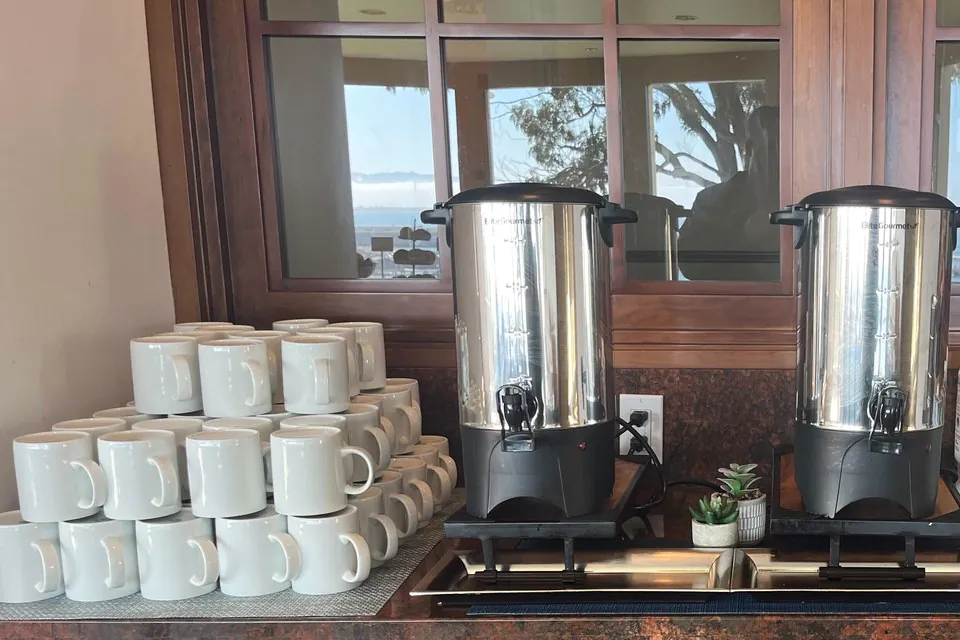
The bus gets to the venue at 8:40 and 40 people walk into a room with no coffee. That is the offsite failure mode, and it has nothing to do with the food being bad. Catering an offsite breaks the playbook that works at the office: there is no kitchen, no fridge, no loading dock, and no facilities manager who knows where the extra tables live. The day runs nine hours across five separate eating moments instead of one lunch drop. And nobody in the room can leave to find something else, so a menu that misses is a person who does not eat until dinner. This guide covers the five moments of an offsite day, the questions to ask the venue before you call a single caterer, what to order so the afternoon session survives lunch, what it costs per person, and the delivery problems that turn a retreat into a scramble.
In This Guide
- Why an Offsite Breaks Your Normal Catering Playbook
- The Five Eating Moments of an Offsite Day
- Quick Comparison Table
- Ask the Venue These Questions First
- What to Order at Each Moment
- Let the Agenda Set the Menu
- Delivery Outside Your Normal Radius
- Multi-Day Retreats
- The Mistakes That Wreck an Offsite
- City Cost Guides
- How CaterAi Handles Offsite Catering
- FAQ
Why an Offsite Breaks Your Normal Catering Playbook
Ordering lunch for the office is a solved problem. You know the address, the kitchen, the fridge, the person at the front desk, and the caterer who has delivered there 30 times. Take the same team 40 miles up the coast and every one of those supports disappears at once.
- The venue owns the rules, and you do not. Hotels and conference centers commonly run exclusive or preferred caterer lists, and many restrict outside food to protect their own food and beverage revenue. Even venues that allow an outside caterer attach conditions: proof of insurance, an approved vendor agreement, a load-in window, a ban on open flame. Ask for the policy in writing before you fall in love with a menu.
- It is a sequence, not a meal. An office order is one delivery. An offsite is breakfast on arrival, a mid-morning break, lunch, an afternoon snack, and often dinner or a reception, each with its own format, timing, and dropoff. Plan them as five decisions instead of one.
- The agenda sets the constraints. A facilitated session gives lunch 45 minutes, and 45 minutes does not absorb a buffet line for 60 people. A heavy plate at noon costs you the 2pm block, which is usually the hardest working stretch of the day.
- The room is captive. At the office, a vegan whose meal never showed up walks to a salad place and grumbles. At a retreat center with one road in, that person eats bread until dinner. Every dietary need becomes mandatory rather than nice to cover.
- You are often outside the delivery radius. Caterers work a zone. A venue an hour past the metro edge sits outside many of them, and outside the range where anyone can fix a short order at 11:30. Confirm the address is servable before you shortlist menus.
Handle those five and an offsite is easier to feed than an office, because you control the whole day. Miss them and you get the bus arriving at a room with no coffee.
The Five Eating Moments of an Offsite Day
1. Arrival Breakfast
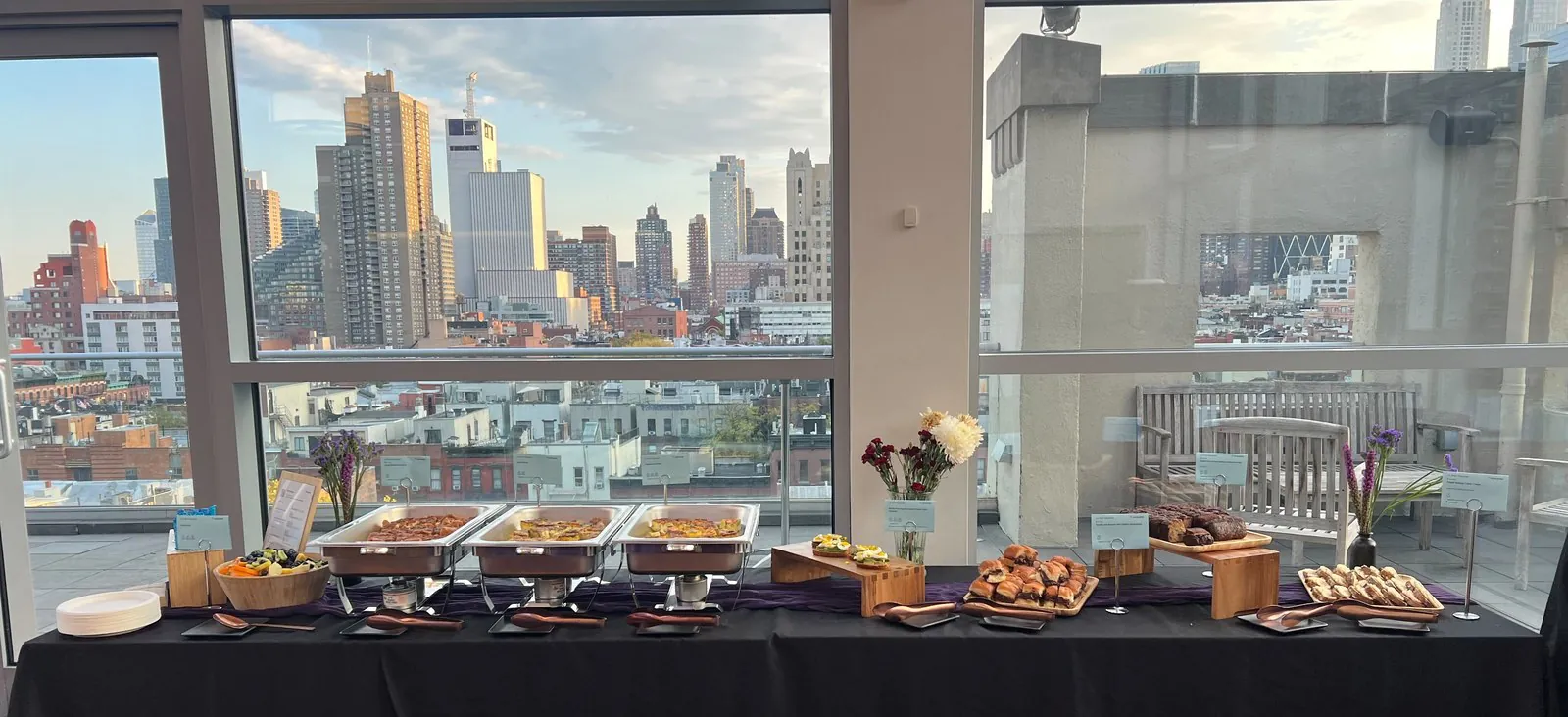
People show up hungry, early, and in a scatter across 30 minutes. Set a grazing spread that survives a staggered arrival: pastries, a fruit platter, yogurt and granola, and enough coffee for everyone to have two cups. This service does more work than its cost suggests, because it fills the awkward stretch before the first session and gets people talking. Our office breakfast catering and boxed breakfast guides both apply.
2. The Mid-Morning Break
The cheapest service on the schedule and the one people notice most when it is missing. Fifteen minutes, standing, somewhere out of the session room: fresh coffee, tea, water, whole fruit, and something small. Keep it running rather than putting it out once, since a 10:30 break where the coffee ran out at 9:15 lands badly.
3. Lunch
The service that decides how the afternoon goes. Lunch has to feed everyone inside the agenda’s window and leave the room able to think afterward, which rules out most of what people order when they want lunch to feel like a treat. Match the format to the clock: boxed meals for a 45-minute break, a buffet when you have an hour or more and space for a line.
4. The Afternoon Snack
Around 3pm the room flags, and a small, well-timed refresh buys back the last two sessions. Think fruit, nuts, cheese and crackers, a cookie tray, cold drinks, and more coffee. A grazing or charcuterie board works here and doubles as something for people to stand around.
5. Dinner or an Evening Reception
Some offsites end at 5, and the ones that run into the evening change register. Nobody has to work after dinner, so this is where the heavy, celebratory, generous food belongs: barbecue, a taco spread, a stationed reception with passed bites, or a proper sit-down meal. Our corporate event catering checklist covers the evening side in detail.
Quick Comparison Table
| Moment | Best Format | Per Person | Why It Works |
|---|---|---|---|
| Arrival Breakfast | Grazing spread, pastries, fruit, coffee | $10 – $18 | Absorbs a staggered arrival; no serving line |
| Mid-Morning Break | Standing coffee and fruit station | $5 – $10 | Cheapest service, most missed when skipped |
| Lunch (tight agenda) | Labeled boxed meals or bowls | $18 – $28 | Feeds 60 people in 10 minutes flat |
| Lunch (full hour) | Buffet or build-your-own bar | $20 – $32 | Choice and variety; gets people mixing |
| Afternoon Snack | Fruit, cheese board, cookies, cold drinks | $5 – $12 | Buys back the last two sessions |
| Dinner / Reception | Barbecue, taco spread, stationed reception | $35 – $70+ | Nobody works after; go generous |
Ranges assume major-metro pricing before delivery, tax, and gratuity, which typically add 20 to 25 percent. A venue outside the metro often carries a delivery premium on top. A day of breakfast, two breaks, and lunch lands around $40 to $70 per person; add dinner and plan on $75 to $130. For a deeper breakdown, see our boxed lunch catering cost guide.
Ask the Venue These Questions First
The venue walkthrough decides your catering options, so run it before you shortlist a single caterer. Get the answers in writing, because a verbal yes from a salesperson in March does not help you at the loading door in July.
- Do you allow outside catering, or do we have to use your list? Exclusive and preferred caterer policies are common at hotels and conference centers, and they decide whether you are choosing a menu or picking from two.
- What does the caterer have to provide? Certificates of insurance, health permits, and signed vendor agreements come up often, and they take days to produce.
- Is there a kitchen, and can we use it? Access to a prep space, a fridge, or even a sink changes the menu. Assume no unless someone confirms yes.
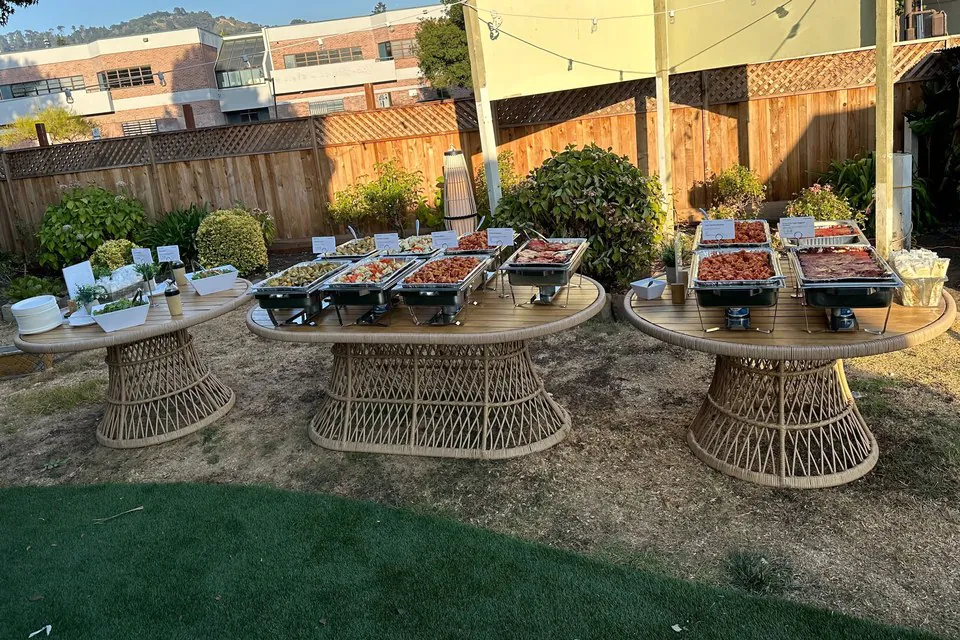
- Are chafing dishes and Sterno allowed? Plenty of venues ban open flame outright, which rules out most hot buffets and pushes you toward hot boxes or cold service.
- Where does the caterer load in, and when? Load-in windows, elevator rules, and a delivery door on the far side of the building all cost time you have not budgeted.
- Do you supply tables, linens, ice, and power? A buffet with nowhere to sit the chafing dishes is a common and avoidable morning.
- Who handles trash and breakdown? Some venues require the caterer to remove everything, some charge for it, and some leave you doing it at 6pm.
- Is there a food and beverage minimum? In-house catering contracts frequently carry one, and it changes the math on whether an outside caterer saves you anything.
The question people forget
Ask who the caterer calls on the day. An offsite venue has no office manager, and the person who booked the room is often in a session with their phone off. Name an on-site contact, give the caterer that number, and tell them the exact door. Half of offsite catering problems are a driver in a parking lot with nobody answering.
What to Order at Each Moment
Breakfast. A spread beats a plated service when people arrive across half an hour. Pastries and bagels, a fruit platter, yogurt and granola, hard-boiled eggs or a breakfast sandwich tray for people who skipped dinner, and more coffee than you think. Individually wrapped items work well when the venue gives you a corridor instead of a room.
Breaks. Whole fruit, nuts, granola bars, cheese and crackers, and cold drinks in a cooler. Refill rather than set once. The afternoon version can lean sweeter, and a party tray spread covers it without a caterer having to return.
Lunch on a tight clock. Labeled boxed meals or sealed bowls, stacked and ready. Sixty people clear a table of boxes in minutes, and every dietary need travels in its own box with a name on it. Our roundup of the best boxed lunch catering companies and the boxed lunch vs. buffet comparison both apply, and boxed wins any time the agenda is the binding constraint.
Lunch with a real hour. A buffet or a build-your-own bar, which gets people out of their seats and mixing with someone they do not sit near. A taco bar scales well and covers most dietary needs by construction. Mediterranean spreads travel and hold better than almost anything else, and Mexican and Italian caterers both handle offsite volume well.
Dinner. Go generous. Barbecue and barbecue caterers suit an outdoor venue, a stationed reception suits a mingling crowd, and a seated meal suits a program with a speaker. If the offsite runs outdoors, our company picnic and outdoor catering guide covers heat, shade, and the food that survives both, and the summer catering ideas guide has warm-weather menus.
Cover a vegetarian, a vegan, and a gluten-free option at every service, breakfast and snacks included. Our vegetarian, vegan, and gluten-free guides go deeper, and the mixed dietary needs guide covers running several at once. Label every dish and keep the special meals somewhere the first ten people through the line will not take them by accident.
Plan offsite retreat catering with CaterAi
Let the Agenda Set the Menu
Ask for the run-of-show before you order anything. The schedule tells you more about what to serve than any preference survey will.
A 45-minute lunch does not fit a buffet. Sixty people through a two-sided buffet takes 20 to 25 minutes before anyone sits down, and the facilitator will start the next session on time regardless. Boxed meals collapse that to five minutes and give people the rest of the break to walk outside.
The session after lunch is the one you can ruin. Heavy carbohydrates, cream sauces, and fried food at noon leave a room that stops contributing by 2:15. Grain bowls, salads with grilled protein, and sandwich builds keep people functional. Our healthy office catering guide covers the menus that hold up in an afternoon working block.
A working lunch is a different order than a break. If the agenda has people presenting through the meal, everything has to be quiet, one-handed, and free of anything that needs cutting. The same logic our lunch and learn guide applies to training sessions applies here.
Match the energy to the arc. Offsites usually front-load the hard thinking and end on something social. Feed that shape: light and functional through the working blocks, generous once the work is done.
Delivery Outside Your Normal Radius
The logistics that never come up at the office are the ones that bite at a retreat center.
- Confirm the address is inside the caterer’s zone before you plan a menu. Caterers work a delivery radius, and a venue past the metro edge often falls outside it or carries a surcharge. Ask first and save yourself a shortlist you cannot use.
- Build in a buffer on the first delivery. A driver who has never been to the venue, on an unfamiliar road, with a gate code, needs slack. Schedule breakfast to land 30 minutes before people arrive.
- Nobody is fixing a shortage at 11:30. At the office you order more sandwiches. An hour out of town, what arrives is what you have. Order to the RSVP, not to the optimistic attendance guess, and keep extra snacks in the room.
- Consolidate the drops. Five services do not need five deliveries. Have the caterer bring the shelf-stable breaks with breakfast and cut your exposure to the drive in half.
- Put one person on food. Someone who is not facilitating, not presenting, and answers their phone. Our office manager’s guide to ordering catering covers building that workflow.
Multi-Day Retreats
Two or three days changes the problem from logistics to variety. The same buffet on day two reads as an oversight.
Rotate the cuisine. Never repeat a cuisine across consecutive meals, and vary the format as well: a buffet lunch, a boxed lunch, an outdoor barbecue. People remember the repeat far longer than they remember the good meal.
Scale breakfast down after day one. Attendance at the 7:30 spread drops once people know the schedule. Order the full breakfast on the first morning and cut it back after.
Leave one meal off-site. A dinner out on a multi-day retreat gives people a break from the room and takes a whole service off your plate. Build it into the budget rather than treating it as extra.
Keep the snack station stocked the entire time. On a multi-day retreat, food between meals is the social space. It costs little and does more for the room than an upgraded entree.
The Mistakes That Wreck an Offsite
- Booking the venue before asking about catering rules. An exclusive caterer clause found in June rewrites a plan built in March.
- Ordering one lunch and calling it done. A nine-hour day has five eating moments. Skipping the breaks is the most common and most noticed cut.
- A buffet inside a 45-minute break. The line eats the break, then the session starts late.
- Heavy food at noon. You pay for it in the 2pm session, every time.
- Assuming a kitchen, a fridge, or a table. Confirm all three. Venues without them are common.
- Treating dietary needs as best-effort. A captive room has no fallback. One missed vegan meal is one person not eating for six hours.
- No named on-site contact. The driver calls someone whose phone is off in a session, and the food sits in a lot.
- Running out of coffee. Order more than you think, and keep it refreshed past 2pm.
City Cost Guides
Catering costs, delivery radii, and lead times vary by market, and offsite venues often sit at the edge of one. For local pricing, see our cost guides for San Francisco, New York City, Chicago, Austin, Denver, Seattle, and Washington, D.C. For a full-service offsite in the Bay Area, our roundup of the best corporate event catering in San Francisco is a starting shortlist.
Different teams run offsites differently. For industry-specific playbooks, see corporate catering for tech companies, law firms, healthcare, financial services, manufacturing, and nonprofits.
How CaterAi Handles Offsite Catering
CaterAi is Zerocater’s catering planning tool, and an offsite is the case it was built for.
Plan the whole day in one place. Describe the shape of it (“40 people, 8:30 to 5, breakfast on arrival, two breaks, 45 minutes for lunch, four vegetarians and one gluten-free”) and CaterAi builds options from over 1,000 restaurants that fit the timing, the format, and the budget for each service. Skip calling five caterers to assemble one day.
Dietary profiles that carry across every service. Store the team’s needs once and every moment of the day respects them, including breakfast and the snack breaks where restrictions usually get dropped.
Rotation across a multi-day retreat. CaterAi tracks what a group has already eaten and varies the cuisine, which solves the day-two repeat without anyone keeping a spreadsheet.
Setup and staffing where the venue needs it. For an offsite with a real evening component, event catering covers setup, service, and breakdown at a venue that gives you nothing. For the standing office program back home, managed corporate catering handles the weekly load. See how it works.
Plan offsite retreat catering with CaterAi
Related reading: corporate event catering checklist, company picnic catering, lunch and learn catering, boxed lunch vs. buffet vs. family style, and holiday party planning for the year-end version of an all-day event.
Frequently Asked Questions
How much does it cost to cater a full-day offsite per person?
Budget by the moment rather than by the day. An arrival breakfast runs about $10 to $18 per person, a mid-morning coffee and snack break about $5 to $10, lunch about $18 to $32, an afternoon snack about $5 to $12, and a dinner or evening reception about $35 to $70 and up. A single day with breakfast, two breaks, and lunch lands around $40 to $70 per person. Add dinner and you are closer to $75 to $130. Ranges assume major-metro pricing before delivery, tax, and gratuity, which typically add 20 to 25 percent, and a venue outside the metro often carries a delivery premium on top.
What food should you serve at a company offsite or retreat?
Serve food that holds, travels, and does not put the room to sleep. Start with a breakfast spread people can graze while they arrive, keep coffee and fruit standing all morning, and make lunch the lightest real meal you can get away with: grain bowls, composed salads with a protein, sandwich or taco builds, or boxed meals when the agenda gives you 45 minutes or less. Save the heavy, celebratory food for dinner when nobody has to think afterward. Keep a vegetarian, a vegan, and a gluten-free option in every single service, because nobody at an offsite can leave and find their own lunch.
Can you bring outside catering into a hotel or conference center?
Sometimes, and you have to ask before you plan anything. Many hotels and conference centers run exclusive or preferred caterer lists, and some prohibit outside food entirely to protect their own food and beverage revenue. Venues that do allow an outside caterer often still require proof of insurance, a health permit, an approved vendor agreement, or a fee. Ask for the food and beverage policy in writing during the venue walkthrough, not the week of the event, because the answer decides whether you are choosing a caterer at all or working from a list of two.
How do you cater an offsite at a venue with no kitchen?
Pick food that arrives ready to eat and needs no reheating, refrigeration, or power. Boxed meals, sandwich and wrap platters, grain bowls, mezze and grazing spreads, and cold sides all work without a kitchen. If you want hot food, confirm the venue allows chafing dishes and Sterno first, since plenty of spaces ban open flame, and ask whether the caterer can bring hot boxes instead. Also confirm the boring parts: tables to set the food on, power for coffee urns, ice, trash removal, and somewhere to stage the delivery.
How much food do you need for an all-day offsite?
More than a normal office day, and spread across more services. People at an offsite eat all day because the food is there and the schedule is long, so plan on roughly 20 percent more than a comparable in-office lunch order and keep snacks and drinks standing between meals rather than in one pile. Order full lunch portions for everyone who RSVPs, since a captive room does not have the option of skipping out for something else. For a multi-day retreat, run a smaller breakfast on later mornings, because attendance drops once the novelty wears off.
What should you serve for lunch at an offsite so people stay awake?
Keep lunch lighter than instinct suggests and lean on protein and vegetables over heavy carbohydrates and cream sauces. A pasta bake, a fried chicken spread, or a rich barbecue plate will cost you the first session after lunch, which is usually the hardest working block of the day. Grain bowls, composed salads with grilled protein, sandwich or taco builds, and Mediterranean spreads all hold up better. Keep coffee, water, and fruit going into the afternoon, and give people ten minutes on their feet before you put them back in a chair.
How far in advance should you order catering for an offsite?
Lock the caterer as soon as the venue and date are set, and plan on more lead time than an office lunch needs. A full-day offsite involves several services, a venue you do not control, and often an address outside the caterer’s normal delivery zone, so two to four weeks is comfortable and a week is tight. Confirm the final headcount and the dietary counts a few days out, then reconfirm delivery times, the exact door, and the on-site contact 24 hours before. Ask the caterer whether your venue is inside their radius before you get attached to a menu.
How do you handle dietary restrictions at an offsite?
Collect the restrictions with the RSVP and treat every one as mandatory, because an offsite audience is captive. Someone who cannot eat what you ordered at the office walks to a deli; someone at a retreat center goes hungry until dinner. Cover a vegetarian, a vegan, and a gluten-free option at every service including breakfast and the snack breaks, label every dish clearly, and keep the labeled meals separate so the first ten people through the line do not clear them. Send the counts to the caterer in writing and confirm them again the day before.