The party tray is the workhorse of office catering. No staff, no chafing dishes, no styling: a caterer or deli drops off a few big platters, you set them on the conference-room counter, and a team of any size feeds itself. It is the fastest, most budget-friendly way to cater an office, and the only real trick is knowing which trays to order and how many. A party tray is food you order by the platter and by size, not by the plate, and getting the mix right is the whole game.
This guide is the practical playbook for ordering them. You get the eight tray types and what each one feeds, the small/medium/large sizing every caterer uses, exactly how many trays to order for 10, 25, 50, or 100 people, a balanced order formula, what it all costs, and where to order. For the styled, built-on-site version of a spread, our grazing table guide and charcuterie guide are the companion pieces; this is the drop-and-go layer below them.
In This Guide
What Is a Party Tray (and When to Order One)
A party tray, sometimes called a catering platter, is a pre-arranged tray of food built to serve a group and priced by size rather than by the person. You pick the type and the size, the caterer arranges it, and it arrives ready to set out. Party trays are the drop-off, self-serve, no-staff end of office catering, which is exactly why they are the default for everyday team lunches and casual events.
It helps to know where trays sit next to the other formats, because they are not always the right call:
| Format | Best For | Trade-Off |
|---|---|---|
| Party trays | Everyday team lunches, casual events, tight budgets | Self-serve and low-frills; you handle setup and plates |
| Grazing table | Receptions, client visits, a styled centerpiece | Costs more and wants a built-on-site setup |
| Boxed / individual | Hybrid teams, dietary precision, grab-and-go | Higher per-person cost, more packaging |
If you want the styled, abundant look, go grazing table. If you need per-person portion control, go boxed; our guide to boxed lunch vs. buffet covers that fork in detail. For nearly everything else (the regular Friday lunch, the team celebration, the lunch-and-learn) party trays win on cost and simplicity. The rest of this guide is about ordering them well.
The 8 Party Tray Types
Almost every office party-tray order is built from the same handful of platters. Here is the working menu, with what each tray holds and roughly how many people it feeds as part of a spread. A good order pulls from three or four of these, not one.
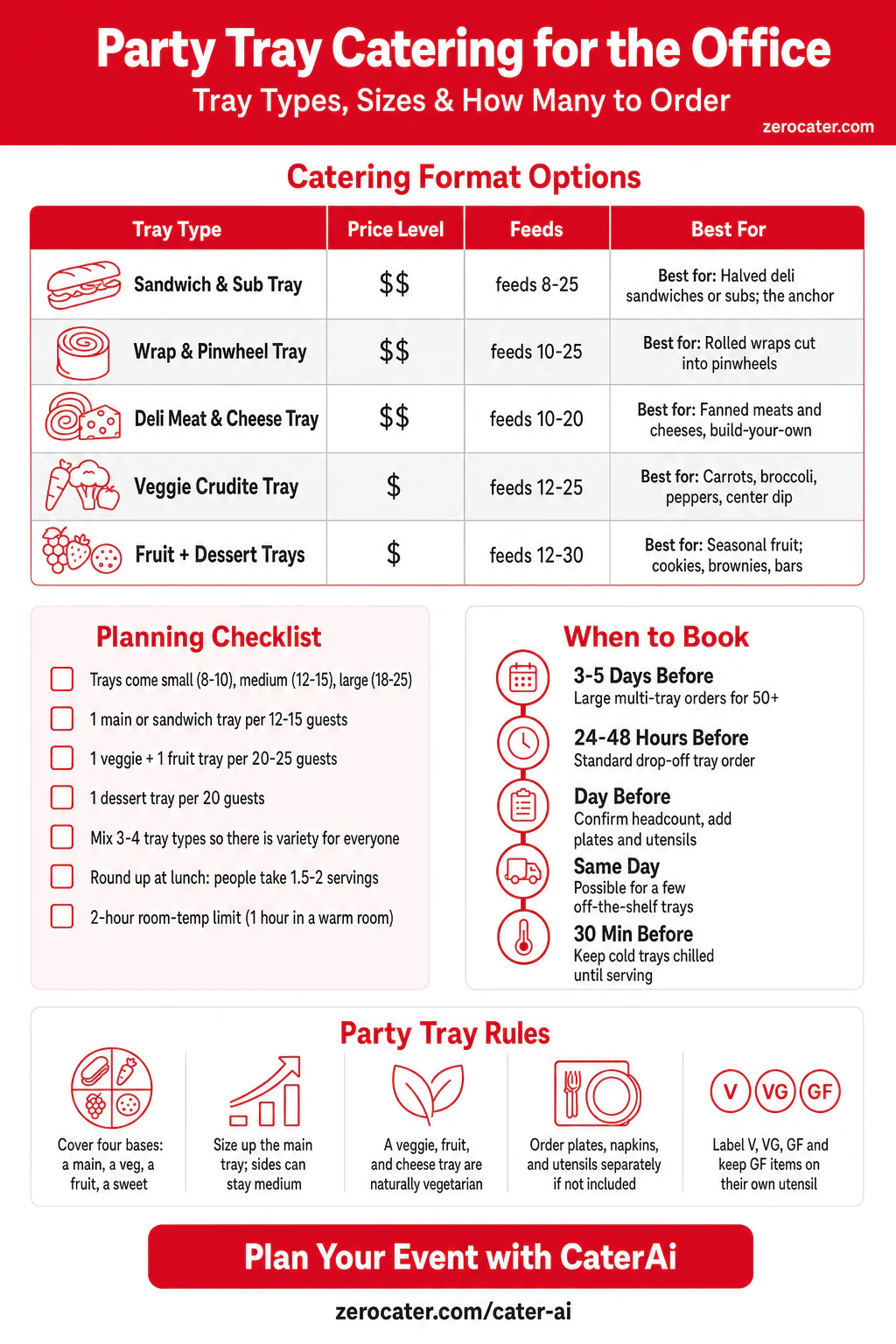
| Tray Type | What Is On It | Feeds |
|---|---|---|
| Sandwich & Sub Tray | Halved deli sandwiches or subs, assorted meats and cheeses on greens | 8 – 25 |
| Wrap & Pinwheel Tray | Rolled wraps cut into pinwheels; turkey, Italian, veggie fillings | 10 – 25 |
| Deli Meat & Cheese Tray | Fanned sliced meats and cheeses with rolls or bread to build on | 10 – 20 |
| Veggie Crudité Tray | Carrots, broccoli, cauliflower, peppers, tomatoes, with a center dip | 12 – 25 |
| Fruit Tray | Melon, pineapple, grapes, berries, and seasonal fruit | 12 – 25 |
| Cheese & Cracker Tray | Cubed or wedged cheeses, crackers, grapes, and nuts | 10 – 20 |
| Salad Tray or Bowl | Composed or green salads with dressings served on the side | 8 – 20 |
| Dessert & Cookie Tray | Cookies, brownies, bars, and mini pastries | 12 – 30 |

Two tray types double as a centerpiece if you want a little more polish without going full grazing table: the deli meat and cheese tray and the cheese and cracker tray. For the deeper version of those (the board math and styling) see our charcuterie catering guide. And if you would rather serve hot, one-handed bites than cold platters, the finger food catering guide has 30-plus ideas that pair well alongside a tray or two.
What Size Tray to Order
Nearly every caterer sells trays in three sizes, and the labels mean roughly the same thing across the board. The one catch: a tray meant to feed 15 as a side feeds fewer when it is the main dish, so size up your protein trays.
| Size | Typically Feeds | Best For |
|---|---|---|
| Small | 8 – 10 people | A single team, a small meeting, a side platter |
| Medium | 12 – 15 people | A department, a standard office lunch |
| Large | 18 – 25 people | All-hands, big groups, the main protein tray |
When in doubt, order one size up on the main tray and keep the sides at medium. Leftover sandwiches get eaten; running out at noon does not get forgiven.
How Many Trays to Order by Headcount
This is the question every office orderer actually has, and most caterer menus do not answer it. Here is the cheat sheet. It assumes party trays are the meal (not a snack), and it leans on a simple ratio: one main or sandwich tray per 12 to 15 guests, one veggie and one fruit tray per 20 to 25 guests, and one dessert tray per 20 guests.
| Guests | Main / Sandwich | Veg + Fruit | Dessert | Total Trays |
|---|---|---|---|---|
| 10 | 1 medium | 1 small (veg or fruit) | 1 small | ~3 |
| 25 | 2 large | 1 veg + 1 fruit | 1 large | ~5 |
| 50 | 3 – 4 large | 2 veg + 2 fruit | 2 large | ~9 – 10 |
| 100 | 6 – 8 large | 3 – 4 veg + 3 – 4 fruit | 3 – 4 large | ~18 – 20 |
Quick math for a 50-person team lunch
- Mains: 50 guests ÷ ~14 per large tray = 3 to 4 large sandwich or sub trays
- Sides: 2 large veggie trays + 2 large fruit trays (~1 of each per 25)
- Sweet: 2 large dessert trays (~1 per 25 at lunch)
- That is about 9 to 10 trays total, plus plates, napkins, and serving utensils
Round up if it is a midday meal, a hungry team, or a celebration; people take one and a half to two servings when the food is good.
For a snack or an afternoon spread rather than a full meal, cut the mains roughly in half and lean on the veggie, fruit, and cheese trays. For the per-person piece math behind appetizer-style spreads, the happy hour appetizers guide has the worked numbers.
Building a Balanced Party-Tray Order
The single most common mistake is ordering three sandwich trays and nothing else. A good order covers four bases so there is something for everyone and the table does not feel like a vending machine. The formula: per roughly 20 guests, one main tray, one veggie tray, one fruit tray, and one sweet.
- A protein-forward main. Sandwiches, subs, wraps, or a deli build-your-own tray. This is the anchor and where most of the budget goes.
- A vegetable. A crudite tray or a salad tray. It feeds your vegetarians and lightens up a meat-heavy table.
- Fruit. The easiest crowd-pleaser, naturally vegan and gluten-free, and it makes the spread look generous.
- A sweet. A cookie or dessert tray to close. Small, cheap, and the thing people remember.
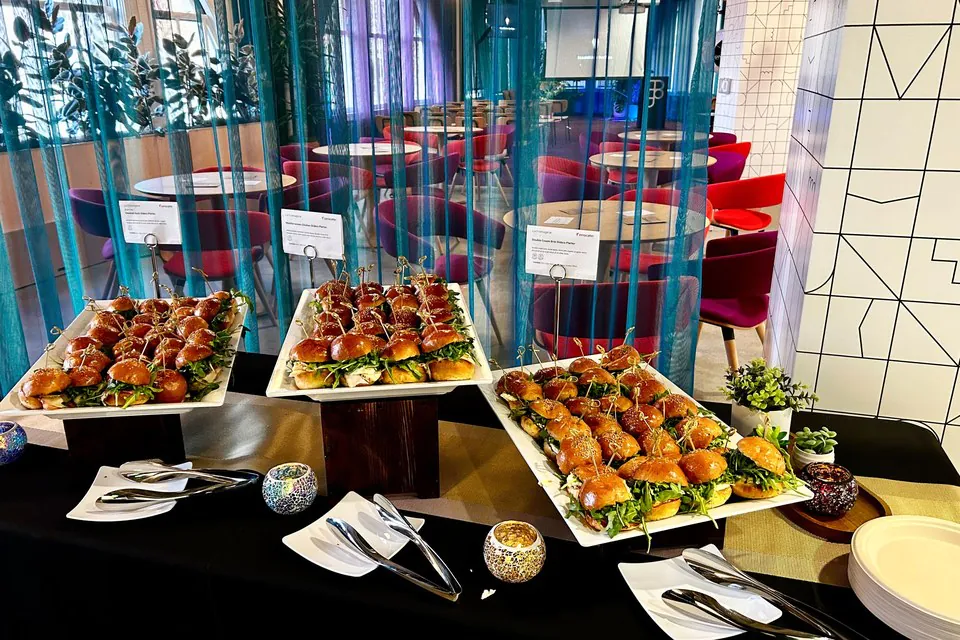
From there you can swap in a theme without changing the structure: an Italian order might run an antipasto tray plus a caprese skewer tray, a Mediterranean order a mezze tray plus a falafel tray, a game-day order a wing tray plus chips and dip. The four-base skeleton holds no matter the cuisine. If you are running a bigger event where the spread is the centerpiece rather than just lunch, step up to our grazing table guide or happy hour menu guide.
Plan party tray catering with CaterAi
What Party Trays Cost
Party trays are priced per tray, which makes budgeting refreshingly simple: pick your trays, add them up, and add service. Here is what to expect per tray, with the per-person math working out to roughly $10 to $20 for a full tray-based meal.
| Tray Type | Typical Price (Large) | Notes |
|---|---|---|
| Sandwich / sub tray | $80 – $110 | The anchor; most of the budget goes here |
| Wrap / pinwheel tray | $60 – $90 | Easy to make part-veggie or part-GF |
| Deli meat & cheese tray | $70 – $120 | Pair with a bread or roll tray |
| Veggie crudité tray | $45 – $70 | Lowest cost per head; always order one |
| Fruit tray | $50 – $85 | Seasonal fruit costs a little more |
| Cheese & cracker tray | $55 – $95 | Doubles as a casual centerpiece |
| Dessert / cookie tray | $40 – $70 | Cheap, high-impact, easy to add |
Add about 20 to 25 percent for delivery, service charge, and gratuity to get the true all-in number, and check whether plates, napkins, and utensils are included or billed separately. Party trays are the most affordable catered format per head, which is why they anchor so many recurring team lunches; for how that compares city by city, see our cost guides for New York City, San Francisco, Chicago, Los Angeles, Boston, Seattle, and Austin. For the boxed-format comparison, our boxed lunch cost guide runs the per-person numbers.
Dietary Needs and Labeling
Party trays make dietary needs unusually easy, because most trays are already a single category. You rarely need special orders; you just need the right mix and clear labels.
A veggie tray, a fruit tray, and a cheese tray are naturally vegetarian and cover most of the room on their own. For more, ask the caterer to make a portion of the sandwiches or wraps vegetarian, vegan, or gluten-free, which most will do without fuss. Then label every tray with simple V, VG, and GF cards so no one has to interrogate a platter, and keep gluten-free items slightly apart with their own serving utensil to avoid cross-contact. For deeper planning, see our guides to vegetarian office catering, vegan office catering, gluten-free office catering, and how to order catering for mixed dietary needs.
Ordering, Drop-Off, and Lead Times
The whole appeal of party trays is the logistics, or rather the lack of them. A standard drop-off order needs little notice and almost no day-of work. A few things to lock in when you order:
- Lead time. Most drop-off tray orders need 24 to 48 hours. A few off-the-shelf trays can go same day; a large order for 50-plus is safest with 3 to 5 days. Order earlier for Mondays, Fridays, and December.
- The extras. Confirm whether plates, napkins, and serving utensils are included. They often are not, and a tray spread with nothing to eat it on is a bad surprise at noon.
- Drop-off window. Ask for delivery 20 to 30 minutes before you want to eat, and keep cold trays refrigerated until about half an hour before serving.
- The 2-hour rule. Perishable items like meat, cheese, and anything mayo-based should not sit out more than two hours, dropping to one hour in a warm room. Put out part of a tray and refrigerate the backup.
For the full event-day workflow (headcount, timeline, day-of staging) our corporate event catering checklist and office manager’s guide to ordering catering cover the details that turn a tray order into a smooth lunch.
Where to Order Party Trays
Zerocater connects offices with vetted caterers that do party trays, platters, sandwich spreads, and individual boxes across 12 US metros. The fastest path is CaterAi: share your headcount, budget, and dietary mix, and the assistant builds a tray-based order from local caterers that match, sizing the order and the tray mix for you, with no quote requests.
Plan party tray catering with CaterAi
Caterers that do strong platters on Zerocater, by cuisine
- Italian (antipasto trays, caprese skewers, mini paninis, arancini): Blue Line Pizza (Bay Area), Joe’s Pizza Union Square (NYC), Firenze Italian Street Food (Chicago), Figo Pasta (Atlanta). Browse Italian catering.
- Mediterranean & mezze (hummus, baba ganoush, falafel, marinated vegetable platters): Hummus Mediterranean Kitchen (SF Bay Area), Baal Cafe & Falafel (NYC), Olive Mediterranean Grill (Chicago). Browse Mediterranean catering.
- Greek (spanakopita, dolmas, skewers, olives, feta): browse Greek catering for a mezze-style platter spread.
The party tray is the everyday backbone of the office-catering playbook. It is the simple, drop-off cousin of the styled grazing table and charcuterie spreads, it pairs naturally with the bites in our finger food and happy hour appetizers guides, and it fits the same calendar as our guides to the company picnic, holiday party, summer office events, and board meeting catering.
Frequently Asked Questions
What is a party tray?
A party tray, also called a catering platter, is a pre-arranged tray of food built to serve a group and ordered by size rather than by the plate. Common types include sandwich and sub trays, wrap and pinwheel trays, deli meat and cheese trays, veggie crudite trays, fruit trays, cheese and cracker trays, salad trays, and dessert trays. Most are sold in small, medium, and large sizes that feed roughly 8 to 25 people each. Trays are the drop-off, self-serve, no-staff format, which makes them the simplest and most budget-friendly way to feed an office group.
How many party trays do I need for 25 or 50 people?
For 25 people, plan about five trays: two large sandwich or protein trays, one veggie tray, one fruit tray, and one dessert tray. For 50 people, plan about nine or ten: three to four large sandwich or protein trays, two veggie trays, two fruit trays, and two dessert trays. The simplest rule is one main tray per 12 to 15 guests, plus one veggie and one fruit tray per 20 to 25 guests, plus one dessert tray per 20 guests. Round up for a midday meal.
What sizes do party trays come in?
Most party trays come in three sizes. A small tray feeds about 8 to 10 people and suits a single team or small meeting. A medium tray feeds about 12 to 15 and covers a department or a standard office lunch. A large tray feeds about 18 to 25 and works as the main protein tray for a big group. Counts vary by caterer, so confirm the serving size, and remember that a tray meant to feed 15 as a side feeds fewer as the main dish.
What kinds of party trays can I order for an office?
The most common office party trays are sandwich and sub trays, wrap and pinwheel trays, deli meat and cheese trays, veggie crudite trays with dip, fruit trays, cheese and cracker trays, salad trays, and dessert or cookie trays. A balanced order combines a protein-forward tray with a veggie tray, a fruit tray, and a sweet, so there is something for everyone. Mixing three or four tray types also covers most dietary needs without ordering anything special.
How much do party trays cost for an office?
Most office party trays run about $35 to $120 per tray depending on type and size, which works out to roughly $10 to $20 per person for a tray-based spread before delivery and service. Sandwich, sub, and deli trays sit at the higher end; veggie and dessert trays at the lower end. A large sandwich tray that feeds 20 commonly runs $80 to $110. Add about 20 to 25 percent for delivery, service charge, and gratuity, and budget for plates and utensils if they are not included.
How far in advance should I order party trays?
For a standard drop-off party tray order, most caterers and delis need 24 to 48 hours. A few off-the-shelf trays can sometimes be ordered same day, while a large multi-tray order for 50 or more is safest with 3 to 5 days of lead time. Confirm the headcount, tray mix, and dietary needs the day before, and ask whether plates, napkins, and utensils are included. Order earlier for Mondays, Fridays, and December.
How do I handle dietary needs with party trays?
Party trays make dietary needs easy because most trays are already a single category. Order a dedicated veggie tray, ask for a portion of sandwiches or wraps to be made vegetarian, vegan, or gluten-free, and label each tray clearly with V, VG, and GF cards. Keep gluten-free items slightly separate with their own utensil to avoid cross-contact. A veggie tray, a fruit tray, and a cheese tray are naturally vegetarian and cover most of the room without special ordering.
Where can I order party trays for my office?
Zerocater matches your office with vetted caterers that do party trays, platters, sandwich spreads, and individual boxes across 12 major US metros. CaterAi builds a tray-based order from your headcount, budget, and dietary mix in minutes, with no quote requests, and sizes the order and tray mix for you.