A charcuterie board is the rare office spread that looks like you hired a stylist and orders like a drop-off. It needs no kitchen, no chafing dishes, and no servers, it holds at room temperature for the length of a reception, and it absorbs vegetarian, vegan, and gluten-free guests because every item sits in its own spot. That combination is why a grazing table has become the default centerpiece for office happy hours, client receptions, and team celebrations.
The catch is that charcuterie is easy to order badly. Most planners either guess at quantities and run short an hour in, or overbuy three cheeses nobody touches. This guide fixes that with the part other guides skip: the per-person board math, the build formula that makes a board look abundant without overbuying, the five formats that scale from a 10-person team to a 200-person reception, and the food-safety rule a shared cured-meat board forces. If you came here from our finger food catering guide for the board math it promised, this is it.
In This Guide
- What Makes a Great Board (the Rule of 3s)
- How Much Charcuterie per Person (the Board Math)
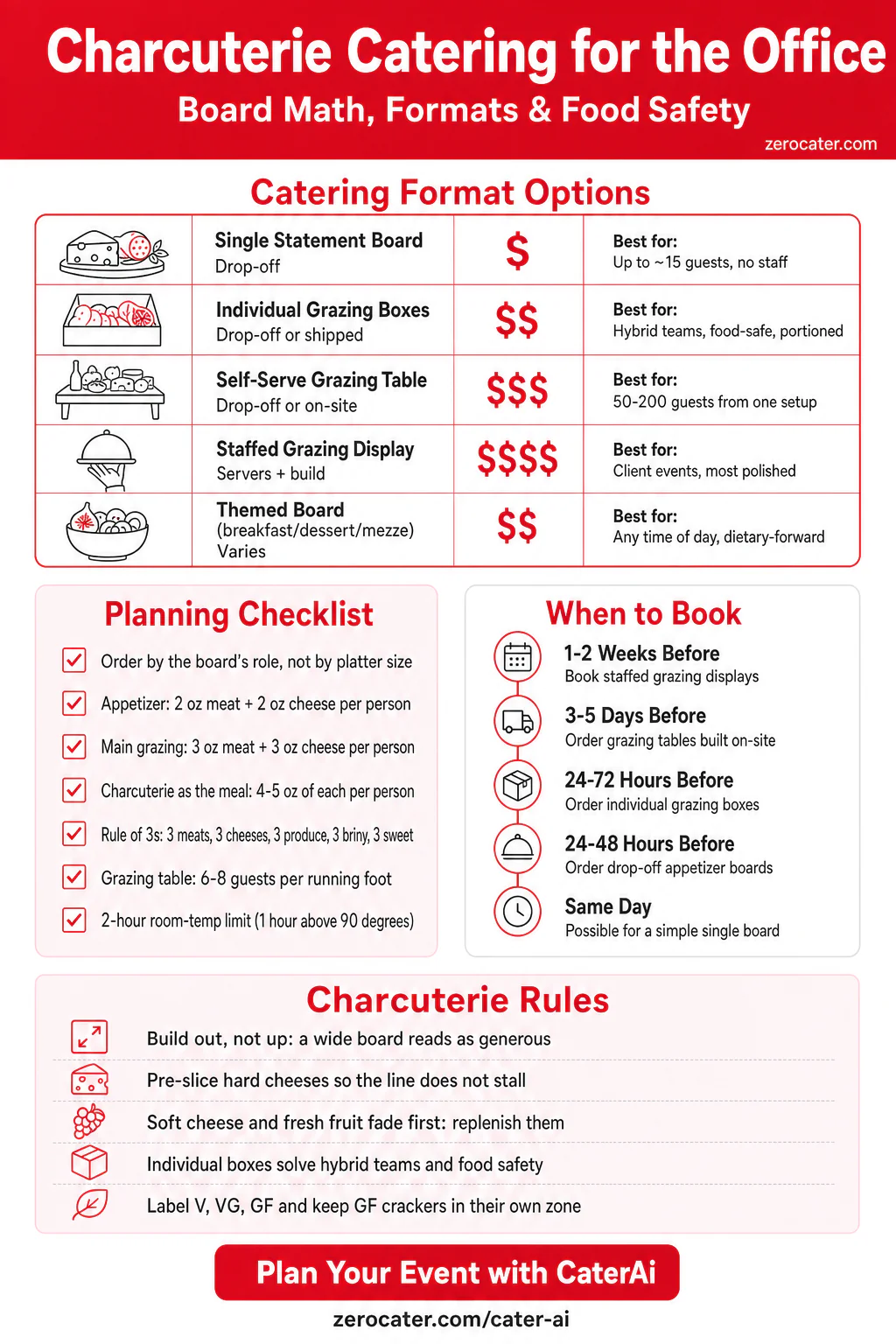
- The 5 Charcuterie Formats for Office Events
- Meats, Cheeses, and Accompaniments to Order
- Themed Boards: Breakfast, Dessert, and Mezze
- Charcuterie for Vegetarian, Vegan, and Gluten-Free Guests
- Food Safety: The 2-Hour Rule
- How Much Does Charcuterie Catering Cost?
- Where to Order Charcuterie Catering
- FAQ
What Makes a Great Board (the Rule of 3s)
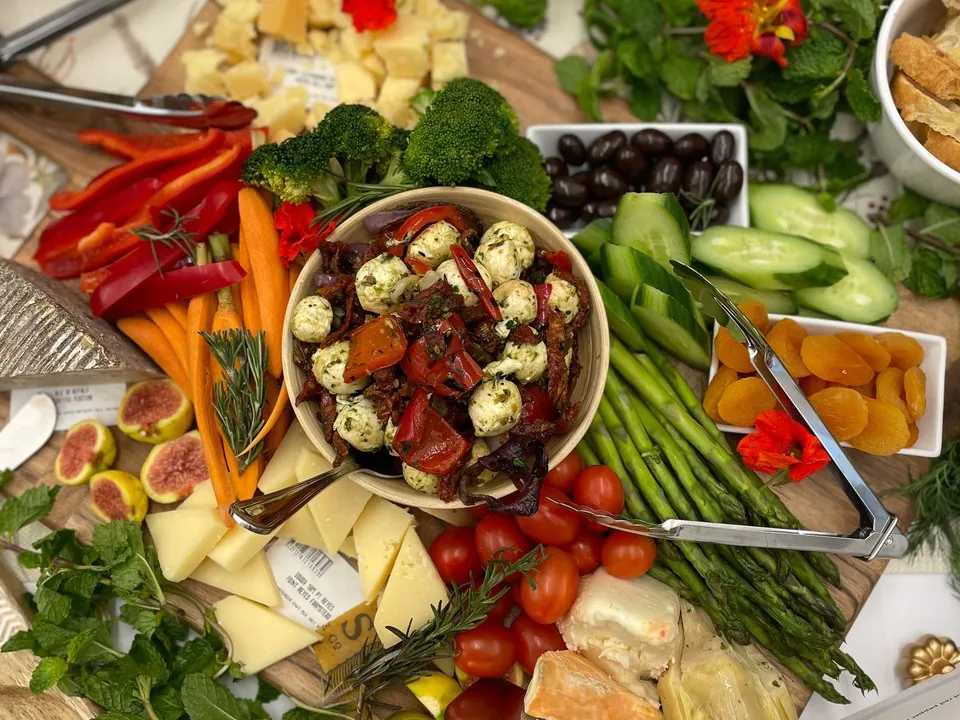
A board that looks abundant and tastes balanced is not random. It is built from six component categories, and the simplest way to get it right is the rule of 3s: pick about three items from each category. Three meats, three cheeses, three produce, three savory or briny items, three crunchy bases, and a few sweet accents. That gives a board with variety in every direction without buying ten of anything.
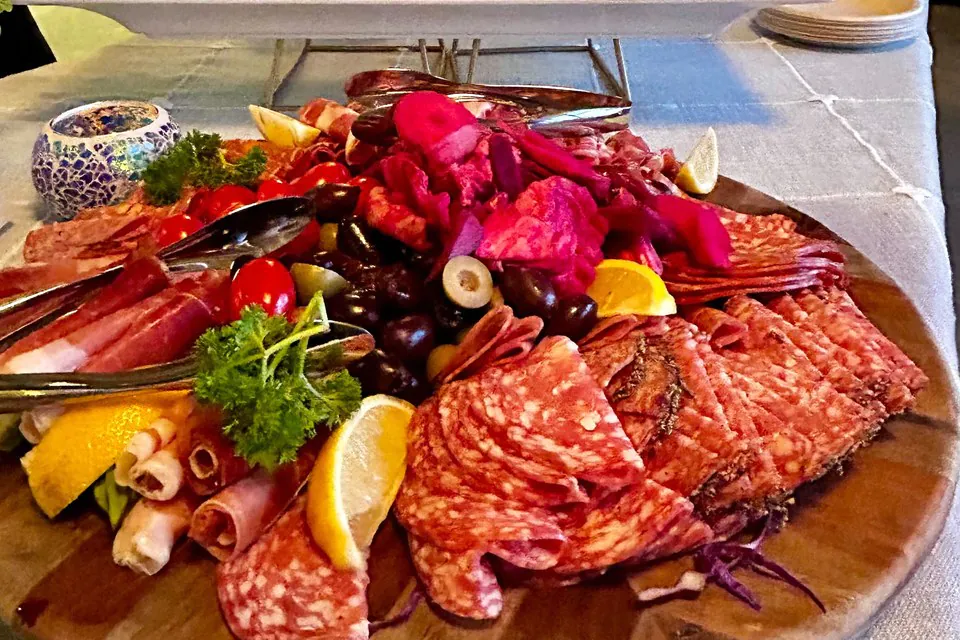
- Cured meats (pick 3). A buttery one (prosciutto), a firm sliced one (salami or soppressata), and a spiced one (capicola or chorizo). Fan or fold them so guests can grab a single slice.
- Cheeses (pick 3). A hard aged cheese (manchego, aged cheddar, parmesan), a soft cheese (brie, goat, camembert), and a third with character (a blue, a smoked, or a flavored cheese). Pre-cut the hard cheeses so the line does not stall on slicing.
- Crackers and bread (the base). Plain crackers, sliced baguette or crostini, and breadsticks. Keep some gluten-free crackers in a separate spot.
- Fresh produce. Grapes, figs, berries, apple or pear slices, cherry tomatoes, cucumber. Color and freshness against the cured meats.
- Savory and briny. Olives, cornichons, marinated artichokes, pickled vegetables, and nuts. These are what make a board feel like a spread instead of a cheese plate.
- Sweet accents. Honey, fig jam, whole-grain mustard, dried apricots, and a few squares of dark chocolate. A small amount of sweet ties the salty and the sharp together.
Arrange in that order: anchor the board with the cheeses, fan the meats beside them, fill the gaps with produce and briny bits, and tuck small bowls of spreads and olives into the open spaces. The goal is no empty board showing through.
How Much Charcuterie per Person (the Board Math)
This is where most orders go wrong. Charcuterie is sold by weight and platter size, but guests eat by appetite and event length, so you have to translate headcount into ounces. The single rule that fixes it: order by the job the board is doing. A board that sits next to a full lunch needs a fraction of what a board that is the entire meal needs.
| Board’s Role | Cured Meat / Person | Cheese / Person | Crackers, Produce & Extras |
|---|---|---|---|
| Appetizer (alongside a meal or other apps) | 2 oz | 2 oz | 1 oz crackers + 2 oz produce/olives |
| Main grazing (happy hour, no separate meal) | 3 oz | 3 oz | 1.5 oz crackers/bread + 3 oz produce/olives |
| The meal (reception, charcuterie is dinner) | 4 – 5 oz | 4 – 5 oz | 2 oz bread + 4 oz produce + add a warm dip or two |
Quick math for a 30-person office happy hour
- Board is the main grazing: 3 oz meat + 3 oz cheese per person
- 30 guests x 3 oz = about 5.5 lbs of cured meat and 5.5 lbs of cheese
- Spread the meat across 3 types (about 1.8 lbs each) and the cheese across 3 types
- Add roughly 3 lbs of crackers and bread and 5 to 6 lbs of produce, olives, and spreads
Round up by about 10 percent if the crowd skews hungry (late-afternoon event, no lunch beforehand) or if it is a celebration where people linger.
For board size to headcount, a useful rule is 6 to 8 guests per running foot of grazing table as a main spread, or about 10 to 12 appetizer servings from a standard large board (roughly 12 by 18 inches). Two planning rules save every charcuterie order:
- Variety beats volume. Three meats and three cheeses at moderate weight always beats one meat in bulk. People graze across options.
- Build out, not up. A board that spreads wide and looks full reads as generous. Piling height onto a small board looks sparse the moment the first few guests serve themselves.
The 5 Charcuterie Formats for Office Events
Charcuterie is not one thing. The same meats and cheeses can arrive as a single statement board, a sprawling grazing table, or a stack of individual boxes, and the right format depends on headcount, whether your team is in one room, and how hands-off you want the food safety to be.
| Format | Best For | Headcount | Relative Cost |
|---|---|---|---|
| Single statement board | Small team happy hours, board-room snacks | Up to ~15 | Lowest |
| Grazing table | All-hands, open houses, large receptions | 50 – 200 | Medium to high (scales well) |
| Individual grazing boxes | Hybrid and distributed teams, client gifting, food-safety-sensitive events | Any (ships to remote) | Medium |
| Charcuterie cones or cups | Passed service, walk-and-talk mingling, stand-up receptions | Any | Medium to high (often staffed) |
| Themed board (breakfast, dessert, mezze) | Morning meetings, afternoon socials, dietary-forward teams | Any | Varies |
Two formats deserve a closer look because they solve the problems offices actually have.
The grazing table is the scale answer. When a single board cannot feed the room, you do not order ten boards, you order a grazing table: one continuous self-serve display that runs the length of a counter or a folding table. It feeds 50 to 200 people from one setup, needs no staff if it is dropped off, and gives a big event a centerpiece. Budget about 6 to 8 guests per running foot.
Individual grazing boxes are the hybrid and food-safety answer. If your team is split between the office and home, or the event is client-facing, individual boxes beat a shared board on every axis that matters: each guest gets a portion-controlled box, there is no shared serving utensil, the boxes ship to remote employees, and the two-hour room-temperature clock is far less of a worry because each box is handled once. They have quietly become the default for remote-inclusive events and client gifting. If you already order boxed lunches for your distributed team, individual grazing boxes are the happy-hour version of the same idea.
Meats, Cheeses, and Accompaniments to Order
Here is the shopping list to hand a caterer, organized by the same six categories as the build formula. You do not need everything, just about three from each.
- Cured meats: prosciutto, Genoa or soppressata salami, capicola (coppa), bresaola, chorizo, and a pate or rillette for a more premium board.
- Cheeses: a hard aged cheese (manchego, aged cheddar, parmesan, gruyere), a soft cheese (brie, camembert, goat), a blue (gorgonzola, stilton), and a flavored or smoked option for variety.
- Crackers and bread: water crackers, seeded crackers, sliced baguette or crostini, breadsticks, and a stack of gluten-free crackers kept separate.
- Fresh produce: grapes, figs, strawberries and blackberries, apple and pear slices, cherry tomatoes, cucumber, and dried apricots.
- Savory and briny: mixed olives, cornichons, marinated artichokes, roasted peppers, pickled onions, marinated mozzarella, and Marcona almonds or candied nuts.
- Sweet spreads and accents: honey or honeycomb, fig jam, whole-grain mustard, quince paste, and a few squares of dark chocolate.
Italian salumi and antipasto are the most natural fit for a meat-forward board, and Mediterranean mezze (hummus, dolmas, marinated vegetables, labneh) makes the most flexible vegetarian-friendly spread. Browse Italian catering and Mediterranean catering for caterers that do both well.
Themed Boards: Breakfast, Dessert, and Mezze
Charcuterie is a format, not a fixed menu, so the same abundant-board idea works at any time of day. Three themed variations earn their place at office events:
- Breakfast charcuterie for a morning meeting or an early all-hands: mini pastries, bagels and cream cheese, smoked salmon, fresh fruit, granola, yogurt cups, hard-boiled eggs, and honey. It pairs naturally with a board meeting catering setup.
- Dessert board for an afternoon social: brownie and blondie squares, cookies, chocolate-dipped strawberries, macarons, dried fruit, and a chocolate or caramel dip. A lighter close than a full cake.
- Mediterranean mezze board for a dietary-forward team: hummus, baba ganoush, dolmas, marinated vegetables, olives, feta, falafel, and warm pita. It is naturally vegetarian-heavy and easy to make vegan.
For seasonal angles, a charcuterie or grazing table is also a workhorse at a holiday party, a company picnic, or a summer office event, where the no-cook, room-temperature nature of the board is exactly what an outdoor or off-site setup needs.
Plan grazing table catering with CaterAi
Charcuterie for Vegetarian, Vegan, and Gluten-Free Guests
Charcuterie is one of the easiest formats for mixed diets because every item is already separated on the board. There is no shared casserole to navigate. The work is in labeling and in keeping a dedicated serving utensil per item so a gluten-free guest is not reaching past the crackers.
| Diet | Reliable charcuterie picks |
|---|---|
| Vegetarian | All the cheeses, marinated and grilled vegetables, hummus, dolmas, olives, nuts, fruit, fig jam and honey; swap meats for roasted vegetable and cheese variety |
| Vegan | Plant-based cheeses, marinated artichokes and peppers, grilled vegetables, olives, dolmas, hummus and baba ganoush, nuts, dried and fresh fruit, dark chocolate |
| Gluten-free | Cured meats, all cheeses, produce, olives and briny items, nuts, honey and jam, with gluten-free crackers kept in their own spot away from the bread |
Two practical rules: label clearly with V, VG, and GF cards so guests are not guessing, and give the gluten-free crackers their own zone with a separate utensil to avoid cross-contact. For deeper dietary planning, see our guides to vegetarian office catering, vegan office catering, gluten-free office catering, and how to order catering for mixed dietary needs.
Food Safety: The 2-Hour Rule
A charcuterie board is built on perishable food sitting out in the open, which makes food safety part of the order, not an afterthought. The rule is simple: cured meats, soft cheeses, and any perishable item should not sit at room temperature for more than two hours, and that window drops to one hour if the room is above 90 degrees.
For an office event that runs a full afternoon, that does not mean you cannot serve charcuterie. It means you stage it:
- Do not pile everything out at once. Set out a portion, keep a refrigerated backup, and replenish the board every 90 minutes or so with fresh product.
- Know what fades first. Soft cheeses and fresh produce are the first to suffer; hard aged cheeses, dried fruit, nuts, and crackers hold much longer.
- Lean on individual boxes for long or warm events. Because each box is handled once and can stay chilled until service, individual grazing boxes sidestep most of the shared-board clock. This is the same heat-and-time logic our summer office catering guide applies to outdoor events.
For the full event-day workflow beyond the food, the corporate event catering checklist covers headcount confirmation, timeline, and day-of logistics, and the office manager’s guide to ordering catering covers vendor selection and capturing dietary needs from the RSVP.
How Much Does Charcuterie Catering Cost?
Charcuterie spans a wide price range because the format does. A drop-off appetizer board and a staffed, built-on-site grazing display are both charcuterie, and they cost very different amounts. Here is what to budget per person by format.
| Format | Per Person | Service | Lead Time |
|---|---|---|---|
| Appetizer board (drop-off) | $9 – $15 | Drop-off | 24 – 48 hrs |
| Individual grazing boxes | $12 – $18 | Drop-off or shipped | 24 – 72 hrs |
| Self-serve grazing table | $14 – $26 | Drop-off or built on-site | 3 – 5 days |
| Staffed grazing display | $22 – $35+ | Servers + on-site build | 1 – 2 weeks |
Add roughly 20 to 25 percent to per-person totals for delivery, service charge, and gratuity to get the all-in number, and more on top of that for staffed service. For metro-specific benchmarks, see our cost guides for New York City, San Francisco, Chicago, Los Angeles, Boston, Atlanta, and Austin.
Where to Order Charcuterie Catering
Zerocater connects offices with vetted caterers that build charcuterie boards, grazing tables, and individual grazing boxes across 12 US metros. The fastest path is CaterAi: share your headcount, budget, dietary mix, and whether you want a single board, a grazing table, or individual boxes, and the assistant builds a charcuterie menu in a few minutes from local caterers that match, with no quote requests.
Plan grazing table catering with CaterAi
Charcuterie-friendly caterers on Zerocater by cuisine
- Italian (salumi, antipasto, marinated mozzarella, olives): Blue Line Pizza (Bay Area), Joe’s Pizza Union Square (NYC), Firenze Italian Street Food (Chicago), Figo Pasta (Atlanta). Browse Italian catering.
- Mediterranean & mezze (hummus, dolmas, marinated vegetables, labneh, feta): Hummus Mediterranean Kitchen (SF Bay Area), Baal Cafe & Falafel (NYC), Olive Mediterranean Grill (Chicago). Browse Mediterranean catering.
- Greek (spanakopita, dolmas, olives, feta, grilled vegetables): Kali Greek Kitchen (Bay Area), Souvlaki GR (NYC). Browse Greek catering.
Charcuterie pairs naturally with the rest of the office-event playbook. It is the board-math companion to our finger food catering guide, and it fits the same occasions as our guides to the company picnic, holiday party planning, and board meeting catering. Planning recurring socials for a tech team? The corporate catering for tech companies guide covers the cadence, and for a heartier centerpiece spread compare formats in our BBQ corporate catering guide.
Frequently Asked Questions
How much charcuterie do I need per person for an office event?
Order by the board’s role. As an appetizer alongside other food or before a meal, plan about 2 ounces of cured meat and 2 ounces of cheese per person. As the main grazing spread with no separate meal, plan about 3 ounces of each. When charcuterie is the meal, plan 4 to 5 ounces of each plus hearty accompaniments. Add roughly 1.5 ounces of crackers and bread and 2 to 3 ounces of produce, olives, and spreads per person on top.
What goes on a corporate charcuterie board?
Use the rule of 3s: about three cured meats (prosciutto, salami, capicola), three cheeses (a hard aged cheese, a soft cheese, and a blue or flavored one), crackers and sliced bread, fresh produce, savory and briny items (olives, cornichons, marinated artichokes, nuts), and sweet spreads (honey, fig jam, mustard, dried fruit). Three from each category looks abundant without overbuying any one thing.
How much does charcuterie catering cost per person?
Charcuterie catering runs about $9 to $35 per person. A drop-off appetizer board runs $9 to $15, individual grazing boxes run $12 to $18, a self-serve grazing table runs $14 to $26, and a staffed grazing display runs $22 to $35 and up. Add roughly 20 to 25 percent for delivery, service charge, and gratuity, and more for staffed service.
How long can a charcuterie board sit out at room temperature?
Follow the 2-hour rule: cured meats, soft cheeses, and perishable items should not sit out at room temperature for more than two hours, dropping to one hour above 90 degrees. For an all-afternoon event, set out a portion, keep a refrigerated backup, and replenish every 90 minutes. Hard aged cheeses and dried items hold longer than soft cheeses and fresh produce.
What is the best charcuterie format for a large office or a distributed team?
For a large in-office event, a grazing table scales best, feeding 50 to 200 people from one self-serve setup at roughly 6 to 8 guests per running foot. For a hybrid or fully distributed team, individual grazing boxes are better: each guest gets a portion-controlled box, there is no shared utensil, and the boxes ship to remote employees while sidestepping the shared-board food-safety clock.
Is charcuterie good for vegetarian, vegan, and gluten-free guests?
Yes, because every item sits in its own spot. A vegetarian board builds around cheeses, marinated vegetables, hummus, and fruit. A vegan board uses plant-based cheeses, grilled and marinated vegetables, olives, dolmas, dips, nuts, and fruit. A gluten-free board leans on meat, cheese, produce, and olives with gluten-free crackers kept separate. Label clearly and keep a dedicated utensil per item.
How far in advance should I order charcuterie catering?
For a drop-off board or individual grazing boxes, most caterers need 24 to 48 hours, and many can turn a simple order same-day. A grazing table built on-site usually wants 3 to 5 days, and a staffed display is best booked 1 to 2 weeks ahead. Order earlier for Fridays, December, and busy event weeks.
Where can I order charcuterie catering for my office?
Zerocater matches your office with vetted caterers that build charcuterie boards, grazing tables, and individual grazing boxes across 12 major US metros. CaterAi builds a charcuterie menu from your headcount, budget, dietary mix, and format in minutes.