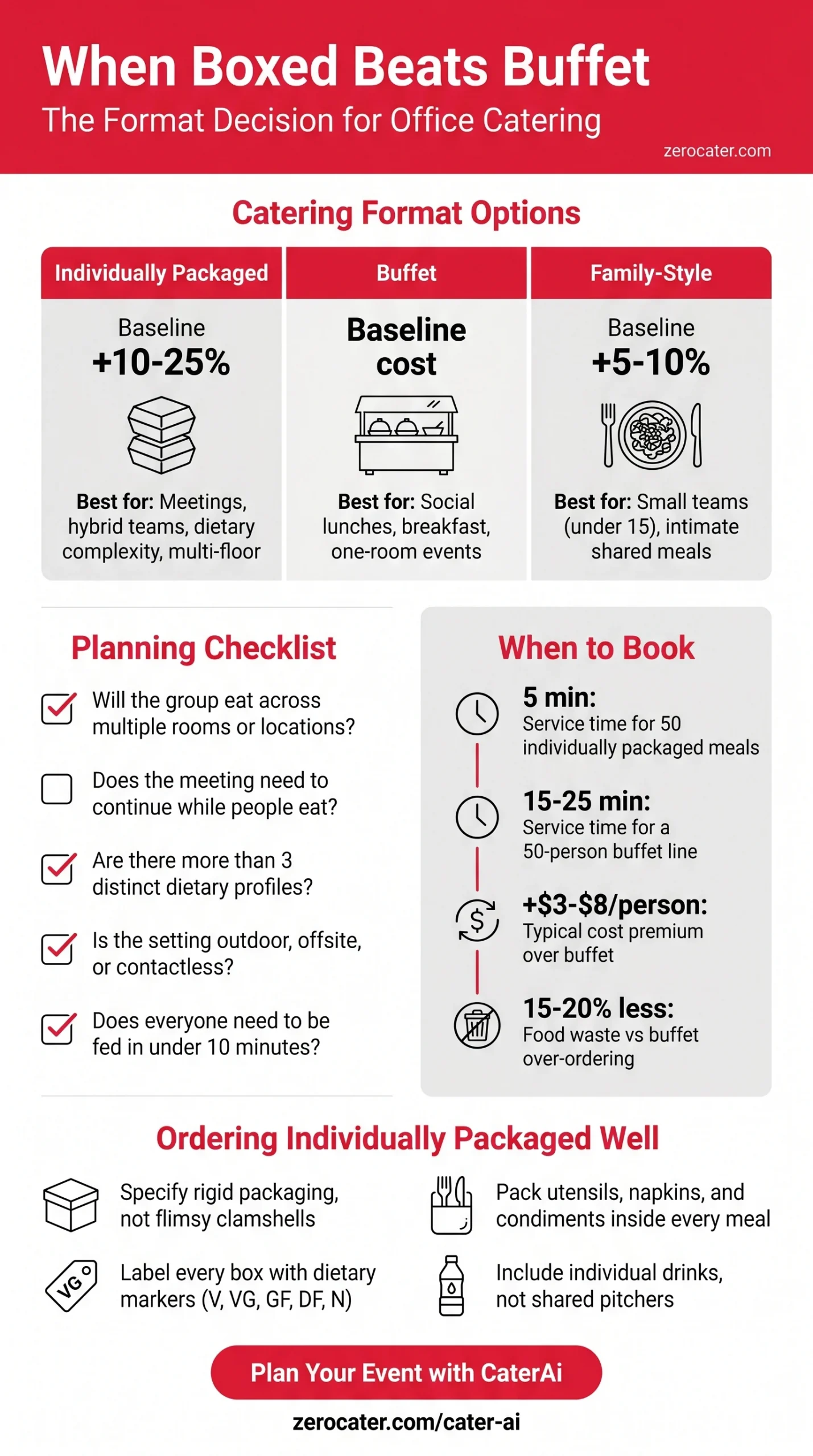
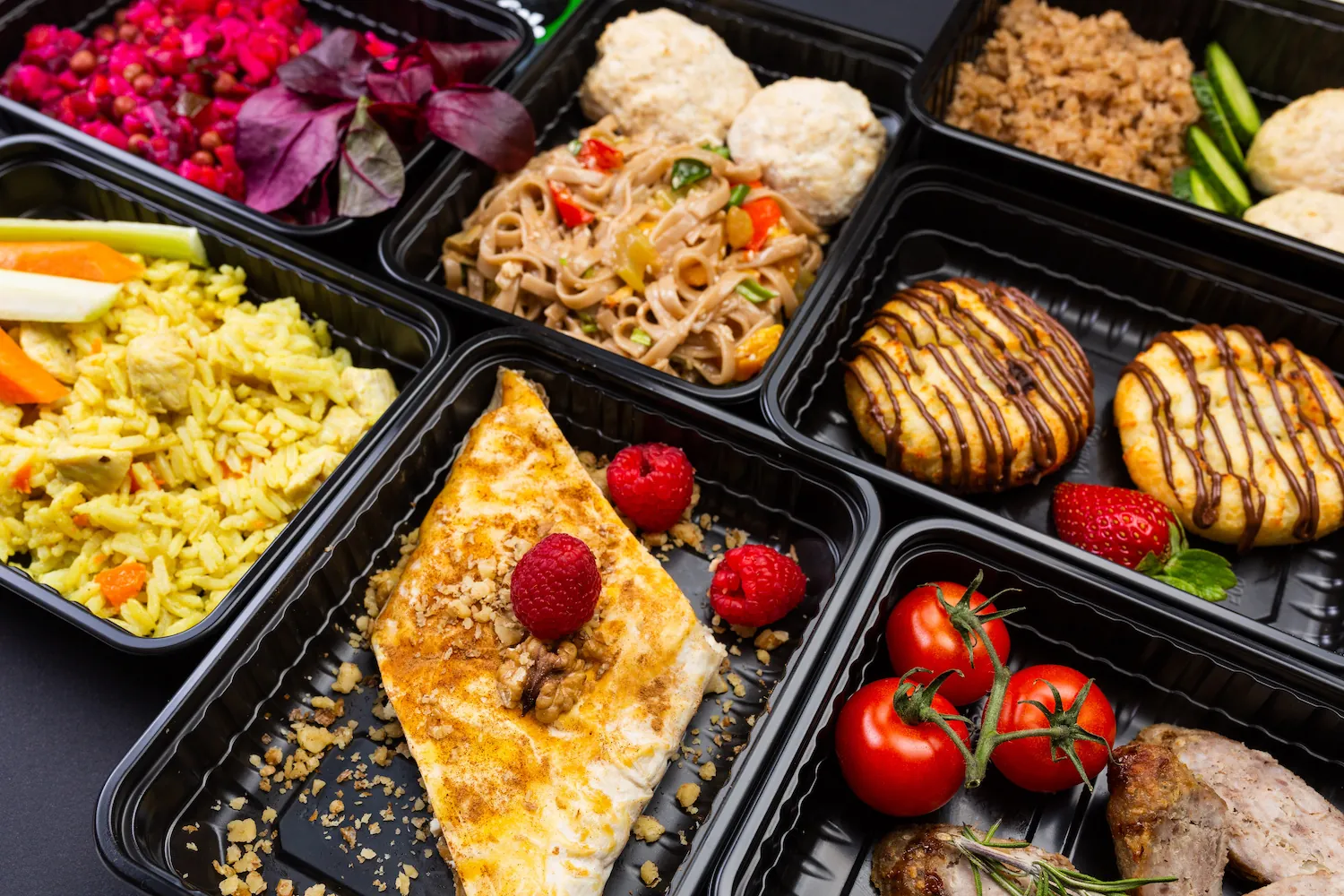
The default move for office catering used to be a shared buffet: big trays in a row, plates at one end, everyone serves themselves. That default broke somewhere between hybrid offices, longer meeting schedules, and a quiet post-pandemic aversion to shared-serving setups. Boxed lunch catering, where every person gets their own sealed meal, now wins more scenarios than it loses, and the cost premium over a buffet has shrunk to 10 to 25 percent depending on cuisine. This guide is the decision framework for boxed lunch catering vs. buffet: the scenarios where boxed wins, the ones where buffet still wins, and how to order boxed lunch catering well so it does not read as airplane food.
In This Guide
- What Counts as Boxed Lunch Catering
- The Boxed vs. Buffet Decision Framework
- 9 Scenarios Where Boxed Lunch Catering Wins
- When a Buffet Is Still the Right Call
- Boxed Lunch Catering vs. Buffet: The Cost Delta
- Boxed vs. Buffet vs. Family-Style Comparison
- How to Order Boxed Lunch Catering Well
- Pitfalls to Avoid
- What to Order by Cuisine
- How CaterAi Handles Boxed Lunch Catering Orders
- FAQ
What Counts as Boxed Lunch Catering
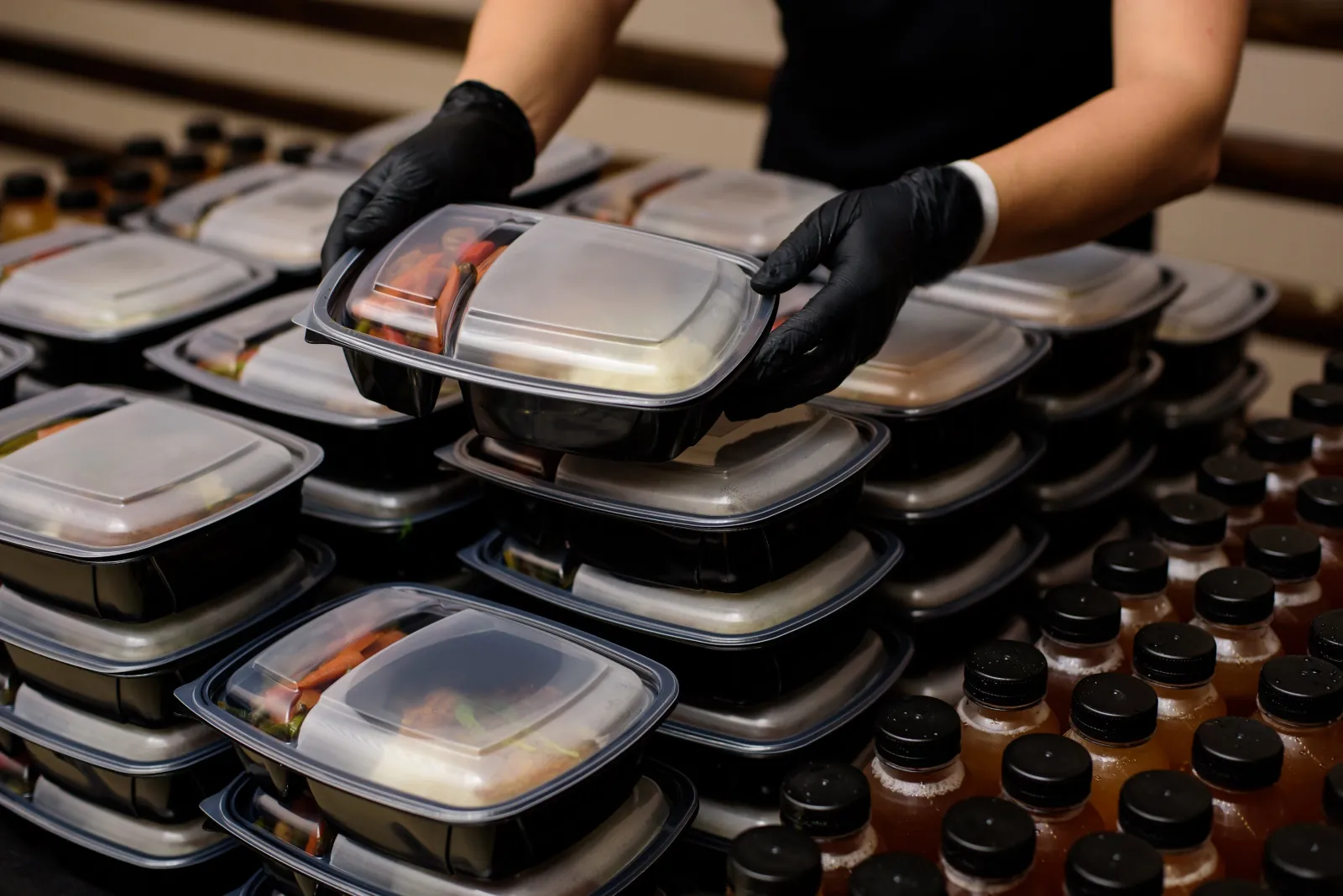
Boxed lunch catering is a category, not a single format. It covers any catering setup where every attendee receives a complete, self-contained meal that nothing else has touched. The packaging is the whole point: no shared serving utensils, no communal platters, no “grab and go” from a central station. If you want the execution playbook (packaging specs, timing, label formats), our complete boxed lunch catering how-to is the anchor; this guide focuses on when to choose the format in the first place.
Common boxed lunch catering formats:
- Boxed lunches: the classic. Sandwich or protein, side, dessert, utensils, napkin in a branded box.
- Bento-style trays: compartmentalized sections for rice, protein, vegetables, and pickled sides. Popular for Japanese, Korean, and healthy-forward cuisines.
- Sealed grain bowls and poke bowls: lidded containers with proteins over grains or greens. Dressings packed separately. Great for poke, Mediterranean, and healthy catering.
- Wrapped sandwiches, wraps, and banh mi: foil or parchment-wrapped, each labeled with filling and dietary markers.
- Individual salads: chopped salad in a cup or clamshell with dressing on the side.
- Clamshell entrees: hot entrees portioned into sealed clamshells, used for Italian, Indian, and barbecue catering.
- Canned or bottled beverages: individual drinks packed with each meal, no communal drink station.
- Packaged desserts: wrapped cookies, individually boxed mini-cakes, sealed fruit cups.
What makes a meal boxed lunch catering is not that it arrives in a cardboard box. It’s that every component a person eats, from entree to utensils to drink, is individually packaged for that one person. Nothing is shared.
The Boxed vs. Buffet Decision Framework
Before deciding on a cuisine or a caterer, pick the format. Boxed lunch catering, buffet, and family-style are not interchangeable, and matching the format to the meeting is the single highest-leverage choice in catering planning.
Run your order through these five questions. If you answer yes to three or more, boxed lunch catering is almost certainly the right call over a buffet.
The 5-Question Boxed vs. Buffet Decision
- Will the group eat across multiple rooms, floors, or locations? Buffets anchor to one spot. Boxed lunches travel.
- Does the meeting need to continue while people eat? Buffet lines pause everything. Sealed boxed meals do not.
- Are there more than three distinct dietary profiles in the group? Buffets get messy with complex dietary needs. Individually labeled boxed meals handle allergens cleanly.
- Is the setting outdoor, offsite, or contactless? Buffets require setup, serving staff, and a surface. Boxed meals land anywhere.
- Do you need everyone fed in under 10 minutes? A buffet for 50 people takes 15 to 25 minutes. Boxed lunch catering takes under 5.
Three or more yes answers means boxed lunch catering. Zero or one yes and a buffet is often the better social experience. The middle (two yes answers) is judgment: weigh the cost premium against the logistics win.
9 Scenarios Where Boxed Lunch Catering Wins
1. Hybrid Teams and Split-Delivery Meetings
Half the team is in the office, the other half is remote. The remote folks expect the same meal experience. Boxed lunch catering lets you send identical meals to the office and ship or deliver the same SKUs to remote workers’ homes or local coworking spaces. You can’t do that with a buffet. Our office manager’s guide to ordering catering covers the split-delivery workflow in detail.
2. Depositions, Client Meetings, and Confidential Sessions
Sensitive meetings stay in the room when food comes sealed. Nobody leaves for a serving line, nobody passes documents over shared platters, and nothing spills on exhibits. The law firm catering guide goes deeper on deposition-specific formats, but the principle applies to any meeting where privacy or professionalism matters: boxed lunch catering belongs in the conference room.
3. Multi-Floor or Multi-Building Offices
An all-hands for a 400-person company across three floors is a buffet nightmare. Elevator queues, food going cold on transit, uneven distribution between floors. Boxed lunch catering solves it: cartons deliver to each floor simultaneously, every person grabs their labeled meal, no one waits. For a board meeting catering setup with partners on different floors, the format is a non-negotiable.
4. Conferences, All-Day Training, and Staggered Breaks
When meal times stagger across sessions (track A breaks at 12:00, track B at 12:30, track C at 1:00), a buffet has to stay set up and food quality degrades by the third seating. Boxed lunch catering holds quality in sealed containers and can be picked up on each track’s own break without restaging.
5. High Dietary Complexity
A team with vegans, a celiac, two nut allergies, a pescatarian, and three kosher observers is hostile terrain for a buffet. One shared spoon between the chicken and the falafel and you have a cross-contamination problem. Boxed lunch catering isolates each dietary profile in its own container, each one labeled clearly. Our mixed dietary needs guide walks through the labeling and ordering process; boxed format is usually the right answer when dietary complexity is high.
6. Outdoor, Offsite, and Non-Traditional Settings
Company picnics, offsite retreats, construction-site lunches, field-office visits, sales-team kickoffs at a warehouse. Anywhere without a stable surface, power, or climate control, a buffet is rough. Boxed lunch catering lands anywhere, holds temperature in insulated delivery, and needs zero setup.
7. Hospital, Clinical, and Lab Environments
Infection control policies in healthcare settings effectively ban shared-serving formats. Many hospital systems require all catering to be individually packaged and single-use. The same applies to certain lab environments and pharmaceutical offices where contamination protocols are strict.
8. Strict Time Budgets
The 45-minute lunch slot on a packed conference agenda. The executive team that walks back into the 1:00 p.m. with the CEO at 12:55. The interview lunch scheduled between back-to-back candidate sessions. When the time budget is tight, a buffet line burns it. Boxed lunch catering gives back 15 to 20 minutes per meal block.
9. Hot-Weather Outdoor Events and Food Safety Concerns
Food safety regulations require hot foods held above 140°F and cold foods below 40°F. On a buffet in an 85-degree conference room after 90 minutes, half the tray is out of safe range. Boxed lunch catering stays sealed until each meal is opened, extending the safe-holding window significantly. Important for longer events and summer outdoor gatherings.
When a Buffet Is Still the Right Call
Boxed lunch catering is not always the answer. Buffets have real advantages in the scenarios they fit, and defaulting to boxed in the wrong context creates a sterile meal experience that works against the event.
Team-building and social lunches. The point of the meal is people mingling at the food. A shared Mediterranean spread or taco bar encourages conversation in a way that sealed boxes at each seat do not. If the social component is the meal’s reason for existing, go buffet.
Breakfast spreads and coffee stations. Continental breakfast, breakfast burrito bars, oatmeal stations with toppings. These are inherently self-serve and buffet formats get the variety right. Boxing a breakfast usually reads as mean.
Small groups (under 15) in one room with flexible time. For a 10-person team lunch with 90 minutes blocked, a shared family-style spread beats boxed almost every time. The logistics case for boxed lunch catering collapses at small scale.
Live-action stations and chef-attended events. Pasta stations, carving stations, sushi chefs, taco bars with someone assembling to order. The show is the point. Packaging defeats it.
Tight budgets at a single-location event. Buffet pricing sits 10 to 25 percent below boxed lunch catering for the same food. If every dollar counts and you’re meeting in one room for the whole event, buffet is the cost-efficient pick.
Boxed Lunch Catering vs. Buffet: The Cost Delta
Expect boxed lunch catering to run 10 to 25 percent more per person than the same food served buffet-style. The premium covers:
- Portioning labor: every component measured and placed per meal instead of served in bulk trays.
- Packaging materials: boxes, clamshells, seal labels, dietary tags, cutlery kits.
- Assembly time: building 200 boxed lunches is more labor than staging 200 servings on trays.
- Individual drinks and sides: cans, bottles, portioned fruit cups instead of pitchers and shared platters.
In dollar terms, that is usually $3 to $8 more per person depending on cuisine tier and region. For a 50-person team lunch, that’s $150 to $400 more.
Where that money comes back: buffet catering has a built-in over-order penalty. Standard guidance is to order 15 to 20 percent extra so the last person in line doesn’t get thin pickings. That over-order shows up as waste. Boxed lunch catering eliminates it entirely, because the order count equals the headcount. On average, a company ordering catering three times a week saves enough from eliminated over-ordering to offset most of the packaging premium over the course of a year.
For a detailed cost breakdown by city, see NYC office catering costs or Chicago office catering costs.
Plan boxed lunch catering with CaterAi
Boxed vs. Buffet vs. Family-Style Comparison
| Factor | Boxed Lunch Catering | Buffet | Family-Style |
|---|---|---|---|
| Service time for 50 people | Under 5 min | 15 – 25 min | 10 – 15 min |
| Cost per person (same cuisine) | Baseline +10 to 25% | Baseline | Baseline +5 to 10% |
| Dietary handling | Excellent, isolated per meal | Moderate, labels on trays | Poor, shared serving |
| Social experience | Low, eat at desk or seat | High, people mingle | High, shared table |
| Multi-location delivery | Easy, split cartons | Not practical | Not practical |
| Setup required | None, grab and go | Tables, chafers, serving utensils | Shared platters and serving ware |
| Food waste profile | Low, headcount order | High, 15 to 20% over-order | Moderate |
| Packaging waste profile | High, single-use per meal | Low, bulk trays | Low |
| Best for | Meetings, hybrid, large groups, dietary complexity | Social lunches, breakfast, budget events | Small team meals, intimate dinners |
How to Order Boxed Lunch Catering Well
The failure mode of boxed lunch catering is that it can read cheap. The fix is in the ordering, not the budget. For the full execution playbook, our boxed lunch catering for meetings guide is the anchor how-to. What follows is the short list that separates a well-ordered boxed lunch from a sad sack meal.
What to Specify With the Caterer
- Rigid packaging, not clamshells with thin lids. Structural integrity matters. Specify rigid boxes or bento trays that do not compress in transport.
- Entree packaged separately from sauces and dressings. Wet ingredients in their own sealed cups prevent sogginess and let people control dressing levels.
- Utensils, napkins, and condiments packed inside each meal. Not as a shared pile. Include salt, pepper, hot sauce, or whatever the cuisine needs.
- Printed or labeled dietary markers. Vegan, vegetarian, gluten-free, dairy-free, contains nuts. Visible without opening.
- Individual drinks included. Bottled water at minimum. Canned sparkling, iced tea, or sodas where appropriate.
- Individual desserts. A wrapped cookie, a bar, a piece of fruit. Something to close the meal out.
- Names on meals when pre-ordered. For meetings where everyone ordered a specific item, labels with first names make distribution zero-friction.
Picking the right cuisine for boxed lunch catering. Not every cuisine packages well. Cuisines built around sealed, portable formats work best:
- Vietnamese: banh mi and vermicelli bowls are already designed to be wrapped.
- Mediterranean: grain bowls, wraps, and falafel platters hold beautifully.
- Japanese: bento, sushi sets, and poke are the template.
- Mexican: burritos, wrapped tacos, and sealed bowls travel well.
- Indian: thali-style boxes with rice, curry, and accompaniments compartmentalized.
- Healthy and salads: chopped salads and grain bowls were built for this format.
- Sandwiches: wrapped sandwich boxes with sides and cookies.
Pitfalls to Avoid
- Ordering boxed for a 10-person team meal. Below 15 people in one room, the logistics case evaporates. A small team deserves a shared family-style spread.
- Not double-checking labels against pre-orders. If attendees picked specific meals, a single mislabeled box means someone gets the wrong food. Always verify the label count matches your order spreadsheet before setup.
- Skipping drinks to save money. A boxed lunch without a drink reads cheap regardless of how nice the entree is. Include at least bottled water.
- Fried food in sealed boxes. Sealed packaging steams anything crispy into limp. If the cuisine is fried chicken or tempura, either order with vents or pick a different cuisine.
- Assuming one vegan box covers “dietary needs.” Vegans, vegetarians, pescatarians, and people with allergies are all different profiles. Order specifically for each.
- Ordering the same cuisine every time. Boxed lunch catering gets monotonous fast when the cuisine also repeats. Rotate at least weekly. Mediterranean one day, Japanese the next, Mexican after that.
- Not briefing the delivery window. Boxed meals held too long before delivery can arrive warm on the cold items, cold on the warm ones. Insist on a tight delivery window aligned with the meal time.
What to Order by Cuisine
Mediterranean (Excellent for Boxed)
- Chicken or falafel grain bowls with tzatziki on the side
- Mediterranean mezze boxes: hummus, pita, falafel, salad, olives
- Shawarma wraps with tabbouleh on the side
Top caterers on Zerocater: La Mediterranee (SF), Hummus Kitchen (NYC), Olive Mediterranean Grill (Chicago). Browse Mediterranean catering.
Japanese and Korean (Excellent for Boxed)
- Bento boxes with protein, rice, vegetables, and pickled sides
- Sushi and sashimi platter sets with individual soy and wasabi packs
- Poke bowls with sauce on the side
- Bibimbap bowls with gochujang on the side
Top caterers: 251 Ginza Sushi (NYC), Kawashima’s Kitchen (SF). Browse Japanese and Korean catering.
Mexican (Excellent for Boxed)
- Individually wrapped burritos with salsa and chips on the side
- Sealed burrito bowls with cilantro-lime rice, protein, beans, toppings
- Boxed taco sets with assembly components separated
Browse Mexican catering or see our Chipotle catering alternatives guide.
Sandwiches and Salads (Purpose-Built for Boxed)
- Wrapped sandwich boxes with chips, cookie, fruit, and drink
- Chopped salads in sealed clamshells with dressing cups
- Banh mi with sides and canned drink
Top caterers: Bon Me (Boston, Vietnamese). Browse sandwich catering and salad catering.
Indian (Works Well with Thali-Style Boxes)
- Thali boxes: rice, 2-3 curries, naan, chutney, raita compartmentalized
- Dosa boxes with sambar and coconut chutney in separate cups
- Biryani bowls with raita on the side
Top caterers: A Saffron Thread (NYC), Rasa (DC), Jo’s Indian Kitchen (Cambridge). Browse Indian catering.
How CaterAi Handles Boxed Lunch Catering Orders
CaterAi is Zerocater’s planning tool, and it’s particularly strong on boxed lunch catering because the format’s logistics are exactly what an intelligent planning engine was built for.
Dietary profiles per person, not per order. CaterAi stores individual dietary requirements for your team and automatically filters menu options so every meal meets the recipient’s restrictions. No per-event surveys, no accidentally serving a celiac a gluten-containing wrap.
Pre-order selection workflows. For meetings where attendees pick their own meals, CaterAi can handle the selection collection and label each meal with the recipient’s name. Your office manager does not have to run a manual spreadsheet.
Split delivery for hybrid teams. Order the same meal for office and remote attendees. CaterAi handles the logistics of splitting the order into office delivery and individual home shipments.
Cuisine rotation tracking. Boxed lunch catering gets monotonous fast with cuisine repetition. CaterAi logs past orders and suggests new cuisines so no format gets served more than once in your rotation window.
For ongoing programs, Zerocater’s managed catering covers daily boxed programs for firms of any size. For one-off events, corporate event catering handles conference and offsite logistics. See how the platform works.
Plan boxed lunch catering with CaterAi
Frequently Asked Questions
What is boxed lunch catering?
Boxed lunch catering is any order where every person gets their own sealed, self-contained meal instead of serving themselves from shared platters. Formats include classic boxed lunches, bento trays, wrapped sandwiches, sealed grain bowls, single-serve salads, and portioned entrees in clamshells. Drinks, utensils, napkins, and condiments come packaged with each meal so nothing is communal.
When should I choose boxed lunch catering over a buffet?
Pick boxed lunch catering when the group is distributed across floors or locations, the meeting cannot pause for a serving line, dietary restrictions are complex, allergens must stay isolated, the setting is outdoor or offsite, or the team has any sensitivity to shared-serving hygiene. Pick a buffet when the group is in one room, time is flexible, and the social component matters more than efficiency.
How much more does boxed lunch catering cost than a buffet?
Boxed lunch catering typically runs 10 to 25 percent more per person than the same food served buffet-style. The premium covers portioning labor, packaging materials, and individual labeling. Expect roughly $3 to $8 more per head depending on cuisine and meal tier. That delta often gets recovered through reduced waste, since buffet over-ordering of 15 to 20 percent disappears when every meal is pre-counted.
Does boxed lunch catering work for large groups?
Yes, and often better than buffet at scale. A buffet line for 200 people takes 25 to 40 minutes to get everyone served. Two hundred boxed lunches can be distributed in under five. For all-hands meetings, conferences, and multi-floor lunches, boxed lunch catering is the format that actually gets everyone fed on schedule.
Is boxed lunch catering environmentally worse than a buffet?
Not necessarily. Boxed lunch catering generates more single-use packaging, but buffet catering generates significantly more food waste, which is a larger environmental footprint per meal when measured end-to-end. Caterers now offer compostable, recycled-fiber, and recyclable packaging that closes most of the gap. Ask your caterer about sustainable packaging options if this matters to your team.
What foods do not work well in boxed lunch catering?
Dishes that rely on live plating or steam suffer in individual packaging. Fried foods lose their crunch in sealed containers, crisp pizza crusts soften, and delicate seafood overcooks in residual heat. Sauced pastas can get gummy. For those cuisines, either pick a format built for packaging like banh mi or burritos, or choose a buffet with on-site staff. For most cuisines though, a thoughtful caterer can box individually without quality loss.
How should boxed lunch meals be labeled?
Every meal should have a label listing the dish name and dietary markers (V for vegan, VG for vegetarian, GF for gluten-free, DF for dairy-free, N for contains nuts). For pre-ordered meals, add the recipient’s first name so everyone grabs the right one. Allergen information should be visible without opening the package. Caterers serious about group orders print this directly on the packaging or on a sealed label.