Domino’s does not sell catering. It sells volume delivery, and the difference shows up the moment your order lands. Food arrives in stacked boxes, on a driver’s schedule, with no setup, no service and no station. In exchange you get something almost no caterer can match: a company built to move hot food fast, at any hour, to any address, including several addresses at once. That trade is the whole decision. Domino’s is the right call for a late launch night, an all-hands split across four offices, or a Friday nobody planned. It is the wrong call for a Tuesday lunch in a room where three people cannot eat gluten and two cannot eat dairy, and the reason why is buried somewhere most office managers never look: the crust.
Tom Monaghan and his brother James bought a single pizzeria in Ypsilanti, Michigan in 1960, and James traded his half of the business for the delivery car eight months later. Everything Domino’s became grew out of that car. The company optimized around getting a hot pizza into a vehicle and out the door, and it built a national logistics operation on top of a menu narrow enough to execute at speed. For an office ordering lunch, that history explains both halves of the experience: the reason a 60-pizza order across three buildings is a solved problem, and the reason the dietary questions get harder than they do at a chain that plates from a hotel pan. This guide covers the slice math, the size and crust traps that change how much food you bought, where the dairy and gluten rules live, how to time the drop, and how Domino’s compares to the other ways to feed a room.
Domino’s menu items, crust availability, sizes, ingredients, delivery radius and business-ordering options vary by location and change over time. Ingredient and allergen information in particular is revised without notice. Confirm the current crust lineup, the Ingredients and Allergen information and your store’s capacity directly with Domino’s before you plan around any of it, and confirm allergen details with the store on every order rather than once.
In This Guide
- How Domino’s Handles a Large Office Order
- Pizza Concierge and the Multi-Site Order
- The Slice Math: How Many Pizzas for Your Headcount
- The Size Trap: A Medium and a Large Hold the Same Eight Slices
- The Crust Is Where the Dairy Hides
- The Gluten-Free Crust Comes With Domino’s Own Warning
- Where Domino’s Runs Out of Room in a Mixed Office
- Pizza Is Timed, Not Scheduled
- The Sides That Survive the Drive
- How to Order Domino’s for a Group
- Pros and Cons for Office Catering
- Who Domino’s Catering Is Best For
- Domino’s vs. Other Catering Options
- A Better Option for Recurring Office Meals
- Frequently Asked Questions
How Domino’s Handles a Large Office Order
Your order goes to one store, and that store makes it on the same line that serves every other customer that night. Nobody runs a separate catering kitchen. A 20-pizza order occupies the make line and the oven for a stretch, which means the constraint on a big Domino’s order is time rather than inventory. Give a store real notice and 20 pizzas is routine. Call at noon for a noon delivery and you are competing with the lunch rush.
Domino’s calls this side of the business Business Orders rather than catering, and the wording is accurate. Drop-off is the entire service. No one arrives to lay out a line, set up chafing dishes, portion anything or clear afterward. Someone in your office opens the boxes, and someone in your office throws them away. If your event needs a person on site running a station, that is a different kind of order, and our corporate event catering checklist covers when you need one.
The practical read: treat a large Domino’s order the way you would treat any single-kitchen order. Call the store rather than relying on the app when the count climbs, tell them the headcount and the time you actually eat, and ask what they can produce in one window. Stores near stadiums and campuses handle volume as a matter of routine. A small store in an office park may want the order split across two days or two locations.
Pizza Concierge and the Multi-Site Order
This is the part of Domino’s most offices never find, and it is the strongest argument for using them. Domino’s runs a service it calls Pizza Concierge on its business site, and its stated job is coordinating food deliveries to, in the company’s words, “two locations or thousands all over the country.” The team handles pricing, payment and scheduling across those sites, and offers a set of menu packages to pick from rather than making you rebuild the order for each address.
Almost no caterer can do that. A distributed all-hands where Austin, Denver and Boston all eat at 12:30 local is genuinely hard to coordinate through a normal catering vendor, because you are managing three separate relationships, three invoices and three delivery windows. Running it through one desk that already has stores in every one of those markets removes most of the work. If your company feeds remote and hybrid staff regularly, it is worth reading this alongside our guide to boxed lunches for hybrid and distributed teams, which covers the same problem from the individual-meal side.
Domino’s also lets companies register a corporate account for gift-card orders above a combined threshold, which some offices use as a standing budget for smaller recurring drops rather than running each one through a card. Ask about both when you call, because neither is surfaced in the consumer app.
The Slice Math: How Many Pizzas for Your Headcount
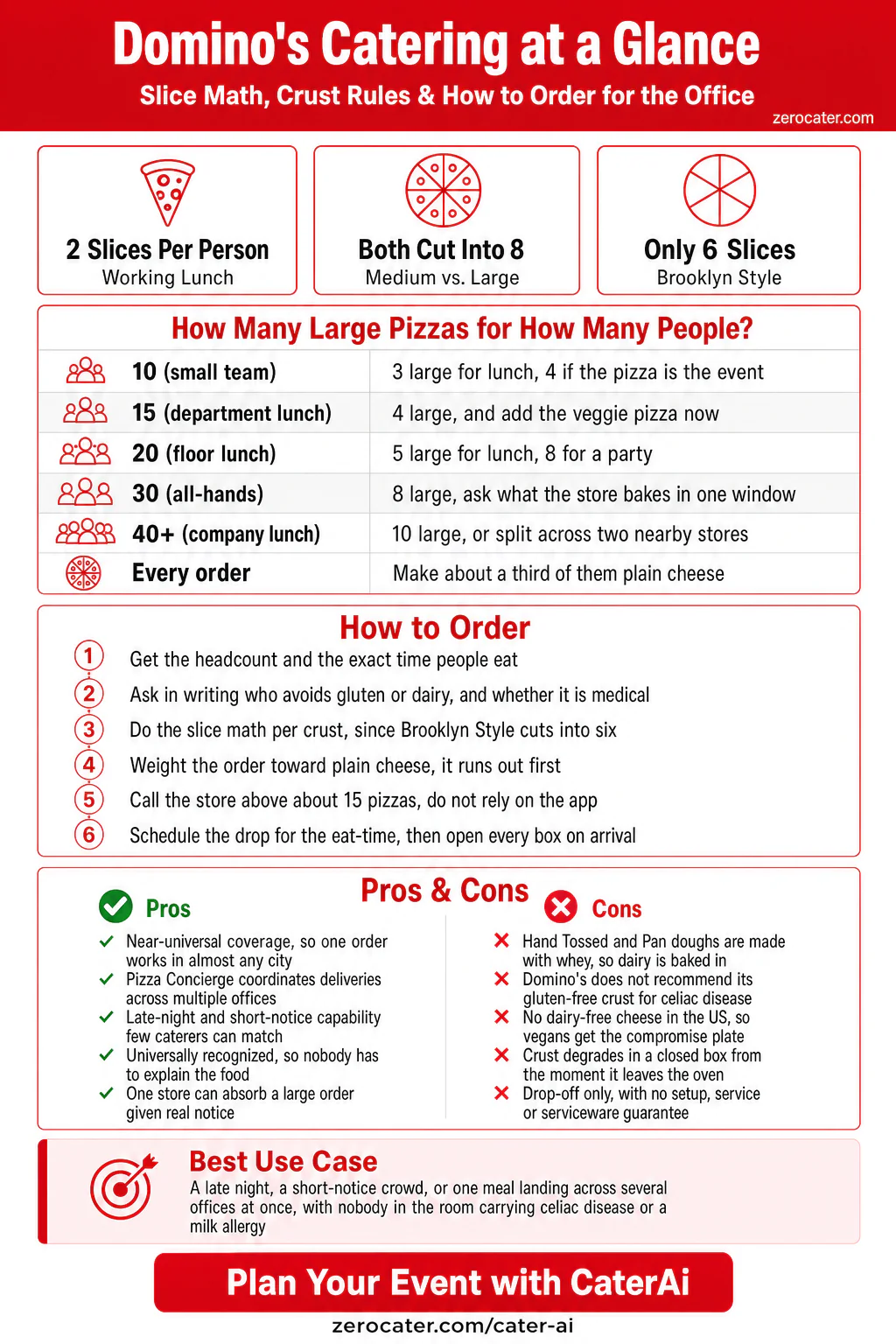
Pizza is priced by the pie and eaten by the slice, so every office pizza failure is an arithmetic failure. The planning heuristic most event planners use is three slices per person, which works out to multiplying your headcount by three-eighths to get the number of large pizzas. Twenty people, three slices each, eight slices to a large pizza: seven and a half pizzas, so you order eight.
Adjust that down for a working lunch. Three slices is a dinner or a party portion. A midday meal with an afternoon of work after it lands closer to two slices for most people, which is headcount divided by four. Order for three slices when the pizza is the event and for two when the pizza is fuel. The table below runs both.
| Headcount | Working lunch (2 slices each) | Party or dinner (3 slices each) | Notes |
|---|---|---|---|
| 10 | 3 large | 4 large | One pizza should be plain cheese |
| 15 | 4 large | 6 large | Add a veggie pizza here, not later |
| 20 | 5 large | 8 large | Call the store rather than using the app |
| 30 | 8 large | 12 large | Ask what the store can bake in one window |
| 40 | 10 large | 15 large | Consider splitting across two stores |
| 50 | 13 large | 19 large | Staggered drops beat one large drop |
Two adjustments matter more than the arithmetic. Plain cheese always runs out first in a mixed room, so weight the order toward it even though it feels boring. And the last two slices of every pizza go cold and uneaten, so a room of 20 fed by five pizzas eats better than the same room fed by ten halves of ten pizzas. Fewer varieties, more of each. Our office manager’s guide to ordering catering covers the same over-ordering instinct across formats.
The Size Trap: A Medium and a Large Hold the Same Eight Slices
Here is the thing that quietly wrecks office pizza budgets. A Domino’s medium is 12 inches and a large is 14 inches, and both are cut into eight slices. Ordering mediums instead of larges does not reduce your slice count. It reduces your slice size, and a smaller slice means people take a third one. You end up buying the same number of slices, feeding fewer people, and doing it again next time because you assumed mediums were the efficient choice.
Brooklyn Style is the other trap, and it runs the opposite direction. Brooklyn Style is cut into six large foldable slices rather than eight, so switching a large pizza to Brooklyn Style drops a quarter of your slice count at the same pizza count. Order 10 large Brooklyn Style pizzas for a room you sized at 80 slices and you have 60. The slices are bigger, so it may still feed everyone, but the arithmetic you did no longer describes the food you bought.
| Size | Diameter | Standard slices | Office read |
|---|---|---|---|
| Small | 10 inches | 6 | Only makes sense as a single-diner accommodation |
| Medium | 12 inches | 8 | Same slice count as a large, smaller slices |
| Large | 14 inches | 8 | The default unit for any group order |
| Brooklyn Style | Large and X-Large only | 6 | Fewer, bigger slices; redo your math before ordering |
| Crunchy Thin | Standard sizes | Square party cut | Small squares suit grazing better than a seated meal |
Crunchy Thin deserves its own note, because it is cut into squares rather than wedges. Square-cut pizza reads as a snack, which is exactly right for a happy hour or an afternoon meeting where people graze standing up, and exactly wrong when you promised the team lunch. Match the cut to the occasion. For grazing formats specifically, our guides to happy hour appetizers and finger food catering cover what else belongs on that table.
The Crust Is Where the Dairy Hides
Ask any office manager how to make a pizza order work for someone avoiding dairy and you will hear the same answer: order it without cheese. At Domino’s that answer is wrong, and the reason is that the dough itself is made with whey, a milk protein. The Hand Tossed crust and the Handmade Pan crust both carry dairy before a single topping goes on. A cheeseless Hand Tossed pizza is not a dairy-free pizza.
The line that matters: “hold the cheese” does not make a Domino’s pizza dairy-free.
Whey is in the dough on the default crusts. If someone on your list has a milk allergy rather than a preference, the crust is the decision, not the toppings. Domino’s revises ingredients without notice, so confirm the current Ingredients and Allergen information with the store on the day you order rather than trusting this or any other guide.
Two crusts skip the dairy: Crunchy Thin and the Gluten Free crust. That gives you a real path, and it comes with a real constraint, because the Gluten Free crust is made in one size only. Crunchy Thin is the practical dairy-free base for a group.
Dairy also lives in places on the menu that look safe. Domino’s Premium Grilled Chicken contains milk, which almost nobody expects from a chicken topping. On the sauce side, Alfredo, garlic parmesan and ranch are dairy by definition, while the standard tomato pizza sauce and the honey barbecue sauce are not. And there is no dairy-free cheese to fall back on, which we cover below.
| Crust | Sizes offered | Dairy in the dough? | Best office use |
|---|---|---|---|
| Hand Tossed | All standard sizes | Yes, made with whey | The default for the bulk of any group order |
| Handmade Pan | Medium only | Yes | Heavy and rich; poor traveler, order it last |
| Crunchy Thin | Standard sizes | No | The workable dairy-free base; square party cut |
| Brooklyn Style | Large and X-Large only | Confirm with the store | Six big foldable slices; recount before ordering |
| Gluten Free | Small only | No | One person’s pizza, with the caveat in the next section |
Notice what the size column does to your planning. Handmade Pan exists only as a medium, Brooklyn Style only as a large or X-Large, Gluten Free only as a small. Picking a crust picks a size, and picking a size picks a slice count. That chain is the single most useful thing to understand about ordering Domino’s for a group, and it is why a mixed-crust order needs its arithmetic done crust by crust rather than in one pass. Our dairy-free office catering guide covers the general version of this problem, which is that dairy tends to sit in the layer nobody inspects.
The Gluten-Free Crust Comes With Domino’s Own Warning
Domino’s sells a certified gluten-free crust and tells you not to give it to anyone with celiac disease. The company’s own language is unambiguous: a pizza made with the Gluten Free Crust is “prepared in a common kitchen with the risk of gluten exposure. Therefore, Domino’s DOES NOT recommend this pizza for customers with celiac disease.”
Read this before you order for a celiac colleague.
The crust arrives gluten free. The kitchen it passes through does not stay that way. Domino’s stores share ovens, work surfaces and utensils between gluten-free and regular pizzas, with no separate preparation area, so the company positions the product for people with mild gluten sensitivity rather than celiac disease. If someone on your list has celiac disease, order their meal from somewhere with a dedicated preparation process and let them tell you where.
This is worth sitting with, because it is a genuinely honest disclosure and it is easy to misread as legal boilerplate. It is not boilerplate. The crust is certified; the kitchen is the problem. An office manager who orders a gluten-free pizza for a celiac coworker in good faith, having seen “gluten free” on the menu, has done exactly what the label invited and exactly what the company advises against.
The practical move is to ask one question before you order rather than after: is this a preference, a sensitivity, or celiac disease? The answer changes where you buy that person’s lunch. Our gluten-free office catering guide walks through the same distinction in more depth, and our guide to catering for people with food allergies at work covers how to collect that information without making anyone announce a medical condition to the room.
Where Domino’s Runs Out of Room in a Mixed Office
Vegetarians do fine. The veggie toppings are extensive, a cheese pizza is always available, and a plain cheese pizza is the most reliably safe order on the menu for someone who does not eat meat. Our vegetarian office catering guide covers how much of the order to weight that way.
Vegans hit a wall. Domino’s does not sell a dairy-free cheese in the United States as of 2026, though it does in the United Kingdom, Australia and a handful of other markets. A vegan ordering from Domino’s in the US is ordering a cheeseless pizza on a Crunchy Thin or Gluten Free crust with vegetables and tomato sauce. That is a real meal and it is also visibly the compromise plate, which is a different experience from everyone else eating the same food. Our vegan office catering guide covers how to avoid that dynamic.
Halal and kosher teams should look elsewhere for the main order. Domino’s does not run halal or kosher certified kitchens in the US, and the pepperoni and sausage are pork. A cheese pizza is vegetarian, which solves some of it, though the shared preparation surfaces make it unsuitable for anyone observing strictly. Our halal office catering guide and kosher office catering guide cover what a certified order requires.
Low-carb and calorie-conscious eaters have the thinnest path of anyone here. Crunchy Thin trims the dough and a salad rides alongside, but pizza is a carbohydrate delivery system and no amount of ordering strategy changes that. If a meaningful share of your team eats that way, our keto office catering guide and healthy office catering guide are the better starting points. When several of these constraints stack in one room, our guide to ordering catering for mixed dietary needs is the one to read first, and allergy-safe boxed lunches covers the format that handles it most cleanly.
Pizza Is Timed, Not Scheduled
Every other catering format gets delivered into a holding window. Sandwiches keep. Chafing dishes hold heat. Boxed lunches sit on a table for an hour and lose nothing. Pizza has a usable window that starts closing the moment the box shuts, and the mechanism is simple: a hot pizza in a closed cardboard box gives off steam, the steam has nowhere to go, and it condenses into the crust. Crisp becomes limp from the bottom up.
Nothing about ordering fixes this. Timing does. Schedule the delivery for the minute people actually eat rather than 20 minutes early, because early is worse than late here. Open every box on arrival so the steam escapes, even if people are still filing in. Prop the lids rather than restacking. If you are running a meeting that starts at noon and eats at 12:30, the pizza should land at 12:25.
Crust choice buys you a little margin. Crunchy Thin and Brooklyn Style hold their character better on a drive than Handmade Pan, which is thick enough to steam itself. If the store is far enough away that none of this is realistic, that distance is a real argument for a format built to sit, and our comparison of boxed lunch catering versus a buffet covers what each one tolerates.
The Sides That Survive the Drive
The wings, the bread sides and the pasta all travel differently, and the office order improves when you pick on that basis rather than on appeal. Bread sides hold up best: breadsticks, the cheesy bread and the stuffed varieties stay recognizable after a drive, and they stretch a pizza order further than another pizza does because people take one out of curiosity rather than hunger.
Wings are the coin flip. Sauced wings sitting in a covered container continue cooking in their own steam, and the skin gives up. Order sauce on the side when the store will do it. Pasta in a bowl holds heat well and is the most reliable hot side on the menu for a longer drive, though it needs forks, which brings us to the thing nobody plans for.
Domino’s is a delivery company, so plates, serving utensils and napkins are not something to assume. Third-party pages claim they come with catering orders; Domino’s own materials do not promise it. Ask when you order, and keep a stock in the office kitchen regardless. A 40-person pizza order with no napkins is a worse afternoon than a 40-person pizza order with a slightly soft crust. Our party tray catering guide covers the same serviceware gap across drop-off formats.
How to Order Domino’s for a Group
- Get your headcount and your eat-time. Both, not just the first. The eat-time drives everything else about a pizza order.
- Ask the dietary question once, in writing. Specifically whether anyone avoids gluten or dairy, and whether it is a preference or a medical condition. The answer determines whether Domino’s can serve your whole room at all.
- Do the slice math per crust. Two slices per person for a working lunch, three for an event. Recount if any part of the order is Brooklyn Style, which cuts into six.
- Weight the order toward plain cheese. It runs out first every time. Aim for roughly a third of the pizzas plain, then split the rest across two or three varieties rather than five.
- Call the store for anything above about 15 pizzas. The app will take the order; the store will tell you whether it can bake it in one window. Ask that question directly.
- Ask about Pizza Concierge if you are feeding more than one address. Coordinating a multi-site order through one desk is the single biggest advantage Domino’s has over a local caterer.
- Confirm serviceware. Plates, napkins and serving utensils. Assume nothing.
- Schedule the drop for the eat-time, then open every box on arrival. Prop the lids. This is the difference between good pizza and a pile of warm bread.
Plan pizza catering with CaterAi
Pros and Cons for Office Catering
| Pros | Cons |
|---|---|
| Near-universal coverage, so the same order works in almost any city you have an office in | Dairy sits in the default crusts, so the obvious dairy-free workaround does not work |
| Pizza Concierge coordinates multi-site orders through a single desk | Domino’s advises against its own gluten-free crust for celiac disease |
| Late-night and short-notice capability that most caterers cannot match | No dairy-free cheese in the US, so vegans get the compromise plate |
| Genuinely easy to order and universally recognized, so nobody has to explain the food | Quality degrades on the drive in a way no other catering format does |
| Predictable across locations, which matters for a recurring order | Drop-off only, with no setup, service, serviceware guarantee or cleanup |
| A single store can absorb a large order with enough notice | Repeats badly, because pizza twice a month stops reading as a perk |
Who Domino’s Catering Is Best For
Order Domino’s when:
You are feeding a launch night, a deadline crunch or a shift that ran long. You need food at an hour when caterers are closed. You are coordinating one meal across several offices in different cities. You are feeding a crowd where speed and recognizability beat refinement, like a big all-hands or a game-day watch party. Or you planned nothing and it is already 11:40.
Order something else when:
Anyone in the room has celiac disease or a milk allergy. You are running a recurring weekly or biweekly meal program, where pizza wears out fast. You are hosting clients, candidates or a board. Your team skews toward low-carb or health-conscious eating. Or the nearest store is far enough away that the food will steam itself on the drive.
Domino’s vs. Other Catering Options
| Option | Best at | Weakest at |
|---|---|---|
| Domino’s | Speed, late hours, multi-site coordination, universal coverage | Dietary range, hold time, anything client-facing |
| A local pizzeria | Better crust, real vegan cheese in many shops, a relationship you can call | Coverage outside its own neighborhood, late-night reliability |
| Boxed lunches | Per-person dietary control, holds for an hour, hybrid-friendly | Costs more per head, needs specs collected in advance |
| A staffed buffet | Variety, presentation, setup and cleanup handled | Lead time, minimums, no help at 9pm |
| A managed platform | Rotating variety, dietary tracking, one invoice across offices | Overkill for a genuine one-off emergency order |
If you want the pizza without the chain constraints, the Zerocater directory lists independent pizzerias that cater in every metro we serve, and many of them stock vegan cheese and run genuinely thin crusts. Browse Italian catering, or start with specific shops: Joe’s Pizza, Unregular Pizza and Little Pizza Parlor in New York; North Beach Pizza and Pizza Ponte in the Bay Area; Slice Factory and Billy Bricks Wood Fired Pizza in Chicago; Dovetail Pizza and Grata’s Pizzeria in Austin; Pizzati in Dallas; Halftime King of Pizza in Boston; Mad Pizza and Olympic Pizza in Seattle; Sexy Pizza in Denver; and Perry’s Pizza in Philadelphia. Our Joe’s Pizza catering spotlight covers what a genuine New York slice shop does differently at office scale.
A Better Option for Recurring Office Meals
Domino’s earns its place in the rotation. As the whole rotation it fails, because the thing that makes it good in an emergency, a narrow menu executed fast, is the thing that makes it tired by the third week. Teams notice pizza twice a month, and what they notice is that nobody is thinking about them.
Zerocater handles the other side of that. CaterAi builds a menu from more than a thousand local restaurants based on your headcount, your budget and your team’s actual dietary constraints, and you edit it by chatting rather than by rebuilding the order. Dietary needs get tracked once instead of re-collected every week, which is the part that eats an office manager’s afternoon. For a standing weekly or biweekly program, corporate catering rotates the cuisine so the room stops predicting lunch, and for a one-time event corporate event catering covers the setup and service Domino’s does not do. Our how it works page walks through the whole flow.
The honest split: keep Domino’s for the emergencies and the late nights, where nothing beats it, and run everything predictable through a platform that can hold your team’s constraints in memory. Pizza is a great answer to an unplanned Friday and a poor answer to a plan.
Plan pizza catering with CaterAi
More on feeding a team well: our lunch and learn catering guide, board meeting catering, holiday party planning, offsite and retreat catering, company picnics and summer catering ideas. Building a station instead of ordering trays? See our taco bar, salad bar and sandwich bar guides. Comparing chains? See our Five Guys, Buffalo Wild Wings, Raising Cane’s, Panda Express, CAVA, Jersey Mike’s, Potbelly, Jimmy John’s, Firehouse Subs, IHOP, Dickey’s Barbecue Pit, Outback Steakhouse, Chick-fil-A and Sweetgreen guides. Budgeting a program? Our cost guides cover San Francisco, New York, Chicago, Austin, Boston, Los Angeles, Seattle, Denver, Dallas, Atlanta, Philadelphia and Washington DC. Ordering boxed instead? See boxed lunches for meetings, for conferences and training and what they cost.
Frequently Asked Questions
Does Domino’s do catering?
Domino’s handles large orders under the name Business Orders rather than catering, and it runs a Pizza Concierge service for companies coordinating deliveries across multiple locations. What you get is volume delivery: stacked boxes at your door on a driver’s schedule. No setup, no service, no staff and no cleanup.
How many Domino’s pizzas do I need for 20 people?
Five large pizzas for a working lunch, eight for a party or dinner. The heuristic is two slices per person for a midday meal and three when the pizza is the event, against eight slices on a large. Recount if any of the order is Brooklyn Style, which is cut into six slices rather than eight.
Is a Domino’s medium or large pizza better value for a group?
Large, and the reason surprises most people: a medium and a large are both cut into eight slices. Ordering mediums does not get you fewer slices, it gets you smaller ones, which tends to make people take an extra. For any group order, treat the large as your default unit.
Can you order a dairy-free pizza from Domino’s?
Yes, but not by holding the cheese on a standard pizza. The Hand Tossed and Handmade Pan doughs are made with whey, a milk protein, so a cheeseless Hand Tossed pizza still carries dairy. The Crunchy Thin and Gluten Free crusts skip the dairy, and Domino’s does not sell a dairy-free cheese in the United States, so a dairy-free order means vegetables and tomato sauce on one of those two crusts. Confirm current ingredients with the store, because Domino’s revises them without notice.
Is Domino’s gluten-free crust safe for someone with celiac disease?
Domino’s says no. In the company’s own words, the pizza is prepared in a common kitchen with the risk of gluten exposure, and Domino’s does not recommend it for customers with celiac disease. Stores share ovens, surfaces and utensils with regular pizzas and have no separate preparation area, so the product is positioned for mild gluten sensitivity. Order that person’s meal from a kitchen with a dedicated process.
Does Domino’s have vegan cheese in the US?
No. Domino’s offers a vegan cheese in the United Kingdom, Australia and a few other markets, and has not brought one to the United States as of 2026. A vegan order in the US is a cheeseless pizza on a Crunchy Thin or Gluten Free crust with vegetables. A local pizzeria is usually the better call when vegans make up a real share of the room.
How far ahead should I order Domino’s for an office event?
Further than you think for the size of the order, and precisely for the time. A store makes your pizzas on the same line it uses for every other customer, so the real constraint is how many it can bake in one window. Call for anything above roughly 15 pizzas and ask that question directly. Then schedule the delivery for the minute people eat rather than early, because pizza starts declining the moment the box closes.
Do Domino’s orders come with plates, napkins and serving utensils?
Do not assume so. Third-party pages claim serviceware is included with catering orders, and Domino’s own materials do not promise it. Ask when you place the order and keep a supply in the office kitchen either way. Pasta and wings in particular need utensils that a pizza order would not.