Somebody on your team asks for the dairy-free option, you write “no cheese, please” in the order notes, and the tray shows up with butter-finished vegetables, a ranch-seasoned chicken, and a dressing built on buttermilk. Nobody lied to you. The cheese really was left off. Dairy just was not where you were looking.
Avoiding dairy is one of the most common food restrictions in a US office, and it is also one of the least well served by a standard catering order. Gluten announces itself as bread. Meat announces itself as meat. Dairy sits in the finishing step, in the sauce, the glaze, the marinade, and the seasoning blend, which means the dish that looks safest on the buffet is often the one that is not.
This guide covers what “dairy-free” actually means when two different people say it, the places dairy hides in catering specifically, and the small set of ordering habits that make the whole thing routine instead of a negotiation every time.
Plan dairy-free catering with CaterAi
Dairy-Free and Lactose-Free Are Not the Same Order
Two people can both write “dairy-free” on the same form and need two different things from you. The distinction matters more here than in almost any other dietary category, because one version is a comfort problem and the other is a medical one.
Lactose intolerance
Lactose intolerance is a missing or reduced enzyme. Without enough lactase, the milk sugar in dairy passes through undigested and causes bloating, cramping, and worse. It tends to be dose-dependent: a splash of milk in coffee may be fine while a cream sauce is not. Many people who are lactose intolerant tolerate hard aged cheeses and butter better than milk or soft cheese, and some carry enzyme tablets and make their own calls at the buffet. It is genuinely miserable and it is not dangerous.
Milk allergy
A milk allergy is an immune reaction, and it is a reaction to the proteins in milk, casein and whey, not to the sugar. That difference has two practical consequences. First, dose does not help: a trace amount can trigger a response, and reactions range from hives to anaphylaxis. Second, lactose-free products do not solve it. Lactose-free milk is still milk with the lactose broken down, so it still carries casein. If someone on your team has a milk allergy, you are running an allergen protocol, not a preference.
Why you have to ask
A dietary form that offers one “dairy-free” checkbox collapses both into a single answer, and the catering order that follows treats a life-threatening allergy the same way it treats a preference. Ask one follow-up question: intolerance or allergy. The answer changes whether you need sauces on the side or you need sealed, labeled, individually packaged food from a kitchen you have spoken to directly. Our guide to ordering catering for mixed dietary needs covers how to collect that without turning it into an interrogation.
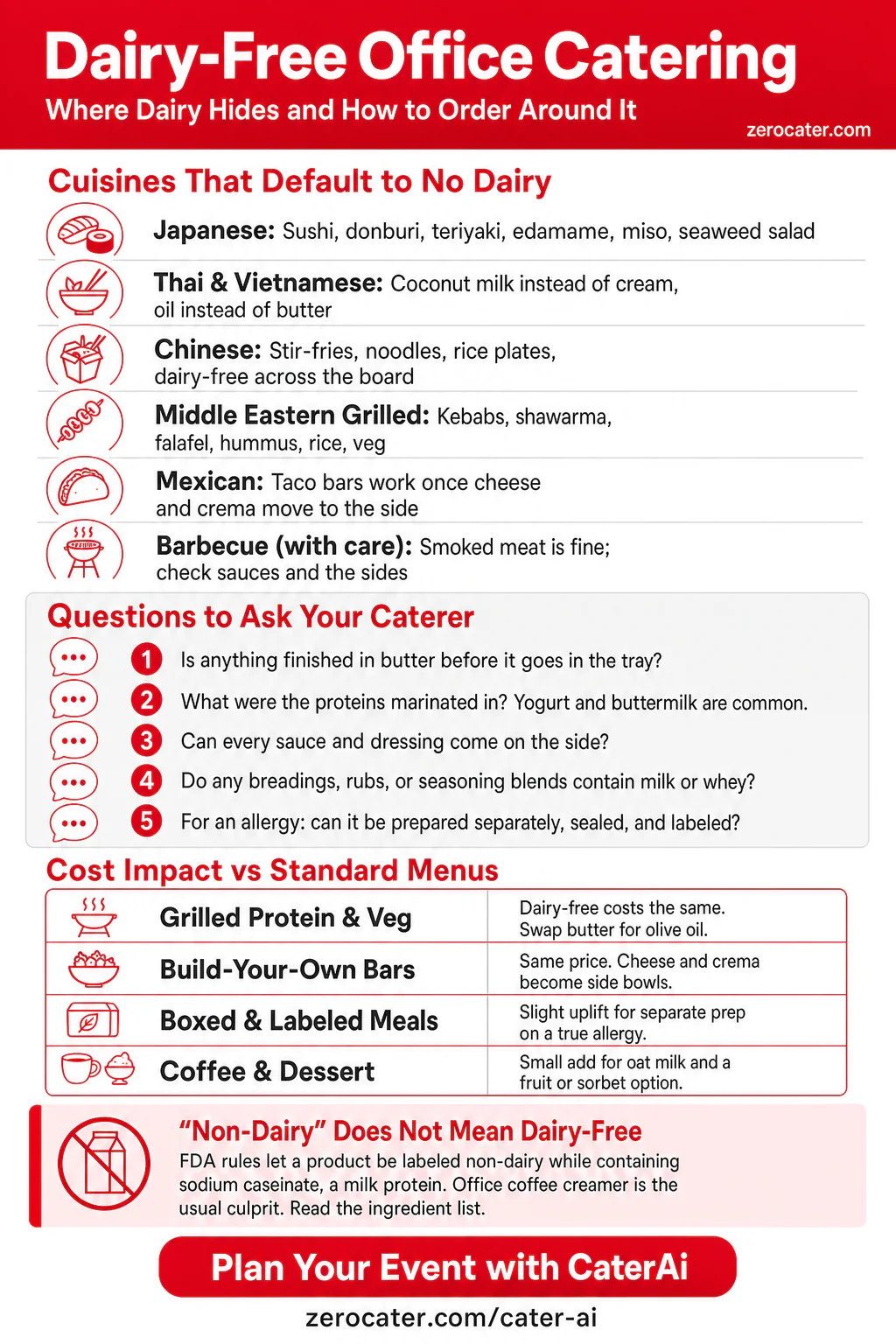
“Non-dairy” is a labeling term, not a promise. Under FDA labeling rules a product can be called “non-dairy” and still contain sodium caseinate, a protein derived from milk, as long as the ingredient list discloses the source, typically as “sodium caseinate (milk)”. The everyday case is the office coffee station: the non-dairy creamer sitting next to the carafe is frequently not dairy-free. “Dairy-free” is the phrase that means no milk-derived ingredients at all. When it matters, read the ingredient list rather than the front of the package.
Where Dairy Actually Hides in a Catering Order
Restaurant kitchens use dairy as a technique rather than as an ingredient. Butter is how you finish a pan sauce and gloss a tray of vegetables. Cream is how you hold a sauce together in a chafing dish for two hours. Milk powder and whey turn up in seasoning blends and breading because they help browning and cling. None of that shows up in a menu description that says “grilled seasonal vegetables”.
These are the positions worth checking on a catering order, roughly in order of how often they catch people out.
| Where it hides | What to look for | The ask |
|---|---|---|
| Dressings and dips | Ranch, caesar, blue cheese, green goddess, tzatziki, most “creamy” anything | Oil and vinegar or lemon on the side, always |
| The finishing butter | Roasted vegetables, rice pilaf, mashed potatoes, steak, garlic bread | Ask for olive oil instead of a butter finish |
| Sauce bases | Roux-thickened gravy, alfredo, vodka sauce, chowders, bisques, queso | Choose tomato, broth, coconut, or vinaigrette-based instead |
| Marinades | Yogurt-marinated chicken, buttermilk brines, tandoori | Ask what the protein was marinated in, not just what it was cooked in |
| Breading and batter | Milk powder and whey in coatings, egg-and-milk wash | Default to grilled or roasted over fried and breaded |
| Bread and buns | Brioche, milk bread, naan, many soft rolls and tortillas | Corn tortillas, pita, baguette, or a bowl instead of a sandwich |
| Seasoning blends | Ranch seasoning, some spice rubs, “cheese” powders on snacks | Ask for salt, pepper, herbs, and citrus as the seasoning |
| The coffee station | “Non-dairy” creamers with caseinate, whipped toppings | Stock a sealed oat or soy carton next to the milk |
| Dessert | Almost everything baked, plus most chocolate | Add a fruit platter or sorbet so there is a real second option |
Read that list once and the pattern is obvious. Dairy rarely arrives as an obvious block of cheese. It arrives as the last thing the kitchen did before the tray went in the box.
The Vegan Tray Is a Fallback, Not a Plan
Vegan food is dairy-free by definition, which makes a vegan option a genuine safety net and the right thing to have on the table. Reaching for it as the whole answer creates a different problem. Someone who avoids dairy and eats meat gets handed a lentil salad while the rest of the team eats brisket. They did not ask to give up protein. They asked to give up milk.
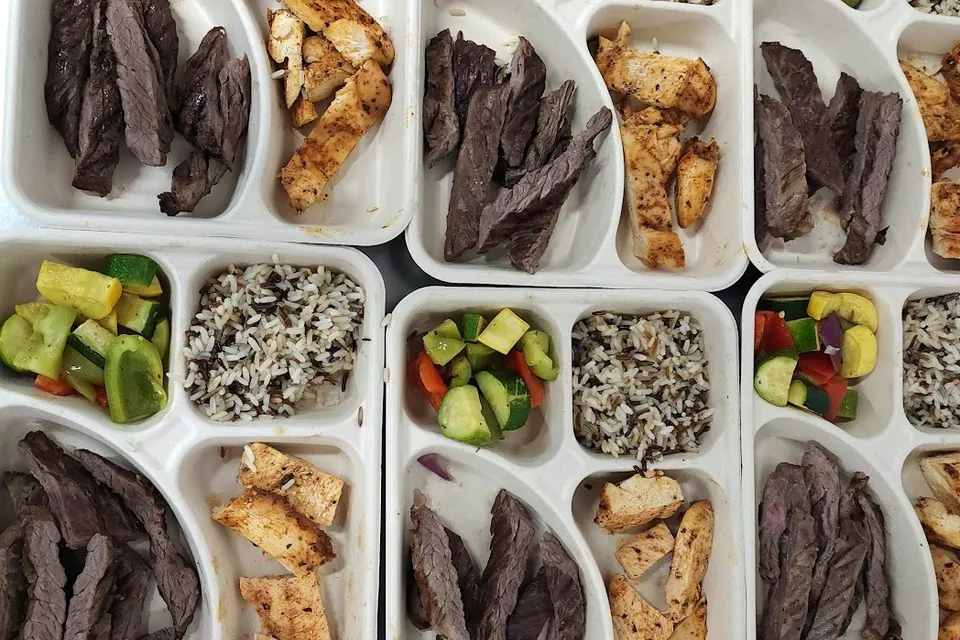
The better move is to order the dairy-free version of the real menu. Most caterers can do this without blinking, because for the majority of dishes the dairy is in a component that can be left off or served separately. Grilled chicken, roasted vegetables finished in olive oil, rice, beans, and a vinaigrette on the side is not a compromise meal. It is just the same meal, assembled slightly differently.
Cuisines That Default to No Dairy
The fastest way to make a dairy-free order easy is to pick a cuisine where dairy was never in the recipe. This is not about labeling a whole cuisine “safe”, because any kitchen can add butter to anything. It is about how much you have to subtract from the default menu.
- Japanese. Sushi, sashimi, donburi, teriyaki, edamame, miso, and seaweed salad are built without dairy. A Japanese catering order is close to the least work you can do here. Vendors like Poke Life in San Francisco, Pokeworks in Mountain View, and Hokey Poke in New York build bowls from components, so the whole order is transparent by construction.
- Chinese, Thai, and Vietnamese. Coconut milk rather than cream, oil rather than butter. Stir-fries, curries, noodle dishes, and rice plates are dairy-free almost across the board. Watch only for crab rangoon and a handful of Americanized dishes.
- Middle Eastern and Mediterranean grilled. Kebabs, shawarma, falafel, hummus, tabbouleh, rice, and grilled vegetables are all fine. The dairy is concentrated in labneh, feta, and tzatziki, which are easy to isolate on the side. SAJJ in Belmont, Zaatar in San Francisco, and Taboon in Dallas all work this way. See the Greek catering directory for more.
- Mexican, with two swaps. Move the cheese and the crema to the side and a taco bar becomes one of the easiest dairy-free formats there is, because everyone assembles their own plate anyway. Tio Luis Tacos in Chicago, El Xolo in Austin, and El Jefe’s Taqueria in Cambridge all cater this format.
- Barbecue, with one caution. Smoked meat is dairy-free. The sauce and the sides are where it goes wrong, since many barbecue sauces are finished with butter and the mac, slaw, and cornbread usually are not safe. Roaming Buffalo in Denver and Little Lou’s in Campbell are both on the barbecue directory, and our barbecue catering guide has the full format breakdown.
One cuisine deserves a specific correction, because it gets assumed onto this list regularly. North Indian food is not a dairy-light default. Ghee, paneer, cream, and yogurt marinades run through a large share of the menu, and tandoori chicken is usually yogurt-marinated. South Indian cooking, by contrast, leans on coconut, lentils, rice, and tamarind and is largely dairy-free. Kitchens like Indian Bento in San Francisco and Our Indian Tiffin in Santa Clara can steer an order that way if you ask. Our Indian corporate catering guide goes deeper on which dishes sit where.
How to Order So the Kitchen Can Actually Deliver
Most dairy-free failures are ordering failures rather than kitchen failures. The kitchen was never told, or it was told in a way it could not act on. Four habits fix nearly all of it.
- Put every sauce and dressing on the side by default. This one habit solves more dairy-free problems than everything else combined, and it costs nothing. It also happens to serve the gluten-free, keto, and low-sodium eaters at the same time.
- Ask about the finish, not only the ingredients. “Is this dairy-free?” gets a fast yes. “Is anything finished in butter, and what is the protein marinated in?” gets an accurate answer, because it points the kitchen at the steps it does not think of as ingredients.
- Order components rather than composed dishes. Protein, starch, and vegetable delivered separately give you a meal that can be assembled several ways. A composed dish gives you one, and it is already sauced.
- Ask for labels on the buffet. Not a full ingredient list, just a card per dish that says whether it contains dairy. It moves the decision to the person who actually knows their own tolerance, and it stops the quiet interrogation at the front of the line.
Plan dairy-free catering with CaterAi
Formats That Make Dairy-Free Easy
Some catering formats do most of the work for you, because they either separate the components or label them individually.
Individually boxed meals
A boxed lunch can be built to spec and labeled by name, which removes the buffet-line guessing entirely. This is the right format when someone has a genuine milk allergy, and it is the same logic behind allergy-safe boxed lunches. It also travels well for conferences and training days and for hybrid and distributed teams.
Build-your-own bars
A taco bar or a salad bar puts every component in its own vessel and lets each person skip what they need to skip. Cheese and crema become two bowls among fifteen rather than a decision baked into every plate. Salad vendors like Just Salad in New York, Saucy Greens in Los Angeles, and Ranch Hand Organic Bowls in Austin build this way as a matter of course.
Grilled platters and grain bowls
Trays of grilled protein and roasted vegetables with rice or grains, sauces on the side, work for nearly every restriction at once. It is the same order that carries a healthy catering brief or a keto one, which is part of why it is worth defaulting to for recurring team lunches.
What to watch on breakfast
Breakfast catering is the hardest meal of the day to make dairy-free, because pastries, yogurt parfaits, egg dishes cooked in butter, and creamers cover most of the table. Fruit, oatmeal made with water, avocado toast on a dairy-free bread, and a sealed oat milk carton give you a real breakfast rather than a plate of fruit as an apology. The same applies to boxed breakfasts.
Cross-Contact: What Changes When It Is an Allergy
Everything above is enough for lactose intolerance. A milk allergy adds one more layer, because the risk is no longer about what is in the dish. It is about what touched it.
For a true milk allergy, treat this as an allergen protocol.
A shared serving spoon moved between the mac and cheese and the vegetables transfers enough protein to matter. So does a grill that just finished a butter-basted steak, or a fryer shared with breaded items. Ask for the allergy meal to be prepared separately, packed sealed, labeled with the person’s name, and handed over rather than set on the buffet. Then tell the person exactly what was and was not done, and let them make the final call. A guide cannot clear a specific kitchen. Only that kitchen can.
Who This Setup Is Ideal For
A component-based, sauces-on-the-side order works well for: recurring team lunches where you cannot re-survey the room every week, lunch and learns and all-hands where nobody wants to hold up the line asking questions, offsites where you are feeding the same group several times in a row, and any office where the dietary list also includes gluten-free, kosher, halal, or vegan eaters, since one build-your-own spread serves all of them from a single order.
It is the wrong setup when: someone has a diagnosed milk allergy and the food is going on an open buffet, in which case you want individually sealed and labeled meals instead; the menu is built around composed dishes that cannot be deconstructed, such as a lasagna or a cream-sauce pasta service; or the event is a passed-appetizer reception where nobody can see what is in what, which needs labeled stations rather than roaming trays.
Dairy-Free Office Catering With Zerocater
The reason dairy-free is annoying to order is that it requires knowing how a specific kitchen finishes a specific dish, which is not information a menu PDF carries. CaterAi builds a menu from a network of more than a thousand restaurants and lets you edit it by chatting, so you can specify sauces on the side, no butter finish, and a labeled dairy-free box for one person without composing a separate order. For ongoing programs, corporate catering keeps those preferences attached to your account so you are not restating them every week, and event catering handles the one-off all-hands. If you are new to this, how it works is the short version.
Dairy-free is rarely the only restriction in the room. If you are stacking it against others, the gluten-free, vegetarian, kosher, and halal guides cover the neighboring cases, and the event catering checklist has the ordering sequence. For budgeting, the cost guides for Los Angeles, Austin, Seattle, Boston, and Denver give you per-head ranges, and the format comparison covers when boxed beats buffet.
Plan dairy-free catering with CaterAi
Frequently Asked Questions
Is lactose-free the same as dairy-free?
No. Lactose-free milk is still milk with the lactose broken down, so it still contains casein and whey. It works for lactose intolerance and does not work for a milk allergy. Only “dairy-free” means no milk-derived ingredients at all.
Can a product labeled “non-dairy” contain milk?
Yes. FDA labeling rules allow a “non-dairy” product to contain sodium caseinate, a milk protein, provided the ingredient list identifies the source, usually written as “sodium caseinate (milk)”. Non-dairy coffee creamer is the most common example in an office. Read the ingredient list rather than the front of the package.
What is the single most useful thing to request on a catering order?
Sauces and dressings on the side. It removes the most common source of hidden dairy, it costs nothing, and it simultaneously helps the gluten-free, keto, and low-sodium eaters in the room.
Is butter dairy?
Yes. Butter is a milk product, and it is the single most commonly missed one in catering because it is used as a finishing technique rather than a listed ingredient. Roasted vegetables, rice, mashed potatoes, and steak are all routinely finished in butter without the menu saying so. Ghee is clarified butter and still carries trace milk protein, so it is not a safe substitute for an allergy.
Which cuisines are easiest to order dairy-free?
Japanese, Chinese, Thai, and Vietnamese menus are built almost entirely without dairy. Middle Eastern grilled food is close, with the dairy concentrated in a few dips that sit on the side anyway. Mexican works well once cheese and crema are moved to separate bowls.
Is Indian food a good dairy-free choice?
It depends on the region. North Indian cooking uses ghee, paneer, cream, and yogurt marinades heavily, so it is one of the harder cuisines to order dairy-free. South Indian cooking leans on coconut, lentils, rice, and tamarind and is largely dairy-free. Ask the kitchen to steer the order south.
How do I handle a milk allergy at a buffet?
Take that person off the buffet. Order their meal prepared separately, packed sealed, and labeled with their name, then hand it to them directly. Shared serving utensils and shared cooking surfaces move enough milk protein to cause a reaction, so an open buffet cannot be made reliably safe for a true allergy.
Do I have to order a separate meal for the dairy-free person?
Usually not. For an intolerance, a component-based spread with sauces on the side lets everyone eat from the same order. A separate labeled meal is worth it when someone has a diagnosed milk allergy, or when the menu is built around composed dishes that cannot be deconstructed.