Your first hire of the quarter got a real welcome lunch. Someone booked a table, six people showed up, and the new designer went home having met her team. Hire number four got a Slack message at 11:40 telling everyone the group was heading out, sent to a channel she had been added to that morning and had not opened yet.
Budget did not cause that gap. Nobody decided the fourth hire mattered less. The first lunch was planned and the fourth was remembered, and remembering is not a process.
This guide covers why the onboarding lunch behaves differently from every other catered thing on your calendar, how to collect dietary needs from a person who does not have a company email address yet, which formats survive a three-person headcount, and how to bind the whole thing to a step in your hiring flow so it happens without anyone being heroic.
Plan an onboarding lunch with CaterAi
An Onboarding Lunch Is a Standing Order, Not an Event
Think about how you plan a lunch and learn or an offsite. You pick a date, you count the room, you order once, and the thing is done. Onboarding breaks all three of those assumptions at the same time.
Recruiting sets the date, and they set it the moment a candidate signs, which might be five weeks out or nine days out. The headcount is one person plus whoever from the team can make it, so you are ordering for three when your usual number is thirty. And it happens again, on a cadence that follows hiring rather than the calendar. Two starts in March, none in April, four in the first half of May.
| Onboarding lunch | The team event you are used to | |
|---|---|---|
| Who sets the date | Recruiting, when an offer is signed | You, around everyone’s availability |
| Headcount | 1 to 8, and you find out late | 20 to 200, from an RSVP list |
| Dietary info | Unknown, from someone you cannot survey yet | Collected in the invite form |
| Frequency | Whenever hiring says, several times a quarter | Once, on a date you chose |
| Owner | Usually whoever remembered | A named organizer with a budget line |
| Failure mode | It quietly stops happening | It goes badly and everyone notices |
That last row is the one worth sitting with. A bad all-hands lunch generates complaints and gets fixed. An onboarding lunch that stops happening generates nothing at all, because the only person who would have noticed is new and assumes this is just how the company works.
You Are Ordering for Someone You Have Never Asked
Every dietary guide assumes you can survey the room. Our guide to ordering for mixed dietary needs opens with a form. On a start date, that form has nowhere to go. The new hire has no company login until IT provisions one, is not in the Slack workspace, and never saw a question about food during the interview loop.
So the dietary email goes out at 9:15 on day one, and the food was ordered on Friday. The vegetarian gets a turkey wrap and says it is fine.
Put the dietary question in the pre-boarding packet. The offer letter, the background check, the equipment survey and the first-day logistics note all reach a personal email address before the company one exists. That packet is the last reliable channel you have, and it goes out with days of runway rather than hours. One line in a document you already send solves the entire problem. Waiting until the person can receive internal mail means you are ordering blind every single time.
Ask two questions, not a form
A nine-field dietary survey sent to somebody who has not started yet reads as bureaucracy. Two sentences do the same work:
- “Is there anything you don’t eat, and is that a preference, an allergy, or a religious practice?” The follow-up clause is doing the heavy lifting. A preference means order thoughtfully. An allergy means you are running a protocol, which is the logic behind allergy-safe boxed lunches. A religious practice usually means sourcing rather than substitution, and the halal and kosher guides cover what that changes.
- “Anything we should know about your first week?” An open question catches the things a checkbox misses. Someone fasting, someone who does not drink, someone who would rather not have a group meal in week one at all.
Store the answer wherever the rest of the onboarding record lives. The second time that person is fed, at a team lunch or an all-hands, you should not be asking again.
The Minimum Is the Constraint, Not the Budget
A three-person lunch is not a small version of a thirty-person lunch. Most caterers set an order minimum, and a single start date frequently sits underneath it. That one fact determines the entire category, because it rules out the formats you reach for first.
Staffed service, chafing setups and on-site stations all price around a room. Below a certain headcount they either refuse the order or charge you the minimum anyway, which turns a welcome gesture into an awkward line item. The formats that survive are the ones built to be portioned rather than staged.
Formats That Work at Onboarding Headcounts
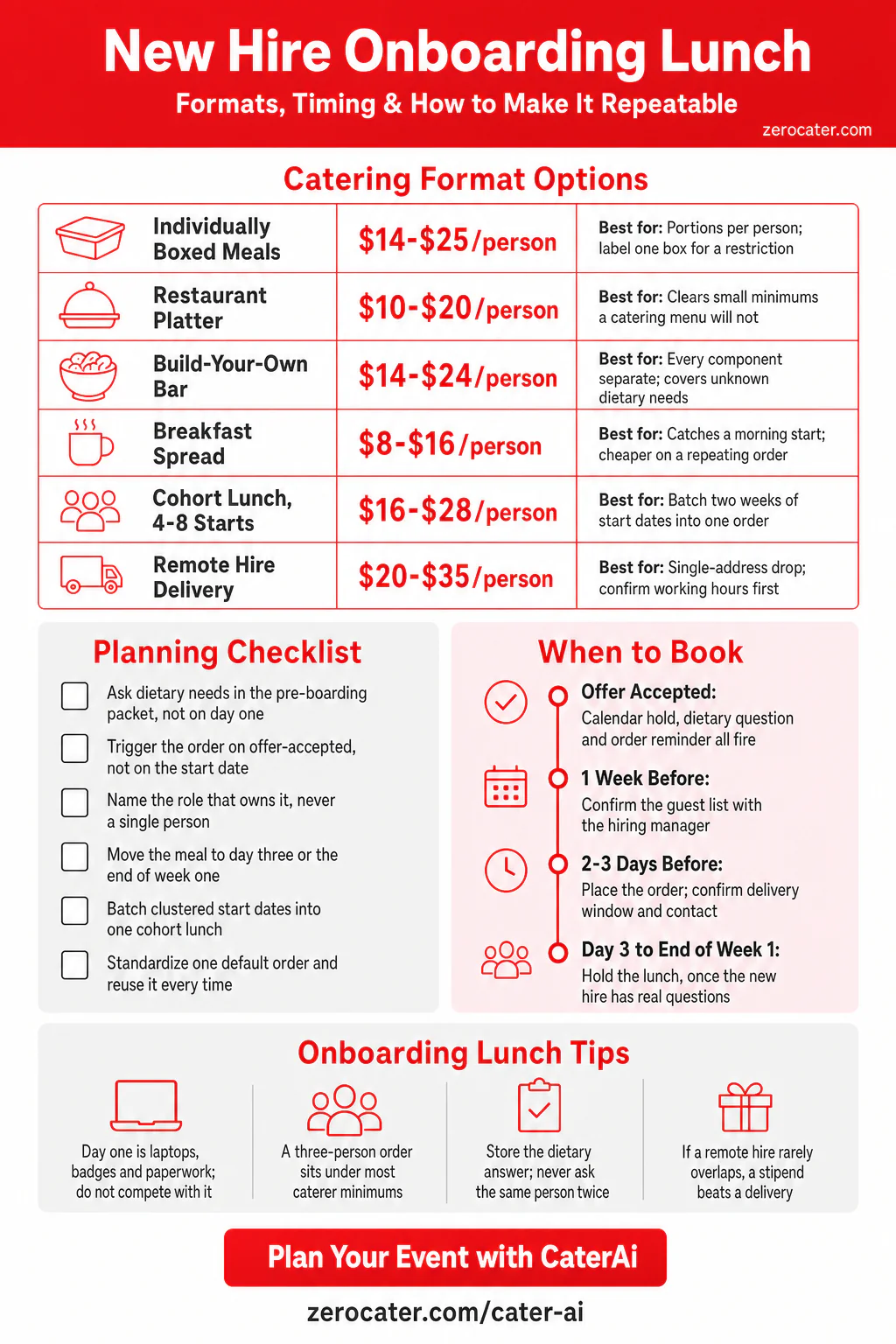
Individually boxed meals
A boxed lunch is the default answer here, and for once the default is right. It portions per person, it can be labeled by name, it holds if the new hire’s IT session runs long, and it works whether three people eat together or six eat at their desks. Ordering one dairy-free box among five is a note on the order rather than a separate purchase. The boxed lunch cost guide has per-head ranges, and boxed lunches for meetings covers the mechanics.
A platter for the table
Sandwich, salad or mezze platters from a single restaurant clear small minimums more often than catering-specific menus do, because you are placing a large restaurant order rather than booking a catering service. Togo’s in Alameda, New York Deli News in Denver and Saigon Sisters in Chicago all work this way. Our party tray guide covers how the formats compare.
Build-your-own, scaled down
A sandwich bar or a salad bar solves the unknown-dietary problem structurally: every component sits in its own vessel and each person builds a plate they can actually eat. At six people it is a reasonable spread rather than a production. Vendors like Zo’s Salads & Bowls in Berkeley, Just Salad in New York and Ranch Hand Organic Bowls in Austin assemble this way as a matter of course. A taco bar does the same job with more energy, which suits a group that is meeting for the first time.
Breakfast for a morning start
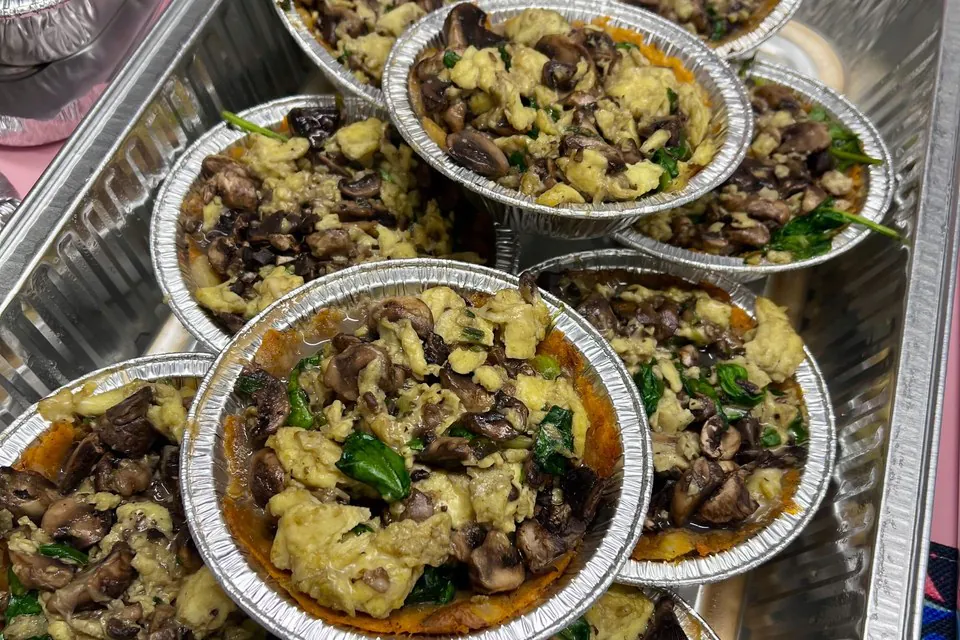
Most start times land in the morning, and a breakfast spread catches the new hire during the hour they are most adrift. It also runs cheaper per head than lunch, which matters on a recurring line item. Boxed breakfasts work if the morning is fragmented across sessions.
What to skip
Passed appetizers, staffed buffets and anything requiring a grazing table build belong to larger rooms. At onboarding scale they cost more, take longer to set up than the meal lasts, and make a lunch for four feel like a performance.
Plan an onboarding lunch with CaterAi
Day One Is the Worst Day for It
The instinct is to put the welcome lunch on the first day, and the first day is already full. Laptop provisioning, badge photo, benefits enrollment, security training, and five introductory calls with people whose names have not landed yet. Dropping a group meal into that runs it as one more scheduled obligation.
The deeper problem is conversational. On day one the new hire has nothing to say about the work, so the table falls back on where-are-you-from and how-was-the-commute, and the lunch produces goodwill without producing colleagues.
Two adjustments fix most of it:
- Move it to day three or the end of week one. By then the new person has seen a codebase, sat in a real meeting, or read the account list, and has actual questions. The lunch becomes useful instead of ceremonial.
- Batch the cohort if starts cluster. Four people starting inside a two-week window is one lunch, not four. It clears the caterer’s minimum, it gives the new hires each other, and it costs less than four separate small orders. Companies with predictable start dates run this every other Monday and stop thinking about it.
Keep the day-one gesture small if you want one. Coffee and pastries on the desk at 9am does the welcoming work without competing with orientation, and it leaves the real meal for a day when it can do something.
The Remote Start Changes the Logistics, Not the Idea
A remote hire’s first lunch is a delivery to an address you may not have, in a timezone that may not match yours, on a day whose schedule you do not control. The idea still works. The order needs different information.
Ask for the delivery address in the same pre-boarding packet that carries the dietary question, and ask what hours they actually work rather than assuming the posted ones. Schedule the delivery to land before the meeting rather than during it, since a doorbell mid-call defeats the purpose. Our guide to boxed lunches for hybrid and distributed teams covers the multi-address version of this in depth.
For a distributed team, the honest answer is sometimes a stipend rather than a delivery, because a lunch sent to somebody who is out that afternoon is worse than nothing. Send food when the meal is shared and the moment is real. Send a stipend when it is not.
Own It as a Role, Not a Favor

Everything above fails the same way. Somebody sets it up, it works twice, that person goes on leave, and the fourth hire gets the Slack message. Fixing it takes three decisions and no additional budget.
- Attach the trigger to offer-accepted, not to start date. The moment a signature lands, the calendar hold, the pre-boarding dietary line and the order reminder all fire. Start date is too late; you are already inside the caterer’s lead time.
- Name the role, not the person. “The hiring manager orders it” survives turnover. “Priya orders it” does not. Whoever holds the office manager function is the usual owner, with the hiring manager confirming the guest list.
- Standardize one order and reuse it. Pick a format, a vendor and a default menu that covers the common restrictions, then change it only when someone’s answers require it. A repeatable order takes four minutes to place. A fresh decision every time takes forty, and then stops getting made at all.
The corporate event catering checklist has the general ordering sequence if you want to write this into a runbook.
A standing onboarding lunch works well when: you hire often enough that start dates cluster, your team is in an office at least some of the week, the group eating together is small enough to hold one conversation, and somebody owns a recurring catering account so the order is a repeat rather than a fresh negotiation. It also works well when your dietary list is already varied, since a build-your-own format serves vegan, vegetarian and gluten-free eaters out of one order.
It is the wrong setup when: hiring is sporadic enough that a standing order lapses between starts, in which case attach it to the offer-accepted trigger and order ad hoc; the new hire is fully remote and rarely overlaps with the team, where a stipend beats a delivery; the start date lands in a week the team is traveling, so the lunch happens with two people and reads as an obligation; or somebody has a diagnosed allergy and the plan is a shared platter, which needs individually sealed and labeled meals instead.
New Hire Onboarding Lunch Catering With Zerocater
The awkward part of onboarding catering is the repetition. The same small order, placed again and again, against a headcount you learn late and dietary needs that change with every hire. CaterAi builds a menu from a network of more than a thousand restaurants and lets you adjust it by chatting, so swapping one box to gluten-free or dropping the headcount from six to four is a message rather than a re-order. For a recurring program, corporate catering keeps your standing preferences on the account so the fourth hire’s lunch is placed the same way the first one was, and event catering handles the quarterly cohort version when starts stack up. If you are setting this up for the first time, how it works is the short version.
Onboarding sits next to a lot of other recurring meals. The lunch and learn, board meeting and offsite guides cover the neighboring occasions, and the industry guides for tech, law firms, healthcare, financial services and nonprofits cover how hiring rhythm changes the answer. For budgeting a recurring line item, the cost guides for San Francisco, New York, Chicago, Austin, Boston, Denver and Seattle give you per-head ranges, and the format comparison covers when boxed beats buffet.
Plan an onboarding lunch with CaterAi
Frequently Asked Questions
Should the onboarding lunch be on the first day?
Usually not. Day one is full of laptop setup, badge photos, benefits paperwork and intro calls, and the new hire has nothing to talk about yet, so the conversation stays at where-are-you-from. Day three or the end of week one works better, because by then the person has seen real work and has real questions. Keep a small day-one gesture like coffee and pastries if you want one.
How do I find out a new hire’s dietary needs before they start?
Put the question in the pre-boarding packet. The offer letter, background check and first-day logistics note all reach a personal email address before the company account exists, and they go out with days of runway. Ask whether there is anything they do not eat and whether that is a preference, an allergy, or a religious practice, since the answer changes whether you order thoughtfully or run an allergen protocol.
What is the best food format for a three-person onboarding lunch?
Individually boxed meals or a platter from a single restaurant. Both portion per person and both clear small order minimums, which staffed buffets and on-site stations do not. Boxed meals also let you label one box for a specific restriction without placing a separate order.
Most caterers have an order minimum. How do I get around it for one person?
Three ways. Batch start dates into a cohort lunch so several new hires are fed at once, order a large restaurant platter rather than a catering-specific menu, or fold the new hire into a team lunch that was already happening. A standing catering account also helps, since recurring customers often have more flexibility on small orders than one-off bookings do.
How do I handle an onboarding lunch for a remote hire?
Ask for the delivery address and their actual working hours in the same pre-boarding packet that carries the dietary question, then schedule the delivery to land before the meeting rather than during it. If the person rarely overlaps with the team, a stipend is more useful than a delivery, because food that arrives while they are out is worse than nothing.
Should every new hire get their own lunch, or should starts be batched?
Batch them when start dates cluster. Four people starting inside a two-week window is one lunch rather than four: it clears the caterer’s minimum, costs less than four small orders, and gives the new hires each other. Run individual lunches when hiring is sporadic enough that batching would leave someone waiting weeks.
Who should own the onboarding lunch?
A role, not a person. Attach the trigger to the offer-accepted step so the calendar hold and the order reminder fire when the signature lands, and name the function that owns it, usually the office manager with the hiring manager confirming the guest list. Assigning it to a named individual works until that individual takes leave.
How much should an onboarding lunch cost?
Budget it as a recurring line item rather than an event. Boxed meals and restaurant platters sit in the same per-head range as any ordinary team lunch in your city, and breakfast runs lower than lunch, which matters when the order repeats several times a quarter. The city cost guides have current per-head ranges.