A grazing table is the spread that makes an office event look like a production without anyone lifting a chafing dish. It is one continuous self-serve display that runs the length of a table, covered edge to edge with charcuterie, cheese, dips, breads, crudite, fruit, salads, and a sweet finish, and it feeds 50 to 200 people from a single setup with no kitchen and no line at a single station. That is why it has become the default centerpiece for all-hands meetings, open houses, client receptions, and team celebrations.
The part that trips planners up is that a grazing table is not a big charcuterie board, it is a table-planning problem. Order it like a platter and you end up with a 12-foot table that runs out in the middle or a single-file line of 80 people waiting on one bowl of hummus. This guide covers the parts other guides skip: the running-foot math that tells you exactly how long the table needs to be, how to design the flow for a crowd, the six zones that build an abundant landscape, and how to keep it looking full for a three-hour reception. If you want the per-person ounce math for the charcuterie board itself, that lives in our charcuterie catering guide; this post is about the table.
In This Guide
- What a Grazing Table Is (and When It Beats Other Formats)
- How Long Should the Table Be? (The Running-Foot Math)
- Designing the Flow: Single vs Double-Sided and Traffic
- What Goes on a Grazing Table (the Six Zones)
- How Much Food per Person
- Grazing Table vs Charcuterie Board vs Individual Boxes
- Building an Inclusive Grazing Table
- Food Safety and Replenishment Over a Long Event
- How Much Does a Grazing Table Cost?
- Where to Order a Grazing Table
- FAQ
What a Grazing Table Is (and When It Beats Other Formats)
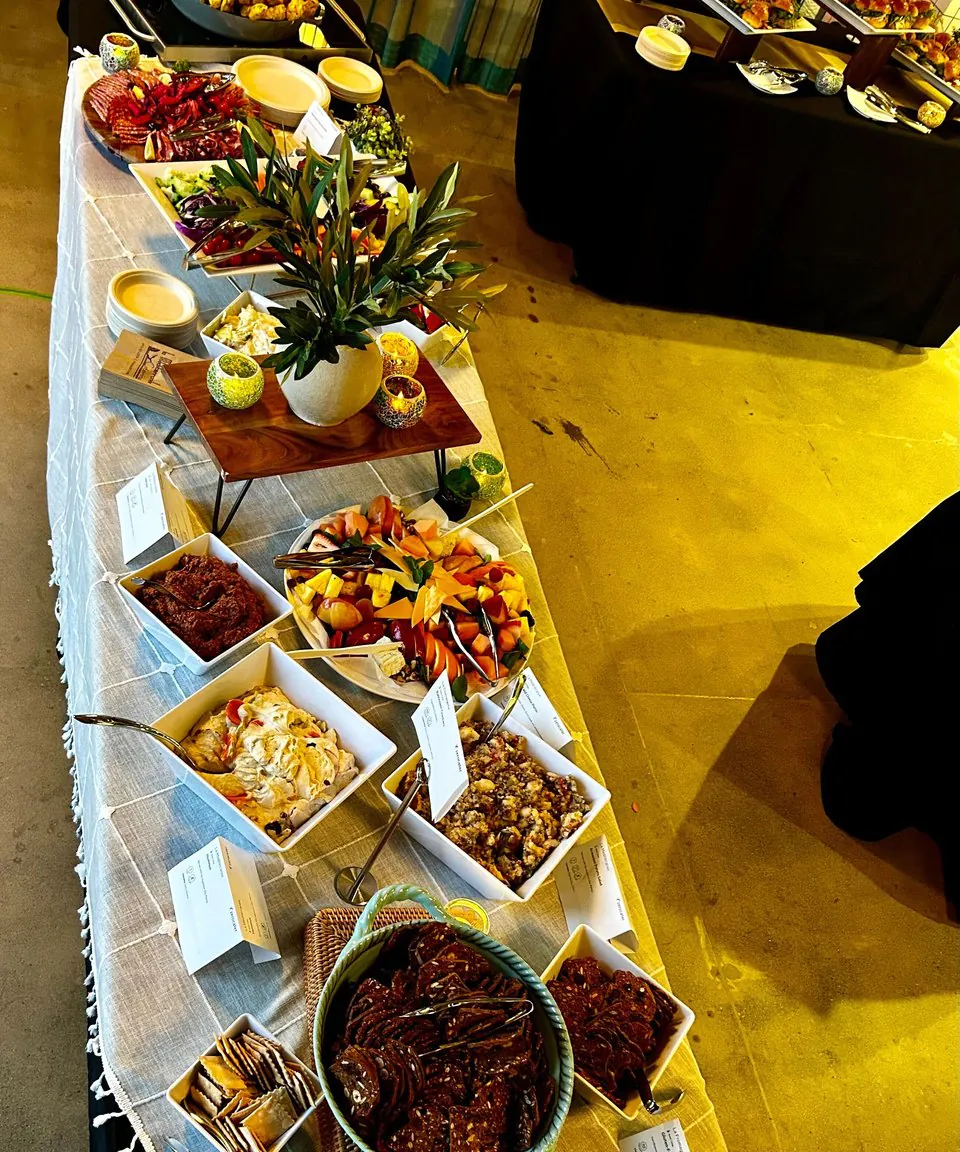
A grazing table is a single, continuous, self-serve spread that covers an entire table top and is built from many food categories rather than one. Picture a 10-foot table with no bare linen showing: cured meats and cheeses anchor it, bowls of warm dip and clusters of crudite and fruit fill in around them, breads and crackers fan between, a salad or grain bowl breaks up the middle, and a run of sweets closes it out. Guests walk the length of it and build a plate as they go.
The format earns its place when the other office options run out of room. A single charcuterie board tops out around 15 guests. A traditional buffet of chafing dishes feeds a crowd but reads as cafeteria, not celebration, and funnels everyone through one slow line. A grazing table solves both: it scales to 200 from one setup, it photographs like an event, and because the food is spread across the whole table instead of stacked at one station, a crowd can graze from multiple points at once. Use it for an all-hands, an open house, a product launch, a holiday party, or any reception where the food is part of the impression.
How Long Should the Table Be? (The Running-Foot Math)
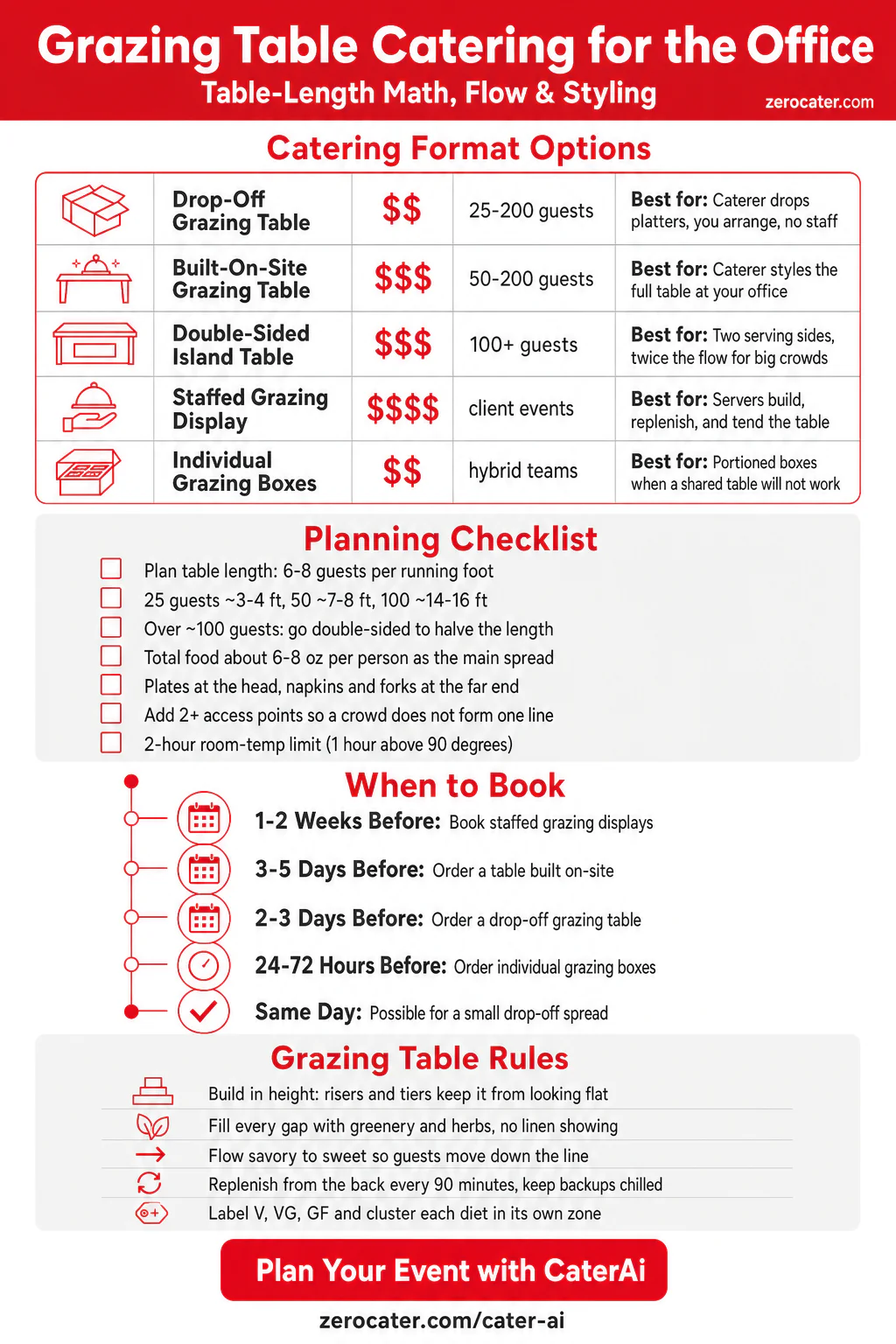
This is the question no platter-ordering guide answers, and it is the one that decides whether your table looks abundant or runs dry. A grazing table is sized by length, not by platter count, and the planning rule is about 6 to 8 guests per running foot when the table is the main spread. Translate your headcount into feet first, then have the caterer fill that length.
| Guests | Single-Sided Length | As Double-Sided Island | Tables Needed |
|---|---|---|---|
| 25 | 3 – 4 ft | Not needed | One 6-ft table (partial) |
| 50 | 7 – 8 ft | Optional | One to two 6-ft tables |
| 100 | 14 – 16 ft | 7 – 8 ft island | Two to three 6-ft tables |
| 200 | 28 – 32 ft | 14 – 16 ft island | Five+ 6-ft tables (or two islands) |
Quick math for a 120-person all-hands
- 120 guests ÷ 7 per running foot = about 17 running feet of spread
- Single-sided that is roughly three 6-foot tables in a row against a wall
- Double-sided that is about 9 feet of island, or two 6-foot tables pushed together as one block guests reach from both sides
- Go double-sided here: it halves the footprint and lets two streams of people serve at once
Add a foot or two of bare table at each end for plates, napkins, and a drinks staging area so the food itself gets the full length.
Two rules keep the length honest. Build out, not up: a table that spreads wide and full reads as generous, while piling height onto a short table looks sparse the moment the first few guests serve themselves. And measure your space before you order, because a 16-foot single-sided table needs a 16-foot clear wall plus standing room in front of it; if you do not have the wall, the double-sided island is not a style choice, it is the only thing that fits.
Designing the Flow: Single vs Double-Sided and Traffic
Length solves capacity; flow solves the line. The most common grazing table mistake at a big office event is treating it like a single station, so 80 people queue single-file from one end and the far end of a beautiful table never gets touched. The fix is to design the table so people enter and exit at multiple points and move in one direction.
- Single-sided, against a wall: best up to about 60 guests. Simple to style because you only build one face, and the wall or window behind it doubles as a backdrop. Plates go at the entry end, food flows along, napkins and forks sit at the exit end.
- Double-sided island, in the room: best for 100 or more. Pull the table into the middle so guests serve from both long sides at once. This roughly doubles throughput, halves the length you need, and is the single biggest fix for a slow line at scale. Mirror the spread on both sides so neither side waits on the other.
- Multiple access points: for any large table, leave two or more clear entry points and signal direction with where you place the plates. A crowd that can start grazing at three spots never forms one bottleneck.
- Stations within the table: for very large events, break one giant table into two or three shorter grazing tables themed by zone (a savory table, a mezze table, a dessert table) and spread them around the room to pull traffic apart entirely.
Set the order of the food to match the walk: plates first, then the heartier savory anchors, then the lighter produce and dips, then breads, then sweets at the end so dessert is the last thing in reach. This is the same crowd-flow logic our corporate event catering checklist applies to the rest of the event-day setup.
What Goes on a Grazing Table (the Six Zones)
A grazing table looks abundant because it is built from many categories, not because any one thing is piled high. The simplest way to fill a table that reads full and balanced is to build in six zones and repeat them down the length so every stretch of the table has variety. You do not need all of everything; you need a little from each, repeated.
| Zone | What Goes In It |
|---|---|
| 1. Charcuterie & cheese (the anchors) | Cured meats, hard and soft cheeses, marinated mozzarella, olives. The visual anchors the rest builds around. |
| 2. Warm bites & dips | Hummus, baba ganoush, spinach dip, warm meatballs, mini quiche, falafel. The part a board cannot do. |
| 3. Breads & crackers | Sliced baguette, crostini, pita, water and seeded crackers, breadsticks, plus a separate gluten-free stack. |
| 4. Crudite & fruit | Cut vegetables, grapes, figs, berries, melon, apple and pear slices. The color and freshness of the table. |
| 5. Salads & grain bowls | A pasta salad, grain bowl, or composed salad that makes the table filling enough to stand in for a meal. |
| 6. Sweet finish | Brownie or cookie squares, chocolate-dipped strawberries, macarons, dried fruit, honey and jam. |
Then style it so the zones do not read as separate platters. Three styling moves do almost all the work:
- Build in height. Risers, wooden boxes, cake stands, and tiered trays under some of the platters keep the table from looking flat and let you fit more on the same footprint.
- Fill every gap. Tuck greenery, fresh herbs, edible flowers, clusters of grapes, and scattered nuts into the spaces between platters so no bare linen shows. Gaps are what make a table read sparse.
- Flow the color. Alternate warm and fresh, dark and bright down the length so the eye reads abundance rather than a row of identical bowls.
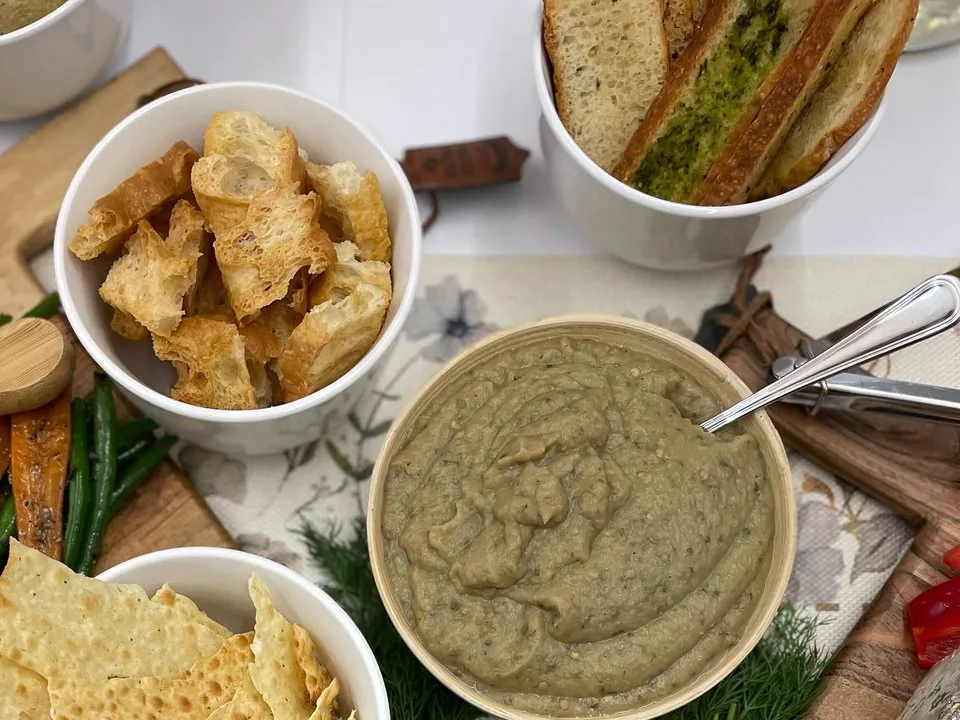
Italian salumi and antipasto make the most natural anchor zone, and Mediterranean mezze (hummus, dolmas, marinated vegetables, labneh, falafel) is the most flexible way to fill the warm-bites and dips zones while covering vegetarian guests. Browse Italian catering, Mediterranean catering, and Greek catering for caterers that do grazing-style spreads well.
How Much Food per Person
Because a grazing table spans many categories, you size it by total food per person, not by ounces of any one thing. The rule is the same as every other office spread: order by the job the table is doing. A table that sits alongside a full lunch needs a fraction of what a table replacing dinner needs.
| Table’s Role | Total Food / Person | Rough Bite Count |
|---|---|---|
| Appetizer (before a sit-down meal) | 3 – 4 oz | 4 – 6 bites |
| Main spread (reception, no separate meal) | 6 – 8 oz | 8 – 12 bites |
| The meal (long reception, table is dinner) | 10 – 12 oz | 12 – 16 bites |
Two adjustments save the order. Spread the total across the six zones instead of doubling up on charcuterie, because variety is what makes a table feel generous, and three meats at moderate weight always beats one meat in bulk. And when the table is the meal, lean on the filling zones (warm bites, salads, and grain bowls), which stretch the spend further than another pound of prosciutto. For the per-person ounce math on the charcuterie portion specifically, see the board math in our charcuterie catering guide.
Grazing Table vs Charcuterie Board vs Individual Boxes
Grazing table, charcuterie board, and individual grazing boxes are three answers to the same craving at three different scales. The right one depends on headcount, whether your team is in one room, and how hands-off you need the food safety to be.
| Format | Best For | Headcount |
|---|---|---|
| Single charcuterie board | Small team happy hours, board-room snacks | Up to ~15 |
| Grazing table | All-hands, open houses, large receptions, in one room | 50 – 200 |
| Individual grazing boxes | Hybrid and distributed teams, client gifting, food-safety-sensitive events | Any (ships to remote) |
The dividing lines are simple. Choose a single board when one platter feeds the room. Choose a grazing table when a single board cannot, your people are gathered in one space, and you want a centerpiece; it is the scale answer. Choose individual grazing boxes when your team is split between the office and home, the event is client-facing, or food safety needs to be airtight, because each box is portioned, handled once, ships to remote employees, and sidesteps the shared-table clock. If you already order boxed lunches for a distributed team, individual grazing boxes are the reception version of the same idea. For the full breakdown of the board itself, the charcuterie catering guide is the companion to this one, and the finger food catering guide covers the no-fork bite formats that fill a grazing table.
Plan grazing table catering with CaterAi
Building an Inclusive Grazing Table
A grazing table is one of the easiest formats for mixed diets because the food is already separated by item, with no shared casserole to navigate. The work is in zoning and labeling so a guest can see at a glance what is safe for them.
| Diet | Reliable grazing-table picks |
|---|---|
| Vegetarian | All cheeses, marinated and grilled vegetables, hummus and dips, dolmas, olives, nuts, fruit, breads, and a vegetable-forward salad or grain bowl |
| Vegan | Plant-based cheeses, marinated artichokes and peppers, grilled vegetables, olives, dolmas, hummus and baba ganoush, nuts, dried and fresh fruit, dark chocolate |
| Gluten-free | Cured meats, all cheeses, crudite and fruit, olives and briny items, nuts, honey and jam, with gluten-free crackers in their own zone away from the bread |
Two practical rules: cluster each diet in its own stretch of the table so a vegan guest is not hunting item by item, and label clearly with V, VG, and GF cards plus a dedicated serving utensil per item to avoid cross-contact. For deeper dietary planning, see our guides to vegetarian office catering, vegan office catering, gluten-free office catering, and how to order catering for mixed dietary needs.
Food Safety and Replenishment Over a Long Event
A grazing table is built to sit out for the length of a reception, which makes food safety part of the plan rather than an afterthought. The rule is the 2-hour limit: cured meats, soft cheeses, dips, and any perishable item should not sit at room temperature for more than two hours, and that window drops to one hour if the room is above 90 degrees.
That does not mean a grazing table cannot run a full afternoon. It means you stage and replenish it:
- Do not put everything out at once. Build the table to look full, keep a refrigerated backup of the perishable zones, and replenish from the back every 90 minutes with fresh product so nothing crosses the two-hour line.
- Know what fades first. Soft cheeses, dips, and cut fruit are the first to suffer; crackers, nuts, dried fruit, hard cheeses, and whole produce hold much longer and can carry the visual abundance while you swap the perishables.
- Lean on a staffed display for long or warm events. A server who tends the table keeps it full, pulls anything past its window, and handles the replenishment math for you. For outdoor or hot rooms, the heat-and-time logic in our summer office catering guide applies directly.
For the full event-day workflow beyond the food, the corporate event catering checklist covers headcount confirmation, timeline, and day-of logistics, and the office manager’s guide to ordering catering covers vendor selection and capturing dietary needs from the RSVP.
How Much Does a Grazing Table Cost?
A grazing table spans a wide price range because the service level does. A drop-off table you arrange yourself and a fully staffed display that a team builds and tends are both grazing tables, and they cost very different amounts. Here is what to budget per person.
| Service Level | Per Person | What You Get | Lead Time |
|---|---|---|---|
| Drop-off grazing table | $14 – $22 | Platters delivered, you arrange | 2 – 3 days |
| Built on-site | $22 – $32 | Caterer styles the full table at your office | 3 – 5 days |
| Staffed grazing display | $30 – $40+ | Servers build, tend, and replenish | 1 – 2 weeks |
Add roughly 20 to 25 percent to per-person totals for delivery, service charge, and gratuity to get the all-in number, and more on top for staffed service. Per person, a grazing table costs more than a single board but scales more efficiently than ordering a dozen separate platters, because one styled setup covers the whole room. For metro-specific benchmarks, see our cost guides for New York City, San Francisco, Chicago, Los Angeles, Boston, Atlanta, and Austin.
Where to Order a Grazing Table
Zerocater connects offices with vetted caterers that build grazing tables, individual grazing boxes, and charcuterie spreads across 12 US metros. The fastest path is CaterAi: share your headcount, budget, dietary mix, and whether you want a drop-off table, a built-on-site spread, or staffed service, and the assistant builds a grazing table menu in a few minutes from local caterers that match, with no quote requests.
Plan grazing table catering with CaterAi
Grazing-table-friendly caterers on Zerocater by cuisine
- Italian (salumi, antipasto, marinated mozzarella, olives): Blue Line Pizza (Bay Area), Joe’s Pizza Union Square (NYC), Firenze Italian Street Food (Chicago), Figo Pasta (Atlanta). Browse Italian catering.
- Mediterranean & mezze (hummus, dolmas, marinated vegetables, labneh, falafel): Hummus Mediterranean Kitchen (SF Bay Area), Baal Cafe & Falafel (NYC), Olive Mediterranean Grill (Chicago). Browse Mediterranean catering.
- Greek (spanakopita, dolmas, olives, feta, grilled vegetables): Kali Greek Kitchen (Bay Area), Souvlaki GR (NYC). Browse Greek catering.
A grazing table fits naturally into the rest of the office-event playbook. It is the scale companion to our charcuterie catering guide and our happy hour appetizers guide, and it suits the same occasions as our guides to the company picnic, holiday party planning, summer office events, and board meeting catering. Planning recurring socials for a tech team? The corporate catering for tech companies guide covers the cadence, and for a heartier centerpiece compare formats in our BBQ corporate catering guide.
Frequently Asked Questions
How long does a grazing table need to be for my headcount?
Plan about 6 to 8 guests per running foot when the grazing table is the main spread. That puts 25 guests at roughly 3 to 4 feet, 50 at 7 to 8 feet, 100 at 14 to 16 feet, and 200 at 28 to 32 feet. Past about 100 guests, set the table up as a double-sided island so people serve from both long sides, which cuts the length you need roughly in half and keeps the line moving. A standard 6-foot folding table comfortably anchors a 40 to 50 person spread single-sided.
What is a grazing table and how is it different from a charcuterie board?
A charcuterie board is a single platter of cured meat, cheese, and accompaniments. A grazing table is the whole table: one continuous self-serve spread that covers the surface and runs the length, built from many categories rather than just meat and cheese. It layers charcuterie and cheese with warm bites and dips, breads, crudite and fruit, salads or grain bowls, and a sweet finish. The board is a component; the grazing table is the centerpiece that scales to feed 50 to 200 from one setup.
How much food do I need per person for a grazing table?
When the table is the main event with no separate meal, plan roughly 6 to 8 ounces per person across all categories combined, about 8 to 12 bites. As an appetizer before a sit-down meal, drop to 3 to 4 ounces. When the table replaces dinner at a long reception, plan 10 to 12 ounces and lean on filling items like warm dishes, salads, and grain bowls. Spread the total across the six zones rather than piling on one so the table reads abundant without overbuying.
Should a grazing table be single-sided or double-sided for a big group?
Use single-sided against a wall for up to about 60 guests; it is simpler to style. For 100 or more, set the table as a double-sided island in the middle of the room so people serve from both long sides at once. Double-sided roughly doubles throughput and halves the length you need, the difference between a 28-foot line and a 14-foot island for 200 people. Either way, put plates at the head, flow food savory to sweet, place napkins and forks at the end, and leave two or more access points.
How much does grazing table catering cost per person?
Grazing table catering runs about $14 to $40 per person by service level. A drop-off table you arrange runs $14 to $22, a table built and styled on-site runs $22 to $32, and a fully staffed grazing display runs $30 to $40 and up. Add roughly 20 to 25 percent for delivery, service charge, and gratuity, and more for staffed service. Per person it costs more than a single board but scales more efficiently than ordering many separate platters.
Is a grazing table good for vegetarian, vegan, and gluten-free guests?
Yes, because the food is already spread out by item. Build a labeled vegetarian and vegan zone around marinated vegetables, hummus and dips, olives, grilled vegetables, fruit, nuts, and plant-based cheeses, and a gluten-free zone with its own crackers, cut vegetables, cheese, and fruit kept away from the bread. Use V, VG, and GF cards and a dedicated utensil per item. Clustering each diet in its own stretch of the table makes it easy to navigate.
How do I keep a grazing table fresh and safe over a multi-hour event?
Follow the 2-hour rule: cured meats, soft cheeses, dips, and perishable items should not sit out more than two hours, dropping to one hour above 90 degrees. Because the table is built to sit out, do not put everything out at once. Build it to look full, keep a refrigerated backup of the perishable zones, and replenish from the back every 90 minutes. Crackers, nuts, dried fruit, hard cheeses, and whole produce hold longest and carry the abundance while you swap soft cheeses and dips.
How far in advance should I order a grazing table, and where can I order one?
A drop-off grazing table usually needs 2 to 3 days, a table built on-site wants 3 to 5 days, and a staffed display is best booked 1 to 2 weeks ahead. Order earlier for Fridays, December, and busy event weeks. Zerocater matches your office with vetted caterers that build grazing tables, individual grazing boxes, and charcuterie spreads across 12 US metros, and CaterAi builds a grazing table menu from your headcount, budget, dietary mix, and service level in minutes.