Nobody in your office sees the invoice. They see the table. A lunch that cost little and a lunch that cost a lot arrive looking different, and the difference comes down to a short list of things people can see from three steps away.
Get that list right and an inexpensive lunch lands as a good one. Get it wrong and you can overspend and still watch people take a small plate and go back to their desk. This guide covers fifteen lunches that are cheap to produce and read as generous, plus the reasoning that makes them work, so you can swap in your own.
Plan office lunch catering with CaterAi
What makes a lunch look cheap
Price is invisible. These five things are not, and people register them before they register a single flavour:
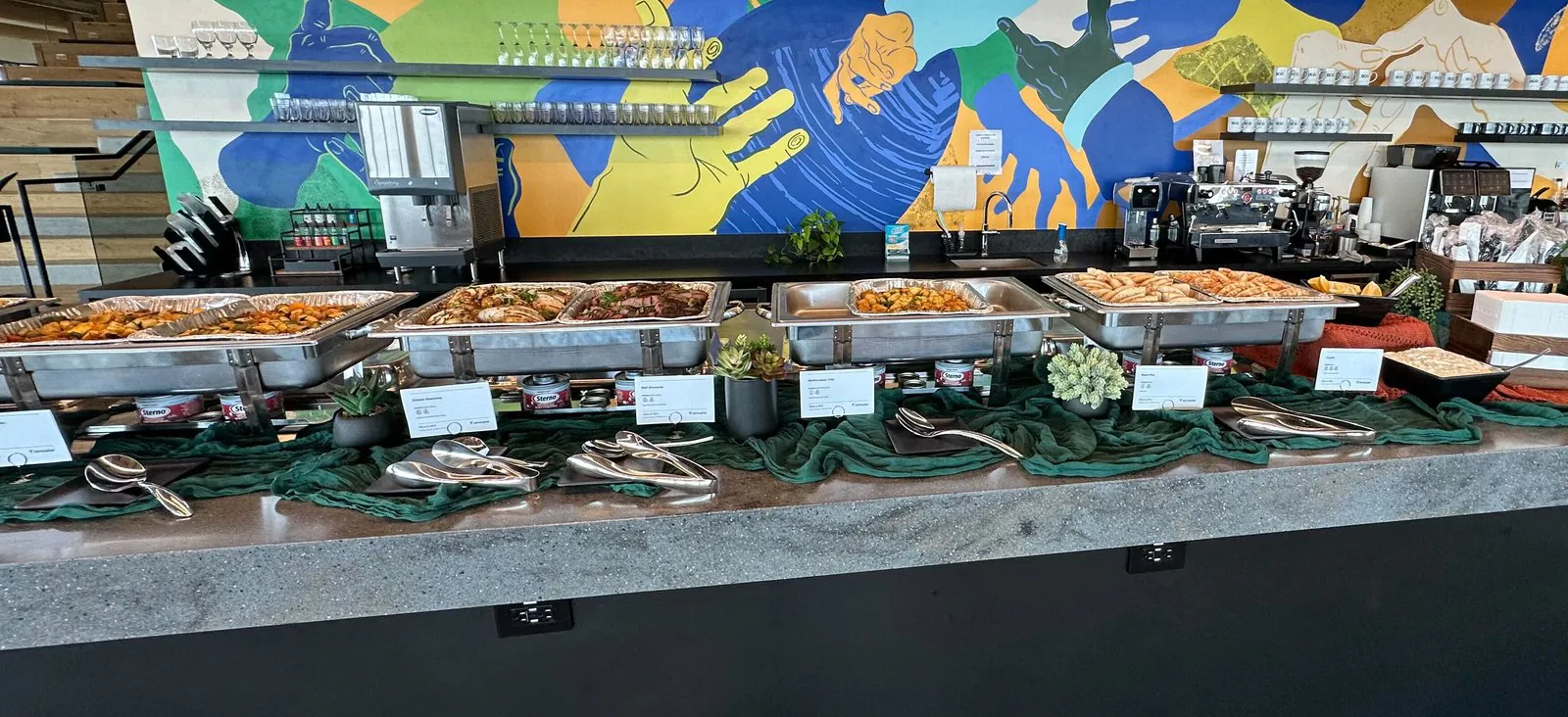
- A container that is not full. A pan at two-thirds reads as picked over even when it is the first serving of the day.
- One item, repeated, with nothing beside it. Forty identical wraps on a tray is a supply run. The same wraps with a bowl of pickles and a sauce beside them is a lunch.
- Everything at room temperature. Heat is the single loudest signal of effort, and cold food has to work much harder to make up for its absence.
- No colour. Beige on beige, in a beige box, under office lighting.
- Nothing happening. No cutting, no ladling, no assembling. Food that appeared on its own reads as bought. Food that somebody served reads as made.
Run your last few catering orders against that list. The expensive ones that underwhelmed usually failed three or four of them, and the cheap ones people still talk about passed most.
The rule underneath the list
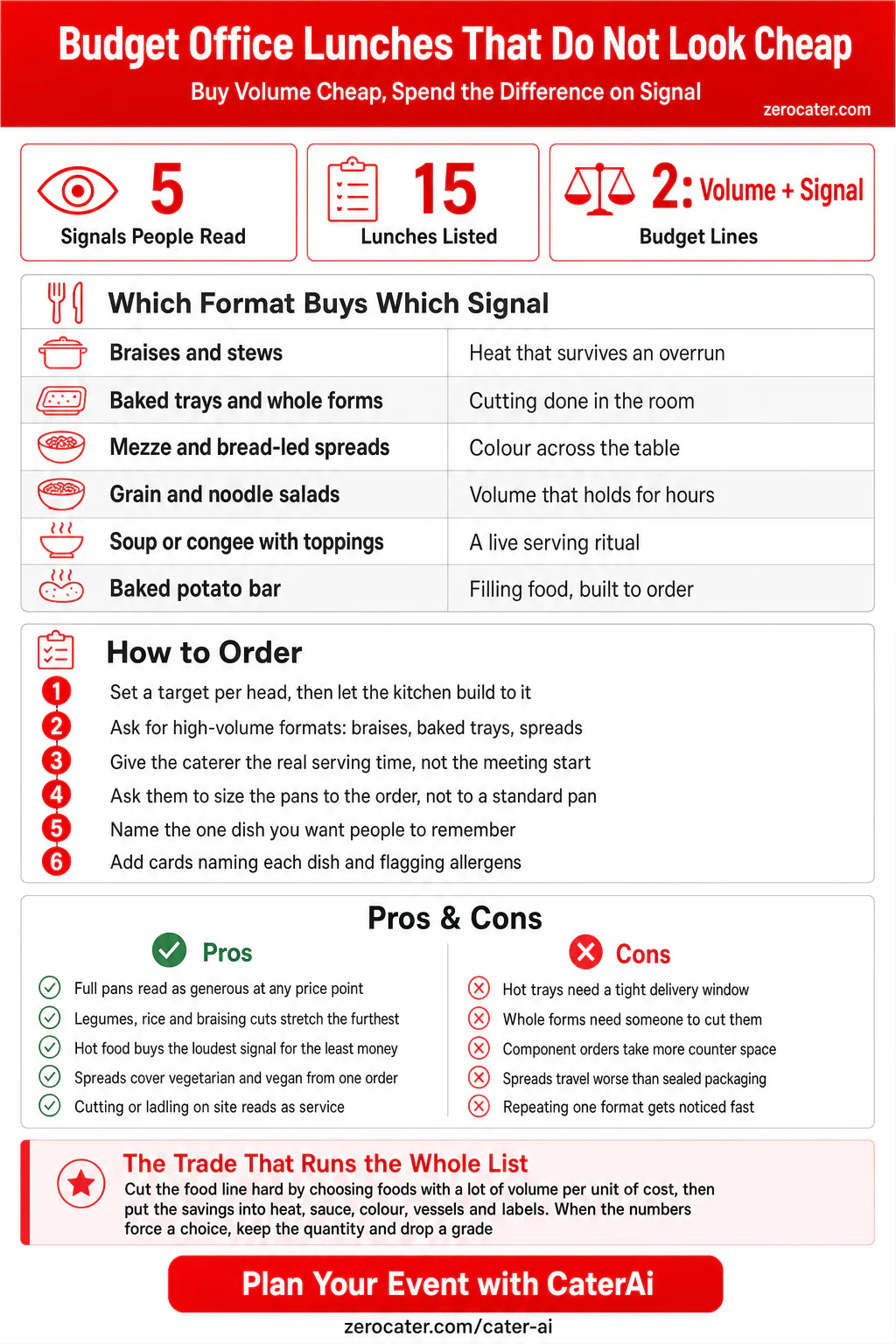
Think of a catering budget as two lines rather than one. The first line buys volume: enough food that no pan looks raided. The second line buys signal: heat, colour, a sauce, a vessel worth looking at, someone cutting something.
Most teams under pressure cut both lines at once, which is why the result reads as cheap twice over. The move that works is to cut the first line hard by choosing foods that give a lot of volume per unit of cost, then put the savings into the second line. Braising cuts, thighs, dried legumes, rice, root vegetables, cabbage, eggs, bread dough and pasta all deliver volume for very little. Portioned fillets, individually wrapped anything and per-person desserts do the opposite.
That trade is the whole method. The fifteen below are grouped by which signal each one buys you.
Braises and stews: the cheapest hot food there is
A braise takes the cuts nobody wants, cooks them for hours and turns them into something that arrives steaming in a full pan. Sauce also buffers heat, so the tray survives a meeting that runs over.
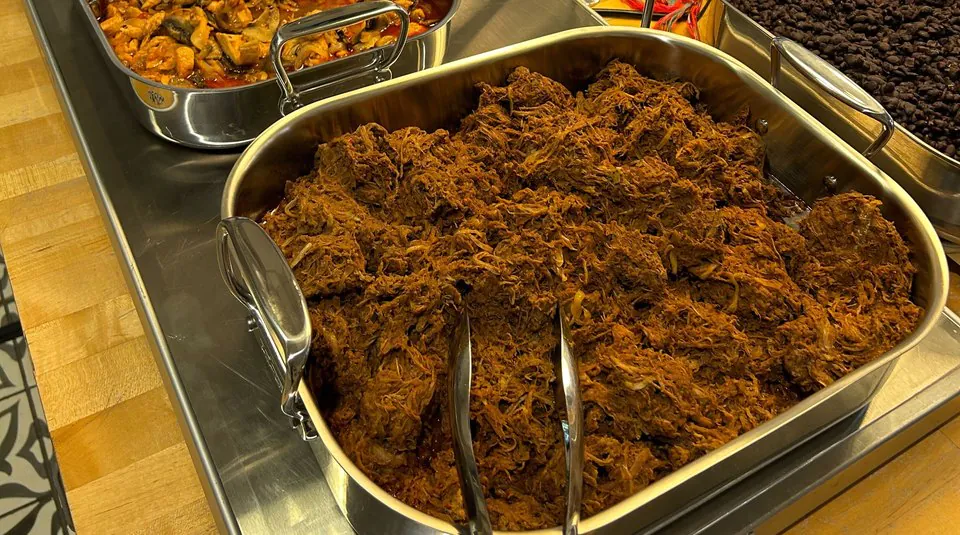
1. Barbacoa or carnitas with warm tortillas
Shoulder, cooked down, piled into a deep pan. Set warm tortillas, a bowl of onion and cilantro, and two salsas beside it. Guests build their own without any of the staffing a full station needs. Look at Mexican caterers such as Amigos Taqueria, El Capitan Taqueria and Early Bird Tacos.
2. Chana masala and dal with rice
Chickpeas and lentils cost almost nothing and carry more flavour per serving than most proteins. Two curries, rice and a stack of naan will feed a room for less than a sandwich order and look like a great deal more. Indian kitchens including Raavi Indian Cuisine, Tandoori Paradise and Koriander Indian Cuisine build their catering around this.
3. Chicken thighs in sauce, over rice
Thigh meat costs a fraction of breast, holds heat without drying and tastes better under a sauce. Every cuisine has a version, from arroz con pollo to chicken curry to braised soy chicken. Order it as one big tray with the rice separate.
4. White bean and greens stew with cornbread
The cheapest hot lunch on this list, and the one people least expect to like. Beans, stock, greens, a lot of black pepper, cornbread cut into squares beside it. Southern kitchens such as Mema’s Southern Hospitality do this well; browse more Southern caterers for local options.
Baked trays and whole forms: food that gets cut in the room
Anything that arrives whole and gets cut in front of people buys the “made” signal for free. The cutting is the event. The food underneath can be flour, water and time.
5. Baked ziti or lasagna
Pasta, tomato, cheese. The cost per serving sits near the bottom of any catering menu and a full tray with a spatula in it looks like somebody’s family cooked. Try Italian caterers such as Pastafi, Figo Pasta and Pasta Paradiso. If you want the interactive version instead, our pasta bar guide covers the setup.
6. Sheet-pan focaccia or grandma-style pizza
Order it uncut. A full sheet arriving intact and getting portioned on the counter changes the whole read of the room, and dough is the cheapest thing in any kitchen. Pair it with a big salad and you have a complete lunch; the pizza and salad menus package this as one order.
7. A tray of roasted chicken thighs, carved on the counter
Roast thighs and drumsticks arrive golden, smell like a roast and cost less per person than almost any composed dish. Ask for them whole rather than pre-pulled, then let someone carve.
8. Torta or banh mi loaves, cut into sections
Full-length loaves, dressed, delivered whole, sliced into portions on site. Bread is inexpensive, the fillings stretch, and cutting a metre of sandwich in front of the room does more for the mood than the same sandwiches would in individual bags. This is the one sandwich format that escapes the supply-run look; our sandwich bar guide covers the self-serve alternative.
Grains, legumes and spreads: colour without cost
Colour is the signal that costs the least to buy. Vegetables, herbs, pickles and sauces are cheap and they photograph well, which is a rough proxy for how a table reads when people walk up to it.
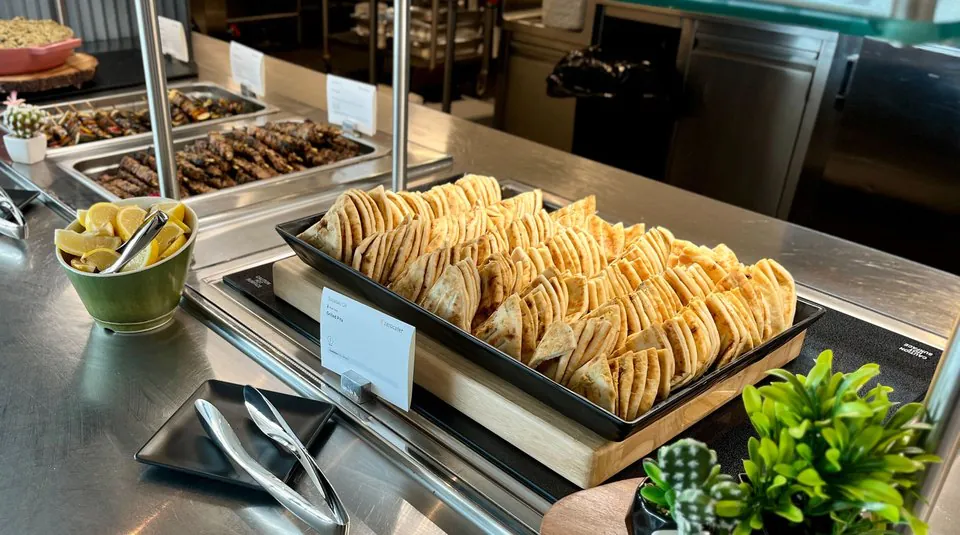
9. A mezze spread with warm pita
Hummus, baba ganoush, a chopped salad, olives, pickled turnips, and pita warmed and fanned across a tray. The entire spread costs less per head than a mid-tier boxed lunch and covers vegetarian and vegan eaters without a separate order. Mediterranean caterers such as Sajj Falafel & Shawarma, Kali Greek Kitchen and Falafel Boy build these as standard.
10. Rice and bean bowl components
Rice, black beans, a braised protein, pico, shredded cabbage, crema. Sent as components rather than assembled bowls, it feeds a wide range of diets from one order and costs less than the packaged version of the same food. The rice bowl menus and grain bowl menus show the standard component sets.
11. A grain salad that eats like a meal
Farro, freekeh or pearl couscous, roasted vegetables, herbs, feta, a sharp dressing. It holds for hours without wilting, which makes it the safest choice when lunch has to sit out through a long session. Send it in one wide bowl rather than portioned.
12. Cold sesame noodles with a vegetable row
Noodles cost little, hold their texture cold and look substantial in volume. Set cucumber, scallion, chili oil and crushed peanut in small bowls alongside. Chinese and Thai caterers such as Wokitchen, Aloy Modern Thai and United Dumplings carry versions of this.
Plan office lunch catering with CaterAi
One live component: the cheapest luxury on the table
Somebody assembling, ladling or topping in front of the room reads as service. You can buy that signal on the least expensive food in the building, which is where these three earn their place.
13. A soup or congee pot with a toppings row
One pot, one ladle, eight small bowls of toppings. Stock and grain cost almost nothing, and the row of toppings does the work that an expensive main would otherwise have to do. The noodle soup bar menus set this up as a single order.
14. A baked potato bar
Potatoes are the cheapest filling food you can put in front of a room. Split them open in a tray and set chili, cheese, broccoli, scallion and sour cream beside it, and people stay full through the afternoon. See the baked potato bar menus.
15. Breakfast tacos or a shakshuka tray at midday
Eggs are the least expensive protein on any menu and almost nobody expects them at lunch, so the surprise does some of the work. A shakshuka tray with bread for dipping, or a run of breakfast tacos with two salsas, lands as a treat rather than as a saving. Our breakfast catering guide covers the formats.
Where to put the money you saved
The second budget line is small and it changes everything. In rough order of what you get back:
- Quantity first. Full pans beat better ingredients in half-empty ones. Nothing on this list survives looking short.
- The sauce. A good sauce rescues an inexpensive protein and nothing else on the table does that job.
- One fresh element. Herbs, citrus, pickles or a raw slaw. It adds colour, cuts richness and costs very little.
- Vessels, where they show. You do not need to lose the foil pans underneath. Ask for the visible layer to be ceramic, wood or steel.
- Labels. Printed cards naming each dish and flagging allergens read as care, and they save the questions.
Notice what is missing from that list: a better cut of meat, a nicer box and a dessert per person. Those three absorb budget and return the least visible signal per unit spent.
Three habits that undo all of it
Ordering one item for everyone. A single format at scale reads as a ration, whatever it cost. Two things beside the main, even cheap ones, fix it.
Letting hot food arrive early. A braise that sat for ninety minutes has lost the one signal you were paying for. Set the delivery window tight and give the caterer the real serving time rather than the meeting start.
Trimming quantity to protect quality. This is the most common error and the most expensive one. Nobody notices a mid-grade protein. Everybody notices an empty pan. When the numbers force a choice, keep the volume and drop a grade.
Briefing a caterer for value
Ask for a target per head and let the kitchen build to it, rather than pricing a menu you already wrote. Kitchens know which of their dishes carry the best margin at volume, and they will steer you there when you leave the room for it. Three things worth saying out loud in that brief: name the serving time, ask them to size the pans to the order, and tell them which single dish you want to be the one people remember.
For the mechanics of what moves a per-unit price, and for the ordering-side moves that lower a bill, our boxed lunch cost guide covers both in detail, and how to budget for office catering covers the planning side. This guide stays on the food itself.
Ordering a budget lunch through Zerocater
Tell CaterAi your headcount, your target per head and your diets, and it builds menus from more than 1,000 vetted caterers, then lets you chat to adjust them before checkout. Asking it for high-volume formats such as braises, baked trays and spreads is a faster route to the food on this list than reading menus one at a time.
For a lunch that repeats, corporate catering sets up the rotation and handles the ordering. For a one-off with a room to fill, corporate event catering covers the logistics. How Zerocater works walks through both. You can also browse buffet menus and lunch menus directly if you already know the format you want.
Adjacent reading: fifteen office lunch ideas matched to the kind of workday, healthy lunch catering, party tray catering, taco bars, salad bars, grazing tables, last-minute orders, onboarding lunches, lunch and learns, catering for nonprofits, vegetarian catering and vegan catering. For barbecue and grilled formats at volume, browse BBQ caterers such as Roaming Buffalo BBQ and Little Lou’s BBQ, or Greek caterers for spreads.
Plan office lunch catering with CaterAi
Frequently Asked Questions
What is the cheapest office lunch that still looks good?
A braise served hot over rice. Shoulder cuts, thighs and dried legumes cost the least per serving of any hot food, and a full tray with a ladle in it carries the two signals people read first: heat and volume. Sauce also holds temperature through a late meeting, so the last person in line gets the same lunch as the first.
How do I make budget catering look more expensive?
Change the container and the serving ritual before you change the menu. The same food reads differently in a shallow ceramic dish than in a foil pan, and it reads differently again when somebody cuts or ladles it in front of the room. Add one fresh component with colour, such as herbs, pickles or citrus, and stop there.
Is a buffet cheaper than boxed lunches for an office?
For the same food, a buffet usually costs less per head, because the caterer skips per-person packaging and assembly. Boxed meals win on portability, allergen labelling and headcount accuracy. Our boxed lunch cost guide breaks down what moves the per-unit price in each format.
Which cuisines give the most food for the money?
Cuisines built on legumes, rice, bread and slow-cooked cuts. Indian, Mexican, Mediterranean and Southern kitchens all developed around stretching a small amount of protein across a lot of people, so the value is in the recipe rather than in a discount.
How much food should I order so it does not look sparse?
Order for the vessel as well as for the headcount. A tray that is two-thirds full reads as picked over from the moment it lands, so ask the caterer to size the pans to the order instead of sending the same pan at every quantity. Smaller pans, filled, beat one large pan half filled.
Can I run a low-budget lunch every week without it getting boring?
Yes, if you rotate the format and not only the menu. A braise week, a baked tray week, a spread week and a bowl week give you four different looking lunches from a similar cost base. Repeating the same format with a different protein is what people notice and get tired of.
Do I need serving staff for a budget office lunch?
Not for most of these. Chafing racks and sterno keep hot trays going without anybody standing there, and a spread needs nothing at all. Book staff when the format depends on someone cutting or assembling to order, which is the one place labour buys you a visible signal.
What should I never cut from a catering budget?
The sauce, the fresh component and the quantity. Those three carry most of what people read as generosity. Cut the protein grade, the packaging tier and the dessert before you cut any of them.