The all-hands moved to noon. A customer flew in a day early. Your director booked a room for thirty people at 8:40 in the morning and mentioned lunch as an afterthought. You call the caterer you always use and a recording tells you they need twenty-four hours.
Most people stop there and order forty individual delivery apps on a company card. That is the expensive answer, and it is usually the wrong one. The twenty-four hours in that recording describes a menu, not a kitchen, and the same kitchen will often hand you a cold platter for the slot you need.
This guide covers what a caterer can still do for you inside a few hours, how to find the ones who will, and the three things that kill a rush order.
Plan a same-day lunch order with CaterAi
What a 24-Hour Notice Policy Actually Means When You Call at 9 a.m.
A published lead time is a promise about the hardest thing on the menu. A caterer who offers carved prime rib, a staffed pasta station and a sandwich platter sets one policy that protects all three, and the sandwich platter inherits the prime rib’s clock. Nobody writes a separate notice period for every line item, because nobody reads that menu.
So the policy tells you what the vendor guarantees. It does not tell you what the shop can do. Those are different questions, and the second one gets answered by a person, not by a form. Chain catering programs make this visible because they publish their floors. Our Chipotle catering guide puts the minimum at twenty-four hours with no expedited path. Our Panera catering guide puts Panera’s same-day window at about two hours and fifteen minutes. Same lunch hour, same city, and a fourteen times difference in how late you can be.
Two more sit in between. Our Jason’s Deli guide and our McAlister’s Deli guide both describe a twenty-four hour standard that individual locations relax for small orders when the shop has capacity. Our Jimmy John’s guide describes a chain built around speed where many shops take same-day work as a matter of course. Lead times move by location and change without notice, so treat every figure here as a starting point and confirm with the shop you are calling.
How Many Caterers Will Actually Take a Same-Day Order
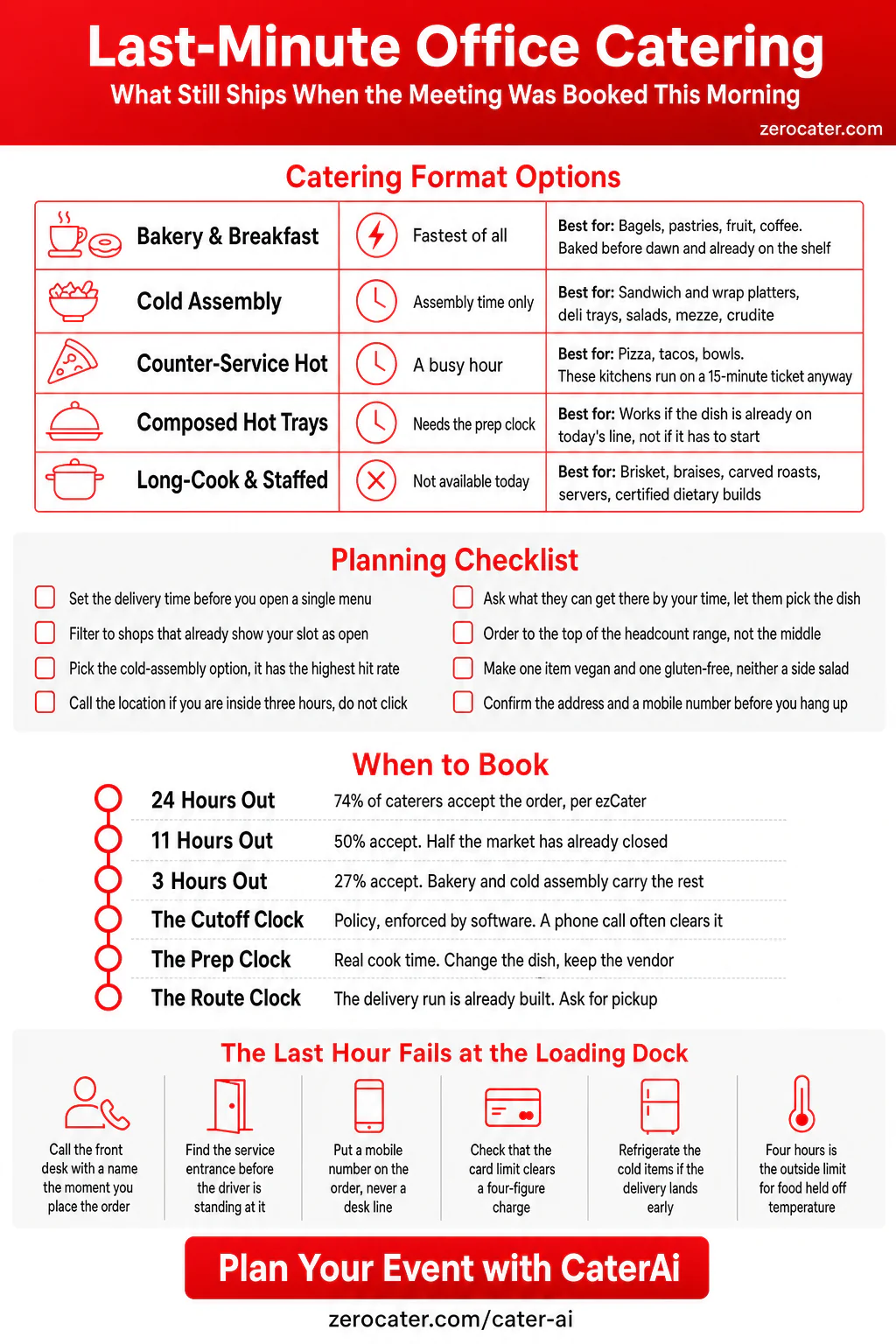
ezCater publishes acceptance figures from its own platform, and they turn a yes-or-no question into a curve. By their numbers, 74 percent of partner restaurants accept an order placed twenty-four hours ahead. At eleven hours, 50 percent. At three hours, 27 percent.
Three hours before lunch, roughly one in four caterers near your office is still open for business. You are not asking whether last-minute catering exists. You are shopping a smaller market, and the work is finding which quarter you are in before the hour runs out.
The one number worth memorising
Between the eleven-hour mark and the three-hour mark, roughly half the market closes. A request you send at 8 a.m. for a noon delivery reaches about double the kitchens of the same request sent at 9:30. On a rush order, the twenty minutes you spend deciding costs more than the twenty dollars you save.
Three Clocks Decide a Rush Order, and Only One of Them Is the Kitchen
When a caterer says no, ask which of these three stopped them. The answer changes what you do next, and only the first one is negotiable by asking nicely.
The cutoff clock
This is the published policy, usually a fixed time the day before, and it exists to protect ordering and staffing. It is set at the menu level and enforced by software. Online checkout will refuse you outright. A phone call to the specific location often will not, because the manager can see the day’s actual load and the website cannot.
The prep clock
This one is real physics. A tray of braised short rib needs hours in an oven and nobody can compress that. A sandwich platter needs a person with a knife and twenty minutes. When a caterer turns down your 11 a.m. request for a noon delivery, the prep clock is usually what beat you, so change the dish and keep the vendor.
The route clock
Catering deliveries run on routes built earlier in the day, and the drivers are already committed. This is the clock nobody explains to you, and it is why a kitchen with food sitting ready still says no at 11:15. Ask whether pickup is available. A colleague with a car and forty minutes turns a hard no into a yes more often than any other move on this list.
| The clock that stopped you | How you can tell | What works |
|---|---|---|
| Cutoff | Online checkout blocks the time slot before you pick any food | Call the location directly and ask for the catering manager |
| Prep | They offer a later delivery time, or a different dish, at the same price | Switch to cold assembly or bakery items and keep the time slot |
| Route | The food is fine, the time is fine, delivery is the sticking point | Ask for pickup, or ask what delivery window they can hit |
What Still Ships on Three Hours Notice
Anything a kitchen assembles can move fast, because assembly scales with hands and cooking scales with time. Three families cover almost every short-notice order.
Cold assembly
Sandwich and wrap platters, deli trays, salad bowls, mezze and hummus spreads, crudité, cheese and fruit. The components already exist in the walk-in, so a shop can build fifty portions in the time it takes to preheat an oven. Our party tray guide covers what these platters hold; for a rush order the relevant fact is that they need no cook time at all. Browse Mediterranean caterers or Italian caterers for shops that keep a cold case stocked, and format-specific menus like sandwich and wrap platters in New York or sandwich and wrap platters in Chicago list vendors already set up to build them.
Cold-assembly shops that keep short lead times: The Don’s Deli in Mountain View, BonBon Sandwiches in Chicago, Tivoli Sandwiches in Boston, Zep’s EpiQ Sandwiches in Denver, and Zaatar Mediterranean in San Francisco.
Breakfast and bakery
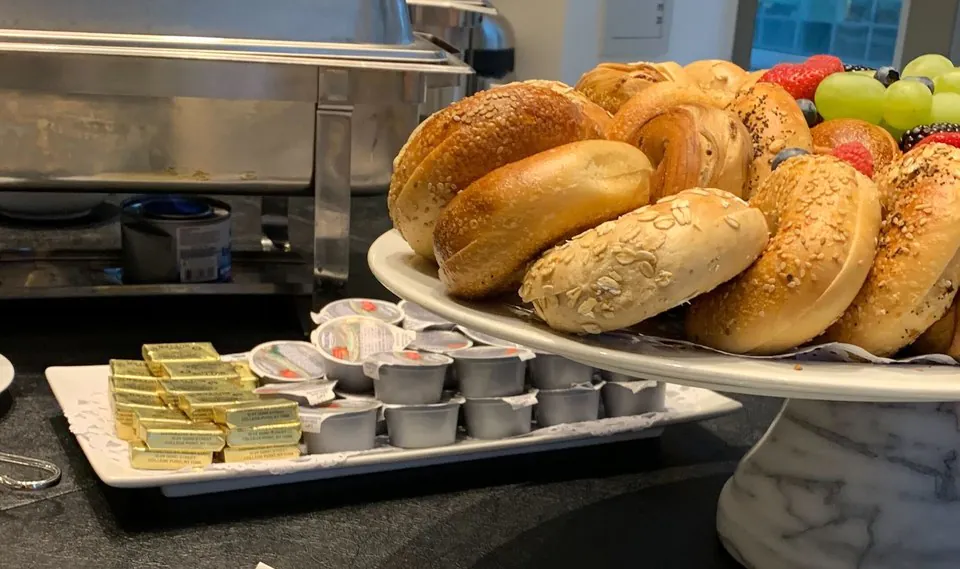
Bagels, pastries, muffins, fruit trays and coffee are the fastest catering on the market, because a bakery baked them at four in the morning and has been selling them since six. A 7 a.m. request for an 8:30 meeting is routine work for these shops, which is exactly the window that panics people. Our office breakfast catering guide and our boxed breakfast guide cover the menus. For a rush, start with Bagel Daddy in San Francisco or Holy Bagel in Chicago, or a build-your-own bagel bar in Chicago or in New York.
Made-to-order hot food that was already going to be made to order
Pizza, tacos, and counter-service bowls run their whole business on a fifteen-minute ticket, so a catering quantity is just a busy hour for them. Our Domino’s guide and our Papa John’s guide walk the chain versions. Independent shops work the same way: Blue Line Pizza in Burlingame, Mexican caterers for taco setups, and salad and bowl shops such as Saucy Greens in Los Angeles, Salad House in Chicago and Zo’s Salads & Bowls in Berkeley.
What Does Not Ship, Whoever You Call
Four things need lead time for reasons no amount of paying extra will fix. Knowing them saves you the twenty minutes you would spend calling around.
- Long-cook proteins. Brisket, braises, whole roasts and anything carved to order. A brisket started this morning is ready tomorrow. Our finger food guide covers what to serve instead when the occasion wanted something impressive.
- Staffed service. Servers, bartenders and on-site chefs come from a scheduling system, and people who were not scheduled this morning are not available this afternoon.
- Certified dietary builds. Certified kosher, certified gluten-free and any allergen protocol that needs a dedicated prep surface require the kitchen to plan around your order, which is the opposite of a rush.
- Custom anything. Logo cookies, printed menu cards, a cake with a name on it, a bespoke menu written for your event. All of these are scheduled work.
How to Pick a Caterer in the Ten Minutes You Have
Under time pressure the ordinary process inverts. Normally you choose food and then check availability. Now you filter for availability and choose food from whatever survives. Work in this order:
- Set the delivery time first, before you look at any menu. Every minute you spend browsing dishes you cannot get is a minute out of the window.
- Filter to shops that already show your slot as open. A vendor list that reflects live availability beats a list of vendors you like.
- Pick the cold-assembly option. It has the highest chance of landing on time and the lowest chance of arriving cold when it should have been hot.
- Call the shop, if the clock is inside three hours. Software enforces the cutoff. A manager can see the actual kitchen.
- Ask one question: what can you get here by [time]? Let the shop choose the dish. They know what is already prepped and you do not.
- Confirm the delivery address and the contact phone before you hang up. This is the step people skip, and it is the step that fails.
Our corporate event catering checklist is built for events you can see coming. Half of it does not apply at three hours notice, and the half that does is the logistics half.
How Many People to Order For When the Headcount Keeps Moving
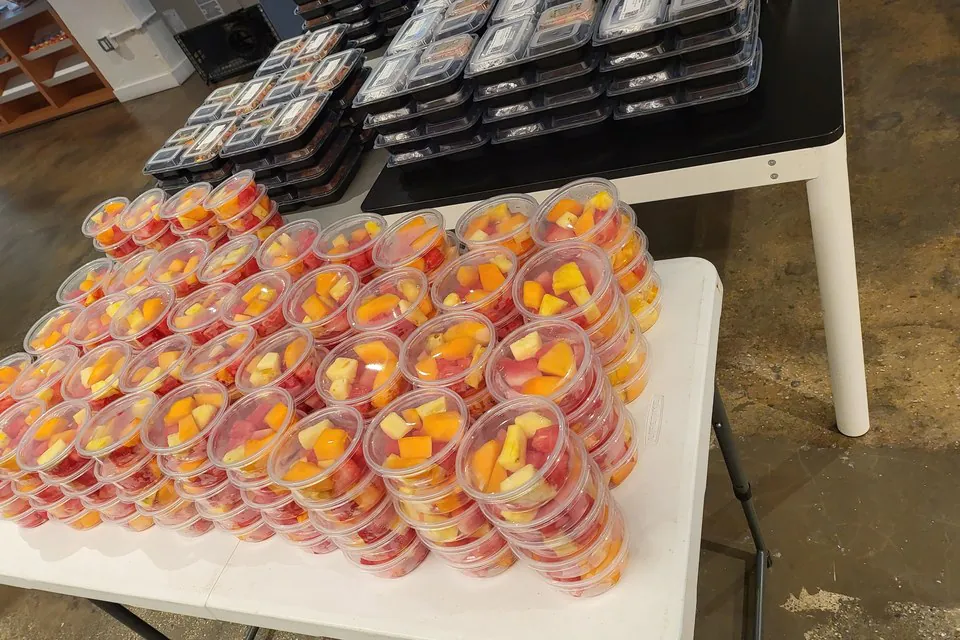
A last-minute meeting has a last-minute headcount, and the number you were given at 9 a.m. is not the number that walks in at noon. Order to the top of the range. On a rush order the cost of ten extra portions is small and the cost of running out in front of a customer is not.
Individually packaged portions handle uncertainty better than trays, because a sealed box that nobody opens goes in the fridge and gets eaten tomorrow, while a half-served chafing tray does not. Our boxed lunch versus buffet guide and our three-format comparison make the full case for each format. On a rush order, the only relevant property is that boxed portions survive a headcount that moved.
Add one shelf-stable item that keeps for a week, a case of chips or a box of whole fruit. It absorbs four surprise attendees at almost no cost, and if nobody needs it, the kitchen still has it on Thursday. Our boxed lunch roundup lists the national programs that hold portion counts steady across locations.
Plan a same-day lunch order with CaterAi
How to Handle Dietary Needs With No Time to Poll the Room
You cannot survey thirty people in ten minutes, and guessing wrong in front of a customer is worse than over-ordering. Order to the ceiling instead of to the answers you do not have.
The ceiling is simpler than it sounds. Make sure one substantial item is vegan, one is gluten-free, and neither is a side salad. That single move covers most of the room, because a vegan dish is also dairy-free and a gluten-free dish is often also nut-free. Then label everything, out loud on the table, by ingredient. Directory pages such as vegan catering and gluten-free catering filter vendors who can do this without a conversation.
What you should not attempt on a rush order is a certified allergen protocol. If someone on the invite has a diagnosed severe allergy, the honest answer is a separate sealed meal from a kitchen that has time to do it right, and our allergy-safe boxed lunch guide explains why. For the ordinary mixed room, our mixed dietary needs guide covers the standing version of this problem.
The Last Hour Fails at the Loading Dock, Not in the Kitchen
You found a caterer, the food is made, the driver is moving, and the order still fails. Rush orders die in the last mile far more often than in the kitchen, and always for the same four reasons.
- The security desk. A driver with no visitor pass waits in a lobby with your lunch. Call the front desk the moment you place the order and give them a name.
- The freight elevator. Many buildings route deliveries through a service entrance with its own hours, and a passenger elevator will not take a hand truck. Find out which door before the driver is outside it.
- The phone nobody answers. Put a mobile number on the order, not a desk line, and keep the phone on the table. Drivers on a rush call once.
- The card approval. At larger companies this is the real bottleneck. A purchase order takes a day, and a card with a per-transaction limit declines a catering charge at checkout. Find out in advance whose card clears a four-figure order.
None of this is about food, and all of it is inside your control. Clearing these four before the driver arrives is worth more than any menu decision you will make.
How Long the Food Can Sit Once It Lands
Rush orders arrive at odd times, often early, because the driver had a gap. Early creates its own problem. The FDA Food Code holds cold food at 41 degrees Fahrenheit or below and hot food at 135 or above, and under the time-as-a-public-health-control provision food held with no temperature control at all must be served or discarded within four hours. Local health codes vary, so treat four hours as the outside limit rather than as a target.
Two practical rules follow. If food arrives more than an hour early, put the cold items in a refrigerator and leave the hot items covered rather than opening everything at once. And start the clock when the food arrives, not when the meeting starts, because a tray that sat in a lobby for forty minutes has already spent part of its window.
How to Make the Next Fire Drill Take Five Minutes
This will happen again. The teams that handle it calmly did the work once, on a quiet afternoon, and then never repeated it.
| Set up once | What it saves you on the day |
|---|---|
| Two or three vendors you have already ordered from, with short lead times | The twenty minutes you would spend searching, during which the market halves |
| A saved order you would be happy to receive for any group size | The decision itself, which is what takes the time |
| The delivery address, floor, dock entrance and building rules written down | The last-mile failures above, all four of them |
| A payment method with a limit that clears a real catering order | A declined card at checkout with ninety minutes left |
| One named person at the front desk who expects food deliveries | The driver stuck in the lobby |
If your team orders food more than twice a month, a standing program removes the fire drill entirely, because the vendor relationship, the address and the payment method are all already in place. Our corporate catering solutions page covers how recurring programs work, and our lunch and learn guide, board meeting guide, onboarding lunch guide and client appreciation guide each cover the recurring occasions that tend to arrive with short notice.
How CaterAi Handles a Same-Day Order
The hard part of a rush order is not cooking. It is finding, in ten minutes, which kitchens near your office still have your time slot open. Calling five vendors to ask that question one at a time is how the window closes.
CaterAi inverts it. You give it the date, the time, the headcount and the address, and it shows you the options and delivery windows that are open for that slot, then builds menus from them. You chat to swap dishes, add a vegan tray or drop the dessert, and check out. For an event that got scheduled this morning, seeing the live window first is the whole game. Our how it works page walks the full flow, and our corporate event catering page covers one-off events, which is what most last-minute orders turn out to be.
Plan a same-day lunch order with CaterAi
Frequently Asked Questions
Can you get catering delivered the same day?
Yes, though you are shopping a smaller market. ezCater’s published platform figures put partner acceptance at 74 percent for an order placed twenty-four hours ahead, 50 percent at eleven hours and 27 percent at three hours. Roughly a quarter of caterers near a given office will still take a three-hour order. Cold-assembly menus, bakery and breakfast items, pizza and counter-service bowls have the highest hit rate, because a kitchen assembles them rather than cooking them to order.
What is the minimum notice for office catering?
Twenty-four hours is the most common published policy, but it describes the hardest item on a menu rather than every item. Chain floors vary widely: our Chipotle guide puts the minimum at twenty-four hours with no expedited option, while our Panera guide puts Panera’s same-day window at about two hours and fifteen minutes. Lead times are set per location and change without notice, so confirm with the specific shop rather than relying on a published figure.
Why did a caterer turn down my last-minute order?
One of three clocks stopped them, and the fix differs for each. The cutoff clock is a published policy enforced by the ordering software, and a phone call to the location often gets around it. The prep clock is real cook time, and the fix is a different dish rather than a different vendor. The route clock means the delivery run is already built, and the fix is to ask for pickup. Ask which one it was and you will know what to try next.
What food is best for last-minute catering?
Anything the kitchen can assemble from what is already in the walk-in. Sandwich and wrap platters, deli trays, salad bowls, mezze spreads, crudité, cheese and fruit all clear a short window because the components already exist. Bagels, pastries and coffee are the fastest of all, since a bakery made them before dawn. Pizza, tacos and counter-service bowls work because a catering quantity is just a busy hour for those shops.
What can I not get on short notice?
Long-cook proteins such as brisket, braises and carved roasts, because the cook time cannot be compressed. Staffed service, because servers and on-site chefs come from a schedule set earlier. Certified kosher, certified gluten-free and dedicated allergen protocols, which need the kitchen to plan around your order. And anything custom, including logo cookies, printed menu cards and a bespoke menu.
How much food should I order when the headcount is still changing?
Order to the top of the range. Individually packaged portions handle a moving headcount better than trays, because a sealed box nobody opens goes in the fridge and gets eaten the next day. Add one shelf-stable item such as a case of chips or a box of whole fruit, which absorbs a few surprise attendees at almost no cost and keeps if nobody needs it.
How long can catered food sit out after it arrives?
The FDA Food Code holds cold food at 41 degrees Fahrenheit or below and hot food at 135 or above. Under the time-as-a-public-health-control provision, food held with no temperature control must be served or discarded within four hours. Local health codes vary, so treat four hours as an outside limit. Start the clock when the food arrives rather than when the meeting starts, and refrigerate cold items if the delivery lands early.
How do I handle dietary restrictions when there is no time to ask everyone?
Order to the ceiling instead of to answers you do not have. Make sure one substantial item is vegan and one is gluten-free, and that neither is a side salad, which covers most of a room because a vegan dish is also dairy-free and a gluten-free dish is often also nut-free. Label everything by ingredient. Skip certified allergen protocols on a rush order; a diagnosed severe allergy needs a separate sealed meal from a kitchen with time to prepare it.
Should I call or order online for a rush catering order?
Call, if you are inside three hours. Online checkout enforces the published cutoff and will refuse the time slot before you have picked any food. A manager at the location can see the day’s actual kitchen load and the delivery runs, and will often say yes to a slot the website blocks. Ask one question: what can you get here by the time you need it, and let the shop pick the dish.