Most office lunch lists hand you cuisines. Thai on Tuesday, Mediterranean on Thursday, tacos when morale dips. That list works right up until the Thursday your team is three hours from a release and nobody wants to queue for a build-your-own bowl.
A team heads-down on a deadline and a team sitting through an all-day workshop need different lunches, and the difference has nothing to do with whether the food is Thai or Italian. The day sets the constraints. The constraints pick the format. Cuisine is the last decision you make, not the first.
Below are fifteen ideas, grouped by the kind of day your team is having.
Plan office lunch catering with CaterAi
What the day tells you before the menu does
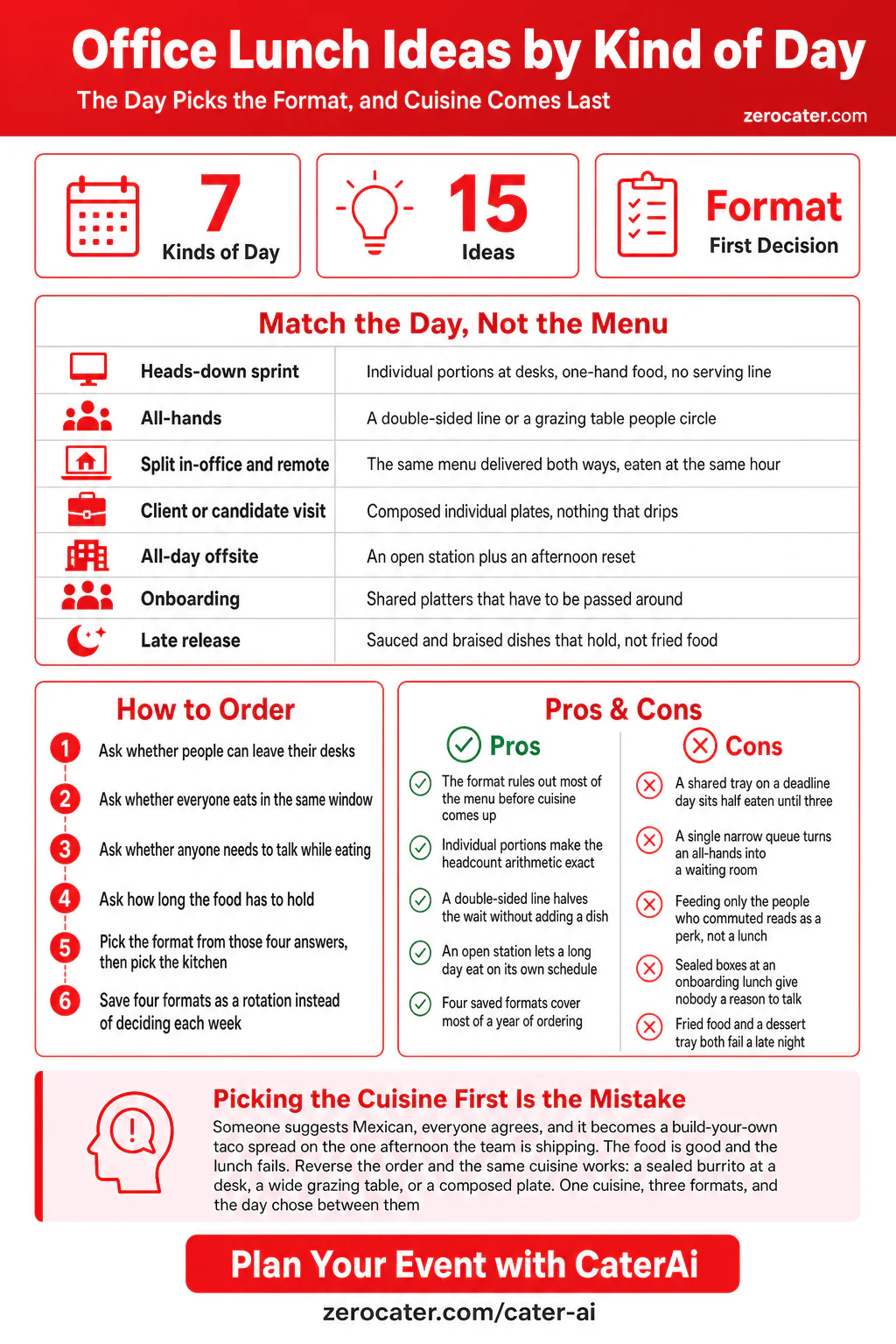
Four questions sort almost every office lunch. Answer them and the format picks itself.
- Can people leave their desks? If no, you are ordering individual portions, whatever else you decide.
- Does everyone eat at the same moment? A single serving window needs throughput. A staggered one needs food that holds.
- Does anyone need to talk while eating? Client lunches and onboarding lunches are conversations with food in them, so the food has to stay out of the way.
- How long does the food have to hold? A 45-minute window and a four-hour window are different orders, not the same order left out longer.
Everything below is those four answers in different combinations.
The heads-down day: nobody wants to stop
Sprint weeks, deadline days, the afternoon before a launch. People will eat, but they will not stand up to do it, and a shared tray on this day sits half finished until three o’clock.
1. Individual portions delivered to desks. One sealed container per person, labelled, no serving line and no decision at the point of eating. On a day when stopping feels expensive, this is the format that holds up. Our roundup of boxed lunch caterers covers who does it well.
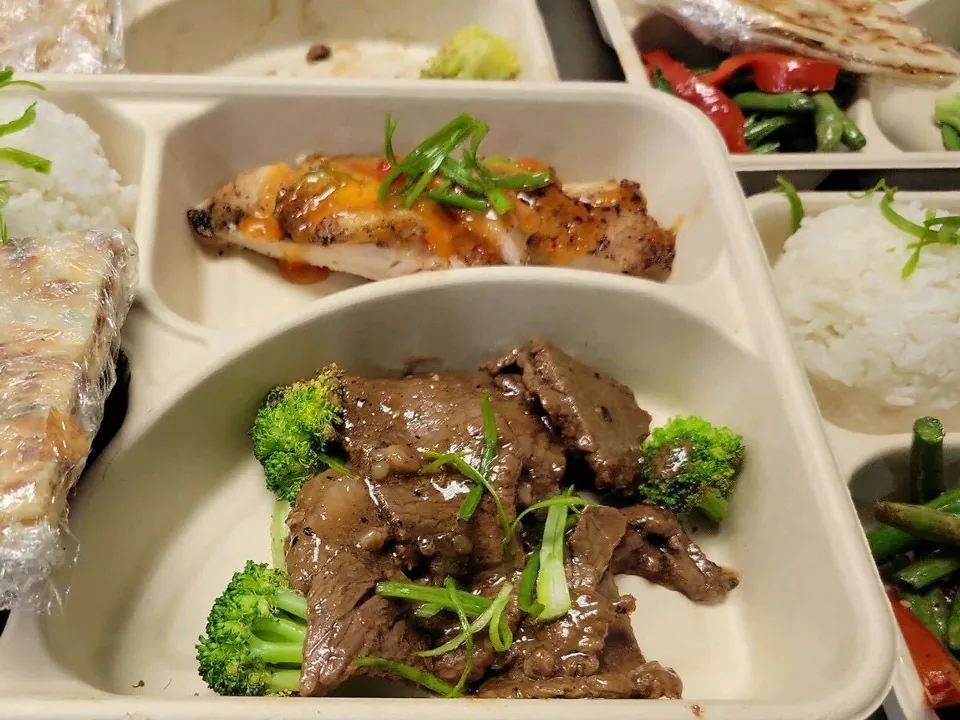
2. Food that survives a keyboard. Wraps, hand pies, filled buns, rice bowls with a lid. Skip anything that needs a knife, anything that drips and long pasta. People will eat this at a desk with one hand on a mouse, which is the actual use case whether or not anyone admits it.
3. A staggered drop in two waves. If half the team is in a review until one o’clock, split the delivery. The second wave arrives warm instead of the whole order going cold on a side table while the meeting overruns.
The all-hands: one room, one window
Everyone eats in the same 30 minutes. The enemy is the queue, not the menu.
4. A line people can enter from both ends. Set the same food out twice, or run the table so people can start from either side. A double-sided line halves the wait without adding a single dish. Our sandwich bar guide covers keeping a line moving in more detail than there is room for here.
5. A grazing table people circle instead of queue. Lay food across a wide surface rather than along a narrow one and the queue stops forming, because there is no single point everyone has to pass. This suits a room that will stand and talk.
6. Pre-portioned mains with shared sides. A hybrid that solves the slowest part of any buffet. The main is already divided, so nobody stands there deciding how much to take, and the sides stay communal for the people who want more.
The split day: half the team is remote
The failure here is social rather than logistical. A lunch that only happens for the people who commuted turns into a story about who counts.
7. The same menu, sent two ways. A shared spread in the office and an equivalent delivered meal for everyone at home, eaten at the same hour. Same food, same day, one event. Individually packaged meals travel to both, which our guide to boxed lunches for hybrid and distributed teams covers in depth.
8. A lunch pinned to a reason to be there. If you want people in the office, put the lunch next to the thing they came for rather than in the middle of an otherwise ordinary Wednesday. Lunch is a poor reason to commute and a good reason to stay.
The day a client or candidate is in the room
The food is a supporting act. Anything that makes a guest negotiate a serving spoon in front of people they just met is working against you.
9. Composed individual plates, no serving line. Everyone gets the same complete meal at the same moment. No queue, no choosing, and no guest hovering at the back of a line trying to work out the etiquette.
10. Food nobody has to fight. Nothing that shatters, splashes or needs both hands. Test it against the sentence “could someone eat this while answering a question?” Our client appreciation catering guide covers the larger version of this problem, and board meeting catering covers the formal end.
The long day: offsites, training and all-day workshops
The room is captive for six hours or more. One lunch at 12:30 is not the problem to solve. Energy across the whole day is.
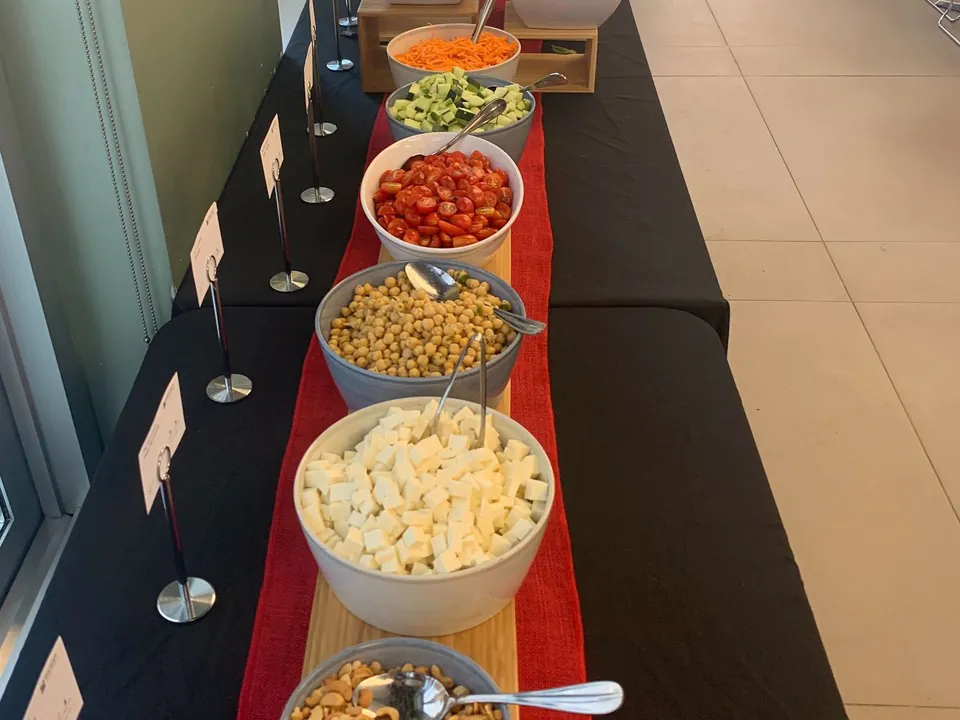
11. A station that stays open rather than a lunch that happens. Components that hold for hours, set out once and topped up. People eat during the break they actually get instead of the break the agenda promised. Our offsite and retreat catering guide covers the full-day build.
12. An afternoon reset around three. The graveyard slot in any training day is the 90 minutes after lunch. Something small and savoury landing mid-afternoon does more for the last session than a bigger lunch would.
The first day: onboarding and new starters
13. A lunch that forces mixing. Shared food that has to be passed, in a room with fewer seats than people, beats individual boxes here. A new starter with a sealed container has no reason to talk to anyone; a new starter holding one end of a platter does. Our new hire onboarding lunch guide covers the first-week version, and lunch and learn catering covers the version with a presentation attached.
The late one: releases, closes and deadlines that run past six
14. Dinner that holds for three hours. Braises, stews, baked pasta and anything sauced hold their quality on a warmer far better than grilled or fried food, which is at its best for about twenty minutes. Order for when people will eat, not for when it arrives.
15. Real food instead of a sugar tray. The reflex on a late night is pizza and sweets. Both spike and drop, and the drop lands at exactly the wrong hour. Protein and something warm carry a room to midnight better than a dessert platter does.
Which kind of day wants which lunch
| The day | What the lunch has to do | Format that does it | What to avoid |
|---|---|---|---|
| Heads-down sprint | Feed people without moving them | Individual portions at desks | Anything with a serving line |
| All-hands | Clear a full room in one window | Double-sided line or grazing table | A single narrow queue |
| Split in-office and remote | Read as one event, not a perk | Same menu delivered both ways | Feeding only the people who commuted |
| Client or candidate visit | Stay out of the conversation | Composed individual plates | Shared spoons and anything that drips |
| All-day offsite or training | Hold energy across six hours | An open station plus an afternoon reset | One fixed sitting at 12:30 |
| Onboarding or first day | Get people talking | Shared platters, passed around | Sealed individual boxes |
| Late release or close | Hold quality for hours, avoid a crash | Sauced and braised dishes on a warmer | Fried food and a dessert tray |
The planning point: write down the shape of the day before you open a menu. Serving window, whether people can leave their desks, and how long the food has to hold. Three lines of notes rule out most of the catalogue and turn the cuisine question into the easy one it should have been all along.
Plan office lunch catering with CaterAi
The mistake that makes every other decision harder
Picking the cuisine first is the most common way an office lunch goes wrong, and it is invisible while you are doing it. Someone suggests Mexican, everyone agrees, and the order becomes a build-your-own taco spread on the one afternoon the team is shipping. The food is good. The lunch fails, because the format asked for something the day could not give.
Reverse the order and the same cuisine works. Mexican on a sprint day is a sealed burrito at a desk. Mexican at an all-hands is a wide grazing table. Mexican with a client in the room is a composed plate. One cuisine, three formats, and the day chose between them.
That is also why a good caterer asks about the meeting before the menu. If you want the food chosen by cuisine after all, our guide to healthy lunch catering runs that way deliberately, and it pairs well with this one: pick the format here, then pick the kitchen there.
Turn fifteen decisions into a rotation of four
Nobody wants to make this choice from scratch every week. Most teams only have four or five kinds of day, so build the rotation around those and vary the kitchen inside each slot.
- A default week. One shared format your team likes, running on the same day each week so people plan around it.
- A desk format. Individual portions on standby for deadline weeks, ordered from a kitchen you already trust.
- A room format. The spread you use when everyone is in, sized for the biggest room you use.
- A guest format. One composed option you can order without thinking when someone external is coming.
Four saved orders cover most of a year. The variety comes from rotating kitchens inside each format, which keeps the food interesting while the logistics stay boring. Our seasonal ideas guide is a good source of rotation without changing the format underneath, and breakfast catering covers the morning version of the same rotation problem.
How CaterAi handles the kind-of-day question
CaterAi builds a menu from a description of the event rather than a cuisine filter, so the constraints in this post are the input rather than an afterthought. Tell it the headcount, the serving window and the dietary split, and it returns menus from kitchens that deliver to you, sized for the room. See how it works for the mechanics, or browse buffet catering menus if you already know the format you want.
For a team ordering every week rather than once, start at corporate catering. For a one-off with a schedule attached, start at corporate event catering. Two lanes this post deliberately leaves alone are covered elsewhere: office potlucks when the team is bringing the food, and high-protein lunches when the goal is what is in the food rather than how it arrives.
Plan office lunch catering with CaterAi
Frequently Asked Questions
What should I order for an office lunch?
Start with the day rather than the menu. Ask whether people can leave their desks, whether everyone eats at the same moment, whether anyone needs to talk while eating, and how long the food has to hold. Those four answers pick the format, and the format rules out most of the menu before you ever choose a cuisine. A heads-down sprint wants individual portions at desks. An all-hands wants a line built for throughput.
How do I pick office lunch ideas for a team with different diets?
Build the default menu so it already covers the room instead of adding labelled plates on the end. Keep starch, protein and sauce separate so people assemble what suits them, and put one substantial vegetarian dish in the middle of the table rather than at the edge. For a shared line, labels do most of the work. Our vegetarian and gluten-free guides cover the brief, and allergy-safe catering covers the questions to ask when someone has a real allergy.
What is the best office lunch for a hybrid team?
Send the in-office group and the remote group the same food, on the same day, so the meal reads as one event rather than a perk for whoever commuted. Individually packaged meals travel to both, which our guide to boxed lunches for hybrid teams covers in depth. When you want something warmer than a box for the people in the room, order a shared spread for the office and a delivered equivalent for everyone else, and start the meeting at the same time for both.
How far in advance should I order an office lunch?
Most kitchens want a day or two for a standard order and longer for a large or custom one. Book earlier when the lunch has a fixed start, such as an all-hands or a client meeting, because a late delivery costs you the meeting rather than the meal. If you have less time than that, our last-minute office catering guide covers what still ships on a short clock.
How much office lunch should I order per person?
Order for the number of people who will actually eat, then add a small margin for the ones who take seconds off a shared tray. Individual portions make this arithmetic exact, which is part of why they suit hybrid and staggered days. Shared trays need a wider margin because the first people through the line take more than the last. Our boxed lunch cost guide covers the headcount maths and what drives the number.
What office lunch works when people cannot stop working?
Individual portions delivered to desks, and food people can eat with one hand. Skip anything that needs cutting, anything that drips, and long pasta. A tray lunch fails on a deadline day for a reason that has nothing to do with the food: it asks everyone to stand up at the same moment, and on that day they will not.
Should I order the same office lunch every week?
Run a small rotation rather than fifteen separate decisions. Pick three or four formats that cover the kinds of day your team actually has, then vary the kitchen inside each format. That keeps the food interesting while the logistics stay boring, which is the right way round. Teams running an ongoing programme should start at corporate catering.
What is the difference between an office lunch and office catering for an event?
The lunch serves the work, and the event is the work. An ordinary team lunch has to fit around what people are doing, so the format bends to the day. An event lunch sets its own schedule, so you can plan service, staffing and a longer menu around it. Our corporate event catering checklist covers the second case, and corporate event catering covers running one at scale.