
Order lunch for an office and the room forgives you. Somebody wipes the counter, the bin is ten steps away, and the carpet has survived worse. Order food for a listing appointment and the room is the thing you are selling.
So the menu answers three questions about residue before it answers anything about taste. What does the food put in the air, what can it leave on a surface, and what has to go out of the door with you at the end. An agent who has spent six weeks and a staging budget getting a property to photograph well will not thank you for a tray of wings on the dining table.
This guide covers the events that happen at the property, or in a building somebody else runs: open houses, broker tours, groundbreakings, launches and tenant appreciation days. Sizing an order for a room of strangers is a separate problem, and our client appreciation event guide already covers it in detail.
Plan open house catering with CaterAi
The clock runs shorter than the event
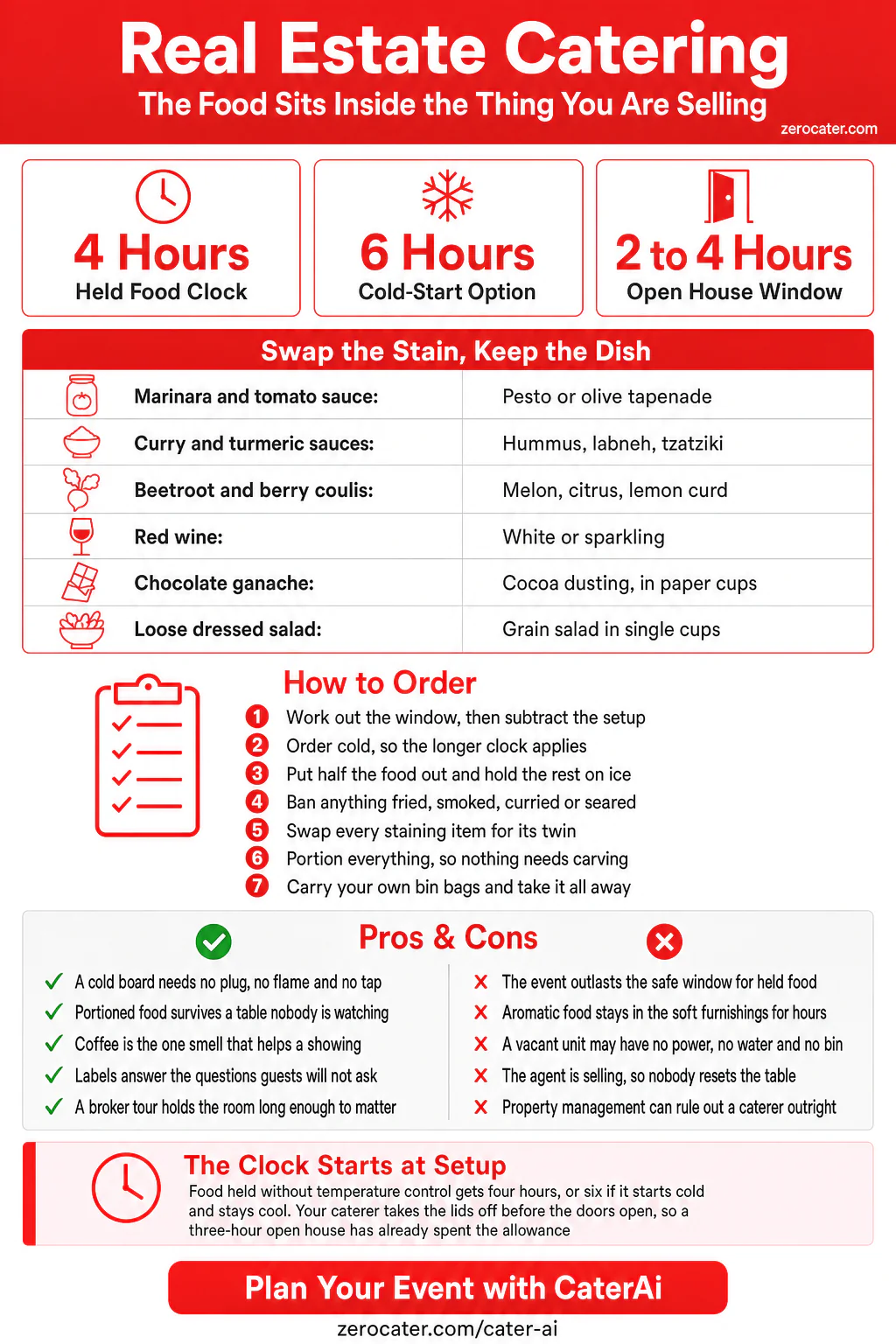
Start here, because it decides the menu before taste does. The FDA Food Code gives food held without temperature control four hours, after which it gets served or thrown away. There is a longer six-hour option, and it applies only to cold food that starts at or below 41 degrees and never rises past 70.
Now put a real event against that. A public open house runs two to four hours. The caterer arrives 30 to 45 minutes before the doors open, and the clock starts when the lids come off, not when the first visitor walks in. A three-hour open house with a proper setup has already spent close to the whole allowance. Add the half hour the agent spends packing up and you are over.
Two things follow. Cold food that arrived cold is the only category with margin left, which is the practical reason a charcuterie or mezze board beats a hot tray at a listing. And you should never put the whole order out at once. Set half the board, keep the rest in a cooler with ice packs underneath, and rebuild at the midpoint. The second wave of visitors gets food that looks untouched, and you have reset the clock on everything in the cooler.

Smell is a listing problem
Office catering guides treat strong-smelling food as a courtesy question. Do not put fish next to the quiet desks. In a property that is on the market, the same food costs you something you can measure.
Sellers spend real effort making a house smell of nothing in particular. Then a tray of butter chicken arrives and fills three rooms in twenty minutes, and it stays in the curtains, the sofa and the staged bedding for the rest of the afternoon. The next twelve visitors walk into somebody else’s lunch. A vacant unit is worse, because there is often no extract running, the windows may be sealed or alarmed, and the air has nowhere to go.
The rule is simple enough to hand to a caterer. Nothing fried, nothing smoked, nothing curried, no fish, and no searing on site. What is left is a long list: cured meats, cheeses, cut vegetables, breads and crackers, thick dips, cold roast chicken, grain and noodle salads, fruit. Our grazing table guide and charcuterie guide both build spreads that need no heat at all.
Coffee is the exception, and it works in your favour. A house that smells of fresh coffee reads as a house somebody looks after. Run a coffee service and let it be the only thing anybody smells.
The stain list, and a swap for every item
A mark on a staged rug comes out of the seller’s budget and out of the agent’s afternoon. Hand your caterer the list below and ask for the right-hand column.
| Leave this off | Order this instead | Why it matters at a listing |
|---|---|---|
| Marinara, tomato sauce | Pesto, olive tapenade, cheese and herb | Tomato pigment sets fast in wool and linen |
| Curry, turmeric sauces | Hummus, labneh, tzatziki | Turmeric is close to permanent on light textiles |
| Beetroot, berry coulis | Melon, citrus, lemon curd | Anthocyanin stains carry into grout and stone |
| Red wine | White, sparkling wine, sparkling water | One knocked glass ends the showing |
| Chocolate ganache, molten centres | Cocoa-dusted or glazed, in paper cups | Melts on to hands, then on to a bannister |
| Mustard, balsamic glaze | Aioli, herbed oil served in a lidded pot | Both stain and both get squeezed |
| Loose green salad in oil | Grain salad in individual cups | Dressing travels off the plate |
Two habits matter as much as the list. Put the entire spread on one hard surface, and lay a tray under anything wet, so a spill has somewhere to go that is not the floor. If the only table in the room is a staged one, ask the caterer to bring a folding table and its own cloth rather than borrowing the seller’s.
One portion per hand, nothing to cut
Guests at a listing hold a phone, a brochure and sometimes a child. They have nowhere to sit, because the staged furniture is a display. Anything that needs two hands and a flat surface goes uneaten and ends up abandoned on a window ledge.
Order food that arrives already portioned: filled breads cut in half, skewers with a bite that does not slide, small cakes in paper cups, cheese already sliced, fruit already cut. Nothing gets carved, nothing gets served, and nothing needs a plate balanced on a forearm. Our finger food guide and canapes guide both list formats that hold up unattended, and the appetizer menus and dessert menus in our directory filter the same way.

Nobody is standing behind the table
At an office lunch somebody notices when the bread runs out. At a listing appointment the agent is mid-conversation with a buyer and cannot leave it to straighten a platter. Plan for a table that has to look after itself.
Order a spread that is finished the moment it goes down: everything visible, nothing that needs assembling, nothing that collapses as it warms. Set out double the napkins you think you need and a small bin bag out of sight, because guests will hunt for somewhere to put a skewer and will otherwise leave it on the mantelpiece.
If the event matters enough, one attendant changes the arithmetic. Their job is not service in the restaurant sense. It is resetting the board every twenty minutes, clearing plates before anybody carries one upstairs, and taking every piece of rubbish off site at the end.
Vacant units: no plug, no tap, no bin
A furnished home has a kitchen you can borrow. A vacant unit, a shell tenancy or a half-built sales suite may have none of it. Utilities get shut off between tenants, the fridge is gone, the water may be capped, and there is nowhere to put a bag of rubbish.
Order as if the room provides nothing. No warmers, no chafing dishes, no kettle. No Sterno and no candles, ever, in a unit you do not control and cannot guarantee has a working alarm. Ask for insulated delivery with ice packs sitting underneath the cold items rather than beside them, and for packaging you can stack straight back into the crate it arrived in.
Carry your own hand sanitiser, your own bin liners and a torch if the showing runs towards dusk in winter. The offsite catering guide covers the same shortage in a different setting, and much of the packing logic transfers.
Five real estate events, and what each one has to survive
The constraint changes with the room. A broker tour in a working office is nearly an ordinary catering job. A groundbreaking on a construction site is closer to a picnic. Work out which one you have before you order.
| Event | Where the food sits | The binding constraint | Format that works |
|---|---|---|---|
| Public open house | Kitchen island or dining table, staged | Odour, stains, a window longer than the food’s clock | Small cold board, refreshed at the midpoint |
| Broker tour or broker open | The property, at a fixed hour | Everybody arrives together and stays | Breakfast board with coffee, or wraps and a grain salad |
| Groundbreaking, topping out | Outdoors, on site | No power, no shelter, dust and weather | Individually wrapped items, drinks on ice, nothing plated |
| Launch or sales suite opening | A finished show unit or marketing suite | The room has to photograph well all evening | Passed-free cold canapes plus a single dessert table |
| Tenant appreciation day | Lobby or amenity floor of a leased building | Building rules and a shared entrance | Repeating stations that hold for a long window |
The last row carries the most rules. A tenant event happens in a building where several companies share the floor, and our coworking catering guide covers that structure in full. Two directory pages line up with the rest of the list: product launch catering for the sales suite, and networking event catering for a broker mixer.

The broker tour is where the food actually earns its keep
Agents put the most effort into the public open house and the least into the broker tour, and it should run the other way. A broker tour lands at a set time, the guests are professionals who came for the comps, and they stay in the room long enough to talk to you. That is an hour of undivided attention from the people who bring buyers.
Late morning works best. A board of bagels, pastries and cut fruit with real coffee reads as generous and costs less than a plated lunch. Our breakfast catering guide and the continental breakfast menus in the directory both cover the shape. If the tour runs at midday, switch to filled breads cut in half, a boxed meal per person if the group splits up, and one sweet item in a single portion.
This is the only real estate event where a hot dish is defensible, and only where the kitchen at the property works, the windows open, and the tour is the last appointment of the day. Everywhere else, keep it cold.

Plan open house catering with CaterAi
Label everything, because nobody can ask you
Write the name of every dish and its allergens on a card next to it. At a listing, guests will not interrupt an agent mid-pitch to ask what is in the dip, so they either guess or skip the table. A card answers the question before anybody has to ask it, and it takes a caterer two minutes.
Make sure at least one substantial item works for a guest avoiding dairy and one works for a guest avoiding gluten, and put both in the middle of the spread rather than at the end. Our mixed dietary needs guide has the labelling brief to hand a caterer.
Getting sign-off in a leased building
A tenant event, a lobby activation or an amenity-floor lunch happens in a building somebody else runs, and their rules land before your menu does. Most property managers keep a certificate of insurance on file for any vendor working on site, and they set the entrance, the service lift and the hours.
Ask three things when you book: which door the caterer uses, who unlocks the amenity floor on the day, and whether the building runs an approved-caterer list. That last one is a hard yes or no rather than a preference, and finding out late costs you the booking. Give property management the caterer’s name and arrival window in writing, and keep a copy on your phone for the day.
Formats that do not belong at a listing
Some of the best office catering is wrong here.
- Anything that needs a plug or a flame. Chafing dishes, warmers, Sterno, urns that draw power. Assume the socket is dead.
- Build-your-own bars. A taco bar is a great office format and a bad listing format: sauces, assembly, and a queue in a room people are trying to look at.
- Red-sauce pasta and wings. Both stain, both need a plate and a fork, and wings bring an odour that outlasts the event.
- Soup and anything in a bowl. Nowhere to sit, nowhere to put it down.
- Cake that needs cutting. Somebody has to serve it, and nobody is free to.
- Open bottles of red on a light floor. If you pour wine, pour white, and pour it away from the rug.
For a lower-key alternative that still holds a room, our happy hour appetizers guide and party tray guide both list spreads that survive an hour with no attendant. If the event came together at short notice, the last-minute catering guide covers what still ships on a tight turnaround.
Who to order from
Look for caterers who already work cold and already deliver in insulated crates. Cheese and charcuterie specialists, Mediterranean kitchens and bakeries all fit the brief without being asked to change anything. La Fromagerie in San Francisco builds the kind of board at the top of this page, Olive Mediterranean Grill in Chicago and Olive & Basil in New York cover mezze and cold platters, and Braid Bakery and Unregular Bakery handle the broker-tour breakfast. Browse the Mediterranean and Italian directories for more in your metro.
City cost guides
Per-head ranges move by metro, so start with the guide for yours: New York, San Francisco, Los Angeles, Chicago, Boston, Seattle, Austin, Denver, Dallas, Atlanta, Philadelphia and Washington DC. If you are running these events on a tight budget, the budget office lunch guide shows where the money goes furthest.
How CaterAi handles a real estate event
Tell CaterAi the address, the window and the constraint, and it builds menus from the kitchens near that property that can work to it. Say the unit has no power and CaterAi drops the hot formats. Say the property is staged and it filters towards cold boards and portioned items. You edit the menu in the chat until it looks right, add staff if you want an attendant, and check out.
For a programme of events across a portfolio, corporate event catering covers the repeating side, and corporate catering covers the brokerage office itself. If none of this is familiar yet, how it works is the short version.
Plan open house catering with CaterAi
Frequently Asked Questions
What food should you serve at an open house?
Cold food that arrives cold, sits in one piece per hand, and cannot mark anything. Cured meats and cheese, crackers and breads, cut vegetables with thick dips rather than runny ones, whole fruit, and small cakes in paper cups. Coffee is the one hot item worth running, because a house that smells of coffee reads as a house somebody looks after. Skip anything sauced, anything fried and anything that needs a fork.
How long can catering sit out at an open house?
The FDA Food Code gives food held without temperature control four hours before it has to be served or thrown away. There is a six-hour option, and it applies only to cold food that starts at or below 41 degrees and never passes 70. Your clock starts when the caterer takes the lid off, which is during setup, so a three-hour open house with a 45-minute setup has already spent most of the window. Put half the food out at the start and hold the rest cold for the midpoint.
Should you cater an open house at all?
Cater the events where people stay in one place. A broker tour, a launch or a tenant event holds a room for a fixed hour and food does real work there. A public open house moves people through in ten or fifteen minutes each, so a small, self-contained cold table earns its place and a full spread does not. Match the spend to how long anyone stands still.
What catering leaves a stain on a staged property?
Tomato and marinara, turmeric and curry, beetroot, berry coulis, red wine, chocolate ganache, mustard and balsamic glaze. Every one of them has a swap that tastes as good and washes out: pesto for marinara, hummus and labneh for curry sauces, white wine or sparkling water for red, lemon curd for berry, and a dry cocoa dusting for ganache. Put the whole table on one hard surface and lay a tray under anything wet.
Can you cater in a vacant unit with the utilities off?
Yes, if you order for it. Assume no plug, no running water, no working refrigerator and no bin. That rules out warmers, chafing dishes and anything on a flame, and it means everything you carry in comes back out with you. Ask the caterer for insulated delivery with ice packs underneath, packaging you can stack back into its own crate, and a bin liner. Bring hand sanitiser, because there may be no tap.
Who has to approve catering for a tenant event in a leased building?
Property management, and usually before the delivery is booked. Most buildings keep a certificate of insurance on file for any vendor working on site, and they set the delivery door, the service lift and the hours. Ask which entrance, who unlocks the amenity floor and whether the building has an approved-caterer list, because a list is a hard yes or no rather than a preference.
What should you cater for a broker tour?
Feed a broker tour properly, because it lands at a set hour and the room stays put. Late morning suits a breakfast board of bagels, pastries and fruit with real coffee. Midday suits wraps or filled breads cut in half, a sturdy salad, and something sweet in a single portion. It is the one real estate event where a hot dish is defensible, and only if the kitchen at the property works and the windows open.
Do you need staff on site for real estate catering?
Only if you want the second half of the window to look like the first. Nobody is standing behind the table at a listing appointment, because the agent is talking to buyers. Either accept that the table is finished when it goes down and order a spread that holds, or pay for one attendant whose entire job is to reset the board, clear plates and take the rubbish away at the end.