There is a tier of office event where boxed lunches and a stack of party trays simply will not do: the client reception, the board dinner that opens with drinks, the holiday party, the product launch, the investor evening. For those, you want hors d’oeuvres and canapes, the small, elegant, eaten-standing-up bites that make a room feel polished without anyone sitting down to a plate. Hors d’oeuvres and canapes are the white-tablecloth end of office catering: bite-sized, beautiful, and built to be eaten with a drink in the other hand.
This guide is the planner’s playbook for that tier. You get the real difference between an hors d’oeuvre, a canape, and an appetizer, the four-layer anatomy of a canape, how many pieces to order per person depending on whether the reception precedes or replaces a meal, a how-many-by-headcount chart that includes how many servers to pass them, passed versus stationed service, the dietary swaps that keep the whole room covered, what it costs, and where to order. For the casual, no-fork version of small bites, our finger food guide has 30-plus ideas; for bites built around a drinks program, see the happy hour appetizers guide and the happy hour menu guide.
In This Guide
- Hors d’Oeuvres vs. Canapes vs. Appetizers
- The Anatomy of a Canape
- Cold Canapes and Hot Hors d’Oeuvres for the Office
- How Many Pieces per Person (the Reception Math)
- How Many Pieces by Headcount
- Passed Service vs. Stationed Display
- Hors d’Oeuvres for Every Diet
- What Hors d’Oeuvres and Canapes Cost
- Where to Order Hors d’Oeuvres and Canapes
- FAQ
Hors d’Oeuvres vs. Canapes vs. Appetizers
People use these three words interchangeably, but caterers do not, and getting the distinction right helps you order exactly what you picture. The short version: a canape is a specific constructed bite, an hors d’oeuvre is any small savory bite served apart from a meal, and an appetizer is a first course.
| Term | What It Means | Typical Example |
|---|---|---|
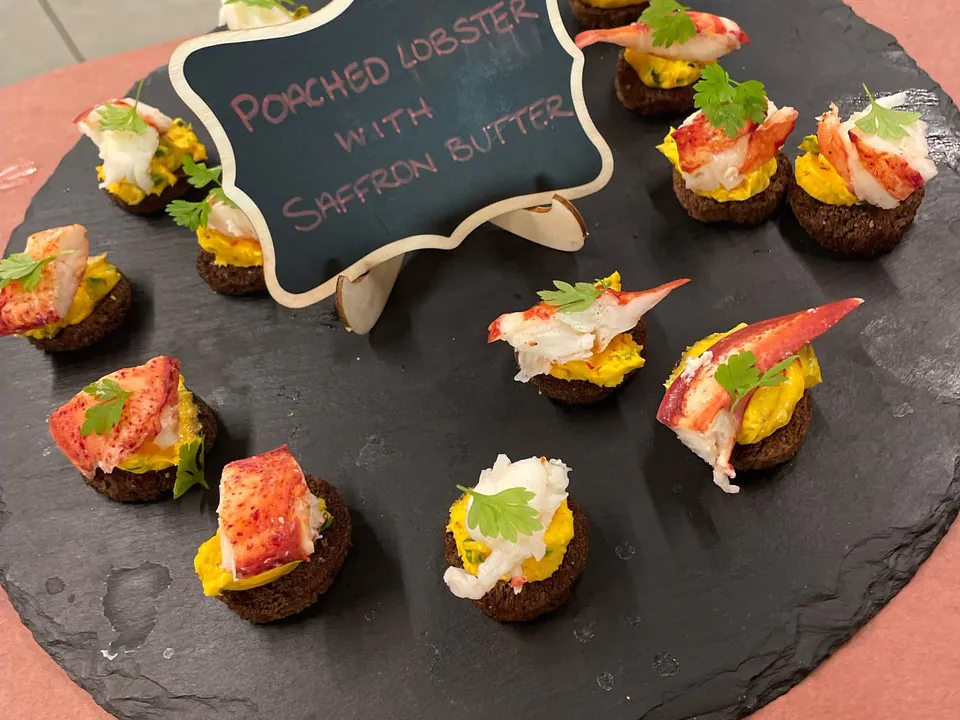
| Canape | A constructed, one-bite piece built on an edible base, topped and garnished | Smoked salmon on a blini; lobster on a pumpernickel round |
| Hors d’oeuvre | Any small savory bite served before or outside a meal, often passed | Bacon-wrapped dates, arancini, mini quiche, a skewer |
| Appetizer | A first course; at a seated event, the plated starter at the table | A small soup, salad, or shared starter before the main |
| Finger food | The casual umbrella for anything eaten with no fork | Sliders, wings, chips and dip, a veggie cup |
So every canape is an hors d’oeuvre, but not every hors d’oeuvre is a canape, and an appetizer can be either a passed bite or a seated first course. For an office reception, you are almost always ordering hors d’oeuvres, a mix that usually includes some true canapes. If your event is casual rather than upscale, the finger food guide is the better starting point; if it centers on a grazing centerpiece, see our grazing table and charcuterie guides.
The Anatomy of a Canape
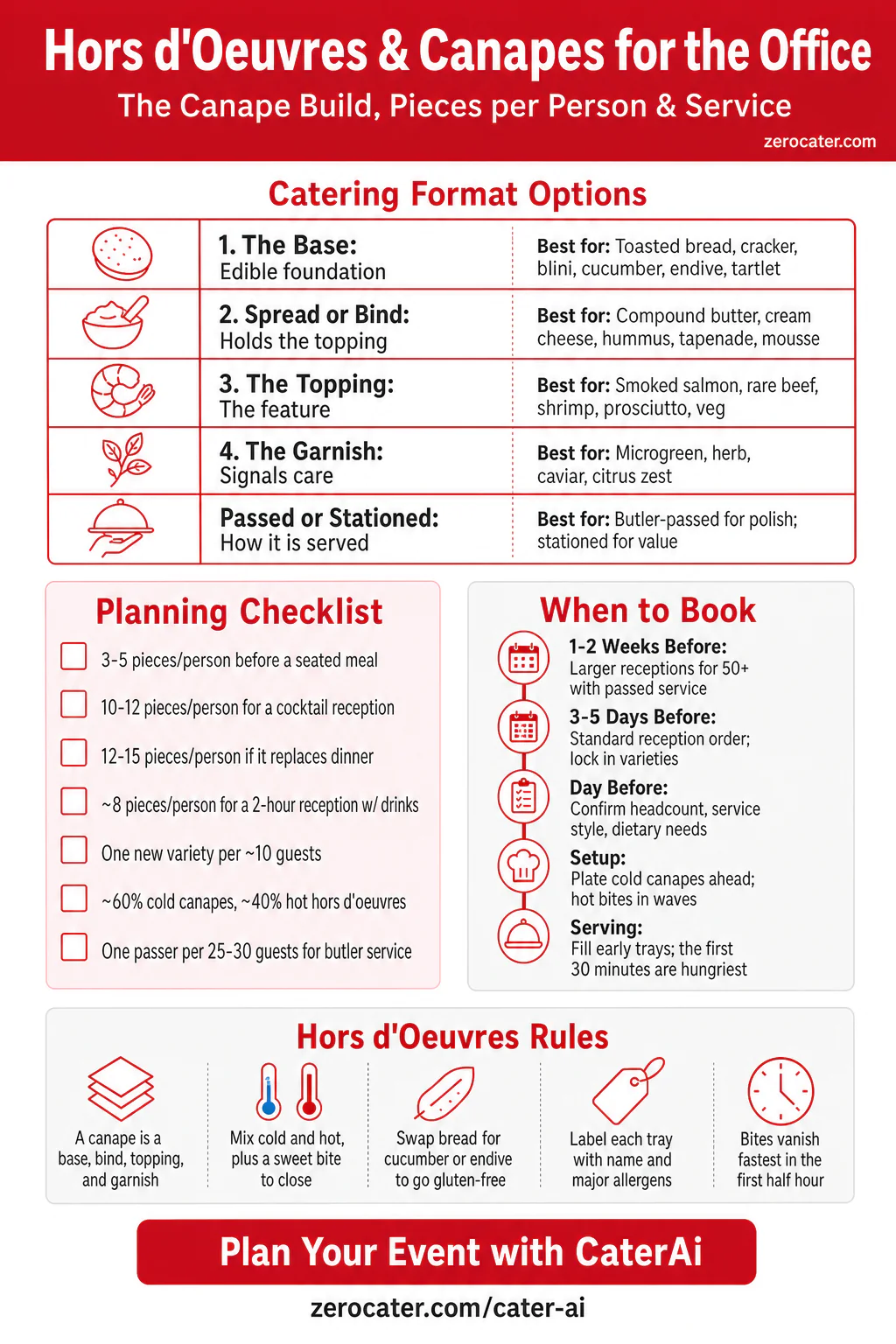
The reason a canape looks like it came from a hotel banquet kitchen is that it is built, not just plated. Every canape has the same four layers, and once you can see them, you can design or order them with confidence. A canape is a base, a spread or bind, a topping, and a garnish, assembled so the whole thing holds together in one bite.
| Layer | What It Does | Examples |
|---|---|---|
| 1. Base | The edible foundation that gives the bite structure | Toasted baguette, cracker, blini, cucumber round, endive leaf, tartlet shell |
| 2. Spread or Bind | A flavored layer that holds the topping in place | Compound butter, herbed cream cheese, hummus, tapenade, mousse |
| 3. Topping | The feature, usually a protein or a vegetable centerpiece | Smoked salmon, rare beef, shrimp, prosciutto, roasted vegetable |
| 4. Garnish | The finishing touch that signals care | Microgreen, herb leaf, caviar, citrus zest, a drop of sauce |
When you brief a caterer, this is the vocabulary that gets you what you want: ask for a cucumber base instead of bread to keep a canape gluten-free, or a whipped-feta bind under a roasted tomato for a vegetarian option. Hot hors d’oeuvres skip the cold-canape construction, but they follow the same one-bite logic, which is what keeps the whole format neat and plate-free.
Cold Canapes and Hot Hors d’Oeuvres for the Office
Within that structure, here is the working lineup most office receptions pull from. You do not need all of it: pick a handful of cold canapes, a few hot hors d’oeuvres, and a sweet bite to close, and balance them across vegetarian, meat, and seafood. The one rule worth keeping is to mix cold and hot, because cold canapes can be set out ahead while hot bites come from the kitchen in waves.
- Cold canapes: smoked salmon on blini, caprese skewers, whipped feta and roasted tomato crostini, bruschetta, cucumber rounds with herbed cream cheese, prosciutto-wrapped melon, deviled eggs, rare beef on toast with horseradish.
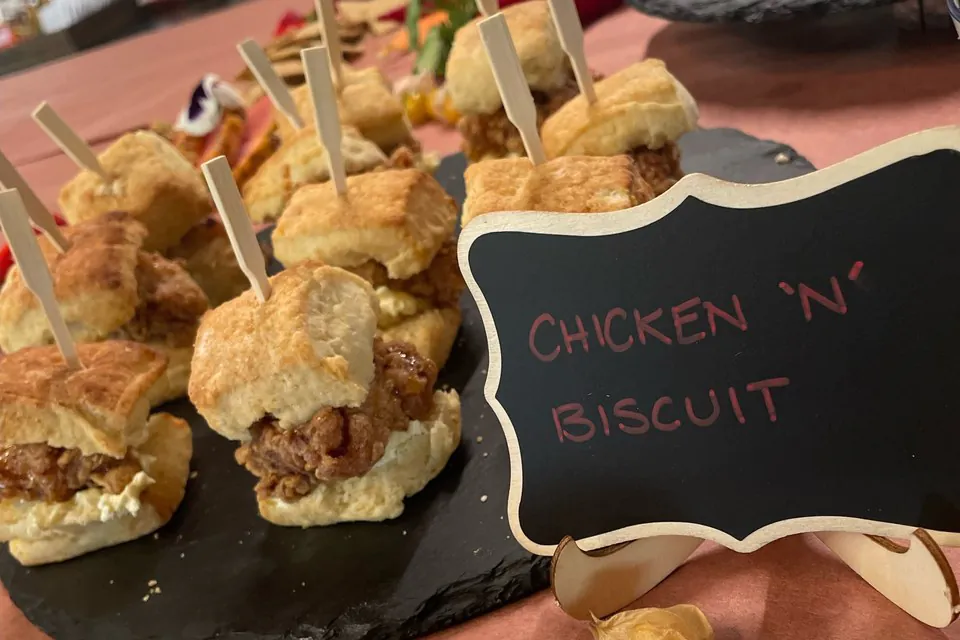
- Hot hors d’oeuvres: arancini, mini quiche, spanakopita, bacon-wrapped dates, vegetable spring rolls, mini crab cakes, stuffed mushrooms, chicken or biscuit sliders on picks.
- Skewers and spoons: caprese skewers, shrimp skewers, antipasto picks, and amuse-style spoons, which feel elegant and travel well on a passed tray.
- Sweet bites to close: mini tarts, macarons, chocolate-dipped strawberries, and petit fours for a reception that runs into the evening.
That lineup themes easily: a Mediterranean reception leans on mezze bites, spanakopita, and whipped feta; an Italian one on caprese, bruschetta, and arancini. For the casual no-fork versions of many of these, the finger food guide goes deeper, and for bites built to pair with cocktails, the happy hour appetizers guide covers the drinks angle.
How Many Pieces per Person (the Reception Math)
This is the question every planner gets wrong in the same direction, by under-ordering. The number of pieces per person is not fixed: it depends entirely on whether the bites come before a meal, stand in as a light meal, or replace dinner outright. The deciding question is simple: are these bites an opener, or are they the meal?
| Reception Type | Pieces per Person | Use It For |
|---|---|---|
| Before a seated meal | 3 – 5 pieces | A short reception ahead of a board dinner or lunch |
| Cocktail reception (light meal) | 10 – 12 pieces | A 2-hour evening event where bites are dinner-ish |
| Heavy reception (replaces dinner) | 12 – 15 pieces | A 2 to 3-hour party with no seated meal at all |
Quick math for a 40-person, 2-hour office reception
- Pieces: 40 guests × ~8 each = ~320 pieces for a reception alongside drinks (bump to ~10 each, or ~400, if it is the meal)
- Variety: ~6 varieties (one per ~10 guests), split across cold, hot, and a sweet bite
- Balance: roughly 60% cold canapes plated ahead, 40% hot hors d’oeuvres out in waves
- Passers: ~2 servers for butler-passed service (about 1 per 25 to 30 guests)
Round up if the crowd skews hungry or the event runs long; bites disappear fastest in the first 30 minutes.
Two more rules that keep a reception from running short. First, the first half hour is the hungriest, so make sure the early trays are full and frequent. Second, offer one new variety per roughly 10 guests, which is what makes a spread feel abundant even when the total piece count is modest. The piece-by-piece math for a drinks-led happy hour, where bites are a lighter snack, lives in our happy hour appetizers guide.
How Many Pieces by Headcount
Here is the chart planners actually want and caterer menus rarely print: total pieces, number of varieties, and number of passers, scaled to your headcount for a two-hour office reception where the bites run alongside drinks. The ratios behind it: about 8 pieces per person, one new variety per 10 guests, and one passer per 25 to 30 guests for butler service.
| Guests | Total Pieces | Varieties | Passers (if passed) |
|---|---|---|---|
| 10 | ~80 | 4 – 5 | 1 |
| 25 | ~200 | 5 – 6 | 1 |
| 50 | ~400 | 6 – 8 | 2 |
| 100 | ~800 | 8 – 10 | 3 – 4 |
If the reception is the meal rather than an opener, scale the piece count up using the per-person table above, keeping the varieties and passers roughly the same. The number that catches people out is the passers: for a stationed display you may need none, but for true butler-passed service, under-staffing is what leaves trays sitting empty between rounds. For the full event-day timeline, our corporate event catering checklist and office manager’s guide to ordering catering have the staging and ordering details, and the board meeting catering guide covers the smaller executive end.
Plan finger food catering with CaterAi
Passed Service vs. Stationed Display
How the bites reach your guests matters as much as what they are, and it is the single biggest lever on how formal the event feels. Passed service feels polished and controls the pace; a stationed display costs less and runs itself.
- Passed (butler) service: servers carry trays of bites through the room. It keeps guests mingling, controls portions, and looks the most refined, which is why it suits client receptions, executive functions, and holiday parties. Plan about one server per 25 to 30 guests.
- Stationed (display) service: the bites are set out on a table for guests to help themselves, the same way a grazing table or party tray spread works. It needs little or no waitstaff and fits casual team gatherings and tighter budgets.
- The hybrid: pass the premium canapes and station the crudites, cheese, and dips. You get the polish of butler service where it counts and the easy economics of a self-serve display for everything else.
Whichever you choose, keep cold bites cold and hot bites hot, and mind the two-hour rule: perishable food should not sit out more than two hours, dropping to one in a warm room, so refill from the back rather than letting a tray sit. For a warm-weather or outdoor reception, our summer office catering guide and company picnic guide cover food safety in the heat, and the holiday party planning guide handles the bigger, dressier end of the calendar.
Hors d’Oeuvres for Every Diet
Small bites are quietly one of the most inclusive formats you can serve, because every piece is self-contained and easy to label. With the canape anatomy in hand, you can build a version of almost any bite for vegetarian, vegan, and gluten-free guests without a separate special order.
- Vegetarian: caprese skewers, mushroom tartlets, whipped feta and roasted tomato crostini, and spanakopita carry a full vegetarian selection on their own.
- Vegan: swap the bind for hummus, tapenade, or marinated vegetables on a vegetable or cracker base, and lean on spring rolls and stuffed mushrooms made without dairy.
- Gluten-free: change the base, not the bite. A cucumber round, endive leaf, polenta cake, or rice cracker replaces bread and keeps the same topping and garnish.
- Label everything. A small card on each tray or station with the bite’s name and major allergens lets people self-select, and you should aim for at least two clearly marked options per dietary need.
For deeper planning on any one of these, see our guides to vegetarian office catering, vegan office catering, gluten-free office catering, and how to order catering for mixed dietary needs.
What Hors d’Oeuvres and Canapes Cost
Hors d’oeuvres are the premium end of office catering, and they are usually priced by the piece or the dozen rather than per head. Expect roughly $2 to $6 per piece, which lands most receptions around $15 to $35 per person for the food, depending on how luxurious the bites are and how many you serve.
| Bite Type | Relative Cost | Notes |
|---|---|---|
| Cold canapes (bruschetta, caprese, crostini) | Lower | Plated ahead; the value end of the menu |
| Hot hors d’oeuvres (arancini, mini quiche, sliders) | Moderate | More labor and kitchen time per piece |
| Luxury canapes (lobster, beef tenderloin, smoked salmon) | Highest | Premium proteins drive the top of the range |
| Stationed displays (mezze, cheese, crudites) | Value | Lowers the per-person average; little staffing |
| Passed service / staffing | Added | Butler service adds servers on top of food cost |
Add about 20 to 25 percent for delivery, service, and gratuity to reach the true all-in number, and decide early whether you want passed service, since the staffing is a separate line. To keep the average down, mix a few luxury canapes with value stations rather than going premium across the board. For how catering prices vary city by city, see our cost guides for New York City, San Francisco, Chicago, Los Angeles, Boston, Seattle, Austin, Washington D.C., and Atlanta.
Where to Order Hors d’Oeuvres and Canapes
Zerocater connects offices with vetted caterers that do passed canapes, hot hors d’oeuvres, and reception stations across 12 US metros, from Mediterranean mezze bites to Italian and American small plates. The fastest path is CaterAi: share your headcount, budget, event type, and dietary mix, and the assistant builds a reception order from local caterers that match, sizing the number of pieces and varieties for you, with no quote requests. For an upscale, event-specific build, our corporate event catering service is set up for exactly this tier.
Plan finger food catering with CaterAi
Caterers for elegant small bites on Zerocater, by cuisine
- Mediterranean & mezze bites: Hummus Kitchen (NYC), Olive Mediterranean Grill (Chicago), Zaatar Mediterranean (SF), and Koz Mediterranean Street Food (Atlanta)
- Greek small plates: Kairos Greek Street Food (NYC) and more on the Greek catering page
- Italian caprese, bruschetta & arancini: Firenze Italian Street Food (Chicago), Joe’s Pizza (NYC), Blue Line Pizza (Bay Area), and Figo Pasta (Atlanta)
- Browse all Mediterranean and Italian catering for caterers near your office.
Hors d’oeuvres and canapes are the format that makes an office event feel like an occasion: more polished than a party tray, more refined than a build-your-own bar, and built for the rooms where the impression matters as much as the food. Get the piece count and the service style right, and a tray of small bites does the work of a full catered dinner, with everyone still on their feet and talking.
Frequently Asked Questions
What is the difference between hors d’oeuvres, canapes, and appetizers?
An hors d’oeuvre is any small savory bite served before or apart from a meal, usually standing up with a drink. A canape is a specific kind of hors d’oeuvre: a constructed, bite-sized piece built on a base such as toasted bread, a cracker, or a cucumber round, topped and garnished to be eaten in one bite. An appetizer is the broader term for a first course, and at a seated event it is the plated starter at the table. Finger food is the casual umbrella for anything eaten without a fork. Every canape is an hors d’oeuvre, but not every hors d’oeuvre is a canape.
How many hors d’oeuvres do I need per person?
It depends on whether the bites precede a meal or are the meal. For a short reception before a seated dinner, plan 3 to 5 pieces per person. For a cocktail reception that stands in for a light meal, plan 10 to 12 pieces per person over two hours. For a heavy reception that replaces dinner, plan 12 to 15 pieces across two to three hours. A good default for a two-hour office reception alongside drinks is about 8 pieces per person, with one new variety for roughly every 10 guests.
What is a canape made of?
A canape is built in four layers. The base is the edible foundation, such as toasted baguette, a cracker, a blini, a cucumber round, an endive leaf, or a tartlet shell. The spread or bind holds the topping in place, like compound butter, herbed cream cheese, hummus, tapenade, or a mousse. The topping is the feature, often a protein such as smoked salmon, rare beef, shrimp, or prosciutto, or a vegetarian centerpiece. The garnish is the finishing touch, such as a microgreen, herb leaf, caviar, or citrus zest. The point is that it holds together as one neat bite with no plate or fork.
Should hors d’oeuvres be passed or set out on a station?
Passed, or butler, service means servers carry trays through the room. It feels the most polished, controls portions, and keeps guests mingling, which makes it the choice for client receptions and executive events; plan about one server per 25 to 30 guests. Stationed, or display, service sets the bites out for guests to help themselves, which costs less in staffing and suits casual gatherings. Many offices do both: pass the premium canapes and station the crudites, cheese, and dips.
How many varieties of hors d’oeuvres should I serve?
A useful rule is one new variety for every 10 guests, with a floor of four or five even for a small group. For 25 guests, plan 5 to 6 varieties; for 50, plan 6 to 8; for 100, plan 8 to 10. Balance the lineup across cold and hot bites, vegetarian and meat or seafood options, and a sweet bite or two to close. A common, easy-to-staff split is about 60 percent cold and 40 percent hot, because cold canapes can be plated ahead while hot bites come out in waves.
Can hors d’oeuvres work for vegetarian, vegan, and gluten-free guests?
Yes, and small bites are one of the easiest formats to make inclusive because each piece is self-contained. Build vegetarian canapes on caprese skewers, mushroom tartlets, or whipped feta crostini; make vegan versions with hummus, marinated vegetables, or tapenade on a vegetable or cracker base; and keep gluten-free guests covered by swapping the bread base for a cucumber round, endive leaf, polenta cake, or rice cracker. Label each tray with its name and major allergens, and aim for at least two clearly marked options per dietary need.
How much do hors d’oeuvres and canapes cost per person for an office event?
Hors d’oeuvres are usually priced per piece or per dozen, commonly about $2 to $6 per piece, which works out to roughly $15 to $35 per person for a reception, depending on how premium the bites are and how many you serve. Cold canapes sit at the lower end, hot hors d’oeuvres in the middle, and luxury canapes built on lobster, beef tenderloin, or smoked salmon at the top. Add about 20 to 25 percent for delivery, service, and gratuity, and budget extra for passed, butler-style service, since that adds staffing.
Where can I order hors d’oeuvres and canapes catering for my office?
Zerocater matches your office with vetted caterers that do passed canapes, hot hors d’oeuvres, and reception stations across 12 major US metros, from Mediterranean mezze to Italian and American small plates. CaterAi builds a reception order from your headcount, budget, event type, and dietary mix in minutes, with no quote requests, and sizes the number of pieces and varieties for you.