Order lunch for your own team and you know almost everything that matters. You know how many people sit on the floor, you can email all of them, and one manager can tell the caterer where to put the trays. Order lunch for a coworking building and every one of those supports disappears at once.
The people eating do not work for whoever paid. They work for eleven different companies, they signed a membership agreement rather than a contract with you, and not one of them owes you an answer about whether they are coming or what they cannot eat. That single fact drives every hard decision in a coworking catering order, and it is why an order that would work in a single-tenant office falls flat in a shared one.
This guide works through the four things it changes: who is paying and what that buys, how to size an order nobody will confirm, how to build a menu for a room you cannot survey, and how to make the food land in an open floor where most people have nowhere to sit.
Plan a coworking lunch order with CaterAi
Who is paying, and why it decides the menu
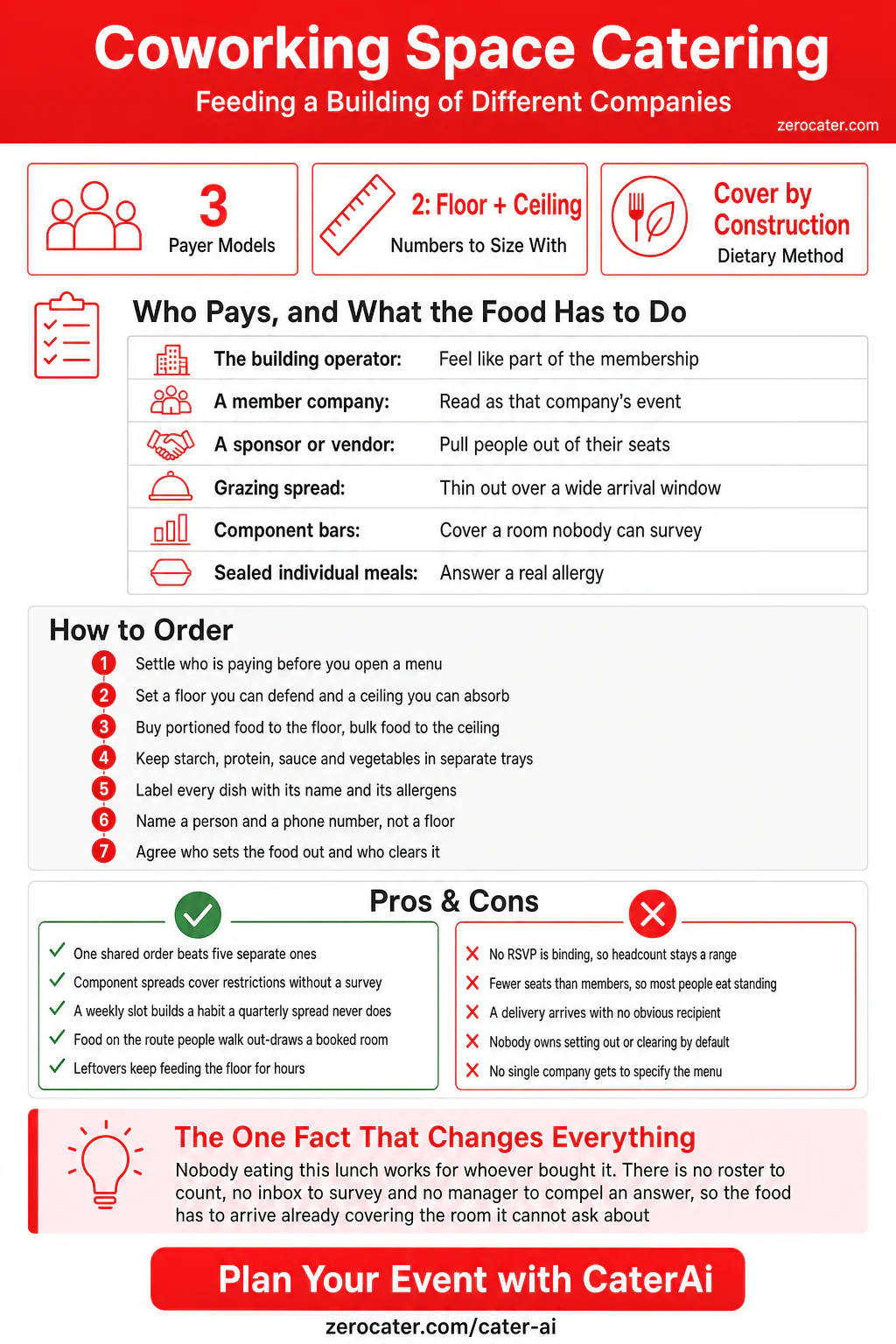
In a single-tenant office this question has one answer and nobody asks it. In a coworking building there are three answers, and the food each one buys looks different. Settle this before you open a menu.
The operator pays
The building feeds its members because food is part of what the membership sells, alongside the meeting rooms and the coffee. That money tends to repeat on a schedule rather than spike for one occasion, which is the most useful thing about it: a smaller spread every week beats a large one every quarter, and the operator generally knows that already.
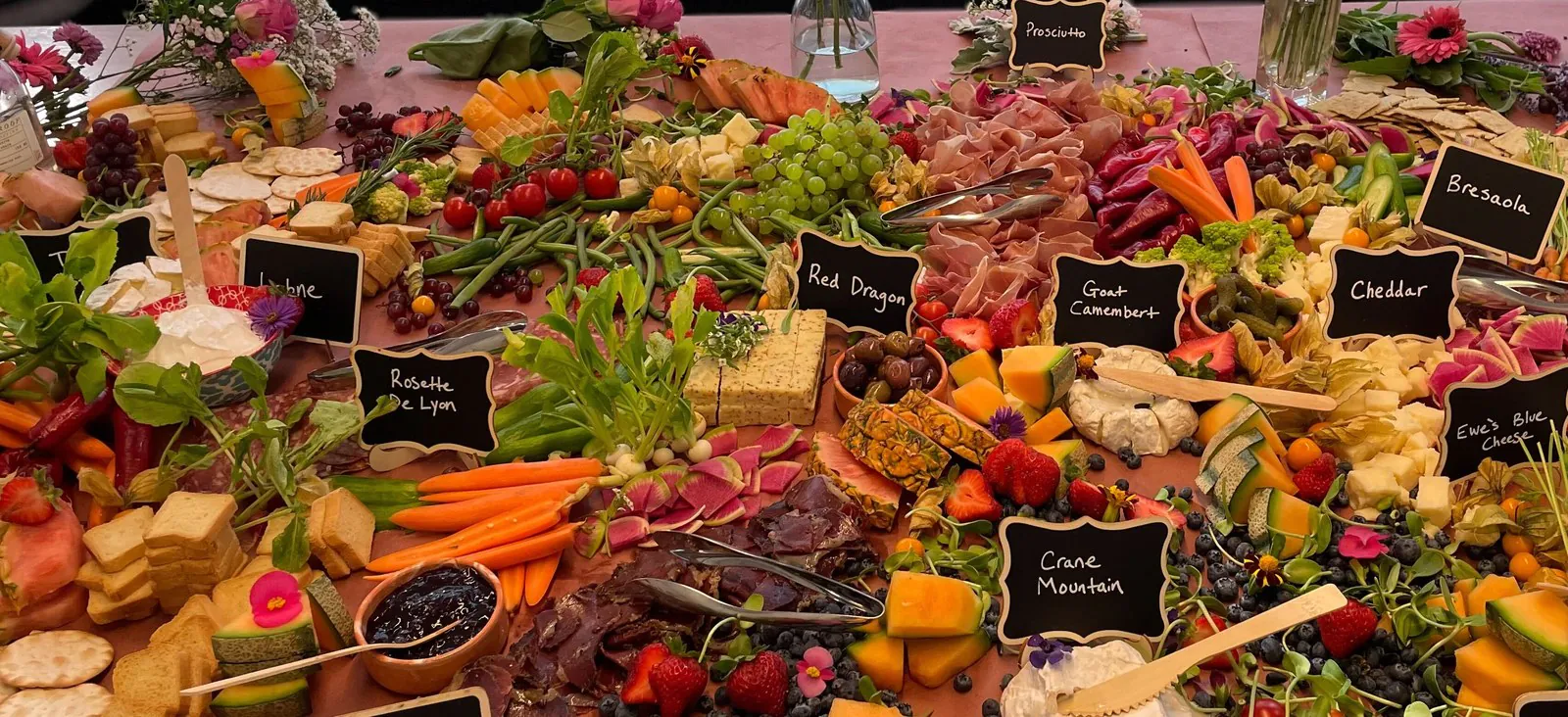
The brief here is grazing rather than dining. People should be able to pass the table, take something, and carry on. Leftovers belong to the building, so food that survives a couple of hours on a counter earns its place over food that has to be eaten in the first twenty minutes.
A member company pays
One company inside the building is hosting: a client meeting, a launch, a team offsite in a room they booked for the day. They are paying, so the food should read as theirs even though it sits in a shared space. That usually means a defined area rather than the main counter, and a menu that matches the occasion instead of the building’s usual rotation.
Leftovers belong to whoever paid, and this causes more friction than it should. Agree upfront whether the surplus goes back to that company’s suite or onto the community table, because the default in a shared building is that anything left on a counter belongs to everyone.
A sponsor pays
A vendor, a recruiter or an investor buys the food in exchange for twenty minutes in front of the room. The food is the draw, so it has to pull people out of their seats rather than reward the ones already standing there. Something warm and fragrant does that better than a cold platter, and something people have to queue for keeps them in the room long enough for the sponsor to get what they came for.
The spend usually caps low, because the sponsor is buying attention rather than catering an event. Our budget-friendly office lunch guide covers how to get volume out of a small order, and the ratio holds here: a hot tray of something braised feeds three times the room that the same money spent on individually packed meals will.
Quick comparison table
| Who pays | What the food has to do | Format that fits | Where it goes wrong |
|---|---|---|---|
| The operator | Feel like part of the membership, every week | Grazing spread on the main counter, labelled | One big quarterly spread nobody plans around |
| A member company | Read as that company’s event, in a shared room | Defined table or booked room, matched menu | Nobody agrees who owns the leftovers |
| A sponsor | Pull people out of their seats and hold them | One hot item with a short queue | Cold platters that only the front row notices |
Sizing an order when nobody owes you an answer
A manager can put a lunch on the calendar and read the acceptances. Nobody in a coworking building has that power over anybody else, so the sign-up sheet undercounts and the member roster overcounts. Neither number is the one you want.
Order against two numbers instead. The floor is what you can defend: the people who put their names down, plus the teams who turn up to everything. The ceiling is the number you could absorb without placing a second order. Buy to the floor on anything portioned and expensive, and to the ceiling on the cheap bulk items, which means bread, rice, salad, fruit and whatever the caterer sells by the tray.
That split matters because of how the two failure modes feel. A spread that thins out over an hour looks like a spread that people enjoyed. A boxed order that runs out at person forty looks like somebody made a mistake, and the person holding the empty box works for a different company and will tell their whole team about it. Our boxed lunch versus buffet comparison covers the trade in full, and in a shared building it leans harder towards the shared format than it does in a private office.
Building a menu for a room you cannot survey
Every dietary guide assumes one thing: that you can ask. Send a form, collect the answers, brief the caterer. In a coworking building that chain breaks at the first link, because you have no list of the people who will show up and no standing to ask them anything.
So cover by construction rather than by survey. Three moves do most of it.
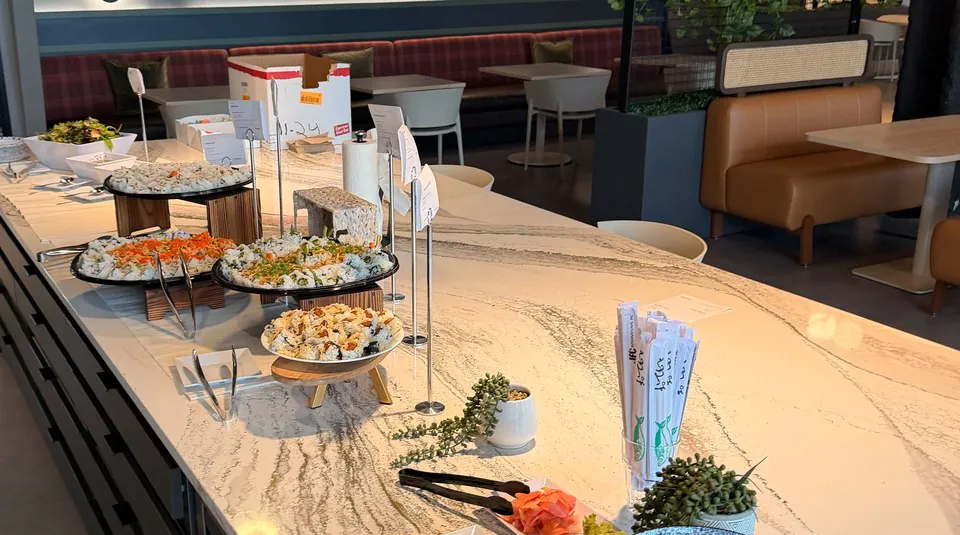
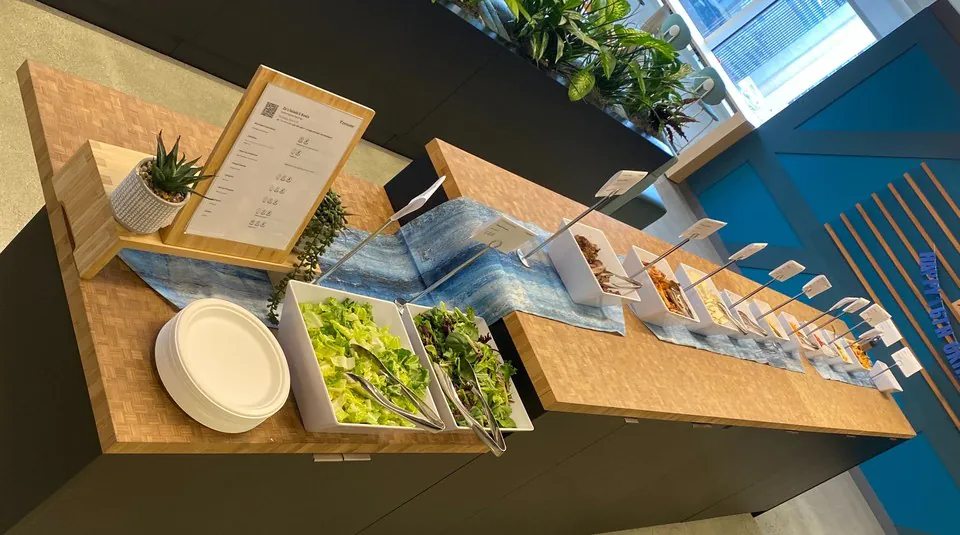
Separate the components. Starch in one vessel, protein in another, sauce in a third, vegetables in a fourth. A room that assembles its own plate solves most restrictions without anyone declaring one out loud, which matters more here than in an office where people already know each other. A salad bar or a sandwich bar is the same idea with a different centre.
Label everything. Dish name and allergens, on a card, in front of the dish. This is the cheapest thing on the list and the one people skip. In a single-tenant office somebody can shout a question at the person who ordered. On a coworking floor there is nobody obvious to ask, so a guest who cannot identify a dish walks past it.
Put a full meal in each lane. Not a token side. One substantial dish that a vegan can make a lunch out of, and another that works for someone avoiding gluten, both placed in the middle of the flow rather than at the end where they read as an afterthought. Our vegetarian, gluten-free, dairy-free, halal and kosher guides each cover what a real version of that dish looks like. Where a genuine allergy is in play, sealed individual meals remain the only honest answer, and they are worth ordering alongside the spread rather than instead of it.
Mediterranean kitchens land this without being asked, because the food already arrives as parts. Look at Mediterranean caterers such as Hummus Kitchen in New York, Olive Mediterranean Grill in Chicago and Lazeez Mediterranean Foods in Austin. Indian kitchens work the same way, with Kanak Indian Cuisine in Seattle, Tandoor Char House in Chicago and Curry Up Now in San Francisco all building catering around trays that get combined at the table.
The floor is a corridor, not a dining room
Most coworking buildings have far fewer seats than members, and the seats they do have are working desks that somebody paid for. The meeting rooms are booked. So the room you are feeding is a route rather than a venue, and people will eat standing, walking, or back at a desk with one hand on a keyboard.
That rules out a whole category of food. Anything that needs a plate in one hand and a fork in the other loses, along with anything that has to be cut, anything that drips and anything that goes cold in the ninety seconds it takes to carry it upstairs. Food you can hold wins: wraps, skewers, hand pies, filled breads, sturdy salads in cups, bowls with a lid.
Put it where people already walk. A counter on the route between the lifts and the coffee machine will out-draw a spread in a room people have to choose to enter, and the difference is not small. Our one-hand food guide and the happy hour appetiser list both work through what survives being eaten upright.
A delivery with no obvious recipient
A caterer arriving at a single-tenant office knows who the food is for. A caterer arriving at a coworking building finds a shared entrance, a desk that may or may not be staffed, and a floor full of companies with no idea an order was placed. Three things fix it, and none of them cost anything.
- Give a name and a phone number, not a floor. Whoever runs the space is the recipient, and the caterer should be able to call that person from the street.
- Ask for a window, not a minute. A shared entrance with one goods route serving a dozen companies does not run on the clock, and a caterer who expects a fifteen-minute slot will be the one who is unhappy.
- Agree who sets it out and who clears it. In a building where the space belongs to nobody in particular, this is the job that goes undone, and a counter of empty trays at four in the afternoon undoes an otherwise good lunch.
When the order is going in on a short clock, our last-minute catering guide covers which formats still ship, and the answer holds here as well: hot trays and bakery orders move fastest.
Plan a coworking lunch order with CaterAi
Make it a rhythm, not an event
Attendance is voluntary in a coworking building, so the food has to earn its audience twice: once when somebody decides to walk over, and again the following week when they decide whether it is worth doing that. A quarterly spread never gets the second chance. A weekly slot at the same hour does.
Pick the slot and defend it. Then rotate the kitchen inside it so the rhythm holds and the menu does not repeat. A bakery week, a Mediterranean week, a taco week and a bowl week give you four lunches that feel unrelated on a similar budget. Morning formats suit a shared building, because a pastry and coffee spread runs itself for two hours and catches people as they arrive rather than competing with whatever they already planned for lunch. Our office breakfast guide covers the formats.
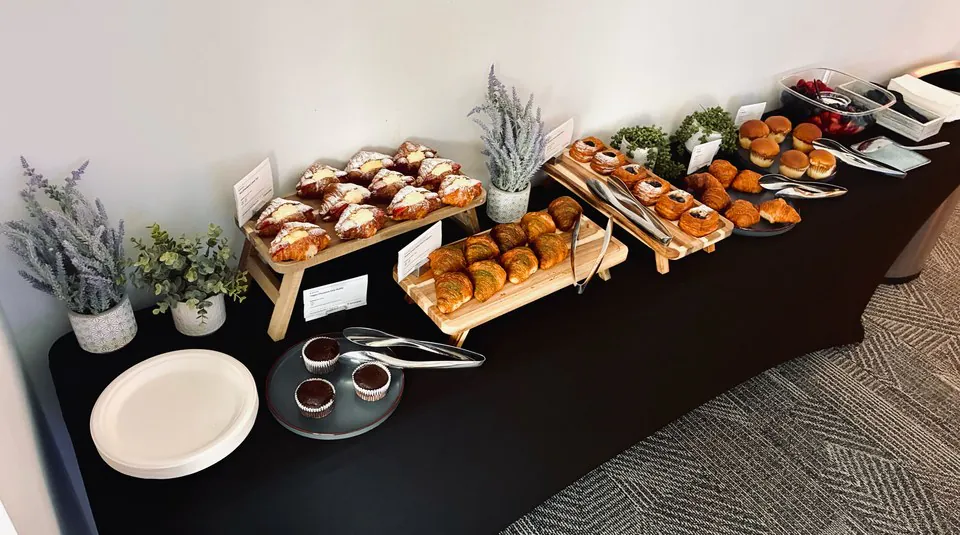
Bakery-led kitchens carry this format well. Eltana in Seattle, Holy Bagel in Chicago, Rosen’s Bagels in Austin and Braid Bakery in San Francisco all cater morning orders at building scale.
Formats that hold up in a shared building
The grazing table. The default for an operator-funded spread. It carries labels without looking fussy, it empties without looking raided, and it holds for the wide arrival window a coworking floor produces. Our grazing table guide covers the build. La Fromagerie in San Francisco is a good example of a kitchen that assembles these at scale.
Taco and bowl bars. Components in trays, assembled by the guest, which solves the survey problem and the standing problem at once. Look at Mexican caterers including Tio Luis Tacos in Chicago, El Xolo Tacos in Austin and Al Horno Lean Mexican Kitchen in New York, or bowl-led kitchens such as Ranch Hand Organic Bowls and Public Grains.
Sealed individual meals. The right call for a member company’s client meeting, for a genuine allergy, and for any order that has to travel to a booked room rather than sit on a counter. They cost more per head than a tray, so use them where the accuracy is worth paying for. Our boxed lunch cost guide covers what moves the per-unit price.
Salad and greens counters. The format that survives longest on a counter and the one that covers the widest set of restrictions with the least explanation. Global Greens in New York and Saucy Greens Salad Shop in Los Angeles both build catering around it.
Hot trays from a single kitchen. The cheapest way to fill a room, and the format that pulls people out of their seats for a sponsor. Braises and stews over rice give the most volume for the money, and they hold heat through the long arrival window. Lebanese Bowl in Chicago, Locali Mediterranean in San Francisco and The Curry Cartel in Austin all ship this way. For a building that wants something less familiar, Southeast Asian kitchens travel well.
If one member company is hosting guests rather than feeding the building, the brief changes and our client appreciation catering guide covers it, along with the onboarding lunch guide for the day a member company brings new people into a building they do not know yet.
City cost guides
Coworking clusters in the same downtown cores where catering prices run highest, so the local number matters more than a national average. Our per-city guides break down what an office order costs in New York, San Francisco, Chicago, Austin, Seattle and Los Angeles. For a building running a standing programme, the office lunch ideas guide is the fastest way to fill a rotation.
How CaterAi handles a shared building
The awkward part of coworking catering is the sourcing. One building may want a bakery order on Tuesday, a Mediterranean spread on Thursday and sealed meals for a member’s client meeting on Friday, which means three kitchens and three conversations for one week of food.
CaterAi takes the brief in chat, builds menus from the local partner network, and lets you edit by asking rather than by starting again. For a building putting food on a standing schedule, our corporate catering programmes handle the recurring side. For a member company hosting an event in the building, event catering is the better fit. If you are working out whether any of it applies to your space, how it works covers the basics.
Plan a coworking lunch order with CaterAi
Frequently Asked Questions
How do you order catering for a coworking space?
Settle who is paying before you look at a menu, because the payer decides the brief. A building that feeds its members wants something people can graze through over an hour. A member company hosting its own guests wants a meal that reads as theirs. A sponsor wants a reason for people to stand near them. Once the payer is fixed, size the order against a floor and a ceiling rather than a headcount, and pick a format that survives people arriving across a wide window.
How many people should you cater for in a coworking space?
Use two numbers instead of one. The floor is the count you can defend: the people who signed up, plus the teams who always come. The ceiling is the number you could absorb without a second order. Buy to the floor on anything portioned, and to the ceiling on the cheap bulk items such as bread, rice, salad and fruit. A spread that gets picked over beats a boxed order that runs out at person forty.
Who pays for catering in a coworking space?
One of three parties, and they want different things. The operator pays when the food is a building amenity, and that budget usually repeats on a schedule rather than spiking for one event. A member company pays when it is hosting a client meeting, a launch or its own team, and it owns the leftovers. A sponsor or vendor pays for access to the room, which makes the food a draw rather than a meal.
How do you handle dietary needs when you cannot ask everyone?
Cover by construction instead of by survey. Keep starch, protein, sauce and vegetables in separate vessels so people assemble what suits them. Label every dish with its name and its allergens. Make sure one substantial dish in the middle of the table works for a vegan guest and another works for someone avoiding gluten, and place both in the flow rather than at the end. Our mixed dietary needs guide covers the labelling brief to give a caterer.
What food works best in an open coworking floor?
Food people can eat standing, holding one thing, without cutting anything. Wraps, skewers, hand pies, filled breads, sturdy salads in cups and anything on a stick. Skip food that needs a plate in one hand and a fork in the other, because most of the room has nowhere to sit and half of them will carry lunch back to a desk.
Should coworking catering be a weekly programme or a one-off event?
A weekly slot beats an occasional large spread when attendance is voluntary. People only build a habit around something that lands at a predictable hour, and a habit is what turns food into an amenity members notice. Rotate the kitchen inside the slot so the rhythm stays and the menu does not repeat.
How do you get a catering delivery into a coworking building?
Name a person, not a floor. A coworking delivery usually has no obvious recipient, so give the caterer the name and phone number of whoever runs the floor, and give them a window rather than an exact minute. Agree in advance who sets the food out and who clears it, because in a shared building that is nobody’s job by default.
Can one order cover several companies in the same building?
Yes, and it is usually cheaper than each company ordering separately, because one larger order carries one delivery instead of five. The trade is that no single company gets to specify the menu. Run it as a shared spread with labelled components, and let any company that needs something specific for a client meeting order that separately.