Doors open at five. By twenty past, eleven of your clients are standing in the room
holding a drink in one hand and a business card in the other, and the caterer has laid out
a beautiful tray of sliced steak that needs a knife. Nobody eats it. The account manager
you brought along has been in the buffet line twice, because she came straight from a
client call and skipped lunch.
You have run a dozen catered events for your own team and every one of them went fine.
This room breaks the habits those events taught you, because the people in it do not work
for you.
This guide covers what changes when your guests are customers: how to build dietary
coverage into the default menu when you cannot send anyone a survey, how to order against
an attendance curve rather than an RSVP list, why one-hand food is a hard constraint,
how to keep your own staff fed and working, and when a small dinner beats a reception.
The Guest List Changes Every Input
Start with what you normally rely on. For an internal event you count the team, send a
form, pick a date everyone can make, and feed the room. Our
corporate event catering checklist
runs that sequence end to end and it works. Point it at a client event and four of its
inputs go missing at once.
| Client appreciation event | The internal event you are used to | |
|---|---|---|
| Dietary information | No channel to ask, so it lives in the menu | Collected in the invite form |
| Attendance | RSVPs soften, arrivals spread over an hour | Close to the headcount you counted |
| Who eats | Guests. Your team is hosting | Everyone in the room |
| What the food says | It reads as a statement about your company | It reads as a perk |
| Budget owner | Sales or marketing, spent per relationship | People or facilities, spent per head |
| Worst failure | A guest stands there with nothing they can eat | You run out and people complain |
Read the last row twice. Your colleague who finds nothing on the table will say so, eat
later, and forget it. A client who finds nothing will smile, hold an empty glass for forty
minutes, and leave with that as the memory of your company.
You Cannot Survey This Room
Every dietary guide on this site opens the same way, including our own guide to
ordering for mixed dietary
needs. Send the form, tally the answers, order against the tally. That method needs a
channel you do not have here. Adding a food-preferences field to a client invitation reads
as intrusive, most guests skip it, and the ones who answer are not a sample you can order
against.
So you move the coverage. Instead of ordering a standard menu plus three labeled special
plates, you build a default menu that a vegetarian, a vegan, a gluten-free guest and
somebody avoiding pork can all eat without asking anyone a question.
A labeled special plate makes a guest announce a
restriction in front of a prospect. That is the part people miss. At an internal
lunch, walking to the tray marked “vegan” costs nothing, because the room already knows.
At a client event you have asked a customer to identify themselves in a room of near
strangers before they have eaten anything. Build the restriction into the default and
nobody has to say a word.
Four defaults that carry most of the room
- Lead with a Mediterranean or mezze base. Hummus, marinated vegetables,
olives, grilled halloumi, dolmas and good bread cover vegetarian, most vegan and most
halal eaters out of the ordinary menu. Our
charcuterie station guide and
the grazing table guide
both cover how to build the spread. Vendors like
Zaatar
Mediterranean in San Francisco,
Kali Greek Kitchen in
Palo Alto and Pita Central in Denver
build this way as standard. - Keep the starch separate from the protein. Skewers beside rice, or
grilled vegetables beside flatbread, let a gluten-free guest assemble a plate without
flagging anything. A composed sandwich gives them nothing. - Put one hot vegetarian item at the centre of the table. Not at the
end, and not in a smaller dish. Guests read placement, and a vegetarian item off in the
corner tells a vegetarian guest what the host thinks of them. - Skip pork in the shared items. Put it in one clearly separate dish if
you want it. Pork inside a mixed platter removes the whole platter for several groups of
guests at once, which the halal and
kosher guides both explain.
Allergies stay a different problem. Coverage in the default menu handles preference and
practice, and it does not handle a diagnosed allergy, because that needs sealed and
labeled food with a known ingredient list. If you know a specific guest has one, order
them an individual sealed meal and hand it over quietly at the door. The
allergy-safe boxed lunch guide covers the
protocol, and our note on
food allergies at
work covers the cross-contact basics.
Order Against the Arrival Curve, Not the RSVP List
Forty people accept. Twenty-eight walk in, and they walk in across a full hour rather
than at five o’clock. Your own eight staff arrive early and stay the whole time. That is
the real shape of a client event, and an order built on the number forty gets it wrong at
both ends of the evening.
Three adjustments handle it.
- Split the headcount into two numbers. Your own team is a known
quantity, so count them exactly. Discount the external acceptances and order the food
against that discounted number plus your staff. The size of the discount tracks how well
the event is anchored: a lunch tied to a meeting people already fly in for holds almost
everyone, and a Thursday evening drinks invitation with no agenda holds far fewer. - Front-load the visible volume. A table that looks generous at ten
past the hour is worth more than a table that still has food at the end. Ask the caterer
to stage the spread full and hold a replenishment tray in the back, rather than laying out
everything at once and watching it thin. - Order abundance in the cheap items and restraint in the expensive ones.
Bread, marinated vegetables, olives, crudites and dips fill a table for very little.
Carve the count back on the items priced per piece. Guests read the table, not the
invoice.
The office catering budget guide
covers the per-head math, and the cost guides for
San Francisco,
New York,
Chicago and
Boston give current ranges by city.
Everything Should Be One-Hand Food

Your guests are standing, holding a glass, shaking hands and swapping cards. They have
one hand free and roughly three seconds to commit to a piece of food. That constraint does
more to shape a client event menu than cuisine or budget does.
What works: skewers, sliders, arancini, croquettes, spring rolls,
crostini, dumplings, empanadas, cheese cubes, grilled halloumi, anything on a stick, and
anything a guest can eat in one or two bites without looking at it. Our guides to
finger food and
happy hour appetizers cover the range,
and the party tray guide covers
how the formats price out.
What to cut: anything needing a knife, saucy items that drip on a suit,
long pasta, whole chicken pieces on the bone, salads that need tossing, and soup. Carving
stations look impressive in a photograph and they create a queue where guests stand facing
away from each other, which is the opposite of what you booked the room for.
Give the plates the same attention. Small plates keep guests moving and make the table
look fuller. Large dinner plates invite people to load up once, find a corner and sit
down, and a client event where everyone is seated in corners has stopped working.
Your Own Team Is Working, Not Eating
Count the hosts separately and then feed them separately. Your account managers are
there to talk to customers, and every minute one of them spends in the food line is a
minute a client stands alone. The version of this that embarrasses people is the account
manager holding a full plate when the client she was assigned to walks in.
Set a simple standard and tell the team before the event:
- Feed the staff before doors. Order a small team meal for an hour
ahead, or bring in boxed meals for
the crew. Nobody hosts well while hungry. - Nobody from the host team queues while guests are arriving. The first
forty minutes belong to the guests. - Name someone to watch the table. One person tracks what is running
low and talks to the caterer, so the rest of the team never has to think about it. Our
office manager guide covers
the day-of ownership pattern.
Pick the Format From the Guest Count
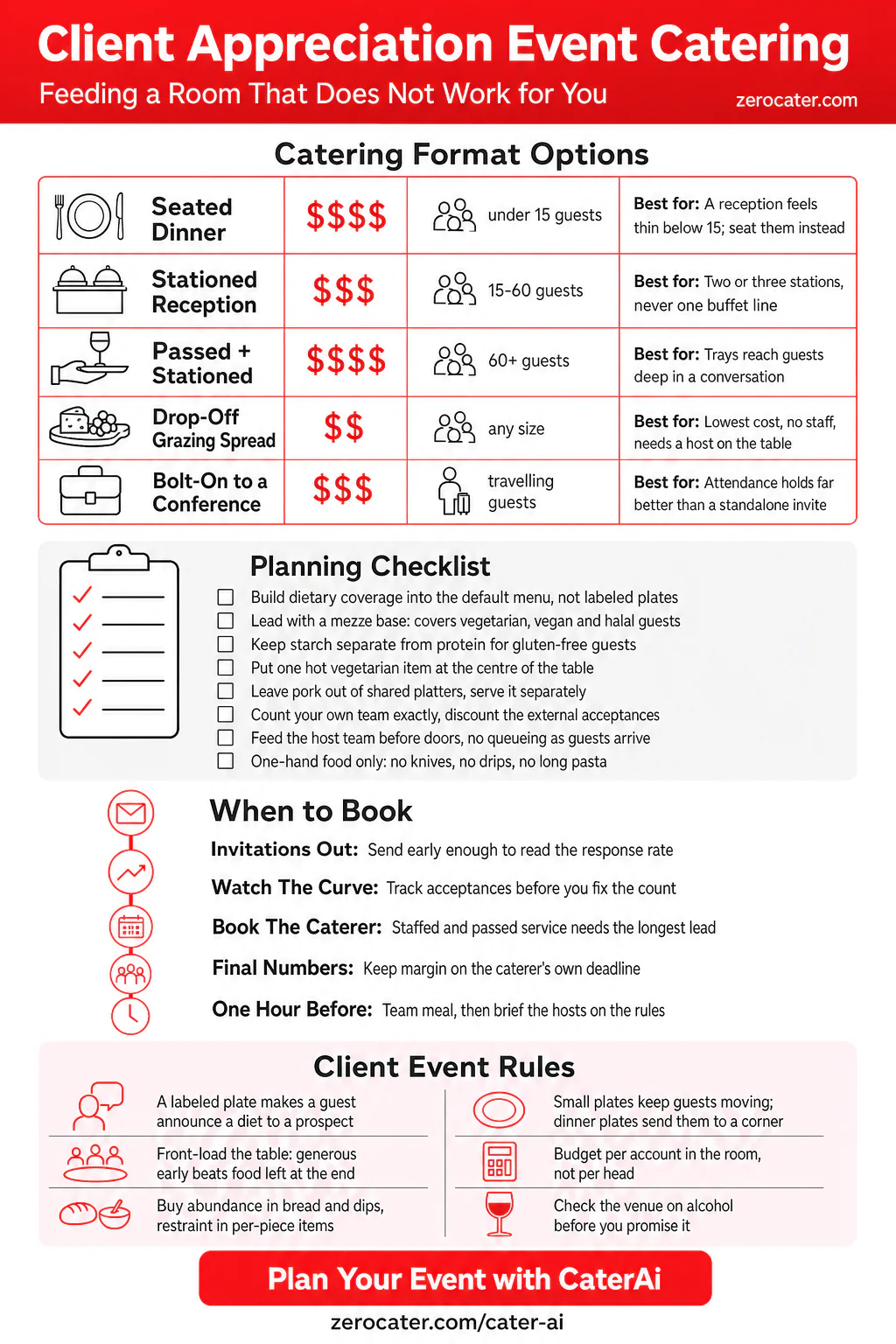
Guest count decides the format, and it decides it more firmly than budget does.
Under fifteen guests: book a dinner instead
A reception for twelve people feels thin no matter how good the food is, because a
standing format needs enough bodies to create small groups. Seat them. A dinner for twelve
lets everyone talk, gives your team a natural seating plan, and you can ask about dietary
needs directly at that size, since a personal note to twelve invited guests reads as care
rather than paperwork. The board meeting catering
guide covers small-room service.
Fifteen to sixty guests: stationed reception
Set two or three stations rather than one line. A single buffet at this size creates one
long queue and one conversation. Two stations at opposite ends of the room keep guests
circulating and give your team an excuse to walk someone across to the other side. Build
one station around the mezze base, one around hot bites, and put drinks somewhere separate
from both, since a drinks table adjacent to a food table jams the whole corner.
Sixty or more guests: passed plus stationed
Above sixty, stations alone leave a third of the room standing empty-handed while the
rest queue. Add passed trays. Passed service costs more because it needs staff, and it
solves the problem stations cannot: the food reaches the guest who is deep in a
conversation and will not break it to walk anywhere. Keep the stationed spread for volume
and use the passed trays for the items you actually want people to notice.
For a larger or multi-city programme, the event guides for
San Francisco,
New York,
Chicago and
Austin list caterers who staff
passed service.
Budget It Per Relationship, Not Per Head
An internal catering budget divides by the number of people. A client event budget
divides by the number of accounts in the room, and those two numbers produce very
different menus at the same total spend.
Twenty-five clients from eleven accounts is a small room with real revenue attached.
Spending the same per person as a team lunch is the wrong call, and so is spending it on
volume. Fewer, better items win: one thing on the table that a guest asks about is worth
more than three more trays of the same. Buy the good cheese, the proper bread and one
memorable hot item, then fill the rest of the table with inexpensive abundance.
Two operational notes that catch people out. Sales or marketing usually owns this line
rather than facilities, which means a different approval path and a different lead time, so
confirm who signs before you brief a caterer. And check with your venue on alcohol before
you promise it, because the rules on serving depend on the venue and the jurisdiction, and
the answer is not the same as the one for your office holiday party. The
holiday party planning guide works
through the alcohol decision in depth.
A client appreciation reception works well when: you
have twenty or more guests from several accounts, the goal is relationship time rather than
a presentation, your team can host at roughly one person per three guests, the venue lets
guests move between two or three stations, and you can build the menu so the default items
cover the common restrictions. It also works well as a bolt-on to something guests already
travel for, like a conference or a user group, because the attendance holds far better
than a standalone invitation.
It is the wrong format when: fewer than fifteen
guests are coming, where a seated dinner does more for the same money; the point of the
event is a demo or a talk, since standing guests with food cannot watch anything; your
whole team is client-facing and nobody is free to host; the room only fits one food table,
which turns the evening into a queue; or the guest list is one major account, where a small
dinner reads as attention and a reception reads as a mailing list.
Client Appreciation Event Catering With Zerocater
The hard part of a client event is ordering well for a room you cannot survey.
CaterAi builds a menu from a network of more than a thousand
restaurants and lets you adjust it by chatting, so asking for a spread where the default
items already cover vegetarian, vegan and gluten-free guests is a message rather than a
research project. For the staffed and passed version,
event catering handles service and
timing, and corporate catering keeps your
preferences on the account if you run these on a quarterly rhythm. If you are booking your
first one, how it works is the short version.
Client events sit next to a lot of neighbouring occasions. The
holiday party,
offsite and
company picnic guides cover the
internal versions, and the
event catering checklist has the
general run-of-show. For menu building, see the guides to
charcuterie,
finger food and
catering
ideas beyond pizza and sandwiches. For the dietary defaults, the
vegan,
vegetarian,
gluten-free and
dairy-free guides cover what each group can
actually eat.
Frequently Asked Questions
What food works best for a client appreciation event?
One-hand food. Your guests are standing, holding a drink and shaking hands, so skewers,
sliders, croquettes, spring rolls, crostini, dumplings and anything on a stick get eaten,
while carved meat, saucy dishes, long pasta and salads that need tossing sit untouched.
Small plates work better than dinner plates, because they keep guests circulating instead
of settling into a corner.
How do I handle dietary restrictions when I cannot survey the guests?
Build the coverage into the default menu rather than into labeled special plates. A
mezze or Mediterranean base covers vegetarian, most vegan and most halal guests out of the
ordinary spread, keeping starch separate from protein covers gluten-free guests, and
leaving pork out of shared platters avoids removing a whole dish for several groups at
once. A labeled plate makes a guest announce a restriction in front of a prospect, and
building the coverage into the default menu spares them that.
How much food should I order when I do not know how many clients will show up?
Split the count in two. Your own team attends in full, so count them exactly, then
discount the external acceptances based on how well the event is anchored, and order
against the sum. Front-load the visible volume so the table looks generous early, and buy
abundance in the inexpensive items like bread, dips and marinated vegetables while
trimming the count on anything priced per piece.
Should my own team eat at a client appreciation event?
Feed them before doors, not during. Your account managers are hosting, and every minute
one of them spends in the food line is a minute a client stands alone. Order a small team
meal an hour ahead, then set the rule that nobody from the host team queues while guests
are arriving.
Is a reception or a seated dinner better for client appreciation?
Guest count decides it. Under about fifteen guests a reception feels thin, because a
standing format needs enough people to form small groups, so a seated dinner does more for
the same money. Between fifteen and sixty, a stationed reception with two or three separate
stations works best. Above sixty, add passed trays, since stations alone leave part of the
room queueing while the rest stand empty-handed.
How far ahead should I book catering for a client appreciation event?
Work back from the invitations rather than from the event. Send invitations early enough
to read the response rate, then book the caterer once you can see how the acceptances are
landing, keeping a few days of margin before the caterer’s own deadline for final numbers.
Staffed and passed service needs a longer lead time than a drop-off spread, so confirm that
requirement first.
Should we serve alcohol at a client appreciation event?
Check with the venue before you promise it. The rules on serving depend on the venue and
the jurisdiction, and the answer for a client event is not automatically the same as the
one for an internal party. Either way, put a proper non-alcoholic option on the
table rather than soft drinks alone, because guests who do not drink notice.
How do I budget for a client appreciation event?
Divide by accounts in the room rather than by heads. Twenty-five guests from eleven
accounts is a small room with real revenue attached, so fewer and better items beat more
volume. Buy the good bread, the good cheese and one memorable hot item, then fill the rest
of the table with inexpensive abundance. Confirm who owns the budget line first, since
sales or marketing usually signs for this rather than facilities.