You book the room in March. In June the venue emails over its catering policy, and the caterer you had in mind is not on it.
That email is the moment most people discover the rule they already agreed to. A venue somebody else runs comes with a clause about food, and the clause was settled when you signed for the space. By the time anyone opens a menu, the field has already narrowed to one company, to a short list, or to whoever survives a document check.
This guide covers events you hold in a building you do not control: conference centres, hotels, museums, university rooms, galleries, members’ clubs and hired lofts. Whether the venue lets you in at all is a separate question from what to serve once you are in, and the second question is the easy one.
Two neighbouring guides pick up either side of this. Our offsite and retreat guide covers what to ask a venue during the walkthrough. The corporate event catering checklist covers the planning calendar once the caterer is settled. This one stays on the clause.
Plan corporate event catering with CaterAi
Three policies, and the venue picked one before you arrived
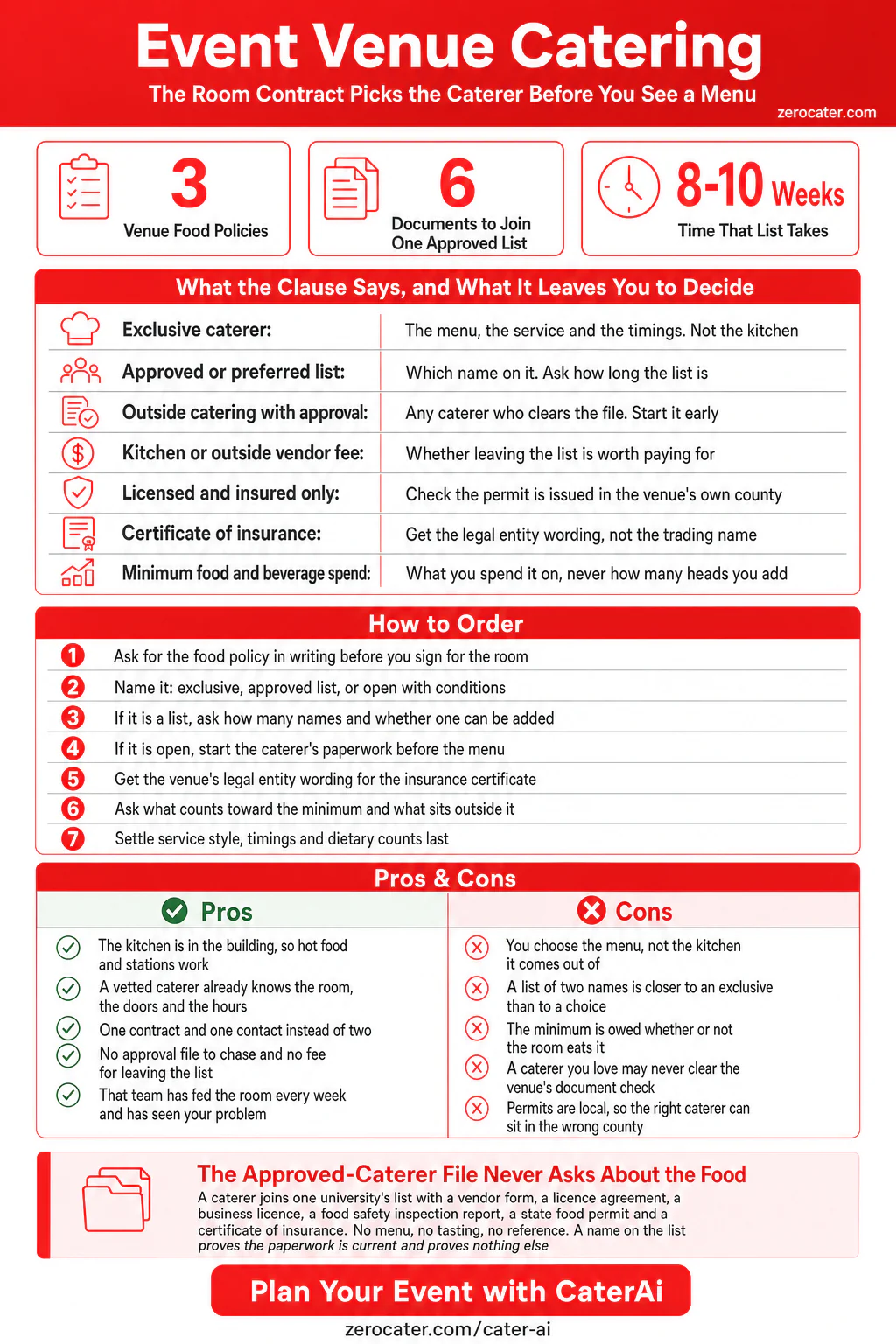
Every venue food policy resolves to one of three, and the wording varies more than the substance.
- Exclusive. One company holds all food and drink in the building. Outside food is barred, sometimes with a penalty attached. The Moscone Center states it in one line: a single named hospitality company provides all food and beverage for the centre. You choose the menu. You do not choose the kitchen.
- Approved or preferred list. The venue keeps a set of caterers it has vetted and contracted, and you pick from it. Lists run from two names to forty. Some venues will consider adding a caterer you bring them, and some will not.
- Open, with conditions. Any caterer may work there once they clear the venue’s requirements, which means paperwork and often a fee. This is the most freedom you get, and it is also the version that puts the most work on you.
The class of building predicts the answer well enough to plan around. Convention centres and hotels lean exclusive, because food and drink revenue is part of what pays for the room. Universities, museums and civic buildings lean toward lists, because they care about who is on site and want the vetting done once. Raw spaces, lofts, galleries and outdoor sites lean open, because they have no kitchen and no catering revenue to protect.
Ask for the policy in writing before you sign for the room. A venue that answers this in a phone call and not in the contract is a venue that can change its mind in April.
The approved-caterer file never asks about the food
The thing that surprises people is what a venue actually checks. George Mason University publishes its approved-caterer requirements in full, and the list is worth reading once because it is representative of the class. To join the list a caterer files a vendor registration form, a signed licence agreement, a current business licence, a current food safety inspection report, a state food establishment permit, and a certificate of insurance naming the university as an additional insured. Two more land on top if they serve alcohol or work one specific building. The university tells applicants to allow eight to ten weeks.
Count the requirements and notice what is missing. Not one of them asks what the caterer cooks. There is no menu, no tasting, no reference, no sample event. A caterer who has never made anything memorable clears that file. A brilliant one whose county permit lapsed last month does not.
Two consequences follow, and both are useful.
- The list is a compliance record, so read it as one. A name on an approved list tells you that caterer’s paperwork is current. It tells you nothing about the food. Ask the venue’s events team which of the names they actually enjoy working with, and ask the caterer for a menu from a recent event in that room.
- Permits are usually local, so a caterer’s home county matters. Mason will not take an out-of-state permit. Plenty of venues follow the same rule. A caterer twenty minutes away in the wrong jurisdiction can be harder to approve than one an hour away in the right one.
The certificate of insurance sets the date you decide by
An open policy sounds like freedom until you look at the paperwork. Nearly every venue that permits outside caterers wants a certificate of insurance. The certificate has to do one specific thing: name the venue’s legal entity as an additional insured. That is not a box the caterer ticks. Their insurer issues an endorsement, and the endorsement takes days.
Three details cause most of the trouble.
- The legal entity is not the trading name. The building markets itself as one thing and holds its lease as another. Get the exact wording from the venue and pass it to the caterer verbatim.
- Some venues want the endorsement, not the certificate. A certificate summarises cover. An endorsement is the document that adds the venue to the policy. Venues that know the difference will ask for the second one.
- Documents have to be current on the event date. A permit that expires the week of your event fails on the day even though it passed when you filed it.
So the date you have to decide by sits earlier than any kitchen’s order cutoff. A caterer can cook for you next week. A venue cannot approve one in that time, and a venue that vets caterers as a standing programme takes far longer. Settle the policy question in the same conversation as the room.
A minimum is a floor on spend, not a price per head
Where the venue holds the food contract, it usually attaches a minimum. The number is a floor on what you spend with the in-house kitchen, and you owe it whether or not the room eats that much. Book for eighty and seat sixty, and the floor does not move down to meet you.
Read that as budget you have already committed. The lever is what you spend it on.
- Spend up, not out. A better main, a proper dessert round, a mid-afternoon break, coffee that runs all day. Adding people you do not have is the one move that never works.
- Ask what counts. Room hire, equipment and staffing often sit outside the floor even when they appear on the same invoice. Get the list of what applies before you plan against the number.
- Ask when it is set. Some venues fix the floor by room and date, so a Tuesday in a smaller room carries a smaller one. Moving the date is sometimes cheaper than filling the gap.
If the budget binds harder than the venue does, our budget office lunch guide covers where the money goes furthest. The office lunch ideas guide has formats that scale up without scaling the price.
What you still decide when the caterer is chosen for you
An exclusive removes one decision and leaves the rest with you. People give up more than they need to here, so it is worth listing what stays yours.
- Service style. Stations, a single line, passed trays, seated service, or food that arrives boxed. The caterer is fixed. The shape of the service is not.
- Timing against the agenda. When doors open, when food lands, whether a break gets its own service point. Our event catering checklist covers building the schedule once these are agreed.
- Dietary coverage. Counts by category, restricted meals kept separate rather than folded into a shared tray, and labels on everything. Our gluten-free guide and mixed dietary needs guide both cover how to brief this.
- Service points. One line of two hundred people is a choice, and usually a bad one. Ask for the same food across two tables.
- What comes in that is not a meal. Many exclusives carve out a cake, a branded item or a supplier’s product sample, often with a fee or a form. Ask, because the carve-out is rarely advertised.
How to read the clause you are given
Venue contracts use a small vocabulary and it repays learning.
| The wording | What it means for you |
|---|---|
| Exclusive caterer / in-house catering only | One kitchen, no alternative. Negotiate the menu and the service, not the supplier. |
| Preferred or approved caterer list | Choose from the list. Ask how long it is and whether a new name can be added. |
| Outside catering permitted with prior approval | You can bring your own once the venue clears them. Start that clearance early. |
| Kitchen fee / outside vendor fee | The price of leaving the list. Ask whether it is per event or per head. |
| Licensed and insured caterers only | Check the permit is issued in the venue’s own jurisdiction, not just somewhere. |
| Certificate of insurance required | The venue’s legal entity has to be named as an additional insured. Get the wording. |
| Minimum food and beverage spend | A floor you owe regardless of headcount. Ask what counts toward it. |
| No outside food or beverage | Read it literally. It often catches the birthday cake and the sponsor’s samples. |
Plan corporate event catering with CaterAi
Formats that hold up under each policy
Match the food to the policy and to what the building can actually give you.
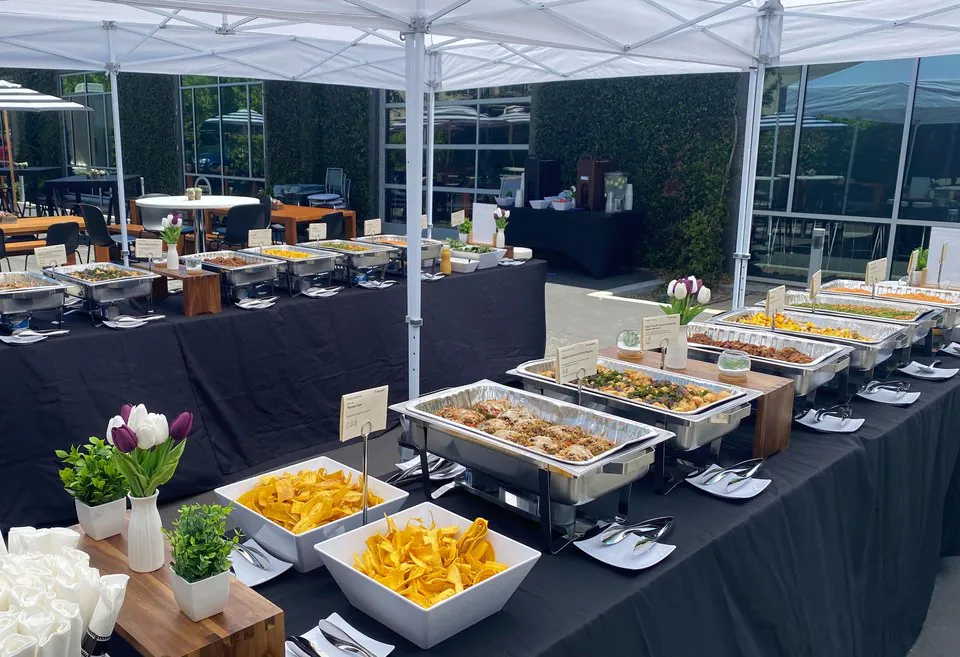
- Under an exclusive, spend the conversation on service rather than sourcing. The kitchen is in the building, so hot food holds and stations work. Ask for two service points and a break service, which is where the in-house kitchens earn their keep.
- Under a list, shortlist by what the caterers already do well instead of asking them to stretch. A caterer who runs Mediterranean spreads every week will beat one improvising them.
- Under an open policy with no kitchen, order food that arrives finished. Platters, boards, filled breads, salads and boxed meals all work with no power and no prep space. Our grazing table guide, party tray guide and canapes guide all cover spreads that need nothing from the room.
- For a conference or a training day, boxed meals move a room faster than a line does. The conference boxed lunch guide covers sizing and distribution.
- For an evening reception, keep it to one service style. Our happy hour appetizers guide lists spreads that hold for an hour without an attendant.
Where this overlaps with other events you run
Several nearby guides cover rooms with rules of their own. A coworking building has an operator whose approval you need before a delivery arrives. A property or tenant event runs on building management sign-off. A client appreciation event brings guests who do not work for you, which changes the order more than the venue does. And if the room came together at short notice, the last-minute catering guide covers what still ships on a tight turnaround. A board meeting held off site sits in the same category as everything above.
Who to order from when the choice is yours
Under an open policy, look for caterers who already deliver finished food in their own equipment and who have worked events rather than desks. South Paw Catering in Chicago and Bottles & Bites in San Francisco both run event work, Perfect Picnic in New York builds spreads designed to arrive complete, Tryst Trading Co. covers Washington DC, and MRKT Cafe Catering covers Los Angeles. Olive Mediterranean Grill in Chicago handles the cold mezze end. Browse the Mediterranean and Italian directories for more in your metro.
City cost guides
Per-head ranges move by metro, so start with the guide for yours: New York, San Francisco, Los Angeles, Chicago, Boston, Seattle, Austin, Denver, Dallas, Atlanta, Philadelphia and Washington DC.
How CaterAi handles a booked venue
Where the venue holds an exclusive, no ordering tool helps you and the in-house team is your caterer. Everywhere else, CaterAi is useful. Give it the venue address, the window and the constraints, and it builds menus from the kitchens that can work to them. Say the room has no kitchen and it drops the formats that need one. Say the food has to arrive finished and it filters to spreads and boxes. You edit the menu in the chat until it looks right, add staff if the venue needs an attendant on site, and check out.
For a run of events across a year, corporate event catering covers the repeating side, and corporate catering covers the office itself between events. If none of this is familiar yet, how it works is the short version.
Plan corporate event catering with CaterAi
Frequently Asked Questions
Can you bring your own caterer to an event venue?
Sometimes, and the room contract decides it rather than the caterer. Venues run one of three policies. An exclusive means one company holds all the food and drink and outside food is barred. An approved or preferred list means you choose from a fixed set of caterers the venue has already cleared. An open policy means any caterer can work there once they clear the venue’s document check, usually with a fee attached. Get the policy in writing before you sign for the room, because after that you are working inside whichever one you were given.
What is an exclusive caterer at a venue?
One company holds the contract for all food and drink in the building, and nobody else may serve there. Convention centres and hotels run this model most often, because the food and drink revenue is part of what pays for the room. The Moscone Center in San Francisco publishes the arrangement: one named hospitality company provides all food and beverage for the building. Under an exclusive you still choose the menu, the service style and the timings. You do not choose the kitchen.
What is a preferred or approved caterer list?
A fixed set of caterers the venue has already vetted and put under agreement, and you pick from it. The list exists because the venue wants vendors who carry the right permits and insurance and who know the building. Ask how many names are on it and whether any of them match the food you want, because a list of two is closer to an exclusive than to a choice. Ask as well what it takes to add a name, since some venues will run an application for a caterer you bring them and others will not.
What does a venue need from an outside caterer?
Documents, and more of them than most people expect. George Mason University publishes its approved-caterer requirements: a vendor registration form, a signed licence agreement, a current business licence, a current food safety inspection report, a state food establishment permit, and a certificate of insurance naming the university as an additional insured. Two more apply if the caterer serves alcohol or works one particular building. The university tells applicants to allow eight to ten weeks. Nothing in that file asks what the caterer cooks.
What is a venue minimum, and does the food have to reach it?
A minimum is a floor on what you spend on food and drink, and you owe it whether or not the room eats that much. It is not a price per head and it does not move when your headcount lands short. So treat the gap as budget you have already committed and spend it on the event: a better main, a mid-afternoon break, a dessert round, a coffee service that runs all day. Ask what counts toward the floor, because room hire and staffing often sit outside it.
How early do you have to choose a caterer for a booked venue?
Earlier than the caterer needs, because the venue’s approval runs before the order does. An additional-insured endorsement has to be issued by the caterer’s insurer with the venue’s legal entity named on it, and that takes days. Permits and inspection reports have to be current on the day, not on the day you sent them. Venues that vet caterers as a programme rather than per event can take weeks. Settle the policy question at the same time you settle the room.
Can you still handle dietary requirements if the venue picks the caterer?
Yes, and it is the part of the order you keep whichever policy you are under. Give the caterer counts by category rather than a list of names. Ask for the restricted meals plated or boxed separately rather than buried in a shared tray, and ask for every dish labelled at the table. An exclusive caterer feeds that building every week and has done all of this before. Our mixed dietary needs guide covers how to split the counts.
What is an outside catering fee?
The price the venue charges for letting a caterer who is not on its list work in the building. Some venues call it a kitchen fee or an outside vendor fee. It buys access to the space and sometimes to the kitchen, and it sits on top of what you pay the caterer. Ask whether it is charged per event or per head, whether it replaces the minimum or stacks on top of it, and what the caterer gets to use for it.