An office manager picks Noodles & Company for a team lunch, clicks the smaller of the two catering packages because the room has ten people in it, and stops thinking about headcount. That is a reasonable thing to do. The package is called Feed the Few, it says it feeds ten, and there are ten people.
The brand’s own serving documents do not support that number. Read the catering page, the printable catering menu and the catering nutrition sheet side by side and the pan inside that package is stated as an eight in every one of them. The ten appears once, on the front of the package, with nothing behind it.
There is a second thing in the order that is not what it looks like. The stainless rack the pans arrive in is not packaging. It is a loaner, the brand charges for it, and it pays you an entree to bring it back.
In this guide
- Why the pan, not the package, is the real unit on this menu
- The four places the brand states a headcount, and the one that disagrees
- The only package whose number matches its own serving sheet
- The Hot Food Hold Kit, and who is walking it back
- What the catering menu covers, and the two dishes it leaves off the sheet
- How to order Noodles & Company for a team
The pan is the unit, and the unit runs the order
Most chain catering menus hand you a mixed bag of units. A sandwich platter feeds twelve, a salad bowl feeds six, a dessert tray feeds twenty, and the first ten minutes of planning go on conversion. Noodles & Company does not work that way. Nearly everything hot on its catering list is a pan, and the pans all carry the same stated yield.
That is a real simplification. Planning a spread becomes one question asked over and over, which is how many pans your room needs. The catering page sells twenty pan dishes: thirteen from the Classic Noodles list, five from the Mac Menu, and two large salads. Every one of them is the same object in a different flavour.
The Classic Noodles list is where the range lives. Basil pesto cavatappi, buttery parmesan noodles, cajun shrimp fettuccine, chicken parmesan, chipotle chicken cavatappi, crispy chicken bacon alfredo, lemon garlic shrimp scampi, pad thai, pasta fresca, rigatoni rosa, spaghetti and meatballs, spicy korean steak noodles and tortelloni rosa. The Mac Menu adds buffalo chicken ranch, creamy cheddar with meatballs, garlic bacon crunch, a gluten-sensitive pipette version and pulled pork barbecue. If you are sizing a similar spread from an independent kitchen instead, the Zerocater directory pages for pasta catering and mac and cheese catering are the equivalent shelf.
The brand states that pan’s headcount four times
Here is where the simplification stops being simple. Noodles & Company publishes the pan’s yield in four separate places, and they do not all say the same thing.
| Where it is published | What it says a pan holds |
|---|---|
| The catering page FAQ | Feeds up to eight guests |
| The menu blurb on the same page | Feeds up to eight people |
| The printable catering menu, in the header above the Classic Noodles list | Feeds six to eight people |
| The catering nutrition sheet, beside every pan it lists | A stated serving unit of eight |
| The Feed the Few package, which contains one of those pans | Feeds ten |
Four of those five statements cap the pan at eight or fewer. The fifth is the one an office manager reads, because it is printed on the button you click.
The spread matters more than it looks. Between the low end of the printed range and the number on the package there is a difference of four people out of every pan, which is half again as many mouths from the same amount of food. Across a room of thirty that is the difference between three pans and four, and nothing on the page tells you which answer the kitchen used.
Feed the Few is the only package with no hedge on it
Look at how the three packages state their numbers, because the brand is careful in two of the three cases and not in the third.
| Package | Pans inside it | Headcount as printed |
|---|---|---|
| Feed the Few | One pan of noodles, or a large garden or caesar salad | Feeds 10 |
| Feed the Many | Two pans of noodles, or large garden or caesar salads | Feeds up to 20 |
| Mac & Cheese Bar | One pan of creamy cheddar mac, plus proteins, sauces and toppings | Feeds up to 10 |
Feed the Many hedges. The Mac Bar hedges on the catering page. Feed the Few states a flat ten on the page and a flat ten on the printable menu, with no qualifier in either place. It is the only package that commits to a number, and it is also the package sitting furthest from its own serving sheet.
The rest of the package points the same way. The printable menu states that one gallon of a drink pours eight servings, so the iced tea or lemonade inside Feed the Few is an eight as well. A pan that the sheet caps at eight, paired with a drink the menu caps at eight, sold as a meal for ten. The one line in that package that reaches ten is the dessert tray, and the dessert tray is the alternative to the drink rather than an addition to it. You get one or the other.
The garlic bread is the exception that proves the rest of the menu is honest. It states twenty-five servings, and the nutrition sheet’s pan row for it divides by about twenty-five. The two side salads state eight and divide by about eight. Every serving number on this menu is backed by a row on the nutrition sheet except one.
The pan is an eight. The package is a ten. Only one of those numbers has a serving sheet behind it.
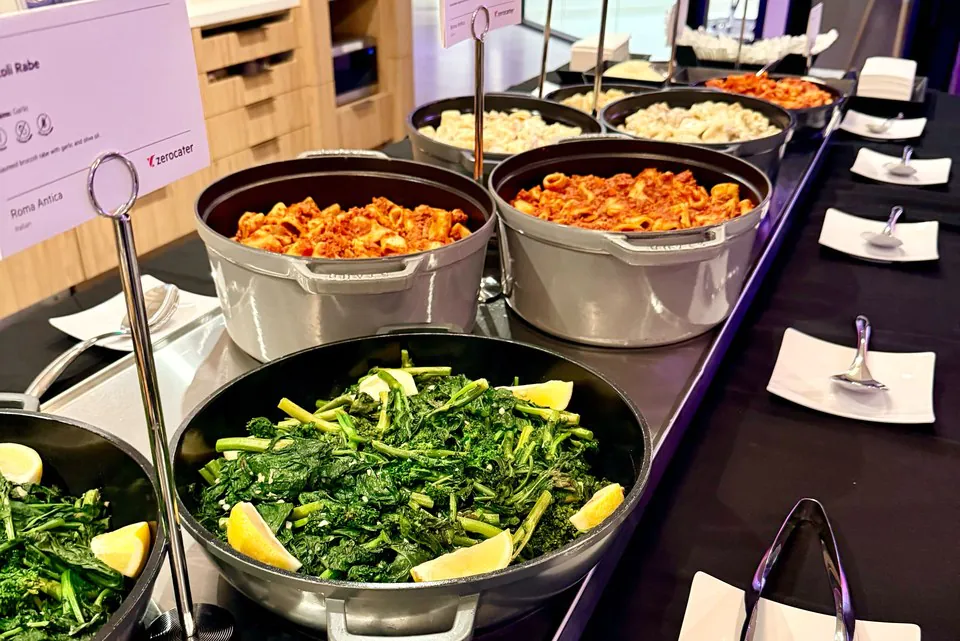
The Mac Bar’s ten is the only one the brand earns
There is one place on this menu where the ten is real, and the nutrition sheet shows why. Every Mac Bar row on that sheet states its serving unit as ten. Every pan row on the rest of the menu states eight. The two units sit a few lines apart in the same document.
The reason is structural rather than generous. A Mac Bar starts as one pan of creamy cheddar mac and then gets stretched. The package adds a choice of two proteins, two sauces and eight toppings, and the sheet prices each protein as its own line at the same unit of ten. Grilled chicken, marinated steak, oven-roasted meatballs, parmesan-crusted chicken, pulled pork, sauteed shrimp and seasoned tofu all appear separately. The brand notes that toppings vary by location.
So the Mac Bar reaches ten because there is more food in it than a pan. That is a coherent claim. The problem is that the two Noodles packages inherited the same headline number without inheriting the toppings that produce it. If you want a package whose number you can plan against without adjusting, the Mac Bar is the one on this menu. Formats built the same way are covered in our guides to build-your-own pasta bars and salad bar catering.
Build a pasta and mac and cheese spread with CaterAi
The Hot Food Hold Kit is a loaner, not packaging
Every hot catering order from this brand arrives sitting in something, and that something has a name and a price. The Hot Food Hold Kit is the stainless rack and heat source the pans sit in. Noodles sells it for a flat charge that is published on the catering page, and the same page states that returning it earns you a free entree.
That is an unusual arrangement. The brand is not selling you a disposable. It is lending you equipment, taking a deposit in the form of a charge, and paying you in food to bring the equipment back. Nothing else in a typical office catering order behaves this way. Foil pans go in the bin. Chafing racks from a caterer go back with the caterer. This one goes back with somebody from your office.
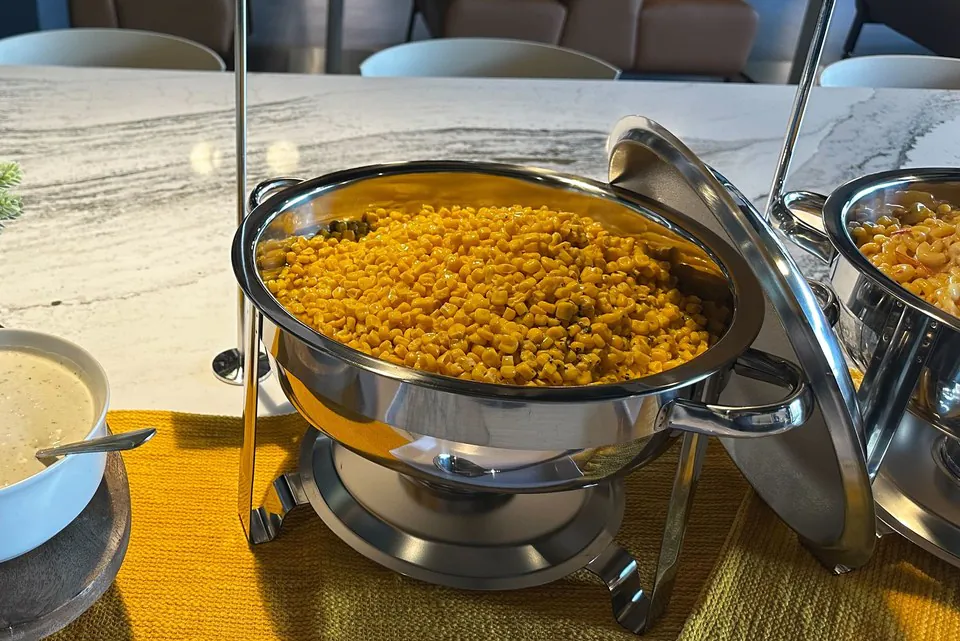
Inside the packages the kits scale one for one with the pans. Feed the Few contains one pan and one kit. Feed the Many contains two pans and two kits. The Mac Bar contains one pan and one kit. Order the larger package and you have two objects to return, not one.
This is worth settling before the food arrives rather than after. The return is a small errand, but it is an errand with a deadline attached to somebody’s afternoon, and it lands on whoever placed the order unless that person hands it off. For teams without a fixed office footprint the problem is sharper still, which is why coworking space catering and site catering both come with their own rules about what may be left behind.
Delivery includes set-up, and set-up is not clean-up
The catering page states a delivery fee that starts at a flat floor, and it states that the fee includes the convenience of set-up. Both facts are useful and the second one is easy to over-read.
Set-up on this menu means the racks going up and the pans going into them. It does not mean a return trip. The kit does not come back on its own, and the delivery fee does not cover collecting it. That is the gap worth naming out loud when you brief whoever is hosting the lunch, because “delivery includes set-up” reads like a full-service arrangement and it is not one.
Everything else in the order is disposable and included. The catering page states that every order comes with plates, forks, knives, napkins, cups and serving utensils. So the paper goods are not a separate decision, which removes one of the more common ordering mistakes before it happens. Our corporate event catering checklist covers the same ground for events where the equipment does not belong to the restaurant.
What the nutrition sheet covers, and what it leaves off
The catering page links two documents in its footer: a printable catering menu and a catering nutrition sheet. Both are worth opening, because they do different jobs and only one of them carries the serving units this post has been reading.
The sheet lists eighteen of the twenty pan dishes the menu sells. Two dishes that appear on the printable menu carry no row on the sheet: one cavatappi from the Classic Noodles list and one mac from the Mac Menu. That is not a trap, but it does mean that if you are checking a dish against the sheet and cannot find it, the dish may still be orderable. Check the menu rather than assuming it is discontinued.
The sheet also carries the brand’s dietary markers and defines them plainly. Vegetarian excludes meat and fish. Gluten-sensitive means made without gluten-containing ingredients, and the brand states in the same sentence that the potential for cross-contact still exists. One Mac Menu pan is built on gluten-sensitive pipette shells and seasoned tofu sits on the Mac Bar protein list, so both markers have something real behind them on the catering list rather than only on the restaurant menu. A menu marker only goes so far, and our guides to vegetarian office catering, gluten-free office catering and dairy-free office catering take it further.
The notice rule counts packages, not people
Noodles & Company prefers a day’s notice for catering orders of two or more packages and two hours for a single pan, and it says a local manager can make other arrangements. The interesting part is what the rule is keyed to.
It counts packages. So a room of sixteen ordered as two packages sits behind the day-long preference, while the same sixteen people ordered as pans sit behind the two-hour one. The headcount did not change. The bundling did. That is the same failure mode as the headline numbers: the package is a merchandising object and the pan is the real unit, and the documents that count pans behave consistently while the documents that count packages do not.
How to build the order for a real room
Put the four findings together and the method is short.
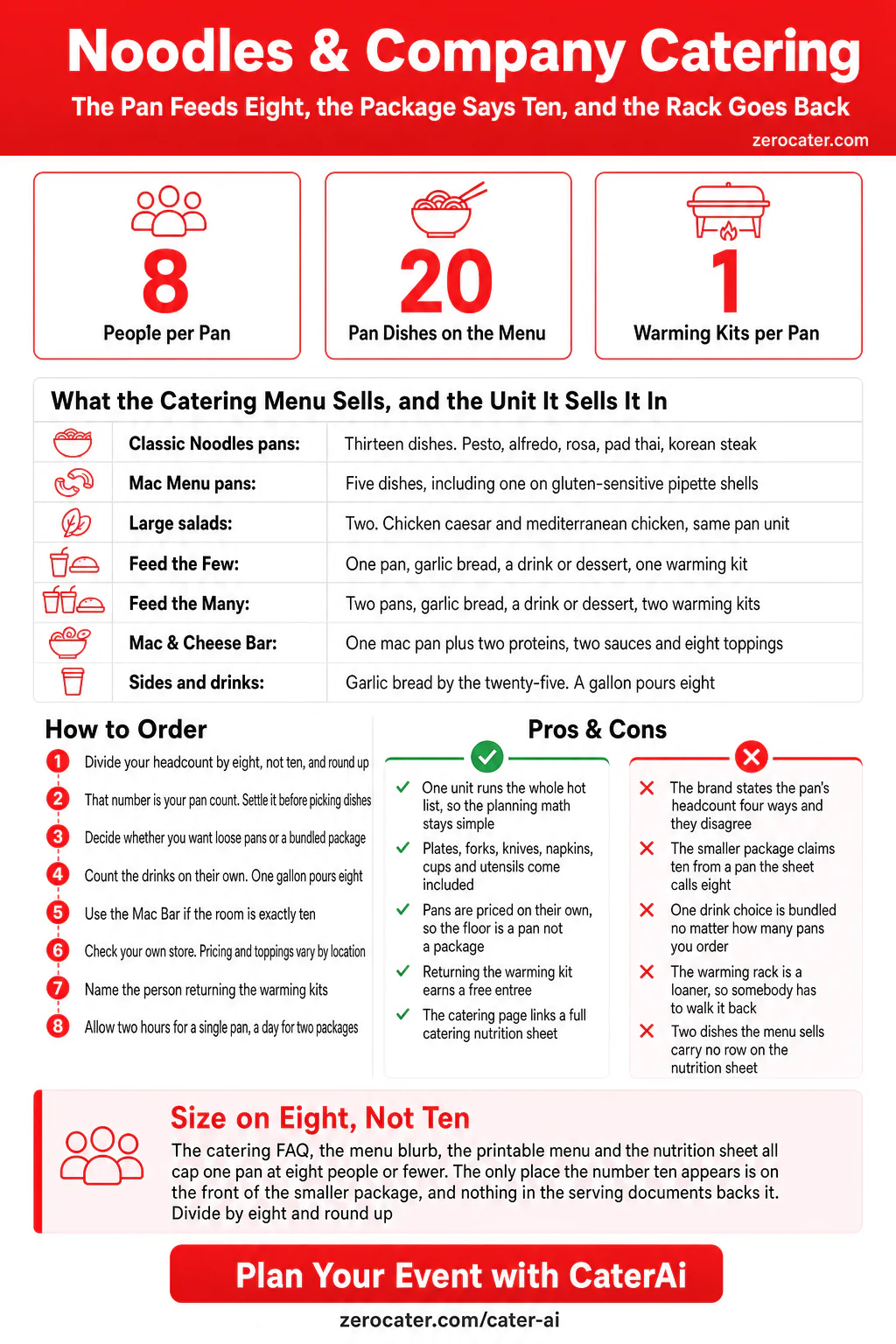
- Size on eight, not ten. Divide your headcount by eight and round up. That is the number of pans, and it is the only number on this menu with a serving sheet behind it.
- Decide whether you are buying pans or packages. Packages bundle bread, a drink or dessert and the warming kits. Pans are priced on their own. A team of eight that wants one dish and nothing else does not need a package at all.
- Count the drinks separately. A gallon pours eight servings by the brand’s own statement, and the packages include one drink choice regardless of how many pans are in them.
- Use the Mac Bar when the room is exactly ten. It is the only package on this menu whose stated headcount matches its own serving unit.
- Name the person returning the kits. One per pan, and the free entree only exists if somebody walks them back.
- Check your own store. The brand states that pricing and menus may be different at your location and that toppings vary by location.
For rooms where the format itself is still open, our guides to office lunch ideas, boxed lunch catering and budget-friendly office lunches cover the alternatives to a hot pan line. For the recurring version, a hot spread that turns up weekly behaves differently from a one-off, and onboarding lunches and client appreciation events each carry their own constraints.
How to order Noodles & Company catering
Ordering runs through the brand’s catering page or by phone, and the page carries the number. The flow is the same either way: pick your store, pick pans or a package, add the warming kits if they are not already bundled, and set a delivery time.
Three things are worth having decided before you start. Your pan count, worked off eight rather than ten. Whether the drink or the dessert tray is the more useful half of that package choice for your room. And who is returning the kit. None of the three is difficult, and all three are easier to settle before the order form than after the delivery.
If the chain option does not fit, the same shape of order is available from independent kitchens. The Zerocater directory pages for Italian catering, pasta, lasagna and mac and cheese are the place to compare, and our guides to other chains that sell hot pans, including Portillo’s, Olive Garden, Fogo de Chão, Whole Foods and Denny’s, run the same read on their own published menus.
Noodles & Company and Zerocater
A chain pan line is one answer to a hot lunch and it is not the only one. Zerocater pairs teams with vetted local caterers, handles the delivery logistics and stays on the order through the day, which covers the part of this article that a chain catering page cannot: the racks, the return and the person who ends up carrying them.
For a recurring programme rather than a one-off, corporate catering and corporate event catering are the two routes in. And if you already know the room but not the menu, CaterAi builds a spread around your headcount, dietary needs and date, and you can adjust items in the chat before you check out.
Menus, packages, serving counts and fees are set by Noodles & Company and vary by location. Every figure in this guide is read from the brand’s own published catering page, printable catering menu and catering nutrition sheet. Check your own store for what it offers.
Plan your next team lunch with CaterAi
Frequently Asked Questions
How many people does one Noodles & Company catering pan feed?
The brand answers that question in four places and gives three answers. Its catering FAQ says a pan feeds up to eight guests. The menu blurb on the same page says up to eight people. The printable catering menu says six to eight. The catering nutrition sheet states a serving unit of eight beside every pan it lists. Four statements, all capped at eight. Plan the pan as an eight and treat anything above that as optimism. Our guide to office catering costs works through the same headcount arithmetic across formats.
So why does the Feed the Few package say it feeds ten?
Because that number is on the package rather than on the pan, and nothing in the serving documents backs it. Feed the Few contains one pan of noodles or one large salad, garlic bread, a choice of a drink or a dessert tray, and one warming kit. The pan inside it is the same pan the nutrition sheet caps at eight. The number changed and the food did not. If you are ordering for a room of ten, order as though the pan feeds eight and fill the gap somewhere else.
Is the Mac Bar package different, or is it the same ten?
It is different, and this is the one place the brand’s own numbers agree. On the catering nutrition sheet, every Mac Bar row states its serving unit as ten, while every pan row on the rest of the menu states eight. The Mac Bar reaches ten because a base pan of creamy cheddar mac gets stretched by two proteins, two sauces and eight toppings. It is the only package whose headline number has a serving sheet behind it.
What is the Hot Food Hold Kit, and do I have to give it back?
It is the warming rack the pans sit in, and yes, the brand wants it back. Noodles sells the kit for a flat charge and offers a free entree when it is returned. That makes it a loaner rather than packaging, and it is the one item in a catering order that creates an errand after lunch is over. Inside the packages the kits scale with the pans: one pan comes with one kit, two pans come with two. Decide who is walking them back before the food arrives.
Does Noodles & Company deliver catering, and does anyone set it up?
Yes to both. The brand charges a delivery fee that starts at a flat floor published on its catering page, and it states that the fee includes set-up. Read that word narrowly. Set-up is the racks going up and the pans going in. It is not the same thing as someone coming back for the racks, and the return of the warming kit stays with you.
How much notice does a Noodles & Company catering order need?
The brand prefers a day’s notice for orders of two or more catering packages and two hours for a single pan, and it says a local manager can make other arrangements. The rule counts packages rather than people, which means the same headcount can sit on either side of it depending on how you bundle the order. Our guide to last-minute office catering covers what still ships on a short clock.
Is there a vegetarian or gluten-sensitive option on the catering menu?
The catering menu carries a vegetarian marker and a gluten-sensitive marker, and it defines both. Vegetarian excludes meat and fish. Gluten-sensitive means made without gluten-containing ingredients, with the brand stating plainly that the potential for cross-contact still exists. One pan on the Mac Menu is built on gluten-sensitive pipette shells, and seasoned tofu appears on the Mac Bar protein list. Our guides to vegetarian office catering and gluten-free office catering go further than a menu marker can.
What is the smallest Noodles & Company catering order?
One pan. The catering FAQ sets a two-hour preference for single pans, and the printable menu prices pans individually rather than only inside packages. That makes the floor a pan rather than a package, which matters for a team of six or eight that does not need garlic bread, a gallon of iced tea and a warming rack to go with it. Pricing and menus may be different at your location, so check your own store before you build the order.