Somebody books the Brazilian steakhouse for the quarterly all-hands, and the first thing that happens is a category error. At the restaurant, the food comes to you on skewers and keeps coming. Nobody at that table ever decides how much beef the room needs. On the catering menu, that decision is the whole job, and it arrives in a form most office planners have not seen before.
Open the Fogo de Chão catering menu and read the small grey type beside each heading. Market Table: serves 8-10. Fire-Roasted Meats: serves 8-10. Brazilian Sides: serves 8-10. Platters, seafood, desserts: the same. One unit runs almost the entire list.
In this guide
- Why one tray yield turns headcount into a rounding problem
- The three food lists, and which one actually sets your bill
- The thirteen cuts, ranked by how far apart they are priced
- What the calorie column shows that the price column hides
- The guest minimums, and the one door with no floor
- How to order Fogo de Chão for a team
One tray, eight to ten people, one repeated question
Most chain catering menus mix their units. A sandwich platter feeds twelve, a salad bowl feeds six, a dessert tray feeds twenty, and you spend the first ten minutes of planning converting between them. Fogo de Chão does not do that. The tray list runs on a single stated yield, and it holds across every category on the page.
That simplifies one thing and complicates another. The simplification is obvious: planning a spread becomes one question asked repeatedly, which is how many groups of eight to ten are in your room. The complication is that the yield is a range and not a number.
A tray covers a table of eight well and a table of ten thinly. Across a room of forty, choosing the optimistic end of that range and the pessimistic end are two different orders, and the gap between them is a whole tray in every category you pick. Settle which end of the range you are planning against before you look at a single dish. Everything downstream depends on it.

Four lines on the menu break the single-unit pattern, and they break it for the same reason. Smoked salmon is sold by the pound. Jumbo shrimp cocktail is sold by the dozen. The cheese bread is sold by the thirty. Drinks are sold by the gallon or the bottle. Each of those is a food you cannot portion into a tray without deciding the portion for the guest, so the brand sells the raw count instead and leaves the serving to you.
The three food lists look equal, and they are not
A Fogo de Chão package builds a spread in steps: pick your salads from the Market Table, pick your fire-roasted cuts, pick your Brazilian sides. Three steps, presented as three columns of similar length, all drawing from tray lists with the same stated yield. The layout invites you to treat them as three equivalent decisions.
Price the lists against each other and that reading falls apart. Take the cheapest and dearest line in each list and express the gap as a ratio:
| Tray list | Lines to choose from | Cheapest to dearest |
|---|---|---|
| Market Table salads | Thirteen | About a third apart |
| Brazilian sides | Ten, plus the cheese bread on its own unit | About triple, or about double once the lobster line is set aside |
| Fire-roasted cuts | Thirteen, including the two premium cuts | About two and a half times, and nearly double even without them |
The salad list is the flattest price list on the menu. Every one of the thirteen sits inside a band roughly a third wide, which in practice means your Market Table choices are close to free. Swapping the cheapest salad for the dearest changes your order by less than the difference between two neighbouring cuts.
The cut list is the steepest, and it is steep in both directions. Even ignoring the two premium cuts, the standard eleven still run close to double from the chicken end to the beef end. Add the premium pair back and the list spans two and a half times end to end. Same tray. Same stated yield. A very different bill.
Every salad costs less than every cut
The dearest of the thirteen salads still lands under the cheapest of the thirteen cuts. And one side, the version of the mac and cheese with lobster in it, outprices eight of those thirteen cuts.
Read off the brand’s own tray list. The salads are almost free. The cuts, and one specific side, are the bill.
That ordering is worth checking yourself, because it inverts the intuition most people bring to a steakhouse menu. Nobody expects the salad list to be irrelevant to the price. Nobody expects a pasta side to outrank most of the beef. Both are true here, and both are printed.
The practical use is a running order for your decisions. Fix your tray count first, since it multiplies everything. Choose your cuts second, because that is where the money moves. Choose your sides third, watching the one lobster line. Then take as much salad variety as the step allows, because it costs you very little to do so.

The cut list: thirteen names in two tiers
The standard list runs to eleven. Picanha is the signature, the prime part of the top sirloin, and it appears twice because the garlic version is its own line. Fraldinha covers the bottom sirloin. Frango and the marinated grilled chicken breast anchor the cheap end. Saucy legs are chicken legs in a hot Brazilian barbecue sauce. Linguiça is the spicy pork sausage and torresmo is the crispy pork belly. Cordeiro is lamb picanha with mintchurri. Two bacon-wrapped lines round it out, one chicken and one steak. Every one of them arrives with chimichurri and the house hot sauce included.
Above that list sit two premium cuts, filet mignon and lamb chops, and the tray list prices both above every cut below them. The lamb chops are the dearest line in the three package lists by a clear margin.
Inside a package, those same two cuts sit behind a per-guest surcharge, and the surcharge does not add a slot to your order. It changes what one of your existing slots may hold. On the tray list, the identical pair is the only entry in a separately headed premium section. The two price lists were built independently and they draw the fence in the same place, which is a small piece of evidence that the fence is real rather than a merchandising flourish.

The Market Table: the cheapest variety on the menu
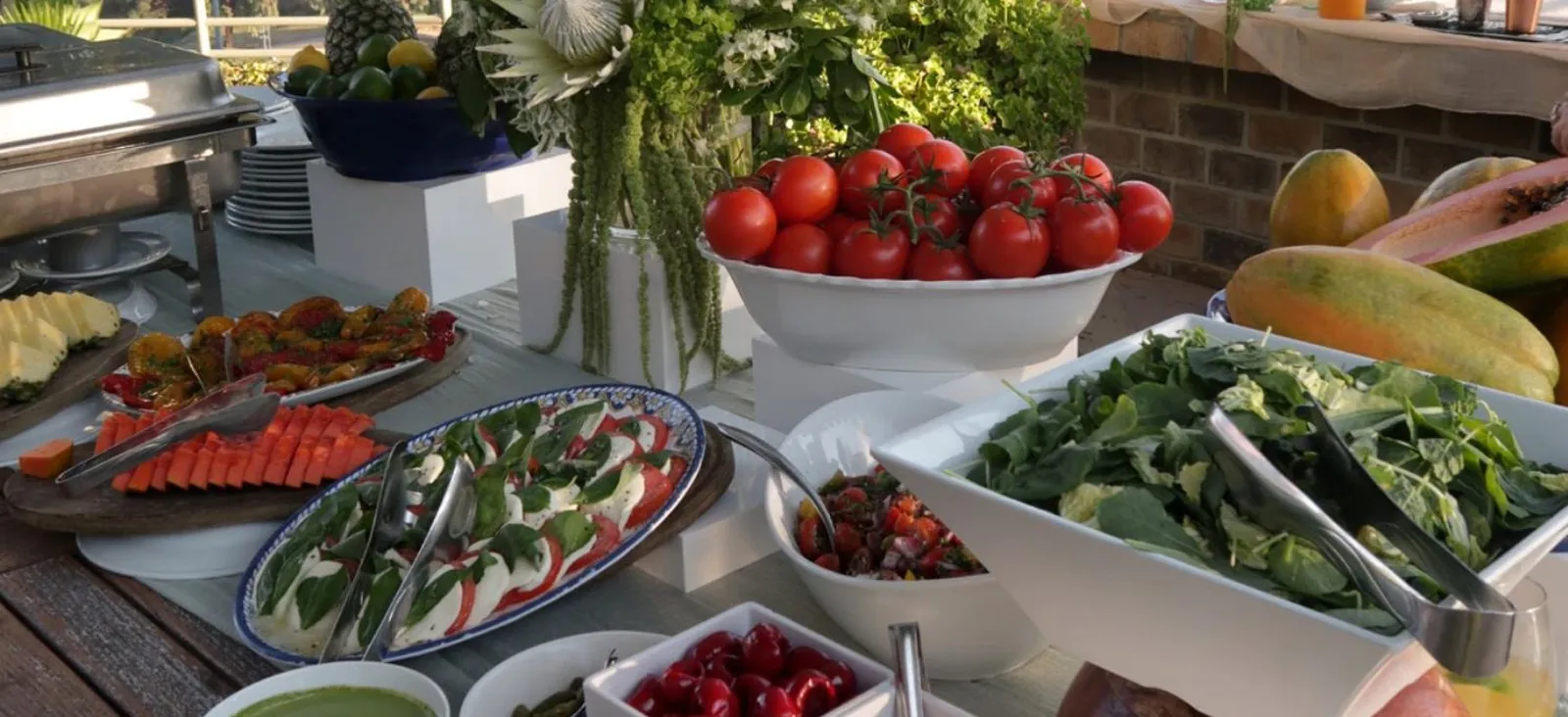
In the restaurant, the Market Table is the salad and antipasti bar you walk to. On the catering list it becomes thirteen separate trays, and the brand states that the salads are prepared fresh in-house and are gluten free.
The range is wider than the price band suggests. Power greens, a caesar and a Brazilian potato salad cover the familiar ground. Quinoa tabbouleh, tri-bean salada and beet tartare pull in a different direction. Caprese and an antipasti platter give you the Italian corner the brand has always carried. Brazilian street corn, close cousin to elote, and fresh papaya with pineapple sit at the sweet end, and a citrus chicken salad is the one line on the list carrying a protein.
Since the whole list prices within about a third of itself, variety here is the cheapest lever on the menu. If your room has vegetarians, or people who will not eat much beef at two in the afternoon, or a table that just likes having options, the Market Table is where to spend the choice rather than the money. For a comparable spread built from scratch, see our guides to salad bar catering and creative catering ideas for office meetings.
The sides: nine ordinary lines and one that breaks the pattern
The Brazilian sides list is the middle case. White rice and chiles toreados sit at the cheap end. Garlic mashed potatoes, parmesan broccoli, lemon garlic asparagus and roasted cauliflower fill the middle. Brazilian fried rice and feijoada, the black beans over rice, sit a step above. That group behaves like the salad list: a band you can move around inside without much consequence.
Then there is the mac and cheese, which is already the dearest of the ordinary sides, and its lobster version, which is a different animal. That one line outprices eight of the thirteen cuts. Inside a package it appears as a per-guest add-on to the plain version rather than as its own choice.
Cheese bread sits outside the whole structure. It is the only side sold by the piece rather than by the tray, in a count of thirty, which makes it the one item on the list you can size against your headcount exactly instead of rounding to the nearest eight-to-ten.
What the calorie column shows that the price column hides
Fogo de Chão prints a calorie figure beside nearly every catering line, which is unusual for a catering menu and useful for a reason that has nothing to do with anybody’s diet. It tells you how heavy the spread you are assembling is, and the answer does not track the price.
The heaviest line across the three package lists is not a cut. It is the mac and cheese, and the lobster version is heavier still. Against that, the two cheapest cuts on the menu, frango and the marinated chicken breast, are also the two lightest. The lamb chops are the dearest line in the three lists and carry a figure well above every other cut, while the filet mignon, priced just below them, sits near the middle of the pack.
Read as a planning tool rather than a health one, this is the column that tells you whether your room will be able to work after lunch. A spread built from the top of the cut list plus the mac and cheese is a dinner. A spread built from chicken, rice and four salads is a lunch. Both are available from the same three lists at the same tray yield, and only the calorie column distinguishes them at a glance. For the same read on other formats, see our guide to office lunch ideas.
The guest minimums, and the one door with no floor
The menu gates itself in four different places, and the gates are not the same height.
| How you order | Stated guest floor | What it gets you |
|---|---|---|
| Catering package | Ten guests | Salads, cuts and sides as a per-guest package in three tiers |
| Boxed meals | Written for groups of ten or more | Individually packed meals, each a cut with a salad and two sides |
| Action stations | Twenty guests | Interactive stations, including the carving station that comes with a service upgrade |
| Build your own trays | None stated | Any single tray off any list, at the same eight-to-ten yield |
The tray list is the interesting row. It is the only door on this menu with no stated guest floor at all, and a single tray already feeds eight to ten. So the smallest order the brand will take is not the ten-guest package. It is one tray, which is already a small meeting. A team of eight that wants one cut and one salad can order exactly that.
At the other end, the twenty-guest floor on action stations is the only place the menu asks for a bigger room, and it is also the only place a person comes with the food. That is the trade the number is describing.
How to order Fogo de Chão for a group
The brand publishes three ways the food can arrive, and none of them touches the food decision. The same cuts and the same salads reach you three different ways.
- Pickup or delivery. The straightforward route. Warming kits are listed as available, and packages include plates, napkins, plasticware and serving utensils.
- Personalized service. A catering specialist delivers and sets up the event rather than handing over boxes at a door.
- Full-service catering. On-site grilling with either buffet or gaucho service, arranged through a local restaurant sales manager rather than a form.
Practical sequence, in the order that saves the most rework. Fix which end of the eight-to-ten range you are planning against, then count your trays. Pick a location and confirm it caters, since the catering order form is location-scoped. Choose your cuts, because that is the decision carrying the price. Fill the sides, watching the one lobster line. Take the salad variety last and take plenty of it. The brand asks for a minimum of two hours’ notice on the order, and prints that its listed prices cover the food alone.
Plan a Brazilian catering menu with CaterAi
Fogo de Chão vs. other catering options
| Option | Serving unit | Where the price moves | Best for |
|---|---|---|---|
| Fogo de Chão | One tray, stated at eight to ten, across almost every list | The cut list, and one lobster side | An event where the beef is the point |
| Outback Steakhouse | Mixed, by platter and by entree | Entree selection | A steakhouse spread with a familiar menu |
| Barbecue catering | Usually by the pound of meat | Meat weight, chosen directly | Rooms where you want to control portions exactly |
| Boxed lunches | One box per person | Box tier | Meetings that cannot pause for a buffet line |
| Grazing table | A single build, sized to the room | Board size and components | Receptions where people graze rather than sit |
The comparison that matters is the middle row. Barbecue catering usually sells meat by weight, so you decide the portion. Fogo de Chão sells it by the tray, so the brand decides the portion and you decide the count. Neither is better. They fail differently, and the failure modes are worth knowing: buying by weight goes wrong when you misjudge appetite, and buying by tray goes wrong when your headcount lands badly against a range.
A better option for recurring office meals
A Brazilian steakhouse is a strong choice for the event on your calendar that people will remember. It is a weaker choice for the fourth Tuesday in a row. One cuisine gets old, the tray yield rounds awkwardly against a headcount that changes every week, and the cheapest variety on the menu all sits on the salad side.
Zerocater runs the other pattern. Instead of repeating one restaurant, you rotate across a vetted network, and the ordering, delivery and support stay in one place. Browse Brazilian catering or barbecue catering on the directory to see what is near your office, and our corporate catering page covers how an ongoing programme is set up.
For the one-off, CaterAi is the faster path. Give it the headcount, the date and the constraints, and it builds a menu from partners that can actually deliver to your address. It does not quote; it plans, and you adjust from there. Our corporate event catering checklist covers the rest of the event, and what office catering costs sets expectations before you start.
Plan a Brazilian catering menu with CaterAi
Menus, availability, guest minimums and service options vary by location and change over time. For the current Fogo de Chão catering menu and what a given restaurant offers, check the brand’s own catering page and menu.

Frequently Asked Questions
How many people does one Fogo de Chão catering tray feed?
Eight to ten, and the brand prints that same yield beside almost every line on the tray list. Salads, fire-roasted cuts, Brazilian sides, platters, seafood and desserts all carry it. Treat it as a range rather than a number: one tray covers a table of eight comfortably and a table of ten thinly. For a room of forty that difference is one whole extra tray, which is the single most useful thing to settle before you start picking dishes. Our guide to party tray catering covers the same arithmetic across other formats.
Which part of the Fogo de Chão menu actually decides the price?
The cuts. Priced against each other, the thirteen salads sit in a band of about a third from cheapest to dearest, while the thirteen cuts run about two and a half times. Every salad on the tray list lands under the cheapest cut. So your Market Table choices barely move the bill and your cut choices set it. If you are trying to land a spread inside a number, work the cut list first and treat the salads as free.
Is there a minimum order for Fogo de Chão catering?
It depends which door you use. Packages carry a ten-guest minimum. Action stations carry a twenty-guest minimum. Boxed meals are written for groups of ten or more. The tray list is the exception: it states no guest floor at all, and a single tray already feeds eight to ten. The smallest order this menu will take is therefore one tray, which is already a small meeting.
How much notice does Fogo de Chão need for a catering order?
The brand asks for a minimum of two hours’ advance notice on catering orders, and states that on the menu itself. That is a short window by catering standards, and it applies to the order rather than to the staffing: the full-service option routes through a restaurant sales manager, so a served event is a conversation rather than a form. For anything tighter, see our guide to last-minute office catering.
What comes with a Fogo de Chão catering order?
Plates, napkins, plasticware and serving utensils are included with catering packages, and the fire-roasted cuts include chimichurri and the house hot sauce. The brand lists warming kits as available on delivery, and points anyone who wants premium serve ware, buffet setup or event staffing to a local restaurant sales manager. The menu also prints that its listed prices cover the food alone.
What is the Market Table on a catering order?
The salad half of the menu, sold as trays. The dine-in Market Table is the salad and antipasti bar; on the catering list the same idea arrives as separate trays you choose from a list of thirteen, and the brand states that the salads are prepared fresh in-house and are gluten free. It is the flattest price list on the menu, which makes it the cheapest place to add variety. For a spread built on the same shape, see our salad bar guide.
Does Fogo de Chão deliver catering to an office?
Yes, and it publishes three ways the food can arrive: pickup or delivery, a personalized service where a catering specialist delivers and sets up, and full-service catering with on-site grilling and either buffet or gaucho service. The last of those is the one with the twenty-guest floor and the sales-manager conversation attached. The first is the one a tray order uses. Our how it works page covers what a delivered order includes on the Zerocater side.
Is a Brazilian steakhouse a good fit for regular office catering?
It suits the event better than the routine. A launch, a client dinner or a quarterly all-hands is exactly what a cut list and a Market Table are built for. A weekly programme runs into the same three problems every time: one cuisine, a tray yield that rounds awkwardly against a changing headcount, and a menu whose cheapest variety all sits on the salad side. That is the case for rotating caterers rather than repeating one, and CaterAi builds the menu side from the constraints you give it. Browse Brazilian catering on the Zerocater directory to see what else is nearby.