The order lands at 11:30 at the address on the contract. The driver finds a chain-link fence, a gravel turnout and no door. Nobody answers the office number because the office is a trailer with the door shut, and the crew that was going to eat at noon is forty feet up on a deck they cannot leave.
None of that is a catering failure. It is what happens when an order built for a building arrives at a site that does not have one yet. A job site is not an office with dust on it. It has no lobby, no receptionist and no kitchen, and it runs under a set of published federal rules that decide where food may sit before anyone has looked at a menu.
This guide covers feeding crews on active construction sites. It works from four standards the Occupational Safety and Health Administration publishes for construction work, and it stops at what those documents say. Where a decision depends on your site, it sends you to the person on your site who owns it. Our corporate catering and how it works pages cover how Zerocater runs the order. This one covers what you are ordering into.
Plan a jobsite lunch order with CaterAi
The address exists before the way in does
Somebody assigns a street number to a construction project at permit stage. That happens months before there is a driveway, a threshold or a mapped entrance, so the number on your paperwork can be real and still route a driver to the middle of a lot line.
Emergency dispatchers treat this as a known problem and draw a line between a mailing address and a dispatchable one. A project can collect mail at a number that no map will take a vehicle to. Delivery software makes the same mistake for the same reason, and it throws no error, because the address validates.
Give the caterer the way in instead of the identity of the building. Three things do the work:
- The gate. Which cross street it opens onto, and which of several gates takes deliveries. Sites often run a separate gate for materials and keep it locked outside working hours.
- A landmark. Something a driver reads from the road: the tower crane, the sign board, the color of the fence screen.
- A mobile number. A named person who will pick up. The trailer’s desk phone is not that, and neither is the main office line.
Sites also move. A contractor finishes and the address stops existing as a delivery point, which breaks a recurring order in a way an office order never breaks. Put a review date on any standing order tied to a project.
Your driver stops at the fence
Walk onto an active site in street clothes and you are the hazard. OSHA requires protective helmets for employees working where objects can fall or fly, and eye protection for employees exposed to eye and face hazards. A third standard makes the employer pay for that equipment rather than the worker.
Read who those standards are about. They are written about employees and the employers who direct them. A catering driver is neither, which means no federal standard hands your driver a helmet at the gate, and the contractor’s own site rules decide what happens next. Some sites keep visitor equipment in the trailer. Some will not let a non-worker past the fence under any circumstances.
Settle it once, before the first delivery, and the answer holds for the run of the project. On most orders it comes out the same way: the driver stops at the gate and hands the order to somebody from the crew, who carries it in. Everything else in this guide follows from that handoff.
Two standards name food, and one of them does not
Offices decide where lunch goes by looking for a free surface. Sites decide it from a document, and the document is specific.
The lead standard for construction is the blunt one. Where employee exposure runs above the permissible limit, it requires that “food or beverage is not present or consumed, tobacco products are not present or used, and cosmetics are not applied”. Not eaten. Not present. The same standard then makes the employer provide a lunchroom or eating area, keep it “as free as practicable” from contamination, and see that people wash their hands and face before they eat. It even specifies the warning sign for the work area, and the sign says do not eat, drink or smoke there.
The asbestos standard reaches the same place in one line. Under prohibited activities, the employer ensures that employees “do not eat, drink, smoke, chew tobacco or gum, or apply cosmetics in the regulated area”.
The respirable silica standard is the interesting exception. It runs on a written exposure control plan, a competent person to enforce it, and restrictions on dry sweeping and compressed air. It carries no eating prohibition of its own. On a silica job the answer therefore lives in the site’s own plan rather than in the federal text, which is why you ask rather than assume.
One more paragraph is worth knowing about, because it puts your order inside the safety standard rather than outside it. The sanitation standard has a paragraph on food handling: food service on a jobsite has to meet the local rules that apply, follow sound hygienic principles, and arrive wholesome, free from spoilage and protected against contamination. Your delivery is a regulated thing on that site.
None of this tells you what any particular site requires, and this guide is not the place to find that out. Which standards are in play depends on the work in progress, the exposure assessments the contractor has run, and where the regulated areas sit that week. Ask the safety lead where the food may go, and ask again when the trade phase turns over.
The sink is already there, and so is a rule about cups
Office catering treats handwashing as a hopeful afterthought. Construction already solved it and wrote it down. The sanitation standard puts lavatories at places of employment, fed with hot and cold or tepid running water, stocked with hand soap and individual towels. It requires washing facilities near the work wherever people handle coatings, paints or other harmful contaminants. On a site that is a fixture in the yard, not a favor.
That changes one practical thing about the order. You do not need to send the wipes and the sanitizer that an office delivery leans on. You do need to know where the washing point sits, because the walk from the food to the soap is the whole reason people skip it.
The same standard also rules on drinks, and it names a setup caterers reach for by reflex. Drinking water containers have to close and have to pour from a tap, and the standard states that “the common drinking cup is prohibited”. Where single service cups are supplied, it wants two containers: a sanitary one for the clean cups and a receptacle for the used ones.
An urn with a sleeve of cups balanced on the lid is the arrangement that paragraph exists to stop. Sealed individual drinks avoid the question. If an urn makes more sense for a large crew, send it with a tap, a covered holder for the clean cups and somewhere for the empties to go.
Read the crew size off the yard
Ask the superintendent first. A site signs people in every morning for reasons that have nothing to do with lunch, so the number exists and one person holds it. That beats every estimate below.
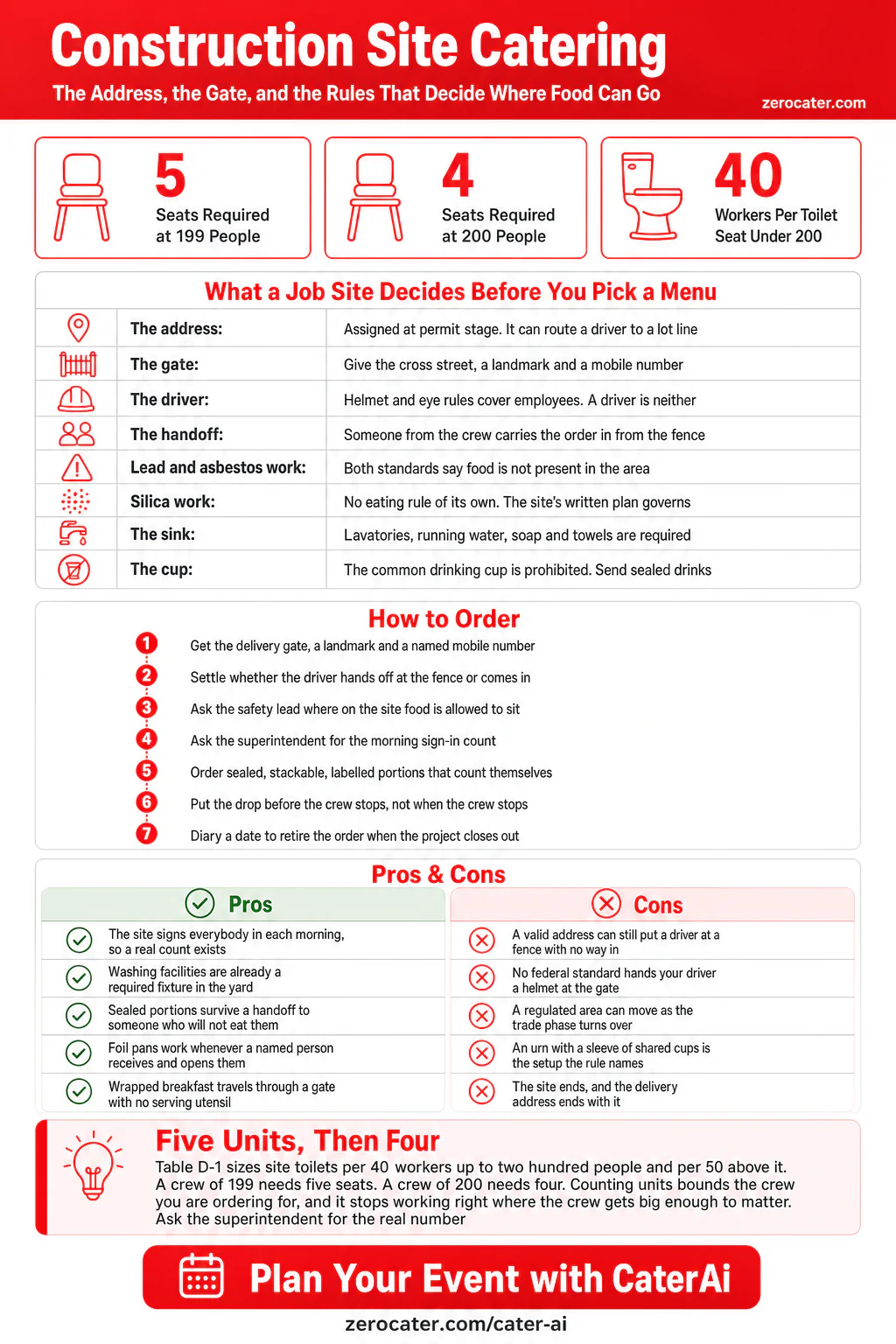
When you are ordering days ahead and cannot ask, the yard will bound it for you. Table D-1 of the sanitation standard sizes toilet facilities by headcount: one facility for twenty or fewer people, then one toilet seat and one urinal per 40 workers, and past two hundred people, one per 50. Run that backwards and a count of units becomes a range.
| Toilet seats you can count | Crew the table implies | What to order against |
|---|---|---|
| 1 | Up to 40 | One drop, one person meets the driver |
| 2 | 41 to 80 | Two stacks, split by trade or by area |
| 3 | 81 to 120 | Sealed portions only, no serving line |
| 4 | 121 to 160 | Staged drops, one per work area |
| 5 | 161 to 199 | Confirm the number, stop estimating |
Two cautions come with that table, and both matter. A contractor can put out more units than the rule asks for, so the count gives you a ceiling rather than a measurement. And the table does something strange at two hundred: the per-40 rule needs five seats for a crew of 199, while the per-50 rule needs four for a crew of 200. Add one person and the requirement drops by one unit. Past that point the yard stops telling you anything useful and you go back to asking.
Five units, then four. The sanitation table sizes facilities per 40 workers up to two hundred people and per 50 above it. A crew of 199 needs five seats. A crew of 200 needs four. The estimate you can read off a yard works right up to the point where the crew gets big enough to matter most.
The days a site orders food
Sites do not run a weekly lunch program the way an office does. They order against events in the schedule, and the events repeat across projects.
| Occasion | What decides the order |
|---|---|
| Groundbreaking | Owner and client facing, held before the site is a site. Closest to a normal event order. |
| Safety stand-down | Work pauses for a talk. OSHA runs a national stand-down on fall prevention each year, and contractors hold their own. Breakfast, early, everybody at once. |
| A pour | Concrete sets on its own schedule and the crew starts before dawn. Food lands before the first truck, not at noon. |
| Inspection day | People on site who are not on the crew and not in the sign-in estimate. Order above your band. |
| Topping out | The final beam goes up signed by the crew, often with an evergreen on it. A milestone the trades treat as theirs. |
| The punch-list push | Small crew, long days, near turnover. Repeat orders for a handful of people. |
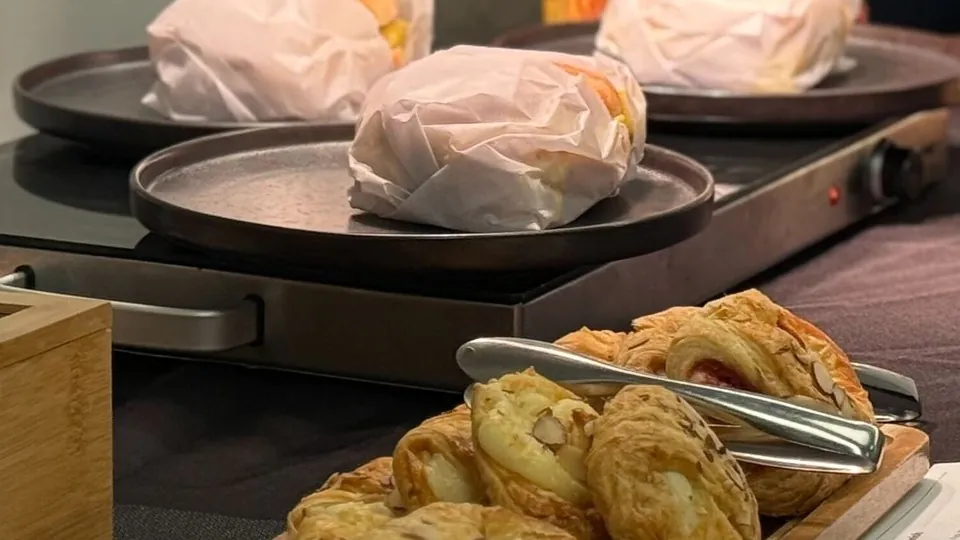
The stand-down and the pour both land in the morning, which makes breakfast the format a site orders most. Wrapped items travel through a gate handoff without a serving utensil, and they hold while people finish what they are doing. Breakfast catering and boxed breakfast cover the formats. Kitchens that build a morning order well include A Great Start, Moonlight Breakfast, Best Damn Breakfast Burrito and Renegade Burrito.
Plan a jobsite lunch order with CaterAi
Formats that survive a handoff
The order changes hands at the gate. Somebody who is not going to eat it carries it in, sets it down and walks away, and that single fact rules out more formats than the weather does.
Four properties matter:
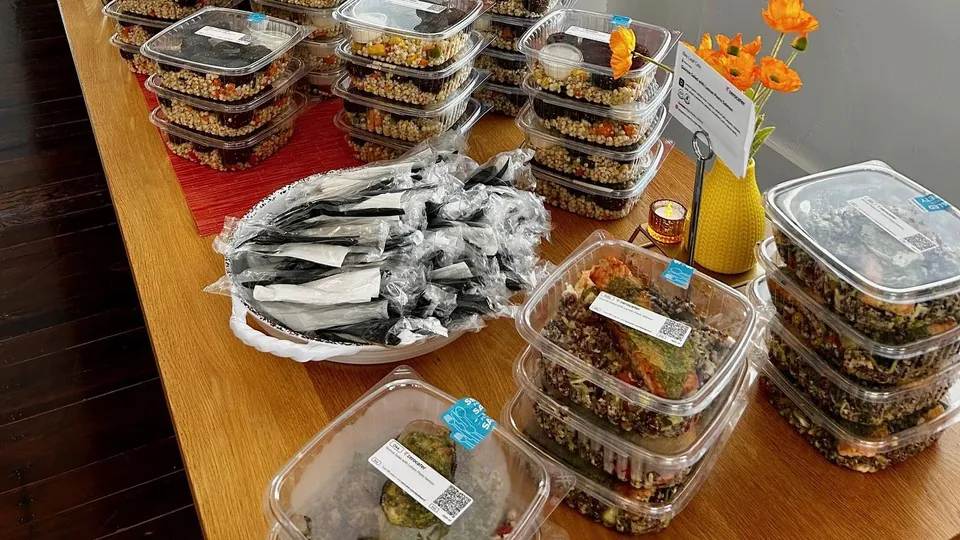
- Countable at a glance. The person taking the handoff signs for it without opening anything. Stacks of identical sealed portions count themselves.
- Stackable. One trip from the gate, carried by one person, often up a temporary stair.
- Labeled. Nobody is standing behind the food to answer a question about it, and the crew comes through in ones and twos.
- Closed. Sites generate dust as a byproduct of working, and the sanitation standard’s food-handling paragraph asks that food arrive protected against contamination.
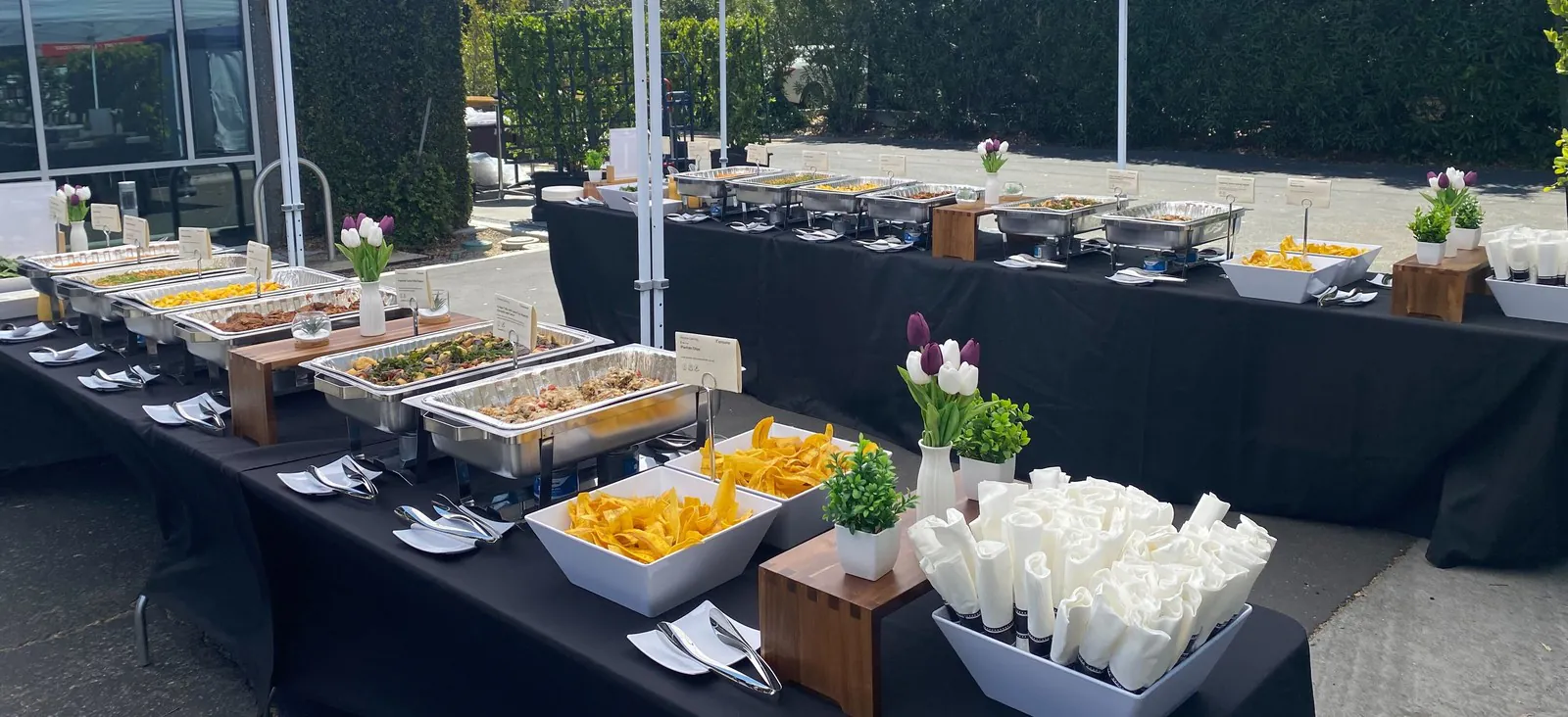
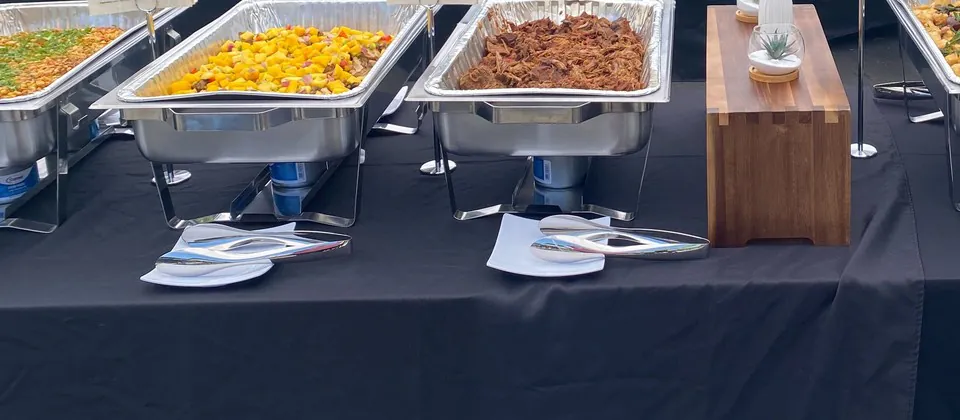
That points at two formats and away from a third. Sealed single portions carry, count and label themselves, and boxed lunch formats are built for it. Hot food in foil pans works when a named person is going to receive it, set it down and open it, which is the topping-out and stand-down case. A build-your-own bar with shared utensils and open trays does not work, and the shared-spoon problem is a smaller cousin of the cup rule above.
For the food itself, sites lean on cuisines that hold and travel. Barbecue takes a foil pan without complaint, and Baco’s Smokehouse, 1202 Smokin BBQ and Roaming Buffalo build orders that survive a drive. Mexican kitchens wrap by default, and Early Bird Tacos, Tio Luis Tacos, Nano’s Tacos and Matty’s Mexican Kitchen all pack that way. Deli and sub counters sell the single sealed portion as their whole product, which is why Woodside Deli, The Boys Deli, Mickey’s Deli, Sub Culture and Togo’s read well on a site. Italian and Southern kitchens cover the hot-pan case, with Heroic Italian, Fratello’s and From The Grill among them. Pizza travels in its own container and needs no utensil at all, so Blue Line Pizza and Pizza Ponte earn their place on a punch-list week.
Who answers which question
Send the questions in this guide to the right desk and you get answers in a morning. Send them to the wrong one and they sit.
- The superintendent runs the site day to day and holds the headcount, the gate and the schedule. This is your contact for anything about where, when and how many.
- The safety manager owns the exposure assessments and the written plans, and therefore owns the answer about where food may sit. Nobody else on the project should be answering that.
- The project manager handles budget and client communication and often works from an office rather than the site. Good for approving a standing order, wrong for a delivery question.
Ask all three questions in one message when you set the order up: the gate and the contact, the headcount and how it moves, and where the food is allowed to go. Get those in writing at the start and a site order becomes as routine as an office one. Our manufacturing catering guide covers the neighbouring case where the plant is permanent, and craft services catering covers crews on a set. For an order you have to place at short notice, our last-minute guide covers what still ships.
City cost guides
What a site order runs depends on the metro more than on the site. These guides break down catering in the markets Zerocater serves: San Francisco, New York City, Chicago, Los Angeles, Austin, Seattle, Denver, Boston, Atlanta, Dallas, Philadelphia and Washington DC.
How CaterAi handles a job site order
CaterAi plans catering from a network of more than a thousand restaurants, and it works from constraints rather than from a menu you already picked. For a site that means you can hand it the awkward parts: a crew size you can only bound, a delivery that has to clear a gate, a morning window set by a pour, and a format that has to arrive sealed.
For a project that runs for months, a standing order through corporate catering keeps the same site contact and the same delivery instructions on file, which is most of the work. For the groundbreaking and the topping out, where guests come and the site behaves like a venue for an afternoon, corporate event catering is the closer fit. Put a date in the calendar to retire the order when the project closes out, because the address will stop existing before anyone remembers to cancel.
Plan a jobsite lunch order with CaterAi
Frequently Asked Questions
What address do you give a caterer for a construction site?
Give the gate, not the building. A municipality assigns a street number at permit stage, long before there is a driveway or a door, so the number on the paperwork can route a driver to a lot line with no way in. Send the caterer three things instead: the cross street the delivery gate sits on, a landmark the driver can see from the road, and the mobile number of the person who will meet them. A mailing address and a dispatchable address are two different things on a live site.
Can a catering driver walk onto a construction site?
Usually not, and the reason is equipment rather than paperwork. OSHA requires protective helmets for employees working where objects can fall, and eye protection for employees exposed to eye hazards. Both standards are written about employees and their employers, and a delivery driver is neither, so what happens at the fence comes down to the contractor’s own site rules. Settle it before the first delivery. On most orders the answer is a handoff at the gate to somebody from the crew.
Are there places on a job site where food is not allowed?
Yes, and two federal standards say so in their own words. Under the lead standard, in areas where exposure runs above the permissible limit, “food or beverage is not present or consumed”. Under the asbestos standard, employees “do not eat, drink, smoke, chew tobacco or gum, or apply cosmetics in the regulated area”. The silica standard takes a different route and carries no eating prohibition at all, which means the site’s own written plan governs there. Ask the safety lead where the food may sit. Do not guess, and do not read this paragraph as a ruling about any particular site.
Does a construction site have anywhere to wash hands before eating?
It generally does, and the requirement is already written down. The sanitation standard puts lavatories at places of employment, with hot and cold or tepid running water, hand soap, and individual towels. Under the lead standard the employer also has to see that people wash their hands and face before eating. Offices worry about this and job sites have already answered it, so the useful question is where the washing point sits relative to where you want the food.
Why should you avoid a drinks dispenser with a stack of shared cups?
Because the sanitation standard names that exact setup. It states that “the common drinking cup is prohibited”, and where single service cups are supplied it wants both a sanitary container for the clean ones and a receptacle for the used ones. Sealed individual drinks sidestep the whole question. If you do send an urn, send it with a tap, a covered cup holder and somewhere for the empties.
How many people are on a construction site?
Ask the superintendent, because the site counts everybody in every morning and the number exists. If you are ordering before you can ask, the yard gives you a band. Table D-1 of the sanitation standard sizes toilet facilities by headcount, so one seat implies up to 40 people, two implies 41 to 80, three implies 81 to 120, and four implies 121 to 160. Treat that as a ceiling rather than a count, since a contractor can always put out more units than the table asks for.
What should you order for a crew that has no break room?
Sealed portions that survive a handoff. The driver passes a stack to whoever meets them at the gate, and that person carries it in, so the order has to be countable at a glance, stackable, labeled and closed. Hot food in foil pans works when someone from the crew is going to set it down and open it. Wrapped items work when people are collecting food and walking off with it. Skip anything that needs a serving line, a shared spoon or assembly on arrival.
Can Zerocater deliver to a construction site?
Yes, and the details that matter are the ones above rather than the menu. Give us the gate and the site contact, tell us whether the driver hands off at the fence, and say where on the site the food is allowed to sit. CaterAi builds the menu from the constraints you give it, including a crew size you can only estimate and a delivery window that has to land before the crew stops work. Our corporate catering pages cover recurring orders for a site that runs for months.