
You send the invitation on Monday. By Wednesday two people have written back. One cannot eat what is on the menu because of a medical condition. The other cannot eat it because of religious observance. Both of them asked you, the person who booked the caterer, and both of them expect the same thing: a lunch they can eat, in the same room, at the same time as everyone else.
Those two messages look identical in your inbox. In the rulebooks that govern them, they are not the same request at all. They run through different statutes, they are measured against different tests, and the bar an employer has to clear before saying no sits at a different height in each one.
In this guide
- The activity the statute puts on its own list
- The body systems a meal runs through, and where they sit
- The short list of seventeen, and the one food-adjacent name on it
- Why managing a condition well is set aside on purpose
- The limb of the definition a work lunch lands on
- Seven named examples, and not a meal among them
- The conversation the regulation calls informal
- Five factors, four of which are about the employer
- The second rulebook, and the hearings that named food
- What this changes about the order you place
This guide reads published documents and stops at what they say. It is not legal advice, it cannot see your workforce or your jurisdiction, and every decision it describes belongs to your own counsel and your HR team. State and local law can go further than the federal floor described here. Our corporate catering and how it works pages cover how Zerocater runs the order itself.
The statute names eating
The Americans with Disabilities Act defines disability around a phrase that does a lot of work: a physical or mental impairment that substantially limits one or more major life activities. Congress then did something unusual for a statute. It listed the activities.
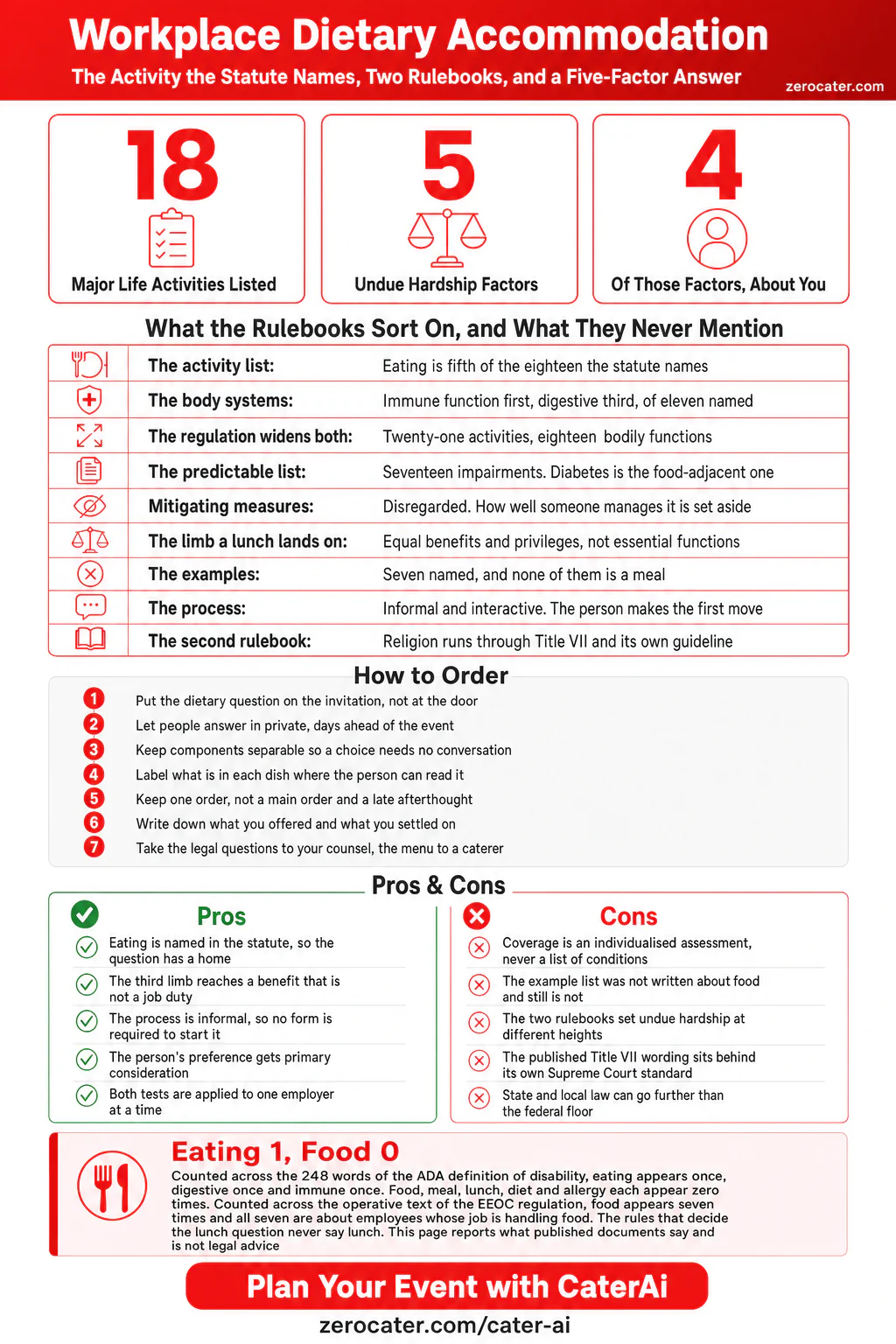
42 U.S.C. 12102(2)(A) names 18 of them: caring for oneself, performing manual tasks, seeing, hearing, eating, sleeping, walking, standing, lifting, bending, speaking, breathing, learning, reading, concentrating, thinking, communicating and working. Eating is fifth.
The EEOC regulation that implements the employment half of the ADA carries the same list at 29 CFR 1630.2(i)(1)(i) and adds three the statute left out, sitting, reaching and interacting with others, which brings the regulation’s list to 21. Eating stays where it was.
Read that list looking for the word “food” and you will not find it. Read the whole 248-word definition of disability at section 12102 and you will not find “food”, “meal”, “lunch”, “diet” or “allergy” either. Each of those appears zero times. “Eating” appears once, “digestive” once and “immune” once.
Eating 1, food 0. The passage that decides whether somebody is covered names the activity of eating, the immune system and digestive function. It never once names food.
And it names the systems a meal runs through
The second half of the definition covers a category the original 1990 Act did not spell out. A major life activity also includes the operation of a major bodily function, and the statute lists 11 of those: the immune system, normal cell growth, digestive, bowel, bladder, neurological, brain, respiratory, circulatory, endocrine and reproductive functions.
Note the order. The immune system comes first. Digestive comes third. An allergic response is an immune-system event and coeliac disease is an immune-system event, which puts both of them on the same list as eating itself, by a second route.
The regulation extends that list too. Section 1630.2(i)(1)(ii) adds special sense organs, skin, genitourinary, cardiovascular, hemic, lymphatic and musculoskeletal functions, taking the count from 11 to 18, and it adds that the operation of a major bodily function includes the operation of an individual organ inside a body system.
The short list of seventeen
The regulation carries a passage called predictable assessments. Section 1630.2(j)(3)(iii) names impairments that, applying the rules of construction above them, “should easily be concluded” to substantially limit a major life activity. There are 17 entries, each tied to a specific function: deafness to hearing, blindness to seeing, cancer to normal cell growth, epilepsy to neurological function, HIV infection to immune function, and so on.
One of the 17 is food-adjacent. The passage reads “diabetes substantially limits endocrine function”. Food allergy is not on the list. Neither is coeliac disease.
That absence proves less than it looks like it does, and the section says so itself. The list is introduced with “for example”, and it closes by noting that the impairments described “may substantially limit additional major life activities not explicitly listed above”. The rules of construction sitting directly above it push the same way: section 1630.2(j)(1)(i) says the term is construed broadly in favour of expansive coverage and “is not meant to be a demanding standard”, and section 1630.2(j)(1)(iv) requires an individualised assessment in every case.
So the route to coverage runs through the function and the individual. It does not run through a roster of diagnoses, and no page can tell you where a particular person lands.
Managing it well is set aside on purpose
Section 1630.2(j)(1)(vi) states that whether an impairment substantially limits a major life activity is determined “without regard to the ameliorative effects of mitigating measures”. Ordinary eyeglasses and contact lenses are the only carve-out.
Section 1630.2(j)(5) spells out what counts as a mitigating measure, and the list includes medication, medical supplies and equipment, prosthetics, hearing aids, mobility devices, and reasonable accommodations themselves.
Someone who has organised their whole life around avoiding one ingredient is managing a condition, and managing it well. The regulation tells the analysis to look past that management to what would happen without it. Section 1630.2(j)(4)(ii) adds that the burdens of following a treatment regimen may be considered too.
A work lunch is not a job duty, and there is a limb for that
This is where the usual mental model breaks. Most people picture reasonable accommodation as something that helps a person do their job: a screen reader, a modified schedule, a different chair. Lunch is not a job duty, and a catered event is not an essential function of anything.
Section 1630.2(o)(1) defines reasonable accommodation in three limbs, and only the middle one is about performing a job.
- Limb (i) covers the job application process, so a qualified applicant can be considered.
- Limb (ii) covers modifications to the work environment or to how the position is customarily performed, so a qualified employee can perform the essential functions.
- Limb (iii) covers modifications “that enable a covered entity’s employee with a disability to enjoy equal benefits and privileges of employment as are enjoyed by its other similarly situated employees without disabilities”.
Limb (iii) is the one a catered lunch lands on, and it never mentions essential functions. The Appendix to Part 1630 restates the same structure in the Commission’s own words and calls them three categories of reasonable accommodation, the third being accommodations that let employees with disabilities “enjoy equal benefits and privileges of employment”.
The Appendix goes further and defines what equal means here: an opportunity “to enjoy the same level of benefits and privileges of employment as are available to the average similarly situated employee without a disability”. Read against a room where everyone else is eating, that sentence is about the room, not about the menu.
Plan a mixed dietary menu with CaterAi
Seven named examples, and not a meal among them
Section 1630.2(o)(2) gives examples of what a reasonable accommodation may include. Counted as the regulation writes them, there are seven: making existing facilities accessible, job restructuring, part-time or modified schedules, reassignment to a vacant position, acquiring or modifying equipment or devices, adjusting examinations or training materials or policies, and providing qualified readers or interpreters.
None of the seven is about food. The list opens with “may include but is not limited to”, and the Appendix then adds examples of its own that are not in the regulation at all: accrued paid leave, additional unpaid leave for treatment, accessible employer-provided transportation, reserved parking spaces, a page turner, a travel attendant, and permitting a guide dog at work.
Widen that out and the pattern is plain. The examples describe a workplace in the 1990s and the definition above them was written to outlast the examples. Limb (iii) does the reaching; the example list was never asked to.
The same point lands on the operative text of the whole part. Across the 8,610 words of 29 CFR Part 1630, setting the Appendix aside, the word “food” appears seven times. All seven sit in section 1630.16(e), which is about employees whose job is handling food and the infectious-disease list the Secretary of Health and Human Services maintains. Not one of the seven is about food served to staff. “Meal”, “lunch”, “diet”, “kitchen” and “cafeteria” appear zero times each.
The conversation the regulation calls informal
Section 1630.2(o)(3) describes how the answer gets worked out: “To determine the appropriate reasonable accommodation it may be necessary for the covered entity to initiate an informal, interactive process with the individual with a disability in need of the accommodation.” The process “should identify the precise limitations resulting from the disability and potential reasonable accommodations that could overcome those limitations”.
Two words in that sentence do real work. The process is informal, so nobody needs a form. And the verb is may, which the Appendix explains: sometimes the right answer is obvious to both sides and the whole thing happens without either party noticing a process occurred.
When it is not obvious, the Appendix sets out four steps. Analyse the job and its purpose. Consult the person about the precise limitations. Identify potential accommodations with them and assess how well each would work. Consider the person’s preference, then select and implement. The Appendix says this sequence is written in terms of essential functions but applies equally to accommodations that let someone enjoy equal benefits and privileges, which is the limb a lunch sits on.
Two more details matter for anyone planning an event. The person’s preference “should be given primary consideration”, and the employer still “has the ultimate discretion to choose between effective accommodations” and may pick the cheaper or easier one. And the first move belongs to the person: the Appendix states that it is the responsibility of the individual with a disability to inform the employer that an accommodation is needed, and that the duty runs to limitations known to the employer.
For an office lunch that translates into something simple. Put the question on the invitation so people can answer without a conversation they did not ask for, and keep a route open for the answer that arrives late.

Five factors, and four of them are about you
An employer can decline on undue hardship. Section 1630.2(p)(1) defines it as “significant difficulty or expense incurred by a covered entity”, judged against the factors in paragraph (p)(2). There are five.
| Factor | What it asks about |
|---|---|
| (i) Nature and net cost of the accommodation, counting tax credits, deductions and outside funding | The accommodation |
| (ii) Financial resources of the facility involved, how many people work there, the effect on its expenses | The employer |
| (iii) Overall resources of the entity, the size of the business by headcount, the number, type and location of its facilities | The employer |
| (iv) Type of operation, including workforce composition and structure, and how separate the facility is from the entity | The employer |
| (v) Impact on the operation of the facility, including on other employees and on its ability to conduct business | The employer |
One factor out of five looks at the request. The other four look at the organisation receiving it. That is the design, and it has a practical consequence: the same accommodation can be a hardship for one employer and routine for another, and neither answer generalises. The EEOC’s own enforcement guidance on reasonable accommodation and undue hardship works through the analysis in more depth.
One more limit sits nearby. Section 1630.2(o)(4) says the duty to accommodate runs to someone covered under the “actual disability” prong or the “record of” prong, and not to someone covered solely under the “regarded as” prong. Three prongs, two of which carry the duty.
The second rulebook, and the hearings that named food
Religious observance arrives through Title VII of the Civil Rights Act rather than the ADA, and the EEOC’s guideline for it is 29 CFR 1605. Section 1605.1 defines religious practice broadly: the Commission includes moral or ethical beliefs about right and wrong that are sincerely held with the strength of traditional religious views, and it adds that no religious group has to espouse the belief for it to count.
Food is written into that guideline’s history. Appendix A records the Commission’s public hearings, held in three cities and drawing roughly 150 witnesses. Finding (3) lists the religious practices the Commission found were not being accommodated, and there are seven of them:
- Observance of a Sabbath or religious holidays
- Need for prayer break during working hours
- Practice of following certain dietary requirements
- Practice of not working during a mourning period for a deceased relative
- Prohibition against medical examinations
- Prohibition against membership in labor and other organizations
- Practices concerning dress and other personal grooming habits
Dietary requirements sit third on a list of seven, put there by people who came to a hearing to say it was being missed. Everything else on that list is about the calendar, the body or the wardrobe. This is the only entry about a table.
The guideline also sets out how the Commission judges whether an offered accommodation was reasonable. Section 1605.2(c)(2) says it examines the alternatives the employer considered and the alternatives it actually offered, and that where more than one would work without undue hardship, the employer must offer the one that least disadvantages the person. Section 1605.2(c)(1) adds that assuming many others with the same practice might also ask is not evidence of hardship.
The two bars sit at different heights
Both statutes use the phrase “undue hardship”. They do not mean the same thing by it.
| Disability request | Religious request | |
|---|---|---|
| Statute | Americans with Disabilities Act | Title VII, Civil Rights Act |
| EEOC rules | 29 CFR 1630 | 29 CFR 1605 |
| Hardship test | Significant difficulty or expense | Substantial increased costs in relation to the conduct of the particular business |
| Named factors | Five, listed at 1630.2(p)(2) | None listed; judged on the facts of the business |
| Who raises it | The individual, per the Appendix | The individual, per 1605.2(c)(1) |
The Title VII wording has a reading note attached to it. The published text of section 1605.2(e)(1) still says an employer may assert undue hardship by showing “more than a de minimis cost”, citing the 1977 Hardison decision. In Groff v. DeJoy the Supreme Court held unanimously that Title VII “requires an employer that denies a religious accommodation to show that the burden of granting an accommodation would result in substantial increased costs in relation to the conduct of its particular business”, and directed courts to weigh all relevant factors including the size and operating cost of the employer. The Court’s phrasing governs; the older wording is still sitting in the code. Anyone quoting that paragraph should quote the decision alongside it.
For someone booking a lunch, the takeaway is smaller than the law is. Two requests that read the same in an inbox travel different routes, and neither route is decided by how many people asked.
What this changes about the order you place
None of the above tells you what to put on a table. It does change four practical habits, and every one of them is cheap.
Ask on the invitation, not at the door. The duty runs to what the employer knows, and the first move belongs to the person. A field on the invitation lets someone answer in private, days ahead, without standing in a doorway explaining a medical condition to a colleague.
Keep components separable and labelled. A label lets a person decide without asking anyone. The regulation never mentions signage and the practice does most of the work anyway, which is why our mixed dietary needs guide leans on it and why the allergy-safe boxed lunch and gluten-free guides go into the food-safety side in detail.
Keep one order, not a main order and an afterthought. Limb (iii) is about enjoying the same benefit as everyone else. A separate sad tray delivered late is a different experience of the same event. A format that carries several diets inside one menu does this on its own.
Write down what you offered. The Appendix’s four-step sequence ends with considering the person’s preference, and the religious guideline judges an employer on the alternatives it considered as well as the ones it offered. Two lines in a document beat a memory of a hallway conversation.
The rest is the menu, and a caterer that works with offices handles it without a briefing. CaterAi plans an event menu across a wide bench of restaurants, which is the practical answer to a room where four people need four different things and everyone eats at the same time. Our vegetarian, vegan, dairy-free, low-sodium and keto guides each cover one lane of that in depth.
Two neighbouring pages read different rulebooks over the same lunch: office catering tax deductions reads the Internal Revenue Code on your return, and office catering permits reads the model food code on your caterer’s licence. Together with this one they cover three separate bodies of rules that all land on the same table. If you book for a specific setting, the government office, healthcare, nonprofit and coworking guides pick up from there, and corporate event catering covers the one-off side.
Plan your next work event with CaterAi
What this page is not
It is not legal advice. It reports what two published rulebooks and one Supreme Court opinion say, and it stops there. It cannot tell you whether any person is covered, whether any request is reasonable, or whether any cost is an undue hardship, because all three of those are individualised assessments that turn on facts this page cannot see.
It carries no medical or dietary guidance and makes no claim that any food is safe or unsafe for anyone. It describes a federal floor, and state and local law can sit above it. Your counsel and your HR team own every decision described here. The point of reading the documents is narrower than that: knowing which rulebook a question belongs to tells you who to hand it to, and knowing that eating is on the statute’s own list tells you why the question is worth asking early.
Frequently Asked Questions
Is a food allergy a disability under the ADA?
The statute does not answer that with a list of conditions, and this page will not either. The documents do put the pieces within reach. 42 U.S.C. 12102 names “eating” among its major life activities, and names the immune system first and digestive function third among its major bodily functions. The regulation then says the term “substantially limits” is construed broadly and is not a demanding standard, and that the question needs an individualised assessment. So the route runs through the function and the individual, never through the name of the condition. Whether any particular person is covered is a question for your counsel and your HR team, on that person’s facts.
Does the regulation list diabetes?
Yes, and it is the only food-adjacent condition on that particular list. Section 1630.2(j)(3)(iii) gives 17 impairments that “should easily be concluded” to substantially limit a major life activity, and it reads “diabetes substantially limits endocrine function”. Celiac disease and food allergy are not on that list. The section says in its own text that these are examples and that the impairments it describes may substantially limit other major life activities too, so absence from the list settles nothing on its own.
Someone manages their condition well. Does that change the analysis?
The regulation tells you to set that aside. Section 1630.2(j)(1)(vi) states that whether an impairment substantially limits a major life activity “shall be made without regard to the ameliorative effects of mitigating measures”, with ordinary eyeglasses and contact lenses as the single carve-out. Section 1630.2(j)(5) lists what counts as a mitigating measure, and reasonable accommodations are named there. Someone who avoids a trigger food every day is managing the condition, and the regulation says the analysis looks past the management.
A catered lunch is not part of anyone’s job. Does the duty still reach it?
The definition of reasonable accommodation has three limbs, and the third one is written for exactly this gap. Section 1630.2(o)(1)(iii) covers “modifications or adjustments that enable a covered entity’s employee with a disability to enjoy equal benefits and privileges of employment as are enjoyed by its other similarly situated employees without disabilities”. That limb never mentions essential functions. The EEOC’s Appendix to the part describes the same three categories in its own words and confirms that the interactive process applies to the benefits-and-privileges limb as well.
Who is supposed to raise it, the employer or the employee?
The Appendix puts it on the person: “it is the responsibility of the individual with a disability to inform the employer that an accommodation is needed”. The same passage says an employer is obligated to accommodate limitations that are known to it, and that where the need is not obvious it may ask for documentation. That is an argument for a standing intake question on every event invitation rather than a guess about anybody. Our guide to ordering for mixed dietary needs covers how to collect the answers.
What does “undue hardship” mean?
It means two different things depending on which law the request arrives under, which is the part most planning guides skip. Under the ADA, section 1630.2(p)(1) defines it as “significant difficulty or expense” and paragraph (p)(2) gives five factors. Only the first asks about the accommodation itself. The other four ask about the employer: the resources of the facility, the resources and size of the whole entity, the type of operation, and the impact on the facility. Under Title VII, the Supreme Court held in Groff v. DeJoy that an employer must show “substantial increased costs in relation to the conduct of its particular business”. Both tests are written to be applied to one employer at a time.
Does religious dietary observance run through the same rules?
It runs through a different part of the code. Disability sits in the ADA and 29 CFR 1630. Religion sits in Title VII and 29 CFR 1605, which defines religious practice broadly enough to include moral and ethical beliefs sincerely held with the strength of traditional religious views. Food is not an afterthought in that guideline. Appendix A records what the Commission found at its own public hearings, and its list of religious practices that were not being accommodated has seven entries, with “practice of following certain dietary requirements” third. Our kosher and halal guides cover the ordering side.
What should we change about how we order, then?
Four habits carry most of it, and none of them requires a legal judgment. Ask the question on the invitation rather than at the door, so people can answer in private. Keep components separable and labelled, because a label lets someone decide without asking anybody. Keep the reply route open, since the regulation calls the process informal and puts the first move on the person. Write down what you offered and what you settled on, because the Appendix’s own four-step sequence ends with considering the person’s preference. A caterer that works with offices will build a menu around all four without being asked twice.