You order the same sandwich tray twice in one week. On Tuesday it feeds a project team working through a deadline. On Friday it feeds the whole company at a farewell party for someone who is leaving. Your accountant may treat those two orders differently, and nothing about the food explains why.
The deduction turns on three things that happen around the tray: who eats it, why it is served, and whether your building runs an eating facility. Get those three straight and the rest follows. At the start of 2026 one whole category stopped being deductible at all, so guidance written before that date can be wrong on its main point.
In this guide
- What the statute keys on, and the words it never uses
- Three rates, one tray
- The exception whose title sounds right and does not help
- The category that went to zero, and the four words that set its reach
- What still carries a full deduction
- Two pieces of advice that went stale
- How to order so the invoice matches the categories
This guide reads the statute and the regulations and stops at what they say. It is not tax advice, it cannot see your books, and every decision it describes belongs to your accountant. Our corporate catering and how it works pages cover how Zerocater runs the order itself.
The statute never mentions lunch
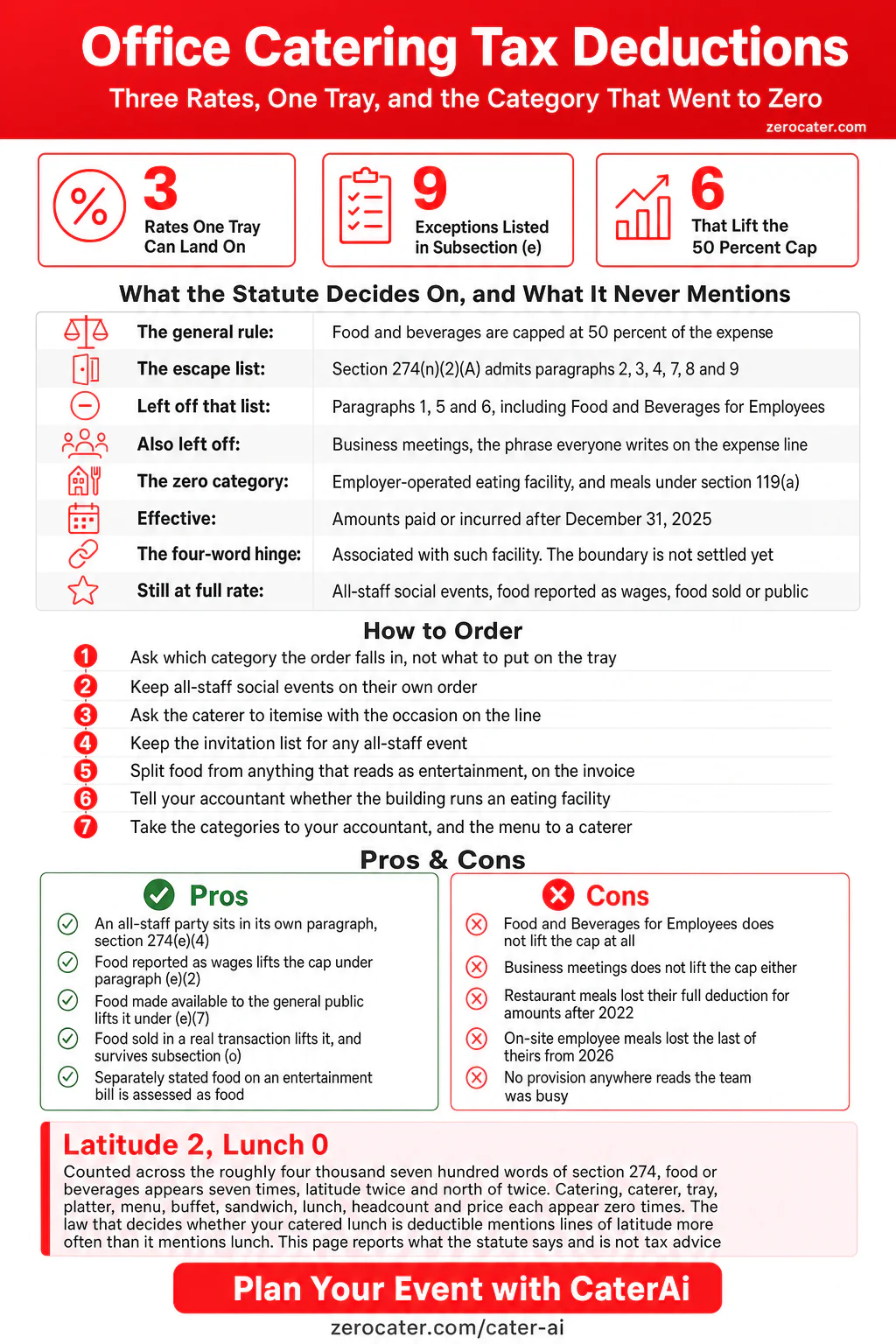
Start with what the law does not say. Section 274 of the Internal Revenue Code is the provision that decides how much of a food expense a business may deduct. Its operative text runs to roughly four thousand seven hundred words. Search it for the vocabulary of an office order and you come up empty. Catering, caterer, tray, platter, menu, buffet, sandwich, lunch, headcount, price: each appears zero times.
What the statute does say, seven times, is “food or beverages”. It then spends the rest of its length sorting those words into categories by circumstance. Who received the food. Whether the employer reported it as wages. Whether the public could have walked in and taken some. Whether the money changed hands in a real sale. None of that is a question about the menu.
Two words the statute does use, twice each, are “latitude” and “north of”. A later section explains why. Hold on to the count for now, because it makes the point better than an argument would: the law that decides whether your catered lunch is deductible mentions lines of latitude more often than it mentions lunch.
So stop asking what to order and start asking which category the order falls in. That is the only question the statute answers, and it is the one your accountant will ask you.
Three rates, one tray
The statute builds its answer in three moves.
The general rule is half. Section 274(n)(1) says the deduction for any expense for food or beverages “shall not exceed 50 percent” of what would otherwise be allowable. That is the default, and most ordinary business food lands there.
A named list escapes the cap. Section 274(n)(2)(A) points at six paragraphs of subsection (e). An expense described in one of those six is not subject to the 50 percent limit at all. The company party lives here. So does food you reported as wages, and food you made available to the general public.
From 2026, one group gets nothing. Subsection (o) applies to amounts paid or incurred after December 31, 2025. For an employer-operated eating facility, and for meals furnished for the convenience of the employer, it states that no deduction shall be allowed. Not half. None.
Three rates, and the food can be identical in all three. That is the whole shape of the thing, and everything below is detail about which door an order walks through.
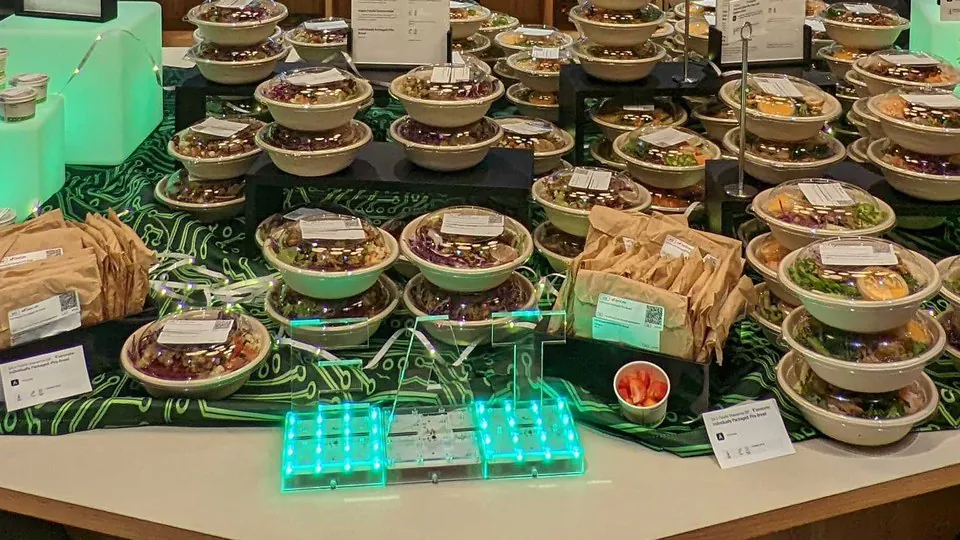
The ordinary working lunch sits at half
Food brought in so a team can keep working is the case the 50 percent cap was built for, and the conditions that ride with it have not moved. The expense has to be ordinary and necessary to the business. It cannot be lavish or extravagant in the circumstances. The taxpayer or an employee has to be present. A client lunch and a meal eaten while travelling on business sit in the same place.
Our guides to lunch and learn catering and board meeting catering describe the formats these orders usually take. Neither the format nor the format’s name changes the rate.
One caution before you file every office order here. A meal served on the premises so that employees stay at work can also meet the description in section 119(a), which is the convenience-of-the-employer rule, and that description now routes to zero rather than to half. Which side a specific lunch falls on depends on facts this page cannot see. Raise it with your accountant rather than assuming the friendlier answer.
The exception that sounds right is not on the list
Subsection (e) of section 274 carries nine numbered exceptions. Section 274(n)(2)(A) admits six of them past the 50 percent cap: paragraphs (2), (3), (4), (7), (8) and (9). Three paragraphs are left out: (1), (5) and (6).
Read the title of paragraph (e)(1). It is “Food and beverages for employees”, and its text covers expenses for food and beverages furnished on the business premises of the taxpayer primarily for his employees. That is the only paragraph in the entire subsection whose title is literally about feeding your staff, and it does nothing to the cap.
The reason is structural rather than mysterious. Subsection (e) is a list of exceptions to subsection (a), which disallows entertainment. Paragraph (e)(1) keeps your break room from being taxed as a nightclub. It was never a deduction-rate provision, and Congress did not put it on the rate list.
Paragraph (e)(5) tells the same story with a sharper edge. Its title is “Employees, stockholder, etc., business meetings”, and it covers expenses directly related to business meetings of employees, stockholders, agents or directors. That is the exact phrase an office manager writes on the expense line: it was a business meeting. Paragraph (e)(5) is also missing from the rate list.
So the two justifications people reach for first, food for employees and a business meeting, are both real exceptions in the statute and neither one lifts the cap. Anyone who tells you otherwise is reading subsection (e) without checking which paragraphs subsection (n) actually cites.
The category that went to zero
Subsection (o) is short and it is blunt. Except for an expense described in subsection (e)(8) or (n)(2)(C), no deduction shall be allowed for two things: any expense for the operation of a facility described in section 132(e)(2), including food or beverages associated with such facility, and any expense for meals described in section 119(a). It applies to amounts paid or incurred after December 31, 2025.
Both of those categories used to sit at 50 percent. A company cafeteria and the sandwiches an employer brings in so people stay at their desks were half-deductible through 2025 and are outside the deduction now.
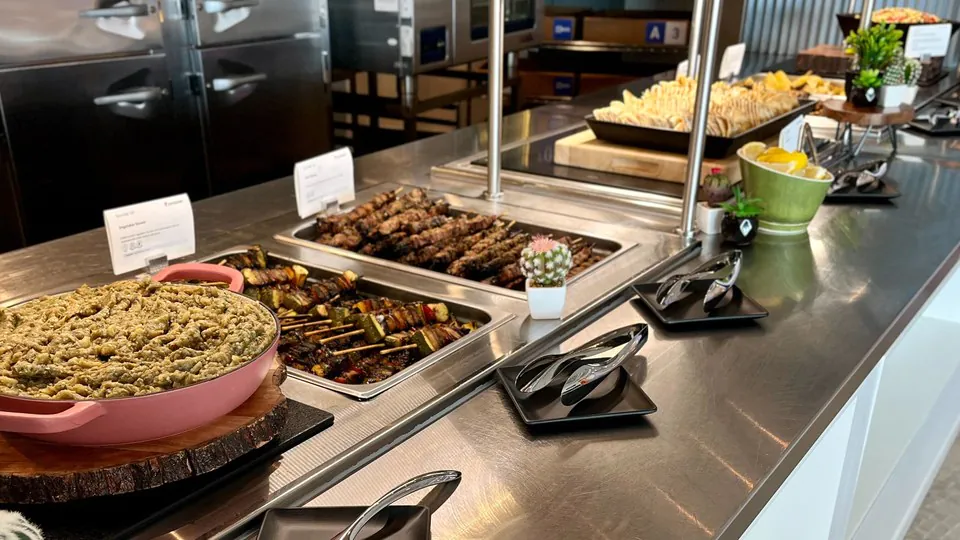
The reach of the first limb is the live question, and it turns on four words: “associated with such facility”. Section 132(e)(2) defines the facility with two conditions. It has to sit on or near the employer’s business premises, and revenue from it has to normally equal or exceed its direct operating costs. A subsidised staff cafeteria where people pay something is the case the drafters had in mind.
A break room is a harder question, and so is a fruit bowl that sits ten steps from a cafeteria. The subsection names the de minimis fringe rule inside its own text, which pulls small employee food into the analysis when it is associated with the facility, and leaves it outside when it is not. The AICPA has asked Treasury for guidance on where that boundary falls. Until the guidance lands, treat the edge as unsettled. Two offices can order identical bagels and be looking at different lines, and the difference is the room down the hall rather than the bagels.
The same subsection keeps two escape routes open. Food sold to customers in a bona fide transaction for full consideration stays deductible under paragraph (e)(8), which is why a restaurant feeding its own staff is treated differently from a software company feeding its own staff. Crew meals covered by section 274(n)(2)(C) also survive, and that list is the subject of the next section but one.
What still carries a full deduction
The rate list carries six paragraphs. Four of them matter to an office.
The all-staff social event, paragraph (e)(4). Expenses for recreational, social or similar activities primarily for the benefit of employees. The holiday party, the summer picnic, the team celebration. The statute attaches a condition that does real work: the activity has to benefit employees other than highly compensated employees, and the paragraph carries its own rule for when an individual counts as an owner. A party for everyone reads differently from a dinner for the executive team.
Food you reported as wages, paragraph (e)(2). If the employer treats the expense as compensation to the employee and reports it as wages for withholding, the cap lifts. The employee picks up the income. The deduction follows the reporting.
Food available to the general public, paragraph (e)(7). Expenses for goods, services and facilities made available by the taxpayer to the general public. An open house where anyone can walk in and eat is the clean case.
Food you sold, paragraph (e)(8). Goods or services sold in a bona fide transaction for an adequate and full consideration. This is the paragraph that also survives subsection (o).

The practical consequence is about bookkeeping rather than menu design. An all-staff celebration and a project team’s working lunch belong in different categories, so putting them on one combined order makes your accountant’s job harder than it needs to be. Our guides to company picnic catering and client appreciation events cover what those occasions look like on the food side.
Plan a team celebration with CaterAi
The full-deduction list is drawn by latitude
Section 274(n)(2)(C) keeps a full deduction for a set of meals defined by where the eating happens. Food required by federal law for crew members of a commercial vessel. Crew meals on vessels working the Great Lakes, the Saint Lawrence Seaway or an inland waterway. Food provided on an offshore oil or gas platform or drilling rig. Food on a rig, or at a support camp integral to one, located in the United States north of 54 degrees north latitude. Food on a fishing vessel or fish tender, or at a fish processing facility north of 50 degrees north latitude that also sits outside a metropolitan statistical area. Vessels primarily engaged in luxury water transportation are pushed back out.
Read that list twice and notice what does the deciding. Not the food, and not how badly anyone needed it. Congress drew a map, put two lines of latitude on it, and wrote the deduction around the places where a worker cannot leave to buy a sandwich.
No office is on that map, and that is the useful lesson rather than a piece of trivia. There is no provision anywhere in the section that reads “the team was busy” or “nobody could leave the building”. The single lever an office actually controls is which category the order falls in, which is why the categories are worth learning.
Two pieces of advice that went stale
Older guidance is still circulating, including on pages that have never been updated, and two claims in particular will lead you wrong.
“Restaurant meals are fully deductible.” They were, temporarily. Section 274(n)(2)(D) lifted the cap for food and beverages provided by a restaurant, and by its own terms it reached only amounts paid or incurred before January 1, 2023. The provision is still printed in the statute with that date attached, which is probably why the advice outlived it. A restaurant meal is back at half.
“On-site meals for employees are fully deductible.” This one was true before 2018, when an exception kept small employee food outside the 50 percent cap. That exception was repealed, which moved on-site employee food to half. Subsection (o) then moved a large part of it to zero. A page written in 2015 and never revisited can be wrong twice over on the same sentence.
One more rule worth knowing, because it is the rare case where paperwork changes the answer. The 2017 tax act disallowed entertainment outright from 2018 onward. Food served at an entertainment activity gets caught in that disallowance, unless it was purchased separately or stated separately on the bill at something like its usual selling price. Take a client to a game with a catered suite on one undifferentiated invoice and the food goes down with the tickets. Ask for the food on its own line and it is assessed as food.
Order so the invoice matches the categories
Nothing here asks you to change what you serve. It asks you to make the paperwork show what your accountant needs to see.
Keep social events on their own order. A team celebration and a working lunch sit in different paragraphs of the statute. Booking them together produces one invoice that has to be split later, by someone who was not in the room.
Ask for itemisation. A single line reading “catering” tells your accountant nothing about category. Line items with the occasion attached tell them most of what they need.
Keep the invitation list. Paragraph (e)(4) turns on who the activity primarily benefits. An all-staff invite is evidence. A memory of one is not.
Separate food from anything that reads as entertainment. Same event, same day, separate lines, per the regulation above.
Tell your accountant whether you run an eating facility. It is the question subsection (o) turns on, and it is the one most office managers have never been asked.
Zerocater can help with the ordering side of that. Tell us which occasions are all-staff social events and which are working meals, and we keep them on separate orders with itemised invoices. CaterAi takes the constraints you give it, including a headcount you can only estimate, and builds the menu inside them. Our guides to corporate event catering and office lunch ideas cover the food itself.
Plan a working lunch with CaterAi
What this page is not
This guide reports what published federal documents say. It is not tax advice, and it cannot be, because every question above turns on facts that live in your books rather than in the statute.
Four limits are worth stating. This page describes federal income tax treatment only, and says nothing about any state’s rules. It never tells you which category a specific order of yours belongs in. It takes no position on the unsettled edge of subsection (o), because the AICPA has asked Treasury for guidance there and none has landed. And it is about the employer’s deduction, which is a different question from whether an employee is taxed on the food, and a different question again from sales tax on the purchase, which our guide to tax-exempt invoicing touches from the buying side.
Two other guides on this blog use the same method, reading one published rulebook and stopping where it stops: government office catering and construction site catering. If your workplace has its own rulebook, it is usually the fastest thing to read.
Take the categories to your accountant. Take the menu to us.
Frequently Asked Questions
Is office catering tax deductible?
Sometimes at a full deduction, more often at half, and in one category at nothing. The rate turns on who eats the food and why it is served, not on what you order. Section 274 of the Internal Revenue Code caps food and beverage expenses at 50 percent as its general rule, lists a set of categories that escape the cap, and since the start of 2026 removes the deduction entirely for an employer-operated eating facility and for meals furnished for the convenience of the employer. Your accountant applies that to your own facts. This page explains the categories so the conversation starts in the right place.
What changed for employer-provided meals in 2026?
Subsection (o) of section 274 took effect for amounts paid or incurred after December 31, 2025, and it removes the deduction rather than trimming it. Two things fall inside it: the cost of operating an employer-operated eating facility, along with food and beverages associated with that facility, and meals furnished on the business premises for the convenience of the employer. Both sat at half before. Two carve-outs survive, one for food sold to customers in a real transaction and one for crew meals on certain vessels and fish processing facilities. Ask your accountant which of your food spending the subsection reaches.
Does the 50 percent limit still apply to an ordinary catered lunch?
For a business meal that does not fall inside subsection (o), the general 50 percent cap in section 274(n)(1) is still the rule, and the usual conditions still ride with it: an ordinary and necessary business expense, not lavish or extravagant, with the taxpayer or an employee present. A client lunch and a travel meal sit in the same place. Whether a particular catered lunch for your own staff is an ordinary business meal or a meal furnished for the convenience of the employer is a question about your facts, and this page does not answer it.
Why does the exception for food and beverages for employees not help?
Because it was written to solve a different problem. Subsection (e) of section 274 lists nine exceptions, and its first paragraph is titled “Food and beverages for employees”. That paragraph excuses the expense from the entertainment disallowance in subsection (a). It does not appear in section 274(n)(2)(A), which is the list that lifts the 50 percent cap. Paragraph (e)(5), “Employees, stockholder, etc., business meetings”, is missing from that list too. So the two phrases an office manager reaches for first, food for employees and a business meeting, are the two that leave the cap exactly where it was.
Is the company holiday party or summer picnic still fully deductible?
Recreational and social activities for employees have their own paragraph, section 274(e)(4), and that paragraph IS on the list that lifts the 50 percent cap. The statute attaches a condition: the activity has to be primarily for the benefit of employees other than highly compensated employees, and it carries its own rule about who counts as an owner. An all-staff party reads differently from a dinner for the leadership team. Keep the invitation list and the invoice for that event separate from your everyday catering, and let your accountant apply the paragraph.
What is an employer-operated eating facility?
Section 274(o) points at a facility described in section 132(e)(2), which names two conditions: the facility sits on or near the employer’s business premises, and revenue from it normally equals or exceeds its direct operating costs. A subsidised company cafeteria is the case the provision was written about. A break room with a coffee machine and a fruit bowl is a harder question, and the phrase doing the work is “associated with such facility”. The AICPA has asked Treasury for guidance on where that boundary falls, so treat the edge as unsettled and ask your accountant rather than reading a rule into the silence.
Are office snacks and break-room coffee still deductible?
Snacks were pulled under the 50 percent cap in 2018, when the exception that had kept small employee food at a full deduction was repealed. From 2026 the question has a second half, because subsection (o) reaches food and beverages associated with an employer-operated eating facility, and it names the de minimis fringe rule in doing so. An office with no such facility and an office with a subsidised cafeteria may therefore be looking at different lines for the same bagels. The IRS guide to fringe benefits covers the employee side. Your accountant covers yours.
Can Zerocater help with how the catering invoice is itemised?
Yes, and it is worth asking before the order rather than after. Tell us which occasions are all-staff social events and which are working meals, and we keep them on separate orders so the paperwork matches the categories your accountant works in. CaterAi builds the menu around the constraints you give it, including a headcount you can only estimate and a delivery window somebody else set. Our corporate catering pages cover recurring orders for a team that eats together every week.