Someone on your team comes back from a cardiology appointment with a number written on a card. Two thousand three hundred milligrams a day, maybe fifteen hundred. On Thursday you order the catering everybody calls the healthy option, a salad bar with grilled chicken, and you feel good about it. Your colleague builds a bowl of greens, feta, olives, sliced turkey and a ladle of dressing, and eats most of a day’s sodium standing at the counter.
Nothing on that table was junk food. That is the problem with sodium. It does not track the thing you were looking at.
This guide covers ordering, not medicine. The number itself comes from your colleague’s doctor. Everything below sits on four questions: where sodium hides in a catering order, which components to swap, which formats make the swap easy, and what a kitchen can honestly tell you when you call.
Plan low-sodium catering with CaterAi
The Salad Bar Is Often the Saltiest Table in the Room
Rank a catering menu by how healthy it looks and you get one order. Rank the same menu by sodium and you get a different one. The two lists disagree hard enough that ordering from the first while thinking about the second is how teams get this wrong.
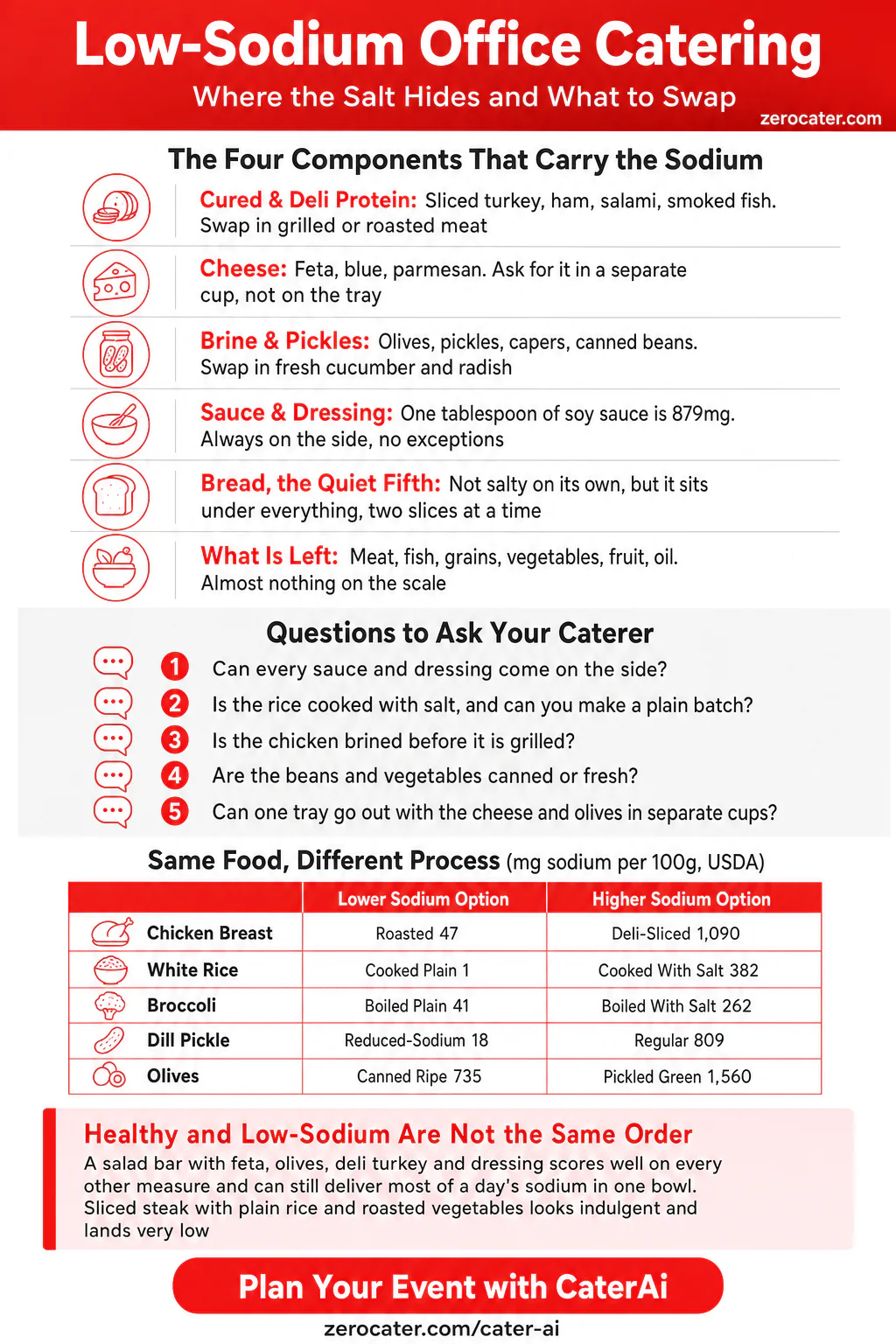
Look at what the US Department of Agriculture measures. Roasted skinless chicken breast carries about 47 milligrams of sodium per 100 grams, roughly three and a half ounces. The same bird, sliced and packaged as oven-roasted deli chicken, carries about 1,090. That is more than twenty times the sodium for something a menu describes with the same three words. Plain cooked white rice sits at 1 milligram per 100 grams. Cook it with salt and it goes to 382. Boiled broccoli moves from 41 to 262 the same way.
Now the toppings people pile onto greens because greens feel virtuous. Feta runs about 1,140 milligrams per 100 grams. Pickled green olives run about 1,560. Dill pickles run about 809, and the reduced-sodium version of the identical pickle runs 18. Commercial hummus, which reads as the healthy dip, runs about 426.
Our healthy office catering guide gets you to a good plate on protein, fiber and afternoon energy. Sodium answers to none of those. You can build a lunch that scores well on every other measure and still clear a full day’s limit, and you can build a plate that looks like a steakhouse and land under 400 milligrams. Judge the order on the axis you actually care about.
The Number Your Colleague Is Working With
US dietary guidelines cap sodium at 2,300 milligrams a day. The American Heart Association recommends an ideal limit of 1,500 milligrams for most adults, and points that figure especially at people with high blood pressure. Actual US intake averages about 3,400 milligrams a day, and roughly 70 percent of it arrives already inside packaged and restaurant food, before anyone touches a shaker.
Do the arithmetic on a working lunch. If lunch is about a third of what someone eats in a day, a 2,300 milligram ceiling puts lunch near 750 milligrams and a 1,500 milligram target puts it near 500. That is arithmetic, not a prescription, and your colleague’s doctor may have said something different. It is still the most useful thing you can hold in your head while you read a catering menu, because it tells you how fast the budget goes.
Fast, is the answer. Take the AHA’s own figures: one slice of bread can carry up to 230 milligrams, and deli or prepackaged turkey can carry up to 1,050 per serving. Two slices and the turkey clears 1,300 milligrams before anyone adds cheese, a pickle or chips. One cup of canned chicken noodle soup can carry up to 940. A single sandwich-and-soup lunch, the most ordinary office order there is, can spend the whole day.
The AHA groups the worst offenders as the Salty Six: bread and rolls, pizza, sandwiches, cold cuts and cured meats, soup, and processed poultry. Read that list again and notice what it describes. It is not a list of indulgences. It is a list of the office lunch.
Sodium Hides in Four Components, Not in Five Cuisines
Most dietary guides organise around cuisine, because most restrictions work that way. If someone cannot eat dairy, some kitchens are easier than others, and our dairy-free guide sorts them for you. Sodium does not sort like that. Every cuisine has low-sodium dishes and salt bombs sitting on the same menu page, and which one arrives depends on preparation rather than on the flag on the restaurant.
Components sort reliably. Across almost every catering order, four of them carry the load:
- Cured, brined and deli protein. Sliced turkey, roast beef, ham, salami, bacon, smoked fish, rotisserie deli chicken. USDA puts prepackaged sliced turkey breast near 898 milligrams per 100 grams and deli rotisserie white turkey near 1,200, against 47 for a roasted breast. Same animal, different process.
- Cheese. Feta near 1,140, blue near 1,150, brie near 629. Cheese is a preserved food and salt is the preservative, so the sharper and firmer it tastes, the more of it is usually there.
- Anything brined or pickled. Olives, pickles, capers, pepperoncini, kimchi, sauerkraut, canned beans and canned vegetables. These sit in salt water by design.
- Sauce, dressing and glaze. One tablespoon of soy sauce carries about 879 milligrams. A single takeout packet, at nine grams, carries about 489. Teriyaki, hoisin, fish sauce, gravy, most vinaigrettes and nearly every creamy dressing belong here too.
Bread is the quiet fifth. It is not usually salty enough to notice on its own, and it shows up under everything, two slices at a time in a sandwich, so it adds up faster than anyone expects.
Take those four components out of a catering order and what remains is meat, fish, grains, vegetables, fruit and oil, which is close to nothing on the sodium scale. That is the whole method. You are not looking for a low-sodium restaurant. You are looking at four lines on a menu.
The Swap Table: Same Menu, Different Components
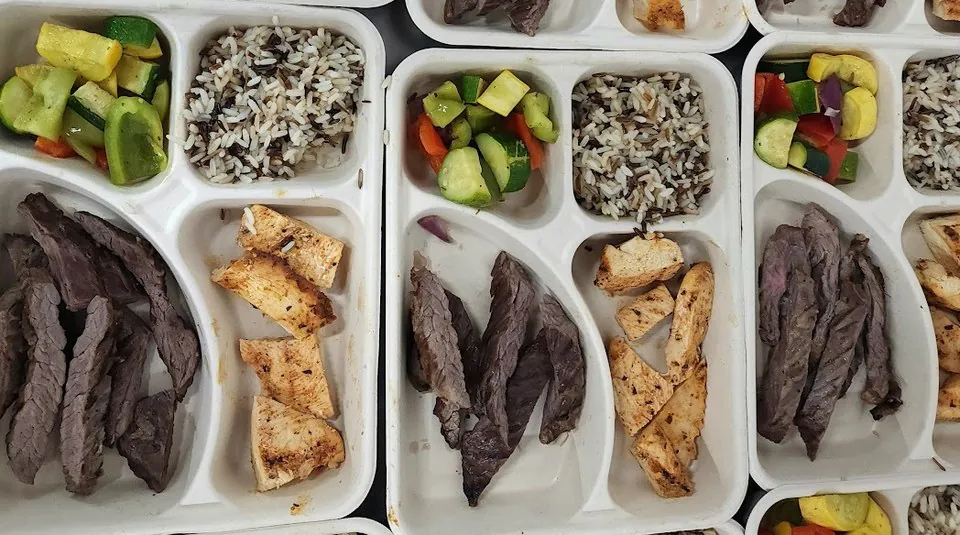
Because sodium lives in components, you rarely have to change what you ordered. You change what goes in it. Keep the format your team already likes, keep the caterer, and move four lines.
| Component | What usually shows up | Ask for this instead |
|---|---|---|
| Protein | Deli turkey, ham, salami, rotisserie chicken, smoked salmon | Grilled or roasted chicken, steak, whole fish fillets, shrimp, roasted lamb |
| Cheese | Feta, blue, parmesan, shredded cheese blends | Served on the side so people take a little, or fresh mozzarella and ricotta |
| Brine | Olives, pickles, capers, canned beans, canned corn | Fresh cucumber, radish, roasted peppers, dried beans cooked in-house |
| Sauce | Poured over the tray in the kitchen | Every sauce in its own container on the side, no exceptions |
| Starch | Salted rice, seasoned potatoes, bread basket, chips | Plain rice, plain roasted potatoes, plain grains, fruit instead of chips |
| Vegetables | Sauteed with soy, salted at the pass, dressed before service | Roasted with oil and herbs, or raw with dressing alongside |
Sauce on the side is the single highest-yield request on that table, and it costs the kitchen nothing. It moves the largest sodium source in most orders out of the food and onto the counter, where each person decides. It also happens to help every other dietary need in the room at once, which is why our mixed dietary needs guide recommends it for reasons that have nothing to do with salt.
Formats That Make Low-Sodium Easy, and the One That Fights You
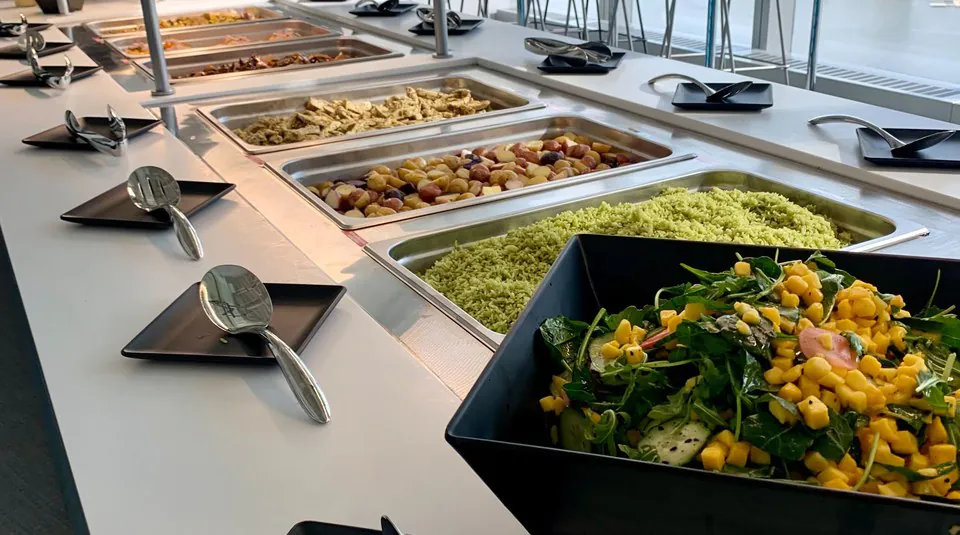
Format decides how much control your colleague has once the food is on the counter. Rank the common ones by that and the order is clear.
Build-your-own bars work best. A grain bowl bar, taco bar or salad bar keeps every component in its own pan with its own utensil, so somebody counting milligrams can take the rice, the grilled chicken and the vegetables and walk past the olives, the cheese and the dressing. Nothing needs to be ordered separately, and nobody has to announce anything. Our build-your-own salad bar guide covers the station mechanics.
Boxed lunches work if you order them right. A box locks in what the kitchen packed, which cuts both ways. Order a box built around a grilled protein, a plain grain and a vegetable with the dressing in its own cup and it is the most predictable option on this list. Order a sandwich box and you have bought bread, deli meat and cheese in one package, which is three of the four components. The boxed lunch versus buffet comparison weighs the other tradeoffs.
Composed hot trays are a coin flip. A tray of braised short rib in sauce has already made every decision for you. A tray of roasted chicken and vegetables has made almost none. Ask how the dish is finished before you order it, not what it is called.
Sandwich and wrap platters fight you hardest. Bread, cured meat, cheese and spread arrive pre-assembled, and there is no version of taking the sodium back out at the table. If your office runs on sandwich platters, the honest fix is to add one build- your-own item alongside rather than to hunt for a lower-sodium sandwich.
Cuisines That Cater Low-Sodium Well, and Where Each Hides Salt
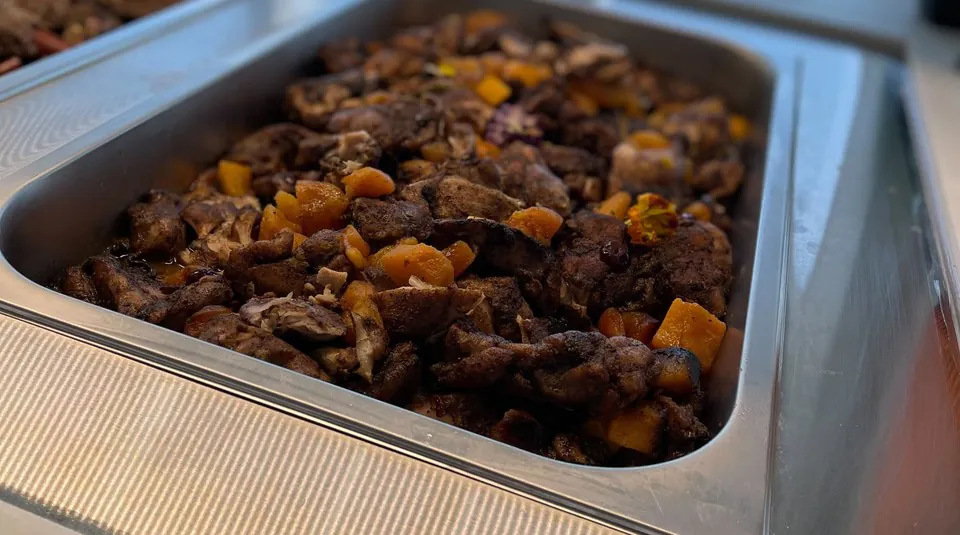
Cuisine matters less than component, but it is not neutral, because different kitchens default to different techniques. Here is where each one helps and where it turns on you.
Grill and kebab houses. The core technique is a dry rub or a marinade on whole muscle meat, cooked over fire, and rice or flatbread alongside. Ask for the sauces separately and this is close to the ideal order. The salt shows up in the pickled vegetable plate and the salted flatbread. Try Original Kabob Factory in Glendale, City Kebabs and Gyros in Daly City, or Miraj Healthy Grill in New York.
Mediterranean and Greek. Grilled protein, rice, salads and vegetables give you a lot of good components, and the Mediterranean catering directory and Greek catering directory list caterers in every metro we serve. The trap is that the parts everyone reaches for first, feta, olives and preserved lemon, are three of the highest-sodium items in this guide. Order the spread and steer people toward the grill. Olive Mediterranean Grill in Chicago, SAJJ Falafel and Shawarma in Belmont and Shawarma Shack in Denver all cater the format.
Indian. Component service is the norm rather than the exception. Rice, dal, a vegetable, a protein and breads arrive in separate vessels, so anyone can skip a line, and the spice does the flavour work that salt does elsewhere. Pickles, papadum and raita are where it hides. Browse the Indian catering directory, or start with Koriander Indian Cuisine, The Monk’s Indian Cuisine or Indian Valley. Our Indian corporate catering guide covers how the formats work.
Mexican. A taco bar is a component format by construction, and grilled meat, rice, beans, salsa fresca, lettuce and lime are all modest. Watch the cheese, the canned beans and the chips. The Mexican catering directory has options in every metro, including Taqueria Los Altos in San Francisco, Tia’s Taqueria in Denver and Amigos Taqueria in Hayward.
Japanese and poke, with one caveat. Raw fish, rice and vegetables start low, and a poke bowl lets each person dress their own. Then soy sauce lands at about 879 milligrams a tablespoon, miso and teriyaki run high, and pickled ginger is brine. Order it and put every sauce on the side, and this cuisine goes from one of the riskiest to one of the best. Pokeworks in Mountain View, Fresh Catch Poke in San Jose and Pokeworks in Greenwood Village all cater bowls, and the Japanese catering directory lists more.
Salad and bowl shops. Good raw material, and the whole business model is that the customer picks the parts. Everything in this guide about cheese, cured protein, olives and dressing applies at full force, so the format only helps if people use it. Kurated Greens in Sunnyvale, Vibrant Greens in San Mateo and Bowls by KO in Denver all cater.
What to Ask the Caterer, and What They Can Actually Answer
Here is where sodium differs from every other restriction your office handles. Gluten, dairy, pork and nuts are yes-or-no questions, and a kitchen can answer them from the recipe. Our gluten-free guide and allergy-safe boxed lunch guide both work that way. Sodium is a quantity, and almost no independent caterer has a per-tray nutrition panel, because nobody requires them to produce one.
So asking “how many milligrams of sodium are in this” gets you a guess or an apology. Ask about process instead. Process questions have real answers:
- Can you serve every sauce and dressing on the side?
- Is the rice cooked with salt, and can you make a plain batch?
- Is the chicken brined before it is grilled?
- Are the beans and vegetables canned or fresh?
- Can the vegetables be roasted with oil and herbs instead of finished with soy or salt?
- Can you leave the cheese and olives off one tray and send them in separate cups?
Every one of those is a kitchen instruction rather than a lab result, and a caterer who wants your recurring business will say yes to most of them. Give the list at least a couple of days before service so it reaches prep rather than the pass, and put it in writing on the order.
Plan low-sodium catering with CaterAi
Feeding One Low-Sodium Colleague Without Ordering Twice
Usually this is one person, sometimes two. You do not need a separate order and you should not build one, because a labeled special plate tells the whole room about somebody’s cardiology appointment.
Set the default so it works for them and nobody notices. Order the format everyone already eats, ask for sauces and dressings on the side, and make sure at least one protein on the table is grilled or roasted rather than cured. That is three requests, none of which changes what the rest of the team sees.
Then add one plain component. A pan of unsalted rice or plain roasted vegetables alongside the seasoned version costs very little and gives your colleague a base to build on. When somebody asks, it is the side dish, not the accommodation.
If your office runs a recurring program rather than one-off orders, standing instructions beat repeating yourself. A note on the account covering sauce placement and one plain component carries across every delivery, which is one of the practical advantages of a managed catering program over ad hoc ordering.
Reading a Label When the Food Arrives Packaged
Snacks, drinks and pre-packed items come with a Nutrition Facts panel, and the FDA sets exactly what the words on the front are allowed to mean. Learn four of them and the shelf gets easy to read:
| Claim on the package | What the FDA requires |
|---|---|
| Sodium free or salt free | Under 5 mg of sodium per serving |
| Very low sodium | 35 mg or less per serving |
| Low sodium | 140 mg or less per serving |
| Reduced sodium or less sodium | At least 25 percent less than the regular version of the same food |
Note the gap between the third row and the fourth. “Low sodium” is an absolute threshold, so it tells you something. “Reduced sodium” is relative to whatever the original was, so a reduced-sodium version of a very salty food can still be a salty food. The pickle numbers earlier make the point from the other direction: the low-sodium dill pickle really does drop from 809 milligrams per 100 grams to 18.
What Low-Sodium Office Catering Costs
It does not cost more. Every swap in this guide moves toward cheaper raw material or holds it flat. Grilled chicken thigh costs less than deli-sliced turkey breast. Plain rice costs less than a seasoned pilaf. Fresh cucumber costs less than imported olives. Roasting vegetables with oil and herbs costs the same as finishing them with soy.
What it costs is attention, spent once. Someone has to read the menu by component instead of by dish name, write six lines of instruction on the order, and check that the sauces arrived on the side. On a recurring program that is a one-time setup. On a one-off order it is ten minutes.
The only place a real cost appears is staffed service, where you might add a plain component as a separate pan. That is one more tray on the invoice, and it is the cheapest tray on the table. Our boxed lunch catering cost guide has the per-format ranges if you are building a budget.
How CaterAi Handles Low-Sodium Catering
Tell CaterAi that someone in the room is eating low-sodium and it builds the menu around component service rather than composed dishes, keeps sauces and dressings separate, and pulls from the 1,000-plus restaurants on the platform that cater the formats in this guide. You chat to adjust it, swap a tray, add a plain side, then check out.
For a single event, start at CaterAi or read how it works. For a recurring program where the instructions should carry across every delivery without you resending them, look at corporate catering. For a larger one-off with guests, corporate event catering covers the staffed formats.
Plan low-sodium catering with CaterAi
Frequently Asked Questions
What makes office catering low-sodium?
Component choice, not cuisine. Four things carry most of the sodium in a catering order: cured and deli protein, cheese, anything brined or pickled, and sauce or dressing. Swap grilled or roasted protein in for deli slices, keep cheese and olives in separate cups, serve every sauce on the side, and ask for plain rice and plain roasted vegetables. What is left, meat, fish, grains, vegetables, fruit and oil, carries very little sodium on its own.
How much sodium should a catered lunch have?
US dietary guidelines cap sodium at 2,300 milligrams a day and the American Heart Association recommends an ideal limit of 1,500 milligrams, especially for people with high blood pressure. If lunch is about a third of the day, that puts a working lunch somewhere near 750 milligrams against the higher figure and near 500 against the lower. Treat that as arithmetic for reading a menu. The actual target for any individual comes from their doctor.
Is healthy office catering the same as low-sodium catering?
No, and the two lists disagree more than most people expect. A salad bar with feta, olives, deli turkey and dressing rates well on almost every other measure and can deliver most of a day’s sodium in one bowl. Sliced steak with plain rice and roasted vegetables looks indulgent and lands very low. USDA figures show roasted chicken breast at about 47 milligrams per 100 grams against about 1,090 for the same bird sliced as deli meat.
Which catering formats are best for a low-sodium diet?
Build-your-own bars come first, because every component sits in its own pan and your colleague can skip the olives, the cheese and the dressing without asking anyone. Boxed lunches work well if the box is built around a grilled protein, a plain grain and a vegetable with dressing in a separate cup. Composed hot trays depend on whether the dish is finished in sauce. Sandwich and wrap platters are the hardest, because bread, cured meat and cheese arrive already assembled.
What are the highest-sodium items on a typical catering menu?
Deli and cured meats, cheese, olives and pickles, soup, bread, and any dish that arrives sitting in sauce. USDA puts pickled green olives near 1,560 milligrams per 100 grams, blue cheese near 1,150, feta near 1,140, deli rotisserie turkey near 1,200 and dill pickles near 809. One tablespoon of soy sauce carries about 879 milligrams and a single takeout packet carries about 489.
Can I order low-sodium catering for one person without changing the whole order?
Yes, and you should avoid a separate labeled plate, which announces a private medical detail to the room. Order the format the team already eats, ask for all sauces and dressings on the side, make sure one protein on the table is grilled or roasted rather than cured, and add one plain component such as unsalted rice or plain roasted vegetables. Everyone else reads that as an extra side dish.
Does low-sodium office catering cost more?
No. Grilled chicken costs less than deli-sliced turkey, plain rice costs less than seasoned pilaf, and fresh cucumber costs less than imported olives, so the swaps move toward cheaper ingredients or hold flat. The real cost is attention: reading the menu by component, writing the instructions on the order, and confirming the sauces arrived separately. On a recurring program you set that up once.
What cuisines cater low-sodium best?
Grill and kebab houses, Indian, Mexican and Mediterranean all default to component service with grilled or roasted protein, which is what you want. Each hides salt somewhere specific: pickled vegetable plates and salted flatbread at the grill, pickles and papadum in Indian, cheese and canned beans in Mexican, and feta and olives in Mediterranean. Japanese and poke start low on the raw material and end high on the sauce, so they work well when you move soy, miso and teriyaki to the side.