A dim sum order has no main course. A sandwich platter hands every guest one sandwich, a boxed lunch hands them one box, and a wing tray still resolves to a number of wings a person eats. A tray of dumplings hands a room forty pieces and leaves the planner to work out how many of them count as lunch. Nom Wah opened in Manhattan’s Chinatown in 1920 and has been running that arithmetic longer than almost anyone, and it is the part most office planners get wrong.
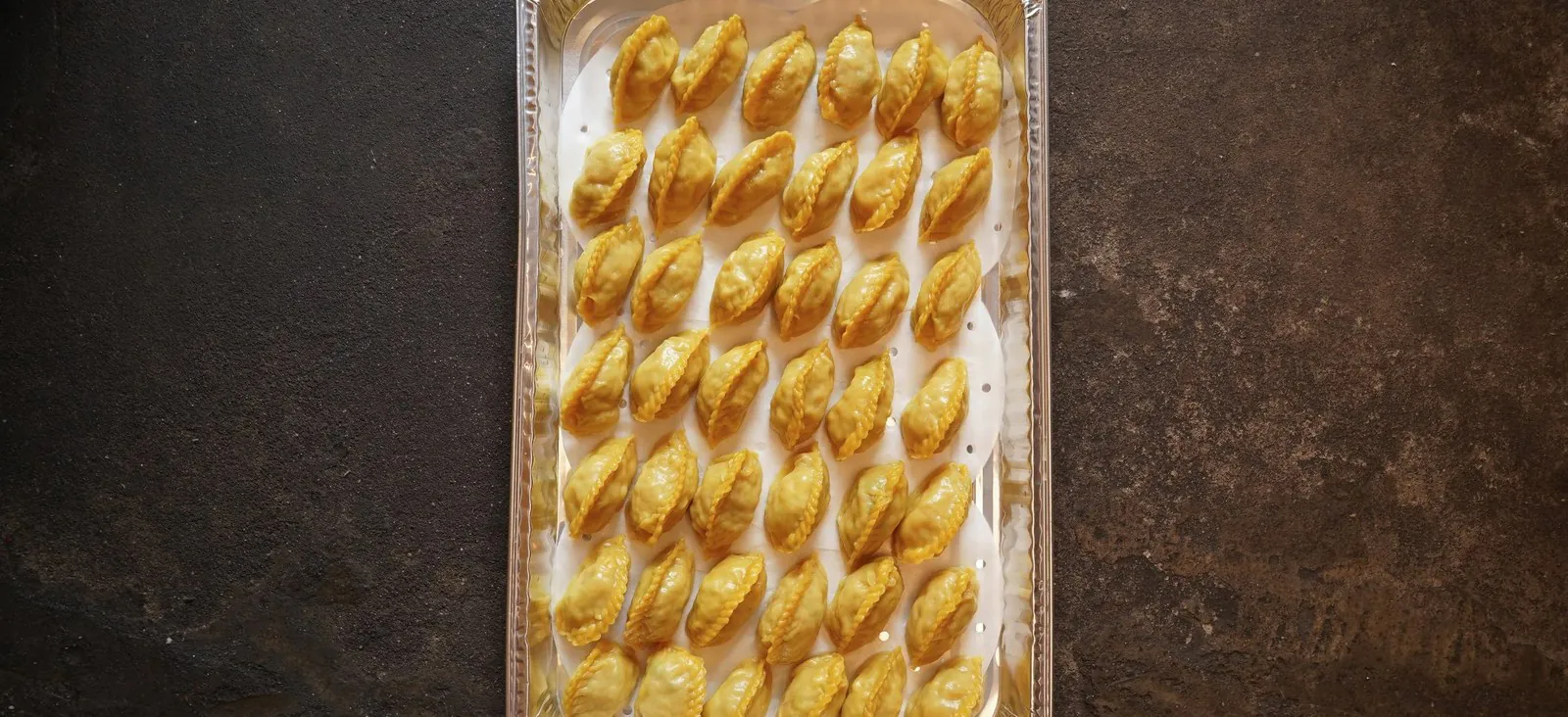
Get the piece count wrong in one direction and you have bought an appetizer for a room that came for lunch. Get it wrong in the other and half the tray goes home in the fridge. Neither mistake shows up until the food is on the table, which is why the arithmetic is worth doing before the order rather than after it.
Plan Nom Wah catering with CaterAi
Origin Story
Nom Wah opened in 1920 at 15 Doyers Street, on the bent little block in Manhattan’s Chinatown that mapmakers call the Bloody Angle. It started as a tea parlor and a bakery, and the dim sum list was short by design, because the small plates existed to accompany the tea rather than to replace a meal. The parlor moved a few doors down to 13 Doyers in 1968 and has stayed there.
Ed and May Choy ran the business from the 1940s, mostly as a bakery. Their sixteen-year-old nephew Wally Tang arrived in New York in 1950 and started working behind the counter. He bought the restaurant in 1976. His own nephew Wilson Tang, who had left a career in finance, bought it from him in 2010 and renovated the following year, switching the parlor from rolling carts to a photo-heavy checklist menu with everything made to order.
That last change is the one an office planner should care about. Made to order is why the kitchen can build a catering tray of one item rather than whatever came around on the cart, and it is why the gluten-free dumplings on the menu exist as their own production run instead of an afterthought.
The Order Is Counted in Pieces, Not Plates
Most office catering formats are per-person formats wearing different clothes. You count heads, you order that many units, and the only real question is what goes in the unit. Dim sum breaks the pattern. The kitchen sends trays, the room shares them, and no individual guest has a portion with their name on it.
Two consequences follow. The first is that appetite variance stops being somebody else’s problem. In a boxed-lunch order the person who eats half a box and the person who eats two boxes cancel out on paper but not in the room. In a shared tray they cancel out for real, which makes dim sum forgiving for a group you do not know well. The second is that the spread has to be balanced, because a room grazing from trays will empty the popular one and leave the rest.
Order rice or noodles alongside the dumplings and the piece count per head drops, because the rice does the filling and the dumplings become the reason people came. Order dumplings alone and the count has to carry the whole lunch by itself. Teams that already think this way about party trays and build-your-own bars will find the logic familiar.
What Nom Wah Sends to an Office
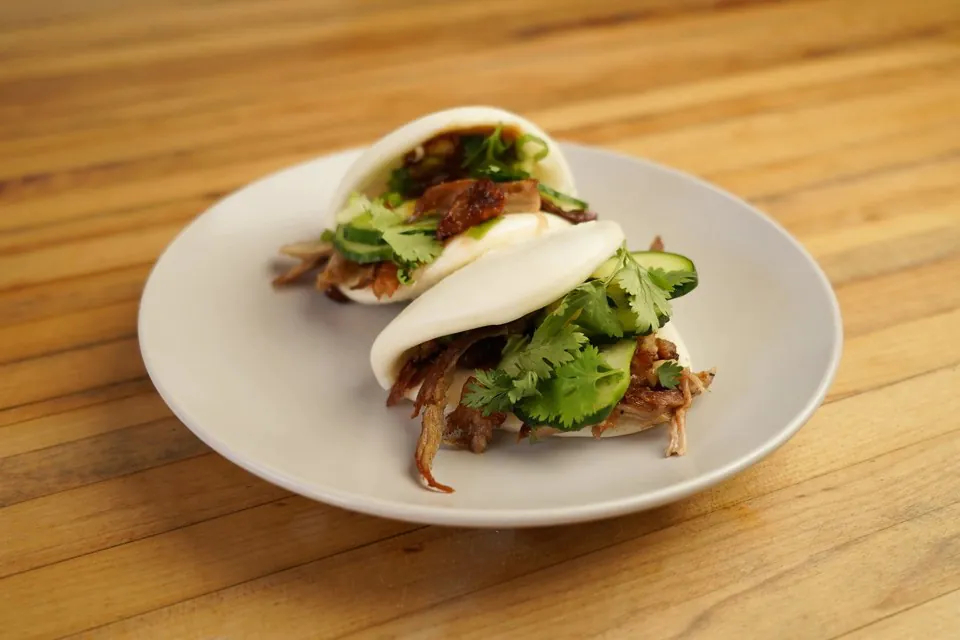
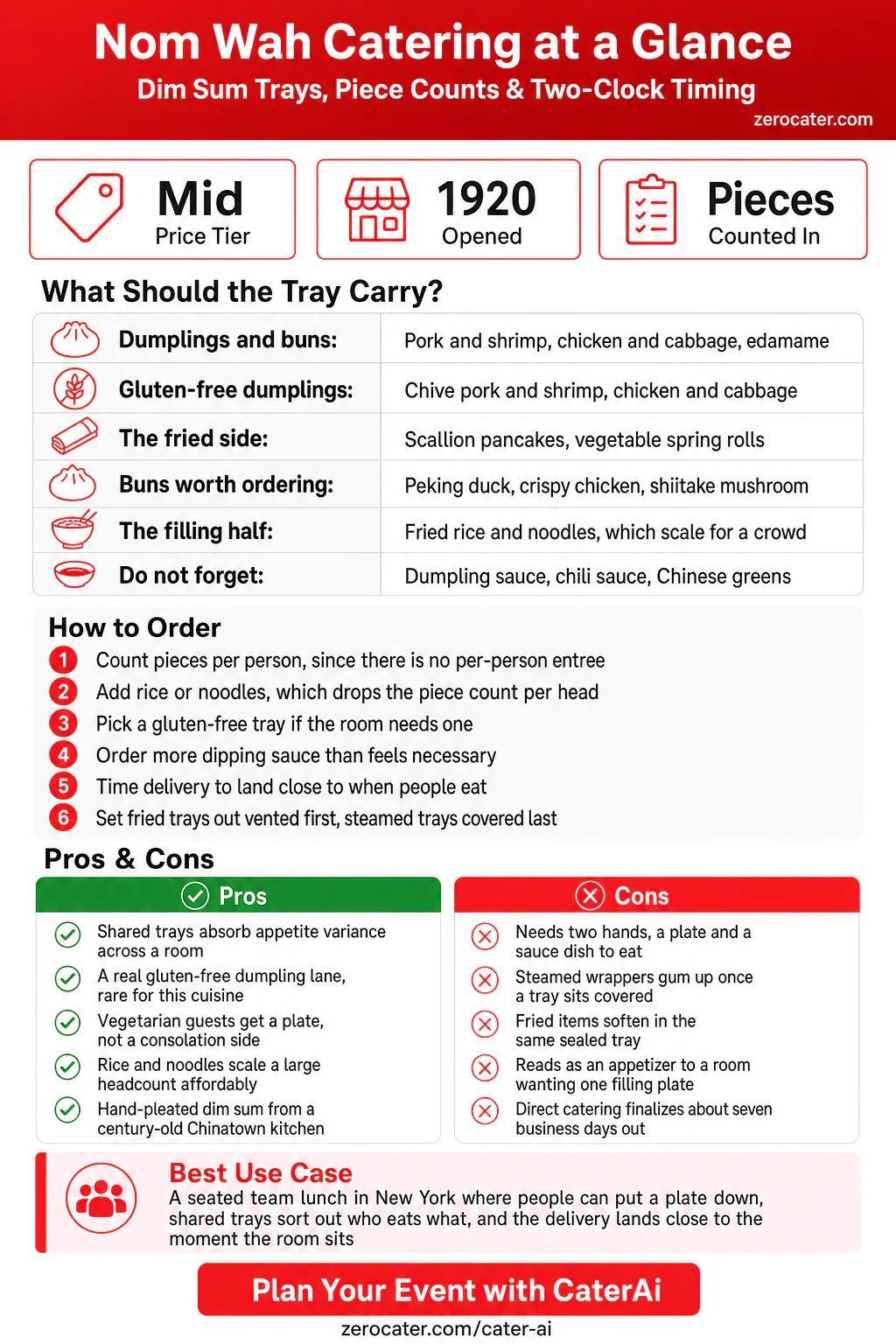
The Zerocater menu splits into four useful groups. The dumpling and bun list runs through pork and shrimp dumplings, chicken and cabbage dumplings, edamame dumplings, Peking duck buns, crispy chicken buns and shiitake mushroom buns, with scallion pancakes and vegetable spring rolls covering the fried side.
The second group is the filling half of the order. Fried rice comes in shrimp, Chinese sausage, crispy chicken and plain egg. Noodles run to miso-braised chicken, Szechuan tofu and chow mein in vegetable or crispy chicken. These are the dishes that turn a dumpling spread into a lunch, and they are also where a large headcount gets affordable, because rice scales in a way that hand-pleated dumplings never will.
The third group is small and easy to forget: Chinese greens, white rice, dumpling sauce and chili sauce. Order the sauces deliberately. A tray of dumplings without enough dipping sauce is a worse lunch than the same tray with it, and the sauce is the cheapest part of the order. The fourth group is the red bean bun, which is the only dessert on the list and reads as a gentle finish rather than a sugar course.
Two Textures, Two Clocks, Running at Once
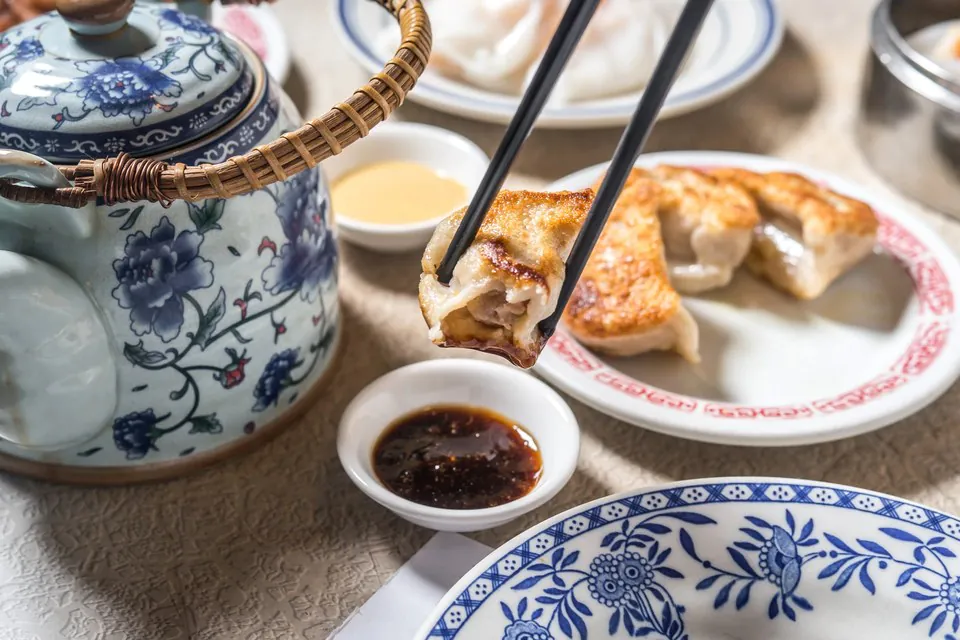
Every catering tray degrades. Dim sum is unusual because a single order degrades in two opposite directions at the same time, and the planner who knows which is which can hold the quality of the spread for an extra half hour.
Steamed items want steam and lose in still air. Wheat and rice wrappers hold beautifully in a steamer basket, then gum up and stick to each other and to the tray once they are covered and stacked. Pull the lid off a covered tray of steamed dumplings late and you find a raft rather than individual pieces. Fried items have the reverse problem. A scallion pancake or a spring roll leaves the kitchen crisp and softens from there, because the steam it gives off has nowhere to go inside a sealed container and works its way back into the crust.
Set the trays out in this order.
Fried first and vented, steamed last and covered. Crack the lid on the spring rolls and scallion pancakes as soon as they arrive so the trapped steam can escape, and leave the steamed dumplings sealed until people are walking up to the table. Doing it the other way round costs you both trays at once.
If the food has to wait, wait it in the rice. Fried rice and noodles hold far better than either dumpling texture, so a spread that leans on them survives a delayed meeting in a way a dumplings-only order will not.
This is also the argument for ordering delivery to land close to the moment people eat rather than comfortably early. Offices that run board meetings and lunch and learns already schedule food to the minute. Dim sum rewards that habit more than most formats do.
The Gluten-Free Lane Is Real, With One Caveat
Chinese catering usually gives a mixed-diet office nothing. The wrapper is wheat, the soy sauce is wheat, and a guest avoiding gluten ends up eating plain rice and steamed greens while everyone else eats lunch. Nom Wah’s Zerocater menu is a genuine exception. It carries gluten-free dumplings in two fillings, chive with pork and shrimp, and chicken with cabbage, alongside gluten-free noodle dishes, gluten-free fried rice and gluten-free vegan Chinese greens.
Nom Wah attaches its own warning to that, and the post repeats it rather than softening it: there is opportunity for cross-contamination during preparation. A shared kitchen making wheat wrappers all day is a shared kitchen. Read the gluten-free list as a strong option for a guest avoiding gluten by choice or by sensitivity, and call ahead before you rely on it for a guest with celiac disease. Our gluten-free office catering guide covers how to ask that question, and the mixed dietary needs guide covers building a spread around it.
The vegetarian and vegan side is stronger still. Edamame dumplings, shiitake mushroom buns, vegetable spring rolls, scallion pancakes, Szechuan tofu noodles, vegetable chow mein, Chinese greens and white rice add up to a plate rather than a consolation side, which is more than a lot of formats manage.
Ideal For
Nom Wah is a strong call when:
- You are feeding a seated team lunch where people can put a plate down and use two hands
- The room has a mix of eaters and you want appetite variance to sort itself out across shared trays
- Somebody in the group avoids gluten and you are tired of offering them a side salad
- You want a lunch that starts a conversation, because a shared tray does social work a stack of boxes does not
- You are hosting visitors in New York and want food that belongs to the city rather than to a national chain
- The order can be timed to land close to when people eat
Dim sum also does something specific for a team that eats together often. A rotation of boxed lunches gets predictable fast, and a shared-tray format breaks the pattern without asking anyone to stand in a line. It works particularly well for onboarding days and small celebrations, where the food is supposed to be part of the event rather than fuel consumed at a desk.
Order something else when:
- The lunch is a standing or walking event. Dim sum needs two hands, a plate and a sauce dish, and it fights a room where people are circulating
- The delivery is long. Both textures are working against you the whole ride
- The room expects one filling plate each. A dumpling spread reads as the appetizer course to people who came for a main
- You need every guest to have an identical, labelled, individually sealed portion. That is a boxed lunch job
- A guest has celiac disease and nobody has called the kitchen yet
How to Order
Two paths, and they run on different clocks. Ordering direct through Nom Wah’s own catering program means online ordering for pickup, drop-off, or drop-off with setup, with delivery charges calculated by distance. That program finalizes orders about seven business days in advance, and Nom Wah asks planners to inquire earlier than that so the order can be confirmed. Anything more complex goes through an inquiry form and comes back as a quote. On-site service wants the longest notice of the lot and carries an order minimum, so start that conversation early.
Ordering through Zerocater runs on a shorter clock, which is the practical reason an office would use it. The Nom Wah vendor page carries the catering menu with the dumplings, buns, noodles, fried rice, sides and sauces laid out, tagged Chinese and East Asian. For a recurring team lunch or a meeting that got scheduled this week, that is the path that matches the notice you have.
Plan Nom Wah catering with CaterAi
Zerocater and Nom Wah
Chinatown dim sum is a narrow lane in office catering. Plenty of caterers will send a Chinese-American buffet of orange chicken and lo mein. Very few will send hand-pleated dumplings from a restaurant that has been making them on the same block for a century. That is the reason Nom Wah sits on the Zerocater roster in New York alongside the rest of the city’s East Asian and Chinese catering options.
New York teams building a rotation around it have plenty to rotate with. MakiMaki Sushi and 251 Ginza Sushi cover the sushi end, Senshi Ramen and Yamitsuki Ramen cover noodles, Kin Khao Thai, Little Mint Thai Kitchen and Suross Thai Bistro cover Thai, and Banh Mi Ngon covers Vietnamese sandwiches. Outside East Asian entirely, Bite and A Saffron Thread keep the rotation from repeating. The full roster sits on the New York City caterers page.
Nom Wah also has a Philadelphia sibling, and Philadelphia teams have their own dumpling bench to work with: China Soul, Brooklyn Dumpling Shop, Bao Nine, Asian Experience and Koto Sushi. If you are pricing a program in either city, the New York cost guide and the Philadelphia cost guide lay out what office catering runs in each city, and the New York event catering roundup covers the bigger-format end.
For a one-off event, CaterAi will build a spread across several vendors and let you edit it by chat, which is useful when a dim sum order needs a rice dish and a dessert from somewhere else to round it out. For a standing program, corporate catering handles the rotation and the invoicing. If you are new to ordering this way, how it works covers the mechanics, and corporate event catering covers the staffed end.
Menus, formats, lead times and availability change. Check the Nom Wah vendor page for the current catering menu and a live quote for your office and headcount.
Plan Nom Wah catering with CaterAi
Frequently Asked Questions
How much dim sum should I order per person for an office lunch?
Count pieces rather than plates. Dim sum has no per-person entree, so the order resolves to a number of pieces a room shares. As a working starting point, a dim sum spread that has to carry a full lunch needs noticeably more pieces per head than one sitting alongside rice or noodles, and a spread meant as an afternoon snack or a meeting starter needs fewer. Order rice or noodle dishes alongside the dumplings and the piece count per person drops, because the rice does the filling. Confirm serving guidance on the Nom Wah vendor page before you commit to a headcount.
How much lead time does Nom Wah catering need?
It depends which path you order through. Nom Wah’s own catering program finalizes orders about seven business days in advance and asks planners to inquire earlier than that so the order can be confirmed. On-site events want more notice again, and Nom Wah tells planners to ask as soon as possible for that service. Ordering through Zerocater runs on a shorter clock, which is the practical reason an office would use it for a team lunch rather than a scheduled event.
Does Nom Wah have gluten-free options?
Yes, and the lane is wider than most Chinese catering offers. The Zerocater menu lists gluten-free dumplings in chive, pork and shrimp as well as chicken and cabbage, plus gluten-free noodle dishes, gluten-free fried rice and gluten-free vegan Chinese greens. Nom Wah pairs that with a clear warning of its own: there is opportunity for cross-contamination during preparation. Treat the menu as a gluten-avoidance option rather than a celiac-safe one, and call ahead if a guest has celiac disease.
Is there a vegan or vegetarian option?
Yes. The menu carries edamame dumplings, shiitake mushroom buns, vegetable spring rolls, scallion pancakes, vegetable chow mein, Szechuan tofu noodles, plain Chinese greens and white rice, with gluten-free versions of several of them. A vegetarian guest at a Nom Wah spread has a real plate rather than a side dish, which is not true of every catering format.
Will steamed dumplings still be good by the time they reach the office?
They travel, but they change. Steamed wheat and rice wrappers hold their texture in the steamer and start to gum and stick to each other once a tray is covered and stacked. Fried items move the opposite direction and soften as trapped steam works back into the crust. Plan for the delivery to land close to when people eat, keep the fried items vented rather than sealed, and set the steamed trays out last.
Can Nom Wah cater an on-site office event with staff?
Nom Wah runs full-service catering and events alongside its pickup and drop-off ordering. That path goes through an inquiry form rather than a checkout button, because the team quotes the work. On-site service carries an order minimum and wants the longest notice of any Nom Wah format, so start the conversation well before the date.
Does Nom Wah deliver, and how are delivery charges worked out?
Nom Wah runs online ordering with pickup, drop-off, and drop-off with setup. Delivery charges are calculated by distance, so an office close to the kitchen pays differently from one across the city. Ordering through Zerocater puts the delivery on Zerocater’s rails instead, which is the simpler path for a recurring team lunch.
How do I order dim sum for an office in a city Nom Wah does not serve?
Nom Wah is a New York restaurant with a Philadelphia sibling, so a team outside those metros cannot order from it directly. Zerocater lists Chinese and broader East Asian caterers across its served metros, so the format travels even when the restaurant does not. Browse Chinese catering or the wider East Asian directory, or ask CaterAi to build the equivalent spread in your city.