Most caterers hand you a menu. Caterman hands you a menu and a second list beside it, and the second list is the one worth reading first. It names thirty-six pieces of equipment you can hire, sorted into nine groups, and it opens by telling you that you can take them on their own, without ordering any food at all.
Read that list against the kitchen’s own answers page and a line appears that no catering menu ever shows you. This San Jose operation sells three things, and it sells them separately: the food, the hardware it sits in, and the people who run the room. For two items it will supply the hardware and the people while refusing to supply the goods. It will not bake your cake. It will not sell you a drink. It will rent you the cake stand and the wine glass.
In this guide
A kitchen that was never a restaurant, and what that changes.
Thirty-six rental pieces, nine groups, and not one of them disposable.
The fourteen pieces that scale with your headcount and the twenty-two that do not.
The two goods the kitchen refuses to supply, and the rental pieces that prove it.
Who Caterman suits, and how to order for a Bay Area office.
A San Jose Kitchen That Was Never a Restaurant
Almost every caterer your office orders from started as somewhere you could sit down. The dining room came first, the catering menu came second, and the catering menu inherits the dining room’s habits: the same dishes in bigger trays, the same portions doubled, the same kitchen squeezing a hundred lunches between two dinner services.
Caterman cooks out of a kitchen at Reynolds Circle in San Jose and has no dining room anywhere. You cannot walk in and eat. Everything that kitchen makes leaves the building, which means the catering menu is not a translation of anything. It is the whole business.
That shows up in the shape of what the operation publishes. A restaurant publishes a menu and, if you dig, a catering page bolted onto it. Caterman publishes a menu, a rental catalogue, an answers page that names the service styles on offer, and a quote form that lets you stack breakfast, lunch, a break and a reception into one booking across one day or several. The kitchen cooks for corporate offices, tech teams, production crews and government departments across San Jose, San Francisco and the wider Bay Area, and it runs the room on the day rather than dropping food at a door.
Order from a restaurant and you buy a meal. Order from this kitchen and you are buying a service, of which the meal is one part. The rental catalogue is where the other parts become visible.
Thirty-Six Pieces, Nine Groups, and Not One of Them Disposable
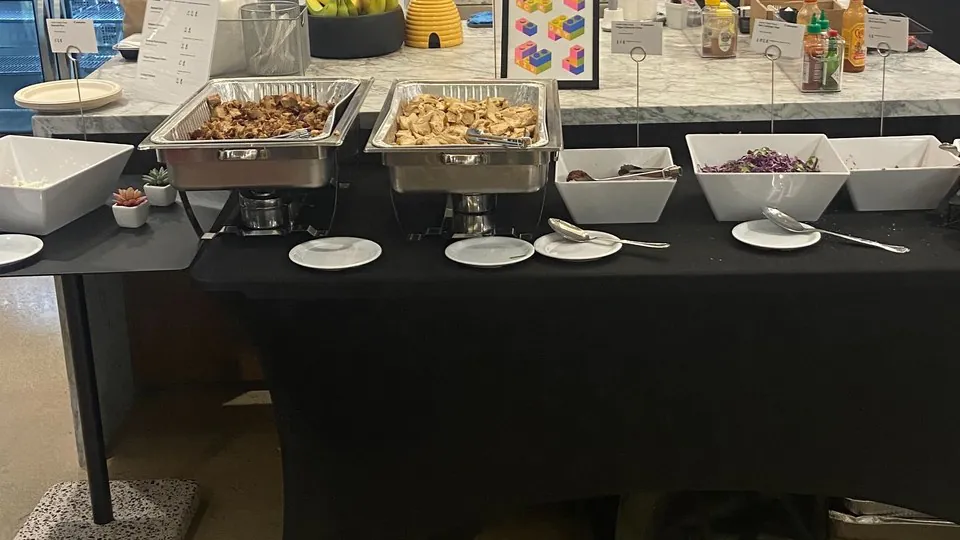
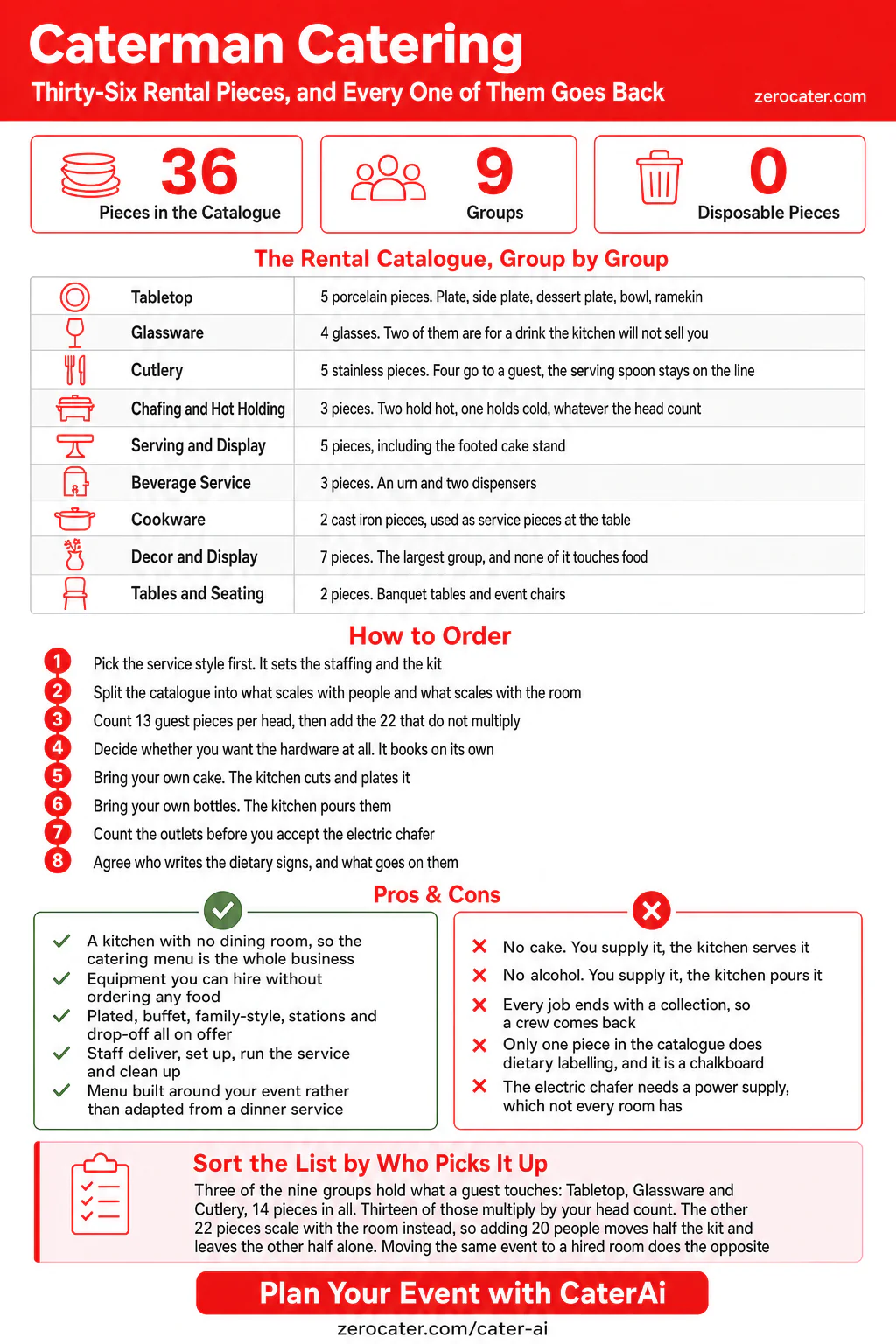
Count the catalogue and you get thirty-six named pieces across nine groups: Tabletop, Glassware, Cutlery, Chafing and Hot Holding, Serving and Display, Beverage Service, Cookware, Decor and Display, and Tables and Seating. Each piece carries a one-line description of what it does, which is how you can sort them without seeing a single photograph.
Sort them by material and the finding lands. Five porcelain pieces. Four glasses. Five pieces of stainless cutlery, plus a stainless gastronorm tray and two stainless chafers. Two pieces of cast iron. A silver cloche and a silver platter. Timber crates, a pallet stand, a garden cart. A terracotta pot, a pierced metal lantern, a glass vase. Banquet tables and event chairs.
Not one of them is disposable. There is no plate stock on this list, no plastic cutlery, no paper napkin, no foil pan. The closest thing to a tray in the whole catalogue is the gastronorm tray, which is the stainless hotel-pan standard that commercial kitchens have used for decades, and which somebody washes afterwards. Thirty-six pieces, and every one of them returns to Reynolds Circle when your event ends.
That single fact explains the business model better than any line of marketing copy on the site. A drop-off caterer can walk away from your office the moment the food is on the counter, because everything it left behind is yours to throw out. A kitchen whose entire service kit is porcelain, glass, stainless, cast iron, wood and terracotta cannot walk away. Someone has to come back, load it, take it home and wash it. The catalogue commits the operation to a return trip on every job, and the staffing answer on the FAQ follows from that rather than sitting beside it: the team handles delivery, setup, service on the day and cleanup.
If your office has ever ended a catered lunch by filling two bins with aluminium and cardboard, this is the opposite arrangement, and the trade is worth naming before you book. You get china and stainless on the table. You also get a crew in the room and a collection at the end, which is a different kind of day from a stack of boxes appearing at reception. Our format comparison walks through where each one fits.
Fourteen Pieces Scale With the Headcount. Twenty-Two Scale With the Room.
Sort the same thirty-six a second way, by who picks the piece up, and the catalogue splits into two halves that behave very differently on a quote.
Three of the nine groups hold the pieces a guest touches: Tabletop, Glassware and Cutlery. Fourteen pieces sit in those three groups, and thirteen of the fourteen go into a guest’s hands. The exception is the serving spoon, which the catalogue describes as a long stainless spoon for buffet and family-style service, so it belongs to the line rather than to any one person. Everything else in those three groups multiplies by your headcount. Forty people means forty dinner plates, and eighty if you are running a dessert course on the matching dessert plate.
The other twenty-two pieces do not move with your headcount at all. Two chafers hold hot food and one chilled tray holds cold, and three of them cover a buffet whether twenty people or two hundred walk past it. One cloche, one cake stand, one coffee urn, one lemonade dispenser. Banquet tables and chairs scale with the floor plan rather than the guest list. The decor group scales with nothing except how dressed you want the room to look.
That split is the useful thing to carry into a conversation with any full-service caterer, not only this one. When an office asks what a catered event costs and gets an answer that seems to jump around, the two halves are usually why. Adding twenty people to a headcount moves one half of the kit and leaves the other half alone. Moving the same event from your own canteen to a hired room can leave the headcount untouched and move the other half hard, because the tables, the chairs and the hot holding now all have to arrive in a van. Our guide to catering at an event venue covers what changes when the room is not yours.
The largest group in the catalogue is the one that touches no food at all. Decor and Display holds seven pieces, more than any other group, and its contents are a chalkboard sign, a vase, a metal lantern, a pallet display stand, a terracotta flowerpot, a wooden crate and a two-wheeled garden cart. Seven pieces out of thirty-six exist to make a room look like something. For a caterer, that ratio is a statement of what the job involves.
The Stand Comes From the Kitchen. The Cake Does Not.
Caterman’s answers page carries two refusals, stated plainly, and they are the most useful sentences on the whole site.
The first: the kitchen does not bake or supply the cake, and it is happy to handle cake service. You bring a cake from your own baker and the team takes care of the cutting, the plating and the serving. Now look back at the rental catalogue, at the Serving and Display group, and you find a footed cake stand described as a pedestal stand for cake tables and dessert displays.
So the kitchen will rent you the object a cake sits on, send people to cut and plate it, and decline to make the cake. Every part of that transaction belongs to Caterman except the thing your guests eat.
The second refusal runs the same way. The team provides bartenders and the full bar setup and does not sell or supply the alcohol. You bring the bottles and the crew pours. Look at the Glassware group and you find four pieces: a tumbler, a water goblet, a wine glass and a champagne flute. Two of the four glasses in this catalogue are stocked for something the kitchen has told you in writing that it will not sell you.
One refusal could be a quirk. Two of them, pointing the same way, describe a rule the operation runs on. Caterman supplies the vessel and the labour. For the two goods that come with a specialist maker or a regulator attached, it supplies neither, and it says so before you ask. That is a better answer than the vagueness most caterers offer on both subjects, and it tells an office manager exactly which two phone calls remain theirs to make.
Take it into your planning as a question rather than a complaint. If you are booking a celebration, work out early which parts of the table your caterer owns and which parts you own, because the gap is where an event goes wrong on the afternoon. Our event catering checklist has the rest of that list.

One Piece on the List Does Dietary Work
Read all thirty-six descriptions and exactly one mentions diets. The chalkboard menu sign is described as a small chalkboard sign for labelling buffet dishes and dietary marks. One piece out of thirty-six, filed under decor.
That placement is worth noticing rather than criticising. The kitchen does carry dietary information: the published menu tags dishes as vegetarian, vegan, gluten-free, dairy-free, nut-free and halal, each dish lists what it contains, and the answers page states that the kitchen is halal-capable across the menu rather than on a short list of dishes. The information exists. The only piece of physical equipment that carries it to the table is a chalkboard, and a chalkboard says whatever the person holding the chalk writes on it.
So if your team has real requirements in the room, the thing to agree is who writes the signs and what goes on them. Send the requirements with the enquiry, because the kitchen builds the menu around them at the planning stage rather than adding to it later, and then ask how each dish gets labelled once it reaches the line. Nothing here is dietary or medical advice, and your own guests’ needs are yours to manage. A neighbouring spotlight, El Sur, runs into the same gap from the other direction.
The Only Piece With a Condition Attached Needs an Outlet
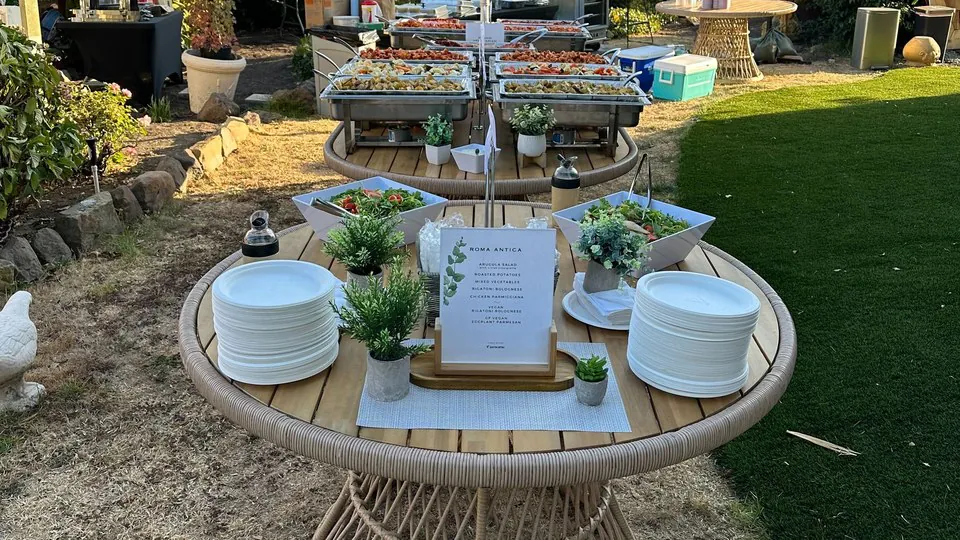
One more line in the catalogue rewards a second read. The Chafing and Hot Holding group carries three pieces: an electric chafer, a water-bath chafer and a chilled display tray. The electric chafer is described as a chafer for hot holding where a power supply is available.
Thirty-six descriptions, and that is the only conditional clause in any of them. Every other piece in the catalogue works wherever you put it down. One piece asks a question about the room first, and the question is about electricity.
The water-bath chafer beside it answers the same question with fuel instead, which is why caterers carry both. If your event runs in a lobby, a courtyard, a tent or anywhere the power comes off one extension lead, that distinction stops being trivia. Ask which of the two the kitchen plans to bring, and count the outlets in the room before you agree. Offices that run catering in unusual spaces already know this: our guides to outdoor company events and offsite retreats keep running into the same wall socket.
What Full Service Adds That a Drop-Off Does Not
Put the catalogue and the answers page together and the offer resolves into something an office can compare against its usual order.
The kitchen cooks from scratch at Reynolds Circle, sources seasonally from California farms, and cooks legumes from dried rather than opening tins. The team plans the menu with you rather than handing over a fixed list, and offers plated, buffet, family-style, stations and drop-off as service styles, plus dessert and bar service where the event suits it. Staff deliver, set up, run the service and clean up. Weddings begin with a tasting. Corporate bookings can run as recurring weekly lunches with a rotating menu, or as a conference day where each service window is planned separately.
Against a restaurant’s catering arm, the differences that matter to an office are these. The menu is built for your event instead of adapted from a dinner service. The hardware arrives with the food and leaves with the crew. Someone stays in the room. And two goods, the cake and the drink, stay your responsibility no matter how much else you hand over.
Against a drop-off order, the trade is time and attention for money and simplicity. A drop-off lands at reception and your team takes it from there. A full-service booking involves a planning conversation, a crew in your space, and a collection afterwards, in exchange for china on the table and nobody on your staff running the buffet. Neither one wins in the abstract. The Bay Area cost picture is the right place to weigh them for your own program.
What Has to Happen After the Last Guest Leaves
Every catering order ends twice. The food ends when people stop eating. The order ends when the last object leaves your floor, and the gap between those two moments is the part nobody quotes on.
A drop-off order closes that gap by making the kit disposable. Foil pans, plate stock, plastic cutlery and cardboard all end up in your bins, which is fast and which your facilities team pays for in bin space rather than in labour. Nothing goes back, because nothing is worth taking back.
Caterman’s catalogue closes the same gap the other way. Thirty-six pieces, nothing disposable, and every one of them returns to Reynolds Circle. The porcelain goes back. The glassware goes back. The stainless cutlery and the gastronorm tray go back. The cast iron, the crates, the lantern and the garden cart all go back. So does the banquet table your buffet stood on. A crew arrives, loads it, and your office ends the day with clear surfaces and an empty bin.
Neither arrangement is better in the abstract, and the choice depends on what your building can absorb. Ask yourself who would otherwise be stacking trays at four in the afternoon. If the answer is an office manager who already has a full day, a kitchen whose kit is not disposable is buying that person their afternoon back, and the collection is the reason it can.
The question to put to any full-service caterer is the plain one: when does your crew come back, and what do they take. Caterman answers it on the catalogue page rather than in a contract, because the answer is the list itself. Everything on it, every time.
Who Caterman Suits, and Who Should Order Elsewhere
This kitchen fits an office that is running an occasion rather than feeding a Tuesday. All-hands meetings, client receptions, launch parties, holiday dinners, conference days with several services, offsites in a hired space, and recurring lunch programs where a rotating menu matters more than speed. It fits teams with mixed dietary requirements who want them handled at the planning stage. It fits events in a room that has no kitchen, because the tables, the chairs and the hot holding all travel.
It is the wrong call for a fifteen-minute desk lunch, for a team that wants food to appear with nobody in the room, or for an office that will not run a planning conversation before every order. For those days, a San Jose vendor with a standing tray menu does the job with less ceremony. Erik’s DeliCafe and Bona Pizza cover the sandwich and pizza end of that. JapaCurry, House of Falafel, Great Khan’s Mongolian Grill and Salad Bowl fill out the rest of the Silicon Valley bench.
How to Order Caterman Catering
Two routes. Go direct through Caterman’s own quote form, which walks you through dates, guest count and service, and lets you add several services across one day or several days. Or order it through Zerocater from the Caterman vendor page, alongside the rest of your catering program.
Either way, settle four things before you book. Which service style the event needs, since plated, buffet, family-style, stations and drop-off each change the staffing and the kit. Which rental pieces you want, since the catalogue is available on its own and you may already own half of it. Whether you are bringing a cake or a bar, because those two stay yours. And how the kitchen labels dietary dishes once they reach the line.
Confirm the current menu, the service styles and what the kitchen can hold for your date before you commit. Caterman plans each event individually, so what is on the site is the shape of the offer rather than a fixed catalogue of packages. The vendor page carries the live quote.
Where Caterman Fits on a Bay Area Catering List
San Jose sits at the bottom of a corridor that runs up through Santa Clara, Sunnyvale, Mountain View and Palo Alto before it reaches San Francisco and Oakland. Most offices along it order across two or three cities in a normal month, and a kitchen that travels the whole corridor with its own tables and chafers solves a problem that a single-site restaurant cannot.
On menu, the kitchen sits in the Californian and Italian register, with enough Mediterranean range to cover a mixed room. On format, it belongs with the full-service end of the directory rather than the tray-and-go end. Teams that book production catering, public-sector events or grazing tables tend to want the same things this kitchen sells: hardware, staff and a menu built for the day. Our roundups of Silicon Valley catering and San Francisco event catering put it next to the rest of the field, and the party tray guide and canape guide cover the food that usually lands on those rental platters. Another kitchen that publishes more than it has to, Atlanta Bread, rewards the same kind of reading.
Caterman and Zerocater
Zerocater works with more than a thousand restaurants and kitchens across twelve metros, and Caterman is one of the Bay Area partners on that list. The reason a full-service kitchen belongs on it is the same reason this post exists: an office program needs both ends of the range. Some weeks you want trays at the door. Some weeks you want a room set with china and somebody running it.
If you are working out which of those a given occasion needs, CaterAi plans the menu with you from the partner network and books onsite staff and decor where an event calls for them. For a standing weekly program, corporate catering is the right door, and event catering covers the one-off occasions. The venue and conference pages carry the detail for events that run outside your own building, and how it works covers the rest.
Menus, service styles and rental availability change. Everything above comes from Caterman’s own published menu, rental catalogue and answers page at the time of writing. Confirm the current details and take a live quote from the Caterman vendor page before you book.
Caterman Catering: Frequently Asked Questions
Does Caterman cater office lunches, or only weddings and large events?
Both. The kitchen runs corporate catering alongside weddings and private events, including recurring lunch programs for Bay Area teams and conference days that carry several services in one booking. An office lunch and a wedding reception come out of the same San Jose kitchen and off the same menu.
Can you rent the equipment without ordering the food?
Yes. The rental catalogue says so in its own opening line: you can book the pieces alongside catering or on their own. That makes the hardware a separate purchase from the meal, which is unusual for a caterer and useful if your office already has the food sorted and needs the china, the chafers or the banquet tables.
Does Caterman supply the cake?
No. The kitchen handles cake service, which covers the cutting, the plating and the serving, and you bring the cake from your own baker. The footed cake stand sits on the rental list, so the display piece comes from Caterman even though the cake does not.
Does Caterman supply alcohol?
No. The team provides bartenders and the bar setup, and you supply the drinks yourselves. Two of the four glasses in the rental catalogue, the wine glass and the champagne flute, are stocked for something the kitchen will not sell you.
Is anything on the rental list disposable?
Nothing. All thirty-six pieces are porcelain, glass, stainless, cast iron, wood or terracotta, and every one of them returns to the kitchen afterwards. A drop-off caterer leaves you holding the packaging. This catalogue leaves you holding nothing, because someone comes back for all of it.
Does Caterman cater outside its own kitchen?
Yes. The team caters at private homes and at venues across the Bay Area, and its own FAQ commits to leaving the space as it found it. The rental catalogue is what makes that portable: banquet tables, chairs, chafers and a full tabletop service travel with the food.
Which dietary options does Caterman handle?
The published menu flags vegetarian, vegan, gluten-free, dairy-free, nut-free and halal dishes, and the kitchen states it is halal-capable across the menu rather than on a short list of dishes. Send your requirements with the enquiry so the kitchen builds the menu around them rather than adding to it later. Nothing here is dietary or medical advice.
How do I order Caterman for a Bay Area office?
Order through Caterman directly, or order it through Zerocater alongside the rest of your program from the Caterman vendor page. Confirm the current menu, the service styles on offer and what the kitchen can hold for your date before you book, and take the live quote from the vendor page.