The call sheet says lunch at 12:30. The caterer arrives early, sets a faultless line, and the crew eats. The production still owes a penalty on every person on the floor, because the last grip reached the food at 12:47.
Nothing went wrong with the food. Something went wrong with the clock, and on a set the clock is the part of the order that a menu cannot fix. A production books its meal times out of a labor agreement signed long before anyone chose a caterer. The agreement sets when the break falls, how long it runs, when it starts counting, and in one case what temperature the food has to be. A caterer who has only ever worked offices will meet none of that by accident.
This guide covers feeding film, television and studio crews on set. It treats the two food jobs on a production as the two separate things they are, and it works from what one union local publishes about its own meal rules. Our film and TV production catering page and our studio production page cover how Zerocater services those orders. This one covers what you are ordering against.
Plan crew meal catering with CaterAi
Craft service and catering are two different jobs
Search for “craft services catering” and the results treat it as one purchase. On a set it is two, and they sit in different columns of the budget for a reason.
- Catering is the meal. It is hot, it is served at a scheduled break, and it is sized to the crew. It arrives, it gets served, and it goes away.
- Craft service is the standing table that stays out between those breaks. Coffee, drinks, fruit, things people can take in one hand on the way back to the floor. It is not a meal and it does not replace one.
The clearest evidence that these are separate is where the union puts them. IATSE Local 80 describes its own jurisdiction as “Motion Picture Grips, Crafts Service, Marine, First Aid Employees, and Warehouse Workers”. Crafts Service sits in the grip local, next to the people who rig the lights. It is a crew position with a person in it, not a delivery you book.
So when a production coordinator asks a caterer to “handle craft services”, two different things are on the table. One is a food order. The other is somebody’s job. Getting the language right on the first call saves an argument about scope on the third.
The agreement asks for a hot meal, and it means the adjective
Most food specs come from the buyer. This one comes from the contract.
Local 80’s member FAQ explains a provision called the non-deductible break, and the wording repays a slow read. If the production supplies a hot meal after work has started, and gives thirty uninterrupted minutes in which to eat it, lunch may then start six hours after the end of that break rather than six hours after the call. The break buys the production time. Two conditions buy it: the meal has to be hot, and the thirty minutes have to be uninterrupted.
The local then gives its own example of what fails. A breakfast burrito eaten while walking to set does not count. The food was real, the food was even hot, and the provision still did not apply, because nobody stopped for thirty minutes.
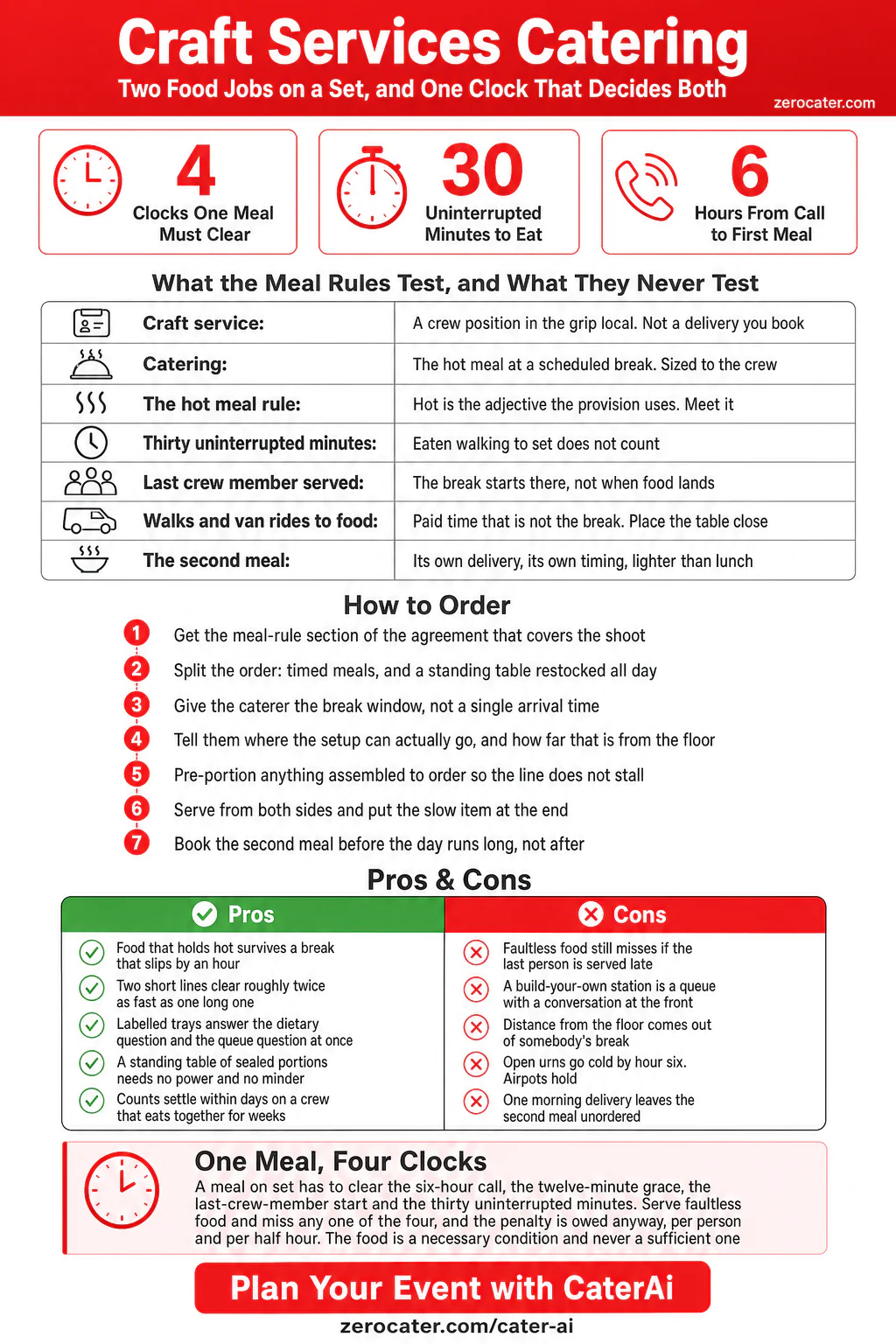
That is the shape of every meal rule on a set. The food is a necessary condition and never a sufficient one. A caterer can deliver something excellent and still leave the production exposed, because the part being tested is the interval, not the tray. Order for that: pick food that survives being held hot for the length of a break that may move, and stop treating an early delivery as an early break.
The clock starts when the last person is served
This is the rule that changes what you order, and it is the one office caterers have never had to think about.
Local 80 describes two ways a meal period gets measured. Under the thirty-minute method, known on set as “Last Man”, the break does not begin until the last crew member has gone through the line and received their food. Under the one-hour “Walk Away” method, it begins when people are genuinely out of the employer’s control.
Read the first one again. The break starts when the last person is served. A serving line that clears in six minutes and a serving line that clears in twenty are not two grades of hospitality. They are two different schedules. The slower line pushes the return to the floor, pushes the next setup, and pushes the wrap, for everybody, by the difference.
Once you see the line as a schedule input, the ordering levers follow:
- Take decisions out of the line. A build-your-own station is a queue with a conversation at the front of it. Pre-portion anything assembled to order and keep the choices to two or three.
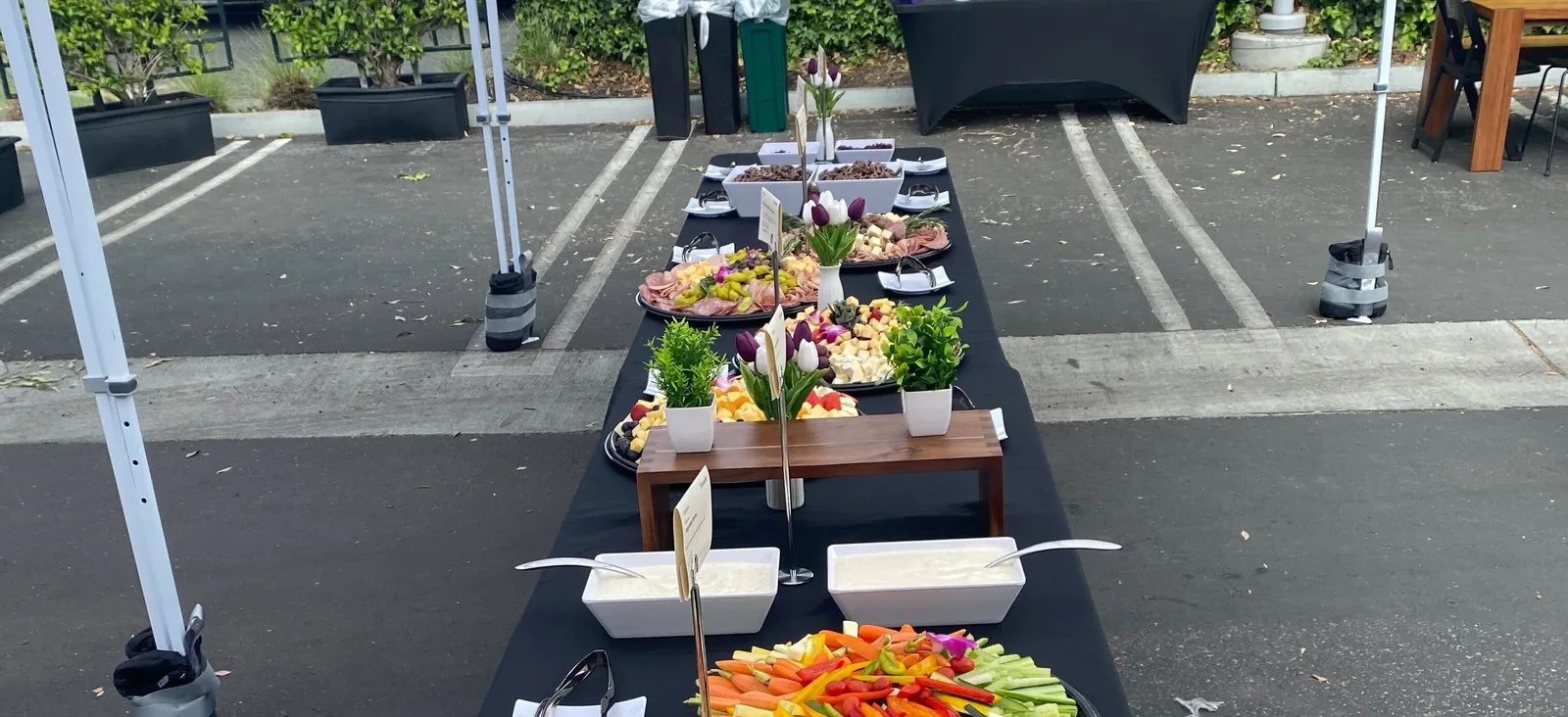
- Serve from both sides. Two shorter lines off one table clear roughly twice as fast as one long one, and cost nothing extra to set up.
- Move drinks and cutlery off the hot line. Put them on their own table so the hot line only does hot food.
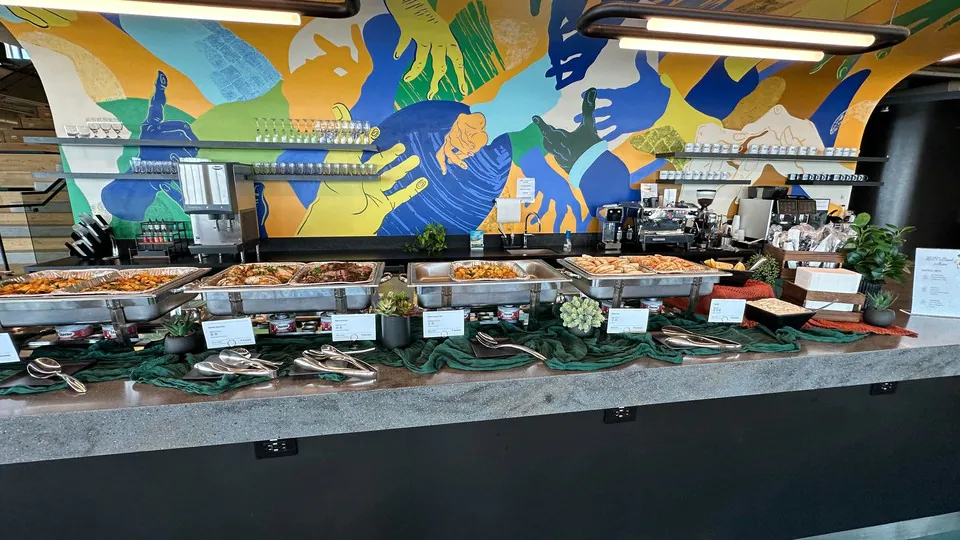
- Label every tray. A legible card at each pan removes the question that stops the line, and it does the dietary work at the same time.
- Put the slow item last. Anything carved, ladled or assembled goes at the end, where the queue behind it has already thinned.
None of that is about generosity. It is about when the clock starts.
The walk to the food is on the clock
The same FAQ lists what counts as employer control, meaning paid time that is not part of the meal period. Two of its examples are about distance: “van rides to catering” and “distant walks to catering”. A third is about the line itself, where producers take priority and give priority to other people ahead of the crew.
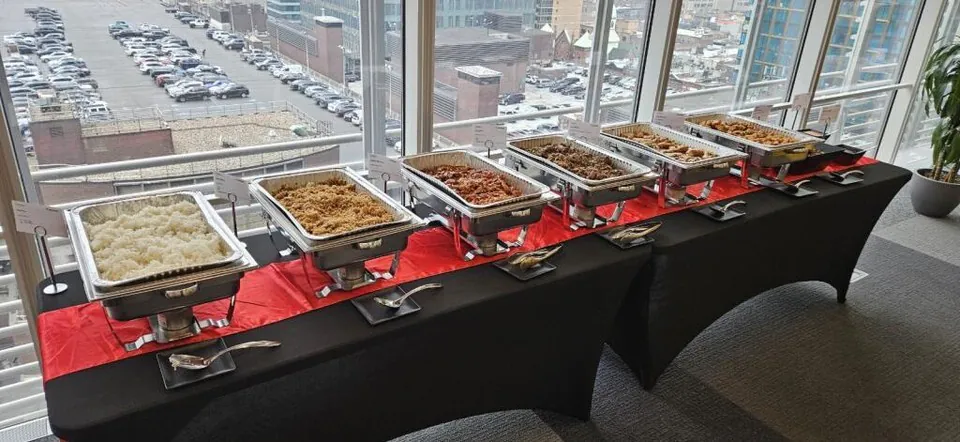
So the position of the table is a scheduling decision, not a hospitality one. Every metre between the floor and the food comes out of somebody’s break, and on location that distance is often set by where a truck can legally park rather than by where anyone wants to eat.
Handle it at the order stage. Tell the caterer where the setup can actually go, not where you hope it will go. If the only viable spot is far from the floor, say so and change the format: individually boxed meals carried to the crew beat a beautiful line nobody can reach in time. Our guide to boxed lunch catering for conferences and training covers how to size that format, and the boxed lunch roundup covers who does it well.
Order the hot meal against the clock
Working backwards from the four rules above gives a short spec that any caterer can quote against.
- Holds hot without degrading. Breaks move. Braises, stews, rice and grain dishes, roasted vegetables and anything saucy hold for a delayed call. Fried food and delicate fish do not.
- Serves in one pass. One protein, one starch, one vegetable, one salad, on separate pans, with a clearly marked plant-based option in the same run rather than in a corner.
- Arrives with its own heat. On location there may be no power at the setup point. Confirm the caterer brings holding equipment and fuel, and confirm where it can be lit.
- Packs down fast. A caterer who takes an hour to break down is occupying space the next setup needs.
Four cuisines meet that spec without argument. Barbecue holds well and portions by weight. Mexican travels in components that stay hot and lets people build fast. Mediterranean spreads carry a plant-based main without a separate order. Italian trays are the most forgiving of a break that slips by an hour.
In the studio corridor north of Los Angeles that means kitchens like MRKT Cafe Catering in Burbank, Baco’s Smokehouse BBQ and Matty’s Mexican Kitchen in Glendale, and Tony’s Cucina Italiana for the trays that survive a moving schedule. Closer to the Westside stages, 5 Elementos and Merka Saltao cover Culver City, and Feast From The East covers the wider city. For East Coast productions, Nourish + Nosh and The Artisan’s Platter sit beside the Long Island City stages, and Eat Street NYC covers Brooklyn. Our Los Angeles catering roundup goes wider on the local field.
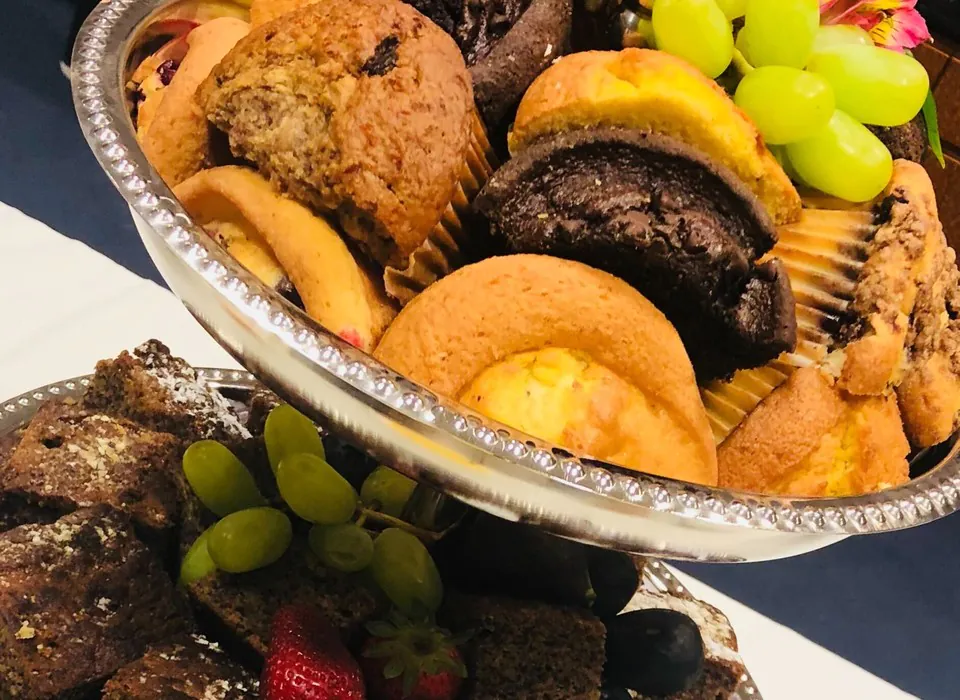
What belongs on the standing table
The other food job runs all day and answers to no clock at all, which is why it gets treated as an afterthought and then runs out at hour four.
Order it as a restock rather than a meal. The test for anything on that table is whether it survives a full day, in whatever weather the location has, without a power source and without a person tending it.
- Whole fruit over cut fruit. It keeps, it does not need ice, and nobody needs a plate.
- Sealed single portions over shared bowls. Bars, nuts, crisps, yoghurt, hard-boiled eggs. Individually wrapped is the whole point outdoors.
- Coffee that is still hot at hour six. Airpots hold. Open urns do not. Order more than the headcount suggests and order it twice.
- Drinks that do not need a fridge. Water first, by a distance, then electrolyte drinks on a hot location.
- Something warm at the far end of a long day. A late delivery of soup or hand pies does more for a night exterior than another tray of pastries.
Keep the standing table away from the hot line at meal times. If people can graze at the same table they are queuing for, the queue stops moving, and the queue is the schedule.
The second meal arrives whether anyone planned it or not
Meal rules do not stop at lunch. The clock restarts when the first meal period ends, and a production that runs long reaches the next one. The productions caught out are the ones that ordered a single delivery in the morning and assumed the day would end on schedule.
Book it as its own delivery, on its own timing, and keep it lighter than lunch. People who have already eaten a hot meal and worked another long stretch want something they can finish standing up. This is also the order most likely to move by an hour with no notice, so pick a caterer who can absorb that. Our last-minute catering guide covers what can still be moved late in the day.
Plan crew meal catering with CaterAi
Feeding a set that moves
A location shoot changes the delivery problem more than it changes the menu. The address on the order is often a parking lot, a park, a closed street or a private property with a gate code, and the person who signs for the food is holding a radio.
Four things belong on every location order:
- An arrival window, not an arrival time. Give the caterer the window that matches the break, and a phone number that will be answered during it.
- The actual access instruction. Which gate, which lot, where a van can stand, and for how long.
- A named receiver who is not the person calling the shot. The first AD cannot take a delivery call.
- Waste out as well as food in. Somebody has to remove the pans. Agree who before the day, because on a location there is often no bin at all.
Our offsite and retreat catering guide covers the walkthrough questions for a space you do not control, and the event venue catering guide covers what happens when the building itself has a say in who feeds you. Both apply whenever a shoot lands somewhere with an owner.
Dietary needs on a crew list
A crew is a long-running group that eats together every day for weeks, which makes the dietary picture both easier and less forgiving than a one-off event. Easier, because the same people come back and the counts settle within a few days. Less forgiving, because a gap that an event survives once becomes a grievance by day ten.
Collect counts by category rather than by name, and give the caterer the counts rather than the story. Ask for restricted meals plated or boxed separately instead of buried in a shared pan, and ask for every dish labelled at the table, which the line speed wants anyway. Our mixed dietary needs guide covers how to split the counts, and the allergy-safe boxed lunch guide covers the format that isolates an allergen.
Read the agreement that covers your production
Everything above describes what one local publishes for its own members. IATSE Local 80 covers grips, crafts service, marine and first aid employees in the Hollywood jurisdiction, and its FAQ is unusually plain about the meal rules, which is why this guide leans on it.
It is not the only agreement in the industry, and the numbers move. Terms differ between the basic agreement and area standards agreements, between regions, between locals, and between a union production and one that is not covered at all. State law sits underneath all of it and differs by state.
So treat this guide as a map of what to ask about rather than a statement of what any given production owes anyone. Get the applicable agreement, get the meal-rule section, and hand the timings to your caterer as a specification. That is the version of this document that is worth anything on a call sheet.
How Zerocater handles a production order
A production is a standing order with a moving schedule, which is closer to how Zerocater already works than to a one-off event booking. One account covers the timed meal deliveries and the standing-table restock, with a different cadence for each, and the kitchens sit across the corporate catering network rather than with a single caterer who may be booked on your worst week.
CaterAi builds the menu side from the constraints you actually have, including how far the food travels, how fast the line has to clear, and the dietary counts on the crew list. You edit the result in chat rather than by email. Our how it works page covers the ordering flow, and the corporate event catering checklist covers the planning side for the shoot-adjacent events a production also has to feed: table reads, wrap parties, and the days the investors visit.
Get the timings from the agreement. Give them to the caterer as a spec. Then order food that holds, serves in one pass, and clears a line fast enough that the clock starts when you said it would.
Plan crew meal catering with CaterAi
Frequently Asked Questions
What is the difference between craft services and catering on a film set?
They are two different jobs and two different line items. Catering is the sit-down meal, served hot, at a scheduled break. Craft service is the standing table of food and drink that stays out between those breaks so nobody leaves the floor to find a coffee. IATSE Local 80 states its own jurisdiction as “Motion Picture Grips, Crafts Service, Marine, First Aid Employees, and Warehouse Workers”, which places Crafts Service in the grip local as a crew position. Only one of the two is an order you place with a kitchen.
When does a production have to break for a meal?
Within six hours of the call, under the meal rules that the union locals publish. IATSE Local 80’s member FAQ also describes a twelve-minute grace to finish a take, and a separate thirty-minute extension, and says the two may not be used together on the same break. Exceed either and the penalties run from the moment the meal was originally due. Terms differ by agreement and by region, so read the one that covers your production rather than this paragraph.
What is a non-deductible break?
A paid break, early in the day, that resets the meal clock. Local 80 describes it plainly: if the production supplies a hot meal and gives thirty uninterrupted minutes in which to eat it, lunch may then start six hours after the end of that break. Two details decide whether it counts. The meal has to be hot, and the thirty minutes have to be uninterrupted. The local’s own example of what fails is a breakfast burrito eaten while walking to set.
When does the meal period actually start?
Later than the moment food appears. Under the thirty-minute “Last Man” method, the clock does not begin until the last crew member has gone through the line and received their food. The one-hour “Walk Away” method starts when people are genuinely off the employer’s control. Both make service speed part of the schedule. A line that takes an extra ten minutes to clear pushes the back half of the day by ten minutes for everyone.
How do you make a serving line go faster?
Take decisions out of it. Pre-portion anything that would otherwise be assembled at the table, split one line into two shorter ones served from both sides, put the slowest item at the end rather than the front, and label every tray so nobody has to ask. Set the drinks and the cutlery on a separate table so the hot line only does hot food. None of this is about generosity. It is about when the clock starts.
Does where you put the food table matter?
Yes, and the reason is the clock rather than comfort. Local 80 lists “van rides to catering” and “distant walks to catering” as examples of employer control, which is paid time that is not the meal period. The further the food sits from the floor, the more of the break is spent reaching it. On a location with no room to set up nearby, that distance is a scheduling input, so plan the placement before the call sheet goes out.
What is a second meal?
The next full meal, due after the next work period once the first meal ends. Productions that run long hit it, and the ones that get caught out are the ones that ordered a single delivery in the morning. Order the second meal as its own delivery on its own timing, and keep it lighter than the first. People who have already eaten a hot meal and worked another long stretch want something they can finish standing up.
Can one order cover both the meals and the standing table?
It can, and separating the two on paper is what keeps it working. The meals are timed deliveries sized to the crew. The standing table is a restock: shelf-stable food, whole fruit, and drinks that survive a day outdoors without a power source. Zerocater can run both from one account, and CaterAi builds the menu side from the constraints you give it, including how far the food has to travel and how fast the line has to clear.