Law firms run on billable hours, and every minute an attorney spends waiting for a late lunch order or leaving the office to grab food is time that does not get billed. If 20 attorneys averaging $500 per hour lose just 30 minutes to a disorganized catering situation, that is $5,000 in unbilled time, enough to cover a month of well-managed catering. From deposition lunches to summer associate programs, this guide covers what to order, what to spend, and how to get the logistics right for every occasion a law firm caters for.

In This Guide
- Why Law Firms Spend More on Catering Than Almost Any Other Industry
- The 6 Occasions Law Firms Cater For
- Quick Comparison Table
- What to Order: Menu Ideas by Occasion
- Recurring Programs vs. On-Demand Orders
- The Logistics Law Firms Get Wrong
- Dietary Management at Scale
- Law Firm Catering by City
- How CaterAi Handles Law Firm Catering
- FAQ
Why Law Firms Spend More on Catering Than Almost Any Other Industry
Law firms are not like most offices. The combination of billable-hour economics, client-facing obligations, and a culture built around long hours creates a catering profile that is both higher-volume and higher-stakes than a typical corporate environment.
Billable-hour economics. When time is literally money, anything that pulls attorneys away from work has a measurable cost. In-office catering eliminates the 45 to 60 minutes lost to a restaurant lunch. For a firm with 50 attorneys, replacing even one outside lunch per week with delivered catering recovers hundreds of billable hours per year.
Client impressions matter. The food you serve during a pitch meeting or client lunch reflects how your firm operates. A $40-per-person Mediterranean spread during a new-client meeting signals attention to detail. A stack of pizza boxes does not. Firms competing for high-value clients invest in catering for the same reason they invest in office design: perception drives decisions.
Associate retention and culture. Summer associate programs, late-night deal perks, and firm-sponsored lunches are recruiting and retention tools. Associates at firms with strong food programs consistently rank it among their top workplace benefits. The firms that get this right use it as a competitive advantage in hiring.
Confidentiality. Sensitive matters stay in the building when meals come to the team instead of the team going to a restaurant. Depositions, merger discussions, and litigation strategy sessions require privacy that a public dining room cannot provide. In-office catering keeps confidential conversations where they belong.
The 6 Occasions Law Firms Cater For
1. Deposition and Working Lunches
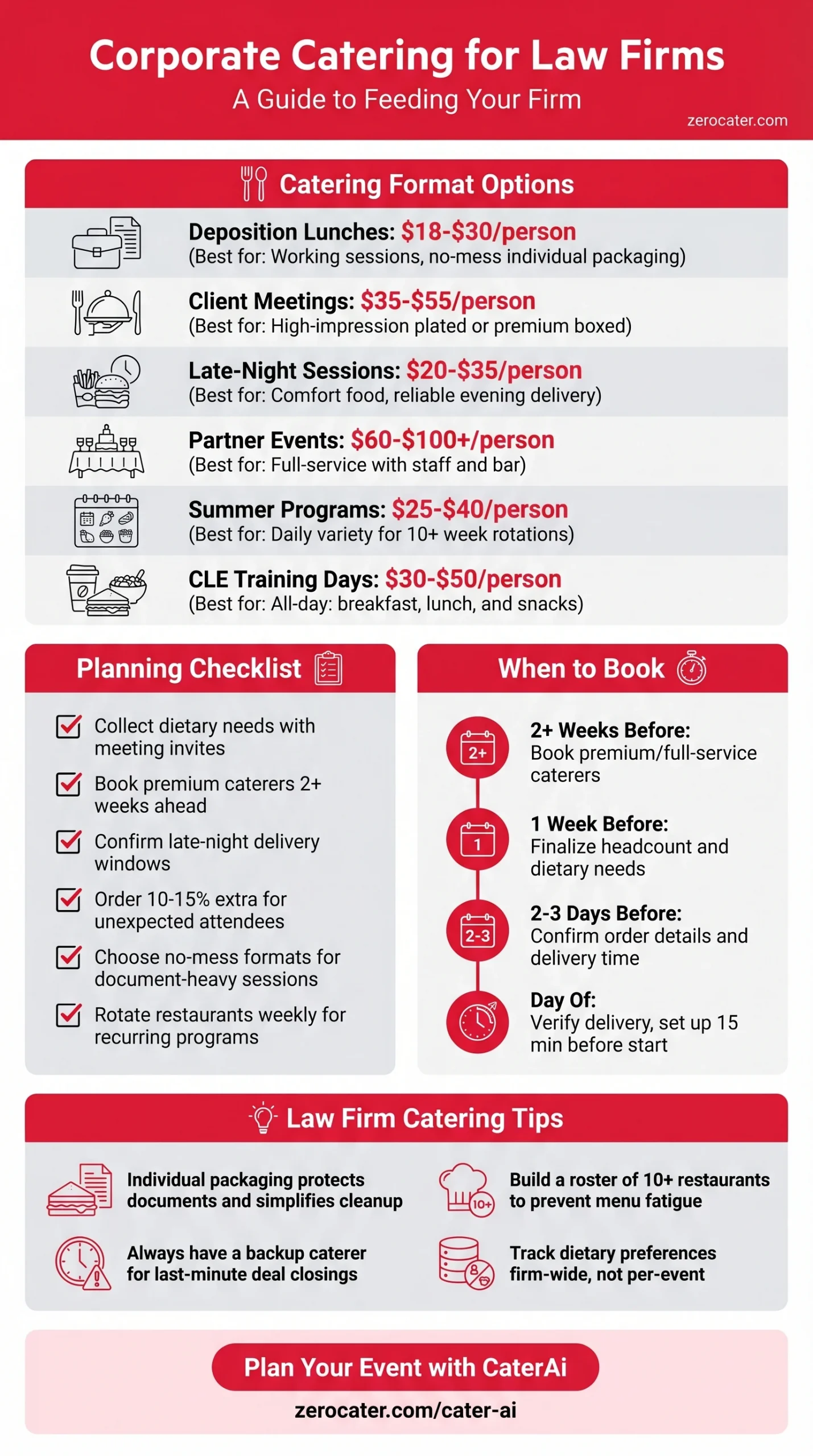
This is the bread and butter of law firm catering: the highest-frequency, lowest-fuss order. Depositions can run six to eight hours, and a working lunch means everyone eats in the conference room while reviewing exhibits or prepping witnesses. The food needs to be individually packaged, impossible to spill on documents, and ready to eat without any setup.
Format: Boxed lunches, wrapped sandwiches, or sealed grain bowls. Each package should include a napkin, utensils (if needed), and a bottled water. No shared platters, no communal dips, nothing that requires passing across a table covered in binders.
Budget: $18 to $30 per person. This is everyday ordering, so the per-person cost needs to be sustainable over hundreds of orders per year.
2. Client Meetings and Pitches
When a prospective client walks into your conference room, the catering is part of the pitch. This is where presentation matters most. The food should look intentional and curated, not like someone grabbed a platter from the deli on the way in.
Format: Plated meals or premium boxed lunches with upscale cuisine. Mediterranean platters, sushi assortments, or individually composed grain bowls all work well. Use real plates or high-end disposables. Add a coffee service and sparkling water at each seat.
Budget: $35 to $55 per person. The ROI on impressing a client who will generate six or seven figures in billings is straightforward.
3. Late-Night Deal Sessions
The M&A closing that runs until 2 a.m. The litigation team preparing for a morning hearing. The associates pulling an all-nighter on a filing deadline. Late-night orders are a staple of BigLaw life, and the logistics are uniquely challenging: the food needs to arrive at 8 or 9 p.m. (or later), from a caterer who actually delivers at that hour.
Format: Comfort food in individual containers. Premium sandwiches, burritos, poke bowls, or pasta in sealed packaging. Easy to eat one-handed while reading a redline. Include snacks (chips, cookies, fruit) and a coffee or energy drink option for sessions that run past midnight.
Budget: $20 to $35 per person. Teams are usually smaller (5 to 15 people), and the food leans more casual since the audience is internal.
4. Partner Retreats and Firm Events
Annual partner meetings, holiday parties, summer outings, and celebration dinners call for full-service catering with a higher level of polish. These events are larger, often include spouses or guests, and may require bar service.
Format: Full-service with on-site staff, passed appetizers, a curated menu, and bar service. For sit-down dinners, plated multi-course meals. For receptions, chef-attended stations with live cooking.
Budget: $60 to $100+ per person. These are showcase events, and the budget reflects it.
5. Summer Associate Programs
Summer associate lunch programs run 10 to 12 weeks, five days a week. That is 50 to 60 consecutive lunches. The number-one problem firms face here is menu fatigue: by week four, associates have eaten from the same five restaurants multiple times and enthusiasm drops. The fix is variety, not volume.
Format: Rotating daily orders from a roster of 10 to 15 restaurants. Mix cuisines aggressively: Mexican on Monday, Japanese on Tuesday, Indian on Wednesday, Italian on Thursday, a local favorite on Friday. Include individual options so each person picks what they want.
Budget: $25 to $40 per person. Over a 10-week program for 30 associates, you are looking at $37,500 to $60,000 total, so vendor negotiation and platform management matter.
6. CLE and Training Sessions
Continuing Legal Education sessions and internal training days run six to eight hours and need breakfast, lunch, and afternoon snacks. The challenge is keeping energy up without the post-lunch crash that kills afternoon engagement.
Format: Multi-meal package. Breakfast: pastries, fruit, yogurt, coffee. Lunch: individually boxed or plated meals with protein-forward options. Afternoon: light snacks, fresh fruit, more coffee. Like board meeting catering, the food should be easy to eat at a conference table.
Budget: $30 to $50 per person for the full day. Look for caterers or platforms that bundle multi-meal packages at a discount.
Quick Comparison Table
| Occasion | Format | Budget/Person | Lead Time | Dietary Complexity |
|---|---|---|---|---|
| Deposition lunches | Individual boxed | $18 – $30 | 2-3 days | Low (small group) |
| Client meetings | Plated or premium boxed | $35 – $55 | 5-7 days | Medium |
| Late-night sessions | Individual comfort food | $20 – $35 | Same day – 2 days | Low |
| Partner retreats | Full-service with staff | $60 – $100+ | 2+ weeks | High (guests + partners) |
| Summer programs | Rotating daily orders | $25 – $40 | Weekly rotation planned in advance | High (large group, 10+ weeks) |
| CLE / training days | Multi-meal package | $30 – $50 | 5-7 days | Medium |
What to Order: Menu Ideas by Occasion
Deposition and Working Lunches
- Boxed grain bowls: quinoa or brown rice, grilled chicken or tofu, roasted vegetables, dressing on the side
- Wrapped sandwiches: turkey club, caprese, or roasted veggie wraps in foil or parchment
- Sealed poke or sushi bowls: pre-portioned with chopsticks and soy sauce packets
- Individual salad containers: chopped salad with protein, dressing in a sealed cup
Browse healthy catering and salad catering options on Zerocater.
Client Meetings and Pitches
- Mediterranean platters: hummus, falafel, grilled halloumi, tabbouleh, warm pita
- Sushi chef’s selection: premium rolls, nigiri, edamame, and miso soup
- Plated Italian: individually composed pasta, Caprese salad, garlic bread
- Upscale boxed lunches: grilled salmon or steak, seasonal vegetables, artisan bread
Find Mediterranean, Japanese, and Italian catering on Zerocater.
Late-Night Deal Sessions
- Premium burritos or burrito bowls: customizable fillings, individually wrapped
- Hot sandwiches: meatball subs, Cubanos, or banh mi in foil
- Pasta in sealed containers: penne arrabbiata, mac and cheese, or pad Thai
- Snack packs: chips, cookies, fruit, energy bars, and coffee for the overnight stretch
Browse Mexican, Thai, and sandwich catering options on Zerocater.
Choosing Between Recurring Programs and On-Demand Orders
The right model depends on how often your firm orders catering and how many people you are feeding.
Managed recurring programs make sense for firms ordering three or more times per week. A platform like Zerocater’s managed catering program handles vendor selection, dietary tracking, menu rotation, and scheduling so your office manager does not have to rebuild the process from scratch every day. This is the standard model for Am Law 100 firms running daily associate lunch programs.
On-demand ordering works for firms with occasional needs: a quarterly partner dinner, ad-hoc deposition lunches, or event-specific orders. CaterAi lets you describe what you need, and it builds a custom menu from over 1,000 restaurants. You chat to adjust, finalize, and order in one session.
The hybrid approach. Many midsize firms (50 to 200 attorneys) use both. A managed program covers daily or weekly team lunches, while on-demand ordering handles one-off events, late-night sessions, and client meetings that require specific menus. See how the platform works.
Plan office lunch catering with CaterAi
The Logistics Law Firms Get Wrong
The #1 mistake: relying on consumer delivery apps for group orders
DoorDash and Uber Eats are built for individual meals, not 30-person conference room lunches. Orders arrive staggered, packaging is inconsistent, there is no setup service, and you have no dedicated point of contact when something goes wrong. Use a corporate catering platform or order directly from caterers who handle group orders professionally.
- Ordering too late for premium caterers. High-quality caterers often need 5 to 7 business days for group orders, especially for plated service. If you are booking 48 hours out, your options shrink to fast-casual chains. Plan ahead for client-facing meals.
- Not collecting dietary needs upfront. Asking about allergies at the start of a deposition or client meeting is awkward and too late. Build dietary collection into your standard process, either per-event with the meeting invite or (better) as a firm-wide profile.
- Rotating the same three restaurants. Summer associate programs and daily catering lose their appeal fast when the options repeat. A roster of 10 to 15 restaurants, with no caterer appearing more than once every two weeks, keeps things fresh.
- No backup plan for late-night orders. Deal closings do not run on a schedule. If your regular caterer stops delivering at 7 p.m. and the team needs food at 10 p.m., you need a second option lined up. Always have a late-night backup caterer in your contacts.
- Treating all occasions the same. A deposition lunch and a client pitch require different food, different presentation, and different budgets. One-size-fits-all ordering is the fastest way to overspend on routine meals and underspend on the ones that matter.
Dietary Management at Scale
Large law firms have diverse teams, and dietary needs multiply fast. A firm of 200 people will typically include vegans, vegetarians, people with gluten sensitivities, kosher and halal observers, and multiple food allergies. Managing this per-event is unsustainable. The solution is a system.
Firm-Wide Dietary Survey Template
Send this once to all attorneys and staff. Update annually or when new hires join.
- Do you follow any dietary pattern? (Vegan, vegetarian, pescatarian, kosher, halal, other)
- Do you have any food allergies? (Nuts, shellfish, dairy, gluten, soy, other)
- Any foods you strongly prefer to avoid?
- Any cuisines you particularly enjoy?
Baseline rules for inclusive ordering: Include at least one vegan and one gluten-free option per 10 people. Label all items with small tent cards listing the dish name and dietary markers (V, VG, GF, DF). For individually packaged meals, print the dietary information directly on the label. Our guide to ordering for mixed dietary needs walks through the full process, and our vegan office catering guide covers plant-forward menus that work for everyone.
Law Firm Catering by City
Legal hubs have distinct catering landscapes. Pricing, cuisine availability, and lead times vary by market. Here are caterer recommendations and city guides for the major legal markets:
Top Caterers for Law Firms on Zerocater
- New York City: A Saffron Thread (Indian fine dining), 251 Ginza Sushi (premium sushi), Hummus Kitchen (Mediterranean), Baby Brasa (Peruvian), Souvlaki GR (Greek) | NYC catering guide
- Washington D.C.: Fresh Bites Kitchen (healthy bowls), Rasa (Indian street food), Delia’s Mediterranean Grill (Mediterranean), Banana Leaves (Asian fusion) | D.C. catering guide
- Chicago: Olive Mediterranean Grill (Mediterranean), Pastafi (fresh pasta), Tiparos Thai Cuisine & Sushi Bar (Thai/sushi), 5411 Empanadas (Argentine) | Chicago catering guide
- San Francisco: La Mediterranee (Mediterranean), Roma Antica (Italian), Kawashima’s Kitchen (Japanese), Kitava (allergy-friendly) | SF catering guide
- Boston: Bon Me (Vietnamese), Jo’s Indian Kitchen (Indian), Oasis Brazilian Steakhouse (Brazilian) | Boston catering guide
- Los Angeles: The French Way (French), Wholesome Foods (healthy), Wildbird (grain bowls) | LA catering guide
Browse the full Mediterranean, Japanese, Italian, Indian, and French catering directories to find more options near your office.
How CaterAi Handles Law Firm Catering
CaterAi is Zerocater’s AI-powered planning tool, and it solves the specific problems law firms face with catering logistics.
Menu variety without the work. Tell CaterAi your headcount, budget, and dietary needs, and it builds a custom menu from over 1,000 restaurants. For summer associate programs, it tracks what you have ordered previously and suggests new options so no restaurant repeats within your rotation window. This solves the menu fatigue problem that plagues long-running programs.
Last-minute flexibility. Deal closings and trial prep do not follow a schedule. CaterAi lets you place orders quickly by describing what you need in plain language: “comfort food for 12 people, delivered by 9 p.m., three vegetarians.” It handles the rest.
Firm-wide dietary tracking. Instead of collecting dietary needs per event, CaterAi stores preferences and allergies for your team. Every order automatically accounts for restrictions you have already flagged, so nothing falls through the cracks when you are ordering for the third time this week.
One platform for every occasion. Whether it is a $20-per-person deposition lunch or a $100-per-person partner dinner, event catering and daily programs run through the same system. Your office manager has one dashboard, one set of vendor relationships, and one place to track spending.
Plan office lunch catering with CaterAi
Frequently Asked Questions
How much does law firm catering cost per person?
Law firm catering costs range from $18 to $100 or more per person depending on the occasion. Deposition and working lunches run $18 to $30, client meetings run $35 to $55, late-night sessions cost $20 to $35, and partner retreats with full service start at $60 and go above $100. Add 20 to 25 percent for delivery, tax, and gratuity.
What is the best food for a deposition lunch?
Individually packaged meals are best for depositions. Boxed lunches, wrapped sandwiches, or sealed grain bowls keep documents clean and let people eat without leaving the conference room. Avoid anything saucy, crumbly, or that requires utensils. Include napkins, a bottled water, and a packaged side with each box.
How far in advance should a law firm order catering?
For routine working lunches, 2 to 3 business days is usually sufficient. Client-facing meetings and upscale orders need 5 to 7 business days. Partner retreats and full-service events should be booked at least 2 weeks ahead. Late-night orders for deal closings are the exception and require a caterer who accepts same-day orders with evening delivery windows.
How do you handle dietary restrictions for a large firm?
Build a firm-wide dietary profile rather than collecting preferences per event. Send a one-time survey to all attorneys and staff asking about allergies, restrictions, and preferences. Store the results and reference them every time you order. As a baseline, include at least one vegan and one gluten-free option per 10 people. See our mixed dietary needs guide for the full process.
What is the best catering format for late-night work sessions?
Comfort food in individual packaging works best for late-night sessions. Think premium sandwiches, burritos, poke bowls, or pasta in sealed containers. The food should be easy to eat with one hand while reviewing documents. Avoid anything that needs reheating or assembling. Include snacks and coffee for sessions that run past midnight.
How do you keep summer associate lunch programs from getting stale?
Build a roster of at least 10 to 15 restaurants and rotate through them so no caterer repeats within a two-week window. Mix cuisines: Mediterranean one day, Japanese the next, Mexican after that. Use a platform like Zerocater that tracks past orders and suggests new options automatically. Collect feedback weekly and drop any caterer that gets consistently low ratings.
Should a law firm use a managed catering program or order on demand?
Firms ordering catering three or more times per week benefit from a managed program that handles vendor selection, dietary tracking, and recurring scheduling. Firms with occasional needs can order on demand through CaterAi. Many midsize firms use both: a managed program for daily meals and on-demand ordering for events.