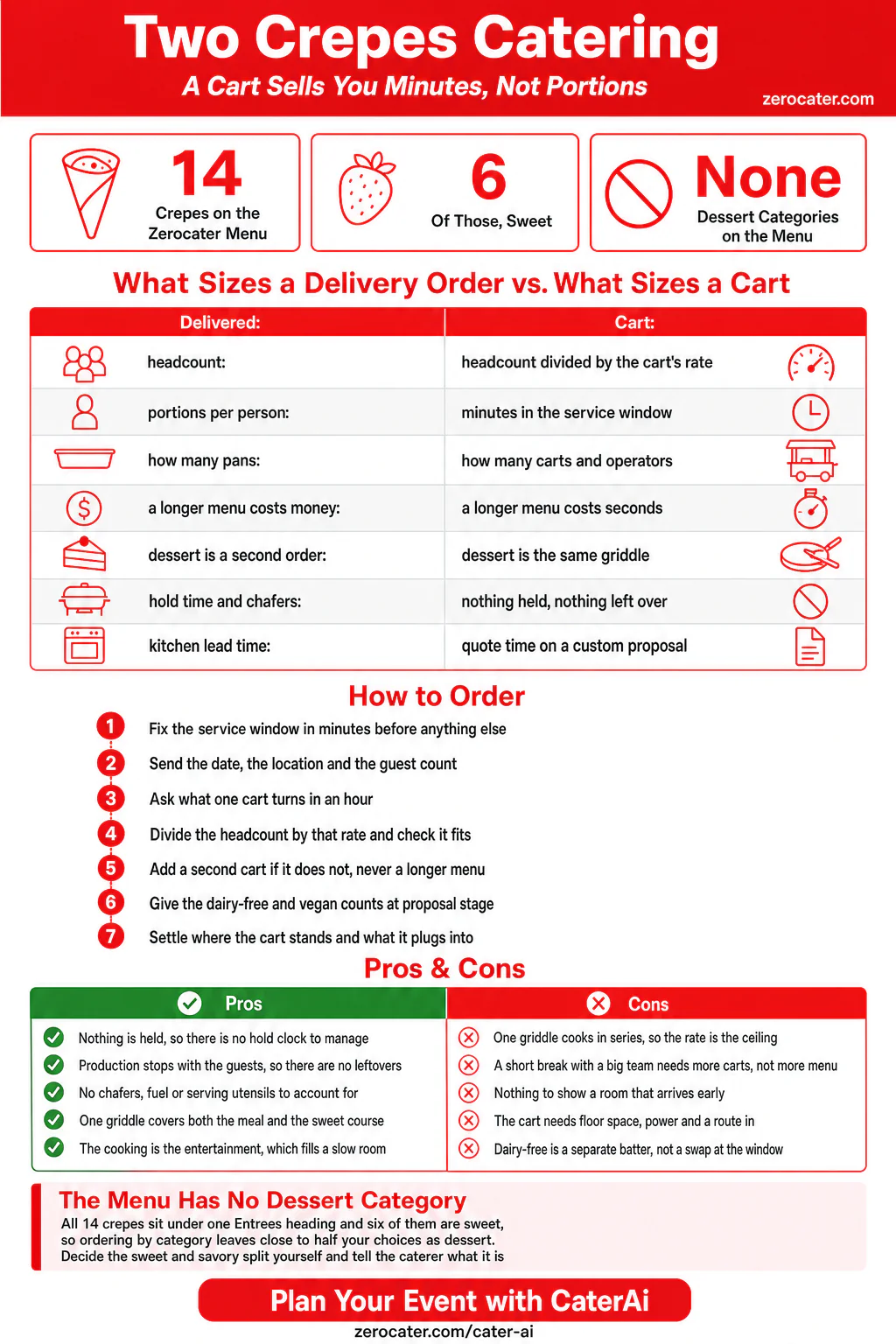
Most caterers sell you a quantity. So many pans, so many boxes, so many pieces, and the order is done when the arithmetic lands on your headcount. Two Crepes sells something different. The company rolls a cart into your room, plugs in a griddle, and cooks each crepe when a guest asks for it. Nothing is finished when it arrives, because nothing has been made yet.
That one difference changes how you size the order, how long a menu you should ask for, and whether you need to order dessert at all. It also moves the questions you have to answer before you book, away from portion counts and toward minutes, power and floor space. For the current menu and a live quote, start at the Two Crepes page on Zerocater.
Plan Two Crepes catering with CaterAi
Two servers who could not find the crepe they wanted
Julian and Lina started Two Crepes because nobody near them made crepes the way they liked. He was working as a server. She was working as a nanny. They built the company around the thing they could not buy, and it grew out of live service. The creperie in Union City, New Jersey came along with it.
That order explains the product. Two Crepes began with people cooking in front of other people, and the catering side still works that way. The company runs several carts off the same idea: a crepe cart, an omelette cart, a barista cart and a bubble tea cart, each one a machine plus an operator who works it in front of your guests. Zerocater lists the crepe and omelette sides separately, at Two Crepes and at Crepes and Omelets by Two Crepes.
The cart is the product, and nothing arrives finished
Picture the room twenty minutes before your event. With a delivered order, the food is already there. Pans are down, lids are on, and the clock on how long that food can safely sit started when the driver set it on the table. With a cart, the room holds a cart. Batter sits in squeeze bottles, plates are stacked, the griddle is warming, and the first crepe does not exist yet.
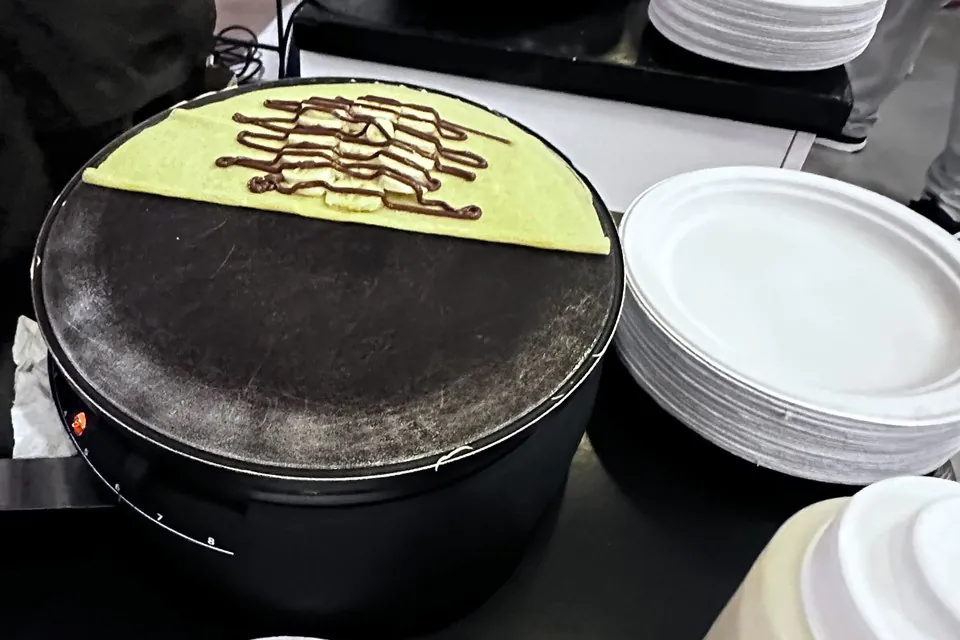
Four things follow from that, and they are the reason to book a cart or to skip one. You have no hold time to manage, because the food is eaten within a minute of being cooked. You have no leftovers, because production stops when the guests stop asking. You have no chafers, fuel or serving utensils to account for. And you have nothing to show a room that arrives early, which is the cost side of the same fact. A cart looks like a cart until the first guest walks up.
Compare that with the formats that ship food ready to eat. Our boxed lunch versus buffet comparison covers the trade between them, and both of those sit on the same side of the line: the food exists before your guests do. A cart sits on the other side.
One griddle cooks one crepe, so the number that matters is minutes
People size a crepe cart the wrong way. They ask how many guests it can feed. The cart has no answer to that on its own, because a griddle produces in series. It turns one crepe, then the next, then the one after that. Feeding 40 people and feeding 120 people are the same job at the same rate, and the only thing that separates them is how long it takes.
Your real input is headcount divided by the rate, measured against the window you have. A drop-in reception with two hours of open service is a different order from a 45 minute lunch break where everyone arrives at once, even at identical headcount. Work out the window first, then ask the caterer what one cart turns in an hour, then check whether those two numbers meet. Two Crepes does not publish a rate, so ask for it rather than assuming one.
When the numbers do not meet, there is exactly one lever that helps: another cart with another operator. Two griddles double the rate. A longer window helps too, if your agenda can spare it. Nothing else moves the number.
A longer menu costs you seconds, not money
On a delivered order, variety is charged in money. You add a second entree, you pay for a second entree, and the extra choice costs your guests nothing at the table because both dishes are already sitting there. At a cart the accounting flips. Every filling is built at the window, per crepe, while the guest stands and waits. Each additional choice you put on the placard adds a decision at the front of the line and reaching time behind it.
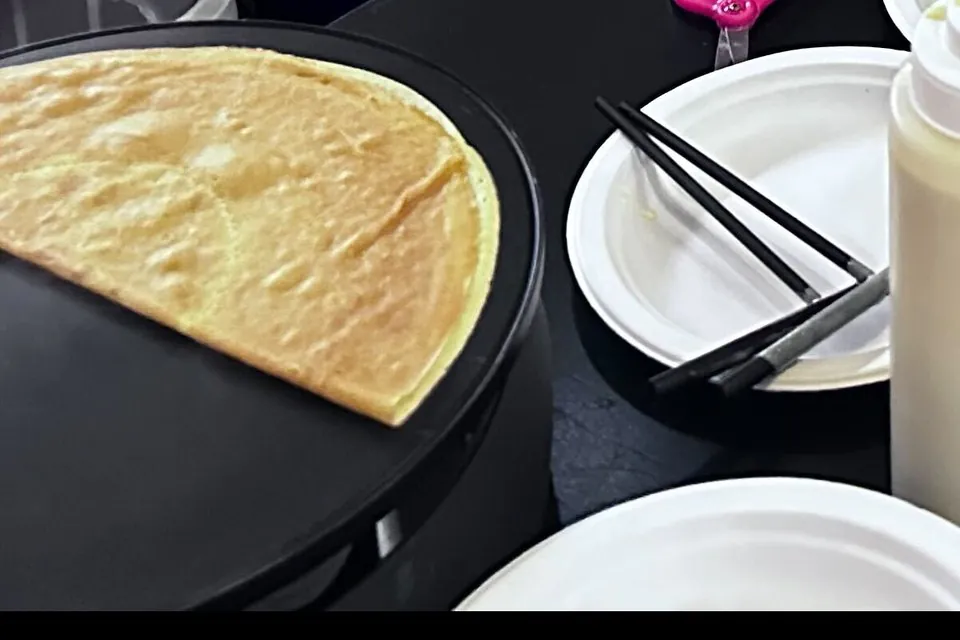
This inverts the usual advice about keeping a room happy. For a buffet, more options is a cheap way to cover a mixed group. For a cart on a tight window, a short placard is what protects the service. Pick a handful of builds that cover the room, keep the dietary options on that same short list, and let the length of your break decide how many lines you can afford. If the break is long and the mood is social, run a longer menu.
Sweet and savory come off the same griddle
A crepe is a wrapper. What goes inside it decides whether the plate reads as lunch or as dessert, and the batter, the griddle and the operator do not change between the two. The Zerocater menu shows exactly that. Savory builds run to turkey with spinach and pepperjack, black forest ham with a three cheese blend, mozzarella with tomatoes, pesto and balsamic, and spinach and mushrooms with provolone. Sweet builds run to strawberries and bananas with chocolate hazelnut spread, mixed berries with white chocolate and raspberry sauce, and a brownie and cookie build. A Traditional group covers butter and sugar, condensed milk and honey.
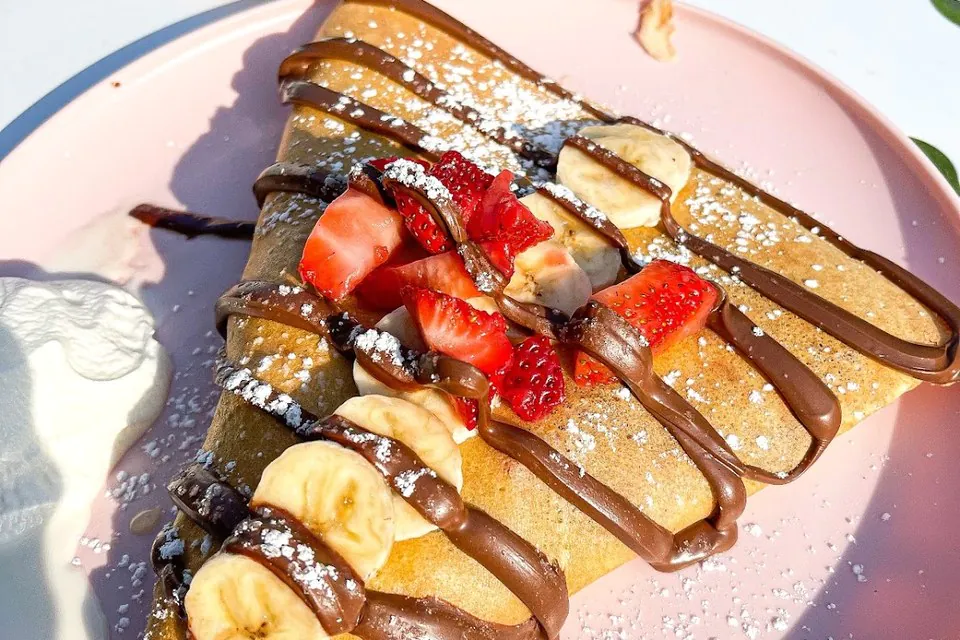
Count the menu and the point sharpens. Fourteen crepes sit under a single Entrees heading, and six of the fourteen are sweet. The menu carries no dessert category at all. Treat that as an ordering instruction. If you order by category and ask for a count of entrees, close to half the catalogue you are choosing from is dessert. Decide the split yourself and tell the caterer what it is.
One cart, one set of staff and one contract cover both the meal and the sweet course, and your guests get the dessert hot off the griddle instead of sitting under cling film since morning. For an event where the food is meant to be part of the entertainment, that is most of the argument for booking a cart in the first place.
The dairy-free line is a different batter, not a substitution
Three of the fourteen crepes on the Zerocater menu are built on a separate dairy-free vegan crepe, and they are listed as their own dishes rather than as a modification you request. That changes how you scope an order. You choose from the builds that already sit on that base, because the batter decision happens before any filling goes near it.
So you scope dietary counts at the proposal stage, before anyone reaches the cart. Tell the caterer how many people need the dairy-free build when you send your headcount, so the right batter is mixed and carried in the right volume. A guest who reaches the front of the line and asks for a swap is asking for something the cart cannot improvise. Confirm the current list with the caterer before you publish a menu to your team, and keep the dietary builds on the same placard as everything else so nobody has to announce a restriction to get fed.
Where a crepe cart is the wrong call
Three situations. A hard 30 minute lunch break with a large team, where the rate cannot stretch far enough and adding carts costs more than the occasion warrants. A room with no power near where you want the food, or a loading route that will not take a cart, which is a facilities problem rather than a catering one. And a working meeting where people need to eat while they talk, because a cart pulls everyone to a queue by design and the queue is the point.
For those, order food that arrives ready. Our guide to last-minute office catering covers what still ships on short notice, and office lunch ideas by the kind of day your team is having matches formats to the shape of the meeting. Around Union City the Zerocater list carries kitchens that deliver ready to eat, including Broadway Grill and Indulge Bowls. Save the cart for the occasion that can spend time on it.
Who Two Crepes is ideal for
Offices in and around New York City and northern New Jersey running an event where the food is meant to hold the room. Open houses and client receptions, where a cart gives people a reason to cross the floor. Team celebrations, launches and anniversaries. Holiday parties that want a live element without a full chef-led kitchen. Any long-window gathering where guests drift in and out rather than sitting down together, which is the pattern a cart handles better than any pan. Our client appreciation catering guide and the corporate event catering checklist cover the rest of the planning around an event like that.
It also suits an office that wants one vendor to cover the meal and the sweet course. Because the same griddle does both, you are not stacking two deliveries and two invoices to get a dessert onto the table.
Plan Two Crepes catering with CaterAi
How to order Two Crepes catering
Direct. Two Crepes asks for your date, location and guest count through a booking form, then comes back with a custom proposal before anything is confirmed. There is no menu you add to a cart and check out. Build that round trip into your timeline, and treat your first message as the start of a conversation.
Through Zerocater. Better when the event has to satisfy several constraints at once, when you want the cart to sit inside a wider order, or when you are running a recurring programme and do not want to manage each vendor separately. Zerocater handles delivery, setup, dietary scoping and consolidated billing, and you can rotate Two Crepes through a schedule alongside other caterers. Start from the Two Crepes page on Zerocater, or let CaterAi build a menu around your headcount and dietary mix.
Either way, four things are worth settling before you confirm: your headcount and how firm it is, the exact minutes of your service window, your dairy-free and vegan counts, and where in the room the cart will stand and what it can plug into. Those four decide the shape of the booking more than the menu does.
Two Crepes and Zerocater
Two Crepes sits in Zerocater’s French catering lineup, and in the New York City slice of it alongside caterers like Paris Baguette, Paradis To Go and Unregular Bakery. The company also carries a Western European tag, and sits alongside patisserie kitchens like Patisserie by Paris Baguette and Cured and Co. Nearer to the creperie, the Union City vendor list also carries Indulge Eats, Broadway Brunch and Sunday Gravy NYC, and the wider New Jersey directory covers the rest of the state.
If you are planning a wider event rather than a single order, event catering covers onsite staffing and decor alongside the food, and corporate catering covers an ongoing programme. How it works walks the process end to end. For a New York office building a shortlist, our New York City event catering roundup and New York City office catering cost guide are the places to start.
Menus, dietary builds and service formats change. Check the Two Crepes page on Zerocater for the current menu and a live quote rather than treating anything here as a price or an availability promise.
Plan Two Crepes catering with CaterAi
Frequently Asked Questions
Does Two Crepes deliver, or do they have to come and cook on site?
Their catering is built around a mobile cart and staff who cook at your event, which is what the company leads with on its own site. Zerocater also lists Two Crepes as a caterer you can order from alongside the rest of the network, so ask for both shapes when you enquire and pick the one that fits the room. A cart suits a reception, an open house or a celebration where the food is part of the entertainment. A delivered order suits a working lunch where people need to eat and get back to a desk.
How many people can one crepe cart serve?
That depends on how long the staff stay, not on your headcount alone. One griddle cooks one crepe at a time, so a cart has a service rate, and your guest count divided by that rate gives you the window you need. Two Crepes does not publish a rate, so ask for it directly when you request a proposal, and give them your headcount and the length of the break you are feeding. If the maths does not fit the window, the fix is a second cart rather than a longer menu.
Is a crepe cart only for dessert?
No. The Zerocater menu lists savory crepes with turkey and pepperjack, ham and a three cheese blend, mozzarella with tomatoes and pesto, and spinach and mushrooms, alongside the sweet builds. Savory and sweet come off the same griddle, so one cart can cover a lunch and the dessert that follows it without a second vendor or a second delivery.
What are the dairy-free and vegan options?
The Zerocater menu carries a small set of crepes built on a separate dairy-free vegan crepe rather than offering a swap on any item. They are named as their own dishes, which matters when you order: you pick from the builds that already exist on that base instead of asking for an existing crepe to be modified. Confirm the current list with the caterer, and flag your dietary counts when you request the proposal rather than at the cart.
How far in advance should I book Two Crepes?
Book earlier than you would for a delivery order. Two Crepes asks for your date, location and guest count and replies with a custom proposal, so the lead time you are waiting on is quote time and staff scheduling, not kitchen time. Treat the proposal round trip as the first step, and settle headcount, the length of the service window and your dietary counts before you confirm.
Where does Two Crepes cater?
The company serves New York City, New Jersey and parts of Connecticut and Pennsylvania from a creperie in Union City, New Jersey. On Zerocater they appear on the Union City vendor list, which puts them inside reach of Manhattan and the surrounding office corridors. If you are outside that footprint, CaterAi can match your office with caterers that run a comparable live station nearer to you.
What does a crepe cart need from the room?
Space, power and a clear path in. The carts roll on casters and the griddles are electric, so the questions worth settling before you book are where the cart stands, which outlets it can reach, and whether the route from the loading dock to the room has a lift and doors wide enough. Sort those three with your facilities contact when you send the date, not on the morning of the event.
Can Two Crepes handle a large office event?
Yes, with the right structure. Because the constraint is how fast the griddles turn rather than how much food fits on a table, a bigger room is a question of adding stations and staff and widening the service window. Give the caterer your headcount and the exact minutes you have, and let them size the cart count to that. For very large rooms on a tight break, pair the cart with a format that scales differently, such as a boxed order for the bulk of the team.