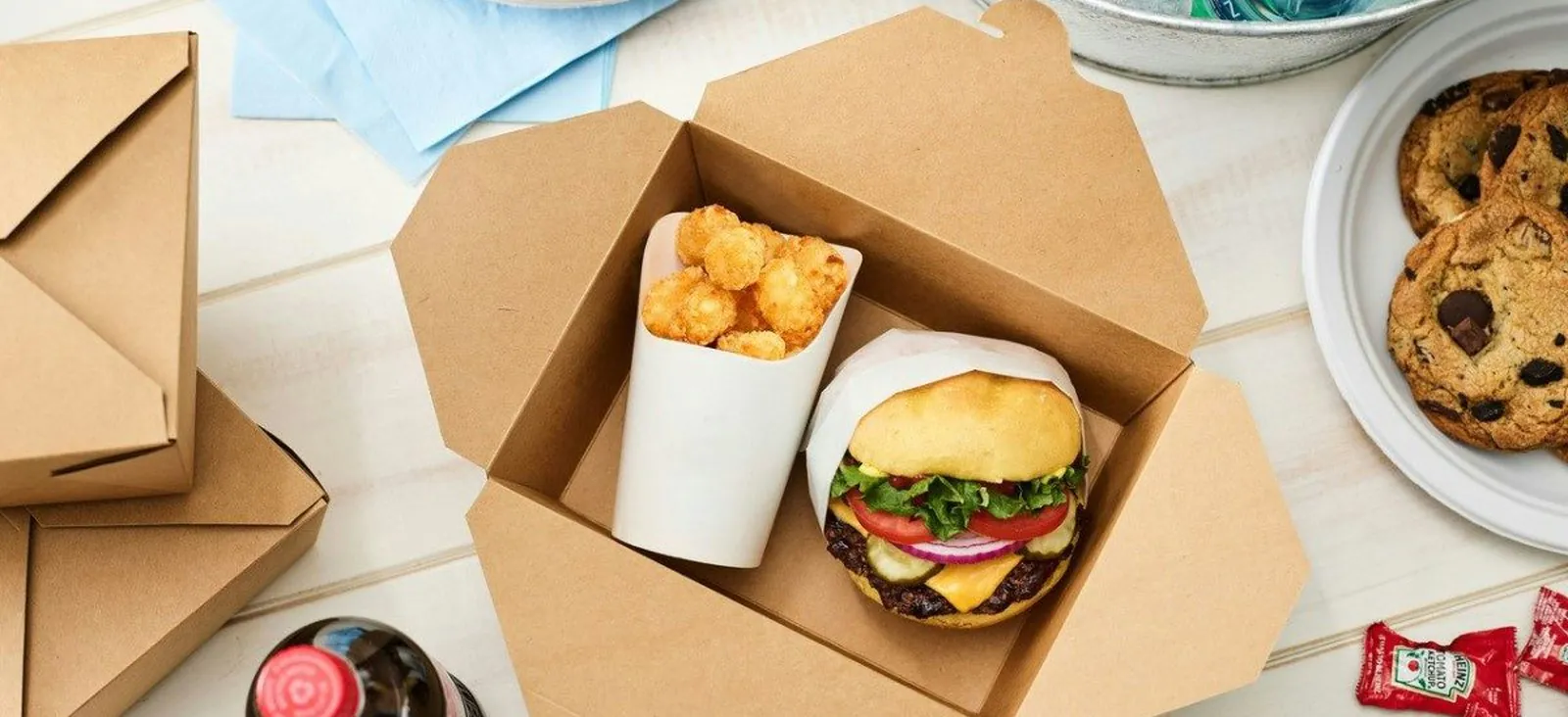
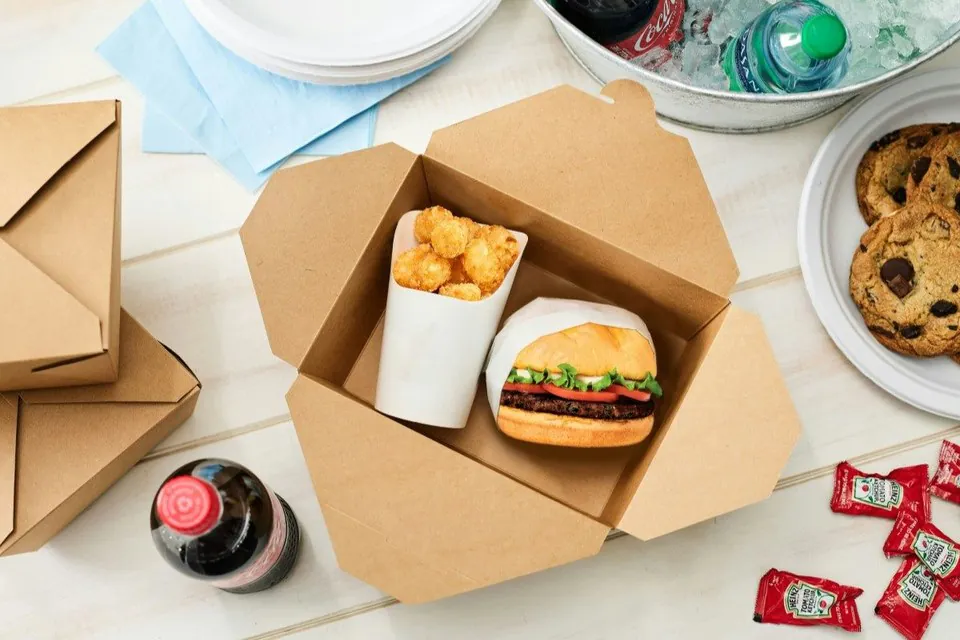
Smashburger sells catering in two shapes, and most office orders come down to choosing between them. Boxed lunches go out one at a time, so each person gets their own sandwich, their own side and their own set of changes. The burger bars go out by the ten, and they arrive with every topping in the box for the room to build from.
The menu behind those two shapes is short enough to hold in your head: twenty-seven items in six groups, three serving sizes across the lot. Open any boxed lunch and the form asks one question about the food, under a heading the brand writes as Please remove. That list is where a no-onions colleague, a no-mayo colleague and somebody who skips cheese all get looked after inside one order, box by box.
The rest is counting. Pick the format, pick the sandwiches, collect the changes, and check the total against the minimum for your route.
In this guide
- What the Smashburger catering menu contains, list by list
- How to handle dietary requests and preferences, person by person
- How to tell what is on a sandwich before you order it
- Which choices are included, and which ones carry a charge
- How the two burger bars differ, and what arrives in one
- Minimums, notice and how to place the order
What a Smashburger catering order contains
The catering menu is a separate list from the restaurant menu, and it lives on its own catering storefront. You choose a store first and the menu appears afterwards. The brand’s catering page describes the range as ready-to-serve selections at participating locations and hands you a button through to it. Behind that button sit twenty-seven items in six groups, and that is the whole menu.
| Group | Items | Sold in units of | What it is |
|---|---|---|---|
| Catering Packages | 3 | Ten people | Two burger bars and a chicken tender bar |
| Boxed Lunches | 9 | One person | A sandwich and a side in a single box |
| Gluten-Free Box Lunches | 6 | One person | The same shape of box on a gluten-free bun |
| Sides | 2 | Five people | Tots, and chicken tenders |
| Dessert | 1 | One person | An individually wrapped chocolate chip cookie |
| Beverages | 6 | One bottle, or ten | Water and three bottled sodas |
Three units run the whole menu: ten, five and one. That is unusually tidy for a chain catering list, and it means planning is a counting exercise rather than a conversion one. Teams sizing a similar order from an independent kitchen can compare against the Zerocater directory pages for North American catering and sliders.
How to handle dietary requests, box by box
This is the part of the menu worth learning first, because it does the job most offices need doing. Open any boxed lunch and you get an option group named Please remove, holding the ingredients of the sandwich you just picked. Fourteen of the fifteen boxes carry one. The exception is the chicken tender box, which has no sandwich in it and so has nothing to take apart.
Nine ingredients appear across those lists in total, and every one of them is free to leave off.
| Ingredient you can leave off | Boxes that list it |
|---|---|
| Lettuce | All fourteen boxes with a remove list |
| Tomatoes | All fourteen |
| Mayo | The chicken, bacon and vegetarian boxes |
| American cheese | The classic and bacon boxes |
| Red onion | The classic boxes only |
| Pickles | The classic boxes only |
| Ketchup | The classic boxes only |
| Smash Sauce® | The classic boxes only |
| Bacon | The bacon boxes only |
A worked example: three requests, one order
Say you are feeding twelve. One colleague does not eat onions, one leaves pickles on the side of the plate, and one asks for no mayo. Order twelve Classic Smash boxes. On the first, tick red onion. On the second, tick pickles. On the third, tick mayo. The other nine go through as they come.
Every change is free, and each one attaches to a single box rather than to the order, so three different requests cost you three ticks instead of a phone call or a note in a comments field. The boxes arrive labelled, which means nobody has to announce their preferences to the room when the food lands on the table.
On a boxed lunch the form offers no group that puts an extra ingredient on the sandwich, so a request for extra anything belongs on a burger bar order instead. The bars arrive with the toppings alongside the burgers and everyone assembles their own, which is where this menu puts hands-on customisation. The group a box calls Add-ons is a separate thing again: it holds a chocolate chip cookie and four bottled drinks, each with its own price, each arriving beside the box.
How to tell what is on a sandwich before you order it
Because the remove list is the ingredient list, its length tells you how built the sandwich is. Line the boxes up and you can read the whole menu off one column.
| Sandwich | Boxes on the menu | Things you may remove |
|---|---|---|
| Classic Smash®, single and double | 4 | 7 |
| Bacon Stack Smash®, single and double | 4 | 5 |
| Crispy chicken, chicken Smash® and the vegetarian box | 6 | 3 |
| Chicken tender box | 1 | 0 |
The classic burger is the most built sandwich on the menu, so it offers the most to strip back. The chicken and vegetarian boxes arrive with lettuce, tomatoes and mayo, so three is the whole list. Either way you can tell what is inside a box from the length of its list, before you have read a word of the description.
That gives you a useful ordering move. A colleague who wants something plain is best served by a classic burger with four things left off, rather than by a plainer box. The classic gives you the most room to tune it. The simpler boxes arrive close to plain already, so there is less left to adjust.
Nine ingredients, and nine ways to fit a sandwich to the person eating it.
Which choices are included and which ones carry a charge
Set the utensils aside and the form offers thirty choices across the whole menu. Eighteen of them are free and twelve carry a charge. The split follows a rule you can apply before you click anything.
| Group | Free or priced | What it does |
|---|---|---|
| Please remove | Free | Takes a named ingredient out |
| Select side | Free | Picks which of two sides is in the box |
| Select cheese | Free | Picks which cheese the bar arrives with |
| Select dipping sauces | Free | Picks which included sauces come with the tenders |
| Add On | Priced | Bacon, on the burger bars |
| Add Sides | Priced | A five-person side alongside a package |
| Add Dessert | Priced | Cookies alongside a package |
| Add beverages | Priced | A ten-pack of bottles |
| Add-ons | Priced | A cookie or a bottled drink beside a box |
| Substitute For Gluten-Free Bun | Priced | Swaps the bun on most regular boxes |
The rule is clean. A choice is free when it takes an ingredient out, or when it picks between things the description already promised you. The side in a boxed lunch is free because the description says the box includes a choice of one side. The cheese on a burger bar is free because the description says the bar includes a choice of cheese. A choice carries a charge when it brings a separate product with it: a cookie, a bottle, a five-person side, a ten-pack. Nine of the eighteen free choices are removals, which is half of them.
One option sits in a category of its own. The gluten-free bun is a substitution rather than an extra product, and it is the only swap on the form that carries a charge; every other swap is free. Worth knowing before you build an order for a team with a mix of needs, and our guide to ordering catering for mixed dietary needs covers what a menu label can and cannot settle.
Build a boxed lunch order with CaterAi
Bacon, the one ingredient you can order onto a burger
One group on this menu puts an ingredient onto a burger, and it has a single member. Bacon, on the two burger bars, under a group the form calls Add On. It carries a charge.
Bacon turns up on the other side of the form as well, on the four Bacon Stack boxes, where it is one of the nine you can leave off. That pairing is handy for a room that splits on it. Order a bar and you can buy bacon in for everyone, or order Bacon Stack boxes and let the two people who skip it tick one box each. Same ingredient, two formats, both routes free to the people who do not want it.
The two burger bars, and what arrives in one
Here is what the brand’s own description says lands on the table in a Build-Your-Own Burger Bar: individually wrapped burgers on a toasted bun, individually packaged condiments, and a set of toppings, namely your choice of American or cheddar cheese, lettuce, tomatoes, onions, pickles, Smash Sauce®, mayo and ketchup.
All of those toppings come with the order, so there is no topping list to fill in and no remove list on a bar. Each person finishes their own burger at the table, which is how this menu does hands-on customisation at room scale. The form asks you for one decision, the cheese, and it offers four answers: American, cheddar, half of each, or none.
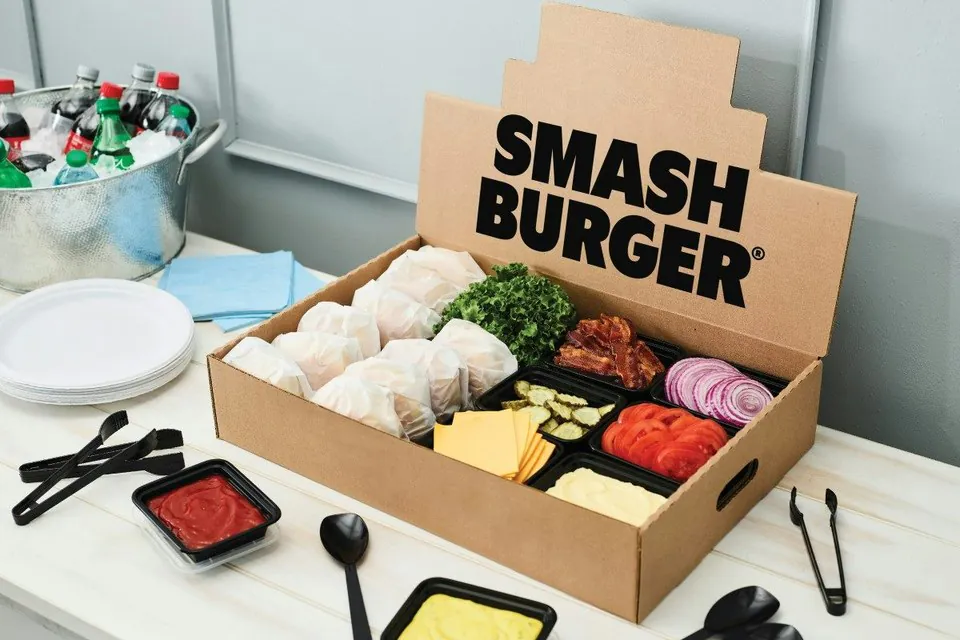
The difference between the two burger bars is the protein and nothing else. Both carry identical option groups. The standard bar is beef throughout. The assorted bar states that a ten-person order arrives as five beef and five chicken burgers, which makes it the only item on the menu that puts two proteins in one order.
The third package is the chicken tender bar, and it is the easiest item on the menu to order, because its sauces and its sides are both optional and nothing on it is compulsory. Teams that want the same idea from a local kitchen can compare against the Zerocater pages for build-your-own burger bars and fried chicken catering.
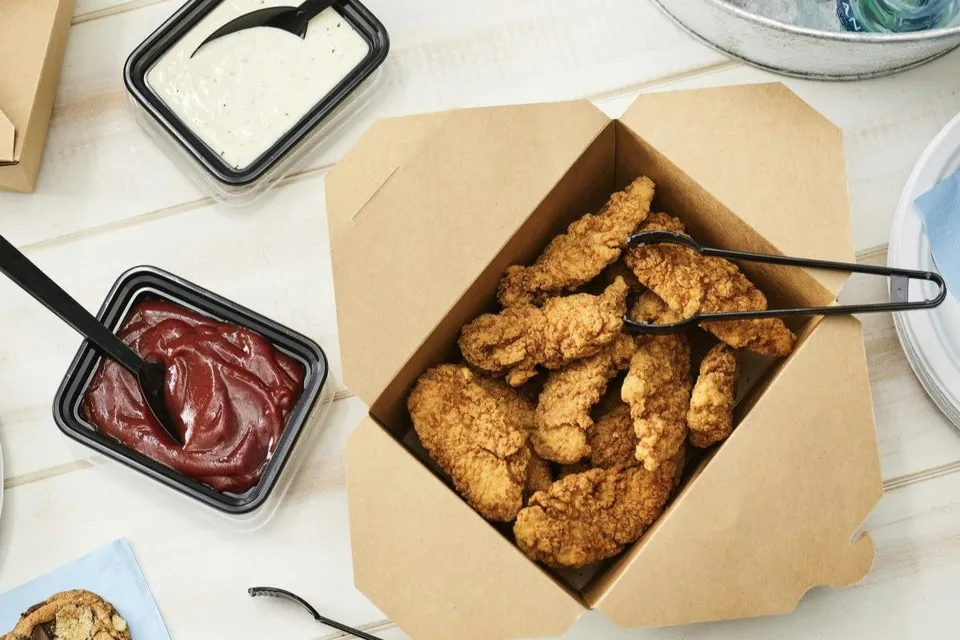
The boxed lunch line, and the one choice to make on each box
The boxed lunches are where most office orders land, because they are the only format sold one person at a time. Nine sit in the main list and six in the gluten-free list, and all fifteen are the same object: a sandwich, a side, in a box.
Each box asks you for one thing, and it is not the sandwich. It is Select side, offering two answers: tots, or a bag of classic Lay’s chips. Everything else on a box is optional.
So a boxed lunch order is a set of sandwich picks, a two-way side pick on each one, and the removals for the people who need them. If the room would rather assemble plates from shared platters, a burger bar suits it better, and our guides to boxed lunch catering for meetings and boxed lunches for conferences and training days set out when each shape works.
Minimums, notice and how the order travels
Two minimums govern this menu, and the gap between them is the thing to plan around.
| Route | Minimum order | What the brand states |
|---|---|---|
| Pickup | The lower floor | Collect from a participating restaurant |
| Delivery | Exactly twice the pickup floor | Delivered to your location |
| Notice | Next day availability | Stated on the brand’s catering page |
| Packaging | Party-ready | The brand’s own phrase for the catering packaging |
Both minimums were identical at every storefront checked for this guide, across five states, so the doubling is a national rule rather than a local quirk. Individual boxed lunch prices did move between stores; the three package prices did not. Check your own location before you commit to a headcount.
One consequence is worth spelling out. A package clears both floors on its own and a single boxed lunch clears neither, so the smallest orders tend to land on a package. If your team is small enough for that to matter, our guide to last-minute office catering covers what else ships on a short clock, and office lunch ideas covers the alternatives to a chain order entirely.
How to order Smashburger catering for a group
The flow is short, and the order of the steps matters because the menu will not show you anything until you have picked a store.
- Open the catering storefront, not the main site. The regular ordering site does not carry the catering menu; it links out to it.
- Choose pickup or delivery, then pick your location. The minimum that applies to your order is set by this choice, before you have added anything.
- Pick the format before the food. Packages for ten, boxed lunches for one, sides for five. The two formats work differently, so this choice shapes everything after it.
- For boxed lunches, collect the changes up front. Ask your team what they would rather leave off. One round of replies covers every preference this form handles.
- For a burger bar, settle the cheese. It is the one choice the form asks you for.
- Add the sides, dessert and drinks last. Every one is a separate priced product, and the package sides come in five-person units while the box sides are already included.
- Check the total against the minimum for your route before checkout, not after.
The brand also publishes an email address on its catering page for orders that need a conversation rather than a form. For anything with a run sheet attached, our corporate event catering checklist is the companion piece.
Pros and cons for office catering
What works well
- Per-person dietary changes on every sandwich box, free, in one order
- Three clean serving units, ten and five and one, with no conversion to do
- Boxed lunches are genuinely individual, so nobody has to serve anything
- The remove lists are explicit rather than a notes field somebody has to read
- A dedicated gluten-free category exists rather than a single hedge
- The assorted bar puts two proteins in one package
- Package prices held steady across every storefront checked
What to plan around
- Boxed lunches take ingredients off rather than on, so extra-of-anything belongs on a burger bar order
- Plainer boxes carry shorter remove lists, so order a classic and strip it back instead
- Two sides on the entire menu, and the same two inside every box
- One dessert, and it is the same cookie in both formats
- Burger bars have no remove list, so per-person changes live on the boxes
- The catering menu lives on a separate site from the brand’s regular ordering
Who Smashburger catering is best for
A good fit
- Teams that want a burger everybody recognises, with no serving to organise
- Rooms with a spread of preferences, where each person needs their own sandwich adjusted
- Groups of ten, or clean multiples of ten, ordering a package
- Meetings that need food to arrive individually portioned and labelled
A poor fit
- Rooms that expect to build plates from shared platters, unless you order a burger bar
- Recurring programmes that need the menu to look different week to week
- Rooms that need several full dietary categories at once, beyond the vegetarian box and the gluten-free line
- Events where sides and dessert are meant to carry part of the spread
Smashburger vs. other catering options
Set against the other chains we have read the same way, the differences are structural rather than culinary.
| Option | Customisation model | Serving units | Best when |
|---|---|---|---|
| Smashburger | Per-person removals on the boxes, shared toppings on the bars | Ten, five and one | The room wants a familiar sandwich and no serving work |
| Five Guys | Toppings chosen at order, carried separately | Boxes and bundles | Eaters want to finish their own burger |
| Portillo’s | Trays finished on site | Trays by headcount band | You have a kitchen and somebody to run it |
| Noodles & Company | Hot dishes chosen by the dish | Packages and single dishes | A hot lunch that holds through a long meeting |
| A local caterer through Zerocater | Menu built around the room | Set to your headcount | The team eats together regularly |
If the comparison you actually want is cost rather than structure, our guides to boxed lunch catering costs and budgeting for office catering put numbers on the same question. And if you would rather order a burger spread from an independent kitchen near the office, the Zerocater directory carries operators like Burger Bar in Chicago, Nomnom Burger in San Francisco, Lucy’s Burger Bar in Denver and 206 Burger Company in Seattle.
Another route for recurring office meals
Smashburger is good at a particular job. A burger everybody knows, portioned one per person, with each person’s changes attached to their own box, ordered off a form that takes a few minutes to fill in. For a one-off team lunch that covers most of what you need, and the three serving units make the headcount arithmetic easy.
A weekly rota asks a different question. It wants the menu to look different this Thursday from last Thursday, it wants several kitchens rather than one, and it wants somebody watching the delivery while you are in a meeting. Zerocater pairs teams with vetted local caterers, builds the menu around the room, and stays on the order through the day. For an ongoing rota, corporate catering is the route in, and for one-off events with a headcount and a run sheet, corporate event catering handles the logistics.
And if you already know the room but not the menu, CaterAi builds a spread around your headcount, dietary needs and date from restaurants near your office, and you can adjust the items in the chat before you check out.
Menus, option groups, serving counts, minimums and prices are set by Smashburger and vary by location. Every fact in this guide is read from the brand’s own published catering page and its own catering ordering storefront, checked across storefronts in five states. Confirm the current menu, quantities and timing with your own location before you plan around any of it.
Plan your next team lunch with CaterAi
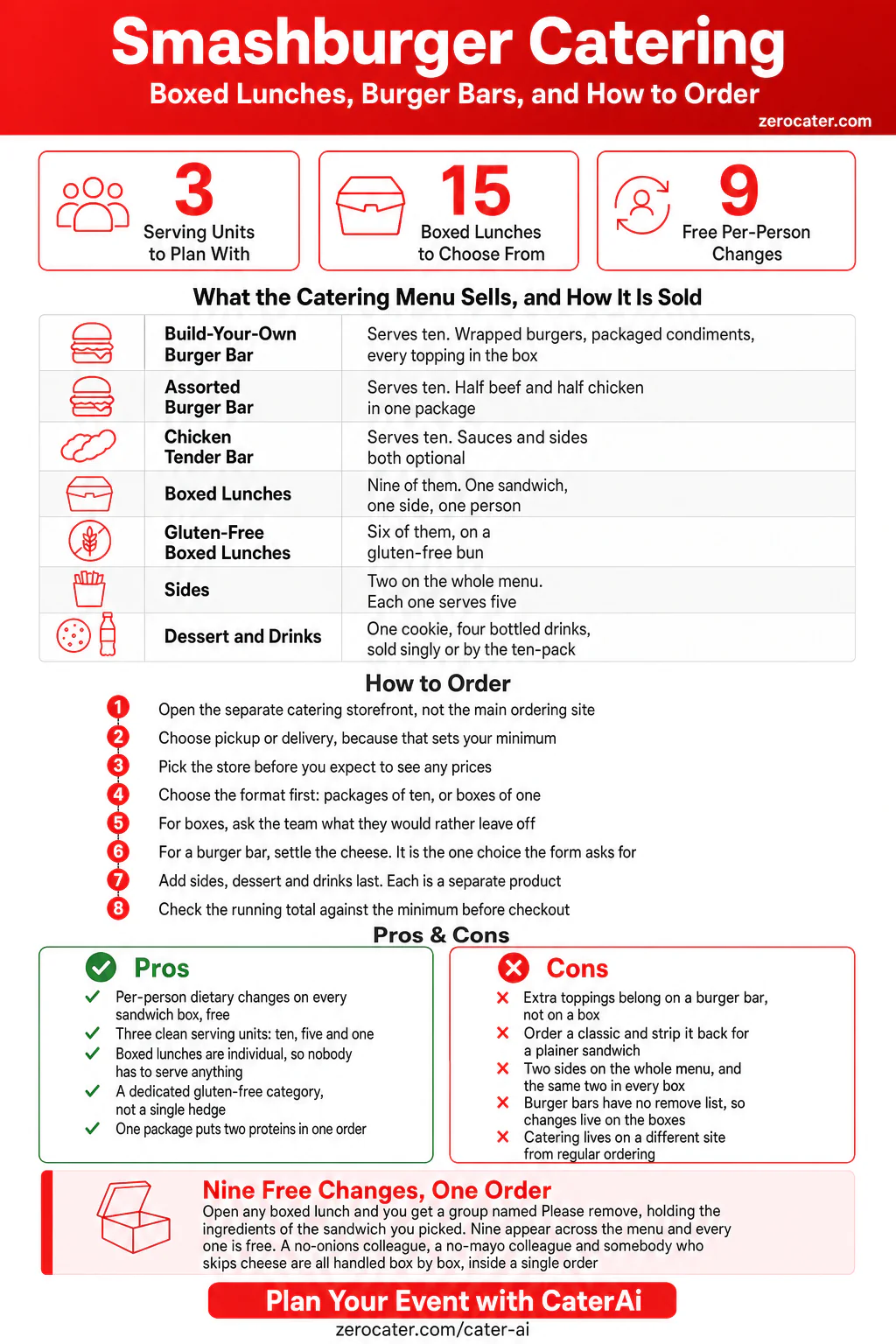
Frequently Asked Questions
Does Smashburger do catering?
Yes, and it runs on its own separate storefront rather than on the regular ordering site. The brand’s catering page describes ready-to-serve catering selections at participating locations and sends you to a dedicated catering ordering site, where you pick a store first and the menu appears afterwards. That menu is not the restaurant menu. It is a short, purpose-built list of twenty-seven items in six groups: catering packages, boxed lunches, gluten-free boxed lunches, sides, one dessert and bottled drinks.
Can you add toppings to a Smashburger catering order?
That depends on which format you order. On a boxed lunch the option group is called “Please remove”, and it lists the sandwich’s own ingredients so each person can leave out what they do not want. The group called “Add-ons” on a box holds a chocolate chip cookie and four bottled drinks, and those arrive beside the box. Toppings live on the two burger bars instead. A bar arrives with the cheese, lettuce, tomatoes, onions, pickles, Smash Sauce, mayo and ketchup in the box, and everyone finishes their own burger at the table. If your team wants to build its own plate, order a bar, and read our guide to boxed lunch versus buffet catering before you choose a format.
What can you take off a Smashburger boxed lunch?
Nine ingredients appear across the menu’s remove lists: lettuce, tomatoes, red onion, pickles, ketchup, Smash Sauce, American cheese, mayo and bacon. No single box offers all nine. The classic burger boxes offer seven, the bacon boxes offer five, and the chicken and vegetarian boxes offer three. The list you get is the ingredient list of the sandwich you picked, so a more built sandwich gives you more to adjust. Every removal is free, and each one attaches to one box, which is what makes a mixed set of preferences easy to order in one go.
How many people does a Smashburger catering package feed?
Each of the three catering packages states that it serves ten. The two sides on the menu each state that they serve five, so a side does not cover a package on its own. Boxed lunches are sold one at a time and feed one person each. Those three units, ten and five and one, are the whole arithmetic of this menu, which makes it easier to plan than most chain catering lists. Our guide to office catering costs works through the same headcount question across formats.
What is the difference between the two Build-Your-Own Burger Bars?
The proteins, and nothing else. The standard bar is described as everything you need to build your own beef burgers. The assorted bar swaps half of them, and its description states that a ten-person order arrives as five beef and five chicken burgers. Both bars carry the same option groups, the same included toppings and the same cheese choice. If you want both proteins in one order, the assorted bar is the only item on the menu that does it.
Is there a minimum order for Smashburger catering?
Yes, and there are two of them. The catering storefront publishes a minimum for pickup and a separate, higher minimum for delivery, and the delivery floor is twice the pickup floor. Both figures were identical at every storefront checked for this guide, across five states, so the gap between the two is a national rule rather than a local one. Prices for individual boxed lunches did move between stores, so check your own location before you build the order.
Are there vegetarian or gluten-free options on the Smashburger catering menu?
Both exist, and they work differently. The vegetarian option is a single boxed lunch built on a Southwest seasoned black bean burger. Its own description carries this note: “Please be aware that due to shared cooking and preparation areas, food may come into contact with meat, and animal byproducts.” Gluten-free arrives two ways: a separate category of six boxed lunches on a gluten-free bun, and a bun substitution offered on most of the regular boxes. That substitution is the one swap on the order form that carries a charge. Our guides to vegetarian office catering, gluten-free office catering and allergy-safe boxed lunches go further than a menu label can.
What is the smallest useful Smashburger catering order?
One boxed lunch is the smallest item, but the pickup minimum means a single box will not place an order on its own. In practice the floor is a handful of boxed lunches for pickup, or roughly twice that many for delivery. The packages clear both minimums by themselves. For a small team the boxed lunches are the flexible route, because each eater gets their own sandwich and their own list of changes, while a package covers the whole room with one set of choices. Our guide to budget-friendly office lunches covers the same trade-off across other chains.