Someone on your team does not eat Indian food. They tried a curry once that ran hotter than they expected, or they have never tried it at all, and now Indian catering loses the vote every time it comes up for a team lunch. The organiser hears two objections out of thirty people, files the whole cuisine under risk, and orders sandwiches again.
Rasa opened in Washington in 2017 with that person in mind. Co-founders Sahil Rahman and Rahul Vinod built a menu you assemble from parts you can see and name, which turns a cuisine that reads as one large unknown into a short list of choices. For an office ordering catering, that design decision matters more than any single dish on the menu.
Plan Rasa catering with CaterAi
Two sons of DC restaurant families built an on-ramp
Rahman and Vinod grew up around Indian food as a business. Their parents, K.N. Vinod and Surfy Rahman, run Indique in Cleveland Park and Bombay Bistro in Rockville, so both founders spent their childhoods inside DC-area Indian dining rooms. They studied together at the University of Maryland, took corporate jobs in New York, and quit them in 2014 to spend three years planning a restaurant. The first Rasa opened in Navy Yard in 2017. The name means essence in Sanskrit.
Vinod has described the problem they set out to fix in specific terms. Walk into a traditional Indian restaurant, face a menu of a hundred-plus items in unfamiliar language, and you order the three things you already know: garlic naan, butter chicken, saag paneer. The rest of the menu may as well not exist. Rahman calls food the “ultimate gateway to culture,” and the pair treated the menu itself as the barrier rather than the food.
Their answer was to stop selling dishes and start selling components. That choice is what separates Rasa from the rest of the Indian catering on a Zerocater order form, and it is worth understanding before you look at formats.
Six steps, and every option is something you can picture
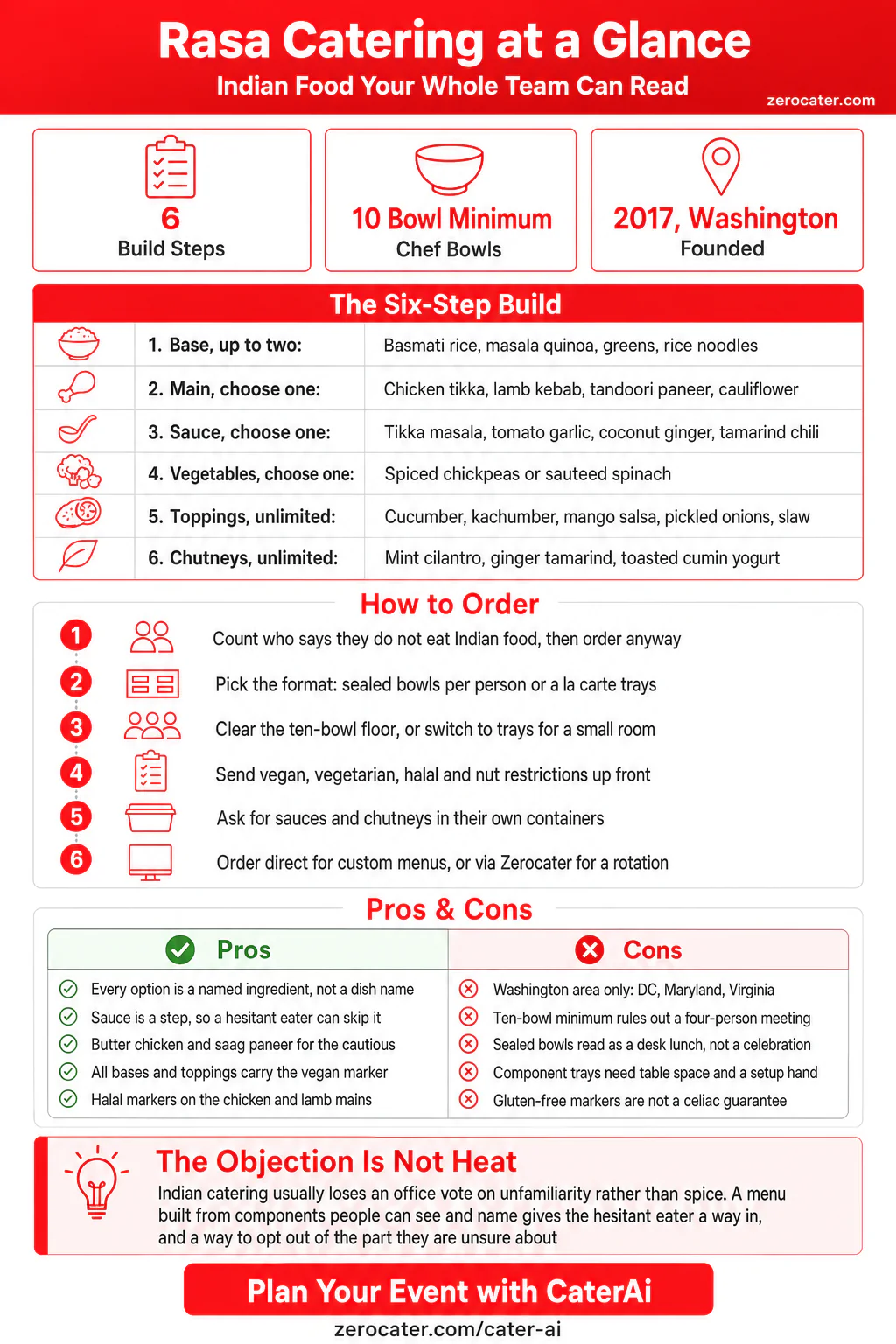
A Rasa bowl gets built in six passes. Read the options and notice how few of them need explaining:
- Base (up to two): spinach, romaine, arugula, a house greens blend, masala quinoa, basmati rice, South Indian rice noodles, lemon turmeric rice.
- Main (one): chicken tikka, spicy chili chicken, lamb kebab, tandoori paneer, roasted cauliflower and potato, harvest vegetables.
- Sauce (one): tikka masala, tomato garlic, coconut ginger, tamarind chili, peanut sesame.
- Vegetables (one): spiced chickpeas or sautéed spinach.
- Toppings (unlimited): cucumber, cilantro, kachumber salad, mango salsa, pickled onions, Indian street corn, carrot slaw, avocado, lentil chips, roasted lentils, shredded paneer.
- Chutneys and dressings (unlimited): mint cilantro chutney, ginger tamarind chutney, kokum vinaigrette, chili lime vinaigrette, toasted cumin yogurt.
Cucumber, rice, chickpeas, carrot slaw and avocado carry no cultural homework. A person who has never ordered Indian food in their life can read that list and recognise most of it. The two or three items they cannot place sit next to a dozen they can, which is a very different reading experience from a menu of dish names.
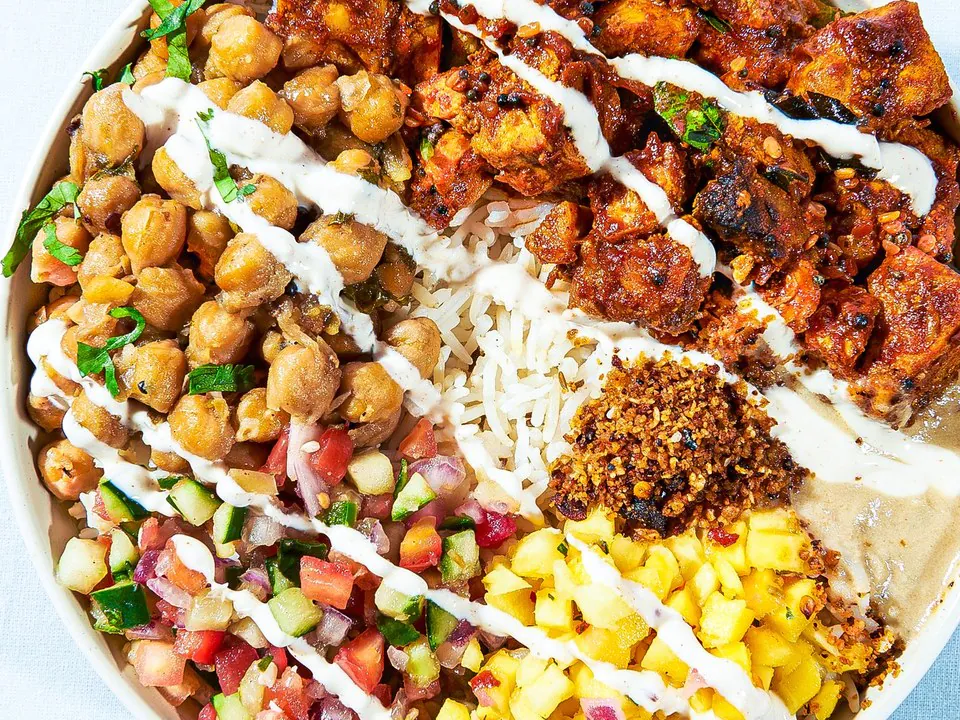
Rasa also sells chef-curated bowls for people who do not want to make six decisions, and a line of classic Indian plates. Those plates carry butter chicken and saag paneer, which are two of the exact three dishes Vinod named as the safe order. The on-ramp works from both ends: components for the curious, familiar anchors for the cautious.
The coworker who says “I don’t do Indian”
Most advice about Indian catering treats this objection as a heat problem and stops there. Heat is the stated reason. Unfamiliarity is the real one, and the two need different fixes.
A shared tray of curry gives a hesitant eater nothing to work with. They cannot see what is in it, the sauce is already on everything, and the only way to find out whether they like it is to commit a full plate in front of colleagues. Declining is easier. Rasa’s format removes that trap in three ways.
They can see it. The components arrive separate and labelled in plain English. Nobody has to ask what a dish is before they can decide.
They can opt out of the unfamiliar part. Sauce is step three, not a marinade. Someone takes chicken tikka over basmati rice, skips step three, adds cucumber and carrot slaw, and eats chicken and rice. They stop blocking the order and they get lunch. Next time they might take the tikka masala.
They have a familiar exit. Butter chicken is on the same menu. The person who only ever orders butter chicken can order butter chicken while everyone else builds something new.
The payoff: the order stops being a referendum on a cuisine. You are asking people to pick a base and a protein, which is the question a salad bar asks. Offices that could never get Indian food past a group vote often clear it on the second attempt with a component menu.
What arrives when you order catering
Rasa’s catering splits into two shapes, and they suit different rooms.
Individually packaged bowls and plates. One sealed container per person, built to a chef-curated spec or to your group’s choices. These count against a headcount and travel to desks without a serving line. The chef-curated bowls carry a ten-bowl minimum.
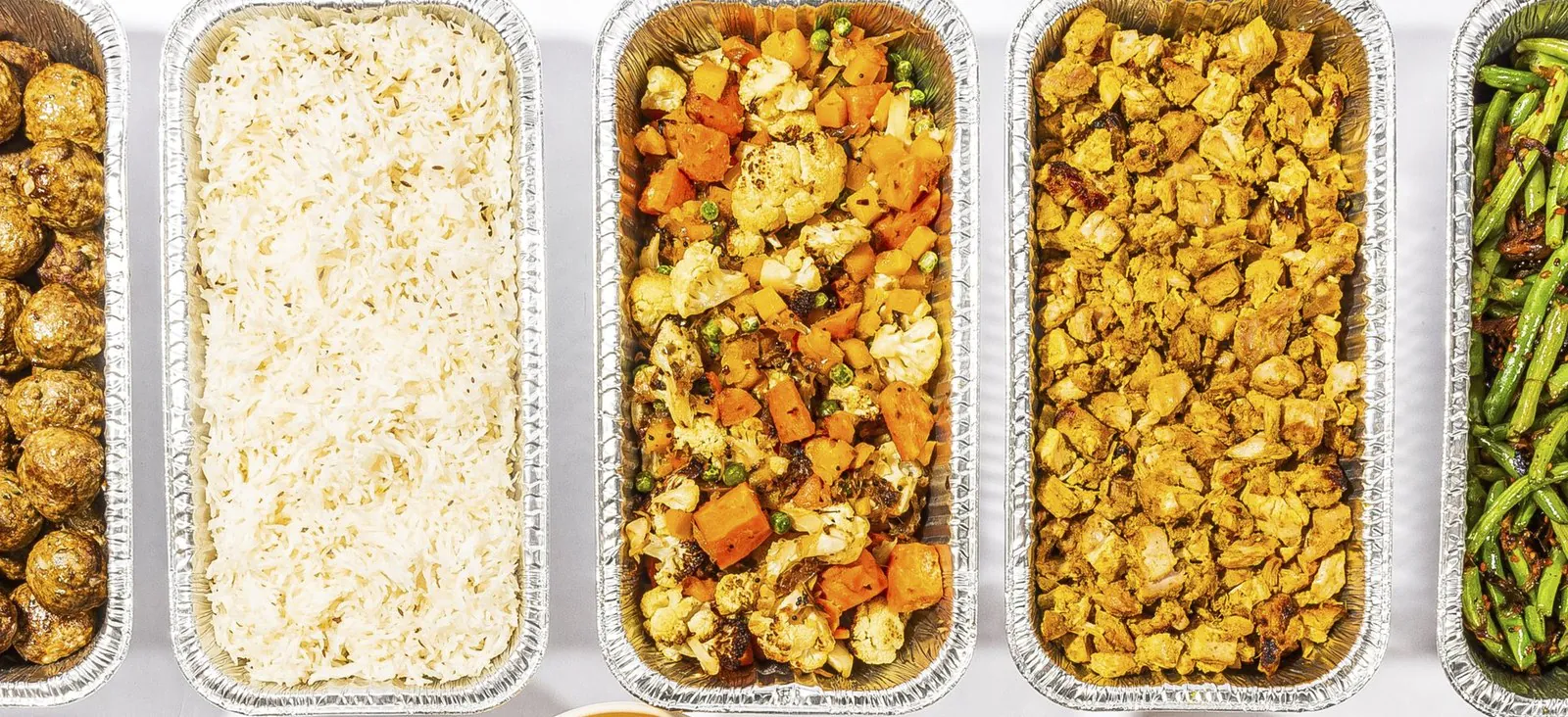
A la carte trays. Mains, warm vegetables and sauces ordered as separate trays, with the sauces and chutneys in their own containers rather than poured over anything. This is the version that reproduces the in-store build at your office: people walk the table and assemble. Rasa also sells sides and sweets on their own, including mini samosas, naan and cookies.
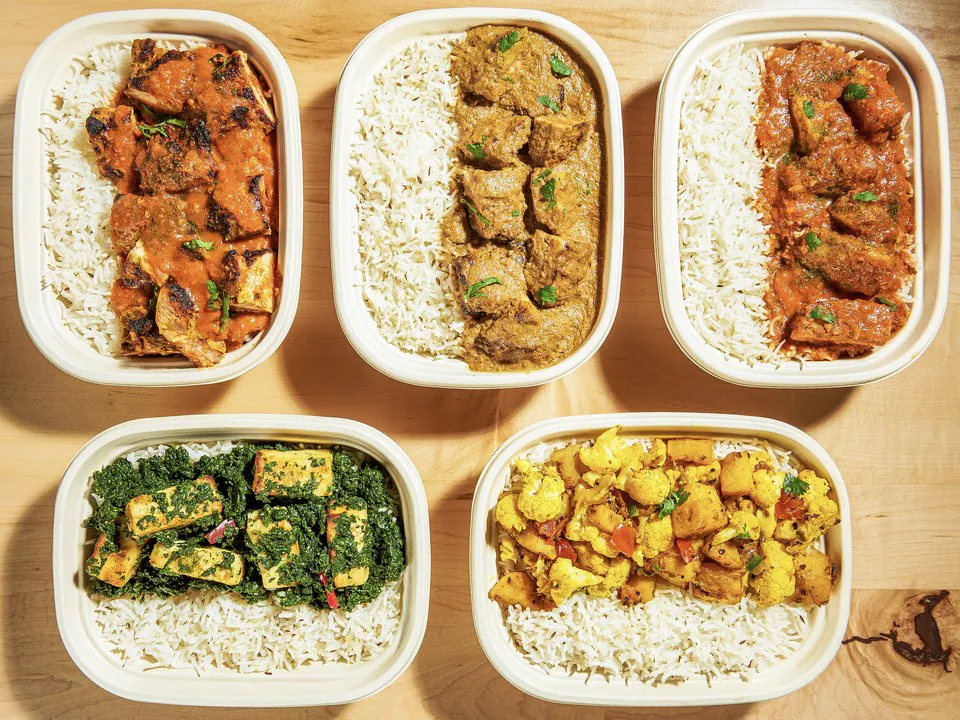
The Zerocater catering menu carries both routes plus the extras that round out an order: cucumber raita, Indian yogurt, roasted vegetables, spinach, mango lassi, iced oat milk chai and a chai chocolate chip cookie basket.
Which Rasa format fits which office meal
| Format | Best for | Watch for |
|---|---|---|
| Individually packaged bowls | Desk lunches, hybrid days, working sessions, conference rotations | Ten-bowl minimum on the chef-curated route |
| Classic Indian plates | Teams who want the dishes they already recognise | Less useful as a first exposure than the build |
| A la carte component trays | All-hands lunches, mixed-preference rooms, first-time Indian orders | Needs table space and someone to set it out |
| Burritos | Walking lunches, offsite starts, no-plate settings | Hides the components the format is selling |
| Sides and sweets on their own | Topping up an existing order, afternoon meetings | Not a lunch on its own |
Dietary coverage runs through the build, not around it
Rasa publishes a menu key, and it does most of the work here. Every base and every topping carries the vegan marker. Every main carries the gluten-free marker. Coconut ginger and tamarind chili are vegan sauces, roasted cauliflower and potato and harvest vegetables are vegan mains, and tandoori paneer covers vegetarians who eat dairy. A vegan guest walks the same six steps as everyone else and ends up with a full bowl rather than a side dish.
The key marks chicken tikka, spicy chili chicken and lamb kebab as halal. Two items carry a nuts marker: the lamb kebab and the peanut sesame sauce. Flag both when you send a group’s restrictions over.
The gluten-free markers describe ingredients. Naan sits on the same catering menu and the kitchen is shared, so cross-contact is possible. Treat the marker as gluten avoidance. Call the team when a guest has celiac disease.
Plan Rasa catering with CaterAi
Three things Rasa does not solve
The format has real limits, and they are easier to plan around when you name them first.
It is a Washington-area brand. Rasa serves the District plus nearby Maryland and Virginia. A team in Chicago or Austin cannot order it at all, which is the hard boundary on everything above.
Small meetings fall under the bowl floor. Ten bowls is the minimum on the chef-curated route, so a four-person leadership sync needs the a la carte trays or a different partner.
A stack of sealed bowls is not a celebration. Individual packaging reads as a desk lunch. When the room wanted a shared, generous spread for a launch or a client visit, order the component trays and give people a table to walk. Our board meeting catering and lunch and learn guides cover the formats built for those rooms.
How to order Rasa catering
Direct. Rasa runs its own catering channel with online ordering, and their team takes the work that does not fit a checkout button. They handle large orders, dietary needs, custom menus and last-minute deadlines through a person rather than a form, so start there when your order has any of those in it.
Through Zerocater. Order from the Rasa vendor page and delivery, invoicing and any recurring schedule run on Zerocater instead. This is the better route when Rasa is one restaurant in a rotation rather than a one-off, and when you want the same billing across every vendor your office uses. See how it works for the mechanics.
Rasa and Zerocater
Rasa sits in Zerocater’s Washington DC network alongside a spread of local kitchens covering other cuisines: TaKorean for Korean bowls, Banana Leaves for Southeast Asian, Springbone Kitchen for bone-broth bowls, and Fresh Bites Kitchen and Grassfed Griddle for broader American menus. Browse the full Washington DC catering directory, or narrow to Indian catering in Washington DC.
Indian catering runs across Zerocater’s other metros too. The Indian catering directory covers New York, San Francisco and Chicago among others, and the wider South Asian directory picks up neighbouring cuisines. For a fast-casual Indian option on the West Coast, Curry Up Now runs a different take on the same idea, covered in our Curry Up Now catering spotlight.
If you are planning Indian catering for the first time, our Indian corporate catering guide covers menu structure and service formats in depth. For the wider DC picture, see the best corporate event catering companies in Washington DC and how much office catering costs in DC. Teams running an ongoing programme rather than one lunch should start at corporate catering, and event planners at corporate event catering.
Menu items, minimums and delivery areas change. Check the Rasa vendor page for the current catering menu and a live quote before you place an order.
Plan Rasa catering with CaterAi
Frequently Asked Questions
What is Rasa?
Rasa is a fast-casual Indian restaurant brand from the Washington area. Sahil Rahman and Rahul Vinod opened the first one in Navy Yard in 2017, and the name means essence in Sanskrit. The menu is built around bowls you assemble from named components, with classic Indian plates, burritos and salads alongside them. Both founders grew up in DC-area Indian restaurant families, and they designed the format for people who had never ordered Indian food before. Rasa is a Zerocater partner, so the current catering menu sits on the Rasa vendor page.
Does Rasa cater office lunches in Washington DC?
Yes. Rasa runs a catering program for offices across the Washington area, covering the District plus nearby Maryland and Virginia. Orders go through Rasa’s own catering channel or through Zerocater. The Rasa vendor page carries the catering menu Zerocater sells, including the bowls, the paneer butter masala and saag paneer plates, the butter chicken burrito, naan, cucumber raita and the sauces and chutneys in their own containers.
Is there a minimum order for Rasa catering?
Rasa’s chef-curated bowls carry a ten-bowl minimum, so a four-person meeting falls under it and wants a different route. A la carte trays of mains, warm vegetables and sauces let a smaller group order without clearing the bowl floor, and ordering through Zerocater puts the whole thing on Zerocater’s rails instead. Confirm the current floor on the Rasa vendor page before you build a headcount around it.
Does Rasa have vegan and vegetarian catering options?
Yes, and they run through the whole build rather than sitting in a corner of the menu. Every base and every topping on Rasa’s menu carries the vegan marker. Roasted cauliflower and potato and harvest vegetables are vegan mains, coconut ginger and tamarind chili are vegan sauces, and tandoori paneer covers vegetarians who eat dairy. A vegan guest assembles a full bowl from the same six steps as everyone else. Our vegan office catering guide and vegetarian guide cover the wider planning question.
Is Rasa halal?
Rasa’s published menu key marks chicken tikka, spicy chili chicken and lamb kebab as halal. That covers the meat mains a catering order would draw from. Confirm it with the Rasa team when halal sourcing is a requirement for your group rather than a preference, because a menu key describes ingredients and not the handling on a given day.
Is Rasa gluten-free?
Most of the menu carries the gluten-free marker, including all of the bases, all of the mains, the sauces and the toppings. Read that as gluten avoidance rather than a celiac guarantee. Naan sits on the same catering menu and the kitchen is shared, so cross-contact is possible. Tell the team when a guest has celiac disease and let them advise. Our gluten-free office catering guide covers how to brief a caterer on this.
How do you order Rasa catering for a team?
Two routes. Order direct through Rasa’s own catering channel, which handles large orders, dietary needs, custom menus and last-minute deadlines through their team rather than a checkout button. Or order through Zerocater from the Rasa vendor page, which puts delivery, invoicing and any recurring schedule on Zerocater. The second route makes more sense when Rasa is one of several restaurants in a rotation.
What if my office is outside the Washington area?
Rasa is a regional brand, so a team in another metro cannot order from it. The format travels even when the restaurant does not. Browse Indian catering or the wider South Asian directory for your city, or ask CaterAi to build a comparable component-style spread from restaurants that deliver to you.