Dave’s Hot Chicken sells one decision that no other chain on the office-catering bench asks you to make. Before a single tender goes in the fryer, you name a heat level, and the spice goes into the crust. It does not arrive in a cup. It cannot be scraped off, diluted, or handed to the one person who wanted it. The chicken you ordered is the chicken your team eats.
That single fact reorganises everything about ordering Dave’s for a group. A wing chain can hand you sauce on the side and let twelve people solve their own problem. Dave’s asks you to solve it in advance, for everyone, from a menu that gives you two heat levels per item when the restaurant itself sells seven. Get the split right and the order lands. Get it wrong and half the room eats bread.
This guide covers the ladder, the Hot Box formats, the waiver on the top rung, and how to spec heat for an office you cannot poll perfectly.
Plan chicken catering with CaterAi
How Dave’s Hot Chicken Catering Works
Dave’s runs its group ordering through a catering menu that sits apart from the walk-in menu. The founders started the brand as a parking-lot pop-up in East Hollywood, and it has since grown fast enough that trade press has called it one of the fastest-growing restaurant chains in the country. Roark Capital took a majority stake in a deal reported at around a billion dollars.
For an office, the practical shape is simple. You choose between individually boxed lunches, which give one person one sealed meal, and Hot Boxes, which are bulk trays meant to be handed out. Sides and drinks come in five-packs. Most locations take catering orders through their delivery partner rather than the main site.
The catering menu is set per location, so the exact list of formats varies. Two things are consistent across every store menu we pulled: every bulk item asks you to pick heat levels at the point of order, and the number you get to pick is capped.
The Seven Spice Levels, and Why Catering Gives You Two
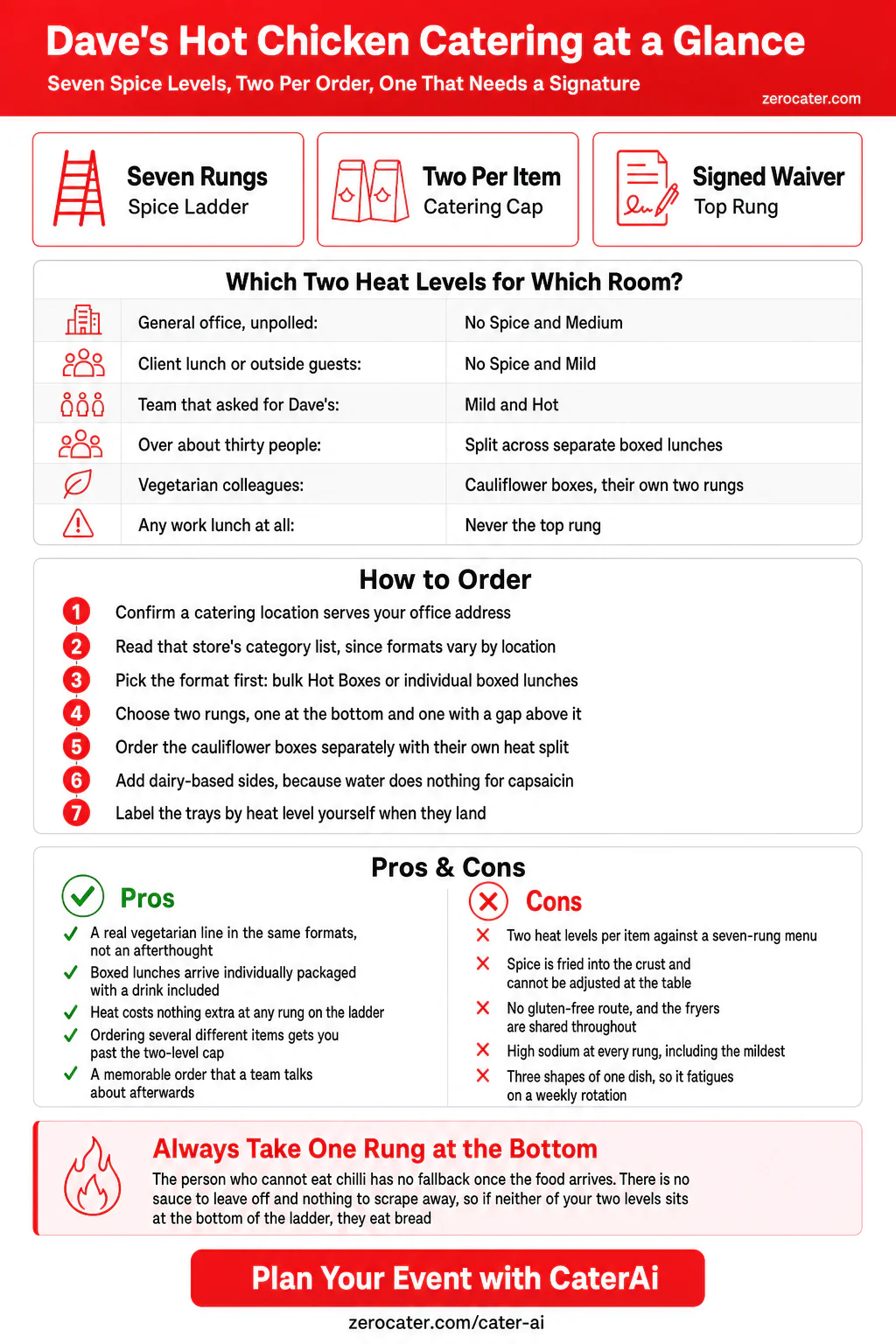
The walk-in ladder runs seven rungs, from no heat to a chilli that needs a signature. Reading from the bottom, the levels are No Spice, Lite Mild, Mild, Medium, Hot, Extra Hot and Reaper. Heat is free at every rung, so nothing pushes you up or down the ladder except appetite.
Those rung names come from the brand’s published ladder rather than from a menu we could pull directly, because the Dave’s menu page will not render without a store selected. Confirm the exact wording with your local store when you order, since the ladder is the one part of this guide most likely to be worded differently on a regional menu.
Catering is where the ladder narrows. Every bulk item on the catering menu carries the same instruction: choose up to two heat levels. One store menu repeated that phrase twenty-seven times across a single page. The smallest boxed lunch, a one-slider box, allows exactly one.
So a twenty-slider Hot Box is not twenty individual spice decisions. It is two piles. You are splitting a room across two rungs of a seven-rung ladder, and the two you pick are the whole range your team gets.
Reaper, the Waiver, and Why It Does Not Belong at a Work Lunch
The top rung is not a marketing flourish. Dave’s requires anyone eating a Reaper to accept a written release, and the brand serves the text on its own site. It is titled a Waiver and Release of Liability, it instructs the eater to proceed at their own risk, and it lists the potential consequences as including illness, distress and death. Accepting it requires the eater to certify that they are eighteen or older.
The release also extends to anyone eating from the brand’s mixed-heat box, where the rungs are scrambled on purpose and nobody knows which piece they picked up. The same product page carries a California Proposition 65 toxic-substance flag.
Read that as an office planner rather than as a fan. You would be asking colleagues to sign a liability release to eat lunch at work, at an event you organised, where at least one person will feel pressure not to be the one who declines. Order the top rung for yourself on your own time. Keep it off the team order.
The same logic applies one rung down. Extra Hot carries no paperwork, but it is still built for people who seek heat out. It is not a safe upper bound for a room that did not choose to be there.
The Hot Boxes: Tenders, Sliders, Bites and Cauliflower
The bulk formats differ in more than portion size. They differ in how cleanly one person can take a portion and walk away, which matters more in an office than it does at a party.
| Format | What it holds | Heat choices | Best for |
|---|---|---|---|
| Tenders & Fries Hot Box | Tenders with bread and pickles, plus shared fries | Up to 2 | Rooms that want the plainest, most portionable option |
| Sliders & Fries Hot Box | Sliders on buns with slaw and pickles, plus fries | Up to 2 | Standing events where a bun does the work of a plate |
| Tenders, Sliders & Fries | A split of both, plus fries | Up to 2 | Mixed appetites, and the easiest single order to default to |
| Hot Box Dave’s Bites | Bite-sized white-meat pieces with bread and pickles | Up to 2 | Snacking, afternoon sessions, grazing rather than a meal |
| Cauli Bites Hot Box | Cauliflower bites, same accompaniments | Up to 2 | The vegetarian share of the room |
| Cauli Sliders Hot Box | Cauliflower sliders on buns with slaw | Up to 2 | Vegetarians at a standing event |
The cauliflower line deserves attention, because chains rarely handle this well. Dave’s does not treat the vegetarian option as a side dish. It runs the same formats, the same accompaniments and the same heat choices, which means your vegetarian colleagues get a real portion instead of a consolation salad. It also means they face the identical two-level cap, so they need their own split rather than inheriting whatever you picked for the chicken.
Fried cauliflower and fried chicken share fryers in most kitchens. If someone in the room avoids meat for religious rather than dietary reasons, confirm the kitchen’s practice before you promise anything. Our vegetarian catering directory and vegan directory list restaurants that separate preparation properly.
Boxed Lunches When Everyone Needs Their Own Heat
Dave’s numbered boxed lunches are the answer to the two-level cap, and they are underused. Each one is an individually packaged meal built around a fixed combination: two tenders with fries, two sliders with fries, one tender and one slider, or a single slider with fries. Each includes bread or a bun, pickles, sauce, a side of fries and a drink.
The trade is straightforward. Boxed lunches cost more per head than bulk trays, and they take longer to assemble. In exchange, every box is sealed, labelled and portioned for one person, which solves the problems bulk trays create in an office: no serving line, no guessing which tray is which, no last person arriving to an empty pan.
They also loosen the heat constraint in practice. Because the cap applies per item rather than per order, ordering several different boxed lunches lets you place more than two heat levels on the same table. If your room splits three or four ways on spice, that is the route to take. Our boxed lunch cost guide covers what drives the per-person price on this format.
How to Split Two Heat Levels Across a Real Office
Most planners pick their two levels by picking their own favourite and one below it. That is the wrong instinct, because it centres the order on the person ordering.
Spec it the way you would spec anything else with a hard cap. Your two rungs need to cover the widest span of the room, not the middle of it. In an office that has not opted into a spice challenge, the distribution runs heavily toward the bottom of the ladder, with a small tail of enthusiasts.
| The room | Pick these two | Why |
|---|---|---|
| General office, mixed and unpolled | No Spice and Medium | Covers people who want none at all and people who want a real kick, with nothing stranded in between |
| Client lunch or external guests | No Spice and Mild | Nobody visiting your office should have to negotiate a chilli they did not choose |
| Team that asked for Dave’s by name | Mild and Hot | They know the brand, so the bottom rung is wasted on them |
| Large group, over about thirty | Split across separate boxes | At that size two rungs will not cover the spread, and per-item ordering buys you more |
Three rules make the split hold up:
- Always take one rung at the very bottom. The person who cannot eat chilli at all has no fallback once the food arrives, and there is no version of this menu where they can fix it themselves.
- Do not put both rungs adjacent. Mild and Medium wastes your second choice on a difference most people will not detect.
- Label the trays yourself when they land. Bulk boxes are not always marked by heat, and the two piles look similar under a fryer’s colour. A folded card costs nothing and prevents the one bad outcome.
Sides, Drinks and What Actually Cools the Burn
Sides come in five-packs and most arrive individually packaged, which suits an office better than a communal tub. The list runs to mac and cheese, kale slaw, boxed fries and cheese fries. Drinks come in bundles of five, with the usual soft drinks and bottled water.
Order more dairy than feels necessary. Capsaicin does not dissolve in water, so the water bundles will not help anyone who overshot their rung. Mac and cheese and the creamy slaw both work, and both run out first at any Dave’s order. The kale slaw does double duty as the only fresh thing on the menu.
There is no salad, no soup and no lighter main. For a team that wants an occasional fried lunch this is fine. For a recurring programme it is a real gap, and our healthy office catering guide covers what to rotate alongside it.
Where Dave’s Hits a Wall in a Mixed Office
The menu is narrow by design. Five of those limits bite hardest in an office.
- Sodium. Brined, breaded and fried chicken sits high on sodium at every rung, including No Spice. Anyone managing blood pressure gets no useful option here. See our low-sodium office catering guide.
- No gluten-free path. Everything central to the menu is breaded, and the fryers are shared. There is no route to a safe order for a coeliac colleague.
- The heat is fixed at the kitchen. This is the whole point of the brand and the whole problem in an office. A person who finds their tray too hot cannot fix it at the table.
- Fried food holds badly. The crust that carries the spice is the part that suffers most in transit.
- Menu fatigue. Tenders, sliders and bites are three shapes of the same thing. It is a strong occasional order and a weak weekly one.
How to Order Dave’s Hot Chicken for a Group
- Find your nearest catering location. Catering is store-level, so confirm your address is served before you plan around a format.
- Read that store’s category list. Formats differ between locations, and the boxed lunches in particular are not guaranteed everywhere.
- Pick the format before the heat. Bulk trays for standing events, boxed lunches when the room splits more than two ways on spice.
- Choose your two rungs. One at the bottom of the ladder, one with a real gap above it.
- Order the vegetarian boxes separately. They carry their own heat choices and need their own split.
- Add dairy-based sides generously. They are the only thing on the menu that helps someone who overshot.
- Check the delivery minimum and lead time. Group orders generally need a day or more of notice, and stores set their own floors.
- Confirm the change window. Amendments typically close a full business day before the event, and late cancellations carry a fee.
If your timeline is shorter than the store’s lead time, our last-minute office catering guide covers what still ships on short notice.
Plan chicken catering with CaterAi
Keeping Fried Chicken Good on the Drive Over
A sealed box of hot fried chicken steams itself. The crust goes soft within about twenty minutes, and the spice layer suffers first because it sits on the outside.
Three things help. Ask for the trays to be vented or cracked open on arrival rather than left sealed. Set the food out immediately instead of holding it in the boxes. And schedule the delivery for the moment people actually eat, not fifteen minutes early, since fried chicken loses more in the first twenty minutes than in the hour that follows.
Pros and Cons for Office Catering
| Strengths | Limits |
|---|---|
| A genuine vegetarian line in the same formats, not an afterthought | Two heat levels per item against a seven-rung ladder |
| Individually packaged boxed lunches with drinks included | No gluten-free option and shared fryers throughout |
| Heat costs nothing extra at any rung | High sodium at every rung, including the mildest |
| Strong reception scores on group orders | Narrow menu that fatigues on a weekly rotation |
| A memorable order that people talk about | Spice cannot be adjusted after it arrives |
Who Dave’s Hot Chicken Catering Is Best For
A good fit for: team celebrations and milestone lunches, groups that asked for it by name, standing events where sliders replace plates, and offices with a real vegetarian contingent who are tired of being handed salad.
A poor fit for: client-facing meals with guests you have not polled, weekly recurring programmes, teams with coeliac or low-sodium needs, and any room where you cannot predict how the spice will land.
Dave’s vs. Other Catering Options
| Option | How heat is handled | Fit for a mixed room |
|---|---|---|
| Dave’s Hot Chicken | Fried into the crust, chosen at order time, two levels per item | Workable with a careful split, unforgiving if you guess |
| Buffalo Wild Wings | Sauce applied after cooking, and available on the side | Easier, because each person adjusts their own |
| Raising Cane’s | No heat axis, one sauce on the side | Safest fried-chicken order, least interesting |
| Barbecue chains | Sauce on the side, smoke instead of chilli | Broad appeal, heavier food |
| Local restaurants via Zerocater | Set per dish, with heat noted per item | Widest coverage of a mixed room |
If hot chicken is what the team wants, independent restaurants often handle the heat spread better than a chain menu allows. Zerocater works with places like Charred Wing Bar in Chicago, Proposition Chicken and Hot Johnnie’s in San Francisco, and Church’s Texas Chicken in Dallas.
For southern cooking more broadly, look at Mema’s Southern Hospitality in Canoga Park, Fay’s Tallow-Fried Chicken in Austin and Soulicious near Dallas. Browse the full southern catering directory, the barbecue directory or the wider North American directory for your city.
A Better Option for Recurring Office Meals
Dave’s earns a place on a rotation. It struggles as the rotation itself, because the same qualities that make it memorable make it hard to repeat: one cuisine, one cooking method, a fixed heat decision and no route for coeliac or low-sodium colleagues.
Zerocater handles the part that a single chain menu cannot. Instead of splitting one restaurant’s ladder two ways and hoping, you get menus assembled across a city’s restaurants, with dietary needs handled per person rather than per tray. Teams running a weekly programme also spend less per head than they do ordering individual boxed meals from a chain, because the format stops being the constraint.
Plan chicken catering with CaterAi
Tell CaterAi your headcount, your budget and who cannot eat what, and it builds a menu from restaurants near your office. For ongoing programmes, see corporate catering. For one-off events, see corporate event catering, or read how it works.
More reading: our client appreciation catering guide, the new hire onboarding lunch guide, our Chick-fil-A alternatives roundup, and what office catering costs.
Frequently Asked Questions
How many spice levels can I order for a Dave’s Hot Chicken catering order?
Two per item. Every bulk Hot Box on the catering menu carries the instruction to choose up to two heat levels, and the smallest boxed lunch allows only one. Because the cap applies per item rather than per order, ordering several different items is how you get more than two heat levels onto the same table.
What are the Dave’s Hot Chicken spice levels in order?
The published ladder runs seven rungs: No Spice, Lite Mild, Mild, Medium, Hot, Extra Hot and Reaper. Heat is free at every rung. Confirm the exact wording with your local store, since regional menus can differ and the brand’s menu page does not display a ladder until a store is selected.
Do you need to sign a waiver for the Reaper?
Yes. Dave’s requires anyone eating a Reaper to accept a written Waiver and Release of Liability, which instructs the eater to proceed at their own risk, lists serious potential consequences and requires the eater to confirm they are eighteen or older. It also applies to the brand’s mixed-heat box. Keep the top rung off a work order.
Is there a vegetarian option at Dave’s Hot Chicken?
Yes, and it is unusually well built for a chain. Cauliflower bites and cauliflower sliders run in the same Hot Box formats as the chicken, with the same accompaniments and the same heat choices. They need their own heat split rather than inheriting the one you chose for the chicken. Fryers are shared, so confirm preparation if that matters for your team.
Does Dave’s Hot Chicken have gluten-free catering options?
No. The menu is built on breaded, fried chicken, and the fryers are shared across the menu including the cauliflower. There is no reliable route to a gluten-free order, so plan a separate dish for anyone with coeliac disease.
How much notice does Dave’s Hot Chicken need for catering?
Plan on at least a full business day, and longer for large orders. Lead times, delivery minimums and delivery areas are set per location. Changes usually close a full business day before the event, and cancellations inside that window carry a fee, so lock your headcount early.
How do I keep Dave’s Hot Chicken from going soggy before lunch?
Vent or open the boxes as soon as they arrive instead of leaving them sealed, set the food out straight away, and schedule delivery for when people actually eat. Trapped steam softens breading within about twenty minutes, and the spice crust is the layer that suffers first.
What are good alternatives to Dave’s Hot Chicken for office catering?
For heat that each person controls, a wing chain that serves sauce on the side is easier to manage. For a fried-chicken order with no spice decision at all, Raising Cane’s is the safe pick. For a mixed room with real dietary needs, local restaurants booked through CaterAi cover the spread better than any single chain menu can.