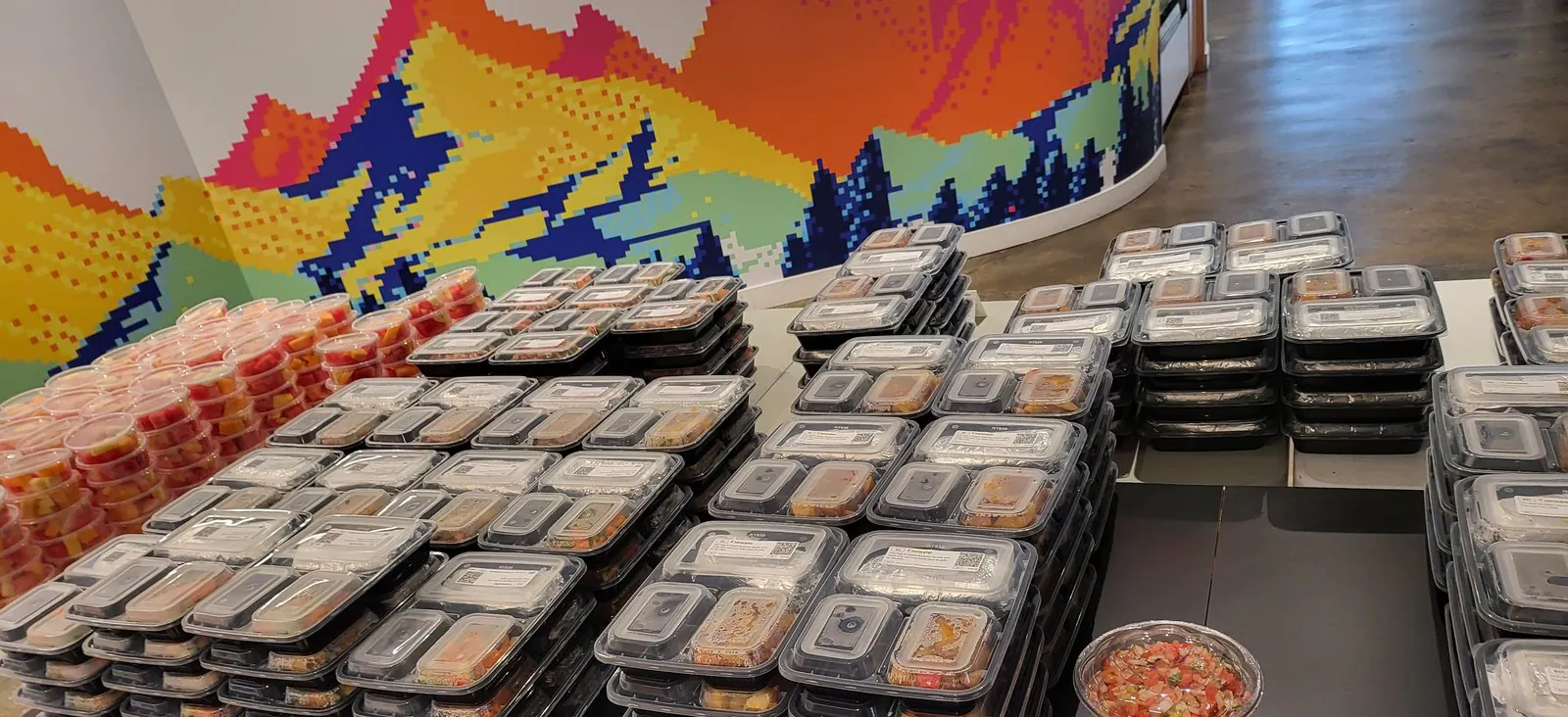
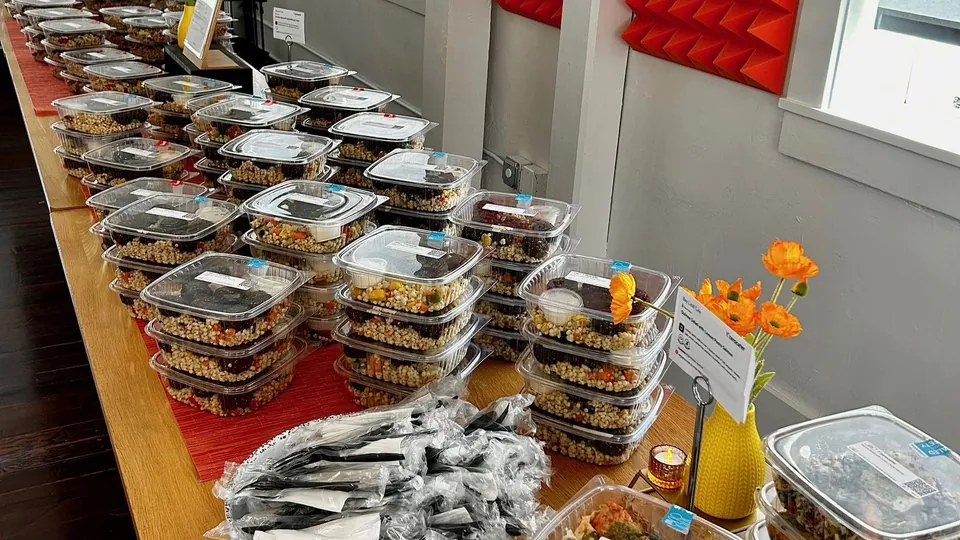
The all-hands ran short. You ordered for a full room, a third of it dialled in from home, and at two in the afternoon the counter still holds sealed boxed lunches, an untouched tray of grain salad and half a pan of roasted vegetables. You would give it away this afternoon if you knew it was allowed.
The worry that stops an office is liability. Somebody eats the food, somebody gets sick, and the company that meant well ends up answering for it. Congress wrote a short statute for that worry. The Bill Emerson Good Samaritan Food Donation Act sits at section 1791 of Title 42, runs to roughly 1,080 words, and answers the question with two lists of donors and two routes the food can take.
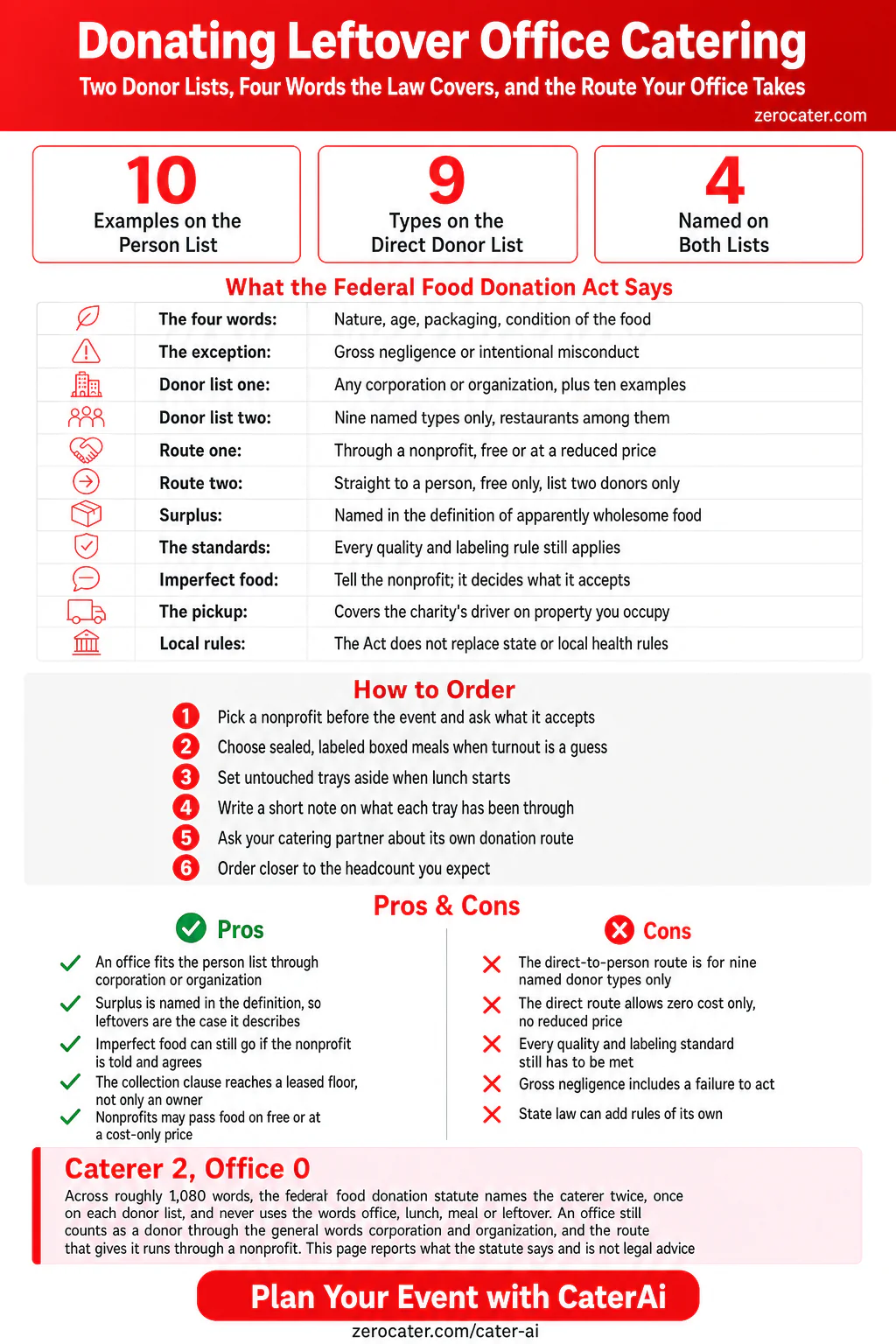
Read the lists closely and one thing stands out. The Act names the “caterer” twice. It never names an office.
In this guide
- What the Act covers, in four words
- Two donor lists, and the “caterer” is on both
- Two routes out of the building
- Apparently wholesome is a standard, not a look
- If the food is not perfect, say so
- The driver at your door
- What this changes about the order you place
This guide reads one federal statute and stops at what it says. It gives no legal advice, it cannot see your food or your state, and state law can add rules of its own on top of the federal text. Every real decision belongs to your own counsel and to the nonprofit you give to. Our office catering and how it works pages cover the ordering side.
What the Act covers, in four words
Subsection (c)(1) is the sentence the rest of the section serves. A person who donates apparently wholesome food in good faith to a nonprofit organization, for ultimate distribution to needy individuals, “shall not be subject to civil or criminal liability arising from the nature, age, packaging, or condition” of that food.
Four words set the scope. Nature is what the food is. Age is how old it is. Packaging is what it sits in. Condition is the state it is in when it changes hands. Leftover catering raises a question on each of the four, which is why the clause fits an office counter so well.
The coverage has one exception, and (c)(4) states it. It does not reach an injury or death that results from gross negligence or intentional misconduct. Subsection (b)(8) defines gross negligence as “voluntary and conscious conduct (including a failure to act) by a person who, at the time of the conduct, knew that the conduct was likely to be harmful to the health or well-being of another person.”
The words in parentheses were not always there. The amendment notes under the section carry the older definition, and it said “voluntary and conscious conduct by a person with knowledge”. A 1996 rewrite added the failure to act, so a decision to do nothing about a problem you knew about sits inside the exception too.
Two donor lists, and the “caterer” is on both
The Act defines a donor twice, and it writes the two definitions in different ways.
The first is “person”, in subsection (b)(11). It opens with six forms: an individual, corporation, partnership, organization, association or governmental entity. Then it says “including” and gives ten examples: “retail grocer, wholesaler, hotel, motel, manufacturer, restaurant, caterer, farmer, and nonprofit food distributor or hospital”. A company is a corporation or an organization whatever it sells, so an office fits the first half of the sentence before the examples begin.
The same definition reaches inside the company. For a corporation or organization, person “includes an officer, director, partner, deacon, trustee, council member, or other elected or appointed individual responsible for the governance of the entity”.
The second is “qualified direct donor”, in subsection (b)(12). It does not say “including”. It says the term “means” nine types: “a retail grocer, wholesaler, agricultural producer, agricultural processor, agricultural distributor, restaurant, caterer, school food authority, or institution of higher education”. There is no general word at the front of that list for an office to enter through.
Four entries appear on both lists: retail grocer, wholesaler, restaurant and the “caterer”. The catering partner who delivered your lunch is very likely one of the four. Your office is on the first list by way of a general word and absent from the second.
| Donor list one | Donor list two | |
|---|---|---|
| Defined term | “Person”, subsection (b)(11) | “Qualified direct donor”, subsection (b)(12) |
| How the definition is written | Six forms, then “including” and ten examples | “Means” and nine types, with no general word |
| Named only here | “hotel”, “motel”, “manufacturer”, “farmer”, “nonprofit food distributor”, “hospital” | “agricultural producer”, “agricultural processor”, “agricultural distributor”, “school food authority”, “institution of higher education” |
| Named on both | “retail grocer”, “wholesaler”, “restaurant”, “caterer” | “retail grocer”, “wholesaler”, “restaurant”, “caterer” |
| Where an office fits | Through “corporation” or “organization” in the first half of the sentence | Not named, and no general word to enter through |
| The route it opens | To a nonprofit organization, at zero cost or a good Samaritan reduced price, subsection (c)(1) | To a needy individual, at zero cost only, subsection (c)(3) |
“Caterer” 2, office 0. Across roughly 1,080 words, the Act uses the word “caterer” twice, once on each donor list. The words office, lunch, meal, leftover and catering do not appear at all.
Two routes out of the building
Each list opens a different route, and the route is where the difference between the lists starts to matter.
Route one runs through a nonprofit. Subsection (c)(1) covers a person or gleaner who donates to a nonprofit organization “for ultimate distribution to needy individuals at zero cost or at a good Samaritan reduced price”. Subsection (c)(2) then covers the nonprofit that receives the food. The Act defines a nonprofit organization in (b)(10) as an entity operating for religious, charitable or educational purposes whose net earnings do not go to an officer, employee or shareholder. A food bank, a shelter kitchen and a church pantry all fit that description; our guide to catering for nonprofits looks at the same organizations from the other side of the table.
Route two runs straight to a person. Subsection (c)(3) covers a qualified direct donor who donates “to a needy individual at zero cost”. Two things are different here. The donor has to be one of the nine types, and the reduced price is gone. Route one allows either zero cost or a good Samaritan reduced price. Route two allows zero cost only.
Route two is the newer one. Public Law 117-362 added the qualified direct donor list, the direct route and the reduced price in one amendment, so a summary written before it describes a single route through a nonprofit and nothing else.
Put the two lists and the two routes together and the office’s position is clear. The route the text gives a company that bought lunch runs through a nonprofit. Handing a sealed box to somebody outside the building is the route the Act describes for the nine types, and your catering partner may be one of them.
Subsection (b)(3) defines the word the whole section turns on. To donate is “to give without requiring anything of monetary value from the recipient”. One nonprofit may still pass food to another for a nominal fee, as long as the person who finally eats it pays nothing or pays the reduced price.
Plan boxed lunch catering with CaterAi
Apparently wholesome is a standard, not a look
The Act only covers food that is “apparently wholesome”, and subsection (b)(2) defines the phrase in one sentence with two halves.
The second half is generous. The food qualifies “even though the food may not be readily marketable due to appearance, age, freshness, grade, size, surplus, or other conditions”. That is seven reasons, and surplus is one of them by name. An untouched tray from a lunch that was over-ordered is the exact thing the drafters described.
The first half is strict. The food has to meet “all quality and labeling standards imposed by Federal, State, and local laws and regulations”. The Act does not write those standards itself, and subsection (f) makes sure nobody reads it as if it did: “Nothing in this section shall be construed to supercede State or local health regulations.” The spelling is the statute’s own.
So the local rules that governed the food when your catering partner delivered it still govern it when it leaves your office. Our guide to office catering permits reads that rulebook, and this page does not restate it. Subsection (b)(4) is also worth a glance: food means “any raw, cooked, processed, or prepared edible substance, ice, beverage, or ingredient”, so the unopened drinks count too.
If the food is not perfect, say so
Some leftovers will not meet every standard. A pan somebody served from, a tray missing its lid, a box of pastries with a torn wrapper. Subsection (e) speaks to that case.
If some or all of the donated food does not meet every quality and labeling standard, the donor still stays outside liability under the section if the nonprofit that receives it meets three conditions. It “is informed by the donor of the distressed or defective condition”. It “agrees to recondition” the food to comply with the standards before distribution. And it “is knowledgeable of the standards to properly recondition” the food.
Read the three conditions again and only the first one is yours. The other two belong to the nonprofit. Tell it what each tray has been through, in plain words, and let it decide what it will accept. A nonprofit that does not recondition food will say no to the open pan, and that answer is part of the system working.
The driver at your door
Somebody has to carry the food out, and subsection (d) covers the person who lets them in.
A person who allows the collection of donations “on property owned or occupied by the person”, by gleaners or by paid or unpaid representatives of a nonprofit organization, for ultimate distribution to needy individuals, is not subject to civil or criminal liability for the injury or death of that gleaner or representative. The same gross negligence and intentional misconduct exception applies.
Two words in that clause matter to an office. The first is “occupied”. A company that leases a floor does not own the building, and the clause is written to reach it anyway. The second is “unpaid”. A volunteer from a food rescue group, collecting in their own car, is inside the same sentence as a paid driver.
The clause says nothing about your building’s loading dock rules, sign-in desk or freight elevator hours. Those still apply, and the easiest time to clear them is before the event.
What this changes about the order you place
The Act never mentions an order. It still rewards a few habits at the moment you place one, because packaging and condition are set long before anybody asks what to do with the surplus.
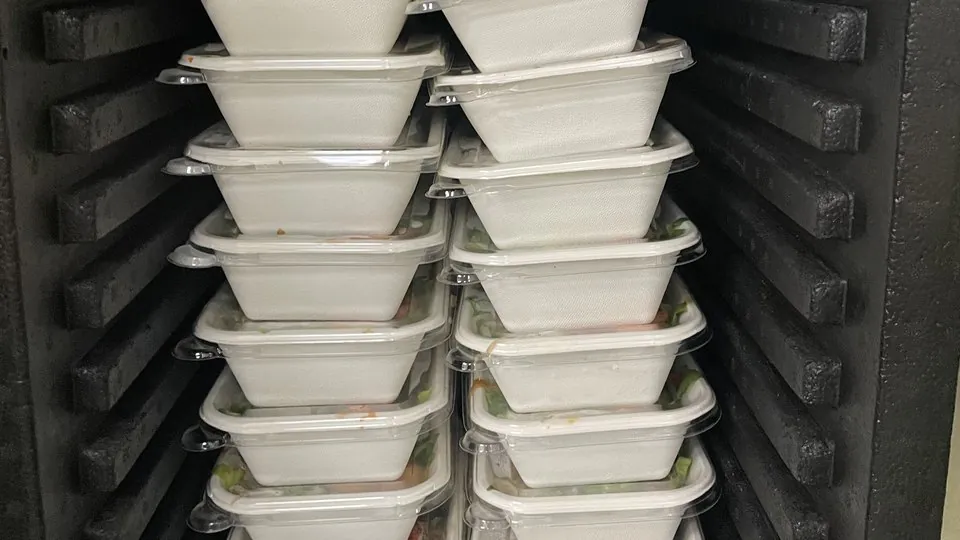
Keep what nobody touched apart from the line. Of the four words, packaging and condition are the two you control after delivery. A sealed box leaves the room in the packaging it arrived in. Pull any untouched trays aside when lunch starts rather than when it ends, and they stay in the best condition you can offer a nonprofit.
Choose sealed, labeled formats when turnout is a guess. An all-hands with remote attendance, a training day with walk-ins, a client event with an uncertain RSVP list: these are the orders most likely to leave surplus. Boxed lunch catering arrives one meal per container with a label on the lid, which carries part of the labeling half of the definition with it. Our comparison of boxed lunches, buffets and family style covers the rest of that trade.
Line up the nonprofit before the event. The Act covers the donation. It does not find a recipient. Ask a local food bank or food rescue group what it accepts, whether it collects from offices, and what it needs to know about each item. Keep the answer with your event notes so the next order starts from it.
Tell the recipient the truth about each tray. Subsection (e) makes that the donor’s part. A short note that separates sealed boxes, untouched trays and anything served from is the whole job.
Ask your catering partner. It is on both lists, so the direct route the Act describes may be open to it when it is closed to you. Ask whether it has a donation route of its own before you assume the leftovers are yours to place.
Order closer to the count you expect. The cheapest surplus to manage is the surplus you never bought. Our guides to budgeting for office catering and last-minute ordering cover the headcount side.
What this page is not
It is not legal advice, and it draws no conclusion about any real donation. It reports what one federal statute says, and subsection (f) is a reminder that State and local health regulations still apply alongside it. States also have food donation laws of their own, and those can differ from the federal text.
It is also not a tax page. A donation can raise a separate tax question, and that belongs to your tax adviser. Other federal rulebooks touch the same lunch for other reasons, and our guides to employer-provided meals and the FLSA and workplace dietary accommodation each read one of them.
Where Zerocater fits
Zerocater handles the ordering half. For ongoing corporate catering, Zerocater manages the rotation across a network of local catering partners, and every order arrives from a partner that already works with offices. For a one-off event, CaterAi drafts a menu from a plain description of the event. Tell it the format you want, boxed or buffet, and the menu starts from that.
The donation half stays with you and the nonprofit you choose. The statute gives that half a clear shape: sealed where you can, honest about the rest, and routed through an organization built to receive it.
Plan office lunch catering with CaterAi
Frequently Asked Questions
Is an office covered when it gives leftover catering to a food bank?
The federal Act describes that exact route. Subsection (c)(1) says a “person” who donates apparently wholesome food in good faith to a nonprofit organization, for ultimate distribution to needy individuals, shall not be subject to civil or criminal liability arising from the “nature, age, packaging, or condition” of the food. The definition of person starts with corporation, partnership, organization and association, so a company fits the words. The one exception is gross negligence or intentional misconduct. Whether a real donation meets every condition is a question for your own counsel, and state law can add rules of its own.
Can we hand leftovers straight to people who need them?
The Act describes that route in (c)(3), and it describes it for a “qualified direct donor” only. Subsection (b)(12) defines that term as nine types: retail grocer, wholesaler, agricultural producer, agricultural processor, agricultural distributor, restaurant, the “caterer”, school food authority and institution of higher education. An office is not one of the nine. The route the text gives an office runs through a nonprofit organization. Your catering partner may sit on the nine-type list, which is worth a question when you order.
Does the food have to look perfect to be donated?
No. The definition of apparently wholesome food in (b)(2) says the food can be donated “even though the food may not be readily marketable due to appearance, age, freshness, grade, size, surplus, or other conditions”. Surplus is on that list by name. The same sentence asks that the food meet “all quality and labeling standards imposed by Federal, State, and local laws and regulations”, so the look can be imperfect while the standards still apply in full.
What if some of the food was opened or served from?
Subsection (e) covers food that does not meet every standard. The donor stays inside the Act if the nonprofit is told about the “distressed or defective condition”, agrees to recondition the food before it goes out, and knows the standards well enough to do that. Only the first of those three is your job: tell the nonprofit what each tray has been through, and let it decide what it will take.
Can the nonprofit charge for the food it passes on?
It can charge a good Samaritan reduced price. Subsection (b)(6) defines that as a price no greater than the cost of handling, administering, harvesting, processing, packaging, transporting and distributing the food. The direct route in (c)(3) does not carry the same option. There the text says “at zero cost” and stops.
Is the charity’s driver covered when collecting at our office?
Subsection (d) speaks to that. A person who allows the collection of donations on property it owns or occupies, by gleaners or by paid or unpaid representatives of a nonprofit organization, shall not be subject to civil or criminal liability for the injury or death of that gleaner or representative, again with the gross negligence and intentional misconduct exception. The words are “owned or occupied”, so the clause is written to reach a tenant as well as an owner.
Does the federal Act replace local health rules?
No, and it says so. The last sentence of subsection (f) reads: “Nothing in this section shall be construed to supercede State or local health regulations.” The spelling is the statute’s own. The rules that governed the food when your catering partner delivered it still govern it when it leaves your office. Our guide to office catering permits reads that side of the question.