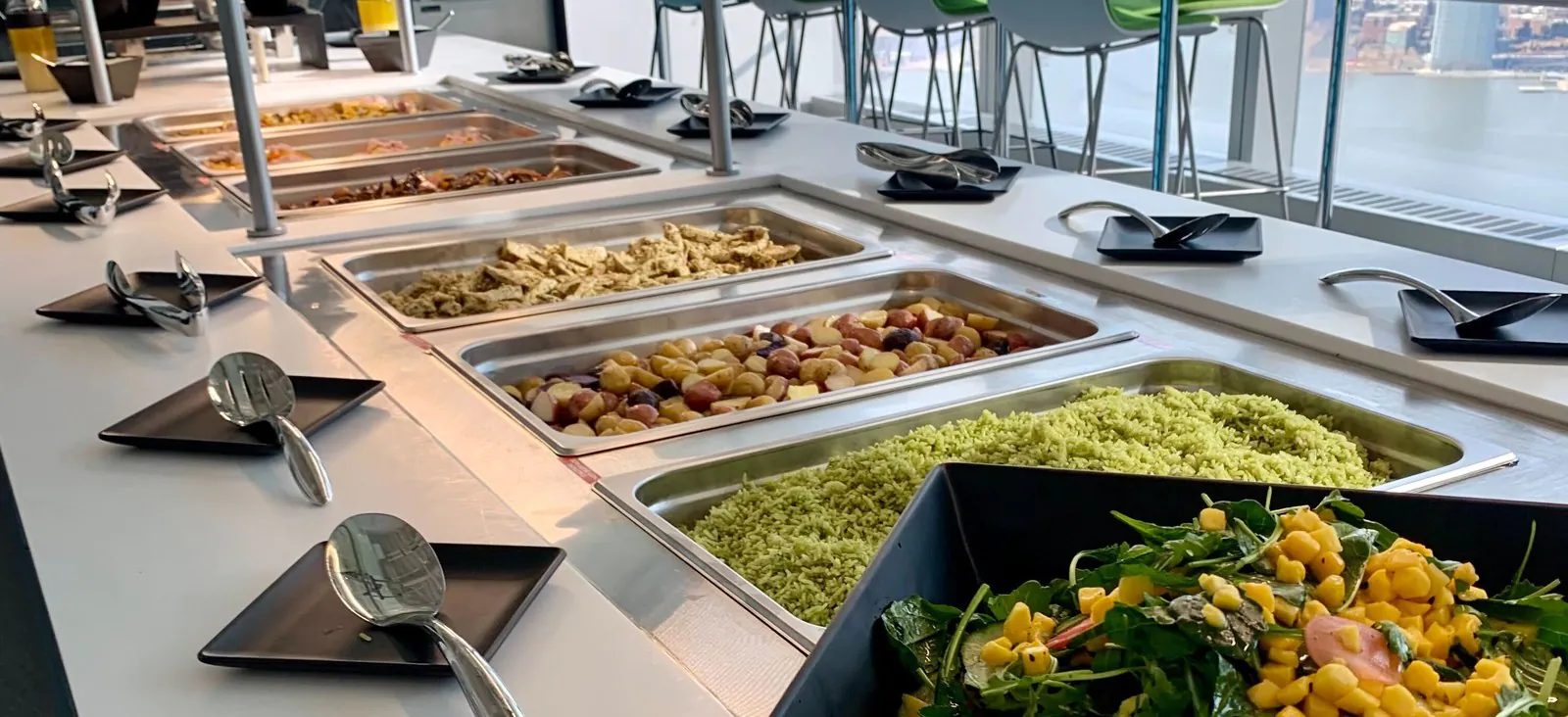
Your office orders lunch every Tuesday. Nobody pays for it, nobody signs for it, and it has never appeared on anyone’s payslip. Somewhere in a filing cabinet there is an invoice, and that invoice is the only paper trail the arrangement has.
Federal wage law has a view about that lunch. It is not the view most people expect, and it is written down in a part of the Code of Federal Regulations that almost nobody who books catering has read. The rules sort workplace perks into two lists by asking a single question about each one: who is it for? Uniforms land on one side. Lunch lands on the other, by name.
In this guide
- The question the Act asks about a lunch
- Two lists, and the count on each side
- The sentence at the end of the employer’s list
- The two items that sit on both lists
- Three conditions before a meal counts as pay
- Given on top, or taken out: the same section
- Where a free lunch lands
- Supper money, and the ask that changes the answer
- The week the whole thing switches off
- What this changes about the order you place
This guide reads published regulations and stops at what they say. It gives no legal advice, it cannot see your workforce or your state, and every decision it describes belongs to your own counsel and the people who run your payroll. State law can go further than the federal floor described here. Our corporate catering and how it works pages cover the ordering side.
The question the Act asks about a lunch
The Fair Labor Standards Act sets a minimum wage and an overtime rate. To do that it needs a definition of what counts as wages, and one clause of that definition reaches past cash. The Act lets an employer count “the reasonable cost to the employer of furnishing such employee with board, lodging, or other facilities” as part of the wage it pays.
Three words there carry the weight. Part 531 of Title 29 is the regulation that unpacks them, and the phrase it keeps returning to is “other facilities”. A meal is not board and it is not lodging, so the whole question for an office lunch is whether it is a facility.
Section 531.32(a) opens with the test in one line. “Other facilities”, it says, “must be something like board or lodging”. Then it gives examples, and the examples are where the argument lives.
Two lists, and the count on each side
The regulation builds two rosters. One holds things furnished “primarily for the benefit or convenience of the employer”, and section 531.3(d)(1) says the cost of those “will not be recognized as reasonable and may not therefore be included in computing wages”. They can never be part of anybody’s pay.
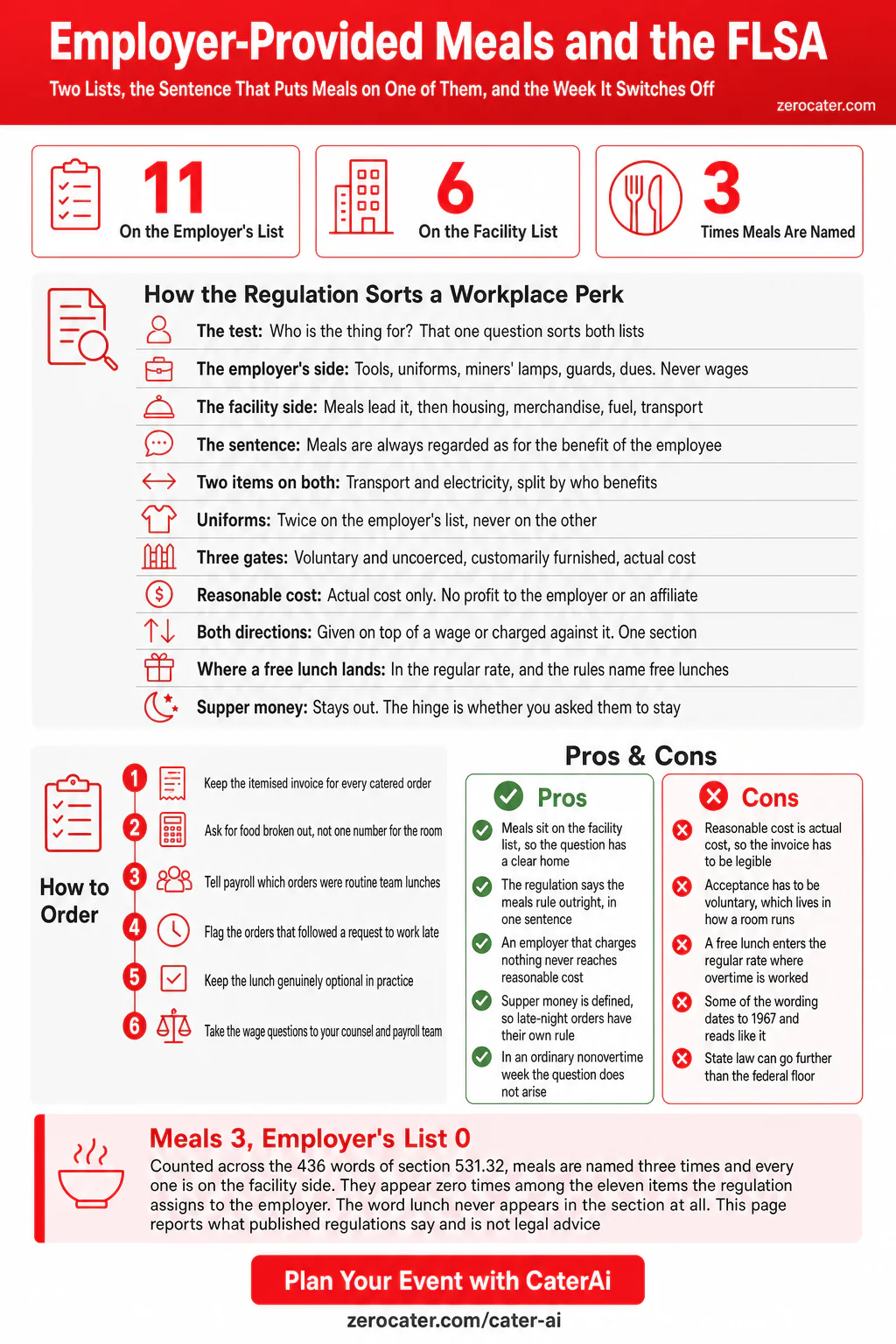
Section 531.3(d)(2) starts that roster with three entries: tools of the trade and materials incidental to the business, construction by and for the employer, and uniforms and their laundering where the business requires one. Section 531.32(c) then adds eight more, which brings the employer’s side to 11 items. Miners’ lamps are on it. So are company guards, insurance on buildings nobody lives in, and chamber of commerce dues.
The other roster is section 531.32(a), the things that are facilities and so may count as wages. It runs to six entries: meals at company restaurants or cafeterias, meals and rooms and tuition furnished by a college to its student employees, housing, general merchandise at company stores, household fuel and utilities for personal use, and transportation between home and work in certain conditions.
Some of this language is old, and the part carries a 1967 source note to prove it. The examples reach for mining and railways because that is the economy the drafters could see. The test underneath them has not moved.

The sentence at the end of the employer’s list
Section 531.32(c) spends its entire length naming things that belong to the employer. It works through the mining gear, the guards, the taxes, the dues, the rented uniforms, the workers’ compensation medical care. Then it stops and turns around.
“On the other hand, meals are always regarded as primarily for the benefit and convenience of the employee.”
One sentence, at the end of the paragraph that exists to list the other side. The regulation could have left meals off both lists and let the test sort them case by case. It chose to say so outright.
Meals 3, employer’s list 0. Across the 436 words of section 531.32, meals are named three times, every one of them on the facility side. The word “lunch” never appears in the section at all.
Count where meals show up and the pattern holds. They lead the facility list at 531.32(a). They appear again in the college entry two lines later. They appear a third time inside the company-store entry, which names “articles of food” among the general merchandise. On the employer’s 11 items they appear zero times.
The two items that sit on both lists
Two commodities appear on both rosters, and comparing their two entries shows you the test working.
Transportation is a facility when an employer furnishes it “between their homes and work where the travel time does not constitute hours worked compensable under the Act and the transportation is not an incident of and necessary to the employment”. Four lines later, transportation is an employer-benefit item “where such transportation is an incident of and necessary to the employment”, with a railway maintenance crew as the example.
Electricity splits the same way. On the facility list it is electricity “furnished for the noncommercial personal use of the employee”. On the employer list it is “electric power (used for commercial production in the interest of the employer)”. Identical commodity, opposite answer, and the only thing separating the two entries is who it is for.
Uniforms show the mirror case. They appear twice, and both times on the employer’s side: purchase and laundering at 531.3(d)(2)(iii), rental at 531.32(c). Nothing pulls them across. Meals are that pattern inverted, three appearances on one list and none on the other.
Set up a weekly team lunch with CaterAi
Three conditions before a meal counts as pay
Landing on the facility list makes a meal eligible, not automatic. Three sections set conditions, and each one is short enough to read in full.
It has to be accepted freely. Section 531.30 says the reasonable cost may count as wages “only where customarily ‘furnished’ to the employee”, and then raises the bar: “Not only must the employee receive the benefits of the facility for which he is charged, but it is essential that his acceptance of the facility be voluntary and uncoerced.”
It has to be customary. Section 531.31 treats that as satisfied if the employer furnishes the facility regularly, or if the same or similar facilities are customary among other employers in the same trade and community. The section closes with a condition that reaches outside itself: facilities furnished in violation of any federal, state or local law “will not be considered facilities ‘customarily’ furnished”. A catering partner’s own licensing sits behind that line.
The figure has to be actual cost, with nothing added. Section 531.3(a) caps reasonable cost at “not more than the actual cost to the employer”. Paragraph (b) is one sentence long and removes any doubt: “Reasonable cost does not include a profit to the employer or to any affiliated person.” Section 531.33(b) then defines affiliated, naming close relatives, partners and officers, connected corporations and agents of the employer.
Given on top, or taken out: the same section
Read the first two gates and you may assume the whole part is about employers who charge for food. Section 531.29 blocks that reading in two sentences.
The section applies where facilities are furnished in addition to a stipulated wage, and where charges for them are taken out of a stipulated wage. Its second sentence explains why: the word “furnishing” and the legislative history show the section was meant to apply “to all facilities furnished by the employer as compensation to the employee, regardless of whether the employer calculates charges for such facilities as additions to or deductions from wages”.
An office that buys Tuesday lunch and charges nobody is doing the first thing. It is inside the section.
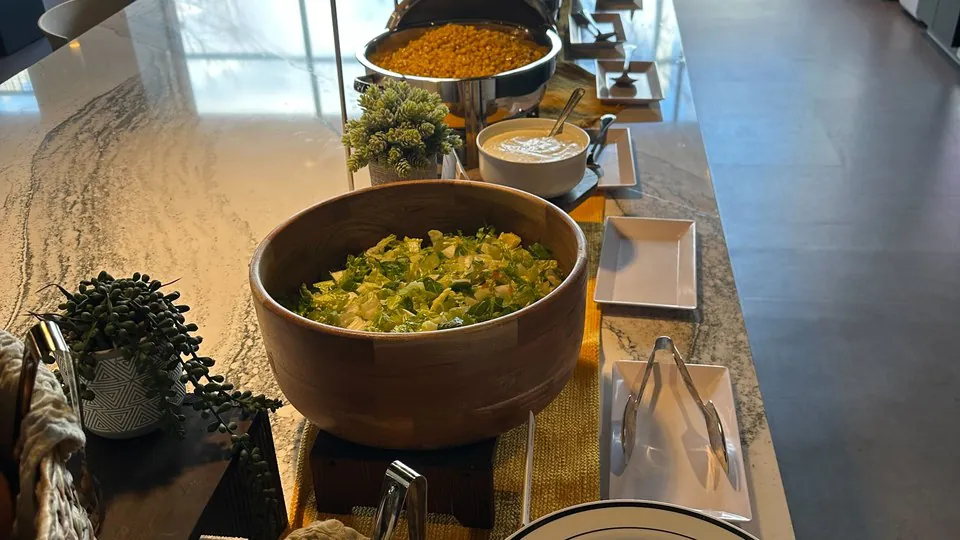
Where a free lunch lands
Section 531.37(b) handles the addition side. “Where board, lodging, or other facilities are customarily furnished as additions to a cash wage, the reasonable cost of the facilities to the employer must be considered as part of the employee’s regular rate of pay.”
The regular rate is the figure overtime pay is calculated from. Section 778.116 says the same thing from the overtime part of the regulations, and uses lodging as its worked example: furnish it in addition to cash wages and its reasonable cost gets added to those wages before the regular rate is worked out.
Then section 778.217 names the meal. Paragraph (d) lists expenses an employee normally incurs for their own benefit and puts “buying lunch” in the middle of that list, beside travel to work and rent. It goes on: whether the employer reimburses those expenses “or furnishes the facilities (such as free lunches or free housing)”, the amount “enters into the regular rate of pay”.
That is as close as a federal regulation comes to naming the Tuesday order. Whether it changes a number for any real person depends on whether that person works overtime in the same week, and that arithmetic belongs to your payroll team.
Supper money, and the ask that changes the answer
The same section that puts lunch inside the regular rate keeps a different meal outside it.
Paragraph (b) of section 778.217 gives five illustrations of reimbursement that stays out of the regular rate. Tools bought for the employer are the first. Uniform costs are the second. Travel on the employer’s business is the third. Fourth is supper money, which the regulation defines as “a reasonable amount given to an employee, who ordinarily works the day shift and can ordinarily return home for supper, to cover the cost of supper when he is requested by his employer to continue work during the evening hours”.
Set the two paragraphs side by side. Ordinary lunch is a normal everyday expense of the employee, so covering it enters the regular rate. Supper on a night the employer asked somebody to stay is an expense incurred for the employer, so covering it does not. The food can come from the same kitchen in the same boxes. What moves it between the two paragraphs is whether the employer made the request.
Paragraph (c) adds the limit on that. Only the actual or reasonably approximate amount of the expense is excludable, and if a reimbursement is “disproportionately large” the excess goes back into the regular rate. Our guide to last-minute ordering covers the practical side of a meal nobody planned for.
The week the whole thing switches off
Section 531.36(a) describes an ordinary week, the kind your Tuesday order already sits inside, and then removes the question from it.
Picture an employee who works a nonovertime week at a cash rate of at least the applicable minimum wage, receives that amount free and clear at the end of the week, and is also furnished facilities. The regulation says “no consideration need be given to the question of whether such facilities meet the requirements of section 3(m) and this part, since the employee has received in cash the applicable minimum wage for all hours worked”.
The protection has nothing left to protect. Section 531.28 explains the design behind that: the intention was to shield the basic minimum wage and overtime pay “from profiteering or manipulation by the employer”, and the limits exist to stop a facility being used to avoid the obligation rather than to stop facilities being furnished at all.
Section 531.35 states the underlying rule in a single phrase. Wages count as paid only where they are “paid finally and unconditionally or ‘free and clear'”, and the section treats anything that flows back to the employer as a kickback whether it is in cash or in kind.
One more line worth knowing sits nearby. Section 531.34 says scrip, tokens, credit cards, coupons “and similar devices are not proper mediums of payment under the Act”, while permitting the same devices for “conveniently and accurately measuring wages earned or facilities furnished during a single pay period”.
This is not the tax question
Two different rulebooks ask questions about the same lunch and both use the word deduction, which is how the two get mixed up.
The Fair Labor Standards Act asks what goes into somebody’s pay. A deduction there is a charge taken out of a stipulated wage, and everything on this page is about that. The Internal Revenue Code asks a separate question about what an employer may claim on its own return, on its own documents, with its own rates. Our guide to office catering tax treatment covers that one, and nothing here speaks to it.
The Wage and Hour Division publishes the FLSA side. It is the right place to start if you want the statute rather than the regulation.
What this changes about the order you place
Very little, which is the honest answer, and the small part that does change is worth building into the habit.
Keep the itemised invoice. Every question on this page begins with what the food cost and who paid it, and reasonable cost under section 531.3 is an actual-cost figure. An invoice that says one number for forty people answers less than one that breaks out the food.
Tell your payroll team which orders were routine and which followed a request to stay late. That is the distinction section 778.217 draws, and nobody downstream can reconstruct it from a delivery receipt.
Keep the lunch optional in practice. Section 531.30 is the only one of the three gates that lives in how a room runs rather than in a document, and a lunch nobody is pressured to take is the easy version of it.
Zerocater handles the ordering half of that. You get a single network to order from, an itemised invoice per order, and a menu built per event rather than per contract, which is what makes the record legible later. CaterAi drafts the menu from a plain description of the event, and our guides to budgeting for office catering, boxed lunch formats and mixed dietary needs cover the rest of the order. If your team sits in a setting with its own rules on top, our government office, construction site and coworking guides pick those up.
Start a catering order with CaterAi
Frequently Asked Questions
Is a free office lunch part of an employee’s wages?
The regulation treats it as capable of being part of wages, which is not the same as saying it always is. Section 531.32(a) lists the things that count as “other facilities”, and meals sit at the top of that list. Section 531.32(c) closes by saying meals “are always regarded as primarily for the benefit and convenience of the employee”. From there three conditions in sections 531.30, 531.31 and 531.3 decide whether a particular meal counts, and section 531.36 describes a common week where the question never has to be asked. Your own payroll team and counsel own the answer for your business.
Does a catered lunch change anybody’s overtime pay?
The documents say where to look. Section 531.37(b) states that facilities customarily furnished “as additions to a cash wage” must be considered part of the employee’s regular rate of pay, and section 778.116 repeats that from the overtime side. The regular rate is the figure overtime pay is built on, so it matters in a week where somebody works overtime and does nothing in a week where nobody does. The arithmetic for any real person belongs to the people who run your payroll.
What does “reasonable cost” mean here?
Section 531.3 defines it as “not more than the actual cost to the employer” of the facilities customarily furnished, and adds in its own next line that reasonable cost “does not include a profit to the employer or to any affiliated person”. Section 531.33(b) then explains who counts as affiliated, naming close relatives of the employer, partners and officers, connected corporations and agents. An employer that charges nothing for the food never reaches the question.
Our people are never charged for lunch. Does any of this reach us?
Section 531.29 answers that directly and it is one of the shorter passages in the part. The section applies “regardless of whether the employer calculates charges for such facilities as additions to or deductions from wages”. A lunch given on top of somebody’s pay is inside the same section as a lunch charged against it. The practical reach then runs through the regular rate rather than through any charge, which is what section 531.37(b) and section 778.116 are about.
What is supper money, and why is it treated differently?
Section 778.217(b) gives five illustrations of reimbursement that stays out of the regular rate, and the fourth is supper money. The regulation defines it as a reasonable amount given to somebody “who ordinarily works the day shift and can ordinarily return home for supper” when that person is “requested by his employer to continue work during the evening hours”. Paragraph (d) of the same section puts ordinary lunch on the other side, naming “buying lunch” as a normal everyday expense of the employee. The food can be identical. The difference the regulation draws is whether the employer asked somebody to stay.
Is there a week where none of this has to be worked out?
Yes, and section 531.36(a) describes it. Where an employee works a nonovertime week and receives at least the applicable minimum wage in cash free and clear, the regulation says “no consideration need be given to the question of whether such facilities meet the requirements of section 3(m) and this part”. The whole apparatus switches off, because the thing it protects has already been paid.
Does this have anything to do with what the meal costs us at tax time?
No, and the two questions are worth keeping apart because they use the same word for different things. The Fair Labor Standards Act asks what goes into somebody’s pay. The Internal Revenue Code asks what an employer may claim on its own return. Our guide to office catering tax treatment covers that second question on its own documents, and nothing on this page speaks to it.
Does the employee have to accept the meal?
Section 531.30 puts it plainly: not only must the employee receive the benefit of the facility, “it is essential that his acceptance of the facility be voluntary and uncoerced”. Section 531.31 adds the second half of the same gate, that the facility has to be “customarily” furnished, which it satisfies if the employer furnishes it regularly or if similar facilities are customary in the same trade and community. The same section ends by noting that a facility furnished in violation of a law is not customarily furnished, which is where a catering partner’s own licensing sits.
What should we actually do differently when we order?
Three habits cover most of it and none of them needs a legal judgment. Keep the invoice, because every question on this page starts with what the food cost and who paid it. Tell your payroll team when a lunch is routine and when it is a late-night order tied to a request to stay, since the regulation treats those two differently. And keep the lunch genuinely optional, because the voluntary-and-uncoerced line in section 531.30 is the one condition that lives in how you run the room rather than in a document. A catering partner that works with offices will give you a clean itemised invoice without being asked.