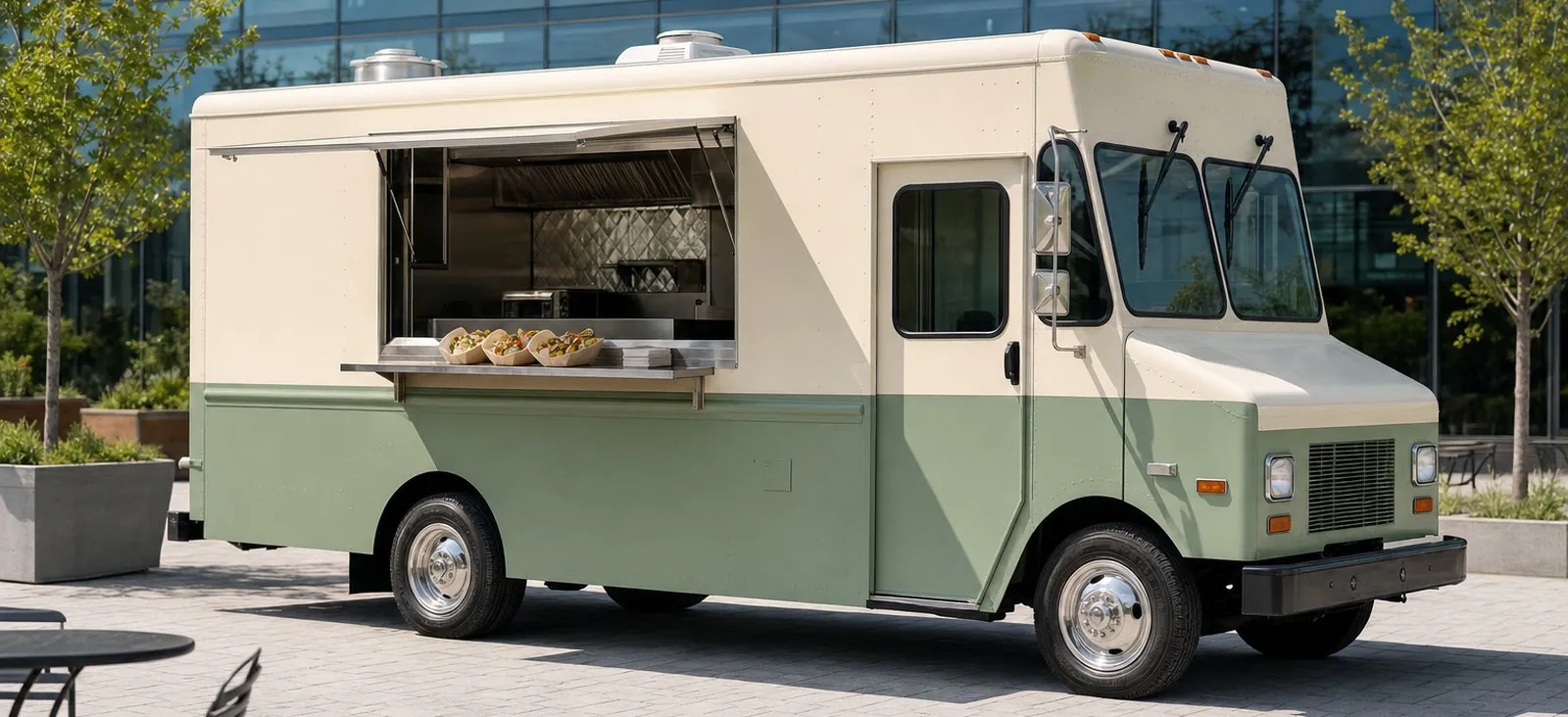
A food truck can turn a company picnic, an office party or a client appreciation day into the part of the event people remember. It also brings planning work that a normal catering order does not: a place to park, permits, a serving window and a minimum spend. Most of that work lands on the person who books the truck.
This guide covers how to hire a food truck for a company event: when a truck fits, where it can park, how many trucks you need, what it costs, and the questions to ask before you book. It ends with food truck menus that you can order as drop-off catering.
In This Guide
When a Food Truck Fits a Company Event
A food truck works best when the event happens outside, runs long enough for a line to move, and has a spot where a truck can legally park close to your guests. That describes a lot of summer and outdoor events:
- Company picnics and field days. The truck is the kitchen and the serving line in one, so you do not need chafing dishes or a buffet table. Our company picnic planning guide compares the truck with the other outdoor formats.
- Office parties and team celebrations in a parking lot, courtyard or plaza, where people stand around and talk while they wait.
- Customer appreciation days, recruiting events and open houses, where a line at a truck gives guests a reason to stay.
A truck is a harder fit in these cases:
- The event is indoors on an upper floor. Every guest has to leave the building, wait in line and come back.
- The whole team has to eat inside a short lunch break. A truck usually cooks to order, so a large group in a short window means a long line or more trucks.
- There is no weather plan. Rain or heat hits the line first, because guests wait outside.
- You need a labeled meal for each guest. Individual dietary needs are easier to manage when each person’s meal arrives packed and labeled.
If the event is outdoors but the truck itself is not the point, company picnic catering from local catering partners can cover the same crowd with boxed meals or buffet trays.
Start With Where the Truck Will Park
Settle the parking spot before you compare menus. A great truck with nowhere to park is not an option, and the answer usually comes from someone other than the truck.
If the truck parks on private property
An office parking lot, a campus plaza or a private driveway needs the owner’s permission. If you lease your office, ask the property manager before you ask the truck. The lot, the loading dock and the sidewalk may not be yours to offer. Get the permission in writing, and ask whether the building has rules on generators, cooking or the hours a vehicle can stay.
If the truck parks on a public street
Street rules come from the city, and they differ from one city to the next. Parking limits, meters and permits for serving food on the street all apply. Ask the truck whether it can serve at your address and which permits it needs for that spot. A truck that works in your area often knows the answer.
If the event is at a venue
The venue’s own policy comes first. Some venues pick the food for you, and some ask every outside food business for insurance paperwork. Our guide to venue catering rules explains the policies and how early you have to decide.
The physical checks
- Space. Ask for the truck’s length and height, then add room for the line and for the service window side of the truck.
- Access. Check the route in: gates, low garage ceilings, tight turns and tree branches.
- Ground. The truck needs a level, firm surface.
- Noise and fumes. Ask whether the truck runs on a generator. Keep it away from open windows, air intakes and the area where people sit.
- Distance. Put the truck close to where guests gather. A long walk shrinks the crowd at the window.
How Many Food Trucks You Need
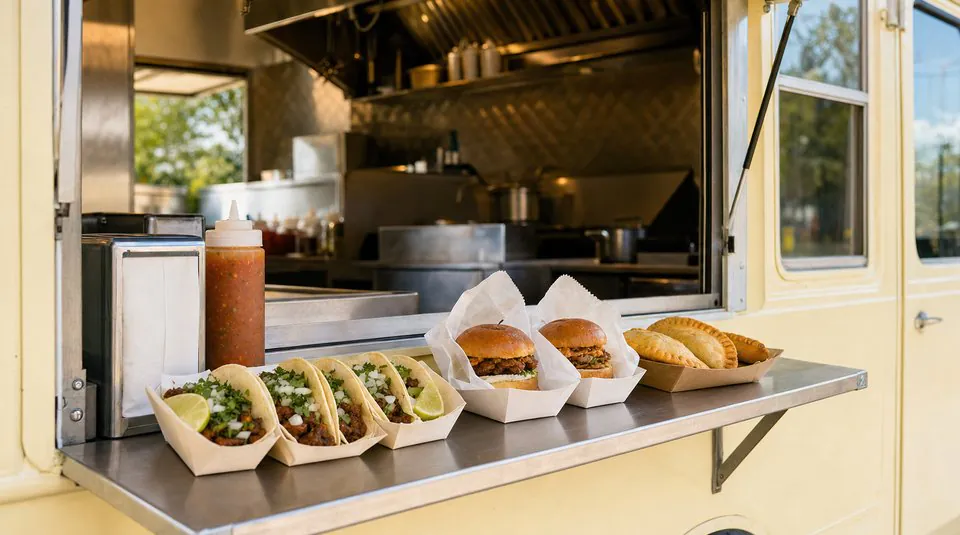
There is no single number of guests per truck. Serving speed depends on the menu, the kitchen and the crew, so ask each truck for its own number. Then do the math yourself:
- Ask each truck how many meals it serves per hour at an event of your size, with the menu you plan to offer.
- Decide the service window. This is the time in which everyone has to eat, for example the lunch hour.
- Divide your headcount by the window. If 150 people will eat within one hour, you need trucks that together serve 150 meals an hour.
If one truck falls short, you have three options: add a second truck, make the window longer, or send teams out in waves. A short event menu also helps, because every extra choice at the window slows the line. Ask the truck which of its dishes are fastest to serve.
What It Costs to Rent a Food Truck for an Event
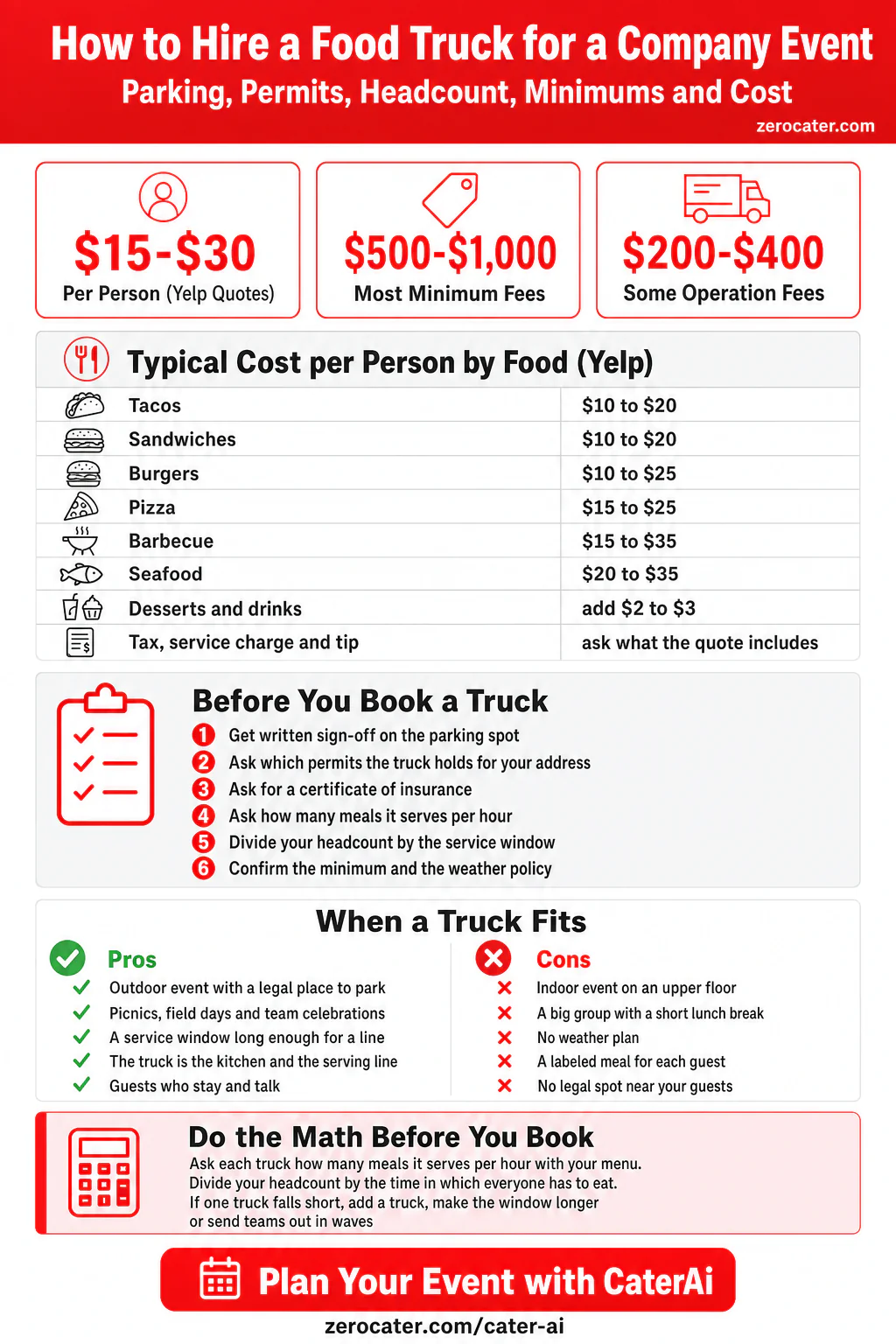
Food truck rental for an event is usually priced per guest, with a minimum spend. Yelp’s cost guide, which is built from real quotes from US businesses, puts food truck catering at $15 to $30 per person. By that range, 100 guests cost $1,500 to $3,000 before any fees.
The same guide breaks the price down by food:
| Food | Typical cost per person (Yelp) |
|---|---|
| Tacos | $10 to $20 |
| Sandwiches | $10 to $20 |
| Burgers | $10 to $25 |
| Pizza | $15 to $25 |
| Barbecue | $15 to $35 |
| Seafood | $20 to $35 |
The per-person price is only part of the quote. Ask about each of these:
- The minimum. This is the least the truck charges for the booking, even if fewer people eat. Most minimum fees in Yelp’s data fall between $500 and $1,000.
- Operation or travel fees. Some trucks add an operation fee of $200 to $400.
- Extras. Desserts and non-alcoholic drinks typically add $2 to $3 per person.
- Tax, service charge and tip. Ask which of these the quote already includes.
- Who pays. The company can pay a set price per person, or run an open tab with a cap, or guests can pay at the window. Tell the truck which one you want, because it changes the quote.
Plan company picnic catering with CaterAi
Questions to Ask Before You Book a Food Truck
Send the same list to every truck you consider. The answers make the quotes easy to compare, and a truck that answers fast and in writing is a good sign for the day of the event.
Paperwork
- Which permits and licenses do you hold for this city and this address?
- Can you send a certificate of insurance? Can it name our company or the property owner?
- Do you need anything from us, such as a signed permission letter from the property manager?
The site
- How much space do you need, including the line?
- Do you run on a generator, or do you need a power outlet?
- What time do you arrive, and how long does setup take?
- Who takes away the trash?
The food
- Can you run a short menu for the event?
- How many meals do you serve per hour with that menu?
- How do you mark allergens, and what can you serve vegetarian, vegan and gluten-free guests?
The money
- What is the minimum, and what happens if fewer people eat?
- Which fees are extra: travel, service charge, tax, tip?
- How much is the deposit, and what is the cancellation policy, including for bad weather?
- When do you need the booking, and when do you need the final headcount?
Food Truck Menus as Drop-Off Catering
When the food is the main draw, you can also order food truck favorites as drop-off catering. The catering partners below run food trucks, and on Zerocater their food arrives packed for your group. Most of them offer individual boxed meals, many also offer buffet trays, and some offer build-your-own bars. The largest group is in the San Francisco Bay Area. See every catering partner that runs a food truck on our food truck catering page.

- Tacos and burritos. Travieza Latin Flavors makes carne asada, al pastor and birria tacos. Isidro’s packs wet burritos as boxed meals. Bobcha SF fills its burritos with Korean BBQ, and Halal Fusionz serves nihari birria tacos on naan. For more choice, see taco catering from all our catering partners, or set up a build-your-own taco bar.
- Sliders. Curveball Sliders pairs its sliders with onion rings. STUF’d makes brisket and BBQ chicken sliders, and The Waffle Roost makes fried chicken sliders.
- Musubi and poke. Hapa Musubi makes Spam, chicken katsu and tofu katsu musubi, and Miss Subi packs musubi boxes. For poke, Fresh Catch Poke and Ocean Sushi offer poke bars, and Feisty Fish Poke makes poke bowls.
- Empanadas and pupusas. Yapa Empanadas packs empanada and salad boxed meals, and 5411 Empanadas makes Argentine empanadas. Pupusa Time and Rice Around the World both make Salvadoran pupusas.
- Dumplings. Hongry Kong and WoKitchen pack dim sum boxes with dumplings, siu mai and BBQ pork buns.
- Lobster rolls. Happy Lobster makes lobster rolls, with gluten-free rolls on the menu.
- Chicken and waffles. The Waffle and the Rooster serves a fried chicken and waffle breakfast, and The Waffle Roost packs chicken and waffle boxed lunches.
- Yakitori. Yakitori Harue packs chicken, shrimp and mushroom yakitori with fried rice as boxed meals.
If you are not sure which one fits, CaterAi can plan the menu around your headcount, your address and your team’s dietary needs. For food at the office every week, Zerocater runs office catering programs with a rotation of catering partners. See how it works.
Plan company event catering with CaterAi
Frequently Asked Questions
How much does it cost to rent a food truck for an event?
Yelp’s cost guide, built from real quotes from US businesses, puts food truck catering at $15 to $30 per person. Most minimum fees fall between $500 and $1,000, and some trucks add an operation fee of $200 to $400. By that range, 100 guests cost $1,500 to $3,000 before fees, tax and tip.
Do I need a permit to bring a food truck to my office?
It depends on your city and on where the truck parks. On private property, you need written permission from the property owner or manager. On a public street, city rules apply. Ask the truck which permits it holds for your address, and ask your property manager about building rules.
Can a food truck park in our office parking lot?
Only with permission from whoever controls the lot, which may be the property manager rather than your company. Also check the space the truck and the line need, the route in, a level surface, and any building rules on generators or cooking.
How many food trucks do I need for my event?
Ask each truck how many meals it serves per hour with your menu. Then divide your headcount by the time in which everyone has to eat. If 150 people will eat within one hour, you need trucks that together serve 150 meals an hour. If one truck falls short, add a truck, make the window longer or send teams out in waves.
What is a food truck minimum?
A minimum is the least a truck charges for a booking, even if fewer people eat. Yelp’s cost guide says most minimum fees fall between $500 and $1,000. Ask each truck what happens if your headcount drops below it.
Can I order food truck food as drop-off catering?
Yes. Several Zerocater catering partners run food trucks, and you can order their food as drop-off catering, packed as individual boxed meals or buffet trays. Menus include tacos, burritos, sliders, musubi, poke bowls, empanadas, pupusas, dumplings, lobster rolls and chicken and waffles.