The FDA publishes two documents that a pregnant reader brings to a lunch menu. One is a fish chart that sorts seafood by mercury into three columns. The other is a booklet with a table for eating out. Read either one next to an office catering menu and the menu holds up well. Salmon and shrimp, the two fish a catering order is most likely to carry, both sit in the chart’s first column.
One word needs a question. Tuna is the one word on a catering menu that sits in all three columns, and the menu line rarely says which tuna it means. This guide reads both FDA documents in catering terms: what the fish chart sorts, why the tuna line needs one question, the two other lines worth a look, and how to write the order so the menu answers for itself.
In this guide
- The two FDA documents
- The fish chart sorts by species
- The tuna question
- Salmon and shrimp carry the order
- Cooked is a second question
- Sprouts and eggs
- How to write the order
The two FDA documents
The first document is the FDA and EPA advice about eating fish. It sorts more than sixty kinds of fish and shellfish into Best Choices, Good Choices and Choices to Avoid by their mercury levels. For pregnancy and breastfeeding, it sets a serving at 4 ounces and advises “2 to 3 servings a week” from the Best Choices list, or one serving from the Good Choices list.
The second is the FDA’s food booklet for pregnant women, their unborn babies and children under five. Its section on eating out carries a two-column table headed “Make Safe Menu Choices”, with a higher-risk food on the left and a lower-risk version on the right. The same booklet tells a pregnant reader to contact a healthcare provider with any concern about food. That conversation decides what one person eats. The office decides what goes on the table.
The office’s part is the menu, and the menu does that job best when every line answers the question on its own. Nobody has to ask a coworker anything, and nobody eats from a separate plate. Our guide to workplace dietary accommodation covers the employer side. For a baby shower, the Zerocater baby shower catering page already lists four swaps for the party menu, starting with raw fish. This guide covers the everyday lunch order and the lines that page leaves for another day.
The fish chart sorts by species
The chart has no rows for dishes. It has no line for poke, sushi, fish tacos or a salmon bowl. It lists the fish by name, and each name sits in one column. So the useful question about a fish dish on a catering menu is which fish it holds.
| Fish you will see on a catering menu | Column on the FDA and EPA chart |
|---|---|
| Salmon, shrimp, cod, tilapia, crab, scallops, squid (calamari), catfish, clams, oysters, trout, sardines, anchovies | Best Choices |
| Canned light tuna (skipjack) | Best Choices |
| Albacore (white) tuna, canned or fresh | Good Choices |
| Yellowfin tuna | Good Choices |
| Halibut, mahi mahi, snapper, grouper, Chilean sea bass, rockfish | Good Choices |
| Bigeye tuna | Choices to Avoid |
| Swordfish, shark, king mackerel, marlin, orange roughy, tilefish from the Gulf of Mexico | Choices to Avoid |
| Yellowtail (hamachi), eel (unagi), bluefin tuna | Not on the chart |
Read the first row of the table again. Every fish in it is a Best Choice, and those fish fill most catering menus. The Choices to Avoid column is short and mostly holds fish that a lunch order rarely carries. Across the menus on Zerocater’s catering partner pages, two lines name a fish from that column: a swordfish kebab, and a tuna roll that offers bigeye or yellowfin. Three kinds of fish that do turn up, yellowtail, eel and bluefin tuna, are not on the chart at all, and the chart does not sort them.
The tuna question
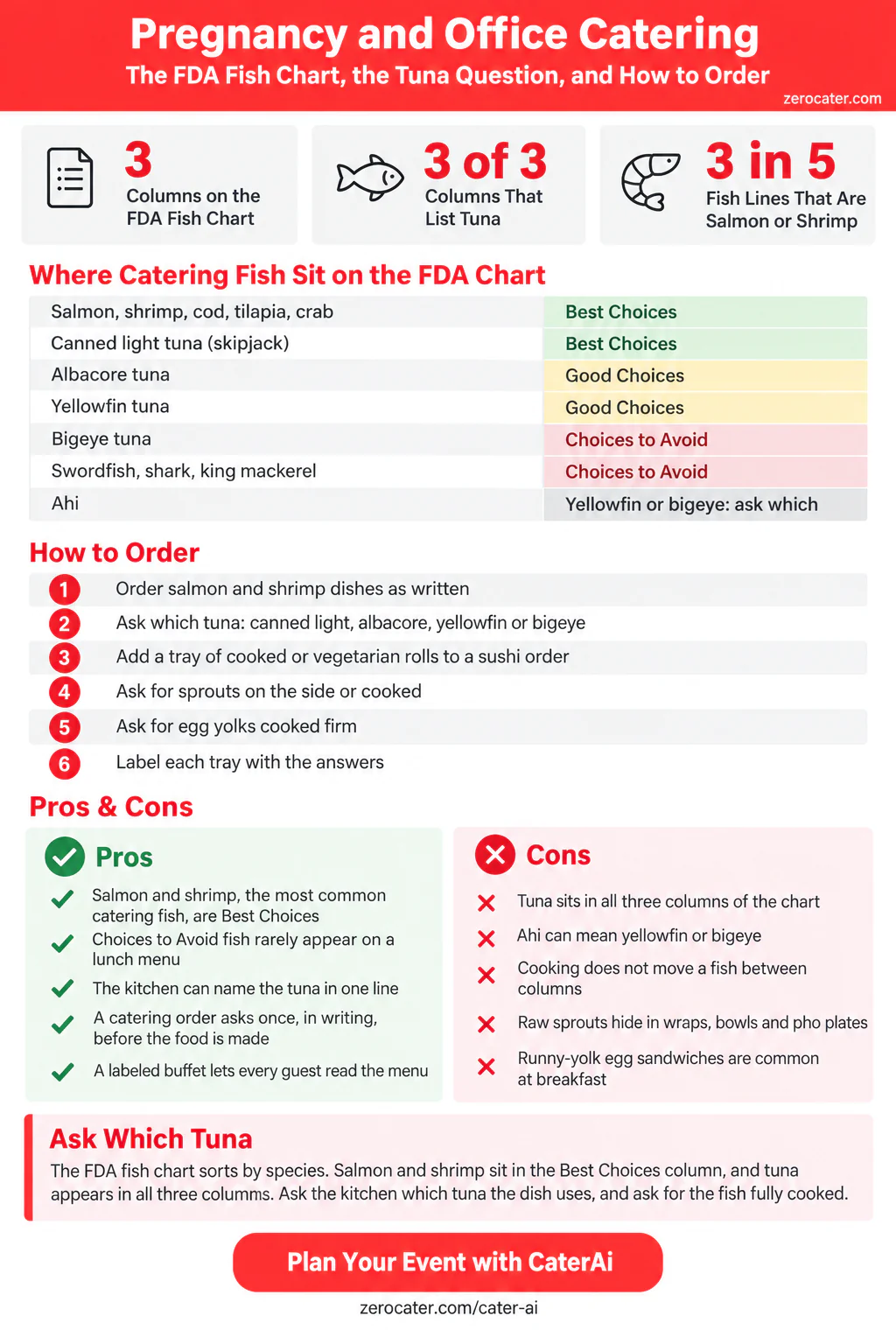
Tuna is the exception, because the chart lists it four times. Canned light tuna, which includes skipjack, is a Best Choice. Albacore, also sold as white tuna, canned or fresh, is a Good Choice, and so is yellowfin. Bigeye is a Choice to Avoid. One word on a menu can point at any of the three columns.
The word “ahi” adds one more step. NOAA Fisheries lists Pacific yellowfin tuna as also known as ahi, and Pacific bigeye tuna under the same name. So an ahi poke bowl or a seared ahi tray can be either a Good Choice or a Choice to Avoid, and the name on the menu does not say which.
We counted the fish on the menus that Zerocater’s catering partners list. Tuna or ahi appears on more than one fish line in five, which puts it with salmon and shrimp among the three most common fish words. Of those tuna lines, fewer than one in five names the species. And not one ahi line says yellowfin or bigeye. A catering menu names the dish, and the kitchen knows the fish. The species is a one-line question, and the kitchen that buys the tuna can answer it.
| What the menu line says | What the chart needs to know |
|---|---|
| Tuna salad, tuna melt, tuna sandwich | Canned light (Best Choices) or albacore (Good Choices) |
| Albacore tuna | Good Choices, already named |
| Ahi, ahi poke, seared ahi, spicy tuna roll | Yellowfin (Good Choices) or bigeye (Choices to Avoid) |
| Tuna steak, tuna tataki | Which species, and how far it was cooked |
Salmon and shrimp carry the order
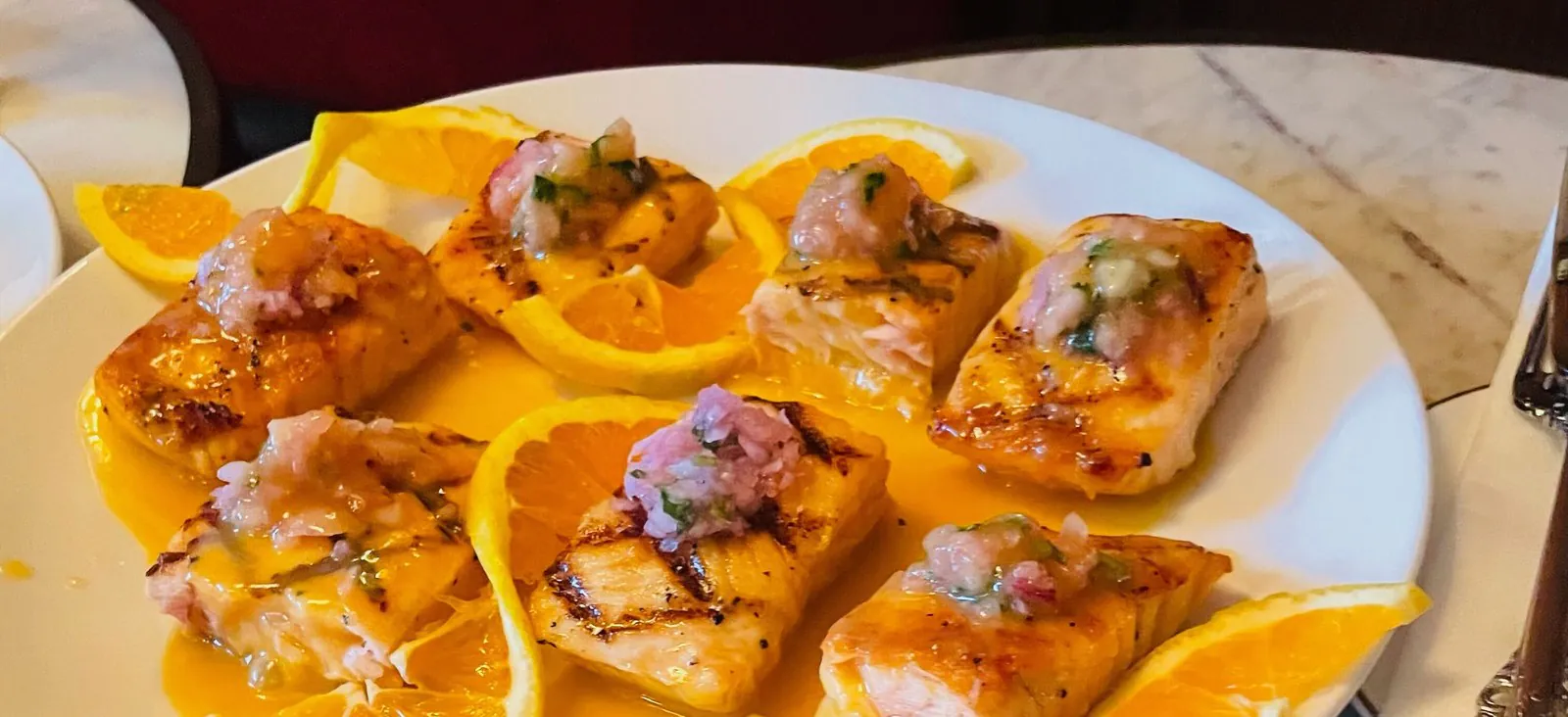
The same count shows where most of the fish sits. Salmon or shrimp appears on three fish lines in five, and both sit in the Best Choices column. A grilled salmon tray, a shrimp stir-fry, a fish taco bar built on cod or tilapia, a crab cake: each one is a Best Choice, and each one can go on the order as written.
That makes the fish plan for a recurring lunch short. Lead the seafood with salmon, shrimp or a white fish. When the menu has a tuna dish, ask which tuna. If the answer is bigeye, pick another dish for that day. Zerocater’s seafood boil catering page and its Japanese catering and Hawaiian catering pages list partners whose menus lean on these fish.
Cooked is a second question
The fish chart sorts by mercury, and cooking does not move a fish between its columns. The booklet’s eating-out table asks a different question. It puts “raw or undercooked fish, such as sashimi, non-vegetarian sushi, or ceviche” and refrigerated smoked seafood on the higher-risk side, and “fully cooked fish that is firm and flaky” on the lower-risk side. A rare-seared ahi steak meets both questions at once: which species, and how far it was cooked.
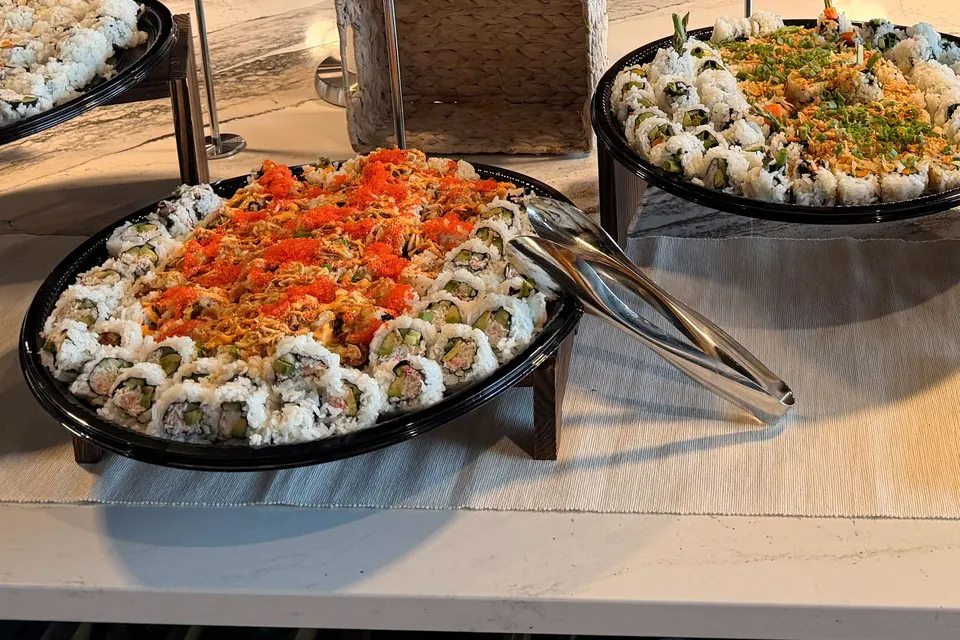
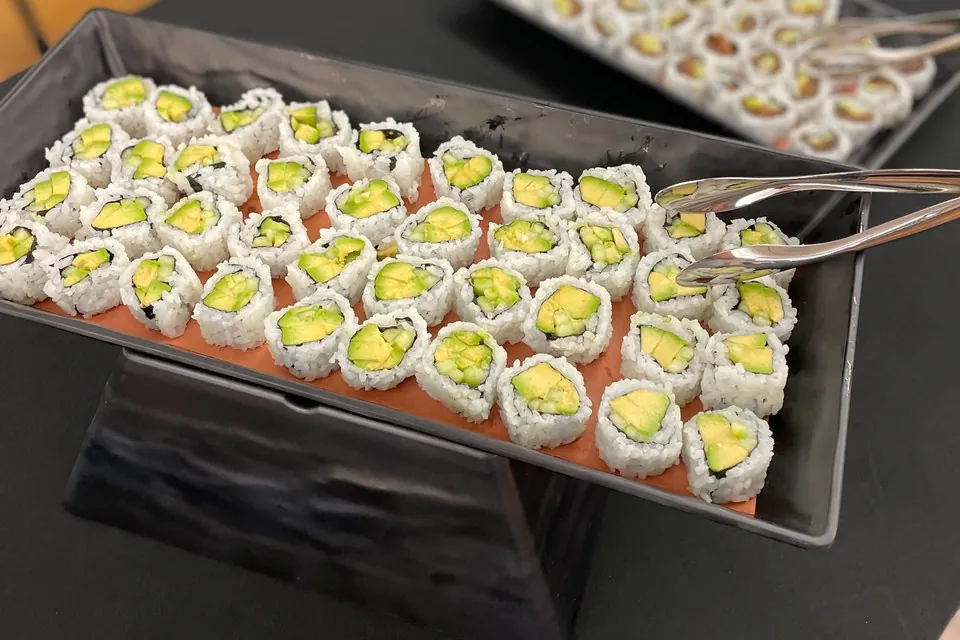
For a sushi or poke order, add a tray that answers both. Vegetarian rolls, cooked shrimp rolls and rolls built on cooked crab sit beside the raw ones, and a build-your-own poke bar can carry a cooked protein next to the raw fish. The sushi buffet page lists partners who build these platters for offices. The baby shower page linked above covers the raw-fish swap for a party in more detail.
Sprouts and eggs
The booklet’s eating-out table has seven rows, and two of them are easy to miss on a lunch menu. The first is sprouts. The table puts “salads, wraps, or sandwiches containing raw (uncooked) or lightly cooked sprouts” on the higher-risk side and the same dishes with cooked sprouts on the lower-risk side. On a catering menu, sprouts turn up on the herb plate that comes with pho, inside a banh mi or a spring roll, on a grain bowl and in a deli-style wrap. Ask for them on the side, or cooked into the dish. Our guide to ordering pho covers the garnish plate, and the Vietnamese catering page lists partners who send it.
The second is eggs. The table puts soft-boiled and over-easy eggs on the higher-risk side and “fully cooked eggs with firm yolk and whites” on the lower-risk side. That matters most at a breakfast meeting, where a runny-yolk egg sandwich is a common line. Ask for the yolks cooked firm. The booklet’s food chart adds one more egg line, homemade Caesar dressing, made with raw egg, and its advice for eating out is short: “Ask if pasteurized eggs were used.” Our office breakfast catering guide covers the rest of the morning order.
How to write the order
The booklet’s basic rule for ordering out fits a catering order word for word: “Ask whether the food contains uncooked ingredients such as eggs, sprouts, meat, poultry, or seafood. If in doubt, make another selection!” Its next line is to ask how the foods have been cooked. A catering order has one more advantage over a restaurant table. You ask once, in writing, before the food is made, and the answer arrives with the delivery.
| On the menu | The line to put on the order |
|---|---|
| Salmon or shrimp, cooked | Order as written |
| Anything named tuna or ahi | Which tuna is this: canned light, albacore, yellowfin or bigeye? |
| A sushi or poke platter | Which rolls are cooked or vegetarian? Add a tray of those |
| A salad, wrap, sandwich or pho plate with sprouts | Are the sprouts raw? Send them on the side or cooked |
| A breakfast egg sandwich or egg dish | Are the yolks cooked firm? |
| A Caesar salad | Is the dressing made with pasteurized eggs? |
Put the questions in the order notes, or ask them when you confirm the order. Then label the trays on the table with what the answers were: “salmon, grilled”, “shrimp rolls, cooked”, “sprouts on the side”. A labeled buffet lets every guest read the menu for themselves. Our guide to ordering catering for mixed dietary needs covers labels for the rest of the room.
Plan an office lunch with CaterAi
Keep hot food hot and cold food cold
The booklet’s party section gives two numbers for food on the move. Keep cold food at 40°F or below, and keep hot food at 140°F or above. For a delivered lunch, that means the chafing dishes stay lit until the last guest has eaten, and the cold trays stay on ice or in the refrigerator until the room arrives. Our company picnic guide covers the two-hour limit for food left out on the table.
Where Zerocater fits
A recurring lunch rotates through many partners and many menus, and the tuna line on Tuesday is a different tuna line from the one on Friday. For ongoing office catering, Zerocater manages that rotation across its local catering partners, and how it works covers the ordering side. The office lunch catering page lists the partners near you.
For a single lunch, CaterAi drafts a menu from a plain description of the event. Describe the lunch you want, then put the questions from the table above in the order notes for whichever dishes it picks.
Plan an office lunch with CaterAi
Frequently Asked Questions
Which fish on a catering menu sit on the FDA’s Best Choices list?
Salmon, shrimp, cod, tilapia, crab, scallops, squid, catfish, clams, oysters, sardines, anchovies, trout and canned light tuna all sit in the Best Choices column of the FDA and EPA fish chart. Salmon and shrimp carry most of the fish on catering menus, so most fish orders start in that column.
Why does the tuna on a catering menu need a question?
Tuna appears in all three columns of the chart. Canned light tuna is a Best Choice, albacore and yellowfin are Good Choices, and bigeye is a Choice to Avoid. NOAA lists ahi as a name for both yellowfin and bigeye, so a line that says ahi or tuna does not tell you which column it sits in. The kitchen can answer that in one line.
Does a cooked fish dish settle the question?
Cooking answers a different question. The FDA booklet puts raw or undercooked fish and refrigerated smoked seafood on its higher-risk side and fully cooked fish that is firm and flaky on its lower-risk side. The mercury chart sorts by species, and cooking does not move a fish from one column to another. Check both: the species and how it was cooked.
Which other menu lines are worth a second look?
Sprouts and eggs. The FDA eating-out table lists salads, wraps or sandwiches with raw or lightly cooked sprouts, and soft-boiled or over-easy eggs, on the higher-risk side. Its egg row names homemade Caesar dressing, and its advice when eating out is to ask if pasteurized eggs were used.
Should the office ask who is pregnant before ordering?
No. Order a menu whose lines answer the question for anyone who reads them, and serve that menu to the whole room. Our guide to workplace dietary accommodation covers the employer side.
Is this guide medical advice?
No. It reads two FDA documents and puts them into catering-order language. The FDA booklet tells a pregnant reader to contact a healthcare provider with any concern, and that conversation decides what one person eats.