Mirch Masala is a family-run North Indian restaurant on Broadway East in Seattle, and its catering menu is laid out the way most Indian menus are: a chicken section, a lamb section, a seafood section and a vegetarian section. Read the dish names across those sections, though, and you will see the same sauces come back again and again.
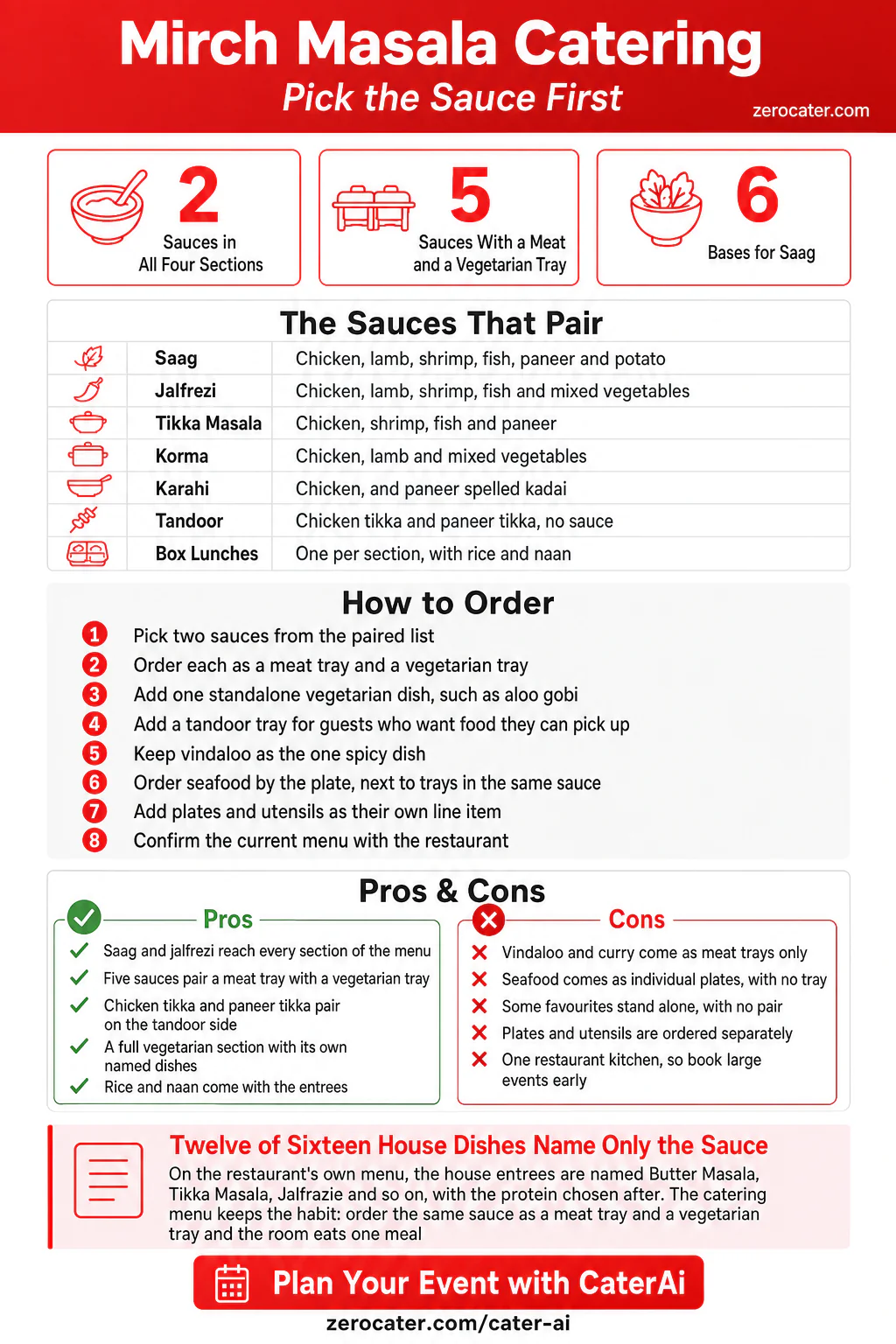
Saag appears on six different bases and jalfrezi on five. Two sauces run through all four sections. Five sauces come as both a meat tray and a vegetarian tray, which means you can order one dish twice, chicken saag next to saag paneer, and the whole room eats the same meal. Pick the sauce first. The protein is the second choice.
In this guide
- Why the sauce is the real choice on this menu
- The two sauces that run through every section
- The five sauces you can order as a matched pair of trays
- Where the pairing stops, and what to do instead
- How to order for a Seattle office
A family restaurant on Broadway East
Mirch Masala describes itself as a family owned and operated business that cooks a wide range of traditional Indian dishes, with an emphasis on North Indian classics. It is a sit-down restaurant first, with a dining room, a bar and space for private parties, and it cooks catering out of the same kitchen. The restaurant’s own site puts a Catering button in the main navigation, and that button opens its online catering listing.
North Indian food is a good fit for an office for plain reasons. The dishes are sauced, so they hold on a table. Rice and naan come with them, so nobody has to build a plate from parts. And the vegetarian side of a North Indian kitchen fills a full section of the menu with its own named dishes, from aloo gobi to baingan bhartha to dal makhani.
The sauce is the dish, and the protein is the second choice
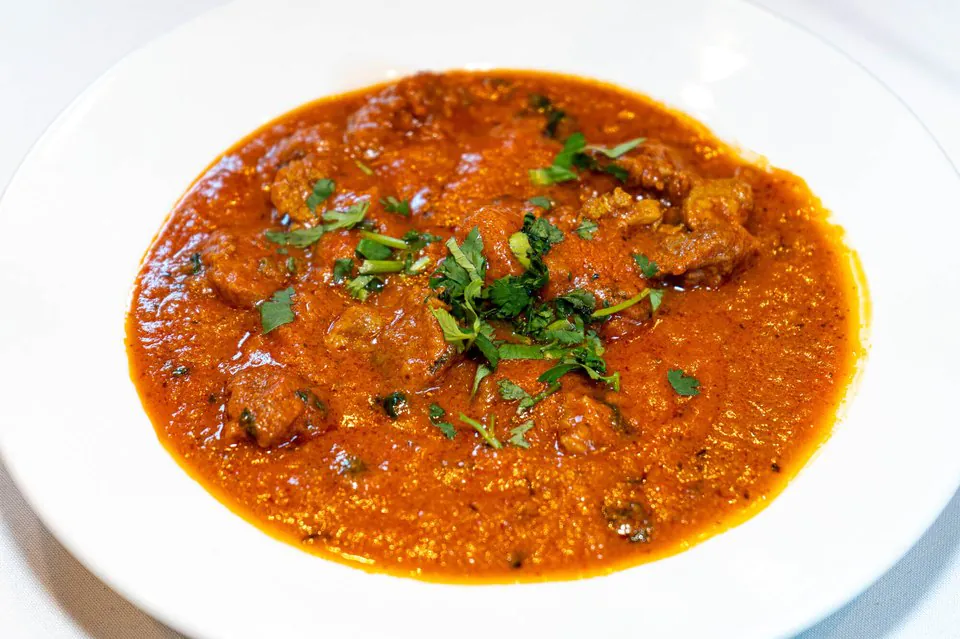
The clearest sign of how this kitchen thinks is on its dine-in menu. The section called Mirch Masala Entrees lists sixteen house dishes, and twelve of the sixteen carry no protein in the name at all. Butter Masala, Tikka Masala, Shahi Korma, Jalfrazie, Madras Curry, Palak Masala: each is a sauce, and the protein is a separate choice you make after it. The other four name a fixed protein, such as the goat curry and the rack of lamb chop masala.
The catering listing is written differently, one line per finished dish, so it reads Chicken Saag, Lamb Saag, Shrimp Saag and so on. But the same habit sits underneath it. Across the four entree sections there are seven sauces that repeat on more than one base, and they account for most of the entree lines. If you read the listing section by section, you see a long list. If you read it sauce by sauce, you see a short one, and the short one is easier to plan with.
Two sauces run through all four sections
Saag is the widest. It comes on six bases: chicken, lamb, shrimp, fish, paneer and potato. Jalfrezi comes on five: chicken, lamb, shrimp, fish and mixed vegetables. Those are the only two sauces that appear in the chicken, lamb, seafood and vegetarian sections alike, so they are the two that can cover any combination of guests from a single choice.
| Sauce | Chicken | Lamb | Seafood | Vegetarian | Bases |
|---|---|---|---|---|---|
| Saag | Yes | Yes | Yes | Yes | 6 |
| Jalfrezi | Yes | Yes | Yes | Yes | 5 |
| Tikka masala | Yes | No | Yes | Yes | 4 |
| Korma | Yes | Yes | No | Yes | 3 |
| Vindaloo | Yes | Yes | Yes | No | 4 |
| Karahi | Yes | No | No | Yes | 2 |
| Curry | Yes | Yes | No | No | 2 |
The rest of the grid is useful too. Tikka masala covers chicken, seafood and paneer. Korma covers chicken, lamb and vegetables. Vindaloo covers chicken, lamb and seafood. Karahi is on chicken and paneer, and the listing spells it two ways, karahi on the chicken and kadai on the paneer, for the same wok-cooked dish. If one of these is the sauce your office already likes, you can see at a glance which guests it can reach.
Five sauces come as a matched pair of trays
Trays are where the pattern pays off for a shared table. Five sauces come as both a meat tray and a vegetarian tray on the listing, so you can put the same dish out twice, once with meat and once without.
| Sauce | Meat trays | Vegetarian trays |
|---|---|---|
| Tikka masala | Chicken Tikka Masala | Paneer Tikka Masala |
| Karahi | Chicken Karahi | Kadai Paneer |
| Korma | Chicken Shahi Korma, Rack of Lamb Korma | Vegetable Korma |
| Saag | Chicken Saag, Lamb Saag | Saag Paneer, Saag Aloo |
| Jalfrezi | Chicken Jalfrezi, Lamb Jalfrezi | Vegetable Jalfrezi |
Ordering this way changes how the table looks. Put chicken saag and saag paneer side by side and your guests see one meal in two versions. The vegetarians eat the same sauce as everyone else, and so does the colleague who wants paneer that day.
A practical way to build an order for a mixed room: pick two sauces from the paired list, order each as a meat tray and a vegetarian tray, then add one vegetarian dish that stands on its own, such as aloo gobi or dal makhani. That gives you variety on the table and the same sauce on both sides of it. Our vegetarian office catering guide covers how to size the vegetarian share of an order, and the guide to ordering for mixed dietary needs covers the wider planning.
Where the pairing stops
Two sauces come as meat trays only. Vindaloo and the plain curry each come as a chicken tray and a lamb tray, with no vegetarian tray in the same sauce. If your room wants vindaloo, pair it with a vegetarian tray from a different sauce, and treat it as the one spicy dish on the table. The listing describes it as a spicy vinegar-based sauce with potatoes and onions.
Seafood works differently. The seafood section carries eight dishes, every one of them in a shared sauce, shrimp and fish each in tikka masala, vindaloo, jalfrezi and saag. There is no seafood tray. Seafood comes as individual plates, so order it by the portion for the guests who want it, next to trays in the same sauce for everyone else.
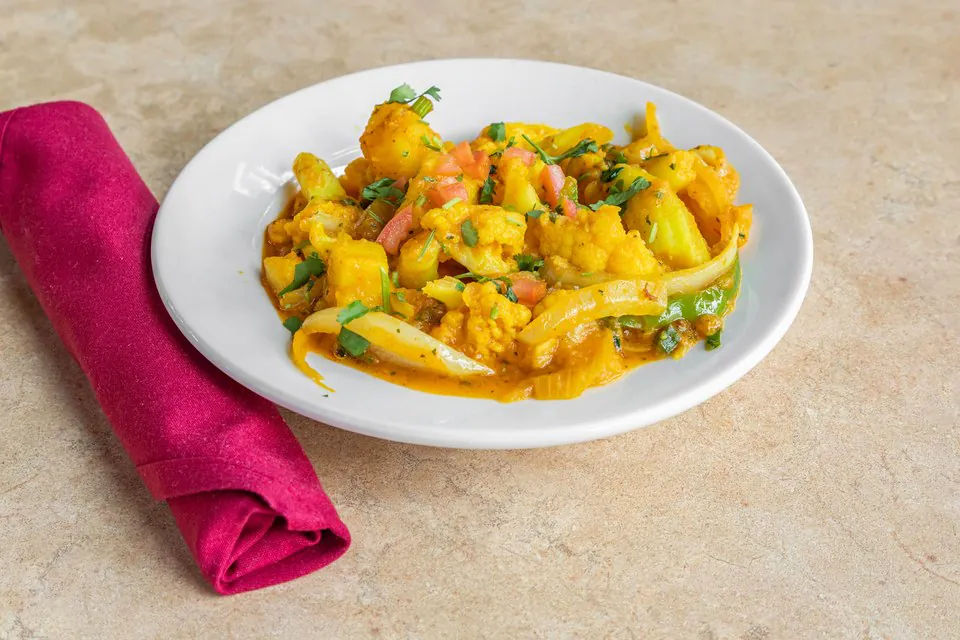
A handful of dishes stand alone, with no sibling in another section: butter chicken, lamb kofta, malai kofta, dal makhani, aloo gobi and baingan bhartha among them. They are some of the most ordered dishes on the listing, so include one or two. Plan them as singles, with no matching tray on the other side of the table.
The tandoor side of the menu carries no sauce
Nine of the entree lines skip the sauce and come from the clay oven: tandoori chicken, chicken tikka, paneer tikka and seekh kebab, as plates and as trays. These are dry, marinated and charred, and they sit on a table the way grilled food does.
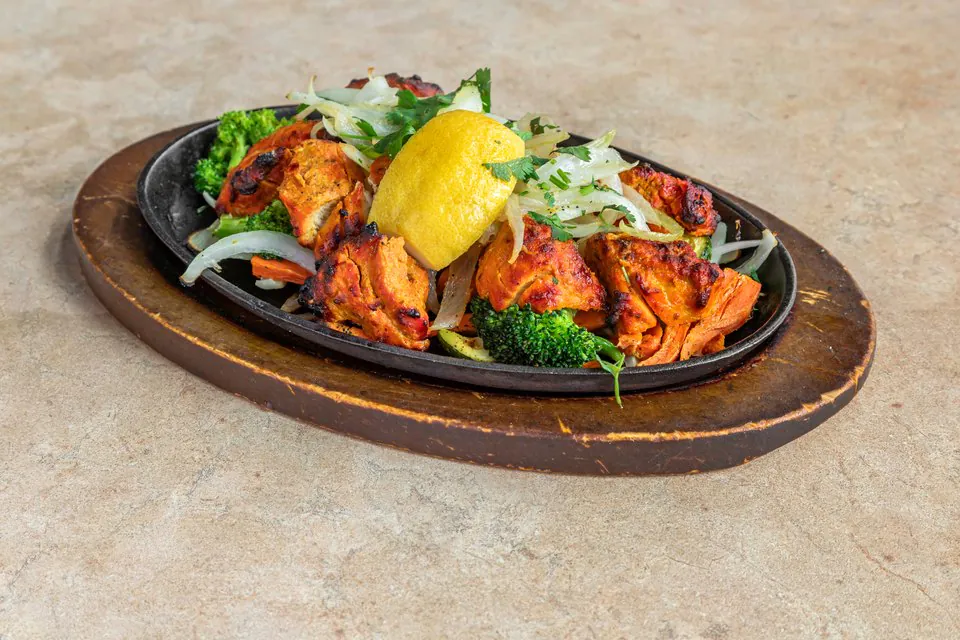
The tandoor side pairs as well. Chicken tikka and paneer tikka are the same marinade and the same oven on two bases, and both come as trays. For a room that prefers food it can pick up, or for an event where people stand, a pair of tikka trays does the same job as a pair of sauce trays without the bowls.
The boxes follow the same four sections
For individual meals, the listing carries four box lunches: chicken, lamb, seafood and vegetarian. Each box holds an entree from its section with rice and naan. Because the sauces repeat across sections, a round of boxes can stay on one or two sauces. A chicken saag box and a saag paneer box look like the same lunch when you hand them out around a meeting table.
Two small planning notes from the listing. Most entrees can come in individual packaging if you ask for it. And plates and utensils are their own line item, so add them to the order if the office does not keep a supply. Our boxed lunch guide for meetings covers the rest of the format.
How to order Mirch Masala catering for a Seattle office
Direct is simple. The Catering button on the restaurant’s own site opens its online catering listing, which is the menu this guide has been reading, and the restaurant takes calls at its Broadway East address. For an event in the restaurant itself, the site takes private party requests separately.
Through Zerocater, the Mirch Masala page carries the current menu and a live quote, and the order sits alongside every other kitchen your office already uses, on one invoice. How it works covers the mechanics. The Indian catering directory for Seattle shows what else is available in the same lane, and our Seattle office catering cost guide covers budgeting.
Whichever route you take, the ordering advice from the grid is short. Choose two sauces from the paired list. Order each as a meat tray and a vegetarian tray. Add one standalone vegetarian dish and one tandoor tray for variety. Keep vindaloo as the single spicy option, and order seafood by the plate.
Mirch Masala and Zerocater
A neighbourhood restaurant with a deep North Indian menu is the kind of kitchen an office lunch rotation needs and seldom finds on its own. Putting it on the same account as the sandwich order and the taco order lets you book it on an ordinary Tuesday as well as for a celebration.
CaterAi builds the rotation, keeps track of what the office has already eaten, and brings a kitchen like this one in when the week needs variety. Our Indian corporate catering guide covers the wider category, and our guide to corporate event catering in Seattle covers the city. For other Indian kitchens on the blog, see Rasa and Curry Up Now.
Menus, dishes and serving formats change. This guide describes how the Mirch Masala catering menu is laid out rather than what is on it this week. For the current menu and a live quote, use the Mirch Masala page on Zerocater, and confirm the current detail with the restaurant before you order for anyone with a dietary requirement.
Frequently Asked Questions
What kind of food is Mirch Masala catering?
North Indian, cooked by a family-run restaurant on Broadway East in Seattle. The catering menu covers the classics an office will recognise: tikka masala, saag, korma, jalfrezi, vindaloo, tandoori chicken, dal, naan and basmati rice, with samosas and pakoras as starters and lassi and chai to drink.
How is the Mirch Masala catering menu organised?
By protein. There are four entree sections, chicken, lamb, seafood and vegetarian, plus rice, bread, sides, desserts and drinks. The useful thing to notice is that the same sauces repeat across those sections. Saag appears on six bases and jalfrezi on five, so you can choose a sauce first and then decide which proteins it comes on.
Can a vegetarian and a meat eater share the same dish?
Yes, and the menu makes it easy. Five sauces come as both a meat tray and a vegetarian tray: saag, jalfrezi, korma, tikka masala and karahi. Order chicken saag next to saag paneer, or chicken jalfrezi next to vegetable jalfrezi, and the whole table eats the same dish. Confirm the current detail with the restaurant before you order for anyone with a dietary requirement. Nothing here is dietary or medical advice.
Does Mirch Masala cater boxed lunches?
Yes. The catering listing carries four individual boxes, one per entree section: chicken, lamb, seafood and vegetarian. Each box holds an entree from its section with rice and naan. Because the sauces repeat across sections, you can keep a whole round of boxes on one or two sauces. Plates and utensils are their own line item on the listing, so add them if you need them.
Is Mirch Masala catering spicy?
Most of the menu is built on mild to medium North Indian sauces, and the listing marks vindaloo as the spicy one, in a vinegar-based sauce with potatoes and onions. For a mixed office, lead with saag, korma or tikka masala and treat vindaloo as the one dish for the people who want heat. Ask the restaurant about heat when you order if the room is sensitive to it.
Can you order seafood trays from Mirch Masala?
Seafood comes as individual plates on the catering listing: shrimp and fish in tikka masala, vindaloo, jalfrezi and saag. There is no seafood tray. For a shared table, order the seafood as individual portions alongside the trays, or pick a chicken or vegetarian tray in the same sauce.
How do you order Mirch Masala catering?
Two routes. Direct, through the Catering button on the restaurant’s own site, which opens its online catering listing, or by phone to the restaurant. Or through Zerocater, where the Mirch Masala page carries the current menu and a live quote, and the order sits alongside every other kitchen your office uses.