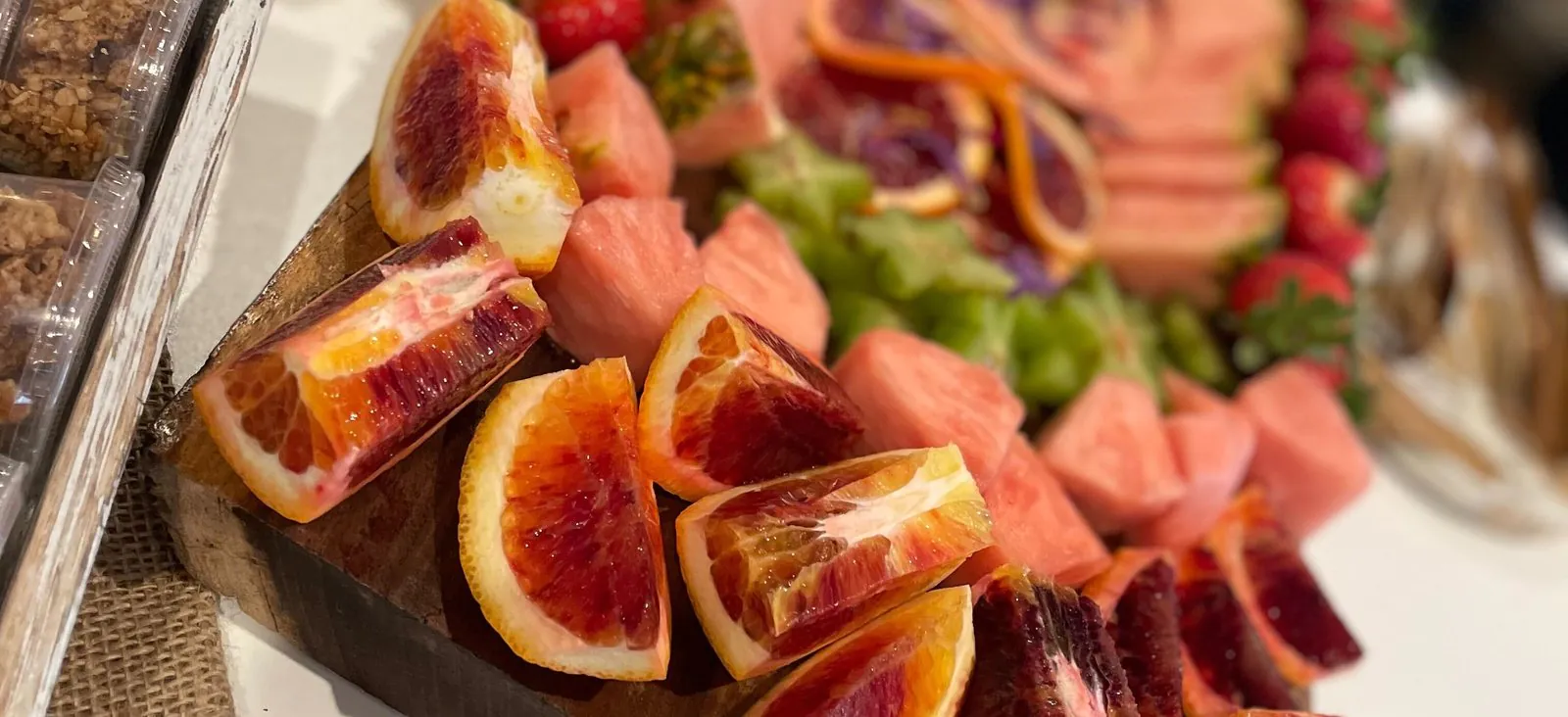
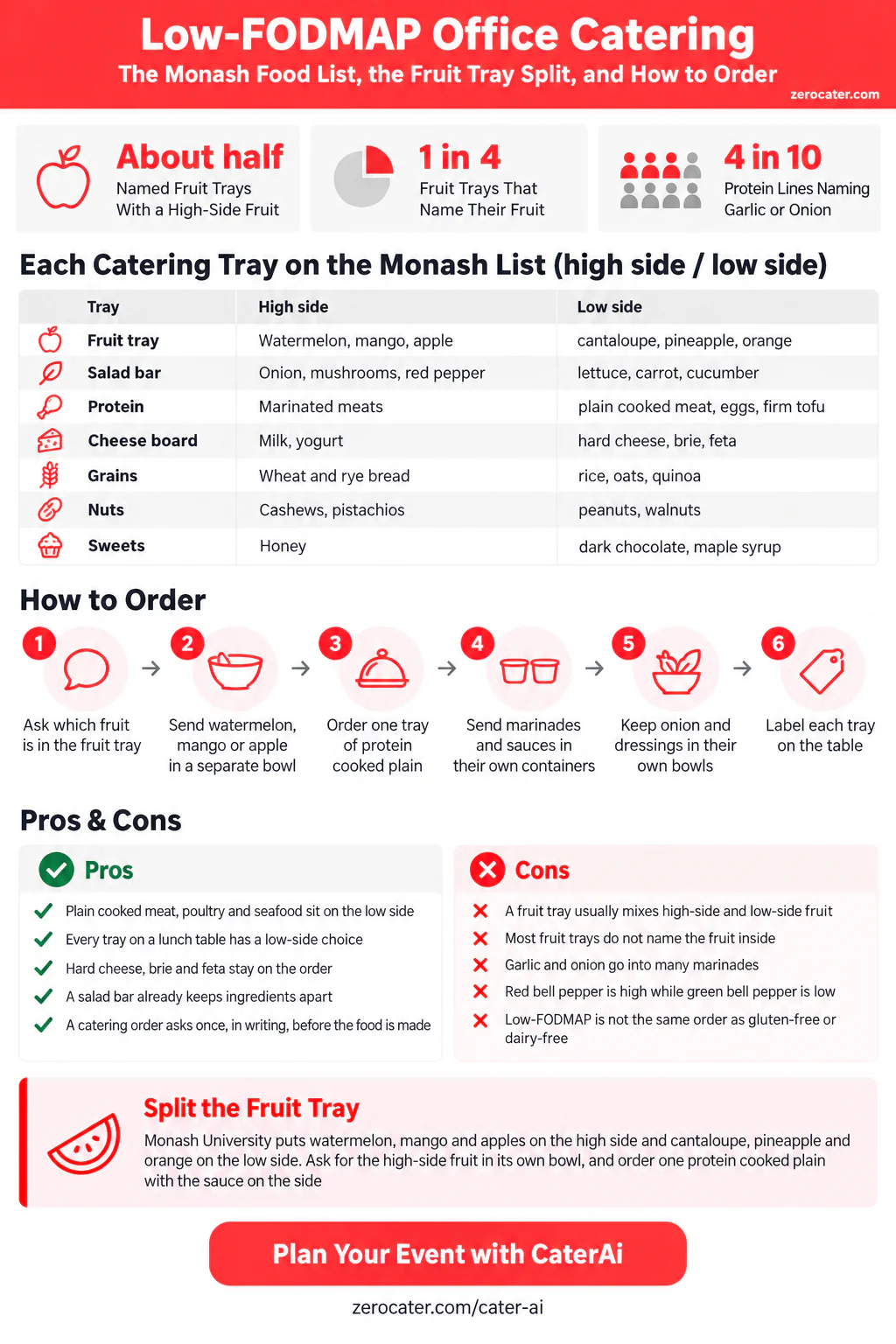
Monash University, where researchers first described FODMAPs, publishes a food list that sorts everyday foods into high and low. Hold that list next to an office catering menu and one tray stands out. The fruit tray splits across the list. Watermelon, mango and apples sit on the high side. Cantaloupe, pineapple, orange, kiwifruit and blueberries sit on the low side. A catering fruit tray usually holds some of each.
That makes a low-FODMAP order a sorting job. This guide reads the Monash list in catering terms: what the diet is, how the list splits each tray on the table, what the fruit trays on Zerocater’s partner menus hold, where garlic and onion turn up, and the few lines that put it all on the order.
In this guide
- What low-FODMAP means
- The list splits every tray
- The fruit tray
- Protein and sauce
- Three different orders
- How to write the order
What low-FODMAP means for a lunch order
FODMAPs are a group of short-chain carbohydrates that the small intestine does not fully absorb. The name stands for fermentable oligosaccharides, disaccharides, monosaccharides and polyols. Gut bacteria ferment them, and in people with irritable bowel syndrome (IBS) the gas and water that result can bring on pain and bloating. Monash puts it plainly: “One in seven adults suffer from IBS.”
The Monash diet runs in steps. It begins with two to six weeks of strict limits, and then foods return gradually to find out which ones a person handles well. The National Institutes of Health lists the low FODMAP diet as one of three diet changes a doctor may suggest for IBS. Monash writes that the diet is for people with medically diagnosed IBS and that it is essential to consult a dietitian before starting it.
So a coworker on the diet may sit in the strict phase this month and the reintroduction phase next month. The office cannot track that, and it does not need to. It needs an order where the low-side food is easy to find and the high-side food sits in its own dish. Our guide to ordering catering for mixed dietary needs covers the wider room, and the guide to workplace dietary accommodation covers the employer side.
The Monash list splits every tray
The Monash food list does not ban whole food groups. It sorts inside them. Green bell pepper is on the low side and red bell pepper is on the high side. Hard cheese is low and cow’s milk is high. Peanuts are low and cashews are high. Monash notes that “it is impossible to guess the FODMAP content of a food”, which is why the university tests foods in a lab and rates each one in its app.
The public list is a sample, and the app holds the full ratings. The sample still covers most of what a catering order carries. Here it is, grouped by the tray each food lands in.
| On the catering table | Monash high side | Monash low side |
|---|---|---|
| Fruit tray | Watermelon, mango, apples, pears, cherries, peaches, nectarines, plums, dried fruit | Cantaloupe, pineapple, orange, mandarin, kiwifruit, blueberry |
| Vegetables and salad bar | Onion, garlic, leek, mushrooms, asparagus, artichoke, green peas, red bell pepper | Lettuce, carrot, cucumber, green beans, bok choy, eggplant, potato, green bell pepper |
| Protein | Most legumes, some marinated meats, some processed meats | Plain cooked meat, poultry and seafood, eggs, firm tofu, tempeh |
| Cheese board and dairy | Cow’s milk, yogurt, custard, ice cream | Hard cheese, brie, camembert, feta, lactose-free milk, almond milk |
| Bread, pasta and grains | Wheat, rye and barley breads, breakfast cereals | Oats, quinoa, rice and corn pasta, plain rice cakes, sourdough spelt bread |
| Sauces | Garlic and onion based marinades and sauces | Barbecue sauce, mayonnaise, soy sauce |
| Nuts and sweets | Cashews, pistachios, honey, high fructose corn syrup, sugar free candy | Peanuts, walnuts, macadamias, pepitas, dark chocolate, maple syrup |
Read across any row and both columns hold ordinary catering food. Every tray on a lunch table has a low-side choice in it. The order only has to keep the two sides apart.
The fruit tray splits across the list
The fruit tray is the clearest case, because it is the one tray built from a mix. We read the fruit trays, fruit salads and fruit cups on the menus that Zerocater’s catering partners list, deduplicated per chain so that one brand’s menu counts once.
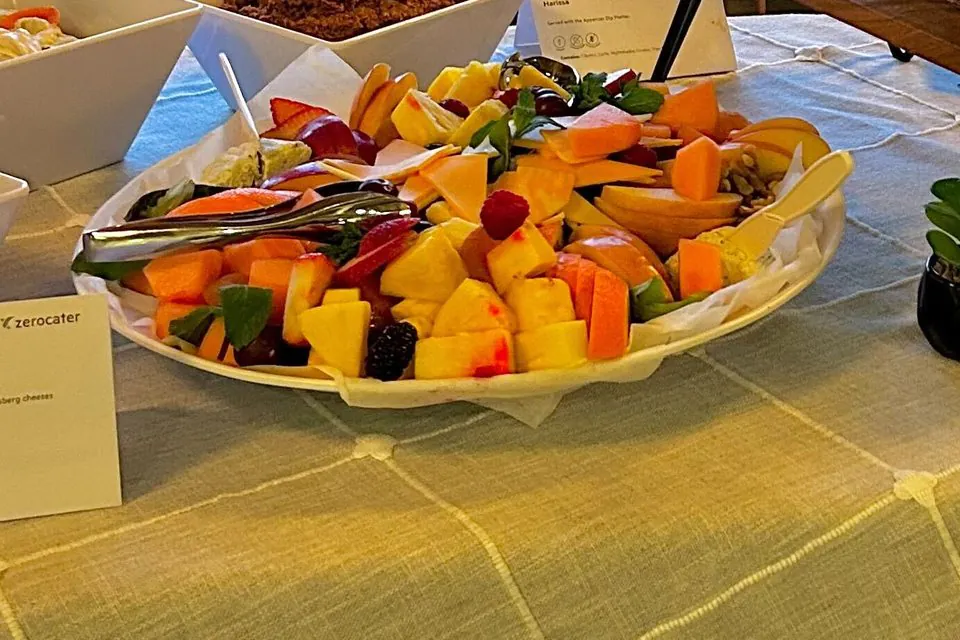
Most of them do not say what is inside. About one fruit tray in four names its fruit from the Monash list, and many of the rest read “seasonal fruit” or “fresh fruit”. Of the trays that name their fruit, about half name a fruit from the high side of the Monash list, and watermelon is the one that appears most. And all but two of those also name a fruit from the low side. Of the fruits on the Monash list, pineapple is the one the trays name most, and it sits on the low side with cantaloupe.
So the typical tray holds cantaloupe and pineapple next to watermelon, often with apples or mango in the same bowl. Nothing on it needs to change for the rest of the room. The order needs one line: send the watermelon, mango or apple in a separate bowl. The person who follows the diet takes from the main tray, and everyone else takes from both. The Zerocater fruit platters page lists partners who build these trays for offices.
Protein is low, the marinade decides
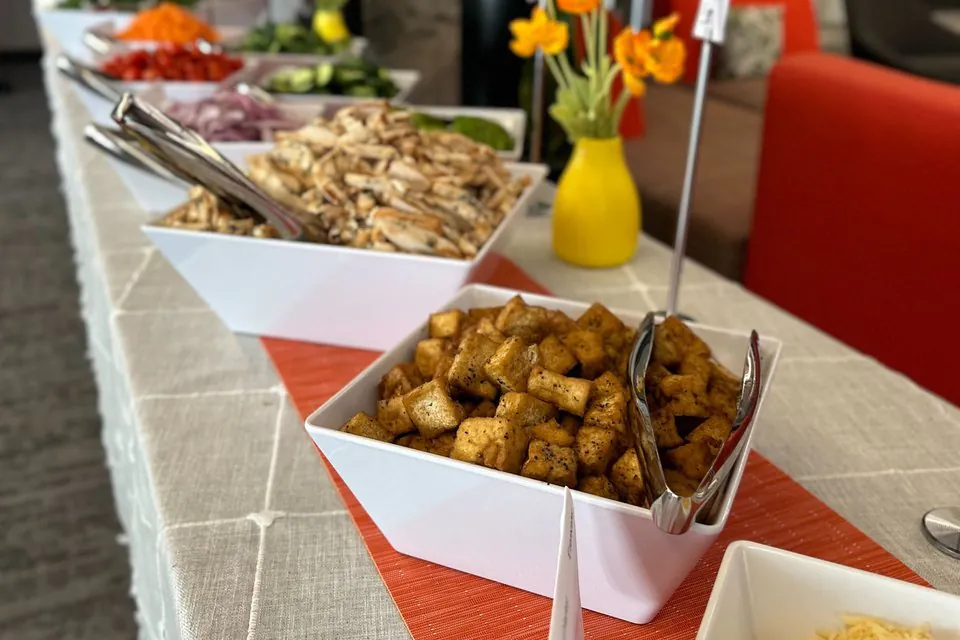
Monash writes that “protein foods such as meats, poultry and fish are naturally free of FODMAPs”. Its low side lists plain cooked meats, poultry and seafood, eggs, firm tofu and tempeh. What moves a protein dish across is what goes on it. Monash names marinated meats, processed meats such as sausage, and meat served with a gravy or sauce that may hold garlic or onion.
Catering menus lean on exactly those flavors. About four protein lines in ten on Zerocater’s partner menus name garlic, onion, leek or scallion in the dish name or description. About one in twenty says plain or on the side. The answer is the advice Monash gives for sauces: “Ask for them separately or on the side.” Order one tray of the protein cooked plain and send the marinade or sauce in its own container. Our dairy-free office catering guide sends sauces and dressings on the side too, and the same habit covers this one.
Monash also lists barbecue sauce, mayonnaise and soy sauce on its low side. So the sauce question is about what is in the sauce, and a separate container lets the person read the label or ask.
Low-FODMAP, gluten-free and dairy-free are three orders
The low-FODMAP list overlaps with other diets, but it does not match any of them. Soy sauce is on the Monash low side, and our gluten-free office catering guide treats soy sauce as a wheat question. Butter, hard cheese, brie and feta are on the low side too. Monash writes that “dairy foods are definitely not excluded from a low FODMAP diet”, while a dairy-free order takes all of them off the table.
The difference runs the other way as well. Garlic, onion, apples and honey sit on the high side whether or not a dish holds wheat or milk. A vegan tray can lean on lentils and beans, and Monash lists most legumes on the high side. So name the diet the person names. A note that says “gluten-free” will not move the watermelon, and a note that says “low-FODMAP” will not keep the butter off the vegetables.
How to write the order
A catering order has one advantage over a restaurant table. You ask once, in writing, before the food is made. Put these lines in the order notes, or ask them when you confirm the order.
| On the menu | The line to put on the order |
|---|---|
| A fruit tray or fruit cups | Which fruit is in it? Send watermelon, mango or apple in a separate bowl |
| Grilled chicken, steak, salmon or tofu | One tray cooked plain, with the marinade or sauce in its own container |
| A salad bar or salad tray | Onion and the dressings in their own bowls |
| A rice or grain bowl bar | Rice or quinoa as one of the bases |
| A sandwich or wrap platter | Add a tray with a rice or potato side |
| A cheese board | Hard cheese, brie or feta as written |
| A dessert tray | One sweet without honey, such as dark chocolate |
Then label the trays on the table: “fruit: pineapple, cantaloupe, orange”, “chicken, plain”, “sauce, contains garlic”. A labeled buffet lets the person who follows the diet read the table without asking anyone. For the base of the meal, Zerocater’s rice bowl bar page and salad bar page list partners who send every ingredient in its own dish.
Plan an office lunch with CaterAi
Where Zerocater fits
A recurring lunch rotates through many partners and many menus, and the fruit tray on Monday is not the fruit tray on Thursday. For ongoing office catering, Zerocater manages that rotation across its local catering partners, and how it works covers the ordering side. The office lunch catering page lists the partners near you.
For a single lunch, CaterAi drafts a menu from a plain description of the event. Describe the lunch you want, then add the lines from the table above to the order notes for whichever dishes it picks.
Plan an office lunch with CaterAi
Frequently Asked Questions
What does low-FODMAP mean for an office catering order?
FODMAPs are a group of short-chain carbohydrates that some people with irritable bowel syndrome (IBS) absorb poorly. Monash University, where the diet was developed, publishes a food list that sorts common foods into high and low. For a catering order, that list turns into a few plain requests: which fruit is in the tray, one protein cooked plain, and the sauces in their own containers.
Which fruit on a catering fruit tray is low FODMAP?
On the Monash list, cantaloupe, kiwifruit, mandarin, orange, pineapple and blueberry sit on the low side. Watermelon, mango, apples, pears, cherries, peaches, nectarines, plums and dried fruit sit on the high side. Many catering fruit trays mix the two, so ask for the high-side fruit in its own bowl.
Is a gluten-free or dairy-free order the same as a low-FODMAP order?
No. The lists overlap but do not match. Monash puts soy sauce, butter, hard cheeses, brie and feta on the low side, and puts garlic, onion, apples and honey on the high side whether or not a dish carries gluten or dairy. Order for the list the person names.
Is plain grilled chicken low FODMAP?
Monash writes that meats, poultry and fish are naturally free of FODMAPs, and lists plain cooked meats, poultry and seafood on its low side. A marinade or sauce made with garlic or onion is what moves a protein dish across, so ask for one tray cooked plain.
Should the office ask who follows the diet?
No. Ask the person who raised it what works for them, if they want to say. Monash describes a strict phase of two to six weeks and then a slow return of foods, so what one person needs changes over time. The order works best when the trays are labeled and the sauces are separate for everyone.
Is this guide medical advice?
No. It puts the Monash University food list and the NIH page on IBS into catering-order language. Monash writes that the diet is for people with medically diagnosed IBS and that it is essential to consult a dietitian. That conversation decides what one person eats.